• 검색 결과가 없습니다.

Percutaneous Closure of an Iatrogenic Ventricular Septal Defect Following Concomitant Septal Myectomy at the Time of Aortic Valve Replacement

N/A
N/A
Protected

Academic year: 2022

Share "Percutaneous Closure of an Iatrogenic Ventricular Septal Defect Following Concomitant Septal Myectomy at the Time of Aortic Valve Replacement"

Copied!
4
0
0

로드 중.... (전체 텍스트 보기)

전체 글

(1)

45 Copyright © 2014 The Korean Society of Cardiology

Korean Circulation Journal

Introduction

Approximately 10% of patients with severe aortic valve stenosis (AS) have asymmetric basal septal hypertrophy (ABSH), relative to the posterior left ventricle (LV) free wall.

1)

The presence of ABSH and the need for myectomy may present a dilemma for surgeons per- forming aortic valve replacement (AVR). Without a concomitant my- ectomy, the gradient across with the left ventricular outflow tract (LVOT) can persist in patients with unresected ABSH.

2)

Many authors have reported that concomitant myectomy should be considered for patients with a preoperative diagnosis of ABSH, even without a demonstrated significant obstruction.

3)

Although it is known that

Case Report

http://dx.doi.org/10.4070/kcj.2014.44.1.45 Print ISSN 1738-5520 • On-line ISSN 1738-5555

Percutaneous Closure of an Iatrogenic Ventricular Septal Defect Following Concomitant Septal Myectomy

at the Time of Aortic Valve Replacement

Il Hwan Ryu, MD 1 , Won Ho Kim, MD 1 , Ah Jeong Ryu, MD 1 , Min Gyu Kim, MD 1 , Jae Woong Jeon, MD 1 , Joo Seok Kim, MD 1 , Jae Joon Lee, MD 1 , and Jin Ho Choi, MD 2

1

Department of Internal Medicine, Eulji University Hospital, Eulji University School of Medicine, Daejeon,

2
Division of Thoracic and Cardiovascular Surgery, Eulji University Hospital, Eulji University School of Medicine, Daejeon, Korea

A 77-year-old female patient underwent aortic valve replacement (AVR) with concomitant septal myectomy and tricuspid annuloplasty.

Her symptoms did not improve after a successful operation. Echocardiogram demonstrated the presence of an iatrogenic ventricular sep- tal defect (VSD). It was muscular in location and not the usual AVR with membraneous type of VSD, suggesting a complication from the myectomy. Percutaneous closure of the VSD remained the only feasible option due to her poor overall medical status. A 14-mm Amplaz- ter VSD occluder was deployed successfully, by means of the trans-septal technique. She has improved very well postoperatively. (Korean Circ J 2014;44:45-48)

KEY WORDS: Heart septal defects; Septal occluder device.

Received: July 28, 2013

Revision Received: September 4, 2013 Accepted: September 10, 2013

Correspondence: Jin Ho Choi, MD, Division of Thoracic and Cardiovascu- lar Surgery, Eulji University Hospital, Eulji University School of Medicine, 95 Dunsanseo-ro, Seo-gu, Daejeon 302-799, Korea

Tel: 82-42-611-3083, Fax: 82-42-611-3175 E-mail: [email protected]

• The authors have no financial conflicts of interest.

This is an Open Access article distributed under the terms of the Creative Commons Attribution Non-Commercial License (http://creativecommons.

org/licenses/by-nc/3.0) which permits unrestricted non-commercial use, distribution, and reproduction in any medium, provided the original work is properly cited.

concomitant myectomy with AVR is relatively safe and effective, complications beyond surgeons’ control, such as iatrogenic ventric- ular septal defect (VSD) and atrioventricular block, may be devel- oped. The presence of a hemodynamically significant VSD with left to right shunt may result in a left ventricular volume overload, and a prompt closure is necessary to prevent complications such as ventricular dysfunction, arrhythmias, aortic regurgitation and pul- monary hypertension.

4)5)

We describe a successful percutaneous closure of an iatrogenic VSD, following concomitant septal myec- tomy at the time of AVR.

Case

A 77-year-old female was diagnosed with severe AS and ABSH.

On echocardiography, the patient showed a restriction of aortic cusp

movement, raised trans-aortic peak instantaneous velocity of Vmax

(5.93 m/s), mean pressure gradient of 80.49 mm Hg, peak pressure

gradient of 140.56 mm Hg and a narrowed effective orifice area of

0.64 cm

2

. She also manifested moderate tricuspid regurgitation (TR)

with a dilated tricuspid annulus and an elevated right ventricular

systolic pressure (RVSP) of 56 mm Hg. Based on indications for sur-

gery in AS, she underwent AVR using a 19-mm Carpentier-Edward

valve (CE valve, Edwards Lifesciences LLC, Irvine, CA, USA) with con-

comitant septal myectomy and tricuspid annuloplasty (TAP), using

(2)

46 Percutaneous Closure of an Iatrogenic VSD Following Septal Myectomy

http://dx.doi.org/10.4070/kcj.2014.44.1.45 www.e-kcj.org

a 28-mm Edwards MC

3

(Edwards Lifesciences LLC, Irvine, CA, USA).

After a successful operation, the patient complained of worsening dyspnea. On physical examination, a new continuous pansystolic

murmur was noted. Echocardiogram demonstrated an abnormal high-velocity jet between the LVOT and right ventricle (RV) with a raised velocity of 4.78 m/s and peak pressure gradient of 91.33

A B C

Fig. 1. Iatrogenic VSD assessment by echocardiography. A: parasternal long-axis view shows a muscular VSD (arrow), suggesting of a complication by my- ectomy, not AVR in which it is usually present with membraneous type of VSD. B: color Doppler imaging depicts a high-velocity jet between the left ventri- cle and right ventricle. C: the velocity and peak pressure gradient across the defect are measured at 4.78 m/s and 91.33 mm Hg, respectively. VSD: ventricu- lar septal defect, AVR: aortic valve replacement, RV: right atrium, LV: left ventricle, Ao: aorta.

A

C

B

D

Fig. 2. Placement of Percutaneous Amplatzer Muscular ventricular septal defect (VSD) occluder. A: a 0.035 inch extra-stiff guide wire (arrow) is advanced

from the femoral vein through the defect, and into the left ventricle (LV) apex. B: the diameter of Amplazter VSD occluder is measured using an Amplazter

sizing balloon II (arrow). C: the LV disc of the Amplazter VSD occluder (arrow) is deployed first in the LV. D: it has released the right ventricle (RV) disc of the

device (arrow) in the RV by rotating the delivery cable in a counterclockwise direction.

(3)

47 Il Hwan Ryu, et al.

http://dx.doi.org/10.4070/kcj.2014.44.1.45 www.e-kcj.org

mm Hg, suggesting the presence of a possible iatrogenic VSD (Fig. 1).

The VSD was muscular in location, suggesting of complication by myectomy, not AVR in which it is usually present with membrane- ous type of VSD. The diameter of the VSD was about 12 mm, and the distance from the tissue aortic valve was about 1.5-2 cm. There was also an RV volume overload with moderate TR and an elevated RVSP of 61 mm Hg, despite the TAP. Medical treatments to main- tain an optimal volume status was not effective, and the overall medical condition was poor. Therefore, a closure of the iatrogenic VSD with percutaneous intervention was decided, as it was felt to be hemodynamically significant.

At the right heart catheterization with the blood oximetry series to assess the degree of intra-ventricular shunting, there were re- markably elevated RV and pulmonary artery (PA) filling pressures, with an unidirectional left to right shunt of 2 : 1 (Qp/Qs=2).

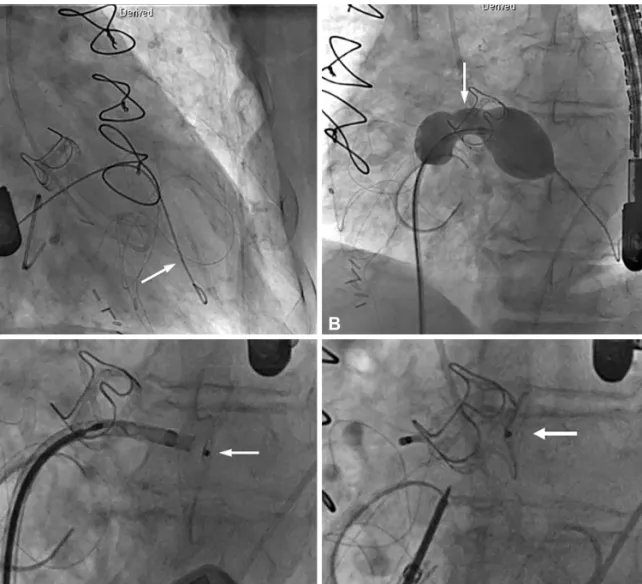
On the 5th postoperative day, percutaneous closure of the VSD was attempted. It was decided that an attempt would be made to cross the VSD first from the RV (trans-septal technique). Left fem- oral artery and right femoral vein were punctured with 7 Fr sheaths.

An LV angiogram showed a significant flow into RV cavity. Cross- ing of the VSD was made from the right side, using a 0.035-inch hy- drophilic guidewire (angled straight tip, Terumo Medical, Tokyo, Ja- pan) supported by a 5 Fr multipurpose catheter (Infiniti; Cordis, Miami, FL, USA), which was advanced into the LV apex. Then, the guidewire was replaced by a 0.035-inch extra-stiff guide wire (260-cm length, Amplatz Extra-Stiff, Cook, Bloomington, IN, USA).

Then, a 14-mm Amplazter VSD occluder (AGA Medical Corporation, Golden Valley, MN, USA) attached to a delivery cable was advanced through the defect. The LV disc of the Amplazter VSD occluder was deployed first in the LV, and released the RV disc of the device in the RV by rotating the delivery cable in a counterclockwise direc- tion (Fig. 2). An LV angiogram was performed confirming a minimal residual VSD flow, and intraoperative transesophageal echocardiogram

demonstrated an excellent positioning of the device without shunt- ing or any interference with aortic valve functions. At postproce- dural catheterization, the PA pressure and saturation were decreased dramatically, from 50/15 mm Hg (mean 26 mm Hg), 91%, to 31/17 mm Hg (mean 23 mm Hg), 75%. Postprocedural echocardiogram showed a minimal shunt between the LVOT and RV without LVOT obstruction (Fig. 3).

Discussion

Iatrogenic VSD following concomitant septal myectomy with AVR is not a common complication, and may warrant closure. A po- tential mechanism leading to iatrogenic VSD following septal my- ectomy may be related to myocardial tissue necrosis by obstruction of the septal perforator arteries, with the incisions or excisions made too deep.

6)7)

Repeat sternotomy for surgical closure of the VSD seems undesirable, and percutaneous VSD closure presents an at- tractive alternative. The success in eliminating hemodynamically- significant shunts produce stabilization and improvement in the signs and symptoms for which the percutaneous VSD closure is undertaken. Some reports of patients who have undergone percu- taneous VSD closure following septal myectomy have been pub- lished in literature, with reasonable results and limited complica- tions.

8)9)

Percutaneous VSD closure with trans-aortic approach would be unsafe in patients with AVR, because a bulky VSD device might get entrapped in the artificial aortic valve. Therefore, trans- septal approach from the RV side would be better than trans-aor- tic approach in such patients. The challenge of VSD closure by trans-septal approach lies in crossing the guidewire across the VSD and the safe positioning of VSD device in the LV. More than neces- sary manipulations of a guidewire in the ventricles-RV or LV should be avoided to minimize the risks of ventricular arrhythmia or free- wall perforation.

A B

Fig. 3. Post-procedural echocardiography. A: parasternal long axis view shows the appropriate positioning of the Amplazter ventricular septal defect oc-

cluder. The device is seen as a dense crescent-like structure (arrow), at the left side of the interventricular septum. The left ventricular outflow tract is not

obstructed. B: color Doppler imaging shows near-elimination of the left to right shunt after device delivery. RV: right ventricle, LV: left ventricle, LA: left

atrium, Ao: aorta.

(4)

48 Percutaneous Closure of an Iatrogenic VSD Following Septal Myectomy

http://dx.doi.org/10.4070/kcj.2014.44.1.45 www.e-kcj.org

In summary, percutaneous VSD closure may appear to amelio- rate the pathologic changes that flow from hemodynamically-sig- nificant left to right shunting, easily, safely and effectively. We be- lieve that through this case report, we may strengthen the use of percutaneous VSD closure in the cases of iatrogenic VSD following concomitant septal myectomy with AVR.

References

1. Panza JA, Maron BJ. Valvular aortic stenosis and asymmetric septal hypertrophy: diagnostic considerations and clinical and therapeutic implications. Eur Heart J 1988;9 Suppl E:71-6.

2. Kayalar N, Schaff HV, Daly RC, Dearani JA, Park SJ. Concomitant septal myectomy at the time of aortic valve replacement for severe aortic stenosis. Ann Thorac Surg 2010;89:459-64.

3. Hess OM, Schneider J, Turina M, Carroll JD, Rothlin M, Krayenbuehl HP. Asymmetric septal hypertrophy in patients with aortic stenosis: an adaptive mechanism or a coexistence of hypertrophic cardiomyopa- thy? J Am Coll Cardiol 1983;1:783-9.

4. Carminati M, Butera G, Chessa M, et al. Transcatheter closure of con- genital ventricular septal defects: results of the European Registry.

Eur Heart J 2007;28:2361-8.

5. Holzer R, de Giovanni J, Walsh KP, et al. Transcatheter closure of peri- membranous ventricular septal defects using the amplatzer membra- nous VSD occluder: immediate and midterm results of an internation- al registry. Catheter Cardiovasc Interv 2006;68:620-8.

6. Minakata K, Dearani JA, O’Leary PW, Danielson GK. Septal myectomy for obstructive hypertrophic cardiomyopathy in pediatric patients:

early and late results. Ann Thorac Surg 2005;80:1424-9; discussion 1429-30.

7. Valeti US, Nishimura RA, Holmes DR, et al. Comparison of surgical sep- tal myectomy and alcohol septal ablation with cardiac magnetic reso- nance imaging in patients with hypertrophic obstructive cardiomyop- athy. J Am Coll Cardiol 2007;49:350-7.

8. Kilicgedik A, Karabay CY, Aung SM, et al. A successful percutaneous closure of ventricular septal defect following septal myectomy in pa- tients with hypertrophic obstructive cardiomyopathy. Perfusion 2012;

27:253-5.

9. Spies C, Ujivari F, Schraeder R. Transcatheter closure of a ventricular

septal defect following myectomy for hypertrophic obstructive car-

diomyopathy. Cardiology 2009;112:31-4.

수치

Fig. 2. Placement of Percutaneous Amplatzer Muscular ventricular septal defect (VSD) occluder
Fig. 3. Post-procedural echocardiography. A: parasternal long axis view shows the appropriate positioning of the Amplazter ventricular septal defect oc- oc-cluder

참조

관련 문서

Changes in the composition and structure of Mediterranean rokey-shore communities following a gradient of nutrient enrichment: Descriptive study and test

This expression is used when the content of the following clause is a condition or method to achieve the situation of the first clause.. 갈비가 타지 않게끔

At the same time, member countries may draw up partial scope agree- ments with other developing countries or respective economic integration areas outside Latin America,

This modifier is attached to the stem of action verbs and follows a premodifying clause and modifies a following noun.. When verbs with ‘ㄹ’ meet the ending starting with

(1.1 points) According to the passage, which of the following is NOT mentioned as the nature of pain.. ① Pain is not tied to any referent in

(1.1 points) According to the above study, which of the following is NOT included in the key research priorities of renewable energy developments.. ① selection of the

We are pleased to have the following individual, ( ), who transferred from your school, studying here at Jeju National University. Your answers to the following

Based on the results of root cause analysis, the following corrective action to mitigate the erosion and corrosion damage at hot leg check valve were