Vol. 29, No. 3, pp. 211-218, August, 2013 http://dx.doi.org/10.7747/JFS.2013.29.3.211
Comparison of Ground Beetle Communities (Coleoptera: Carabidae) between Coniferous and Deciduous Forests in Agricultural
Landscapes
Jong-Kook Jung1, Seung-Tae Kim2,*, Sue-Yeon Lee2, Jung-Sun Yoo3 and Joon-Ho Lee1,2
1Entomology Program, Department of Agricultural Biotechnology,
2Research Institute for Agriculture and Life Sciences, Seoul National University, Seoul 151-921, Republic of Korea
3Department of Invertebrates, National Institute of Biological Resources, Incheon 404-170, Republic of Korea
Abstract
This study was conducted to examine the community structure of ground beetles between coniferous- and deciduous-domi- nant forest in agricultural landscapes, in Miryang-si, Yeongdong-gun, Icheon-si, and Cheolwon-gun during April to October in 2009. A total of 19 species belonging to 15 genera of 9 subfamilies were identified from 6,253 collected ground beetles. Dominant species from 4 regions were Synuchus nitidus (3,715 individuals, 59.4% of total) and Synuchus cyloderus (1,783 individuals, 28.5%) respectively. Non-metric multidimensional scaling based on Bray-Curtis similarity showed that ground beetle assemblage was not different between forest stands, but it was significantly different among regions. Overall, forest stands of secondary forests may not show a different community structure of ground beetle assemblages in our study. However, monitoring on the ground beetle fauna as well as other arthropods of secondary forests in agricultural landscapes is still important for the management and conservation of biodiversity, because forests provides important habitats for many predatory arthropods, such as ground beetles, spiders and rove beetles.
Key Words: ground beetles, monitoring, biodiversity, conservation, forest stands
Received: July 3, 2013. Revised: August 12, 2013. Accepted: August 14, 2013.
Corresponding author: Seung-Tae Kim
Research Institute for Agriculture and Life Sciences, Seoul National University, Seoul 151-921, Republic of Korea Tel: 82-2-880-4692, Fax: 82-2-873-2319, E-mail: [email protected]
Introduction
Due to the increasing of disturbance followed by human activity, natural and semi-natural habitats have been con- tinuously decreased in worldwide. Traditional agricultural landscapes are experiencing pressures from development and intensification (Katoh et al. 2009). Thus, the con- servation of biodiversity is also one of the major concerns in these landscapes during environment change. In Korea, ag- ricultural landscapes are composed of mosaic habitats such
as forests (natural and artificial forest, coppice woodlands and grasslands), farmlands (rice and upland fields), settle- ments and reservoirs, and thus, biodiversity in agricultural landscapes is usually rich. The depopulation of rural society and the conversion of land-uses have caused the succession of forests in agricultural landscapes. In particular, land con- versions are leading to a loss of biodiversity because of the decrease of heterogeneity (Choi et al. 2009).
Most studies about biodiversity and conservation in Korea have been focused on mountains, especially well con-
Fig. 1. Locations of 4 study regions.
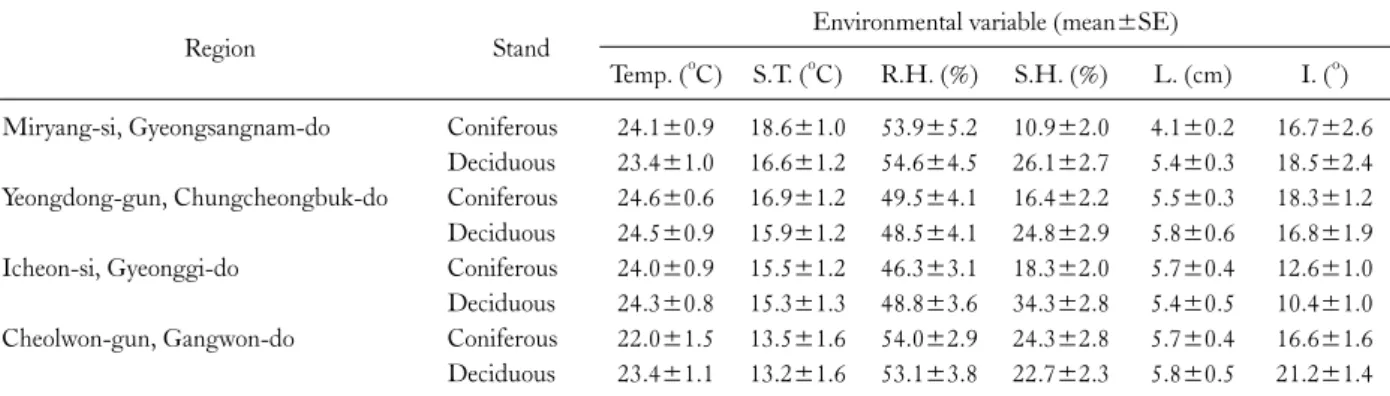
Table 1. Habitat environments in each investigated rural forest
Region Stand Environmental variable (mean±SE)
Temp. (oC) S.T. (oC) R.H. (%) S.H. (%) L. (cm) I. (o) Miryang-si, Gyeongsangnam-do
Yeongdong-gun, Chungcheongbuk-do
Icheon-si, Gyeonggi-do
Cheolwon-gun, Gangwon-do
Coniferous Deciduous Coniferous Deciduous Coniferous Deciduous Coniferous Deciduous
24.1±0.9 23.4±1.0 24.6±0.6 24.5±0.9 24.0±0.9 24.3±0.8 22.0±1.5 23.4±1.1
18.6±1.0 16.6±1.2 16.9±1.2 15.9±1.2 15.5±1.2 15.3±1.3 13.5±1.6 13.2±1.6
53.9±5.2 54.6±4.5 49.5±4.1 48.5±4.1 46.3±3.1 48.8±3.6 54.0±2.9 53.1±3.8
10.9±2.0 26.1±2.7 16.4±2.2 24.8±2.9 18.3±2.0 34.3±2.8 24.3±2.8 22.7±2.3
4.1±0.2 5.4±0.3 5.5±0.3 5.8±0.6 5.7±0.4 5.4±0.5 5.7±0.4 5.8±0.5
16.7±2.6 18.5±2.4 18.3±1.2 16.8±1.9 12.6±1.0 10.4±1.0 16.6±1.6 21.2±1.4 Temp., temperature; S.T., soil temperature; R.H., air relative humidity; S.H., soil humidity; L., leaf litter depth; I., incline.
served areas, but secondary forests in agricultural land- scapes have been neglected during past decades (Choi et al.
2009). Takeuchi et al. (2003) pointed out that conservation of agricultural forests and its landscapes are important to maintain the biodiversity such as mammals, birds and ar- thropods, because these forests provide temporary refuges, habitats of reproduction, and overwintering sites for preda- tory invertebrates including ground beetles (Sotherton
1985; Wallin 1986; Thomas et al. 1991; Kagawa and Maeto 2009). In addition, many predatory invertebrates are needed various habitats including secondary forests for complete of their life cycle (Kagawa and Maeto 2009).
Ground beetles are important in the agricultural ecosys- tem generally, because they feed on many invertebrate pests such as aphids, snails, lepidopteran larvae and so on (Lövei and Sunderland 1996; Kromp 1999; Holland 2002). In ad- dition, many studies showed that ground beetles can be used a bioindicator for assessing the environmental status (Rainio and Niemelä 2003; Pearce and Venier 2006), be- cause they adapt to certain habitats and many factors can af- fect to their distributions generally. Thus, to investigate the ground beetles in agricultural ecosystems will be important for the managements of semi-natural habitat and biodi- versity.
This study was conducted to examine the community structure of ground beetles between coniferous and decid- uous forests in agricultural landscapes along latitudinal gra- dient in Miryang-si, Yeongdong-gun, Icheon-si, and Cheolwon-gun, Korea.
Materials and Methods
Study areas and its environmental variables
Study sites were selected along latitudinal gradient as surrogate for annual mean temperature (Fig. 1, Table 1).
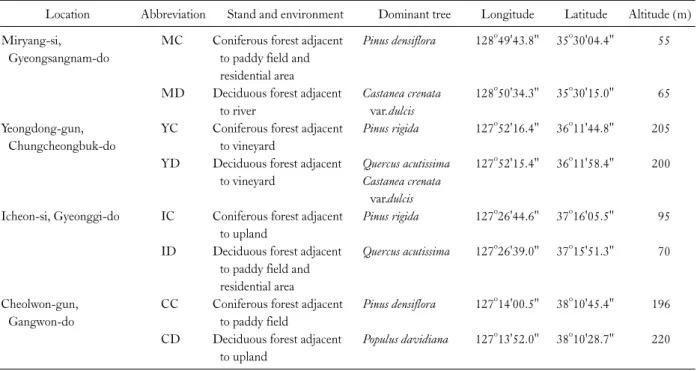
Each study sites were composed of 2 forest stands between coniferous and deciduous forests. Descriptions of each sampling site were showed in Table 2. In general, forests in
Table 2. Habitat environments, coordinates and altitudes of each investigated location
Location Abbreviation Stand and environment Dominant tree Longitude Latitude Altitude (m) Miryang-si,
Gyeongsangnam-do
Yeongdong-gun, Chungcheongbuk-do
Icheon-si, Gyeonggi-do
Cheolwon-gun, Gangwon-do
MC
MD
YC
YD
IC
ID
CC
CD
Coniferous forest adjacent to paddy field and residential area Deciduous forest adjacent
to river
Coniferous forest adjacent to vineyard
Deciduous forest adjacent to vineyard
Coniferous forest adjacent to upland
Deciduous forest adjacent to paddy field and residential area
Coniferous forest adjacent to paddy field
Deciduous forest adjacent to upland
Pinus densiflora
Castanea crenata var.dulcis Pinus rigida
Quercus acutissima Castanea crenata
var.dulcis Pinus rigida Quercus acutissima
Pinus densiflora Populus davidiana
128o49'43.8''
128o50'34.3''
127o52'16.4''
127o52'15.4''
127o26'44.6''
127o26'39.0''
127o14'00.5''
127o13'52.0''
35o30'04.4''
35o30'15.0''
36o11'44.8''
36o11'58.4''
37o16'05.5''
37o15'51.3''
38o10'45.4''
38o10'28.7''
55
65
205
200
95
70
196
220
the rural landscapes of Korea are composed of Pinus densi- flora Sieb. et Zucc., Pinus rigida Mill., Quercus spp. and Robinia pseudoacacia L. (Hong 1999). In particular, P. rigida and R. pseudoacacia are known to be introduced plants from North America for Forest Greenification in the past (Hong 1999). These trees are also dominant in our study sites generally.
Six environmental variables were measured in order to obtain the information of habitat conditions, such as air temperature and air relative humidity, soil temperature, soil humidity, leaf litter depth and incline (Table 1). Air and soil temperature, air and soil relative humidity were measured monthly on the afternoon of a typical sunny day around each pitfall trap within radius 5 m.
Sampling and identification
Ground beetles were collected by pitfall traps during April to October in 2009. Three pitfall traps were installed 10 m apart from each other and were emptied every month.
A pitfall trap was composed of a plastic container (10.5 cm diameter and 8 cm depth) and a lid with 6 holes (2 cm di- ameter in each hole) which prevents collecting unwanted small mammals. A plastic roof was set up to prevent rainfall. Traps were filled with preservative (95% ethyl-al-
cohol:95% ethylene-glycol=1:1) for sample preservation.
Collected ground beetles were brought to the laboratory and were dried, mounted, and identified to the species level under a dissecting microscope. Identification was per- formed according to Habu (1967, 1973, 1978, 1987), Kwon and Lee (1984), and Park and Paik (2001) and com- pared to voucher specimens in the laboratory. Nomencla- ture was confirmed by Park and Paik (2001) and Park (2004). Voucher specimens were stored in the insect ecol- ogy laboratory, Seoul National University.
Data analyses
Abundance and species richness were measured based on the number of individuals, and number of species col- lected in each sampling site, respectively. We pooled the da- ta of collected ground beetles in each site and used in stat- istical analysis. For analysis of the species composition of the ground beetles among sites, a non-metric multidimen- sional scaling (MDS) with Bray-Curtis similarity was con- ducted using the PRIMER 6.0 (Clarke and Warwick 2001; Clarke and Gorley 2006). MDS was chosen because it performs well with ecological data that do not meet the as- sumption of normality (McCune and Grace 2002). Thus, MDS are the most generally effective ordination and classi-
Table 3. List of ground beetles in rural landscape between coniferous and hardwood forests
Subfamily Scientific name Coniferous forest Deciduous forest
MC YC IC CC MD YD ID CD
Carabinae
Nebriinae Pterostichinae
Harpalinae
Zabrinae Callistinae
Licininae Lebiinae
Brachininae Number of species Number of individuals
Aulonocarabus koreanus koreanus Coptolabrus jankowskii jankowskii Coptolabrus smaragdinus branickii Nebria chinensis chinensis Pristosia vigil
Synuchus cycloderus Synuchus nitidus Synuchus sp.1 Trigonognatha coreana Bradycellus sp.1 Harpalus discrepans Amara sp.1 Chlaenius naeviger Chlaenius pallipes Diplocheila zeelandica Calleida onoha Dolichoctis luctuosus Galerita orientalis Brachinus stenoderus
7
2
1
3 10
1 9
823 1,161 286 1 1
1
1 9 2,284
177 53 67 3
1 1 8 1
8 311
1
92 136 36
3
1
6 269
1
1 32
5
1
5 40
1
1 410 1,525 132
1
6 2,070
42 10
1
196 603 91 2
1
2
9 948
84 205 30
1
1
5 321 Abbreviated study site are: MC, YC, IC and CC are coniferous forests in Miryang-si, Yeongdong-gun, Icheon-si and Cheolwon-gun, re- spectively; MD, YD, ID and CD are deciduous forests in Miryang-si, Yeongdong-gun, Icheon-si and Cheolwon-gun, respectively.
fication methods for ecological community data (McCune and Grace 2002). In the MDS, the stress is a measure of distortion between the positions of real data points from the graphical representation. Thus, low stress represents few distortions from the real position of the data points and is associated with a graph that more accurately represents the dissimilarities in species composition. Group averaging cluster analysis was also performed for determining charac- teristics of groups. The one-way ANOSIM permutation test with a maximum of 999 permutations was used to as- sess the significant differences among land-use types in the MDS, and then Global R value approaches 1 if differences among land-use types exist (Clarke and Warwick 2001).
Results
A total of 19 species belonging to 9 subfamilies were identified from 6,253 collected ground beetles (Table 3).
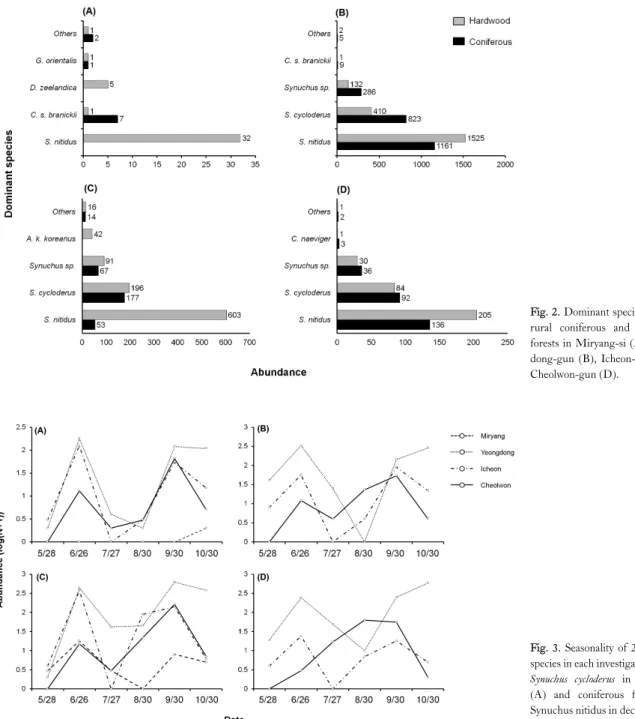
Pterostichinae was dominant and diverse subfamily in all sampling sites except on coniferous forest in Miryang-si (MC) (Table 3). The dominant species of all sampling sites were Synuchus nitidus (3,715 individuals, 59.4% of total abundance) and Synuchus cycloderus (1,783 individuals, 28.5%) (Fig. 2). Two dominant species, S. nitidus and S. cy- cloderus, showed two peaks in seasonal activity and showed a similar pattern between stands and among regions generally (Fig. 3), while the seasonal activity of S. nitidus in con- iferous forest in Cheolwon-gun (CC) seems likely a peak (Fig. 3D).
Some large-sized ground beetles as Carabinae species were collected (Table 3). Coptolabrus smaragdinus branickii was mainly collected from coniferous forests in both Miryang-si (MC) and Yeongdong-gun (YC), while Copto- labrus jankowskii jankowskii was mainly collected from de- ciduous forest in Icheon-si (ID). In particular, Aulonocara- bus koreanus koreanus was only collected from deciduous for-
Fig. 2. Dominant species between rural coniferous and deciduous forests in Miryang-si (A), Yeong- dong-gun (B), Icheon-si (C) and Cheolwon-gun (D).
Fig. 3. Seasonality of 2 dominant species in each investigated region;
Synuchus cycloderus in deciduous (A) and coniferous forest (B);
Synuchus nitidus in deciduous (C) and coniferous forest (D).
est in Icheon-si (ID).
Analysis of similarity showed that there was no difference between forest stands (Global R=-0.146, p=0.886), while there was a significant difference among study regions (Global R=0.573, p=0.019). Non-metric multidimen- sional scaling and cluster analysis showed that 8 study sites diverged into 2 groups, Miryang (MC and MD) and other
regions (Yeongdong, Icheon, and Cheolwon), at similarity level 36.1% (Fig. 4).
Discussion
Studying ground beetles between forest stands, i.e. con- iferous and deciduous forests, can provide some in-
Fig. 4. NMDS ordination (A) and group averaging cluster analysis (B) based on Bray-Curtis similarity using presence-absence data of ground bee- tle assemblage among investigated regions and its forest stands.
formation for forestry due to bioindication characteristics of ground beetles. In Korea, Lee and Lee (1995) and Kubota et al. (2001) compared the ground beetle assemblage be- tween forest stands. Lee and Lee (1995) showed a similar species composition of ground beetles between forest stands, but Kubota et al. (2001) showed some different for species composition and species richness of large-sized spe- cies as Carabinae. However, these previous studies could not represent the secondary forest in the agricultural land- scapes, because study sites of Lee and Lee (1995) and Kubota et al. (2001) were located in mountainous areas, which are well conserved areas. In our study, on the other hands, forests at low altitudes and adjacent to agricultural areas as secondary forests showed a similar community structure of ground beetles between forest stands. This may general phenomenon in secondary forests, because secon- dary forests have been experienced by human activity frequently.
In general, habitat conditions, such as plants coverage,
leaf litter, and soil humidity, may affect the distribution of ground beetles (Thiele 1977; Lövei and Sunderland 1996).
In addition, altitude is one of major factors for community structure of ground beetles (Eyre et al. 2005; Hodkinson 2005), because forests in low altitudes are frequently dis- turbed by human activity, such as logging, fire, land con- versions, and so on. Park (2010) also concluded that habitat management in the urban park may influence to the species composition and diversity of insects. In the results of our study, deciduous forest in Miryang is mainly composed of chestnuts (Castanea crenata var. dulcis), which indicates that this forest and ground flora has been managed by humans, such as spraying of pesticides and herbicides or clearing and thinning of vegetation. In addition, coniferous forest in Miryang showed lower soil humidity than other regions (Table 2). From these findings, low species richness and abundance of both coniferous and deciduous forest in Miryang can be explained, and thus, species composition was also different from other forests. On the other hands, many forest species of subfamily Carabinae and Pterostichi- nae did not collected in most our sampling sites compared to previous studies of mountainous area. Typical forest spe- cies such as A. k. koreanus and C. j. jankowskii are mainly collected from the deciduous forest in Icheon-si. Low spe- cies richness of Carabinae species can be explained by forest characteristics of our study sites as young secondary forests, because forest history is also important to determine the distribution of forest species (Kubota et al. 2001; Riley and Browne 2011).
Though, Choi et al. (2004), Kang et al. (2009), and Do et al. (2011) reported the community structure of ground beetles in the habitats around levee of rice fields or hillocks in the agricultural landscapes of Korea, but there are still few studies on the ground beetle assemblages in the agricul- tural landscapes including secondary forests. In many countries, on the other hands, ground beetles have been studied for a long time in both crop and non-crop fields (Holland 2002), because ground beetles can be used as po- tential predators for reducing the pest populations (Kromp 1999; Holland 2002) and bioindicators for assessing the environmental status (Rainio and Niemelä 2003; Pearce and Venier 2006). For example, some carnivorous species as S. nitidus, which is generally dominant species in Korean forests in addition to Japanese forests (Kubota et al. 2000;
Yeon et al. 2005), can be used as indicator for assessing chemical pollution in human-dominated environment, be- cause their abundances are high in every forest along the urban-rural forest gradient as surrogate for the rate of hu- man disturbances (Fujita et al. 2008).
Conclusion
In conclusion, ground beetles of forests in agricultural landscape showed a similar community structure between coniferous- and deciduous-dominant secondary forests, but different among regions due to different habitat conditions in each site. Although forest stands of secondary forests may not show a different community structure of ground beetle assemblages in our study, monitoring on the ground beetle fauna as well as other arthropods of secondary forests in agricultural landscapes are still important for biodiversity management and conservation, because forests adjacent to arable land are important for temporal refuges, habitats of reproduction, and overwintering sites for predatory arthro- pods, such as ground beetles, spiders and rove beetles.
Acknowledgements
This research was partially supported by Ministry of Environment (The effect of climate change on biogeo- graphical subregions in Korea, NIBR no. 2009-01-008) and the Brain Korea 21 project.
References
Choi SW, Park M, Kim H. 2009. Differences in moth diversity in two types of forest patches in an agricultural landscape in Southern Korea. J Ecol Field Biol 32: 183-189.
Choi YC, Park HC, Kim JG, Sim HS, Kwon OS. 2004. Selection of indicator insects for the evaluation of agricultural environment. Korean J Appl Entomol 43: 267-273. (in Korean with English abstract)
Clarke KR, Gorley RN. 2006. PRIMER v6: User Manual/
Tutorial. PRIMER-E, Plymouth, UK.
Clarke KR, Warwick RM. 2001. Change in marine communities:
an approach to statistical analysis and interpretation. 2nd ed.
PRIMER-E, Plymouth, UK.
Do YN, Jeong KS, Lineman M, Kim JY, Kim HA, Joo GJ. 2011.
Community changes in carabid beetles (Coleoptera: Carabidae) through ecological succession in abandoned paddy fields. J Ecol
Field Biol 34: 269-278.
Eyre MD, Rushton SP, Luff ML, Telfer MG. 2005. Investigating the relationships between the distribution of british ground bee- tle species (Coleoptera, Carabidae) and temperature, precip- itation and altitude. J Biogeogr 32: 973-983.
Fujita A, Maeto K, Kagawa Y, Ito N. 2008. Effects of forest frag- mentation on species richness and composition of ground beetles (Coleoptera: Carabidae and Brachinidae) in urban landscapes.
Entomological Science 11: 39-48.
Habu A. 1967. Fauna Japonica, Carabidae truncatipennes group (Insecta: Coleoptera). Biogeographical Society of Japan, Tokyo, Japan.
Habu A. 1973. Fauna Japonica, Carabidae: Harpalini (Insecta:
Coleoptera). Keigaku Publishing Co. Ltd. Tokyo, Japan.
Habu A. 1978. Fauna Japonica, Carabidae: Platynini (Insecta:
Coleoptera). Keigaku Publishing Co. Ltd. Tokyo, Japan.
Habu A. 1987. Classification of the Callistini of Japan (Coleoptera, Carabidae). Entomol Rev Japan 42: 1-36.
Hodkinson ID. 2005. Terrestrial insects along elevation gradients:
species and community responses to altitude. Biol Rev Camb Philos Soc 80: 489-513.
Holland JM. 2002. The agroecology of carabid beetles. Intercept Ltd. Andover, Hampshire, UK.
Hong SK. 1999. Cause and consequence of landscape fragmenta- tion and changing disturbance by socio-economic development in mountain landscape system of South Korea. J Environ Sci 11:
181-187.
Kagawa Y, Maeto K. 2009. Spatial population structure of the predatory ground beetle Carabus yaconinus (Coleoptera:
Carabidae) in the mixed farmland-woodland landscape of Japan.
European J Entomol 106: 385-391.
Kang BH, Lee JH, Park JK. 2009. The study on the characteristics of ground Beetle (Coleoptera: Carabidae) community for con- servation of biodiversity in agricultural landscape. Korean J Environ Ecol 23: 545-552.
Katoh K, Sakai S, Takahashi T. 2009. Factors maintain species di- versity in satoyama, a traditional agricultural landscape of Japan.
Biol Conserv 142: 1930-1936.
Kromp B. 1999. Carabid beetles in sustainable agriculture: a review on pest control efficacy, cultivation impacts and enhancement.
Agr Ecosyst Environ 74: 187-228.
Kubota K, Kim JK, Lee CY, Furuta K. 2001.Ground beetle fauna in Pinus densiflora forests in Yangyang-gun, Kangwon province, with a special reference to the outbreaks of the pine needle gall-midge (Thecodiplosis japonensis). J Korean For Soc 90:
632-642.
Kubota K, Lee CY, Kim JK. 2000. Invertebrates on the floor in Kangwon Province, Republic of Korea,with special reference to Japanese red pine forest infested with the pine needle gall-midge (Thecodiplosis japonensis). Rev Forest Culture 21: 137-146. (in Japanese with English abstract)
Kwon YJ, Lee SM. 1984. Classification of the subfamily Carabinae
from Korea (Coleoptera: Carabidae). Insecta Koreana, Series 4, Editorial Committee of Insecta Koreana, Seoul, Korea.
Lee HP, Lee GH. 1995. Species composition and seasonal abun- dance of ground beetles (Coleoptera: Carabidae) in three differ- ent types of forests. Entomol Res Bull 21: 84-90.
Lövei GL, Sunderland KD. 1996. Ecology and behavior of ground beetles (Coleoptera: Carabidae). Ann Rev Entomol 41: 231- 256.
McCune B, Grace JB. 2002. Analysis of ecological communities.
Oregon, USA.
Park JK, Paik JC. 2001. Family Carabidae. Economic Insects of Korea 12. Ins. Koreana Suppl. 19, pp 170. (in Korean)
Park JK. 2004. Subfamily Carabinae in Korea (Coleoptera:
Carabidae). Economic Insects of Korea 23. Ins. Koreana Suppl.
pp. 30, 99.
Park JK. 2010. Insect fauna of urban green park in Daegu metro- politan city, Korea (II). Korean Journal of Turfgrass Science 24:
182-190. (in Korean with English abstract)
Pearce JL, Venier LA. 2006. The use of ground beetles (Coleop- tera: Carabidae) and spiders (Araneae) as bioindicators of sus- tainable forest management: A review. Ecol Indic 6: 780-793.
Rainio J, Niemelä J. 2003. Ground beetles (Coleoptera: Carabidae) as bioindicators. Biodivers Conserv 12: 487-506.
Riley KN, Browne RA. 2011. Changes in ground beetle diversity and community composition in age structured forests (Coleop-
tera, Carabidae). In: Proceedings of asymposium honoring the careers of Ross and Joyce Bell and their contributions to scien- tific work. (Erwin T, ed). Burlington, Vermont, 12-15 June 2010. ZooKeys 147: 601-621.
Sotherton NW. 1985. The distribution and abundance of predatory Coleoptera overwintering in field boundaries. Ann Appl Biol 106: 17-21.
Takeuchi K, Brown RD, Wachitani I, Tsunekawa A, Yokohari M.
2003. Satoyama: The traditional rural landscape of Japan with 85 figures. Springer-Verlag, Tokyo.
Thiele HU. 1977. Carabid beetles in their environments: A study on habitat selection by adaptations in physiology and behavior.
Springer-Verlag, Berlin.
Thomas MB, Wratten SD, Sotherton NW. 1991. Creation of
‘Island’habitats in farmland to manipulate populations of benefi- cial arthropods: Predator densities and emigration. J Appl Ecol 28: 906-917.
Wallin H. 1986. Habitat choice of some field inhabiting carabid beetles (Coleoptera: Carabidae) studied by recapture of marked individuals. Ecol Entomol 11: 457-466.
Yeon HS, Park JK, Lee DW, Chung KM. 2005. Distribution of ground-beetles (Coleoptera: Carabidae) in Mt. Gabjangsan, Korea. Korean J Turfgrass Sci 19: 47-55. (in Korean with English abstract)