Vol.20, No.2, (2018), pp.34~39 https://doi.org/10.9714/psac.2018.20.2.034
```
1. INTRODUCTION
A Superconducting Fault Current Limiter (SFCL) protects an electrical power system from fault current by rapid generation of the impedance which results from intrinsic characteristics of a superconductor. The SFCL has several types such as resistive, shielded-core, saturable-core and hybrid types according to an operating principle. The resistive, saturable-core and hybrid type SFCLs are preferable among them [1-2]. The resistive type SFCL utilizes the quench of a superconductor to limit fault current. The quench occurs and then the resistance of a superconductor rapidly increases when the fault current passing through the superconductor gets larger than its critical current. The fault current, therefore, is limited to the design value of the SFCL in less than one cycle by the impedance of superconducting modules, and a shunt which is a combined inductor and resistor parallel to superconducting modules. The hybrid SFCL is a modified type of the resistive type SFCL. A fast-acting switch is additionally installed in series with superconducting modules, which enables rapid isolation and recovery of superconducting modules [3]. This paper describes the design of a cryogenic cooling system for a 154 kV/ 2 kA three-phase hybrid type SFCL.
The SFCL operates under subcooled liquid nitrogen to suppress bubble formation in liquid nitrogen by rapid heat release following the quench. The bubble can lead to the electrical break-down of the SFCL. The SFCL cryostat,
therefore, is pressurized over 1 bar while the liquid nitrogen in the cryostat is cooled less than 77 K. There are different combinations for the cryogenic cooling system to satisfy the operating condition of the SFCL. The cooling system is classified into open-loop and closed-loop systems according to a cooling method [4–7]. The liquid nitrogen is evaporated by a vacuum pump and cooled by its latent heat in the open-loop system while cooled by a cryocooler in the closed-loop system. In addition, the liquid nitrogen in the SFCL cryostat can be directly cooled, or indirectly cooled by its circulation through a separate subcooler or a heat exchanger of the cryocooler. The subcooler is a cryostat with a heat exchanger submerged in liquid nitrogen cooled by the vacuum pump or the cryocooler. The cryocooler liquefies evaporated nitrogen and controls its saturation pressure in the subcooler, thereby adjusting the liquid nitrogen temperature. The closed-loop system with indirect cooling is adopted for the 154 kV/ 2 kA three-phase hybrid type SFCL. It has advantages that an additional supply of liquid nitrogen is not required except its initial supply, and the pressure and temperature of liquid nitrogen can be controlled independently. The independent control makes the subcooling of liquid nitrogen adjustable.
In this paper, the cryogenic cooling system is designed for the 154 kV/ 2 kA three-phase hybrid type SFCL. The cooling system has slightly different configurations, depending on cooling methods, forced flow cooling and re-liquefaction cooling. The system configuration and specifications of system components are determined
Cryogenic cooling system for a 154 kV/ 2 kA superconducting fault current limiter
Sehwan Ina,*, Yong-Ju Honga, Hankil Yeoma, Junseok Koa, Hyobong Kima, Seong-Je Parka, and Young-Hee Hanb
a Korea Institute of Machinery and Materials, Daejeon, Korea
b Korea Electric Power Research Institute, Daejeon, Korea
Abstract
A cryogenic cooling system is designed for a 154 kV/ 2 kA three-phase hybrid type superconducting fault current limiter (SFCL).
The superconducting modules of the SFCL have the operating condition of 71 K at 500 kPa. The total heat load of the SFCL including the cooling system is estimated at 9.6 kW. The cooling system of the closed loop is configured to meet the operating condition, depending on cooling methods of forced flow cooling and re-liquefaction cooling. The cooling system is composed of three cryostats with superconducting modules, cryocoolers, liquid nitrogen circulation pumps, a subcooler and a pressure builder.
The basic cooling concept is to circulate liquid nitrogen between three SFCL cryostats and the cryocooler, while maintaining the operating pressure. The design criterion for the cooling system is based on the operation results of the cooling system for a 154 kV/
2 kA single-phase hybrid SFCL. The specifications of system components including the piping system are determined according to the design criterion.
Keywords : cryogenic cooling system, superconducting fault current limiter, system design, closed loop
* Corresponding author: [email protected]
according to the design criterion. The design criterion is based on the operation results of the cooling system for a 154 kV/ 2 kA single-phase hybrid type SFCL [7].
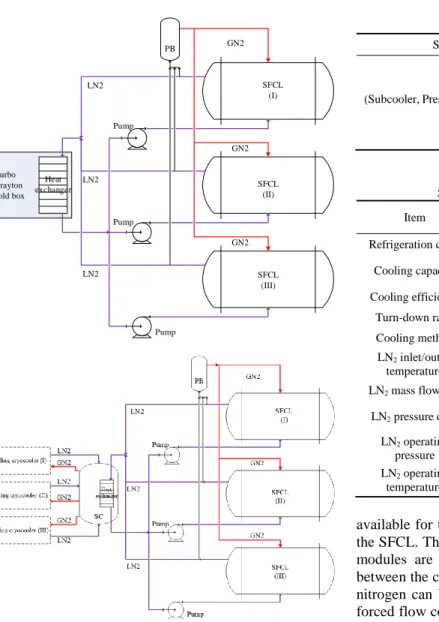
2. COOLING SYSTEM CONFIGURATION The closed-loop cooling system with circulation of liquid nitrogen is designed for the 154 kV/ 2 kA three-phase hybrid type SFCL. The target operating condition of the SFCL is 71 K at 500 kPa. The total heat load is determined at 9 kW with the margin. The actual estimations of the heat load are shown in Table I. It is rough estimations in the design stage calculated by multiplying the heat load which was measured in the experiment for the 154 kV/ 2 kA single-phase hybrid type SFCL by 3. The heat load resulting from the quench of superconducting modules during the operation of SFCL is not considered. It is assumed to be absorbed into liquid nitrogen and then slowly eliminated by the cryocooler. A turbo Brayton refrigerator and a Striling cryocooler are
available for the heat load and the operation condition of the SFCL. The liquid nitrogen which the superconducting modules are submerged in is cooled by its circulation between the cryocooler and the SFCL cryostat. The liquid nitrogen can be cooled by two cooling methods, namely forced flow cooling and re-liquefaction cooling. In forced flow cooling, the liquid nitrogen passes through a heat exchanger of the cryocooler and is cooled by direct heat exchange with refrigerant of the cryocooler. On the other hand, the circulating liquid nitrogen is cooled through the heat exchanger submerged in saturated liquid nitrogen in re-liquefaction cooling. The cryocooler controls the saturation pressure of liquid nitrogen by liquefaction of nitrogen vapor, thereby adjusting the temperature of saturated liquid nitrogen. The cooling system configuration is slight different, depending on the cooling methods. The system configuration is designed according to each cooling method with the turbo Brayton refrigerator and the Striling cryocooler. Fig. 1 shows the cooling system configurations for the 154 kV/ 2 kA three-phase hybrid type SFCL according to the cooling methods. The forced flow cooling and the re-liquefaction cooling methods are respectively applied to the turbo Brayton refrigerator and the Striling cryocooler. The cooling system is composed of three cryostats with superconducting modules, cryocoolers, liquid nitrogen pumps, the pressure builder to maintain the operating pressure and the subcooler to cool the circulating liquid nitrogen. The SFCL cryostat has the double walled structure for vacuum and multi-layer insulation. It has maximum allowable pressure of 10 bar higher than (a)
(b)
Fig. 1. Cooling system configurations; (a) forced flow cooling, (b) re-liquefaction cooling. (PB: Pressure builder, SC: Subcooler)
Turbo Brayton cold box
SFCL (I)
SFCL (II)
SFCL (III) Heat
exchanger
Pump
Pump
Pump PB
GN2
GN2 GN2
LN2
LN2
LN2
TABLEI
ESTIMATIONS OF HEAT LOAD.
System component Heat load (kW)
SFCL cryostat 2.6
Cooling system
(Subcooler, Pressure builder, Pump, Piping etc.) 0.8
AC loss 3.3
Total 6.7
TABLEII
SPECIFICATIONS OF THE CRYOCOOLER.
Item Turbo Brayton
refrigerator Stirling cryocooler Refrigeration cycle Reverse Brayton Stirling
Cooling capacity ≥ 9 kW @ 69 K, 2.4 kg/s
≥ 9 kW (3 kW × 3 EA) @ 68 K Cooling efficiency ≥ 0.05 @ 69 K ≥ 0.05 @ 68 K
Turn-down ratio ≤ 0.4 ≤ 0.36
Cooling method Forced flow Re-liquefaction LN2 inlet/outlet
temperature 71 K / 69 K -
LN2 mass flow rate 1.8 ~ 3.0 kg/s - LN2 pressure drop ≤ 0.03 MPa @ 2.4
kg/s -
LN2 operating
pressure ≤ 1.0 MPa
LN2 operating
temperature 68 ~ 77 K
operating pressure, and a rupture disc for safety. The pressure increase by the quench of superconducting modules during the operation of SFCL is approximately expected by 1 bar. It is estimated from the small-scale experiment for vaporization of subcooled liquid nitrogen by instantaneous heat generation [8]. The subcooler is the system component only used for re-liquefaction cooling, and has the heat exchanger submerged in saturated liquid nitrogen. The temperature of the saturated liquid nitrogen is controlled by adjusting saturation pressure depending on liquefaction of nitrogen vapor on the cold head of the cryocooler. In the forced flow cooling method, liquid nitrogen is cooled while passing through the heat exchanger in the cold box of the cryocooler. The liquid nitrogen is cooled in the heat exchanger by direct heat exchange with the refrigerant of the cryocooler. The pressure builder evaporates a portion of circulating liquid nitrogen by a heater and supplies nitrogen vapor to the SFCL cryostat to maintain the operating pressure. The circulating liquid nitrogen is supplied to the pressure builder by the head difference between the SFCL cryostat and the pressure builder. Table II indicates the specifications of the cryocooler for the cooling system.
The turn down ratio, the cooling efficiency and the LN2 pressure drop in Table II are the ratio of minimum cooling capacity of the cryocooler to maximum cooling capacity, the ratio of cooling capacity to input power and the pressure drop of liquid nitrogen in the heat exchanger of the turbo Brayton refrigerator, respectively. The liquid nitrogen temperatures at the inlet and the outlet of the heat exchanger in the turbo Brayton refrigerator approximately correspond to the minimum and maximum temperatures of liquid nitrogen contained in the SFCL cryostat. The temperature deviation is given by the design criterion of the superconducting module. In the present design, the maximum temperature deviation of 2 K in the SFCL cryostat is assumed, namely between 69 K and 71 K. The assumption for the temperature deviation comes from a 154 kV/ 2 kA single-phase hybrid type SFCL [7]. The requirements for the mass flow rate, inlet and outlet temperatures of liquid nitrogen passing through the heat exchanger of the turbo Brayton refrigerator are determined to satisfy the temperature deviation as shown in Table II. In addition, the base temperature for cooling capacity in the Stirling cryocooler is 1 K lower than the turbo Brayton refrigerator. It results from the additional temperature difference of 1 K, design criterion for the heat exchanger, between liquid nitrogen and the submerged heat changer in the subcooler. In the case of the turbo Brayton refrigerator, the temperature, pressure and mass flow rate of circulating liquid nitrogen are additionally given in the specifications since it includes the heat exchanger in the cold box. The temperatures of circulating liquid nitrogen at the inlet and outlet of the heat exchanger are determined by allowable maximum temperature difference in the SFCL cryostat, 2 K, and the operating temperature of the SFCL, 71 K. Then, the mass flow rate of circulating liquid nitrogen is determined by the cooling capacity and the temperature difference of circulating liquid nitrogen between the inlet and the outlet.
3. SPECIFICATION OF SYSTEM COMPONENTS 3.1 Liquid nitrogen pump
The liquid nitrogen pump circulates liquid nitrogen between the SFCL cryostat and the cryocooler to keep the temperature of the SFCL below the operation temperature of 71 K. The requirements for the pump such as flow rate, maximum allowable working pressure (MAWP) and heat leak are determined by operating conditions and total heat load of the SFCL. In addition, the head requirement of the pump depends on the piping system. Table III indicates the requirements of the pump derived the constraints. The flow rate of 150 lpm is at least required to satisfy the maximum temperature difference of 2 K in the SFCL cryostat. The pump head over 15 m is also required for overcoming head loss in the piping system discussed in the next section. The requirement for the heat leak comes from the specification of a commercial liquid nitrogen pump [10-11] with a margin. In addition, the pump is required to be able to operate over the pressure of 10 bar, maximum allowable pressure of the SFCL cryostat. The head, MAWP and heat leak are main criterion to select the pump, because the flow rate can be satisfied by the arrangement of pumps. The heat leak which affects total heat load is especially critical to the cooling system. An extended shaft type centrifugal pump with small heat leak, therefore, is suitable for the cooling system of the SFCL. The present cooling system for the SFCL is designed to use commercial extended shaft type centrifugal pumps (Barber Nichols) satisfying the requirements for the head and MAWP. Pump specifications are listed in Table IV [10]. The six pumps (two pumps per a phase) are used in parallel to satisfy the flow rate requirement.
3.2 Piping system
The vacuum insulated piping is used to minimize heat leak in the cooling system of the SFCL. The size of the piping is determined by the compromise between the pump
TABLEIII PUMP REQUIREMENTS.
Parameter Requirement
Flow rate > 150 lpm
Head > 15 m
Heat leak < 200 W
MAWP > 10 bar
TABLEIV
SPECIFICATIONS OF A LIQUID NITROGEN PUMP.
Model Type
Flow rate [lpm]
Head [m]
Heat leak [W]
MAWP [bar] Q’ty Barber
Nichols (BNCP 64C)
Extended shaft centrifugal
pump
30 30 30 16.1 6
head, and the head required for the piping system. Based on the piping system which has been applied to the single-phase SFCL [7], the piping configuration of the cooling system including piping length, the number of valves and so on is assumed. In addition, the size of common piping connected together from each SFCL cryostat is assumed to be 2 inches in diameter. The lengths of common piping and piping connected to the SFCL cryostat in the piping configuration are also assumed to be 20 m and 50 m respectively. The size of the piping can be determined from these assumptions. Fig. 2 shows the comparison between the pump head, and the head required for each piping size. In Fig. 2, the head required for each piping size is calculated according to the flow rate with the assumption for the piping configuration, and the pump head comes from the specification of the commercial liquid nitrogen pump (Barber Nichols) [10]. Comparing the heads corresponding to 160 lpm, operating flow rate, it is shown in Fig. 2 that the appropriate size of the piping connected to the SFCL cryostat is 1 inch in diameter.
3.3 Heat exchanger for a subcooler
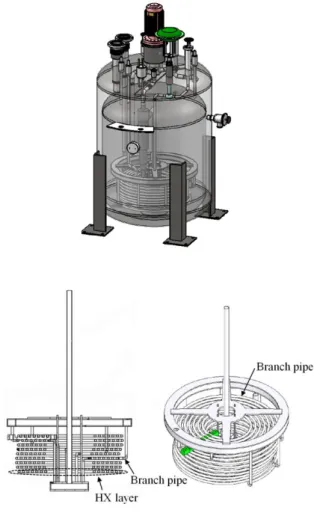
The heat exchanger submerged in saturated liquid nitrogen of the subcooler is used to cool circulating liquid nitrogen by the re-liquefaction cooling method. The simplest type of the heat exchanger for the purpose is a submerged coil heat exchanger. The heat exchanger has a number of branch pipes which divide the flow rate. The each branch pipe makes up the layer of the heat exchanger.
Fig. 3 shows the schematic diagram of the subcooler and the heat exchanger. The heat exchanger is designed to meet design requirements. The design requirements are given in Table V. The heat exchanger capacity in Table V is determined by the total heat load of the cooling system, namely cooling capacity of the cryocooler, 9 kW. The temperature difference between the inlet and the outlet of the heat exchanger approximately corresponds to the temperature deviation of liquid nitrogen in the SFCL cryostat. It, therefore, is the constraint given by the design of the superconducting module. The present design Fig. 2. Pump head and the head required for each piping size.
(a)
(b)
Fig. 3. Schematic diagram of (a) the subcooler and (b) the submerged coil heat exchanger.
Fig. 4. Required heat transfer area of the heat exchanger.
0.0 5.0 10.0 15.0 20.0 25.0 30.0
0 150 300 450 600 750
0.0 0.5 1.0 1.5 2.0 2.5 3.0
Heat transfer area (m2)
Flow rate (LPM)
ΔT (K)
Design point
Flow rate of six BNCP 64C pumps (Barber Nicoles)
TABLEV
REQUIREMENTS FOR THE SUBMERGED HEAT EXCHANGER.
Parameter Design condition
Inlet temperature of LN2 71.0 K
Temperature difference of LN2 2 K
Operating pressure 500.0 kPa
Heat exchanger capacity 9 kW
assumes the temperature deviation of 2 K between 69 K and 71 K. The assumption for the temperature deviation is based on a 154 kV/ 2 kA single-phase hybrid type SFCL [7]. The requirement for the temperature difference between the inlet and the outlet of the heat exchanger is, therefore, given as 2 K corresponding to the temperature deviation in the SFCL cryostat. Fig. 4 shows the relationship between the flow rate and the required heat transfer area according to the temperature difference between the inlet and outlet of the liquid nitrogen passing through the heat exchanger. The relationship is iteratively calculated by the log mean temperature difference (LMTD) method with the constraints of the dimension of the branch pipe and its number of turns given in Table VI. The dimensional constraints are chosen by considering the pressure drop and the size of the heat exchanger. The required heat transfer area is determined in Fig. 4 by the requirement of the heat exchanger, temperature difference of 2 K. Table VI is the specifications of the heat exchanger determined for the required heat transfer area by the LMTD method. The effectiveness in Table VI is the ratio of the actual heat transfer rate for a heat exchanger to the maximum possible heat transfer rate, and defined as
ε = 𝑞
𝑞𝑚𝑎𝑥≈ 𝑇𝑖−𝑇𝑜
𝑇𝑖−𝑇𝐿𝑁2 (1) where Ti, To and TLN2 are the temperatures at the inlet and the outlet of the heat exchanger, and liquid nitrogen
temperature contained in the subcooler, respectively. In addition, the pressure drop in the heat exchanger is calculated by following correlations for a coil [9].
ΔP = 0.00875 ∙ ρ𝑣2∙ 𝜆𝑒𝑙𝛿𝑅0
𝐷𝑜 (2) 𝜆𝑒𝑙 = 20
𝑅𝑒0.65(𝐷𝑜
2𝑅𝑜)0.175 for 50 < Re√2𝑅𝐷𝑜
𝑜≤ 600 𝜆𝑒𝑙 = 10.4
𝑅𝑒0.55(𝐷𝑜
2𝑅𝑜)0.225 for 600 < Re√2𝑅𝐷𝑜
𝑜≤ 1400 𝜆𝑒𝑙 = 5
𝑅𝑒0.45(𝐷𝑜
2𝑅𝑜)0.275 for 1400 < Re√2𝑅𝐷𝑜
𝑜≤ 5000 where ρ, ν, Re, R0, δ and D0 are the density, velocity and Reynolds number of liquid nitrogen, the curved radius and angle of the coil, and the inner diameter of the coil tube, respectively.
3.4 Subcooler
The subcooler is the system component necessary in the cooling system using the re-liquefaction cooling method. It has the heat exchanger submerged in the saturated liquid nitrogen as shown in Fig. 3. The temperature of the saturated liquid nitrogen is controlled by the re-liquefaction cooling in the cryocooler. The liquid nitrogen circulated from the SFCL cryostat passes through the heat exchanger and cools down. The size of the subcooler is determined to accommodate the submerged heat exchanger sufficiently. The specifications of the subcooler, therefore, are given in consideration of separation distance as shown in Table VII. The height ratio in Table VII is that of the heat exchanger to the subcooler.
3.5 Pressure builder
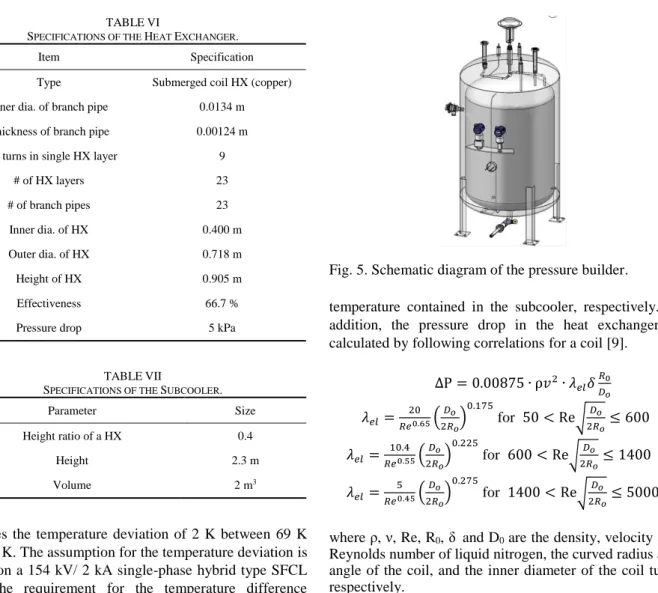
The pressure builder vaporizes a part of liquid nitrogen circulating between the SFCL cryostat and the cryocooler by a heater, thereby increasing the initial pressure to the operating pressure or maintaining the operating pressure.
Fig. 5 shows the schematic diagram of the pressure builder.
It also stores liquid nitrogen in order to adjust the liquid nitrogen level in the SFCL cryostat. Depending on the external condition, the height of the liquid nitrogen needs to be adjusted to minimize the energy entering the heater.
The volume of the pressure builder is determined to adjust TABLEVI
SPECIFICATIONS OF THE HEAT EXCHANGER.
Item Specification
Type Submerged coil HX (copper)
Inner dia. of branch pipe 0.0134 m Thickness of branch pipe 0.00124 m
# of turns in single HX layer 9
# of HX layers 23
# of branch pipes 23
Inner dia. of HX 0.400 m
Outer dia. of HX 0.718 m
Height of HX 0.905 m
Effectiveness 66.7 %
Pressure drop 5 kPa
TABLEVII
SPECIFICATIONS OF THE SUBCOOLER.
Parameter Size
Height ratio of a HX 0.4
Height 2.3 m
Volume 2 m3
Fig. 5. Schematic diagram of the pressure builder.
5% of the liquid nitrogen height. The heater capacity is determined by the heat input required for initial pressurization. The heat input to maintain the operating pressure is much smaller than it. The heater capacity is designed to be 8 kW. It corresponds to the heat input to increase the pressure from 100 kPa to 500 kPa within 5 hours. The specifications of the pressure builder are given in Table VIII.
4. SUMMARY
A cryogenic cooling system is designed for the 154 kV /2 kA three-phase hybrid type SFCL. The operating condition of the SFCL is 71 K at 500 kPa. The total heat load of the SFCL including the cooling system is estimated at 9.6 kW. The cooling system consists of a closed loop with liquid nitrogen circulating between the SFCL cryostat and the cryocooler. The cooling system configuration is respectively designed according to cooling methods of forced flow cooling and re-liquefaction cooling.
Depending on the cooling method, the system components are composed of the cryocooler, the liquid nitrogen pump, the subcooler with the heat exchanger, and the pressure builder. The design guidelines for the cooling system are presented. They are based on the operation results of the cooling system for the 154 kV/ 2 kA single-phase hybrid type SFCL. The specifications of the system components including the piping system are determined to satisfy the operating condition of SFCL according to the design guidelines.
ACKNOWLEDGMENT
This work was supported by the Power Generation and Electricity Delivery of the Korea Institute of Energy Technology Evaluation and Planning (KETEP) grant funded by the Korea government Ministry of Trade, Industry and Energy.
REFERENCES
[1] O. B. Hyun, et al., “Domestic effects for SFCL Application and hybrid SFCL,” Prog. Supercond., vol. 10, pp. 60-67, 2008.
[2] S. Eckroad, “Superconducting power equipment,” Technology Watch 2012 (EPRI), 1024190, 2012.
[3] S. Eckroad, “Superconducting fault current limiters,” Technology Watch 2009 (EPRI), 1017793, 2009.
[4] H. Hong, et al., “Design, fabrication, and operation of the cryogenic system for a 220 kV/300 MVA saturated iron-core superconducting fault current limiter,” IEEE Trans. Appl. Supercon., vol. 24, no. 5, 9002204, 2014.
[5] W. Romanosky, “Development and testing of a transmission voltage SuperLimiter™ fault current limiter,” Final Scientific/Technical Report (DOE), 2012.
[6] F. Schmidt, and A. Hobl, “Latest achievements in resistive type superconducting fault current limiters,” 11th EPRI Supercon. Conf., Hilton university of Houston, Houston, TX, USA, 2013.
[7] H. Yeom, et al., “Test of the Modified Cooling System for the 154 kV SFCL,” ASC 2016, Denver, CO, USA, 2016.
[8] S. In, et al., “Experimental Study on Vaporization of Subcooled Liquid Nitrogen by Instantaneous Heat Generation in LN2 Chamber for HTS-FCL,” IEEE Trans. Appl. Supercon., vol. 25, no. 3, 3800204, 2015.
[9] I. E. Idelchik, Handbook of Hydraulic Resistance, 3rd ed., Begell House, NY, USA, 1996, pp. 359-360.
[10] Installation, Operating, and Maintenance Manual # BNCP-64C -M001, Barber-Nichols, 2010.
[11] Cryopump Technical Specification, Cryozone [Online]. Available:
https://www.cryozone-dhi.com/en/products/cryogenic-pumps/ln2- pump
TABLEVIII
SPECIFICATIONS OF THE PRESSURE BUILDER.
Parameter Size
Volume 5.3 m3
Heater 8 kW