충주대학교 융․복합기술연구소 논문집, Vol. 1, No. 1, pp. 48-51 (2011) Copyright ⓒ 2011 ICT ISSN : 2233-8667
48
미세바늘제작 및 배열을 이용한 반 능동형 가진 약물주입기구 설계
성 연 욱
1)․박 진 호
1)․이 혜 진
*1)한국생산기술연구원 미래융합연구그룹1)
Semi-active Vibration Drug Delivery Device Design using a Micro-needle Fabrication and Array
Yeon-wook Sung
1)․Jean Ho Park
1)․Hye-Jin Lee
1)1)Advanced Convergent Technology R&D Group, Korea Institute of Industrial Technology, Sa-3-Dong, Ansan-si, Gyeonggi-do 426-910, Korea
(2011. 03. 24 Received / 2011. 04. 31 Accepted)
Abstract : Transdermal drug delivery device is a method of drug delivery through the skin. Skin has a very large area, so it is attractive route to drug delivery. When drug delivery through the skin, microneedle has a advantage that painless, constant drug deliver and penetration efficient; nevertheless the cost is expensive because fabrication process need a particular equipment and not suitable in mass production. This study shows microneedle fabrication process using convergence of general MEMS process and dicing process that can make 3-D sharp microneedle tip and this fabrication process suitable for mass production.
Key words : Micro-neeldle(마이크로니들), Ion-tophoresis(이온토포레시스), Transder Drug Delivery(경피약물전달) Lithography(리소그라피), MEMS(마이크로기전시스템)
Subscipts
MEMS : micro- electromechanical systems UV : ultraviolet
LDPE : low-density polyethylene DRIE : deep reactive-ion etching
7)
1. Introduction
Through oral medication and how medication directly through the syringe to the patient and the physician is still the most popular method. But in this method is have a not solving large problem.
* Corresponding author. E-mail: [email protected]
First that is waiting long medication effect time and second is on the skin the syringe needle insertion pain. These pain and reduced medications effect reaction time method is Use to Micro-needle.
That is use to put on the affected or near of hurt area. Micro-needle is a simple and has not pain
These Micro-needles to create tiny hole on the skin that size very smaller than syringe needle. that is designed injection to medication without pain on epidermis or dermis in wide distribution nerve area . In addition, the hydrophilic polymer and the penetration of drugs through the skin, allowing drug delivery has emerged as an effective method using micro-needles. However, injection molding and conventional semiconductor processing to create
Semi-active Vibration Drug Delivery Device Design using a Micro-needle Fabrication and Array
Journal of Institute of Convergence Technology Vol. 1, No. 1, pp. 48-51 (2011) 49 through a micro-needle, once part of the price
competitiveness of the micro-needle will be reduced.
In this paper, to solve these problems through a percutaneous micro-needle for drug injection method for fabrication the MEMS process and after the dicing process was created through a micro-needle, and then evaluate its performance compared with the existing production of cheaper and faster way Time production and a way to get high performance is proposed.
2. Fabrication Method
Micro needles are fabricated using UV lithography, dicing, nickel electro forming and injection molding.
Fig. 1 MEMS Process
Fig. 1 show the micro needle fabrication process. As illustrated in Fig. 1 (2) PR coating (AR-N 4400 series PR), spin coater rotate 250~400rpm during 10s then 10~30μm thickness PR coated. To hardening the PR, soft bake required at 85~95℃ about 1h. (3) UV masks aligned (EVG 6200 Mask aligner) with coated PR substrate, it was patterned Cr layer to define the shape of the micro needle, and Needle shape is form on the PR by UV lithography. (4) Before fabrication, to improve adhesive strength between PR and substrate and harden the PR, hard bake performed. The exposed photo resist removed by soaking in a developer (AZ MIF 300 Developer). (5) Deep
reactive ion etching (DRIE) etched away silicon substrate. DRIE, PR acts as an etching mask. (6) After etching, remained PR removal (7) Dicing.
This process used in fabrication purpose for the positive micro needle and performed in dustless clean room. PR is a light-sensitive material, so this process performed to protect the light effect in yellow room.
3. Semi-solid type Micro-needle
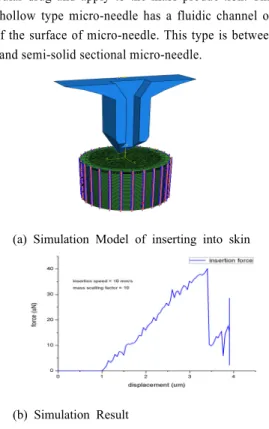
Micro-Needle perforate skin and make micro size holes on it. The solid sectional shaped micro-needle can’t deliver high mo-lecular and hydrophilic drug because the size of hole is smaller than high molecular drug. If we want to deliver high molecular drug into skin, we must use a hollow type mi-cro-needle. But the manufacturing process of hollow type micro-needle is so difficult and can’t apply to the mass production. So we suggest the semi-hollow type micro-needle that can deliver high molecular drug and apply to the mass produc-tion. This semi-hollow type micro-needle has a fluidic channel on one of the surface of micro-needle. This type is between solid and semi-solid sectional micro-needle.
(a) Simulation Model of inserting into skin
(b) Simulation Result
Fig. 2 Simulation result of inserting the semi-solid sectional micro-needle device in to skin
Yeon-wook Sung․Jean Ho Park․Hye-Jin Lee
충주대학교 융․복합기술연구소 논문집 제1권 제1호, 2011
50
4. Insertion force evaluation
fabricated micro-needle as compared to the solid type, when the needle penetrate into skin of percutaneous insertion more effective on elastic and environment. if the needle to bend or damage to the human body can give you the breaks are made . To prevent this damage assessment was carried out the characteristics of the micro-needle.
Fig. 3 Diffusion inspection module
With properties similar to human skin was used for LDPE. This experiment FIG. 2 experiments using a device such as diffusion device and put the water on the bottom of the cube and made a similar to human skin condition. The experimental conditions of the needle insertion speed 0.08mm / s at a rate of LDPE were inserted into the experimental results shown in Fig. 3
0 .0 0 .2 0 .4 0 .6 0 .8 1 .0 1 .2 1 .4
1 0 2 0 3 0 4 0 5 0 6 0
Resistance force(mN)
D is p lac em en t(m m )
Fig. 4 Resistance force needle insertion into LDPE
5. Diffusion Experimental evaluation We can get results of two kinds of micro-needle device (Solid and semi-solid sectional types) using injection molding process and polycarbonate material. An optical monitoring system is developed for inspecting the drug delivery phenomenon. We proved that the efficiency of drug delivery can increase using semi-solid type micro-needle device and optical monitoring system. that method using a photoshop™ and that result shown. Fig. 6
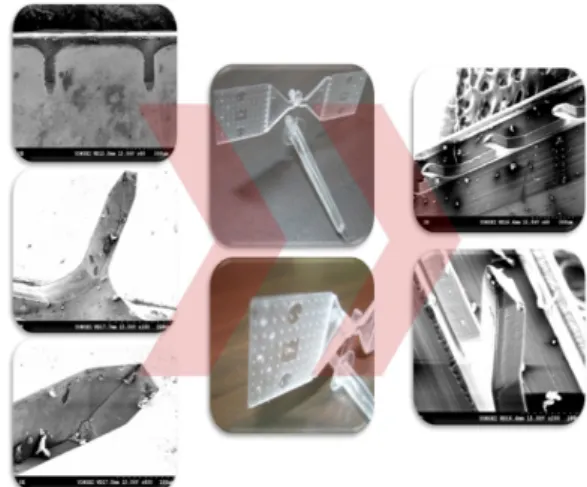
Fig. 5 fabricated micro-needle array mold and device
6. Semi-active Drug delivery device design Transder drug delivery device designed using a fabricated micro-needle. fig. 7 shown Drug delivery device. that is composed four parts of micro- needles, fixing bolts, PZT actuator, electronic board. This device working principle is PZT actuator received amplified electric from circuit board. micro-needle to skin by pzt actuator vibrating. that device optimization experiment frequency fig. 8
Fig. 6 Drug delivery efficiency test result
Semi-active Vibration Drug Delivery Device Design using a Micro-needle Fabrication and Array
Journal of Institute of Convergence Technology Vol. 1, No. 1, pp. 48-51 (2011) 51 Fig. 7 Drug delivery device
Fig. 8 FRF Analysis of Drug delivery device
7. Conclusion
Through this study, three-dimensional shape of the micro-needles fabricated by MEMS process and Dicing process and to evaluate the reliability of percutaneous Micro-needle like conditions into the assessment of the LDPE was carried out.
Former fabrication process is expensive and need particular device. However, this process does not need any particular device, cheap, simple, and useful in mass production for micro-needle fabrication. And through this process, micro- needle device was developed for treatment.
Acknowledgement
This research was financially supported by Korea Research Council for Industrial Science &
Technology (Istk) research project name is
“Convergence Manufacturing Technology Development of Bio-Medical Applicable Network-Embedded Patch System”. The authors are grateful to all the parties concerned.
(B551179-09-02-00)
References
1. Kwang Lee, Hyun Chul Lee, Dae-Sik Lee, Hyungil Jung, “Drawing Lithography: Three-Dimensional Fabrication of an Ultrahigh-Aspect-Ratio Microneedle,” Advanced Materials, 22(4)483-486, 2010.
2. M. Matteucci, M. Casella, M. Bedoni, E. Donetti, M. Fanetti, F. De Angelis, F. Gramatica, E. Di Fabrizio, “ A compact and disposable transdermal drug delivery system,” Microelectronic Engineering 85(2008)1066-1073.
3. Anubhav Arora, Mark R. Prausnitz, Samir Mitragotri, “Micro-scale devices for transdermal drug delivery,” International Journal of Pharmaceutics 364(2008)227-236.
4. Manhee Han, “The development of microneedles’
fabrication methods using inclined UV lithography and polymer molding process, and the analyses of the microneedles’ characteristics,” KAIST, doctoral dissertation.