Vol.22, No.1, (2020), pp.1~6 https://doi.org/10.9714/psac.2020.22.1.001
```
1. INTRODUCTION
REBa2Cu3O7−y (REBCO, RE: rare-earth elements) superconductors may have great impacts on the electric power industry, bio-medical use, fundamental science, transportation system and so on. Two major efforts have been made since the discovery of REBCO superconductors.
One is to fabricate into thin film and the other one is to grow into single-domain large bulk. Thin film application of REBCO superconductors has been matured via the successful fabrication of long-length high performance coated conductor which has an architecture of high Jc REBCO thin film grown on the high strength metal substrate [1-3]. Currently, there is large number of coated conductor suppliers around the world. High performance of coated conductor in market has made it possible for the research on the application of REBCO coated conductor in cable, motor, MRI, NMR, nuclear fusion etc. [2, 4-8].
On the other hand, single grain REBCO bulk superconductors have several huddles for the real application even though they have also a potential for the applications in magnetically-levitated system, permanent magnets, magnetic shielding, MRI and so on [9, 10]. The large grain YBCO bulk superconductors have been fabricated by a top-seeded melt growth (TSMG) or by a top-seeded infiltration growth (TSIG) process [11-15]. The
growth rate of REBCO crystal is sluggish as low as ~0.2 mm/h and it takes longer than 1 week in order to obtain the specimen with a dimension of 50 x 50 mm2. The performance properties of bulk superconductor are not uniform to use in high precision devices NMR or MRI yet [16]. It is also extremely difficult to fabricate a large sized bulk specimen with a diameter over 15 cm. In the aspect of production cost, the preparation step of precursor powder also takes time due to the multiple and repeated steps of the mixing powders, calcination, grinding. Extra time and cost arise by the repeated heat treatment and mechanical grinding. Therefore, there have been attempts to simplify the repeated process [17, 18]. Very recently, we have fabricated the small-sized large grain REBCO bulk superconductor directly using raw materials of Y2O3,
BaCO3, CuO and CeO2 instead of pre-reacted precursors such as Y2BaCuO5, YBa2Cu3O7−y, BaCuO3 [19]. Direct fabrication of bulk superconductor from raw materials without intermediate grinding step should beneficial for the reduction of production cost. In continued works, we have failed to fabricate large-size specimen using the same processing parameters due to two main issues of the dissolution of Sm123 seed and the generation of macro cracks.
In this article, we presents the procedure showing how we have changed the sample preparation steps including the calcination step in order to obtain large-sized single
A parameter study on the pre-heat treatment for the fabrication of a large grain YBCO bulk superconductor without intermediate
grinding step
Yi-Seul Honga, Chan-Joong Kimb, and Hee-Gyoun Leea, *
a Korea Polytechnic University, Siheung, Korea
b Korea Atomic Energy Research Institute, Taejon, Korea
(Received 14 February 2020; revised or reviewed 30 March 2020; accepted 31 March 2020)
Abstract
This is a parameter study for the direct fabrication of a large grain YBCO bulk superconductors using Y2O3, BaCO3 and CuO powders without any grinding step. The cracks, which have been formed due to volume contraction during calcination step, have been prevented by controlling the heating rate at 930~950 ℃. It has been observed that multi-grain growth has occurred due to the dissolution of Sm123 seed due to the retention of carbon in Ba-Cu-O melt. In order to accelerate the carbon release in prior calcination heat treatment, the reduction of pellet thickness and the drilling of artificial holes have been applied. Single-grain YBCO bulk superconductor has been successfully fabricated by stacking multiple thin slab. However, the crack formation has been rather prominent for the compact with artificial holes. The use of buffer pellet, which is supposed to act as diffusion barrier, has prevented the dissolution of Sm123 seed crystal and has led to the growth of single grain of high content of carbon containing specimen.
Keywords: REBCO, bulk superconductors, carbon, Ostwald ripening, cracks
* Corresponding author: [email protected]
grain REBCO bulk superconductors directly by using BaCO3 precursor as a barium precursor and by eliminating the grinding step in TSMG method.
2. EXPERIMENTALS
High purity powders of Y2O3, BaCO3, CuO and CeO2
have been used for the powder mixture. Nominal composition of the powder mixture (hereafter, Y1.8-carbonate) was Y: Ba: Cu = 1.8: 2.4: 3.4 and 1 wt. % CeO2 was added as a refiner of Y211 particles. An appropriate amount of powder mixture was put into a steel mold. Compacts were prepared by a uni-axial pressing and then cold isostatic pressed. CIPed-powder compacts were calcined at various conditions in a muffle furnace in air atmosphere. For instance, compacts were heat treated at 800℃ for 8h, 850℃ for 8h, 900℃ for 8h and 950℃ for 8h in air in previous work [19].
For TSMG, powder compact was placed on the Yb2O3
pieces and then a small-sized Sm-123 seed was put on the top surface of the pre-calcined compact at last. The heat treatment procedure for melt growth (MG) was similar with those reported in the literature [15]. The cooling rate controlled with 0.4℃h−1 at the temperature regime for the growth of Y123 grains. After the MG heat treatment, Y1.8 samples were heated to 500℃ at a rate of 200℃h−1 in flowing oxygen for oxygenation, held at this temperature for 50 h, cooled to 400–500℃ at a rate of 100℃h−1, held at this temperature for 200-300 h, and then cooled to room temperature at a rate of 200℃h−1. Pre-reacted precursor powder mixture (purchased from Superconductor Components Inc., hereafter, Y1.8-SCI) has been used for the preparation of small sized buffer pellet.
Digital images of the specimens have been taken in order to analyze the dimensional changes and investigate the growth behavior of Y123 crystal. The size and the spatial distribution of Y211 particles have been also investigated for the melt-processed specimen using optical microscope (OP).
3. RESULTS AND DISCUSSION
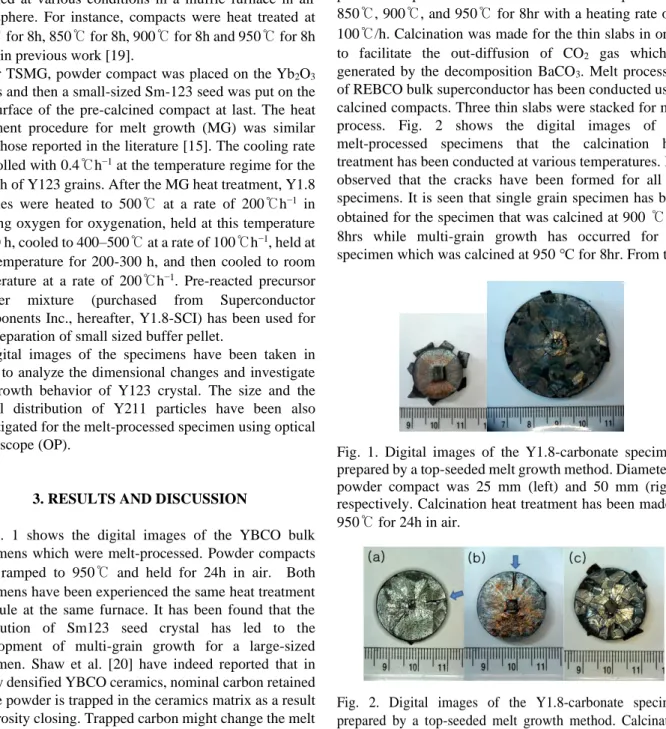
Fig. 1 shows the digital images of the YBCO bulk specimens which were melt-processed. Powder compacts were ramped to 950℃ and held for 24h in air. Both specimens have been experienced the same heat treatment schedule at the same furnace. It has been found that the dissolution of Sm123 seed crystal has led to the development of multi-grain growth for a large-sized specimen. Shaw et al. [20] have indeed reported that in highly densified YBCO ceramics, nominal carbon retained by the powder is trapped in the ceramics matrix as a result of porosity closing. Trapped carbon might change the melt chemistry due to the presence of the residual BaCO3. Diko el al. [21] has reported that the residual BaCO3, which was
not wholly decomposed, formed a non-equilibrium melt in Y-Ba-Cu-O system. It has been also reported that Y123 phase decomposes in the presence of residual carbon [22].
In our previous work [19], we have observed that the melt has presented at the pellet surface and formed crust.
Thus, it can be thought that the diffusion-out of CO2 gas has been hindered once the melt crust has been formed in the pellet surface. Therefore, it is thought that the specimen, which was calcined with a high ramping rate at calcination stage, is densified before the complete decomposition of carbonate and a lot of residual carbon is present during a melt processing. The presence of high residual carbon in turn has led to the dissolution of Sm123 seed and no single grain growth has been obtained.
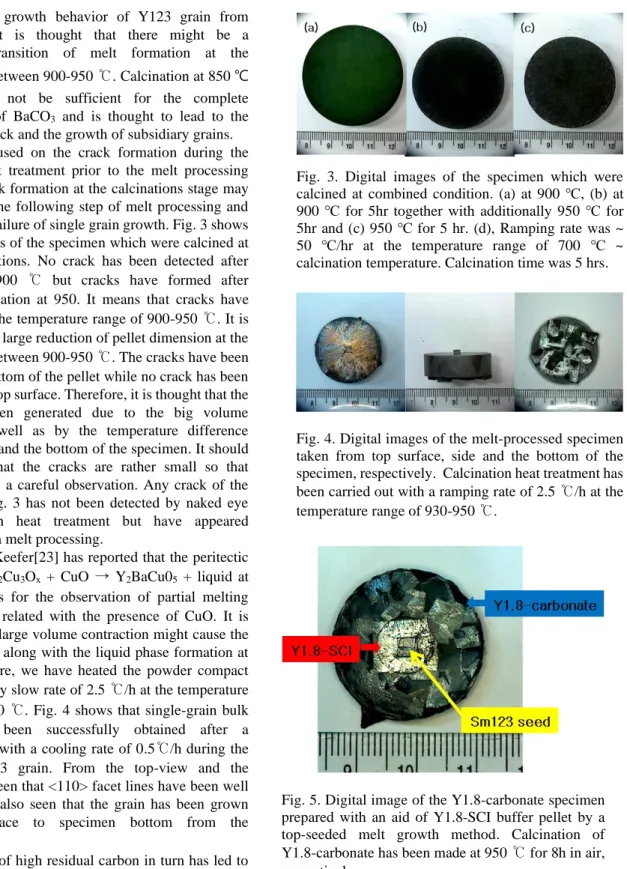
In order to know the proper calcination temperature, powder compacts were calcined at various temperature of 850℃, 900℃, and 950℃ for 8hr with a heating rate of ~ 100℃/h. Calcination was made for the thin slabs in order to facilitate the out-diffusion of CO2 gas which is generated by the decomposition BaCO3. Melt processing of REBCO bulk superconductor has been conducted using calcined compacts. Three thin slabs were stacked for melt process. Fig. 2 shows the digital images of the melt-processed specimens that the calcination heat treatment has been conducted at various temperatures. It is observed that the cracks have been formed for all the specimens. It is seen that single grain specimen has been obtained for the specimen that was calcined at 900 ℃ for 8hrs while multi-grain growth has occurred for the specimen which was calcined at 950 ℃ for 8hr. From the
Fig. 1. Digital images of the Y1.8-carbonate specimens prepared by a top-seeded melt growth method. Diameter of powder compact was 25 mm (left) and 50 mm (right), respectively. Calcination heat treatment has been made at 950℃ for 24h in air.
Fig. 2. Digital images of the Y1.8-carbonate specimen prepared by a top-seeded melt growth method. Calcination heat treatment has been made at (a) 850 ℃, (b) 900 ℃ and (c) 950 ℃ for 8hr in air, respectively. Arrows indicate the cracks.
observations of growth behavior of Y123 grain from Sm123 seed, it is thought that there might be a metallurgical transition of melt formation at the temperature in between 900-950 ℃. Calcination at 850 ℃ for 8hr might not be sufficient for the complete decomposition of BaCO3 and is thought to lead to the generation of crack and the growth of subsidiary grains.
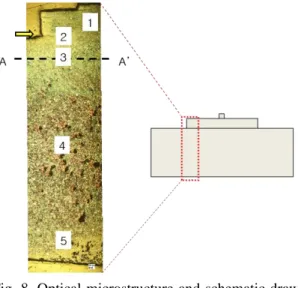
We have focused on the crack formation during the calcinations heat treatment prior to the melt processing because the crack formation at the calcinations stage may be inherited to the following step of melt processing and will lead to the failure of single grain growth. Fig. 3 shows the digital images of the specimen which were calcined at combined conditions. No crack has been detected after calcination at 900 ℃ but cracks have formed after additional calcination at 950. It means that cracks have been formed at the temperature range of 900-950 ℃. It is seen that there is large reduction of pellet dimension at the temperature in between 900-950 ℃. The cracks have been formed at the bottom of the pellet while no crack has been observed at the top surface. Therefore, it is thought that the cracks have been generated due to the big volume contraction as well as by the temperature difference between the top and the bottom of the specimen. It should be mentioned that the cracks are rather small so that detected only by a careful observation. Any crack of the specimens in Fig. 3 has not been detected by naked eye after calcination heat treatment but have appeared prominent after a melt processing.
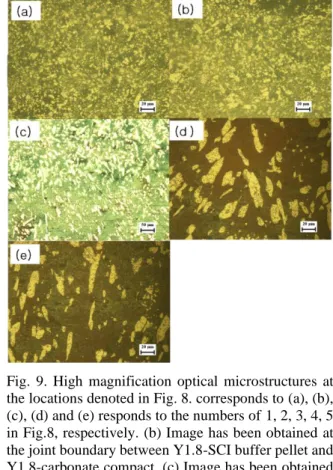
Aselage and Keefer[23] has reported that the peritectic reaction of YBa2Cu3Ox + CuO → Y2BaCu05 + liquid at 940 °C accounts for the observation of partial melting which has been related with the presence of CuO. It is thought that the large volume contraction might cause the crack generation along with the liquid phase formation at 940 °C. Therefore, we have heated the powder compact with an extremely slow rate of 2.5 ℃/h at the temperature range of 930-950 ℃. Fig. 4 shows that single-grain bulk specimen has been successfully obtained after a melt-processing with a cooling rate of 0.5℃/h during the growth of Y123 grain. From the top-view and the side-view, it is seen that <110> facet lines have been well developed. It is also seen that the grain has been grown from top surface to specimen bottom from the bottom-view.
The presence of high residual carbon in turn has led to the dissolution of Sm123 seed and no single grain growth has been obtained. Bru [24] has reported in the investigation of REBCO thin film that the avoidance of the formation of solid BaCuO2 phase facilitates the decomposition of BaCO3. Bru [24] also has reported that the decarburization temperature is increased with the film thickness for a thin film but the decarburization is kinetically controlled by the out-diffusion of CO2 gas for the film thicker than 2.5 m. It should be noticed that Bru’s study has been conducted at reduced pressure.
Balachandran et al. [25] and Selvaduray et al. [26] has reported that faster heating rates resulted in higher CO2
concentrations and yielded powders containing Y2BaCuO5
and other impurity phases. It has been also reported that The CO2 released by decomposition of BaCO3 can, however, react with YBa2Cu3Ox to form BaCO3, Y2O3 and CuO and Y2Cu2O5, depending on temperature [22].
We have applied a buffer pellet above the compact
Fig. 5. Digital image of the Y1.8-carbonate specimen prepared with an aid of Y1.8-SCI buffer pellet by a top-seeded melt growth method. Calcination of Y1.8-carbonate has been made at 950 ℃ for 8h in air, respectively.
Fig. 4. Digital images of the melt-processed specimen taken from top surface, side and the bottom of the specimen, respectively. Calcination heat treatment has been carried out with a ramping rate of 2.5 ℃/h at the temperature range of 930-950 ℃.
Fig. 3. Digital images of the specimen which were calcined at combined condition. (a) at 900 ℃, (b) at 900 ℃ for 5hr together with additionally 950 ℃ for 5hr and (c) 950 ℃ for 5 hr. (d), Ramping rate was ~ 50 ℃/hr at the temperature range of 700 ℃ ~ calcination temperature. Calcination time was 5 hrs.
which has been known to suppress the dissolution of Sm123 seed during melt processing such as infiltration method [27]. Fig. 5 shows a melt-processed specimen with a buffer pellet. For buffer pellet, pre-reacted powder Y1.8-SCI has been used. Y1.8-SCI buffer pellet was put on a powder compact which was calcined at 950 for 8 hr. The calcination heat treatment was the same with the specimen (c) in Fig. 2. With an aid of buffer pellet, it is seen that the Sm123 seed has not been dissolved and grain growth has started from Sm123 seed. However, the Y123 grain from Sm123 seed was not able to grow into a large grain because many grains grew at the outside of buffer pellet. It is seen that the buffer pellet has clearly suppressed the dissolution of Sm123 seed but many grains have been nucleated homogeneously in the matrix of the specimen. It indicates that the undercooling was big at the nucleation stage during melt processing and therefore the homogeneous nucleation of Y123 crystal is possible in whole specimen during the melt processing.
The application of buffer pellet has been one of the key solutions to overcome the several issues related with the dissolution of seed crystal [27], the contamination from seed crystal [28], the enlargement of a-c growth sector [29].
From the observations of Fig. 2(c) and Fig. 5, it is thought that the diffusion of carbon to Sm123 seed may be suppressed by the presence of Y1.8-SCI buffer pellet.
Preparation of artificial holes has clear advantages instead of cost-bearing and time-consuming work. One of them is to reduce the porosity through enhanced out-diffusion of generated gas in the bulk specimen [30].
As-pressed Y1.8-carbonate compact have melt-processed together with calcined Y1.8-carbonate compact.
Calcination was conducted at 900℃ for 8h in air. Buffer pellet has not been applied. It is seen that single-grain bulk specimens have been obtained. It indicates that the reduction of diffusion path has facilitated the decomposition of BaCO3 and it has prevented the dissolution of Sm123 seed crystal. It also means that the fabrication of single-grain bulk specimen is possible through the proper removal of carbon in the Y1.8-carbonate specimen.
As a next step, we have tried to fabricate single-grain bulk specimen without any prior heat treatment but applying a Y1.8-SCI buffer pellet. Fig. 7 shows a digital image of a melt-processed Y1.8-carbonate with Y1.8-SCI buffer pellet. As-pressed Y1.8-carbonate compact has been melt-processed without any prior heat treatment before a melt process.
Our previous and present works have shown that multiple intermediate grinding step is not pre-requisite for the fabrication of single-grain REBCO bulk superconductor The results in Fig. 6 and Fig. 7 let us know that a calcination step can be also eliminated for the fabrication of single-grain REBCO bulk superconductor.
As mentioned earlier, a simple processing procedure will bring us a great benefit of cost-reduction and time-savings.
But it should also be pointed out that the above results have been obtained only for small sized specimens and further
works are remained in order to apply for the preparation of large size specimen.
Fig. 8 shows the locations where the distribution of 211 particles of the melt-processed specimen has been observed and Fig. 9 shows the microstructure changes
Fig. 6. Digital image of the Y1.8-carbonate specimen prepared with six artificial holes. (a) without calcination and (b) with calcination at 900℃ for 8h in air.
Fig. 7. Digital image of a melt-processed Y1.8-carbonate with Y1.8-SCI buffer pellet. As-pressed Y1.8-carbonate compact has been melt-processed without any prior heat treatment before a melt process.
Fig. 8. Optical microstructure and schematic drawing showing the location where high magnification images have been taken. Arrow indicates the joint boundary between Y1.8-SCI pellet and Y1.8-carbonate compact.
Line A-A’ indicates the boundary near to the crust has been formed [19, 30].
depending on the location. The pressed compact, which has been prepared using carbonate raw materials, has been ramped to 980 ℃ for 5hr and held for 2hr and melt-processed with the same schedule on as applied in our previous works [19]. Only the difference is the use of raw materials without enough calcination heat treatment that is needed for the complete decomposition of barium carbonate. The presence of carbon in the Ba-Cu-O melt during a melt processing might change the growth behavior of Y123 crystal as well as Y211 particles due to a melt chemistry change.
It is observed that the size of the Y211 particles becomes larger with the specimen depth and the distribution density also decreases. It is quite different aspect of size distribution of Y211 particles in the melt processed specimen. For both of bottom-seeded and top-seeded specimens, the density of Y211 particles has been increased with the growth of Y123 crystal.; i.e., the density of Y211 particle is low at the early stage of crystal growth [19, 31]. Only the difference from previous works is that the material system contains extra carbon or carbonate in Ba-Cu-O melt. It is also observed that there is certain change of particle distribution density around at line A-A’
in Fig. 8 (corresponds to Fig. 9(c)). The boundary of A-A’
is considered to be related to the crust formation in the surface of the specimen [19, 30]. The out-diffusion of gas is prevented by the crust layer and CO2 gas might be retained at the area inside of outside crust. This assumption is supported from the result that there is no clear change of particle distribution density between the Y1.8-SCI buffer pellet and Y1.8-carbonate compact (Fig. 9(b)).
In our previous work, it has been suggested that the presence of carbon in the specimen may lead to the coarsening of Y211 particle [19]. At that time, the size variation with specimen depth (with extended period of holding before crystal growth) has not been observed. In this work, a specimen also has been fabricated by a top-seeded melt growth method.; i.e., crystal growth starts from the top surface of the specimen and proceeds toward the bottom of the specimen for 50 hours. Therefore, there was maximum 50 hr time interval between the initial nucleation stage at Sm123 seed and the completion stage of crystal growth. Particle coarsening always occurs with a dwell time at high temperature as far as the particles have certain solubility in the matrix. It is evident that the Y211 particle has the solubility of ~0.5% in BaCuO +CuO melt at peritectic decomposition temperature [32]. It means that Y211 particles at the bottom of the specimen has an opportunity of particle coarsening through “Ostwald ripening” if there is no other counter effect of particle growth inhibition.
Nariki et al. [33] have reported that the average size of Y211 particles has been rather reduced after a melt processing for REBCO (RE = Y, Gd, Dy Nd) with the Pt-added specimens irrespective of the size of RE211 staring precursor. Kambara et al. [34] have reported that the RE211 particles have become smaller with Ba/Cu ratio of the REBCO (RE = Nd, Sm) specimens. Endo el al. [35]
themselves also have discussed about the possible refinement of RE211 particles due to the supply of RE source for the growth of Y123 crystal. Therefore, it is considered that the presence of carbon in Ba-Cu-O melt might suppress the particle refinement effect of CeO2
addition and Y211 particles have grown rapidly in the carbon-containing specimen.
In this work, we have mainly focused on the crack formation and the seed dissolution. Further works one chemical analysis and performance properties are expected to be conducted in a consecutive work.
4. CONCLUSIONS
Large sized single-grain bulk YBCO superconductor has been successfully fabricated by optimizing the calcination heat treatment prior to a melt processing. It is observed that the crack generation and the dissolution of Sm123 seed are closely related to the formation of liquid phase during at the calcination step and the presence of carbon in Ba-Cu-O melt. It has been also observed that the presence of carbon in Ba-Cu-O melt has prevent the role of CeO2 particle refiner and led to the rapid growth of Y211 particles.
Fig. 9. High magnification optical microstructures at the locations denoted in Fig. 8. corresponds to (a), (b), (c), (d) and (e) responds to the numbers of 1, 2, 3, 4, 5 in Fig.8, respectively. (b) Image has been obtained at the joint boundary between Y1.8-SCI buffer pellet and Y1.8-carbonate compact. (c) Image has been obtained at the area including line A-A’. Please note that image (c) has been taken at relatively low magnification in order to show the clear change of particle distribution density.
ACKNOWLEDGEMENTS
This work was supported by Korea Institute for Advancement of Technology (KIAT) grant funded by the Korea Government (MOTIE) (P002007, The Competency Development Program for Industry Specialist). HG Lee has spent a sabbatical leave at Korea Atomic Energy Research Institute during this work.
REFERENCES
[1] E.. Galystyan, R. Pratap, G. Majjkic, M. Mehdi. V.Mohan and V.
Selvamanickam, “Correlation between microstructure and In-field performance of Zr-added REBCO coated conductor made by advanced MOCVD”, IEEE. Trans. On Appl. Supercond., vol. 29, 5, 8001206(6 pp), 2019
[2] D. Uglietti, “A review of commercial high temperature superconducting materials for large magnets: from wires and tapes to cables and conductors”, Supercond. Sci. Technol., vol. 32, p.
053001 (29 pp) 2019
[3] S. Sathyamurthy, C. Thieme and M. W. Rupich “American Superconductor: Second Generation Superconductor Wire—From Research to Power Grid Applications”, Springer Series in Materials Science 224, Springer International Publishing Switzerland. pp.
131-165, 2016
[4] B. G. Marchionini, Y. Yamada, L. Martini and H. Ohsaki,
“High-Temperature Superconductivity: A roadmap for electric power sector applications, 2015–2030”, IEEE. Trans. On Appl.
Supercond., vol. 27, 4, 0500907(7 pp), 2017
[5] S. Hahn, K. Kim, K. Kim, X. Hu, T. Painter, I. Dixon, S. Kim, K. R.
Bhattarai, S. Noguchi, J. Jaroszynski and D. C. Larbalestier,
“45.5-tesla direct-current magnetic field generated with a high-temperature superconducting magnet”, Nature, 570, pp.
496-500, 2019
[6] J. B. Na, H. G. Sung, C. Y. Choi, Y. S. Jang, and Y. Hun “Design of 23kV 50MVA class HTS Cable in South Korea”, IOP Conf. Series:
Journal of Physics: Conf. Series 1054, p. 012073(9 pp), 2018 [7] J. Liu, L. Wang, Y. Wang, Q. Wang, and Y. Dai “Design of a 30-T
superconducting magnet for quantum oscillation application”, IEEE.
Trans. On Appl. Supercond., vol. 29, 5, 4301205(5 pp), 2019 [8] Y. Shi, F. Liu, H. Liu, Y. Tan, X. Zhang, H. Jin, M. Yu, L. Lei, and
L. Guo, “Quasi-Round HTS Conductor Using REBCO Tapes for Fusion Magnet Application”, IEEE. Trans. On Appl. Supercond., vol. 30, 1, 4800104(5 pp), 2020
[9] M. Murakami, “Processing and Applications of Bulk RE–Ba–Cu–O Superconductors”, Int. J. Appl. Ceram. Technol., 4 [3], pp. 225–241, 2007
[10] J. H Durrell, M. D Ainslie, D. Zhou, P. Vanderbemden, T.
Bradshaw, S. Speller, Filipenko and D. A Cardwell, “Bulk superconductors-a roadmap to applications”, Supercond. Sci.
Technol. 31, 103501 (17pp), 2018
[11] M. Morita, S. Takebayashi, M. Tanaka, K. Kimura, K. Miyamoto, and K. Sawano “Quench and melt growth (QMG) process for large bulk superconductor fabrication, “Adv. Supercond. Vol. 3, pp.
733-736, 1991.
[12] S. Meslin and J. G. Noudem, “Infiltration and top seeded grown mono-domain YBa2Cu3O7-x bulk superconductor,” Supercond. Sci.
Technol., vol.17, pp.1324-1328, 2004
[13] P. Schaetzle, G. Krabbes, G. Stover, G. Fuchs and D. Schlafer,
“Multi-seeded melt crystallization of YBCO bulk material for cryogenic applications, “ Supercond. Sci. Technol. vol. 12, pp.
69–76, 1999.
[14] Y.A. Jee, C.-J. Kim, T.-H. Sung and G.-W. Hong, “Top-seeded melt growth of Y-Ba-Cu-O superconductor with multi-seeding,
“Supercond. Sci. Technol. vol. 13, pp. 195-201, 2000
[15] C-J Kim, Jee YA Jee, SC Kwon, TH Sung and GW Hong “ Control of YBCO growth at the compact/substrate interface by bottom seeding and Yb2O3 coating in seeded melt-growth processed YBCO oxides using a MgO substrate, “ Physica C, vol. 315, pp. 263-270, 1999.
[16] T. Nakamura, D. Tamada, Y. Yanagi, Y. Itoh, T. Nemoto, H. Utumi, and K. Kose, “Development of a superconducting bulk magnet for NMR and MRI”, J. Magnetic Resonance. 258, pp. 68-75, 2015 [17] J. Li, Y. Shi, A.R. Dennis, D.K. Namburi, J. H. Durrel, W. Yang and
D. A. Cardwell, “A novel pre-sintering technique for the growth of Y–Ba–Cu–O superconducting single grains from raw metal oxides”, Supercond. Sci. Technol. 30, 095001 (9pp), 2017
[18] M. Wang, J. Ma, X. Wang. C. Hu and W. Yang, “A Low-Cost Fabrication Technique for the Growth of Single-Domain GdBCO Bulk Superconductor from Raw Metal Oxides”, J. of Superconductivity and Novel Magnetism, 31, pp.3835–3840, 2018 [19] Y.S. Hong, C.J. Kim and H.G. Lee, “Direct fabrication of a large
grain YBCO bulk superconductor without intermediate grinding step”, Progress in Supercond. and Cryoge., Vol.21, No.3, pp.27~31, 2019
[20] T. M. Shaw, D. Dimos, P. E. Baston, A. G. Schrott, D. R. Clarke and P. R. Duncombe, “Carbon retention in YBa2Cu3O7- and its effect on the superconducting transition “, J. Mater. Res. 5(6), pp.
1176-1184, 1990
[21] P. Diko, A. Kasardova, J. Miskuf and K. Csach, “Analysis of YBa2Cu3O7-δ crystal growth from BaCO3-CuO-Y203 charges”, Journal of AUoys and Compounds, 186, pp. 361-367, 1992 [22] H. Fjellvag, P. Karen, A. Kjekshus, P. Kofstad, T. Norby,
“Carbonatization of YBa2Cu3O6+x “, Acta Chem. Scand., A 42, pp.
178-184, 1987
[23] T. Aselage and Keith Keefer, “Liquidus relations in Y-Ba-Cu oxides”, J. Mater. Res. 3 (6), pp. 1279-1291, 1988
[24] L. S. Bru, “liquid-assisted ultra-fast growth of superconducting films derived from chemical solutions”, Ph.D. thesis, University of Barcelona, 2019
[25] U. Balachandran, R.B. Poeppel, J.E. Emerson, S.A. Johnson,1, M.T.
Lanagan, C.A. Youngdahl, Donglu Shi, K.C. Goretta and N.G. Eror,
“Synthesis of a phase-pure orthorhombic YBa2Cu3Ox under low oxygen pressure”, Materials Letters, 61, pp. 2859–2861, 2007 [26] G. Selvaduray and C. Zhang, U. Balachandran, Y. Gao, K. L.
Merkle, H. Shi, and R. B. Poeppel, “Effect of CO2 on the processing of Y-Ba-Cu-0 superconductors”, J. Mater. Res., Vol. 7, No. 2, pp.
283-291, 1992
[27] L Vojtkova, P Diko and D Volochová, “Melting of SmBa2Cu3O7-y-seeds during preparation of YBCO Bulk Superconductors by Infiltration Growth Method”, Journal of Physics: Conference Series, 695, p. 012011(6 pp), 2016
[28] T.Y. Li, L. Cheng, S.B. Yan, L.J. Sun, X. Yao, Y. Yoshida and H.
Ikuta, “Growth and Superconductivity of REBCO bulk processed by a seed/buffer layer/precursor construction”, Supercond. Sci.
Tech., 23, p. 125002(4 pp) 2010
[29] J. Qian, L. T. Ma, G. Hai Du, H. Xiang, Y. Liu, Y. Wan, S. M.
Huang, X. Yao, J. Xiong and B. Tao “A novel seed/buffer-layer construction for enlarging c-directional growth sector in high performance YBa2Cu3O7-d bulk”, Scripta Materialia, 150, pp.
31–35, 2018
[30] X. Chauda, S. Meslin, J. Noudem, C. Harnois, L. Porcar, D.
Chateigner and R. Tournier, “Isothermal growth of large YBaCuO single domains through an artificial array of holes”, Journal of Crystal Growth, 275, pp. e855–e860, 2005
[31] Y.S. Hong, S.D. Park, C.J. Kim and H.G. Lee, “Fabrication of a high magnetization YBCO bulk superconductor by a bottom-seeded melt growth method”, Progress in Supercond. and Cryoge., Vol.21, No.4, pp.19-23, 2019
[32] Ch. Krauns, M. Sumita, M. Tagami, Y. Yamada and Y. Shiohara,
“Solubility of RE elements into Ba-Cu-O melts and the enthalpy of dissolution”, Z. Phys., B96, pp. 207-212, 1994
[33] S. Nariki, M. Matsui, N. Sakai and M Murakami, “Refinement of RE211 particles in melt-textured RE–Ba–Cu–O bulk superconductors”, Supercond. Sci. Technol., vol. 15, pp. 679-682, 2002
[34] M. Kambara, Y. Watanabe, K. Miyake, A. Endo, K. Murata, Y.
Shiohara and T. Umeda, “Effect of initial composition on distribution of RE211(422) particles in RE123 superconductors “, J.
Mater. Res., Vol. 12, No. 11, pp. 2873-2879, 1997
[35] A. Endo, H. S. Chauhan, T. Egi, and Y. Shiohara
“Macrosegregation of Y2Ba1Cu1O5 particles in Y1Ba2Cu3O7−δ
crystals grown by an undercooling method”, J. Mater. Res., Vol. 11, No. 4, pp. 795-803 1996