Corresponding author: Hongjik Lee, Kangnam University, Gugal-dong, Giheung-gu, Yongin 446-702, Korea
Tel: +82-31-280-3487, E-mail: [email protected] Received November 15, 2011, Revised December 3, 2011
Accepted December 17, 2011
This research was based on the doctorate dissertation of Jihyun Park.
Determinants of Well-Being in Later Life: Focusing on Their Volunteering Experiences
*State University of New York, Albany, USA,
†Kangnam University, Yongin, Korea
Jihyun Park*, Hongjik Lee
†This study aimed to explore the factors that affect on their positive psychological well-being among older adults. Especially, it tried to examine how their volunteering work experiences affect their level of psychological well-being. The data of the Volunteerism among Older Adults between U.S. and South Korea by the Center for Excellence in Aging Services and Community Wellness (CEASCW) in 2010 were used for this purpose. 274 older volunteers in South Korea were adopted as the data of this study. This study conducted the descriptive analyses, correlation analysis and multiple regression analyses to explore the determinants of their psychological well-being. In the regression model, by adding socioeconomic characteristics, two antecedent factors-work assignment and personal efficacy were statistically significant. This result suggests that older volunteers with higher level of work assignment achieved and satisfaction with personal efficacy are more likely to present the higher status of well-being in later life. Therefore, volunteer agency should be took for older volunteers to consider the determinants of satisfaction in order to increase the retention rate of volunteering and improve psychological well-being in later life. (Korean J Str Res 2011;19:333∼
342)
Key Words: Psychological well-being, Volunteering, Satisfaction, Older adults
INTRODUCTION
Volunteering among older adults is seen as a strategy to increase the life satisfaction, enhance role identity in the stage of retirement and improve the positive psychological well-being in their later life. The positive contributions of volunteering that plays central role substitution in their retired life influence on happiness and achieve some sense of psychological well-being
(Morrow-Howell et al., 2003; Mellor et al., 2009). Changing job status and involvement in the recruitment transition activities such as part-time work or volunteering among older adults can lead to involvement in the volunteer force, essentially replacing the central role that employment played in older adults’mid lives.
Ruhm(1990) posits that the transition of boomers from work to
retirement tends to involve substantial “bridge role-substituted
activities” that generally include part-time employment or volun-
teering. In particular, older adults who are in the transitional
phase of retirement tend not to seek full retirement status,
instead utilizing the time prior to retirement to work toward
having a meaningful later life.
1. Volunteering and Well-being
Older adults, especially retired Baby Boomers, look forward to becoming involved in volunteering, seeing it as being productively rewarding as they provide a valuable service to the community and helping them achieve some sense of psychological well-being (Mellor et al., 2009). Previous research on volunteering has attem- pted to investigate the benefits and impacts of volunteering, specifically aimed at exploring the possible consequences of volunteering on an individual’s physical and/or psychological well-being. Volunteering has been show to be positively correlated to physical function and longevity (Morrow-Howell et al., 2003), increased life satisfaction (Van Willigen, 2000), fewer depressive symptoms and negative mental health (Musick et al., 2003), and lower rates of mortality (Musick et al., 1999). As reflected in this line of research, volunteerism and psychological well-being appear to be protective factors that facilitate higher functional levels among older adults (Greenfield et al., 2004).
2. Satisfaction
Satisfaction can be defined as emotional experiences volunteers are likely to have during such encounters because they can determine the degree of satisfaction to volunteer activity and service organizations (Stevens, 1991; Clary et al., 1998; Davis et al., 1999; Davis et al., 2003). This emotional experience toward volunteering would have significant impact on their general well-being which in turn is a predictor of life satisfaction and happiness as measured as positive and negative physical and/or psychological outcomes when taking a holistic approach (Wright 1990; Thoits, 1992; Moen et al., 1992; Adelmann, 1994; Musick et al., 1999; Thoits et al., 2001; Kim J et al., 2002; Windsor et al., 2008). When considering role identification, volunteer satisfaction can be presented as the “older volunteer’s degree of satisfaction with the following qualities in the volunteer role:
sense of belonging training, sense of self-worth, appreciation, responsibility, contact with people, and recognition in the volunteer role (Stevens, 1991)”. It is also logical that the level of satisfaction in the volunteer role is associated with the older volunteer’s self-image within social context in which volunteering occurs, and whether the volunteer role has been internalized and incorporated into one’s self-concept (Callero et al., 1987; Grube
et al., 2000; Piliavin et al., 2002). However, no studies wer found offering direct evidence that suggests the antecedent factors of satisfaction in volunteering among older adults is positively related to psychological well-being in older volunteer’s later life.
This study seeks to explore the relationship between pschological well-being in later life and antecedent factors of satisfaction in volunteering included work assignment, personal efficacy, organizational support, group integration and volunteer role satisfaction.
MATERIALS AND METHODS
1. Design
This study was designed to explore possible determinants of older volunteer’s satisfaction on well-being status in their later life. This study sought to find out the factors of older volunteer’s satisfaction to have an effect on well-being status through volun- teer activity in the transitional retirement phase. This factors of volunteer satisfaction such as work assignment, personal efficacy, organizational support, group integration and volunteer role sati- sfaction would result in the high level of well-being status in older volunteer’s later life.
2. Hypotheses
The following testable hypothesis is presented; older volunteers who achieve higher level of work assignment, personal efficacy and role satisfaction and more full support from volunteer organi- zation will exhibit higher level of well-being status in their later life than their counterparts.
3. Data
Data for this study comes primarily from the Volunteerism
among Older Adults between U.S.A and South Korea by the
Center for Excellence in Aging Services and Community Wellness
(CEASCW) in 2010. For the subsample of older volunteers in
South Korea, data from these who were born from 1946 to 1964
in 2010 was extracted. Total sample size of Baby Boomer volun-
teers in South Korea was 274 respondents. Respondents were 45
years and older, male and female, current active volunteers in
service organization, fully or partially retired, and engaged in
volunteer activities more than six months.
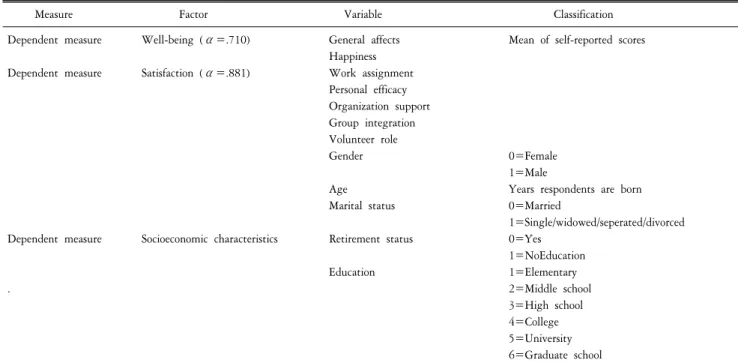
Table 1. Description of variables.
Measure Factor Variable Classification
Dependent measure Well-being (α=.710) General affects Mean of self-reported scores Happiness
Dependent measure Satisfaction (α=.881) Work assignment Personal efficacy Organization support Group integration Volunteer role
Gender 0=Female
1=Male
Age Years respondents are born
Marital status 0=Married
1=Single/widowed/seperated/divorced Dependent measure Socioeconomic characteristics Retirement status 0=Yes
1=NoEducation
Education 1=Elementary
. 2=Middle school
3=High school 4=College 5=University 6=Graduate school 4. Survey
The survey was paper-based and self-administered survey using a 5 point Likert scale that was anonymous and was conducted with participants after consent was given. Data collection was completed by the trained research team members. The data collectors informed that participants might decide to leave the study at any time without penalty or loss of benefits to which you might otherwise had been entitled. The survey consisted of 20 minutes questionnaires asking about 1) personal background information about age, educational background, marital status, retirement status, income and family background; 2) volunteer experience about number of volunteering hours, number of orien- tation/ training, frequency of contact with staff, and field of volunteering; 3) 4) The Volunteer Satisfaction Index (VII) to measure volunteer satisfaction including work assignment, personal efficacy, organizational support, group integration and volunteer role satisfaction (30 items) (Table 1).
The questionnaires was translated English into Korean based on finding similar validated instruments in Korean. To test ter- minology, applicability and comprehension of quantitative ques- tionnaires in order to develop a valid survey instrument for Korean older volunteers; 1) 10 MSW level students from depart-
ment of Social Work, Kangnam University, and 2) 15 older volunteers aged 55 and older from Seoul Volunteer Center. Given high internal consistency among items in each 6 standardized scale, this study summed them to a total score for the regression analyses (ranging from .645 to .945). The alpha reliabilities of all six standardized scale for 274 older Korean volunteers were acceptable.
5. Measurement
1) Dependent variable: There was one dependent varia- ble, well-being status in late life (WELL-BEING).
(1) Index of well-being: The Index of Well-being is a
two-part measure of self-reported well-being with life, developed
by Campbell(1976). The 9-item Index of Well-being is composed
of an Index of General Affect (8 items) and Life Satisfaction (1
item). Much research exists that supports the claim that the Index
of Well-being has adequate reliability. The eight items in the
Index of General Affect had internal consistency of .89 in the
sample of 1,977 employees, and correlated .55 with the life
satisfaction item. And, test-retest reliability correlations for 285
respondents about eight months later were .43, especially .56
only for reliability of the Index of General Affect (Near et al.,
1984).
Table 2. Socioeconomic characteristics.
Variable Frequency Percentage (%)
Age (n=267)
45∼54 114 41.6
55∼64 91 36.1
65∼74 41 15
75+ 13 4.7
Gender (n=274)
Female 236 86.1
Male 38 13.9
Marital status (n=273)
Married 228 83.2
Single/widowed/separated/divorced 45 16.5
Education (n=244)
Elementary school 12 4.4
Middle school 18 6.6
High school 72 26.3
2-year college 68 24.8
4-year college 50 18.2
Graduate school 24 8.8
Retirement status (n=200)
Fully retired 123 44.9
Partially retired 77 28.1
Table 3. Volunteer information.
Mean Median SD Range
Length of total volunteering (month) (N=262) 86.82 60 85.408 4∼540
7 yrs 2 mths 5 yrs 7 yrs 1 mth 4 mths∼45 yrs
Hours of volunteering in a month (N=247) 21.86 12 26.485 1∼200
Number receiving an orientation (N=166) 4.62 3 4.545 0∼30
Number receiving training (N=163) 6.19 3 7.847 0∼50
Contact with volunteer coordinator (N=193) Frequency Percentage (%)
Rarely 12 4.4
Occasionally 13 4.7
Periodically 97 35.4
Frequently 51 18.6
Often 20 7.3
(2) Volunteer Satisfaction Index (VSI): The Volunteer Satisfaction Index developed by Payne et al.(1974) is a 30 items survey used to measure the satisfaction of the volunteering experience. The VSI taps into dimensions dealing with work assignment, personal efficacy, organizational support, group integration, and volunteer role satisfaction. The original VSI used a five-point Likert scale of “very satisfied” to “very dissatisfied.”
The Volunteer Satisfaction Index developed by Payne et al.(1974) has been found to predict elderly volunteer’s satisfaction as it
relates to agency support of the volunteer, participation efficacy achieved as a result of volunteering, and recognition in the volunteer role recognition received as a result of the volunteer role among RSVP elderly volunteers in one longitudinal study (Payne et al., 1974). Because elderly volunteers are to be the targeted population and the VSI has been used for the population, the researcher proceeded with the VSI developed by Payne et al.(1974) even though there is a lack of existence of reliability and validity.
6. Data analysis
Statistical analyses were done using the Statistical Package for the Social Sciences (SPSS). Descriptive analyses were conducted to examine demographic characteristics of the sample of older volun- teers. Correlation analysis was constructed among six variables in the regression model. The hypothesized multiple regression model was assessed to explore the determinants of volunteer satisfaction among older volunteers to have an effect on well-being status in their later life.
RESULTS
1. Characteristics of the volunteers and the volunteer experience
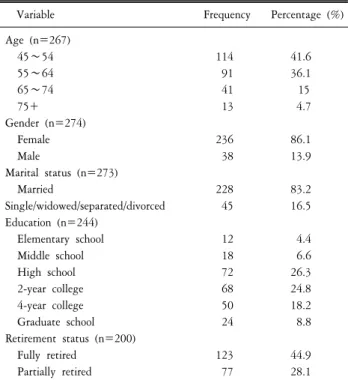
A shown in Table 2, Average ages of total respondents is around 57 years old, ranging from 45 to 84 years old, 86.1%
female, 83.5% married, 26.3% holding the high school degree,
45% being fully retired, and 21.86 hours volunteering in a
month averaged. In terms of volunteer experience among respon-
Table 4. Mean distribution among variables.
Well-being M±SD
General affects 3.95±.67
Happiness 3.84±1.00
Volunteering satisfaction factors M±SD
Work assignment 3.62±.68
Personal efficacy 3.24±.70
Organization support 3.26±.69
Group integration 3.31±.70
Volunteer role 3.53±.59
Table 5. Correlation analysis among variables.
Dependent variable volunteer’s well-being
Independent variables
volunteer satisfaction factors
Well-being Work assignment Personal efficacy Organization support Group integration
Work assignment .54
aPersonal efficacy .41
a.69
aOrganization support .27
a.57
a.65
aGroup integration .36
a.62
a.81
a.61
aVolunteer role .42
a.58
a.46
a.35
a.47
aa
p<.01.
dents by an in Table 3, there was large variation in the intensity of volunteering. Older volunteers, on average, contributed seven years two month in their entire life and 21.86 hours per month.
The average number of orientation that respondents participated in current volunteer position was around five. Most volunteer reported that they periodically contact with their volunteer coordinator in current agency. Respondents participated in a wide range of volunteer program. Approximately half of respondents were involved in community services (51.1 percent) and elderly services (48.9 percent) (Table 3).
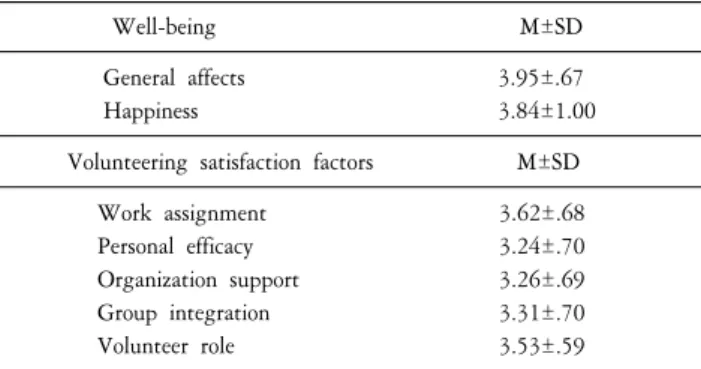
2. Mean distribution among variables
As presented in Table 4, the mean distribution of well-being ranged from 3.84 to 3.97, using 5 point Likert scale, indicated slightly higher mean values among variables (M=3.56, SD=.52).
In terms of volunteer satisfaction factors, the respondents reported higher mean distribution of satisfaction factors than mean value among variables, such as work assignment and volunteer roles under satisfaction (3.62 and 3.53 relatively). However, the mean value of personal efficacy, organizational support and group in-
tegration were lower than the mean value among variables (3.24, 3.26, and 3.31 relatively).
3. Correlation analysis
Table 5 presented the correlation matrix for five variables in regression model. The variable of well-being was comparatively highly correlated with work assignment (r=.54**). In terms of correlation among independent variables, personal efficacy and group integration (r=.81**) was highly correlated. Two variables are free from the multicollinearity problem if the VIF is less than 10.00 (Kim DS et al., 2000). This study could use both variables of group integration and personal efficacy in the regression models since the VIF for the two variables was 1.00, even though the correlation of two variables was as high as .81.
4. Regression analysis
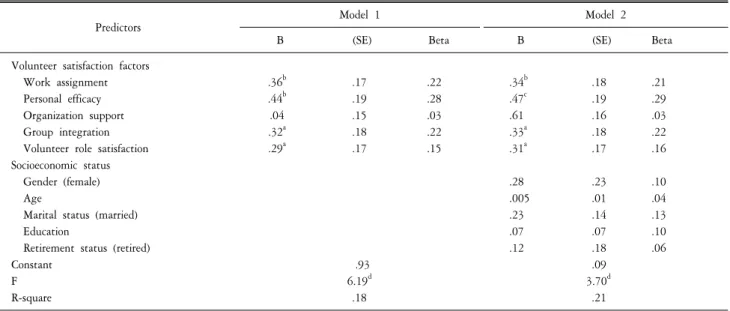
In this regression analysis, series of multiple regression analyses were conducted to explore the finding the best set of explanatory variables by adding socioeconomic status variables. As presented in Table 6, the value of R in model 1 is .18, means 18 percent of explanation between well-being and volunteer satisfaction factors in this regression model. In model 2, the R
2value increased 21 percent by adding socioeconomic status variables that found more powerful model in this regression procedure.
Model1:
WELLBEING=.93
+(.36*)(WORKASSIGNMENT)
+(.44*)(PER-
SONALEFFICACY)
+(.04)(ORGANIZATIONSUPPORT)
+(.32)
(GROUPINTEGRATION)
+(.29)(ROLESATISFACTION)
+e
Table 6. Regression models.
Predictors Model 1 Model 2
B (SE) Beta B (SE) Beta
Volunteer satisfaction factors
Work assignment .36
b.17 .22 .34
b.18 .21
Personal efficacy .44
b.19 .28 .47
c.19 .29
Organization support .04 .15 .03 .61 .16 .03
Group integration .32
a.18 .22 .33
a.18 .22
Volunteer role satisfaction .29
a.17 .15 .31
a.17 .16
Socioeconomic status
Gender (female) .28 .23 .10
Age .005 .01 .04
Marital status (married) .23 .14 .13
Education .07 .07 .10
Retirement status (retired) .12 .18 .06
Constant .93 .09
F 6.19
d3.70
dR-square .18 .21
a