Recognition of body image and food behavior factors among middle school students in San Francisco area
Jung-Hyun Kim
§Department of Home Economics Education, PaiChai University. Deajeon 302-735, Korea
Received January 30, 2007; Revised March 10, 2007; Accepted March 20, 2007
Abstract
The purpose of this study was to determine the recognition of body image and food behavior factors according to the BMI. The subjects of this study were 242 7th grade students resided in San Francisco area. The degree of recognition for self-estimated physique of subjects by gender and by race showed no significant differences by gender but significant differences by race, showing that 20.0% was considered as underweight in Asian and 7.5% was considered as underweight in White students. This showed the same tendency as actual physique status (BMI). Also, the ratio of being recognized as more than overweight was 17.3% in Asian, 23.3% in Hispanic, and 13.4% in White students. In case of female students, the ratio of dieting experience was 63.3%, and 49.3% of White students and 63.3% of Hispanic students experienced dieting. In case of students answered not healthy, their body weight were significantly higher than those answered as healthy, and the BMI was also over 19, showing significant differences. Thus cases that answered as not healthy had greater body weight and BMI. Also it showed that frequent dieting experience is related to higher height and weight. The analysis of food behavior factors perceived by body shape showed that the group perceived itself as overweight consumed more ‘fast food’ but had low scores in ‘vegetables’ intake, with frequent intake of ‘soda’ and tendency to ‘overeat’. Also, the tendency for ‘balanced life’ was significantly lower and for skipping breakfast was significantly higher, suggesting problematic food behavior.
Key Words: Recognition of body image, food behavior, middle school student
Introduction
*Adolescence is a period with the secondary growth spur in the life cycle, during which the number of fat cells is actively increased and the body shape is changed due to hormonal action (Choi et al., 1997; Kim et al., 1998; Won et al., 2000), in addition to the development of reproductive functions. Thus proper nutritional management is very important because the deve- lopment and maturity of physical, mental, and social health during this period directly influence the health status of adulthood (Edwards et al., 1964; Ryu, 1997; Yoon et al., 1992). Further- more, this is the time when the value is firmly established, and the behavior for foods established in this period has been reported to significantly affect the food behavior after the adulthood (Ryu, 1997; Won et al., 2000).
Balanced meal through healthy and rational eating habits is very important in the growth, development and health impro- vement in humans, and this is not accomplished by appetite or food preference but can be accomplished by the practice of proper dietary habits on the basis of proper nutrition knowledge. The preference for eating habits or foods in humans is established by the influences from socioeconomic level of household, religion, tradition, regional characteristics, education level of
parents, public media, and long-term education at home, school, and the society.
Adolescents have increased interests in their appearances due to psychological and social factors, and greatly influenced by various informative media and particularly peer groups. Recently, adolescents have recognized themselves with distorted perception depending on the subjective standard on the body image due to social pressure for slim and thin appearance, and tried reckless and unreal approaches for weight control. It has been reported that many adolescents have fear for obesity regardless of their body weights, and excessive concerns for obesity can induce underweight and be harmful to health (Lee et al., 1996; Must et al., 1992).
The growth rates of adolescents have been continuously increased around the world but the imbalance of undernutrition and overnutrition exists and thus the incidence of anemia due to malnutrition and the incidences of juvenile obesity, diabetes, and chronic diseases due to overnutrition have been increased (Epstein et al., 1985; Epstein et al., 1990; Gortmaker & Dietz, 1987). To solve these problems, as reported in previous studies (Her et al., 1999; Kang et al., 1997; Lee et al., 1997; Lee et al., 2000; Schwars, 1975; Sweeney, 1993), it is important to understand the optimal level of nutrition as healthy status that
§Corresponding Author: Jung-Hyun Kim, Tel. 82-42-520-5424, Fax. 82-42-52-5421, Email. [email protected]
can lead productive life with socially and economically proper values. Also, it has been reported that the organized and scientific investigation for actual condition and the extension of positive and active nutrition education at the national level are imperative to minimize the presence of nutritionally vulnerable groups.
In advanced western countries since 1970s, the preference for thin physique has been excessively spread out in some groups with high interests in physical appearance, and the body image of an individual can affect the motive for weight control and thus poorly perceived body image can show improper weight control pattern (Kang et al., 1997; Must et al., 1992; Schwarz, 1975). Factors affecting distorted body image include gender, age, race, and body weight. Adolescence is a period when the interest for appearance, particularly body shape, is greatly increased and thus distorted body image and excessive obsession for dieting can affect nutritional intake and induce eating dis- orders not only to threaten health but also to cause mental and psychological complications. The degree of satisfaction for body shape and weight control in adolescents can affect their nutri- tional intake and food behavior and thus should be carefully handled along with food behavior and nutritional intake.
According to the studies reported in the USA (Schwarz, 1975;
Sweeney et al., 1993), children who skipped their breakfast were much more aggressive than those who had breakfast, and the study by Ro (1998) reported that high school students with irregular daily meal patterns had poorer health status and lower academic achievements than those who had regular meals. In Korea, increased rate of eating out, fast-food consumption, and over consumption of sweets and carbonated beverages have increased the adolescent obese population, which has led to the incidence of chronic diseases such as diabetes, hypertension, and arteriosclerosis, and the adolescents want to become slim and the obese shape can be excluded in the peer group because of great interests in appearance and body weight, resulting in psychologically bad influence on character formation (Ro, 1998;
Ro, 2000; You et al., 1997). As the preference for thin body shape has been increased in the society, the number of adolescents, while thinking they are obese or overweight, who are skipping meals or practicing irregular meals and unbalanced diet to recklessly reduce their body weights has been increased although the actual body weight is normal, and this situation can induce bad influence on health and lead to nutritional imbalance. Therefore, the necessity for proper recognition of one’s own physique, desirable eating habits, and nutrition education is imperative to establish the proper food behavior during the period of adolescence. However, the importance of nutrition in adolescence with active physical and mental development should be emphasized. Thus, although the necessity for studies on nutritional knowledge, body image recognition, and food behavior in adolescents is urgent, actual studies for teens are greatly limited.
Good nutritional status in adolescents is decided by proper nutritional knowledge, eating habits, and food behavior, which
plays an important role not only in the improvement of physical development but also in the maintenance of mental and emotional stabilization. On the other hand, if the growth and development is delayed and becomes difficult to recover because of malnutri- tion due to poor eating habits and food behavior during this period, balanced nutrition intake in adolescents should be emphasized to promote the most growth during adolescence.
Therefore, it is considered that multi-faceted measures are imperatively needed to manage proper dietary life and to establish desirable eating habits in adolescents with nutritional imbalance.
Thus, the study was performed in middle school students resided in San Francisco to investigate how they recognized their body image by gender and by race, and whether they had weight control experience, and their food behavior were examined and compared by gender and by race. Through the results of this study, the basic data will be provided for the comparative analysis with students in Korea in the future.
Subjects and Methods
Subjects
The subjects of this study were 242 7th grade students consisted of 111 male and 131 female middle school students resided in San. Francisco Area of the U.S.A. This survey was conducted at classes for the cook and language art using a self-administered questionnaire.
Questionnaire
The questionnaire used in this study was developed by referring those of the previous studies (Choi et al., 1997; Kim et al., 1998), and by modifying and complementing it through the verification of validity in the preliminary study. The preliminary survey was performed (March 7~15, 2006) and the main survey was performed (May 8~20, 2006) after collecting, modifying, and complementing the results of preliminary survey. A total of 300 survey questionnaires was distributed and 242 (111 males, 131 females) was used in this study except those data inappropriate to this survey among collected survey questionnaire.
1) General characteristics: Questionnaire items included in general characteristics were sex (gender) and birth place (country). The race (American Indian, Native Asian, African American, Hispanic, Native Hawaiian, White, European, Others) of subjects were investigated
2) Body image: The height and weight of subjects were
investigated, which was first collected as the measurement unit
used in the USA, feet/inch and lb, and then from which the BMI
was calculated for using as a general physical index in middle
school students. BMI is a reliable indicator of body fatness for
most children and teens. Subjects were divided into 3 groups
by BMI based on CDC BMI-for-age growth charts for girls and
Table 1. The Questionnaire on food behavior Food Behavior 1. I always enjoy eating.
2. It takes long time to eat dinner at my house.
3. I have many kinds of foods at every meals.
4. I am interested in eating.
5. I eat fast food everyday.
6. I eat some vegetables every day.
7. I eat some meat every day.
8. I eat some fat (oily foods) every day.
9. I eat some dairy products every day.
10. I eat some sweets every day.
11. I take some vitamins (supplementations) every day.
12. I eat some instant foods every day.
13. I drink some soda every day.
14. I have a tendency to overeat.
15. I have 3 meals a day regularly.
16. I eat out at least 3 times a week
17. I think my diet is closely related to my health.
18. I always tried to do my nutritional knowledge.
19. I live a balanced life as study, exercise, meal and rest.
20. I have a tendency to skip breakfast every day.
Table 3. Height, weight, and BMI of the subjects (n=242)
Variables Height (inch) Weight (lb) BMI1)
Sex Boy (n=111) 61.7 ± 3.8 100.1 ± 21.9 18.4 ± 3.1 Girl (n=131) 61.4 ± 3.4 97.3 ± 18.9 18.1 ± 2.8
Race*2)
White (n=60) 61.9 ± 4.2 102.2 ± 22.4b 18.7 ± 2.9ab Asian 60.9 ± 3.0 94.1 ± 18.2a 17.8 ± 2.7a Hispanic 61.6 ± 3.1 104.2 ± 19.1b 19.3 ± 3.1b Others 61.7 ± 3.6 97.4 ± 19.9ab 17.9 ± 2.8a
Total 61.5 ± 3.6 109.1 ± 26.0 18.2 ± 2.9
*p<0.05.
a,b: significantly different by Duncan’s multiple range test at α=0.05.
1) BMI(Body Mass Index) = Weight(Kg)/Height(m)2.
2) Significant difference in Weight and BMI according to Race.
Table 2. Geral characteristics of the subjects
Variables No. %
Sex Boy 111 45.9
Girl 131 54.1
Birthplace U.S.A 194 80.2
Others 48 19.8
Race
White 67 27.7
Asian 75 31.0
Hispanic 30 12.4
Others 70 28.9
Total 242 100.0
boys (Maiz et al., 2002). BMI is used as a screening tool to identify possible weight problems for children. For teens, BMI is used to screen for overweight (equal to or greater than the 90th percentile and including at risk of overweight (85
thto less than the 95
thpercentile)), healthy weight (5
thpercentile to less than the 85
thpercentile) or underweight (less than the 5
thpercentile). Also, the degree of recognition for self estimated body image was investigated as well as objectively assessed physical status ; as being underweight, healthyweight, overweight.
3) Food behavior factors
(a) Food behavior: Food behavior were investigated by translating the survey tools (Choi et al., 1997; Kim et al., 1998) used in the preliminary studies in the country and modifying it to the actual circumstances in the USA, for the comparative analysis with middle school students in Korea in the future. It was constructed with 20 questions, among which 8 questions were those generated reversely. Questionnaire included the amount of foods consumed in breakfast, lunch, dinner, and snacks, and food behavior of snacking, eating out, and overeating, and the regularity of meal time, skipping meals, over consumption in dinner, eating speed, and the balance of food intake, which were answered as always (5 points), often (3 points), never (0 point) (Table 1).
(b) Weight control factor: As for weight control related factors, the experience of weight control through dieting was surveyed and the currently recognized status of their physique was also investigated. In addition, the degree of satisfaction for their physique was asked to find out how they felt their physique as perceived by themselves.
Statistical Analysis
The survey data were statistically analyzed using SPSS Win 10.0. For Collected data, frequency and percentage by sex and race were obtained and then the independence was verified by x2-test using Cross tabulation analysis. For qualitative variables, the mean and standard deviation were presented, and t-test and ANOVA were performed.
Results
General characteristics
Subjects in this study were 111 male students (45.9%) and 131 female students (54.1%), among which 80.2% was born and have grown in the USA. The distribution by race was shown mainly as White (27.7%) and Asian (31.0%), and then Hispanic (12.4%) and others (under 5% race) including European, African American and other races (28.9%).
The recognition of body image
The height and weight recorded by subjects showed no
difference by sex, and the overall average for height was 61.5 ± 3.6
inch and for weight was 109.1 ± 26.0 lb to produce BMI as
18.2 ± 2.9 (Table 3). It was considered that such results were
obtained because of relatively high ratio of Asian among subjects,
Table 4. Self-estimation on body image by sex n(%)
Sex Underweight Normal Overweight Total
Boy 15(13.8) 80(62.7) 15(17.3) 111(100.0)
Girl 14(10.7) 90(68.7) 27(20.6) 131(100.0)
Total 29(100.0) 172(100.0) 41(100.0) 242(100.0) x2 = 2.761, df = 2, NS (Not Significant)
Table 5. Physique status(BMI) by race n(%)
Race Underweight Normal Overweight Total
Asian 15(20.0) 47(62.7) 13(17.3) 75(100.0)
Hispanic 3(0.0) 20(76.7) 7(23.3) 30(100.0)
White 10(7.5) 53(79.1) 9(13.4) 67(100.0)
Others 9(12.9) 49(70.0) 12(17.1) 70(100.0)
Total 29(100.0) 172(100.0) 41(100.0) 242(100.0) x2 = 22.910, df = 3, p<0.05
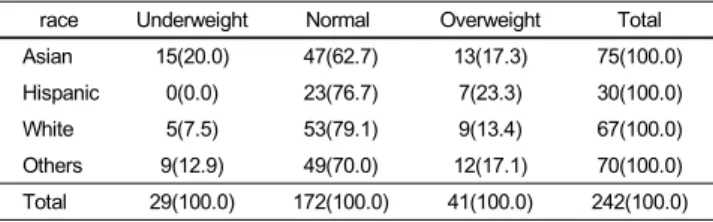
Table 6. Self-estimation on body image by race n(%)
race Underweight Normal Overweight Total
Asian 15(20.0) 47(62.7) 13(17.3) 75(100.0)
Hispanic 0(0.0) 23(76.7) 7(23.3) 30(100.0)
White 5(7.5) 53(79.1) 9(13.4) 67(100.0)
Others 9(12.9) 49(70.0) 12(17.1) 70(100.0)
Total 29(100.0) 172(100.0) 41(100.0) 242(100.0) x2 = 11.520, df = 6, p<0.05
Table 7. Experience of dieting by sex n(%)
Never 1~2times over 3times Total
Boy 71(72.0) 23(18.7) 14(9.3) 75(100.0)
Girl 65(36.7) 42(46.7) 22(16.7) 90(100.0)
Total 137(100.0) 65(100.0) 40(100.0) 242(100.0) x2 = 18.858, df = 6, p<0.05
Table 8. Experience of dieting by race n(%)
Never 1~2times Over 3 times Total
Asian 54(72.0) 14(18.7) 7(9.3) 75(100.0)
Hispanic 11(36.7) 14(46.7) 5(16.7) 90(100.0)
White 34(50.7) 20(29.9) 13(19.4) 67(100.0)
Others 38(54.3) 17(24.3) 15(27.4) 70(100.0)
Total 137(100.0) 65(100.0) 40(100.0) 242(100.0) x2 = 16.073, df = 6, p<0.05
Table 9. Height, weight, and BMI according to the experience of dieting Experience Never 1~2 time 3~5 times over 6 times
Height* 61.1 ± 13.6a 61.8 ± 3.4ab 61.8 ± 3.2ab 63.0 ± 3.7b Weight** 93.2 ± 18.1a 104.8 ± 20.2bc 101.2 ± 23.2ab 112.6 ± 20.0c BMI** 17.5 ± 2.6a 19.2 ± 2.8b 18.6 ± 3.6ab 28.0 ± 3.3b Mean ± S.D.
*p<0.05 **p<0.0001
a,b,c: Different superscript letters mean significant difference among groups by Duncan's multiple range test at α=0.05
which was supported by analytical results by race. According to the analysis by race, in case of height, Asian students were relatively smaller than other students of different races. In cases of body weight and BMI, there were significant differences among races (p<0.05). That is, Hispanic students showed the greatest body weight and BMI, and then came White students.
On the other hand, Asian and other races were analyzed as having less than 100 lb of weight and less than 18 of BMI, showing significant difference.
The degree of recognition for self-estimation on their physique status by subjects themselves was examined. The results, as shown in Table 4, showed no significant differences by sex.
The analysis of physique status based on BMI by race (Table 5) showed that, in case of Asian, 20.0% was considered as underweight and in case of Hispanic, none was considered as underweight, and in case of White, 7.5% was considered as underweight, showing significant differences. This showed the same tendency as actual physical indexes. Also, the ratio of being recognized as more than overweight was 17.3% in Asian, 23.3%
in Hispanic, and 13.4% in White students (Table 6).
Dieting experience
The experience and frequency of dieting in subjects were investigated. The results showed significant differences by sex and by race. As presented in Table 7, the ratio of female students with dieting experience was 63.3%, among which 16.7% had more than 3 times of experience.
In the results of dieting experience by race, 49.3% of White students and 63.3% of Hispanic students experienced dieting, and 27.4% of students of other races experienced more than 3 times of dieting.
Also, the relation between physical indexes and dieting experience showed that more dieting experience was related to higher height and weight. In particular, students with body weight of over 100 lb had dieting experiences and this tendency showed that students had higher weight as the frequency of dieting experience increased. The average weight of students with more than 6 times of dieting was 112.6 ± 20.0 lb and the average BMI was 28.0 ± 3.3. These results showed that the dieting in middle school students, although it had differences by race, were serious nutritional problems.
Food behavior factors
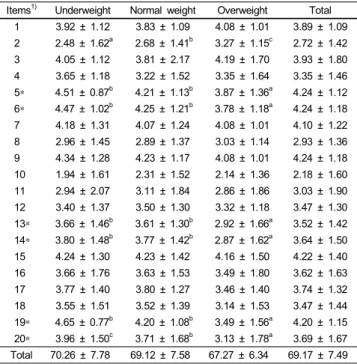
For food behavior of subjects, each 20 questions and overall evaluation were performed. Also, food behavior by body image (self-estimation on their physique status) were analyzed (Table 10). The results showed that the food behavior of overall problems were ‘It takes long time to eat dinner at my house’,
‘I eat some fat food everyday’, ‘I eat some sweets everyday’, and ‘I take some vitamins everyday’.
This phenomenon was analyzed by body image (self-estimation
on their physique status) and the results with significant
differences included as follows: the group perceived itself as
overweight consumed more fast food but had low scores in
Table 10. Food behavior by the self estimation on body image Items1) Underweight Normal weight Overweight Total
1 3.92 ± 1.12 3.83 ± 1.09 4.08 ± 1.01 3.89 ± 1.09 2 2.48 ± 1.62a 2.68 ± 1.41b 3.27 ± 1.15c 2.72 ± 1.42 3 4.05 ± 1.12 3.81 ± 2.17 4.19 ± 1.70 3.93 ± 1.80 4 3.65 ± 1.18 3.22 ± 1.52 3.35 ± 1.64 3.35 ± 1.46 5* 4.51 ± 0.87b 4.21 ± 1.13b 3.87 ± 1.36a 4.24 ± 1.12 6* 4.47 ± 1.02b 4.25 ± 1.21b 3.78 ± 1.18a 4.24 ± 1.18 7 4.18 ± 1.31 4.07 ± 1.24 4.08 ± 1.01 4.10 ± 1.22 8 2.96 ± 1.45 2.89 ± 1.37 3.03 ± 1.14 2.93 ± 1.36 9 4.34 ± 1.28 4.23 ± 1.17 4.08 ± 1.01 4.24 ± 1.18 10 1.94 ± 1.61 2.31 ± 1.52 2.14 ± 1.36 2.18 ± 1.60 11 2.94 ± 2.07 3.11 ± 1.84 2.86 ± 1.86 3.03 ± 1.90 12 3.40 ± 1.37 3.50 ± 1.30 3.32 ± 1.18 3.47 ± 1.30 13* 3.66 ± 1.46b 3.61 ± 1.30b 2.92 ± 1.66a 3.52 ± 1.42 14* 3.80 ± 1.48b 3.77 ± 1.42b 2.87 ± 1.62a 3.64 ± 1.50 15 4.24 ± 1.30 4.23 ± 1.42 4.16 ± 1.50 4.22 ± 1.40 16 3.66 ± 1.76 3.63 ± 1.53 3.49 ± 1.80 3.62 ± 1.63 17 3.77 ± 1.40 3.80 ± 1.27 3.46 ± 1.40 3.74 ± 1.32 18 3.55 ± 1.51 3.52 ± 1.39 3.14 ± 1.53 3.47 ± 1.44 19* 4.65 ± 0.77b 4.20 ± 1.08b 3.49 ± 1.56a 4.20 ± 1.15 20* 3.96 ± 1.50c 3.71 ± 1.68b 3.13 ± 1.78a 3.69 ± 1.67 Total 70.26 ± 7.78 69.12 ± 7.58 67.27 ± 6.34 69.17 ± 7.49
1)Questions on food behavior(Table 1) Mean ± S.D.
*p<0.05
a,b,c
: Different superscript letters mean significant difference among groups by Duncan's multiple range test at α=0.05
‘vegetables’ intake, with frequent intake of ‘soda’ and tendency to ‘overeat’. Also, the tendency for ‘balanced life’ was significantly lower and for skipping breakfast was significantly higher (p<.05).
Discussion
We evaluated height, weight, and BMI and self-estimation on their physique to investigate the degree of recognition of body image by sex and by race. It showed that there was no significant difference by sex in their self-estimation on their physique.
However there was a significant difference by race (p<0.05), and in case of Asian, 20.0% was considered as underweight and in case of Hispanic, none was considered as underweight, and in case of White, 7.5% was considered as underweight, showing significant differences. This showed the same tendency as actual physical indexes (p<0.05). Also, the ratio of being recognized as more than overweight was 17.3% in Asian, 23.3% in Hispanic, and 13.4% in White students.
These results were consistent with other previous studies in Korea. In studies with teenagers in Korea (Kim & Moon, 2001;
Ro, 2000), about half of female students wanted to be slightly underweight, and considerable number of female students recognized themselves as obese despite that they were not obese.
In addition, in the study of recognition for physical status in middle school students, higher ratio of students answered as slightly obese, and female students recognized themselves as more obese compared to male students and most female students
preferred underweight. It is considered that this phenomenon can promote weight reduction in the process of copying popular celebrities appeared in TV commercials and broadcasting, resulting in negative influence on food behaviors of growing adolescents.
Recently, young women and adolescents in our society tend to reduce their body weights recklessly with wrong perception that thinner is more beautiful. Also, many adolescents have wrong body image and poor eating habits with the obsession to appearance and bodyweight without knowing the standard of normal weight (Ryu, 1997). Therefore, eating disorders such as anorexia and bulimia in this age group have been gradually increased (Kang & Paik, 1988; Kim & Moon, 2001; Kim et al., 2000). This phenomenon shows that wrong perception for desirable body shape has greatly influenced food behavior or eating habits, and weight control.
Overweight and obesity have been recognized as common nutritional problems in the western society (Sweeney et al., 1993), and the frequency for overweight has been greatly increased along with changes in the lifestyle due to improved economic standard in Korea (Yoon et al., 1992). Moreover, the age when the obesity develops has been gradually lowered and the incidence of childhood obesity has been increased (Woo et al., 1986). Childhood obesity has high incidence in infancy and school children, and particularly pre-adolescence and adole- scence, and 60~80% of childhood obesity has been led to adult obesity, and 1/3 of adult obesity has been reported as being developed between school children and adolescence, suggesting the importance of health management (Must et al., 1992). In particular, adolescence is not only a period of rapid growth and development but also a period with changes in the body shape due to hormonal action, and thus health management is very important. However in our country, factors leading to obesity include overeating due to psychological instability and the lack of exercise due to excessive school works (Lee et al., 1998).
Adolescence is a period of rapid physical, physiological, and emotional changes, when dietary habits are established and those established dietary habits are fixed. Also, this is a period when adolescents become more interested in their appearance due to psychological and social factors, and when undesirable food behavior such as unbalanced diet, skipping meals, imbalanced food intake, and preference for instant foods tend to appear (Kwon et al., 2001; Lee et al., 1998). In addition, in case of adolescents in these days who sensitively receive the influence of information media and advertisements, it is greatly concerned that they become interested in their appearance and try wrong approach in the aspect of body weight and body shape to cause malnutrition. Thus the health problems of adolescents nowadays have undernutrition along with overnutrition coexisted.
In summary, there was a significant difference by race (p<0.05)
in their self-estimation on their physique (p<0.05). This showed
the same tendency as actual physical indexes (p<0.05). The
analysis for dieting experience and its frequency showed
significant differences by sex and by race. In case of female students, the ratio of dieting experience was 63.3%, and 49.3%
of white students and 63.3% of hispanic students experienced dieting, and 27.4% of students of other races experienced more than 3 times of dieting. The analysis of food behavior perceived by body image showed that the group perceived itself as obese consumed more fast food but had low scores in ‘vegetables’
intake, with frequent intake of ‘soda’ and tendency to ‘overeat’.
Also, the tendency for ‘balanced life’ was significantly lower and for skipping breakfast was significantly higher.
Adolescents in these days who are influenced by advanced western countries can complain about their rapidly changing bodies, and at the same time, want to become their perfect peers or cultural icons because they are affected by external factors (Kim et al., 1997). Adolescents in Korea, as well as those in advanced western countries, prefer and copy the appearance in the frame of mass media, and try to change their appearance and to manipulate their food behavior, and respond impulsively to the propaganda of commercial advertisement.
Therefore, the results of this study suggest that nutritional management which is different from that for adults should be provided considering that the adolescence is a period with rapid growth compared to other life cycle, and particularly in case of female students, it is necessary to correct distorted viewpoint for obesity and to establish positive attitude. Thus it is suggested that the development of effective nutritional education program for middle school students is needed to help them recognize desirable body weight and establish proper eating habits and food behavior through proper nutritional education.
Literature cited
Choi JH, Kim JH, Lee MJ, Moon SJ, Lee SI & Baek NS (1997).
An ecological analysis of iron status of middle school students in Seoul. Korean Journal of Nutrition 30:960-975.
Edwards CH, Hogan G, Spahr S & Gufldford (1964). Country Nutrition Committee Nutrition survey of 6200 teen-age youth. J Am Diet Assoc 45:543-550.
Epstein LH, Valoski A, Wing RR & McCurley J (1990). Ten-year follow-up of behavioral, family-based treatment for obese children.
JAMA 264:2519-2523.
Epstein LH, Wing RR, Valoski A (1985). Childhood obesity. Padiatr Clin North Am 32: 363-379.
Gortmaker SL & Dietz WH (1987). Increasing pediatric obesity in the United States. American Journal of Disease of Children 141:535-539.
Her ES, Lee KH, Jang DS, Lee KY, Lee JH, Ju J & Yoon SY (1999).
A study food habits, food behaviors and nutrition knowledge among obese children in Changwon(I). Journal of the Korean Dietetic Association 5:153-163.
Kang YJ, Hong CH & Hong YJ (1997). The prevalence of childhood and adolescent obesity over the last 18 years in Seoul. Korean Journal of Nutrition 30:832-839.
Kang YR & Paik HY (1998). A study on the etiology of children obesity. Korean Journal of Nutrition 21:283-294.
Kim EK, Lee AR, Kim JJ, Kim MH, Kim JS & Moon HK (2000).
The difference of biochemical status, dietary habits and dietary behaviors according to the obesity degree among obese children.
Journal of the Korean Dietetic Association 6:161-170.
Kim EK & Moon HK (2001). A comparison of the past physical growth, eating habits and dietary intake by obesity index of sixth grade primary school students in Seoul. Korean Journal of Community Nutrition 6:457-485.
Kim JH, Choi JH, Lee MJ & Moon SJ (1998). An ecological study on eating behavior of middle school students in Seoul. Korean Journal of Community Nutrition 3:292-307
Kwon WJ, Chang KJ & Kim SK (2001). Nutrition survey or female middle school students in urban and rural areas of Inchon. Korean Journal of community Nutrition 6:495-506.
Lee HS, Lee JA & Park JJ (1998). A study of food habits, physical status and related factors of college students in Chuncheon. Korean Journal of Community Nutrition 3:34-43.
Lee MS, Sung CJ, Sung MK, Choi MK, Lee YS & Cho Ko (2000).
A comparative study on food habits and nutrient intakes among high school students with different obesity indexes residing in Seoul and Kyunggi-do. Korean Journal of Community Nutrition 5:141-151.
Lee YN, Yim KS, LEE SK, Mo SM & Choi HM (1996). Diet-related fatctors of overweight adolescent girls. Korean Journal of Community Nutrition 1:354-365.
Mei Z, Grummer-Strawn LM, Pietrobelli A, Goulding A, Goran MI, Dietz WH (2002). Validity of body mass index compared with other body-composition screening indexes for the assessment of body fatness in children and adolescents. Am J Clin Nutr 978-985.
Must A, Jacques P, Dallal G, Bajema C & Dietz WH (1992).
Long-term morbidity and mortality of overweight adolescent a follow up of the Harvard Growth Study of 1935 to 1992. N Engl J Med 327:1350-1355.
Ro HK (1998). A study on eating habits and food consumption pattern among high school girls. Korean Journal of Dietary Culture 13:207-214.
Ro HK (2000). Comparisons of nutrient intakes, dietary behavior and perception about body image between adolescent boys and girls in rural area. Korean Journal of Community Nutrition 5:280-288.
Ryu HK (1997). A survey of adolescents’ concern and perception about body image. Korean Journal of Community Nutrition 2:330-140.
Schwarz NE (1975). Nutritional knowledge, attitudes, and practices of high school graduates. J Am Diet Assoc 66:28-36
Sweeney ME, Hill JO & Heller PA (1993). Severe vs moderate energy restriction with and without exercise in the treatment of obesity:efficiency of weight loss. Am J Clin Nutr 57:127- 134.
Won HS, Han SS, Oh SY, Kim HYP, Kim WK, Lee HS, Jang YA, Cho SS & Kim SH (2000). Guidelines of body mass index in Korean Childhood and adolescent obesity and relationship with physical strength. Korean Journal of Nutrition 33:241-249.
Woo MK, Hyun TS, Lee SY & Mo SM (1986). Study of ecology in food focused on breakfast of students and adults with professional occupations in the urban area. Korean Journal of Home Economics Education 24:103-118.
Yoon JS & Kim SY (1992). Effects of body fat distribution on percentage of body fat, serum insulin, lipids and energy intake in adult female. Korean Journal of Nutrition 25:617-627.
You JS, Choi YJ, Kim IS, Chang KJ & Chyun JH (1997). A study on prevalence of obesity, eating habits and life styles of 5th grade students in Inchon. Korean Journal of Community Nutrition 2:23-32.