http://www.medicinalcrop.org http://dx.doi.org/10.7783/KJMCS.2014.22.5.349
압출성형 공정에 따른 참당귀 추출물의 이화화적 특성
이희정*·정헌상*·박춘근**·이정훈**·박충범**·김종태***·최애진****†
*충북대학교 식품공학과, **농촌진흥청 국립원예특작과학원 인삼특작부,
***한국식품연구원 융합기술연구단, ****농촌진흥청 국립원예특작과학원 저장유통연구팀
Physiochemical Characteristics of Extruded Angelica gigas Nakai Depending on the Extrusion Processing Parameter
Hee Jung Lee*, Heon Sang Jeong*, Chun Geon Park**, Jeong Hoon Lee**, Chung Berm Park**, Chong Tai Kim*** and Ae Jin Choi****†
*Department of Food Science and Technology, Chungbuk National University, Cheongju 361-763, Korea.
**Ginseng Research Division, Department of Herbal Crop Research, NIHHS, RDA, Eumseong 369-873, Korea.
***Functional Materials Research Group, Korea Food Research Institute, Seongnam 463-746, Korea.
****Postharvest Research Team, NIHHS, RDA, Suwon 440-706, Korea.
ABSTRACT : This study was designed to maximize extract yields of functional components in Angelica gigas Nakai by extrusion process. In addition, the optimizing condition of the extrusion process was established to increase the extraction of the functional components in A. gigas. The total polyphenol was increased by 40% compared to a control. And the optimiz- ing condition was that the screw speed was 62.76 rpm, the amount of A. gigas powder was 34.79 ㎏/h, and the amount of water was 4.44 ㎏/h. The result of antioxidant activities of A. gigas extrusion, the inhibition of oxidization had the effect of 10.29 ~ 14.59% compared to a control. The content of decursin and decursinol angelate, which were index components, was 6.37%; it was increased by 16.64% compared to a control (5.31%) and showed a significantly difference (p < 0.05). And the optimizing condition was the screw speed 93.71 rpm, the amount of A. gigas powder was 28.67 ㎏/h, and the amount of water was 9.9 ㎏/h.
Key Words : Angelica gigas Nakai, Decursin, Decursinol Angelate, Extract, Extrusion
서 언
참당귀 (Angelica gigas Nakai)는 미나리과에 속하는 다년생 초본으로 참당귀, 승검초, 신감채라는 이름으로도 불리며, 강 원 평창, 인제, 홍천, 태백, 경북 봉화, 울진, 충북 제천, 단양, 전북 무주 등 각지의 해발 200-1500 m 되는 산골짜기의 습한 땅에서 자생한다 (Yu et al., 2007). 참당귀는 한방에서 빈혈 치료, 항균작용, 진정, 진통, 이뇨, 자궁기능조절, 비타민 E 결 핍증 치료, 혈액순환장애로 인한 어혈증과 혈전증, 반신불수 등에 처방되는 중요한 생약이다 (Ahn et al., 1995; Han et al., 1998; Kim et al., 1980; Matsumoto et al., 1998; Ye
et al., 2001). 현재 우리나라에서 유통되고 있는 당귀는 참당 귀, 일당귀 및 중국당귀의 3종이 있으며, 최근에는 중국에서 수입된 당귀가 많이 유통되고 있는 실정이다. 당귀는 대표적 인 보혈제의 원료로써 한국, 중국 및 일본에서 처방되는 한약 재중 하나이나 기원이 서로 상이한 것을 약으로 이용하고 있다. 국내산 참당귀가 중국당귀 및 일본당귀와 비교해 유용 성분 (decursin 및 decursinol angelate)이 더 많이 함유되어 있는 것으로 보고됨에 따라 우리나라에서 재배되고 있는 참당 귀가 주목받고 있으며 (Seong et al., 1993), 최근에는 친환경 유기질 비료를 이용한 참당귀 재배 등 수량 증대를 위한 다양 한 연구를 진행하고 있다 (Kim et al., 2014)
†
Corresponding author: (Phone) +82-31-240-3620 (E-mail) [email protected]
Received 2014 May 20 / 1st Revised 2014 May 28 / 2nd Revised 2014 June 17 / 3rd Revised 2014 June 30 / 4th Received 2014 July 8 / 5th Received 2014 July 15 / Accepted 2014 July 16
This is an open access article distributed under the terms of the Creative Commons Attribution Non-Commercial License (http://creativecom-
mons.org/licenses/by-nc/3.0/) which permits unrestricted non-commercial use, distribution, and reproduction in any medium, provided the original
work is properly cited.
참당귀의 효능으로는 진경작용, 혈압 강화 작용, 진통작용 (polyacetylene 계), 항 염증작용 (β-sitosterol-D-glucoside) (Cho et al., 1982), 항 acetylcholin작용 (phthalide계), 해열작용, 수 면 연장 작용, 혈소판 응집 억제 작용 (adenosine, ligustilide, butylphthalide) 이 보고되고 있으며, coumarin계의 decursin, decursinol, decursinol angelate, nodakenetin, nodakenin, umbelliferone, β-sitosterol, α-pinene, limonene 등이 함유되어 있다 (Kim et al., 2009, Hwang et al., 1997; Ryu et al., 1990). 참당귀는 생리활성과 면역력 증진, 고분자 용액 특성 및 식이섬유소 등과 같은 기능특성을 제공하기 때문에 기능성 식품소재로 이용되고 있다 (Kelly et al., 1999). 따라서 참당 귀 유용성분의 용출을 극대화시킬 수 있는 추출법이 확립되어 야 한다. 일반적으로 식물의 세포벽은 셀롤로오즈, 헤미셀룰로 오즈, 팩틴, 리그닌, 다당류 등의 고분자 물질로 구성되어 있 으며, 이들 각각의 성분들이 상호간에 이온결합, 공유결합, 수 소결합 등을 통해 서로 치밀한 결합 조직을 이루고 있다 (Kim et al., 2007).
따라서 참당귀 중 유용성분을 최대한 용출시키기 위해서는 참당귀를 구성하고 있는 세포벽의 강한 결합 조직을 약화시켜 용매에 의해 용출시키는 것이 좋다. 특히, 세포벽을 수용화시 키기 위해서는 압착법, 환류추출법과 가압추출법 등의 전통적 인 추출방법이 널리 이용되어 왔으나 이러한 방법은 수율이 낮고 작동비용이 많이 드는 문제점과 열에 민감한 성분은 분 해되기 쉬운 단점을 가지고 있다.
압출성형은 단일 공정으로 반죽, cooking, 성형 및 살균이 이루어져 노동력 및 시간 절약에 이점을 가지고 있어 스넥, 크래커, 및 씨리얼 등을 제조하는 식품산업에 많이 이용되고 있다. 압출성형 처리를 이용한 식물 세포벽의 수용화에 관한 연구는 주로 물성의 개선을 위한 것이었다. 압출성형처리 중 에 발생되는 고열, 고압, 고전단력에 의해 고밀도 조직이 팽화 하여 밀도가 낮아지고 내부에 기공이 형성되어 부드러운 조직 으로 되면서 표면적이 증가하여 용매와 이온 교환력이 향상되 고 용해도가 높아지고 유용성분의 확산 속도가 증가한다. 특 히 수용성 성분의 용출이 용이해져 각종 유용성분의 추출 수 율이 증가하는 것으로 보고되고 있다 (Kim et al., 1997, 2005a, b; Ha et al., 2005; Ryu et al., 2004, 2007; Yoon et al., 2005). 또한 밀기울을 압출성형 처리하여 조직의 결합 력을 이완시켜서 수용성 성분의 증가와 구조적 변화에 의해 관능성과 물성이 개선되는 효과가 있는 것으로 보고되고 있다 (Hwang et al., 1994).
따라서 본 연구는 참당귀의 유용성분 및 다당류의 추출 증 대를 위한 압출성형의 최적조건 구명과 압출성형 공정변수 (온 도, 수분함량, 스크류 속도)에 따른 기능성분과 수용성 추출물의 수율 및 이화학적 특성분석을 수행하였으며, 압출성형 공정 처 리를 하지 않은 대조구로 하여 항산화 성분을 측정 비교 하였다.
재료 및 방법
1. 연구 재료
본 실험에 사용된 참당귀 (Angelica gigas Nakai)는 2009 년 강원도 진부에서 GAP 표준재배지침서에 따라 재배생산된 것으로 시중에서 판매되고 있는 제품을 구입하여 동결 건조한 후 60 mesh 미분쇄하여 4℃에 보관하면서 실험하였다.
2. 압출성형물 제조
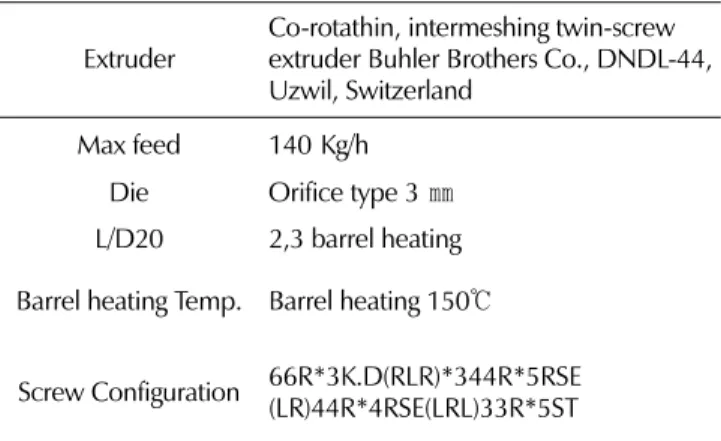
압출성형 참당귀 미분은 쌍축압출성형장치 (DNDL-44, Buhler Brothers Co., Uzill, Switzerland) 를 이용하여 지름이 3 ㎜인 원형 사출구 하나를 열어 압출성형 하였다 (Fig. 1).
강한 층 밀림을 유도하기 위해 3개의 역방향 스크류를 조합하 였으며 참당귀 분말을 일정하게 (140 ㎏/h) 투입하여 가수량을 변화시키며 압출성형 하였다. 이 때 바렐은 150℃ 고정하여 유지하였다. 식물의 세포벽 성분을 수용화하기 위해서는 강한 전단응력 및 마찰열을 필요로 하기 때문에 압출성형 조건을 Table 1 과 같이 설정하였다. 압출성형 시 온도와 압력을 측정 하고자 사출구와 스크류 전면사이에 열전대 및 변화기를 통하 여 압출성형 온도와 압력을 측정하였다. 요인변수에 따른 변화 양상은 압출온도와 기계적 소모 에너지 (Specific Mechanical
Table 1. Screw configuration and extrusion condition for Angelicagigas Nakai.
Extruder
Co-rotathin, intermeshing twin-screw extruder Buhler Brothers Co., DNDL-44, Uzwil, Switzerland
Max feed 140 Kg/h
Die Orifice type 3㎜ L/D20 2,3 barrel heating Barrel heating Temp. Barrel heating 150℃
Screw Configuration 66R*3K.D(RLR)*344R*5RSE (LR)44R*4RSE(LRL)33R*5ST
L; Length, D; Diameter, 66; Screw pitch, R; Right handed, 3; The number of screw, K.D; Kneading disk element, L; Left handed, RSE;
Reverse screw element, ST; Screw top.
Table 2. Levels of independent variables for central composite design.
Variables Levels
−1 0 1
Screw speed (X1) 40 60 80
Feed rate (X2) 30 35 40
Water (X3) 3.0 4.5 6.0
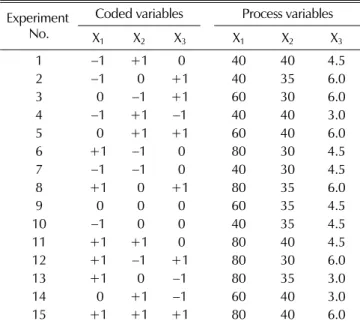
Energy Input, SME) 로 조사하였다. 또한 추출물의 특성을 최대 로 하는 추출조건을 설정하기 위해 반응표면분석법 (Response Surface Methodology, RSM) 을 사용하였다 (Gontard et al., 1992). 추출조건에 대한 실험계획은 중심합성계획 (Central composite design) 을 사용하였으며, 반응표면분석을 위해 SAS (Statistical Analysis System) 를 사용하였다. 실험계획은 Table 2 와 같이 추출공정에서 중요한 변수인 압출성형기의 스크류 속도 (40 ~ 80 rpm, X
1), 원료 투입량 (30 ~ 40 ㎏/h, X
2), 가 수량 (3.0 ~ 6.0 ㎏, X
3) 를 −1, 0, 1의 3단계로 부호화하여 중 심합성계획에 따라 Table 3과 같이 15구간으로 설정하여 추출 실험을 실시하였다. 또한 이들 요인변수에 의해 영향을 받는 종속변수 (Yn) 즉, 수율, 수분용해지수, 수분흡착지수, 총 폴리 페놀함량, 총 플라보노이드함량, DPPH 라디칼 소거능, ABTS
라디칼 소거능, decursin과 decursinol angelate 함량으로 하였 으며, 이들은 3회 반복 측정하여 그 평균값을 회귀분석에 사 용하였다.
3. 참당귀 압출성형물의 추출
참당귀 압출성형물의 이화학적 특성을 분석하기 위해 참당 귀 압출성형물 5 g을 고온 고압 추출장치 고압멸균기를 이용 하여 상온에서 95 mL 물을 가해 120℃에서 20분간 추출하였 다. 추출물은 3000 rpm에 5분 동안 원심 분리하여 얻은 상등 액을 추출액으로 하였다.
4. 참당귀 압출성형물의 이화학적 특성분석 1) 수분용해지수 및 수분흡착지수
수분용해지수 (Water Soluble Index, WSI)와 수분흡착지수 (Water Absorption Index, WAI) 는 Anderson 등 (1969)의 방 법에 따라 구하였다.
WSI = (soluble solids g/10 mL) 100 mL × 100%
10 g
WAI = Weight of precipitate Weight of dry solids
5. 참당귀 압출성형물의 항산화성분 및 항산화 활성 1) 항산화 성분 분석
(1) 총폴리페놀 함량 측정
총폴리페놀의 함량 측정은 Folin-Denis 방법 (1959)을 변형 시켜 실시하였다. 시료 0.2 mL에 증류수를 가하여 1 mL로 만 든 후, 여기에 0.1 mL의 Folin-ciocalteu's phenol reagent를 가하여 혼합하고 3분간 실온에서 방치하였다. Na
2CO
3포화용 액 0.2 mL를 가하여 혼합하고 증류수를 첨가하여 2 mL로 만
Table 3. Experiment designs of extrusion with Angelica gigas Nakai.Experiment No.
Coded variables Process variables
X1 X2 X3 X1 X2 X3
1 −1 +1 0 40 40 4.5
2 −1 0 +1 40 35 6.0
3 0 −1 +1 60 30 6.0
4 −1 +1 −1 40 40 3.0
5 0 +1 +1 60 40 6.0
6 +1 −1 0 80 30 4.5
7 −1 −1 0 40 30 4.5
8 +1 0 +1 80 35 6.0
9 0 0 0 60 35 4.5
10 −1 0 0 40 35 4.5
11 +1 +1 0 80 40 4.5
12 +1 −1 +1 80 30 6.0
13 +1 0 −1 80 35 3.0
14 0 +1 −1 60 40 3.0
15 +1 +1 +1 80 40 6.0
X1; Screw speed (rpm), X2; Feed rate (㎏/h). X3; Water (㎏/h).
Fig. 1. Schematic diagram of twin-screw extruder.
든 후, 실온에서 1시간 방치하고 3,000 × g에 10분간 원심 분 리하였다. 상등액을 취해 725 ㎚에서의 흡광도를 측정하였으 며, 총폴리페놀이 다량 함유되어 있다고 알려진 Catechin (Sigma-Aldrich, St. Louis, MO, USA) 을 이용하여 작성한 표 준곡선으로부터 총폴리페놀 함량을 구하였다.
(2) 총플라보노이드 함량 측정
총플라보노이드의 함량 측정은 Davis 방법 (1995)을 변형하 여 측정하였다. 에탄올 추출 검액 0.2 mL에 90% diethylene glycol 2 mL 과 1 N NaOH 0.2 mL을 혼합하여, 37℃ 수조에 넣어서 1시간 동안 반응시켰다. 흡광도의 변화는 420 ㎚ 에서 측정하였으며, Naringin (Sigma-Aldrich, St. Louis, MO, USA) 을 이용하여 작성한 표준곡선으로부터 총플라보노이드 함량을 구하였다.
2) 항산화 활성 평가 (1) DPPH radical 소거능
압출성형물의 DPPH radical 항산화 활성 측정은 Abe 등 (1995) 과 Kim 등 (2013)의 방법을 변형하여 실시하였다.
100 ㎛ DPPH (2, 2-Diphenyl-1-picryl hydrazyl) 메탄올 용액 을 제조하여 여과지 (Watman No. 4)에 여과하여 준비하였다.
시료를 농도별대로 제조한 후 (0.1, 0.3, 0.5, 0.7, 1 ㎎/mL), 0.1 mL 에 DPPH solution 2.9 mL을 첨가한 후 23℃ 암실에서 30 분간 반응시킨 후 517 ㎚에서 흡광도를 측정하였다. 항산화 효능의 대조구는 일반적으로 많이 알려져 있는 L-ascorbic acid 와 비교실험 하였고 아래의 식으로 계산하였다.
Inhibition % = Control
Abs-(Sample
Abs-Sample blank
Abs) Control
AbsSample
Abs: 추출물을 넣었을 때의 흡광도 값
Sample blank
Abs: 추출물대신 동량의 증류수를 첨가했을 때의 흡광도 값
(2) ABTS
+radical 소거능
ABTS
+radical 을 이용한 항산화력 측정은 ABTS
+cotion decolourisation assay 방법으로 Roberta 등 (1999)의 방법을 변 형하여 시행하였다. 7 mM 2,2-azino-bis (3-ethylbenthiazoline- 6-sulfonic acid) 와 2.45 mM potassium persulpate를 최종 농 도로 혼합하여 실온인 암실에서 12시간 이상 방치하여 ABTS
+을 형성 시킨 후 734 ㎚에서 흡광도 값이 0.7 ~ 0.8 ㎚ 가 되 도록 희석하였다. 희석된 용액 990 μL에 시료 10 μL를 가하여 60 분 방치한 후 흡광도를 측정하였다. 대조구는 일반적으로 많 이 알려져 있는 Ascorbic acid와 Trolox로 비교실험 하였으며 아래의 식으로 계산하였다.
Inhibition % = Control
Abs-(Sample
Abs-Sample blank
Abs) Control
AbsSample
Abs: 추출물을 넣었을 때의 흡광도 값
Sample blank
Abs: 추출물대신 동량의 증류수를 첨가 했을 때의 흡광도 값
6. 지표성분 함량 측정
각 시료의 20 ㎎을 정확히 취하여 80% 메탄올 1 mL에 초 음파추출기를 사용하여 20분간 추출액을 4,000 × g, 18℃에서 10 분간 원심분리한 후, 이 조작을 한 번 더 반복하였다. 추출 액을 syringe filter (0.45 ㎛ pore size) 로 여과하여 Table 4 에 명시한 조건으로 HPLC를 이용하여 분석하였다. 지표성분 은 decursin과 decursinol angelate (Chromadex Inc., Irvine, CA, USA) 가 혼합되어 있는 시약을 구입하여 측정하였다.
7. 통계처리
본 연구에 대한 실험결과는 통계분석 SAS 8.2를 이용하여 Analysis of variation test (ANOVA) 와 Duncan’s Multiple Range Test (DMRT) 의 다중범위검정 (유의수준 5%)을 이용하 였다.
결과 및 고찰
1. 참당귀 압출성형물 특성
1) 압출성형물 제조 및 이화학적 특성
참당귀의 수용성 고분자 물질의 수율을 높이기 위해 압출성 형 조건을 참당귀미분 투입량과, 가수량, 스크류 속도를 변수 로 사용하여 참당귀 압출성형물을 생산하였고, 반응 표면 방 법론의 통계적 분석 (RSM)으로 확인하였다. 압출성형에 있어 세포벽 성분 수용화에 가장 큰 영향을 끼치는 요인 중에 하나 인 마찰열과 전단응력 및 투입되는 수분량의 감소에 따라 기
Table 4. Condition of HPLC for analysis of decursin anddecursinol angelate.
HPLC system G1379A Degasser Pump G1311A Quat-pump Detector G1314A VWD
Column Zorbax SB-C18 Mobile phase A: Acetonitrile, B: H2O
Gradient Time (min) 0-20 20-25 25-29 29-30 30-35
%A 60-85 85-100 100 100-60 60 Flow rate 0.8 mL/min
Injection 20µL Column Temp. 35℃
Detection 280㎚
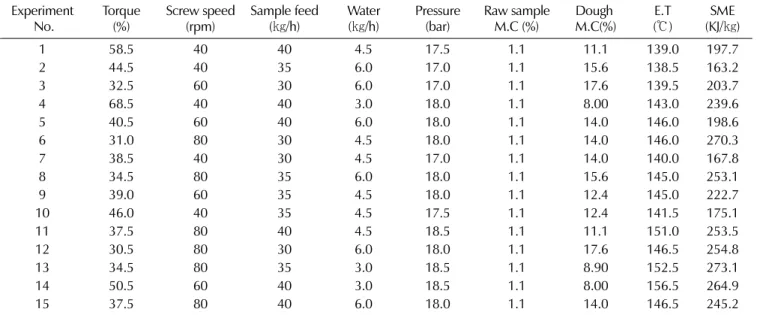
계적 에너지 소모율이 증가하였다. 이 같은 결과는 압출성형 기 내에 투입되는 수분량이 감소됨에 따라 시료의 점도가 증 가되고 이에 따라 스크류와 바렐 사이에서 참당귀 미분이 머 무르는 시간이 오래되어 기계적 소모 에너지가 증가된 것으로 판단되었다 (Table 5). Feltcher 등 (1985)은 수분이 증가됨에
따라 압출성형기 내 시료가 낮은 점도를 형성하고, 이는 곧 압출압력 및 기계적 소모 에너지를 낮추는 결과를 보고하여 본 실험의 결과와 같은 현상을 나타내었다.
2. 참당귀 압출성형물의 이화학적 특성과 수율
압출성형 공정변수에 따른 참당귀 압출성형물의 이화학적 특성을 압출처리하지 않은 참당귀와 비교한 결과는 Table 6에 나타내었다. 수용성 성분 추출률은 참당귀 압출성형물이 대조 구 대비 21.75%으로 증가하여 유의적(p < 0.05)인 차이를 나타 내었다. 이와 같이 압출성형처리 변수에 따른 참당귀 압출성 형물의 수용성 성분 수율 증가는 압출성형처리 중에 발생되는 마찰열, 전단응력 및 고온의 조건이 참당귀 세포벽을 파괴하 여 세포벽 성분의 용출을 촉진시키고, 추출잔사의 수분용해지 수가 참당귀 압출성형물에서 대조구 대비 15.26%으로 증대한 결과와 수분흡착지수가 감소된 결과로 판단된다.
Table 5. Processing factors on each extrusion condition with Angelica gigas Nakai.
Experiment No.
Torque (%)
Screw speed (rpm)
Sample feed
(㎏/h) Water
(㎏/h) Pressure (bar)
Raw sample M.C (%)
Dough M.C(%)
E.T
(℃) SME
(KJ/㎏)
1 58.5 40 40 4.5 17.5 1.1 11.1 139.0 197.7
2 44.5 40 35 6.0 17.0 1.1 15.6 138.5 163.2
3 32.5 60 30 6.0 17.0 1.1 17.6 139.5 203.7
4 68.5 40 40 3.0 18.0 1.1 8.00 143.0 239.6
5 40.5 60 40 6.0 18.0 1.1 14.0 146.0 198.6
6 31.0 80 30 4.5 18.0 1.1 14.0 146.0 270.3
7 38.5 40 30 4.5 17.0 1.1 14.0 140.0 167.8
8 34.5 80 35 6.0 18.0 1.1 15.6 145.0 253.1
9 39.0 60 35 4.5 18.0 1.1 12.4 145.0 222.7
10 46.0 40 35 4.5 17.5 1.1 12.4 141.5 175.1
11 37.5 80 40 4.5 18.5 1.1 11.1 151.0 253.5
12 30.5 80 30 6.0 18.0 1.1 17.6 146.5 254.8
13 34.5 80 35 3.0 18.5 1.1 8.90 152.5 273.1
14 50.5 60 40 3.0 18.5 1.1 8.00 156.5 264.9
15 37.5 80 40 6.0 18.0 1.1 14.0 146.5 245.2
M.C; Moisture contents, E.T; Extrusion temperature, SME; Specific mechanical energy.
Table 6. Extract yields and physicochemical properties of extruded Angelica gigas Nakai.
Sample Yield (%) WSI (%) WAI (mL/g) NEA 44.40± 1.55g 63.43± 2.21c 10.42± 1.22*a**
1 48.77± 0.33g 68.20± 0.46abc
08.39
± 0.08cd 2 54.23± 1.64bc 74.85± 12.9a08.00
± 0.13def 3 54.07± 1.44bc 69.33± 1.84abc08.22
± 0.13de 4 56.74± 1.13a 72.28± 1.44ab09.00
± 0.25b 5 53.99± 0.44bc 67.49± 0.55abc07.82
± 0.15ef 6 54.39± 1.48b 67.56± 1.84abc07.74
± 0.19ef 7 53.40± 0.80bcd 67.17± 1.00abc07.80
± 0.12ef 8 54.40± 0.12b 69.29± 0.15abc08.12
± 0.19de 9 52.41± 0.22d 65.51± 0.27bc08.43
± 0.09cd 10 52.43± 0.15d 66.37± 0.19bc08.83
± 0.27bc 11 53.97± 1.07bc 67.47± 1.33abc07.96
± 0.53def 12 53.50± 0.24bcd 67.72± 0.31abc08.08
± 0.24de 13 52.56± 0.62d 65.70± 0.77bc07.81
± 0.11ef 14 52.94± 0.59bc 65.36± 0.72bc07.51
± 0.14f 15 53.95± 0.30a 67.02± 0.37abc07.97
± 0.30def WSI; Water Solubility Index, WAI; Water Absorption Index, NEA;non-extruded Angelica gigas Nakai, 1 ~ 15; Extruded Angelica gigas Nakai depending on different condition.
*Values are Mean ± SD.
**
Values on the same row with different superscripts were significantly different at p < 0.05.Table 7. Analysis of variance for physicochemical properties of Angelica gigas Nakai extract with extrusion conditions during processing.
Source DF Yield (%) WSI (%) WAI (mL/g) SS F-value SS F-value SS F-value X1 4 3.71 1.33 37.50 3.72* 2.65 6.34***
X2 4 2.89 1.04 12.14 1.20 1.60 3.82*
X3 4 9.23 3.31 31.89 3.16 1.92 1.59**
R-square 0.3104 0.4487 0.5694
X1; Screw speed (rpm), X2; Feed rate (㎏/h). X3; Water (㎏/h), WSI;
Water Solubility Index, WAI; Water Absorption Index, DF; degrees of freedom, SS; Sum of squares,.
참당귀 압출성형물이 압출성형처리하지 않은 참당귀보다 유 용성분 함량이 증가한 결과는 압출성형 공정과정에서 고온, 고 압에 의한 세포벽조직의 파괴에 의한 것이라 판단된다. 또한 Na 등 (1999)은 양파껍질을 이용하여 압출성형한 결과 기계적 에너지 소모율이 증가됨에 따라 수분 흡착지수가 낮게 나타난 다고 보고 하여 본 실험과 동일한 결과를 나타내었다. Matthee 와 Appleddrf (1978)는 과채류의 경우 열처리에 의해 가공하
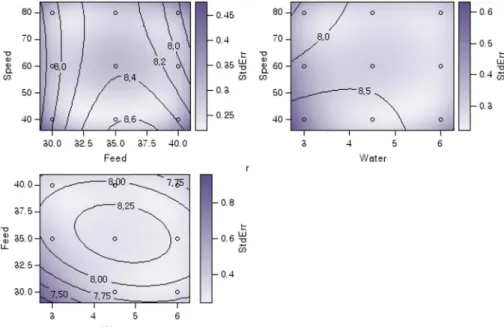
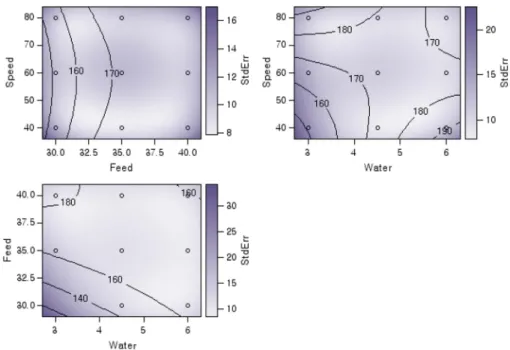
는 경우에는 상당한 양의 불용성 성분이 가용성 성분으로 전 환된다고 보고하였고, Ralet와 Thibalt (1991)는 레몬을 압출성 형 처리하여 고형분 용해도를 16.6%에서 47.5%까지 높아짐을 보고하였는데, 본 실험도 이와 유사한 결과를 보였다. 참당귀 압출성형물의 이화학적 특성을 반응표면분석 통계처리를 통해 분석한 결과는 다음과 같다. 압출성형처리 중 열수 추출물의 수율은 가수량이 영향을 주며, 선정된 최적조건은 압출성형처
Fig. 2. Response contour polt of screw speed, water and feed rate on the extractsyield. Speed; Screw speed (rpm). Feed; Feed rate (㎏/h), Water; Water (㎏/h), StdErr; Standard error.
Fig. 3. Response contour polt of screw speed, water and feed rate on the water solubility index. Feed; Feed rate (㎏/h), Water; Water (㎏/h), StdErr; Standard error.
리 중 스크류 속도가 92.48 rpm이고, 참당귀 미분 투입량 30.56 ㎏/h와 가수량 4.16 ㎏/h이다. 또한, 수분용해지수는 스크 류 속도 (X
1) 와 가수량이 영향을 받는 것으로 나타났으며 (p < 0.01), 참당귀 미분 투입량 61.50 ㎏/h와 가수량 3.43 ㎏/h 이다. 수분흡착지수는 스크류 속도가 영향을 주며, 선정된 최
적조건은 압출성형처리 중 스크류 속도가 68.42 rpm이고, 참 당귀 미분 투입량 34.97 ㎏/h와 가수량 5.22 ㎏/h이다 (Table 7, Fig. 2, 3, 4). 이에 대한 이화학적 분석 결과는 Table 14 에 나타내었다.
2. 압출성형 조건에 따른 참당귀의 항산화성분과 항산화 활성 1) 항산화 성분
압출성형처리 조건에 따른 참당귀 압출성형물의 항산화 성 분의 함량을 측정한 결과와 참당귀 원료와 비교 분석하였다 (Table 8). 총폴리페놀 함량은 압출성형물 13번 처리구가 대조 구 함량 대비 40% 증가하여 유의적 (p < 0.05)인 차이를 나 타내었다. 또한 총폴리페놀 함량은 스크류 속도와 원료투입량 이 영향을 받아 폴리페놀은 스크류 속도, 원료투입량이 높을 수록 증가하는 경향을 확인할 수 있었다 (Table 9, Fig. 5).
따라서 선정된 최적조건은 압출성형처리 중 스크류 속도가
Fig. 4. Response contour polt of screw speed, water and feed rate on the waterabsorption index. Feed; Feed rate (㎏/h), Water; Water (㎏/h), StdErr; Standard error.
Table 8. Contents of functional ingredients of extrudated Angelica gigas Nakai.
Sample Total polyphenol (%) Total flavonoids (%) NEA 0.63± 0.01h 0.46± 0.00*g**
1 0.93± 0.01e 0.72± 0.00e
2 0.95± 0.01d 0.78± 0.00bcd
3 0.95± 0.01d 0.78± 0.01bcd
4 0.77± 0.01g 0.67± 0.01f
5 0.98± 0.03cd 0.80± 0.00a
6 0.85± 0.01f 0.67± 0.00f
7 0.97± 0.01cd 0.77± 0.01cd
8 1.02± 0.02b 0.79± 0.01abc
9 0.97± 0.02cd 0.77± 0.02d
10 1.02± 0.00b 0.79± 0.01ab
11 0.90± 0.03e 0.68± 0.00f
12 1.00± 0.03c 0.68± 0.01f
13 1.03± 0.02b 0.72± 0.01e
14 1.10± 0.00a 0.73± 0.01e
15 1.01± 0.00b 0.79± 0.01abc NEA; non-extruded Angelica gigas Nakai, 1 ~ 15; Extruded Angelica gigas Nakai depending on different condition.
*Values are Mean ± SD. **Values on the same row with different superscripts were significantly different at p < 0.05.
Table 9. Analysis of variance for functional ingredients of Angelica gigas Nakai extract with extrusion conditions during processing.
Source DF Total polyphenol (%) Total flavonoids (%)
SS F-value SS F-value
X1 4 0.04 39.22*** 0.26
02.43*
X2 4 0.04 40.82*** 1.27 11.91***
X3 4 0.03 32.41*** 1.48 13.89***
R-square 0.9106 0.7957
X1; Screw speed (rpm), X2; Feed rate (㎏/h). X3; Water (㎏/h), DF;
degrees of freedom, SS; Sum of squares.
62.76 rpm 이고, 참당귀 미분 투입량 34.79 ㎏/h와 가수량 4.44 ㎏/h이었다.
총플라보노이드 함량은 압출성형물 5번 처리구가 대조구 보 다 42.5% 높게 함유하고 있어 유의적 (p < 0.05)인 차이를 나 타내었다. 총플라보노이드 함량은 원료투입량, 가수량이 높을 수록 증가하는 경향을 확인할 수 있었다 (Table 9, Fig. 6).
압출성형처리 중 스크류 속도가 52.28 rpm이고, 참당귀 미분
투입량 33.59 ㎏/h와 가수량 4.62 ㎏/h일 때 최적조건으로 선 정되었다.
결합형 페놀 성분이 가열처리에 의해 유리형으로 전환되어 용출이 용이해지거나 고분자 페놀화합물이 저분자 페놀화합물 로 분해되어 총 페놀함량이 증가하기 때문이라는 연구보고와 유사한 결과를 나타내었다 (Choi et al., 2006; Kang et al., 1996; Turkmen et al., 2005). 참당귀와 압출성형 참당귀의
Fig. 5. Response contour polt of screw speed, water and feed rate on the totalpolyphenol. Feed; Feed rate (㎏/h), Water; Water (㎏/h), StdErr; Standard error.
Fig. 6. Response contour polt of screw speed, water and feed rate on the total flavonoids. Feed; Feed rate (㎏/h), Water; Water (㎏/h), StdErr; Standard error.
총폴리페놀, 총플라보노이드 등 항산화 성분 함량을 비교 분 석한 결과 참당귀를 압출성형처리 후 고온고압에서 추출할 경 우 세포벽 성분의 수용화가 극대화되는 것을 알 수 있었다.
즉, 비전분 탄수화물 추출률 및 전분의 붕괴는 압출성형에 의 한 물리적 전단에 의해 높일 수 있음을 확인하였다.
2) 항산화 활성
항산화 활성을 일반적으로 많이 알려진 DPPH에 의한 전자 공여능과 ABTS
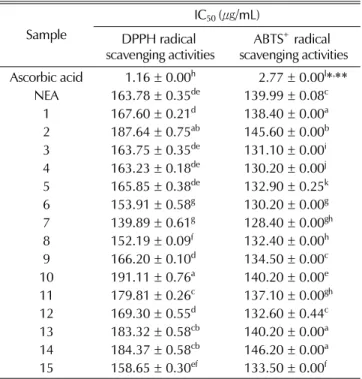
+Radical 소거 활성을 측정하였다. 본 실험에 서 최적조건으로 선발된 참당귀 압출성형물을 DPPH에 의한 전자공여능으로 압출성형처리하지 않은 참당귀와 비교한 결 과, 참당귀 압출성형물 7번 처리구가 대조구 163.78 ㎍/mL 대 비 14.59% 향상된 산화억제 효과를 나타내었다 (Table 10).
이러한 결과는 전자공여능이 phenolic acid와 플라보노이드 및 기타 페놀성 물질에 대한 항산화작용의 지표이며, 환원력이 큰 것일수록 전자공여능이 높다 (Seog et al., 2002). 또한 식물 체의 총폴리페놀 함량이 높을수록 전자공여능이 높은 경향이 있다고 알려져 있는데 (Choi et al., 2009; Kim et al., 2002), 압출성형물 7번 처리구의 총폴리페놀 함량도 대조구 대 비 유의적 (p < 0.05)으로 높았기 때문에 서로 연관이 있음을 확인할 수 있었으며, 이러한 결과는 압출성형 처리로 인해 세 포벽이 수용화되면서 저분자화된 참당귀 다당체의 활성에 의 한 결과라고 판단된다. 참당귀의 항산화 활성에 대한 반응표 면분석 결과, DPPH radical 소거 활성은 원료투입량, 가수량 이 높을수록 활성이 증가하는 경향을 확인할 수 있었다 (Table 10, Fig. 7). 따라서 선정된 최적조건은 압출성형처리 중 스크 류 속도가 54.54 rpm이고, 참당귀 미분 투입량 38.34 ㎏/h와 가수량 4.57 ㎏/h이다. 또한 ABTS
+radical 소거 활성은 압출 성형물 (처리구 7번, 스크류 속도 40 rpm, 원료투입량 30 ㎏/
h, 가수량 4.5 ㎏/h)의 ABTS
+radical 소거 활성 IC
50value 가 110.07 ㎍/mL로 압출처리하지 않은 참당귀의 122.69 ㎍/mL에 대비 10.29% 향상된 항산화 활성의 효과를 보였다. Kim (2007) 은 인삼을 압출성형하여 항산화 활성을 측정한 결과 유 의적 (p < 0.05)으로 증가되었다고 보고하였으며, 이는 압출성 형으로 인해 세포벽이 수용화되면서 인삼의 유용성분인 저분
자 proteoglucan과 산성다당체를 포함한 수용성 다당체가 용출 된 결과라고 보고하여 본 연구와 일치하였다. 이에 따라, 참당 귀의 ABTS
+radical 소거 활성은 DPPH radical 소거 활성과 같이 반응표면분석 결과 스크류 속도 (X
1) (p < 0.01), 원료투입 량 (X
2) (p < 0.001), 가수량 (X
3) (p < 0.001) 에 영향을 받는 것 으로 나타났으며, 스크류 속도 (X
1) 에 따른 F값이 2.43, 원료투 입량 (X
2) 는 11.91, 가수량 (X
3) 은 13.89로 나타나 원료투입량, 가수량이 높을수록 증가하는 경향을 확인할 수 있었다 (Table 11, Fig 8). 따라서 선정된 최적조건은 압출성형처리중 스크류 속도가 93.71 rpm이고, 참당귀 미분 투입량 28.67 ㎏/h와 가수 량 9.9 ㎏/h이며, 이때 항산화 활성은 Table 14에 나타내었다.
Table 11. Analysis of variance for radical scavenging activities of Angelica gigas Nakai extract with extrusion conditions during processing.
Source DF
DPPH radical scavenging activities
ABTS+ radical scavenging activities
SS F-value SS F-value
X1 4 2403.65
07.69***
0.2602.43*
X2 4 3215.88 10.29*** 1.27 11.91***
X3 4 3272.20 10.47*** 1.48 13.89***
R-square 0.6896 0.7957
X1; Screw speed (rpm), X2; Feed rate (㎏/h). X3; Water (㎏/h), DF; degrees of freedom, SS; Sum of squares.
Table 10. Radical scavenging activities of extruded Angelica gigas Nakai.
Sample
IC50 (㎍/mL) DPPH radical
scavenging activities
ABTS+ radical scavenging activities Ascorbic acid
001.16
± 0.00h002.77
± 0.00l*,**NEA 163.78± 0.35de 139.99± 0.08c 1 167.60± 0.21d 138.40± 0.00a 2 187.64± 0.75ab 145.60± 0.00b 3 163.75± 0.35de 131.10± 0.00i 4 163.23± 0.18de 130.20± 0.00j 5 165.85± 0.38de 132.90± 0.25k 6 153.91± 0.58g 130.20± 0.00g 7 139.89± 0.61g 128.40± 0.00gh 8 152.19± 0.09f 132.40± 0.00h 9 166.20± 0.10d 134.50± 0.00c 10 191.11± 0.76a 140.20± 0.00e 11 179.81± 0.26c 137.10± 0.00gh 12 169.30± 0.55d 132.60± 0.44c 13 183.32± 0.58cb 140.20± 0.00a 14 184.37± 0.58cb 146.20± 0.00a 15 158.65± 0.30ef 133.50± 0.00f NEA; non-extruded Angelica gigas Nakai, 1 ~ 15; Extruded Angelica gigas Nakai depending on different condition.
*Values are Mean ± SD. **Values on the same row with different superscripts were significantly different at p < 0.05.
3. 압출성형물의 지표성분 함량
참당귀의 지표성분인 decursin과 decursinol angelate 함량은 압출성형물(처리구 3번, 스크류 속도 60 rpm, 참당귀 미분 투 입량 30 ㎏/h, 가수량 6.0 ㎏/h)이 6.37% 함량으로 대조구 함 량 5.31% 대비 16.64% 증가하여 유의적 (p < 0.05)인 차이를
나타내었다 (Table 12). 참당귀의 조파쇄 분말과 압출성형 분 말에 대한 decursin과 decursinol angelate의 추출함량을 비교 분석한 결과 압출성형시 유용성분 함량이 3∼4배의 함량이 증 대되었다고 보고하여 본 연구와 유사한 결과를 나타내었다 (Kim et al., 2008). 이에 따라 decursin과 decursinol angelate
Fig. 8. Response contour polt of screw speed, water and feed rate on the ABTS+ radicalscavenging activity. Feed; Feed rate (㎏/h), Water; Water (㎏/h), StdErr; Standard error.
Fig. 7. Response contour polt of screw speed, water and feed rate on the DPPH radical scavenging activity. Feed; Feed rate (㎏/h), Water; Water (㎏/h), StdErr;
Standard error.
Table 12. Contents of decursin and decursinol angelate of extruded Angelica gigas Nakai.
Sample Decursin (%) Decursinol Angelate (%) Decursin
+ Decursinol Angelate (%)
NEA 3.22± 0.02 2.08± 0.01 5.31± 0.03*f**
1 3.56± 0.09 2.23± 0.06 5.79± 0.15cd
2 3.68± 0.03 2.30± 0.02 5.98± 0.55bc
3 3.91± 0.07 2.45± 0.05 6.37± 0.12a
4 3.42± 0.10 2.15± 0.06 5.57± 0.17e
5 3.83± 0.07 2.42± 0.05 6.25± 0.12a
6 3.94± 0.04 2.49± 0.02 6.43± 0.06a
7 3.87± 0.07 2.45± 0.04 6.32± 0.11a
8 3.88± 0.04 2.45± 0.03 6.33± 0.07a
9 3.63± 0.10 2.29± 0.07 5.92± 0.17bc
10 3.69± 0.09 2.33± 0.06 6.02± 0.15b
11 3.50± 0.10 2.20± 0.06 5.70± 0.17de
12 3.87± 0.06 2.44± 0.04 6.31± 0.10a
13 3.39± 0.04 2.13± 0.02 5.53± 0.07e
14 3.49± 0.09 2.20± 0.06 5.69± 0.15de
15 3.68± 0.16 2.32± 0.10 6.00± 0.26b
NEA; non-extruded Angelica gigas Nakai, 1 ~ 15; Extruded Angelica gigas Nakai depending on different condition. *Values are Mean ± SD.
**Values on the same row with different superscripts were significantly different at p < 0.05.
Table 13. Analysis of variance for decursin and decursinol angelate of Angelica gigas Nakai extract with extrusion conditions during processing.
Factor DF Sum of squares F-value
X1 4 401.47 10.59***
X2 4 426.35 11.24***
X3 4 490.05 12.93***
R-square 0.7422
X1; Screw speed (rpm), X2; Feed rate (kg/h). X3; Water (kg/h), DF; degrees of freedom.
Table 14. Experimental data on proximate compositions, antioxidant components and antioxidant activities, and decursin of Angelica gigas Nakai by central composite design for response surface analysis.
Experiment No.
Screw speed (X1)
Feed rate (X2)
Water (X3)
Predicted value
Yield (%)
WSI (%)
WAI (mL/g)
Total polyphenol
(%)
Total flavonoids
(%)
DPPH scavenging
activity IC50
(㎍/mL)
ABTS+ scavenging
activity IC50
(㎍/mL)
Decursin, decursinol angelate
(%)
1 −1(40) +1(40) 0(4.5) 48.77 68.20 10.4 0.93 0.72 167.60 138.40 5.79
2 −1(40) 0(35) +1(6.0) 54.23 74.85 8.39 0.95 0.78 187.64 145.60 5.98
3 0(60) −1(30) +1(6.0) 54.07 69.33 8.00 0.95 0.78 163.75 131.10 6.37
4 −1(40) +1(40) −1(3.0) 56.74 72.28 8.22 0.77 0.67 163.23 130.20 5.57
5 0(60) +1(40) +1(6.0) 53.99 67.49 9.00 0.98 0.80 165.85 132.90 6.25
6 +1(80) −1(30) 0(4.5) 54.39 67.56 7.82 0.85 0.67 153.91 130.20 6.43
7 −1(40) −1(30) 0(4.5) 53.40 67.17 7.74 0.97 0.77 139.89 128.40 6.32
8 +1(80) 0(35) +1(6.0) 54.40 69.29 7.80 1.02 0.79 152.19 132.40 6.33
의 추출함량을 반응표면분석 결과 스크류 속도 (X
1), 원료투입 량 (X
2), 가수량 (X
3) (p < 0.001)에 영향을 받는 것으로 나타 났으며, 스크류 속도 (X
1) 에 따른 F값이 10.59, 원료투입량 (X
2) 는 11.24, 가수량 (X
3) 은 12.93으로 나타나 원료투입량, 가 수량이 높을수록 증가하는 경향을 확인할 수 있었다 (Table 13, Fig 9). 따라서 선정된 최적조건은 압출성형처리 중 스크 류 속도가 93.71 rpm이고, 참당귀 미분 투입량 28.67 ㎏/h 와 가수량 9.9 ㎏/h이며, 이때 지표성분 함량은 Table 14에 나타 내었다.
감사의 글
본 연구는 농촌진흥청에서 주관하는 약용작물 고부가 소재 개발 및 나노기술 상품성 증진 연구(과제번호: PJ006921)의 연구비 지원으로 수행된 결과로 이에 감사드립니다.
REFERENCES
Abe N, Murata T and Hirota A. (1998). Novel DPPH radical scavengers, bisorbicillinol and demethyltrichodimerol, from Table 14. Continued.
Experiment No.
Screw speed (X1)
Feed rate (X2)
Water (X3)
Predicted value
Yield (%)
WSI (%)
WAI (mL/g)
Total polyphenol
(%)
Total flavonoids
(%)
DPPH scavenging
activity IC50
(㎍/mL)
ABTS+ scavenging
activity IC50
(㎍/mL)
Decursin, decursinol angelate
(%)
9 0(60) 0(35) 0(4.5) 52.41 65.51 8.12 0.97 0.77 166.20 134.50 5.92
10 −1(40) 0(35) 0(4.5) 52.43 66.37 8.43 1.02 0.79 191.11 140.20 6.02
11 +1(80) +1(40) 0(4.5) 53.97 67.47 8.83 0.90 0.68 179.81 137.10 5.70
12 +1(80) −1(30) +1(6.0) 53.50 67.72 7.96 1.00 0.68 169.30 132.60 6.31
13 +1(80) 0(35) −1(3.0) 52.56 65.70 8.08 1.03 0.72 183.32 140.20 5.53
14 0(60) +1(40) −1(3.0) 52.94 65.36 7.81 1.10 0.73 184.37 146.20 5.69
15 +1(80) +1(40) +1(6.0) 53.95 67.02 7.51 1.01 0.79 158.65 133.50 6.00
WSI; Water Solubility Index, WAI; Water Absorption Index.
Fig. 9. Response contour polt of screw speed, water and feed rate on the decursin and decursinol angelate. Feed; Feed rate (㎏/h), Water; Water (㎏/h), StdErr; Standard error.
a fungus. Bioscience, Biotechnology and Biochemistry.
62:661-666.
Ahn KS, Shim WS and Kim IH. (1995). Detection of anticancer activity from the of Angelica gigas in vitro. Journal of Microbiology and Biotechnology. 5:105-109.
Ahn KS. (1996). A study on the anticancer and imnunostimulating agents from the root of Angelica gigas Nakai. Ph. D. Thesis.
Korea University. p.39-48.
Anderson RA, Conway HF and Peplinski AJ. (1970).
Gelatinization of corn grits by roll cooking, extrusion cooking and steaming. Starch-Strke. 22:130-135.
Association of Official Analytical Chemists(AOAC). 1980.
Official Methods of Analysis(13th ed.). Association of Official Analytical Chemists. Arlington, Virginia, USA. p.376-384.
Cho S, Takahashi M, Toita S and Cyong JC. (1982).
Suppression of adjuvant arthritis at by oriental herb(I).
Shoyakagaku Zasshi. 36:78-81.
Choi AJ, Jee HK, Ko BS, Kim YH, Lee SJ, Kim CJ, Cho YJ and Kim CT. (2009). Solubilization of arabinogalactan by extrusion from Portulaca oleracea L. and its in vitro antioxidant activity. Food Engineering Progress. 13:169-175.
Choi Y, Lee SM, Chun J and Lee J. (2006). Influence of heat treatment on the antioxidant activities and polyphenolic compounds of Shiitake(Lentinus edodes) mush-room. Food Chemistry. 99:381-387.
Dewanto V, Wu X and Liu RH. (2002). Processed sweet corn has higher antioxidant activity. Journal of Agricultural and Food Chemistry. 50:4959-4964.
Fletcher SI, Richmond P and Smith AC. (1985). Chemical components of red, white and extruded root ginseng. Journal of Food Engineering. 4:291-312.
Gontard N, Guilbert S and Cuq JL. (1992). Edible wheat gluten films:Influence of the main process variables on film properties using response surface methodology. Journal of Food Science.
57:190-196.
Ha DC, Lee JW, Kim NM and Ryu GH. (2005). Effect of barrel temperature and screw speed on characteristics of extruded raw ginseng. Journal of Ginseng Research. 29: 97-112.
Han SB, Kim YH, Lee CW, Park SM, Lee HY, Aan KS and Kim HM. (1998). Characteristics immunostimulation by angelan isolation from Angelica gigas Nakai. Immunopharmacology.
40:39-48.
Hwang, JK, Kim JT, Hong SI and Kim CJ. (1994).
Solubilization of plant cell walls by extrusion. Journal of the Korean Society of Food Science and Nutrition. 23:358-370.
Hwang JB, and Yang MO. (1997). Comparison of chemical components of Angelica gigas Nakai and Angelica acutiloba Kitagawa. Korean Journal of Food Science and Technology.
29:1113-1118.
Kang YH, Park YK and Lee GD. (1996). The nitrite scavenging and electron donating ability of phenolic compounds. Korean Journal of Food Science and Technology. 28:232-239.
Kelly GS. (1999). Larch arabinogalactan: Clinical relevance of a novel immune-enhancing polysaccharide. Alternative Medicine Review. 4:96-103.
Kim BS and Ryu GH. (2005a). Effect of die temperature and dimension on extract characteristics of extruded white ginseng.
Journal of the Korean Society of Food Science and Nutrition.
34:544-548.
Kim BS and Ryu GH. (2005b). Effect of die temperature and on puffing of extruded white and red ginseng. Journal of the Korean Society of Food Science and Nutrition. 34:1109-1113.
Kim HK, Choi YJ and Kim KH. (2002). Functional activities of microwave-assisted extracts from Flammulina velutipes. Korean Journal of Food Science and Technology. 34:1013-1017.
Kim HS and Park HJ. (1980). A study of the effects of the root components of Angelica gigas. Korea Journal of Pharmacognosy.
24:173-179.
Kim HS, Kim TW, Kim DJ, Lee JS, Kim KK and Choe M.
(2013) Antioxidant activities and α-glucosidase inhibitory effect of water extracts from medicinal plants. Korean Journal of Medicinal Crop Science. 21:197-203.
Kim KM, Jung JY, Hwang SW, Kim MJ and Kang JS. (2009).
Isolation and purification of decursin and decursinol angelate in Angelica gigas Nakai. Journal of the Korean Society of Food Science and Nutrition. 38:653-656.
Kim NS, Lim DJ, Kim DE, Sun HJ, Kang WS and Ko SH.
(2008). Increased yield and decrusin content in powder of Angelica gigas by extrusion process. Korean Journal of Medicinal Crop Science. 16:184-185.
Kim SH. (2007). Effect of the Extruded Ginseng on Antioxidant Activity. Journal of the East Asian Society of Dietary Life.
17:402-408.
Kim YG, An TJ, Yeo JH, Hur M, Park YS, Cha SW, Song BH and Lee KA. (2014). Effect of eco-friendly organic fertilizer on growth and yield of Angelica gigas Nakai. Korean Journal of Medicinal Crop Science. 22:127-133.
Matthee V and Appleddrf H. (1978). Effect of extrusion-cooking on vegetable fiber. Journal of Food Science. 43:1344-1345.
Matsumoto K, Kohno S, Ojima K, Tezuka Y, Kadota S and Watanabe H. (1998). Effect of ethylenechloride-soluble fraction of Japanese Angelica root extract ligustilde and butylidenphthalide on pentibarbital sleep in group-housed and socially isolated mice. Life Sciences. 38:112-119.
Ng A, Lecain S, Parker ML, Smith AC and Waldron KW.
(1999). Modification of cell-wall polymers of onion waste III.
Effect of extrusion-cooking cell-wall material of outer fresh tissues. Carbohydrate Polymers. 39:341-349.
Park BH, Cho HS and Park SY. (2005). A study on the antioxidative effect and quality characteristics of cookies made with Lycii fructus powder. Korean Journal of Food Cookery Science. 21:94-102.
Ralet MC and Thibalt JF. (1994). Extraction and characterization of very highly methylated pectins from lemon cell walls.
Carbohydrate Research. 260:283-296.
Roberta RE, Pellegrini N, Proteggente A, Pannala A and Yang M and Rice Evans C. (1999) Antioxidant activity applying an improved ABTS radical cation decolorization assay. Journal of Free radical Biology & Medicine. 26:1231-1237.
Ryu GH. (2007). Recent trend in red ginseng manufacturing process and characteristics of extruded red ginseng. Food Engineering Progress. 11:1-10.
Ryu GH, Remon JP. (2004). Extraction yield of extruded ginseng and granulation of its extracts by cold extrusion spheronisation.
Journal of the Korean Society of Food Science and Nutrition.
33:899-904.
Ryu KS, Hong ND, and Kim YY. (1990). Studies on the coumarin constituents of the root of Angelica gigas Nakai Isolation of decursinol angelate and assay of decursinol angelate and decursin. Korean Journal of Pharmacognosy. 21:64-68.
Seong HM, Seo MS, Kim SR, Park YK and Lee YT. (2002).
Characteristics of barley polyphenol extract(BPE) separated from pearling by products. Korean Journal of Food Science and Technology. 34:775-779.
Seong NS, Lee SW, Kim KS and Lee ST. (1993). Environmental variation of decursin content in Angelica gigas. Korean Journal of Crop Science. 38:60-65.
Swain T, Hillis WE and Oritega M. (1959). Phenolic constituents of Ptunus domestica. I. Quantitative analysis of phenolic constituents. Journal of the Science of Food and Agriculture.
10:83-88.
Turkmen N, Sari F and Velioglu YS. (2005). The effects of cooking methods total phenolic and antioxidant activity of selected green vegetables. Food Chemistry. 93:713-718.
Ye YN, Liu ELS, So HL, Cho CM, Sheng HP, Lee SS and Cho CH. (2001). Protective effect of polysaccharides enriched fraction from Angelica sinensis on hepatic injury. Life Science.
69:637-646.
Yoon SR, Lee MH, Park JH, Lee IS, Kwon JH and Lee GD.
(2005). Change in physicochemical compounds with heating treatment of ginseng. Journal of the Korean Society of Food Science and Nutrition. 34:1572-1578.
Yu HS, Park CH, Park CG, Kim YG, Park HW and Seong NS.
(2004). Growth characteristics and yield of the three species of genus Aangelica. Korean Journal of Medicinal Crop Science.
12:43-46.