• 검색 결과가 없습니다.

Development of Rutting Prediction Model of Flexible Pavement using Repetitive Axial Loading Test

N/A
N/A
Protected

Academic year: 2021

Share "Development of Rutting Prediction Model of Flexible Pavement using Repetitive Axial Loading Test"

Copied!
8
0
0

로드 중.... (전체 텍스트 보기)

전체 글

(1)

A B S T R A C T KEYWORDS The primary objective of this research is to develop a rutting performance prediction

model of flexible pavement. Extensive laboratory testings were conducted to achieve the objective. A new test method employing repetitive axial loading with confinement was also adopted to estimate the rutting performance of asphalt concrete in the research. The rutting prediction model employes a layer-strain theory. The required rutting coefficients for the prediction model were determined through the laboratory rutting characterizations of the asphalt concrete layer materials. Within the limits of this study, a laboratory rutting prediction model of flexible pavement using repetitive axial loading test was presented. It is noted that the developed rutting prediction model simulates propery the behaviors of flexible pavement layer materials.

rutting performance prediction model flexible pavement

본 연구의 주 목적은 연성 도로포장의 소성변형 예측모델을 개발하는 것이다 . 목적을 수행

하기 위하여 다양한 실험실 시험이 수행되었다 . 소성변형 량을 측정하기 위하여 측면 구속

압을 제공하는 새로운 반복 일축압축시험이 채택되었으며 소성변형 예측모델은 층별 -변형

률 이론이 적용되었다 . 예측모델의 소성계수는 아스팔트 콘크리트 재료의 소성변형시험을

통하여 결정되었다 . 본 연구가 수행된 범위내에서 반복 일축압축시험을 통한 연성포장의

소성변형 예측모델이 제안되었다 . 제안된 소성변형 예측모델은 연성포장 층 재료의 거동을

적절하게 모사하는 것으로 나타났다 .

소성변형 공용성 예측 모델 연성 포장

ⓒ 2017 Society of Disaster Information All rights reserved

반복 축하중 시험을 이용한 연성포장의 소성변형 예측모델 개발

Development of Rutting Prediction Model of Flexible Pavement using Repetitive Axial Loading Test

Nakseok Kim a*

a
Department of Civil Engineering, University of Kyonggi, Iui-dong, Yeongtong-gu, Suwon, Republic of Korea

* Corresponding author. Tel. 82-31-249-9710. Fax. 82-31-249-9710.

Email. [email protected] ARTICLE HISTORY

Received Sep. 26, 2017

Revised Oct. 16, 2017

Accepted Dec. 11, 2017

Available online at www.sodi.or.kr

(2)

1. Introduction

In the last two decade, permanent deformation(rutting) has been one of the two major traffic associated failure models in asphalt concrete pavements. Especially, with increases in axle loads, load repetitions, tire pressures, and asphalt-concrete thickness, a need has developed for a methodology to predict permanent deformation to mitigate potential safety problems and associated with this distress(Sausa and Craus, 1990).

An extensive amount of pavement research has focused on the development of a performance prediction model of rutting in asphalt pavement and resulted in many papers in recent years. Many of these have simply considered laboratory material characteristics; some have discussed the theoretical methods; others have suggested through field observations. However, to be generally acceptable performance prediction model, it is considered that the methodology should come from the combination of these aspects.

The literature review(Monismith et al., 1988) showed that there arte two principal predictive methodologies using analytical procedures to estimate the amount of rutting in a multi-layered asphalt pavement system. These two predictive methodologies, layer-strain predictive methodology and viscoelastic procedure, have commonly been used to predict the permanent deformation occurring in asphalt pavements.

2. Selection of Rutting Characterization Method

Analysis results of the field rutting data suggest that an asphalt concrete layer should be divided into several layers for the laboratory characterization. This is because the major part of the permanent deformation was found to be originated from the top portion of the asphalt concrete layer rather than uniform distribution of permanent deformation along the depth of AC(Asphalt Concrete) layer.

The nonuniform contribution of permanent deformation along the depth was reasoned to be due to changes in temperature and stress level along the depth. Temperature measurements from the test sections have revealed that temperatures near the pavement surface are higher than temperatures at lower depths during the most of daytime.

The multi-layered structural analysis results from WES-5 showed significant variation of stress distribution within the asphalt concrete layer(Kim, 1994; Kim, 2014). The amount of vertical stress decreased with a hyperbolic trend as the depth increased.

The higher stress level with higher temperatures near the pavement surface causes greater permanent deformation from the higher portions of asphalt layers. Therefore, based on their depths within the asphalt concrete layer, the asphalt concrete layers were divided into three groups for the permanent deformation characterization.

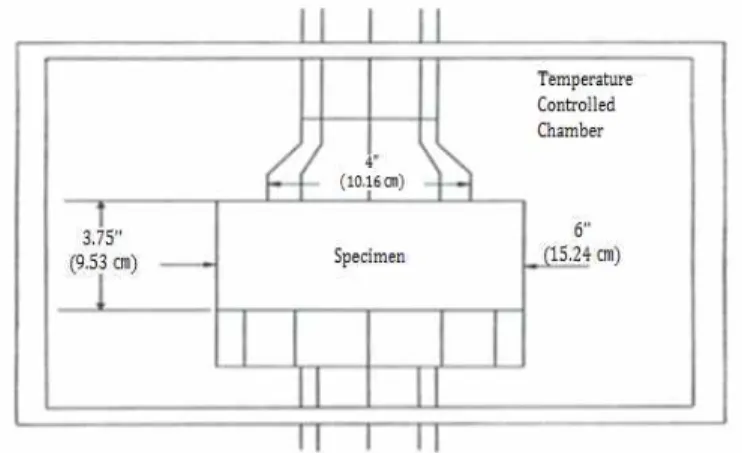
The general objective of materials testing is to simulate in-situ field conditions as closely as possible, including loading conditions, climatic conditions, etc. Also, the test method should be easy, inexpensive, simple, and efficient to conduct to become an acceptable standard laboratory testing method for state highway agencies. Based on these reasons, a new test method employing repetitive axial loading with confinement was developed to evaluate the permanent deformation of asphalt concrete. The schematic drawing of the repetitive axial loading test with confinement is presented in Fig. 1. This testing method can be conducted using conventional uniaxial testing equipment and therefore, easily adoptable to many state highway agencies. More detailed information for the test method can be found elsewhere(Kim, 1994; Kim, 2014).

In addition, the testing mode can avoid the discontinuity problem between the loading and unloading parts of the specimen

due to the existence of the ring-shaped ligament outside of 4-inch (10.16-cm) diameter of the cylindrical specimen. This is one

of the advantages of this test method compared to the conventional triaxial test in which the lateral confining pressure is supplied

by pneumatics or hydraulics.

(3)

Fig. 1. Schematic drawing of the repetitive axial loading test with confinement

3. Materials and Specimen Preparation

3.1 Asphalt Binder

The asphalt binder used in this research was AC-20 asphalt, and the level of asphalt content for the asphalt cement was determined by Blythe Industries, Inc., Staley, North Carolina. According to the construction record maintained by the NCDOT, the optimum asphalt contents of the heavy duty surface (HDS) and the heavy duty binder (HDB) courses were determined using the U.S. Army Corps of Engineers (Marshall) 75-blow procedure (ASTM D 1559). The procedure required a minimum 1,500 Marshall stability.

On the other hand, the optimum asphalt content of the asphalt-stabilized base course (HB) was determined using the U.S. Army Corps of Engineers (Marshall) 50-blow procedure. The procedure required a minimum 800 Marshall stability. Table 2. summarizes the asphalt cement properties tested separately by North Carolina State University and Blythe Industries, Inc., Staley, North Carolina. Also, the selected optimum asphalt contents of each asphalt concrete are presented in Table 1.

Mixture Type Optimum Asphalt Content (%)

(by weight of aggregate)

Heavy Duty Surface (HDS) 5.5

Heavy Duty Binder (HDB) 4.7

Asphalt-stabilized Base (HB) 4.0

Table 1. Selected optimum asphalt contents of each mixture.

3.2 Aggregate

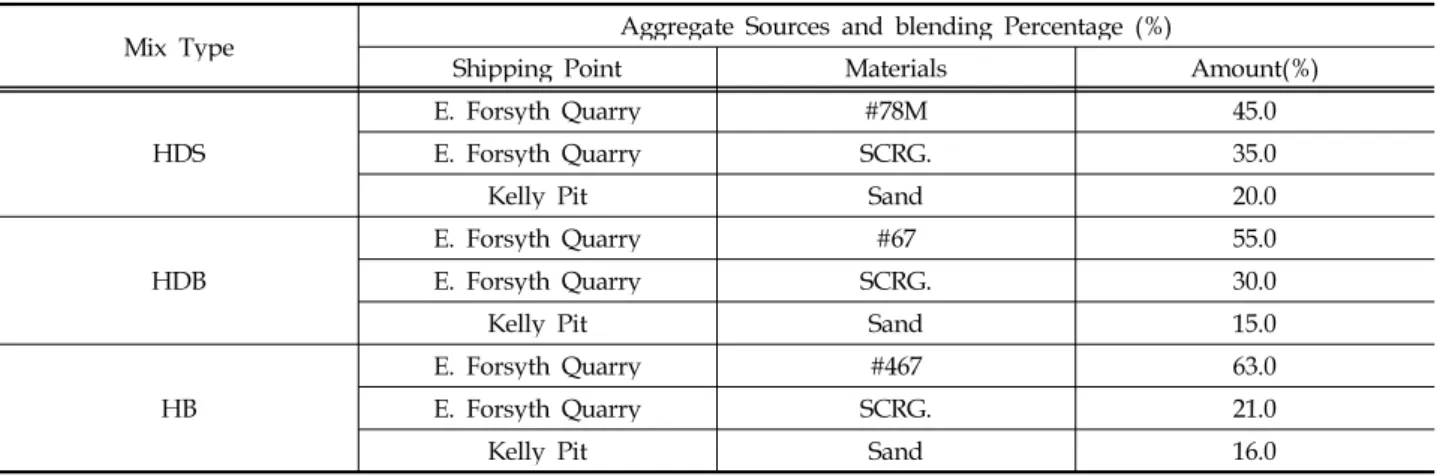
The aggregates used in this research were #67, #467, #78M, SCRG., and Sand. To get three type of mixtures (HDS, HBD, and

HB), these aggregates were blended properly in certain proportions. The aggregate sourses and the selected blending proportions

for each mixture are shown in Table 2. Also, the selected gradations with North Carolina specification limits of the three mixtures

are presented in Table 3. The tests on aggregates were performed by Blythe Industries, Inc., Staley, North Carolina.

(4)

Mix Type Aggregate Sources and blending Percentage (%)

Shipping Point Materials Amount(%)

HDS

E. Forsyth Quarry #78M 45.0

E. Forsyth Quarry SCRG. 35.0

Kelly Pit Sand 20.0

HDB

E. Forsyth Quarry #67 55.0

E. Forsyth Quarry SCRG. 30.0

Kelly Pit Sand 15.0

HB

E. Forsyth Quarry #467 63.0

E. Forsyth Quarry SCRG. 21.0

Kelly Pit Sand 16.0

Table 2. Aggregate sources and blending proportions for each mixture.

Mix Type JMF Combined Sieve Size

Percent Passing (%)

NC Spec. Limits Selected Gradation

HDS

3/4"(1.91cm) 100 100

1/2"(1.27cm) 96 - 100 98

#4 55 - 80 67

#8 40 - 60 51

#40 11 - 38 25

#80 4 - 20 11

#200 2 - 8 4.1

HDB

1"(2.54cm) 100 100

3/4"(1.91cm) 90 - 100 95

1/2"(1.27cm) 67 - 88 77

#8 25 - 45 40

#200 1 - 7 4

HB

2"(5.08cm) 100 100

1.5"(3.81cm) 90 - 100 95

3/4"(1.91cm) 60 - 85 75

#4 25 - 50 37

#8 25 - 40 33

#200 0 - 6 2.9

Table 3. Selected aggregate gradations for each mixture.

3.3 Compaction

The compaction efforts were adjusted based on the target air voids content of the specimen. In this research, the target air

void content of the specimen was six percent with a Wet-With-Parafilm(WWP) measurement procedure regardless of the specimen

size or mixture type. This target air void content of the specimen was selected based upon the air voids content measurements

from the field core specimens. Generally, the air void contents from the field core specimens were in the wide range of four

to eight percent.

(5)

3.4 Air Void Content Measurement

The air void content measurement was done in accordance with the new method, "Wet-With-Parafilm (WWP)" developed by the researchers at the University of California, Berkeley as a part of the SHRP Project A-003A. The maximum specific gravities of different asphalt concrete mixtures were measured at Blythe Industries, Inc. and are shown in Table 4. More detailed information and procedures for air void content measurement using parafilm can be found elsewhere (Harvey, 1990; Kim, 1991; Kim et al., 1992).

Mixture Type Maximum Specific Gravity

Heavy Duty Surface (HDS) 2.51

Heavy Duty Binder (HDB) 2.55

Asphalt-stabilized Base (HB) 2.55

Table 4. Maximum specific gravity of each mixture.

4. Laboratory Testing Program

4.1 Expermental Design

Some variables were kept constant due to the scope of this study, such as asphalt (binder) type (AC-20), aggregate sources and gradations, curing time (15 hrs) and temperature, specimen compaction (GTM), and air void content (6%).

In this experiment design, the effects of the asphalt mixture, temperature level, and vertical loading level on the permanent deformation (rutting) of the test specimens were investigated. The graphical representation of the experiment is shown in Table 5.

Temperature (℉)

Vertical Stress

(psi)

Mix Type

HDS1 HDB1 HB2

104(40°C) 90(620.55Pa) X

95(35°C) 80(551.60Pa) X X

95 50(344.75Pa) X

Note: 1. Three replications in each cell.

2. Two replications in each cell.

Table 5. Experimental design for rutting characterization

4.2 Failure Criteria

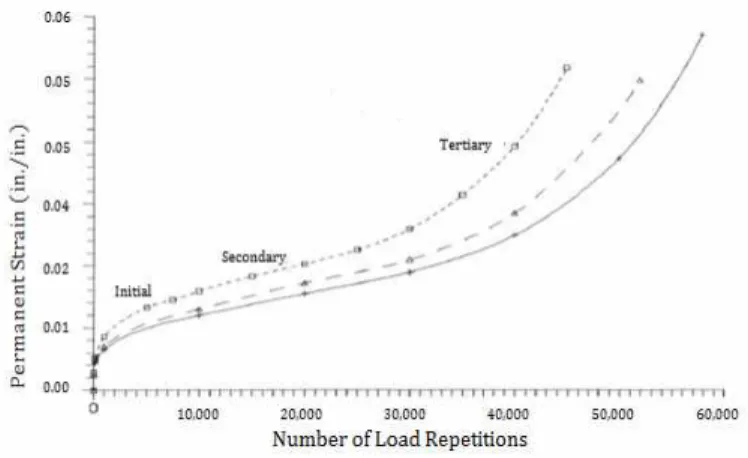
Test results of the HDS mixture under the testing conditions of 90 psi(620.55Pa) and 104°F (40°C) display that the vertical deformation increases in three stages: initial, secondary, and tertiary (Fig. 2). When the tertiary stage data were plotted with the initial and secondary stage data on a log-log scale, they deviated from the best fit straight line increasingly as the number of repetitions increased. Since some hair-line cracks were observed from the side of the specimens at the beginning of the tertiary stage it was concluded that the main reason for the tertiary stage was due to the shear failure around the top loading plate.

A wide range of test results from different mixtures have been studied, and 0.02 inch/inch of vertical strain has been selected

as the general transition point from the secondary to the tertiary stages. Hence the permanent deformation failure was defined

(6)

Fig. 2. Vertical permanent deformation versus number of load repetitions with HDS mixture.

5. Rutting Test Results and Prediction Model

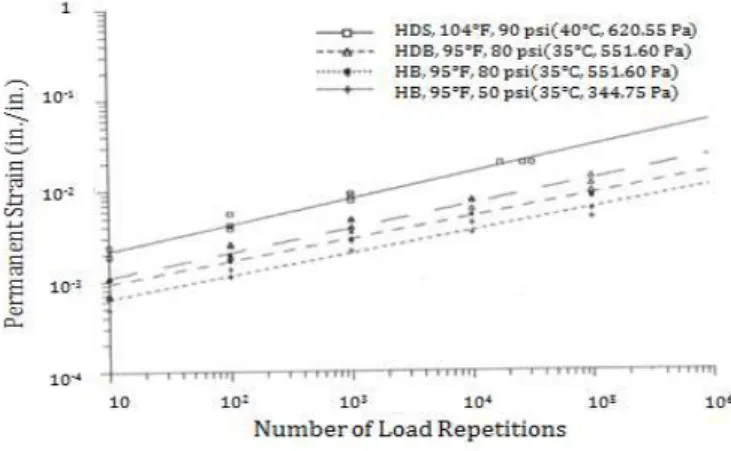
The permanent strain during the repeated uniaxial loading is plotted against the number of repetitions on a log-log scale. The complete test results with three mixtures (HDS, HDB, and HB) at different testing temperatures are presented in Fig. 3 in accordance with the experimental design in Table 5.

As expected, the permanent deformation from the top two inches of the asphalt layer, that was subjected to harsher testing conditions (higher temperature and higher vertical stress level), showed more permanent deformation. The permanent deformation of the asphalt concrete layer deeper than 2 inches(5.08cm) was almost negligible compared to that of the top two inches(5.08cm) of the asphalt layer. The regression coefficients of the test results are summarized in Table 6.

Mix Type Testing

Temperature (℉)

Vertical Stress

(psi)

Regression Constant

a b

HDS 104(40°C) 90(620.55Pa) 0.00110 0.2897

HDB 95(35°C) 80(551.60Pa) 0.00059 0.2708

HB 95 80 0.00053 0.2471

HB 95 50(344.75Pa) 0.00036 0.2492

Table 6. Regression coeffficients from rutting tests.

(7)

Fig. 3. Permanent deformation (rutting) test results.

A mechanistic and analytical rutting performance prediction model was decided based on the laboratory characterization of materials. The approach employed in this study is a laboratory-based approach which utilizes laboratory characterization of the materials under simulated field conditions such as loading forms, loading levels, loading times, and the testing temperatures. As a mechanistic and analytical approach, a layer-strain theory was used to predict the permanent deformation of the asphalt concrete layer.

Based on the layer-strain theory, the asphalt concrete layer is divided into three sublayers to estimate the amount of permanent deformation that would occur after a given number of wheel load applications. Then, with the vertical stress used for the laboratory characterization of each sublayer, the corresponding axial plastic strain is evaluated from the results of each laboratory characterization. As a result, the total rut depth for a given number of load repetitions is obtained by summing the products of the average plastic strain occurring from each sublayer and the corresponding sublayer thickness.

The proposed rutting performance prediction model of asphalt concrete layer is as follows:

      



where,  = total cumulative rut-depth(inch)

= calibration factor for i-th layer

 = experimentally determined regression constants from i-th layer

= i-th layer thickness(inch)

 = number of load repetitions

 = total number of layers

6. Conclusions

A new test method employing repetitive axial loading test with confinement was adopted as a means of characterizing the laboratory rutting performance of asphalt concrete in this research. Within the limits of the study, the following main conclusions can be drawn:

(1) A wide range of test results from different mixtures have been studied, and 0.02 inch/inch of vertical strain has been selected

(8)

in this study as the moment the permanent strain reaches 0.02inch/inch.

(2) Based on the layer-strain theory, the asphalt concrete layer is divided into three sublayers to estimate the amount of permanent deformation that would occur after a given number of wheel load applications. Then, with the vertical stress used for the laboratory characterization of each sublayer, the corresponding axial plastic strain is evaluated from the results of each laboratory characterization.

(3) The total rut depth for a given number of load repetitions is obtained by summing the products of the average plastic strain occurring from each sublayer and the corresponding sublayer thickness. It is noted that the developed rutting prediction model simulates properly the behaviors of flexible pavement materials.

Acknowledgement

This work was supported by Kyonggi University Research Grant 2016.

References

Harvey, J. T. (1990). "Asphalt Concrete Specimen Preparation Protocol SHRP Project A-003A", Strategic Highway Research Program, Technical Memorandum 90-4 Prepared for SHRP Project A-003A, Asphalt Research Program, Institute of Transportation Studies, University of California, Berkeley, US.

Kim, N. (1991). "Effect of Temperature and Mixture Variables on Fatigue and Permanent Deformation of Asphalt Concrete", Master Thesis, North Carolina State University, US.

Kim, Y.R., Khosla, N.P., Kim, N. (1992). "Effect of Aggregate Type and Gradation on Fatigue and Permanent Deformation of Asphalt Concrete", Proceedings of a Symposium, Effects of Aggregates and Mineral Fillers on Asphalt Mixture Performance, ASTM Publication STP 1147, American Society for Testing and Materials, 1992, pp. 310-328, US.

Kim, N. (1994). “Development of Performance Prediction Models for Asphalt Concrete Layers”, Ph. D. Dissertation of North Carolina State University, US.

Kim, N. (2014). "Development of Practical Rutting Characterization Method for Bituminous Mixtures", Journal of the Korea Society of Disaster Information(KSDI), Vol. 10, No. 1, pp. 25-32

Little, D.N., Button, J.W., Youssef, H. (1993). "Development of Criteria to Evaluate Uniaxial Creep Data and Asphalt Concrete Permanent Deformation Potential", Published in 1992 Annual Meeting of the Transportation Research Board, US.

Monismith, C.L., Tayebali, A.A. (1988). "Permanent Deformation (Rutting) Considerations in Asphalt Concrete Pavement Sections", Proceedings, Association of Asphalt Paving Technologists, Vol. 57m, US.

Sousa, J.B. and Craus, J. (1990). "Summary Report on Permanent Deformation in Asphalt Concrete", Institute of

Transportation Studies, University of California, Berkeley, US.

수치

Fig. 1. Schematic drawing of the repetitive axial loading test with confinement
Table 2. Aggregate sources and blending proportions for each mixture.
Table 5. Experimental design for rutting characterization
Fig. 2. Vertical permanent deformation versus number of load repetitions with HDS mixture.
+2

참조

관련 문서

1 John Owen, Justification by Faith Alone, in The Works of John Owen, ed. John Bolt, trans. Scott Clark, "Do This and Live: Christ's Active Obedience as the

Being firmly based on the meteorological observation and prediction, the KMA is also involved in a wide variety of matters, from research into earthquakes, volcanic

Analysis for Thermal Test Assessment Method of Spent Fuel Concrete Cask Using a Scale Down Model Ju - Chan Lee , Kyung - Sik Bang , Seung - Hwan Yu , and Woo - Seok Choi ( KAERI

Analysis for Thermal Test Assessment Method of Spent Fuel Concrete Cask Using a Scale Down Model Ju - Chan Lee , Kyung - Sik Bang , Seung - Hwan Yu , and Woo - Seok Choi ( KAERI

The anaerobic metabolic ability of the lower body was measured by a wingate test using a bicycle ergometer. The upper body anoxic metabolic ability was

In von Mises stresses of abutment, loading to the abutment was concentrated mainly by the morse taper in the one-piece abutment but was concentrated by

This study investigated the loading rate effect on the fracture resistance under cyclic loading conditions to clearly understand the fracture behavior of

architecture adopted to construct a building of repetitive units: Mies brought this factuality and the commonplaceness of the modern urban office to a sublime order..