Introduction
After grand open of domestic market by the world wide trade liberalization and social's topic of rice over- production, land-use of the reclaimed tidal land has been strongly recommended from paddy use only for rice cultivation to upland use for vegetable, fruit trees and other cash crops. Research on the multiple use of the reclaimed tidal land is now leaded by KARICO (RRI.
2006) and also widely discussed by many agricultural researchers of universities and research institutes (Yoo and Park. 2004; RDA, 2007; RRI. 2007). However, technical limitation of desalinization has been one of the most important problems for the reclaimed land not to be widely used for cultivation of upland crops. Koo et al.
(1992) reported that washing or extracting method of saline soils was very effective for the well drained soils with high hydraulic conductivity, and 1,200 mm of water was needed for depth 40 cm of saline soil to be desalted lower than 4.0 dS m
-1as limit concentration of saline soil.
Amount of water for desalinization can be estimated on the basis of checking salinity, pH and extractable Na (Koo et al, 1989a, 1989b) and amount of water used for soil washing method was generally needed 10 times more than for extracting method (Koo et al., 2001).
To find the practical desalting method is one of the most important things for the upland use of the tidal reclaimed land. In order to evaluate desalting efficiency of flooding method as one of the practical desalting methods, field study was experimented in a sandy soil of the Iweon reclaimed tidal land.
Effect of Flooding Treatment on the Desalting Efficiency
and the Growth of Soiling and Forage Crops in a Sandy Soil of the Iweon Reclaimed Tidal Land in Korea.
Yong-Man Sohn*, Hyun-Tea Kim, Geon-Yeong Jeon, Jae-Do Song, Jae-Hwang Lee, and Moo-Eon Park
Rural Research Institute. KARICO. Ansan 426-170, Korea
Effect of flooding on the desalting efficiency and the growth of sudan grass, barnyard grass, sesbania and corn was studied in a sandy soil of the Iweon reclaimed tidal land. Flooding plots were treated by 400 (one time flooding), 800 (two times flooding), and 1,200 mm (three times flooding) of water, respectively, and then soil salinities of the treated plots were compared with salinity of the control plot (not flooded) for estimation of desalting effect. Desalting ratio of 1,200 mm treatment was 78.3%for depth 0-20 cm, 70.5%for depth 20-40 cm and 60.8% for depth 40-60 cm, and then the soil salinity reached at 3 6 dS m ∼
-1. Consequently, it was considered that sandy saline soil was satisfactorily desalted for upland crops to be cultivated by 1,200 mm flooding, but insufficiently desalted by 400 mm and 800 mm flooding because of high salinity ranged 5 14 ∼ dS m
-1even after flooding treatment. In addition, it was estimated that soil salinity should be controled lower than 7.7dS m
-1in order to obtain more than 80% of crop emergence when four crops are simultaneously cultivated by inter- or mixed cropping in a field. Dry matter yields (kg 10a
-1) was 1,068 for sudan grass, 696 for barnyard grass, 1,426 for sesbania, and 1,164 for corn by 1,200 mm flooding treatment, but only 46.8∼
74.3% by 800 mm flooding treatment and 2.9 25.5% by 400 mm flooding treatment. Therefore, it is ∼ concluded that the flooding treatment more than 1,200 mm is necessary forsatisfactory desalinization in order for the low salt tolerance crops to be cultivated in the sandy reclaimed tidal land.
Key words: Reclaimed tidal land, Desalinization, Flooding treatment, Forage crop, Soiling crop
Received : January 29. 2010 Accepted : February 10. 2010
*Corresponding author : Phone:+82314001836
E-mail: [email protected]
Materials and Methods
Analysis of physico-chemical properties of soil used. Soil texture was decided by USDA texture triangle according to particle size distribution data analyzed by pipeting method. Bulk density was measured by core method and soil hydraulic conductivity was measured by the inversed auger-hole method (Park and Yoo, 1983;
Boast and Kirkham, 1971; Maasland, 1955). Measure- ment of water table level was done by installing PVC pipe (4 m in length, 3 cm in diameter) into soil.
Soil samples for chemical analysis was collected from soil depth 0-20 cm, 20-40 cm, and 40-60 cm in the experimental site. Soil chemical properties was analysed by standard method of the Rural Development Administrate (NIAST, 2000). Soil pH was measured for mixture sample of soil 1 to distilled water 5 ratio by pH meter. Various analysing methods for other chemical properties were used, such as Tyurin method for soil organic content, Lancaster method for available phosphate, 1N-NH4OAc (pH7.0) method for exchange- able cations. Soil salinity was measured for mixture sample of soil 1 to distilled water 5 ratio by EC-meter (NIAST, 2000). Soil salinity (EC) was practically expressed to be multiplied by five times of the values obtained from the 1:5 dilution method in this paper.
Table 1 and 2 show soil physical and chemical properties of the experimented site in the Iweon reclaimed land.
Flooding treatment for desalinization of the soils.
Four treatment plots were used for the experiment.
Control plot was not flooded before cultivation, and three flooding treatments for soil desallinization were plotted in the experiment field, such as 400 mm flooding treatment (one time application), 800 mm flooding treatment (two times application by 400 mm) and 1,200 mm flooding treatment (three times application by 400 mm).
Cultivation method of crops and measurement of growth status. Experiment was done in the plot of 500 m
2(10×50 m) in the Iweon reclaimed tidal land. Four crops such as sudan grass (G7), barnyard grass (native variety of Jeju island), sesbania (unknown) and corn (Gangilok) were used for the experiment. Seeds of sudan grass, barnyard grass and sesbania were sown in narrow strip (40 cm×18 cm) on June 1st, 2008 and 4 kg 10a
-1of sudan grass and sesbania seeds, and 1.3 kg 10a
-1of barnyard grass seeds were used for seeding. Corn were seeded in spot of 60×30 cm intervals. Application rate of fertilizers was 18-6-9 kg 10a
-1of N-P
2O
5-K
2O. Plant height was measured from 10 plants of crops in the every treatment and forage yield was obtained by cutting and weighing all plants in 6m
2(3×2 m) of sample area. Dry matter was calculated by drying and weighing 2 kg of fresh samples.
Table 1. Soil physical properties of the experimented site before crop cultivation in the Iweon reclaimed land.
Depth Particle distribution Soil
Texture BD Hydraulic
conductivity
Sand Silt Clay
cm ---%--- Mg m
-3cm day
-10-20 82.8 13.2 4.0 LS 1.48
27.67
20-40 83.7 13.0 3.3 LS 1.60
40-60 84.5 10.5 5.0 LS 1.60
Table 2. Soil chemical properties of the experimented soils before crop cultivation at the experimented site of the Iweon reclaimed land.
Samples pH EC OM Av.P
2O
5Ex. cations
Ca K Mg Na
cm (1:5) dS m
-1g kg
-1mg kg
-1--- cmol
ckg
-1---
0-20 8.75 14.27 45 13.8 4.65 1.47 5.17 9.02
20-40 8.96 11.13 27 8.3 5.77 1.25 3.96 6.78
40-60 9.00 10.28 35 4.1 8.37 1.15 3.62 6.30
Results and Discussion
Desalting effect of flooding treatment In order to estimate desalinization effect of the flooding treatments, soil salinities of soil depth 0-20cm, 20-40 cm and 40-60 cm were measured in the treated plots and compared with the control plot. Table 3 shows the soil salinities of the treated plots and the control plot after flooding treatment.
Soil salinities were 3.19 dS m
-1of depth 0-20 cm, 4.46 dS m
-1of depth 20-40 cm and 5.73 dS m
-1of depth 40-60 cm in the plot treated by 1,200 mm flooding, 5.15 dS m
-1of depth 0-20 cm, 6.11 dS m
-1of depth 20-40 cm and 9.58 dS m
-1of depth 40-60 cm in the plot treated by 800 mm flooding and also 10.54 dS m
-1of depth 0-20 cm, 10.07 dS m
-1of depth 20-40 cm and 13.68 dS m
-1of depth 40-60 cm in the plot treated by 400 mm flooding. Fig. 1 shows desalting ratio with soil depth by flooding treatments.
Fig. 1. Desalting ratio with soil depth by flooding treat- ment in the sandy soil of the Iweon reclaimed tidal land.
The desalting ratio obtained by the 400 mm flooding treatment was estimated as 35.5% for depth 0-20 cm, 33.4% for depth 20-40cm and 6.5% for depth 40-60 cm, that obtained by the 800 mm flooding treatment was estimated as 64.9% for depth 0-20 cm, 59.6% for depth 20-40 cm and 34.5% for depth 40-60 cm, and also that
obtained by the 1,200 mm flooding treatment was done as 78.3% for depth 0-20 cm, 70.5% for depth 20-40 cm and 60.8% for depth 40-60cm. Koo et al. (2001) reported that soil substrata was very difficult to be desalted by washing or extracting method. In this research, soil salinities of substrata (depth 40-60 cm) after desalting treatment were 13.68 dS m
-1in the 400 mm flooding treatment, 9.58 dS m
-1in the 800 mm flooding treatment and 5.73 dS m
-1in the 1,200 mm flooding treatment, which were more than 4.0 dS m
-1of limit concentration for the saline soil (Yoo, 2000). Salinities of the plots treated by flooding for desalinization were too high for the low salt tolerance crops to be grown well, because the salinities were 10 14 ∼ dS m
-1after 400 mm flooding treatment and 5 10 dS m ∼
-1after 800 mm flooding treatment. However, it was satisfactorily desalted for the low salt tolerance crops to be grown well, because soil salinity reached at 3 6 dS m ∼
-1after 1,200 mm flooding treatment. It was concluded that flooding treatment more than 1,200 mm should be needed for soil salinity of the sandy saline soil to be lowered down less than 4.0 dS m
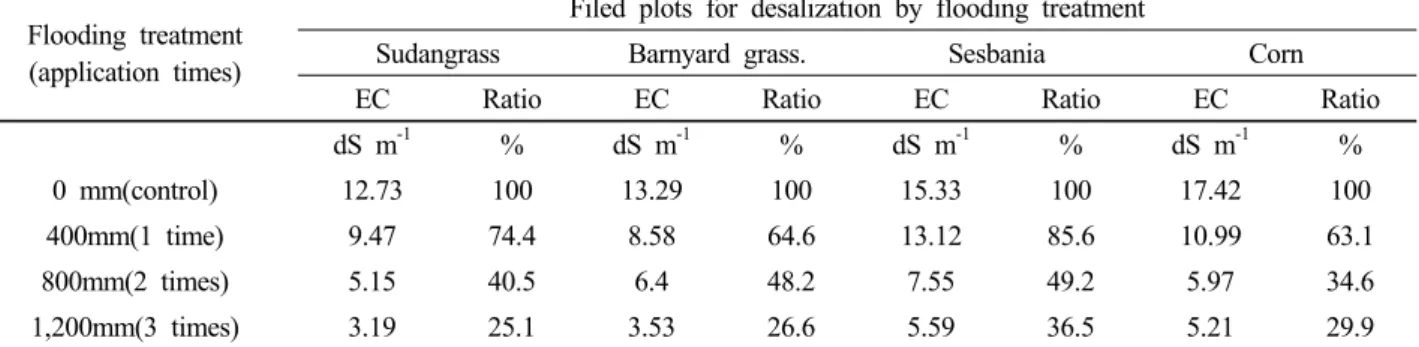
-1as limit concentration of saline soil (Yoo, 2000; Knott, 1962). Table 4 shows soil salinities of plots planted by sudan grass, barnyard grass, sesbania and corn.
Although same amount of flooding water was applied to the field, desalting effect was variable, because soil EC and ratio were not same after flooding treatment. This salinity variation might be influenced from different acting process because of original soil variation. Fig. 2 shows relationship between amount of applied water and desalting ratio by flooding treatment.
It was estimated that the desalting ratio was near zero when less than 130 mm of flooding water was applied in the sandy reclaimed soil. This means that 130 mm water for flooding treatment is low limit for the soil to be desalted in the sandy reclaimed soil.
Table 3. Soil salinities of the field plots treated by flooding and the control plot(not flooded).
Flooding treatment (application times)
Soil EC and relative ratio of plots treated.
0-20cm 20-40cm 40-60cm Average
EC Ratio EC Ratio RC Ratio EC Ratio
dS m
-1% dS m
-1% dS m
-1% dS m
-1%
0 mm(control) 14.69 100 15.13 100 14.63 100 14.82 100
400mm(1 time) 10.54 64.5 10.07 66.6 13.68 93.5 11.43 77.1
800mm(2 times) 5.15 35.1 6.11 40.4 9.58 65.5 6.95 46.9
1200mm(3 times) 3.19 21.7 4.46 29.5 5.73 39.2 4.46 30.1
Change of soil salinity during crop cultivation . Soil salinity of the experimental field was continuously changed by influence of water table rising, evapo- transpiration or rainfall. Table 5 shows rainfall data
measured at the Seosan station of Korea Meteorological Administration in 2008.
It was recorded that five to fourteen days rained during a month and amount of rainfall was 335.5 mm in July of rainy season and 34.0 mm in October of dry season in 2008. Although amount of rainfall was 335.5 mm in July, only 14 days were rained. This means that torrential rains such as 108.5 mm on 19th of July, have been occasionally happened and lost by much runoff not to be effective for soil desalinization. Rising and lowering of water table also affect to the soil salinity change. Fig. 3 shows changes of water table and salinity of underground water in the Iweon reclaimed tidal land.
Water table had been risen upto -23 cm in summer and lowered down upto -167 cm in the autumn-winter. Rising of water table might be one of the reasons for the soil to be re-salted in the reclaimed tidal land, because height of capillary movement was estimated as 35 70 cm for fine ∼ sand and 70 150 cm for silt (Jung, 2009). However, it ∼ was estimated that influence of water table rising was not significant for the soil to be re-salted, because water table was fluctuated from -106 cm to -59 cm during crop cultivation.
It was generally known that soil salinity was continuously changed by pattern of evapo-transpiration, Table 4. Surface soil salinities of field plots treated by flooding times and water amount used in the sandy soil of the Iweon reclaimed tidal land.
Flooding treatment (application times)
Filed plots for desalization by flooding treatment
Sudangrass Barnyard grass. Sesbania Corn
EC Ratio EC Ratio EC Ratio EC Ratio
dS m
-1% dS m
-1% dS m
-1% dS m
-1%
0 mm(control) 12.73 100 13.29 100 15.33 100 17.42 100
400mm(1 time) 9.47 74.4 8.58 64.6 13.12 85.6 10.99 63.1
800mm(2 times) 5.15 40.5 6.4 48.2 7.55 49.2 5.97 34.6
1,200mm(3 times) 3.19 25.1 3.53 26.6 5.59 36.5 5.21 29.9
Fig. 2. Relationship between amount of applied water and desalting ratio of the surface soil by flooding treat- ment before seeding operation of crops in the sandy soil of the Iweon reclaimed tidal land.
Table 5. Rainfall and rained days during crop cultiva- tion measured at the Seosan station of Korea Meteoro- logical Administration.
Jun. Jul. Aug. Sep. Oct.
Rainfall(mm) 118.1 335.5 114.2 62.7 34.0
Rained days 9 14 12 8 5
Fig. 3. Changes in height of water table and salinity of underground water in the Iweon reclaimed tidal land.
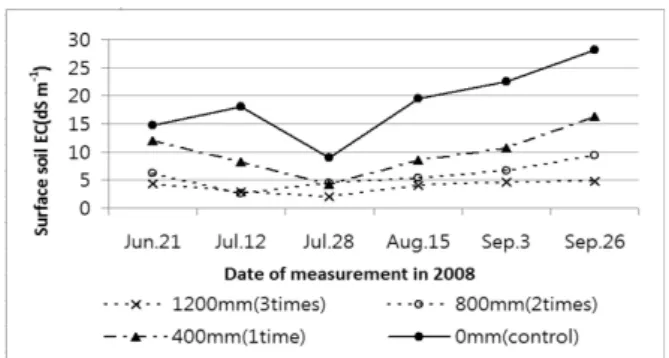
fluctuation of water table and rainfall. Fig. 4 shows soil salinity changes during crop cultivation.
The lowest EC of surface soil salinity was measured in July and the highest value was recorded in September and salinity difference among four treatments was steadily remained after the beginning of desalting treatment during cultivation period even if July had 335.5 mm of rainfall.
Soil salinity of the plot treated by 1,200 mm flooding was continuously low enough for crops to be grown, but soil salinity of the plots treated by 400 mm or 800 mm flooding was more or less high for crops to be grown well, because salinity occasionally increased more than 4.0 dS m
-1as limit concentration of saline soil. This means that desalting treatment must be done before crop cultivation by applying more than 1,200mm flooding. Changing pattern of soil salinity was similar among crops on plots treated differently. Fig. 5 shows soil salinity changes of four plots cultivated by different crops.
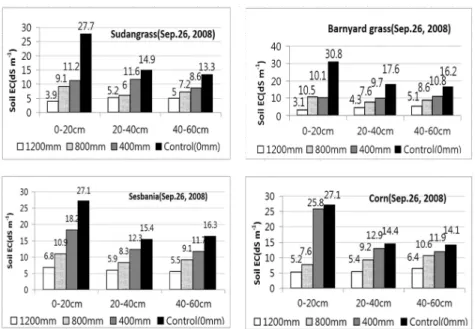
Changing pattern of soil salinity was very similar among control plots of the crops and difference among four crops on the plots treated by different flooding was very small. Salinities of plots treated by different flooding were more or less higher in plots of sesbania and corn than in plots of sudan grass and barnyard grass. Soil salinity change was also different with soil depth. Fig. 6 shows soil salinity changes with soil depth.
Soil salinity of the control plot was higher than those of the plots treated by flooding. Salinity of top soil was higher than those of subsoil of depth 20-40 cm and depth 40-60 cm in the control plot, but that of top soil was more or less same as those of subsoil in the plots treated differently by flooding, except for corn. It was peculiar and questionable for salinity pattern with depth to be very similar between the control plot and the plot treated by 400 mm flooding.
Relation between soil salinity and crop growth.
Emergence and growth of crops greatly decrease with salinity increase, and soiling and forage crops were well emerged and grown below 7 dS m
-1(Sohn et al., 2009a,b), and also vegetable crops such as young radish, crown daisy and so on, were well grown below 8.40 dS m
-1(Lee et al., 2003). Fig. 7 shows relationship between soil surface salinity and emergence of crops.
Emergence ratios of plants were significantly much more in barnyard grass and sudan grass than in corn and sesbania, because seed numbers per weight of barnyard grass and sudan grass were much more than those of corn Fig. 4. Change in surface soil salinity during period of
crop cultivation at the Iweon reclaimed tidal land.
Fig. 5. Change in surface soil salinity during period of crop cultivation at the Iweon reclaimed tidal land.
and sesbania. In order to know the reasonable control range of soil salinity when four crops are simultaneously cultivated for the inter- or mixed-cropping in the same field, the regression analysis has been done by using emergence ratio of four crops. From the regression analysis, soil salinity must be controlled less than 7.7 dS m
-1in order to obtain more than 80% of emergence and emergence was near zero when soil salinity rose higher than 15 dS m
-1. It was reported that emergence ratio of the crops was deeply related with soil salinity and critical point of salinity for seed emergence ratio to be reached at zero, was estimated as 17 dS m
-1for sudan grass, 25 dS m
-1for barnyard grass, 20 dS m
-1for sesbania and 17 dS m
-1for corn by regression analysis (Sohn, 2009a). However, critical point of salinity estimated in this study was 15 dS m
-1and was much different for barnyard grass and sesbania from the previous report, but similar for sudan grass and corn (Sohn, 2009a). It is concluded that estimation of critical salinity not to be emerged is not simple because of involving of many different factors
including soil salinity and needs further studies for the inter-cropping or the mixed cropping.
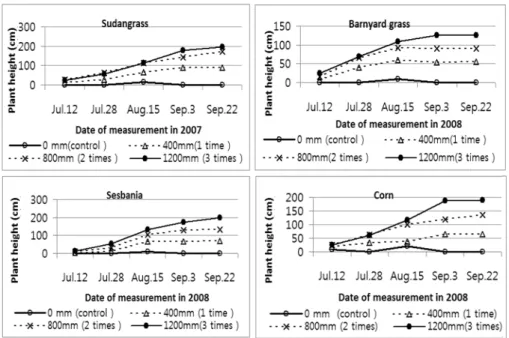
Plant growth and yield. Difference of salinity caused by different flooding treatments could be deeply related with plant growth and yield. Fig. 8 shows plant growth pattern of the crops with time according to flooding times and water amount used for desalinization.
Plant height increased with increase of flooding times and water quantity for desalinization. Especially, seeds of the control plot were not emerged in June, but few seeds were emerged at the end of July and killed in mid-August when soil salinity rose. It is concluded that salinity difference at beginning of desalinzation may be influenced for whole life of crops from emergence to harvest. Fig. 9 shows forage and dry matter of the crops with water amount and flooding times used for desalinization in the Iweon reclaimed tidal land.
Forage and dry matter yields (kg 10a
-1) were 3,000 and 1,068 for sudan grass, 1,575 and 696 for barnyard grass, Fig. 6. Soil salinities with soil depth at Sep. 26, 2008.
Fig. 7. Relation between soil salinity and emergence of crops.
4,375 and 1,426 for sesbania and 3,000 and 1,164 for corn in the plots treated by 1,200 mm flooding (three times), while forage and dry matter yields (kg 10a
-1) were only 750 and 277 for sudan grass, 256 and 128 for barnyard grass, 250 and 85 for sesbania and 88 and 34 for corn in the plots treated by 400 mm flooding (one time). Yields of the plots treated by 400 mm flooding and the plots treated by 800mm flooding were only 26% and 75% for sudan grass, 17% and 53% for barnyard grass, 6% and 46% for sesbania, and 3% and 50% for corn in comparison with yields of the plots treated by 1,200 mm flooding.
According to the previous report (Song et al., 1981), forage and dry matter yields (kg 10a
-1) were 2,080 and 466 for sorghum, 1,120 and 247 for barnyard grass, and 900 and 162 for corn. It is concluded that reasonable yield can be obtained by the flooding treatment more than 1,200 mm. Therefore, desalting treatment before seeding operation is strongly recommended for the cultivation of upland crops in the reclaimed tidal land.
Fig. 8. Plant growth pattern of the crops with time according to flooding times and water amount used for desalini- zation.
Fig. 9. Forage and dry matter of the crops with flooding times and water amount used for desalinization in the Iweon
reclaimed tidal land.
Conclusion
It was estimated that sandy saline soil was desalted up to 35.5% for depth 0-20cm, 33.4% for depth 20-40 cm and 6.5% for depth 40-60 cm by the 400 mm flooding treatment(one time), upto 64.9% for depth 0-20 cm, 59.6% for depth 20-40 cm and 34.5% for depth 40-60 cm by the 800 mm flooding treatment (two times), and also upto 78.3% for depth 0-20cm, 70.5% for depth 20-40 cm and 60.8% for depth 40-60 cm by the 1,200 mm flooding treatment (three times). In addition, it was estimated that the effective desalting ratio of soil depth 0-20 cm was near zero by flooding treatment less than 130 mm according to result of regression analysis. From the regression analysis, soil salinity when four crops are simultaneously cultivated by inter- or mixed cropping in a field, must be controlled less than 7.7 dS m
-1in order to obtain more than 80% of emergence and emergence ratio was near zero when soil salinity rose higher than 15 dS m
-1. Consequently, it was considered that desalting effect might be not expected unless flooding treatment more than 130 mm be applied, and then when flooding treatment more than 1,200 mm was applied for desalinization, sandy saline soil was satisfactorily desalted less than 4.0 dS m
-1for the low salt tolerance crops to be grown well. Fresh and dry matter yields (kg 10a
-1) were 3,000 and 1,068 for sudan grass, 1,575 and 696 for barnyard grass, 4,375 and 1,426 for sesbania and 3,000 and 1,164 for corn in the plots treated by 1,200 mm flooding (three times), while yields of the plots treated by 400 mm flooding (one time) and the plots treated by 800 mm flooding (two times) were only 26%
and 75% for sudan grass, 17% and 53% for barnyard grass, 6% and 46% for sesbania, and 3% and 50% for corn in comparison with yields of the plots treated by 1,200 mm flooding (three times). Finally, it is concluded that desalting treatment of more than 1,200 mm flooding before seeding operation is strongly recommended for upland crops to be grown well in the reclaimed tidal land.
References
Boast C.W., and D. Kirkham. 1971. Auger hole seepage theory.
Soil Sci. Soc. Am. Proc. 35:365-373.
Jung, Y.H. 2009. Proposal for active development of tree nursery farm in the Saemangeum reclaimed tidal land.
Symposium report pp 41-60, Rural Research Institute, KARICO in Korea.
Knott J.E. 1962. Handbook for vegetable growers. p44-45.
Wiely & sons, Inc.
Koo, J. Choi, J.G. Son, K.S. Yoon, D.W. Lee, and K.H. Cho.
2001. Analysis of electrical conductivity during desalini- zation of reclaimed tidal lands. J. Korean Soc. Agricultural Engineer 43(4):37-48.
Koo, J.W., K.W. Han, and C.H. Eun. 1989a. A laboratory study on the estimation of water requirement for the desalinization of reclaimed tidal land. J. Korean Soc. Agricultural Engineer 31(1):96-105.
Koo, J.W., K.W. Han, and C.H. Eun. 1989b. Experimental studies for analysing salt movement desalinization effect on reclaimed new Manggeum tidal land. J. Korean Soc.
Agricultural Engineer 31(2):92-103.
Koo, J.W., K.W. Kang, S.J. Gwon, and D.W. Lee. 1992.
Determining irrigation requirements and water management practices for normal growth of dry field crops in reclaimed tidal land. J. Korean Soc. Agricultural Engineer 34(4): 80-96.
Lee, S.H., B.D. Hong, Y. Ahn, and H.M. Ro. 2003. Relation between growth condition of six upland-crops and soil salinity in reclaimed land. J. Korean Soc. Soil Sci. Fert. 36(2):66-71.
Maasland, M. 1955. Measurement of hydraulic conductivity by the auger hole method in anisotropic soil. Soil Sci. 71:379-389.
NIAST. 2000. Analysis of soil and plant. National Inst. of Agr.
Sci. & Teck. RDA, Suwon, Korea.
Park M.E., and S.H. Yoo. 1983. A comparison of soil hydraulic conductivities determined by three different methods in a sandy loam soil. J. Korean Soc. Soil Sci. Fert. 16(1):14-19.
RDA. 2007. Studies on friendly environmental development for foundation of multiple agriculture in reclaimed land. Res.
Rpt. Natl. Inst. Honam Agr. pp99-147.
RRI. 2006. Agricultural complex development for upland &
Horticultural crops in the Seamangeum reclaimed farmland.
Res. Rpt. Rural Research Institute. pp 1-504, Korea Rural Community & Agriculture Corporation.
RRI. 2007. Development method of the future agriculture com- plex in reclaimed land. Res. Rpt. Rural Research Institute. pp 1-400. Korea Rural Community & Agriculture Corporation.
Sohn, Y.M. G.Y. Jean, J.D. Song, J.H. Lee, and M.E. Park.
2009a. Effect of spatial soil salinity variation on the emergen- ce of soiling and forage crops seeded at the newly reclaimed tidal lands in Korea. Korean J.Soil Sci. Fert. 42(3):172-178 Sohn, Y.M. G.Y. Jean, J.D. Song, J.H. Lee, and M.E. Park.
2009b. Effect of spatial soil salinity variation on the growth of soiling and forage crops seeded at the newly reclaimed tidal lands in Korea. Korean J.Soil Sci. Fert. 42(3):179-186.
Song, J.D., K.J. Lee, and J.Y. Lee. 1981. Selection experiment of forage crops suitable for reclaimed land. Res. Rept.
Livestock Exp. Sta. p782-789.
Yoo, S.H. 2000. Dictionary of Soil Science. Printed by Seoul National University.
Yoo, S.H., and M.E. Park. 2004. Proposal of land-use planing for agricultural use of the Saemangeum reclaimed land. J.
Soc. Agr. Res. on Reclaimed Lands 2:68-91.
이원간척지 사질 염류토양의 담수제염처리가 제염효과와 녹비 사료작물의⋅ 생육에 미치는 영향