• 검색 결과가 없습니다.

A Study on Textile Design Preferences in Outdoor Clothing According to New Senior Women's Psychological Comfort

N/A
N/A
Protected

Academic year: 2021

Share "A Study on Textile Design Preferences in Outdoor Clothing According to New Senior Women's Psychological Comfort"

Copied!
16
0
0

로드 중.... (전체 텍스트 보기)

전체 글

(1)

. Introduction

Due to the development of modern medicine, improvement of living standards, decrease of fertility rate, and extension of an average life span, Korea is rapidly becoming an aging society.

Corresponding author: Young-Seok Koo Tel, +82-51-510-2843, Fax. +82-51-583-5975, Email: [email protected]

This work was supported by a 2-Year Research Grant of Pusan National University.

Therefore, the new senior people play a important role as a new consumer group. The new senior are distinct from the former 'senior' in that they are active in consumption activities with a firm asset base (Kang & Park, 2009).

According to Statistics Korea (2015), as of

A Study on Textile Design Preferences in Outdoor Clothing According to New Senior Women's Psychological Comfort

Min Nyoung Seo · Young Seok Koo

Dept. of Clothing & Textiles, Pusan National University, Busan, Korea

Abstract


The purpose of this study is to analyze the differences in color, pattern, and texture of functional materials of outdoor clothing according to new senior women's psychological comfort. The data were collected from 163 female respondents aged 55-64 living in Busan. The results of the study are as follows. First, both the high and low psychological comfort groups preferred soft material the most. The high psychological comfort group particularly preferred soft textures and highly evaluated textured material in general.

Second, both groups mostly preferred plain patterns while the high psychological comfort group preferred the dot pattern more. Third, in terms of colors, the high psychological comfort group preferred navy and purple, while the low psychological comfort group preferred brown. As to achromatic colors, both groups preferred black the most with the high psychological comfort group preferred gray and white more than the other group.

Fourth, the high psychological comfort group preferred colors and patterns of clothing that made one look the most slimming, while the low psychological comfort group strongly preferred colors and patterns of clothes. Therefore, our results suggest that new senior women have a strong interest in outdoor clothing, not only in terms of textile functions, but also having interest in textile designs. In particular, the new silver women value psychological comfort in colors more than patterns of textile design.

Keywords : functional materials, psychological comfort, new senior women, textile design

(2)

2013, the assets of their 50s accounted for the largest portion among the householders in different age groups; in addition, the level of their consumption and expenditure is also high.

Those in their 50s, i.e. in the transition period from their middle age to the old age, form their own market. They also take the lead of a shift in generations, changing the general concept of existing aging populations. The motivation underlying their consumption activity can be summarized with three key words: youth, nostalgia, and the self (Statistics Korea, 2015).

Specifically, the new senior pursue their physical and mental 'youth' that goes beyond the common desire for health, 'nostalgia' for feelings and values of the past, and 'the self’

(self-realization) through self- development and association (An, 2011). Accordingly, since the new senior have more versatile and specific consuming styles, as well as various characteristics pertinent to different age groups, it is difficult to define them as a simple and distinct category. Therefore, market targets for this generation should be segmented depending on their consumption characteristics.

In general, the silver industry needs to seek growth through emotional approaches, as well as ensure satisfaction with material values in order to meet their demands (Seo, 2011).

Inconvenience due to physical functions in older age needs to be considered as styles and emotion with which they can enjoy cultures in a sophisticated and dignified manner (Kim, Kim, &

Kim, 2011). In particular, they express desires for psychological satisfaction and belonging to the society or a group activity. They show keen attention to clothing as a way of complementing their physical and psychological loss (Kim, 2011). They attach more value to clothing than they did in their young age. In addition, their

interest in appearance grows in parallel to the physical shape changes due to aging, which makes the role of clothing even more important.

Therefore, the clothing industry for the silver generation will continue to grow. According to Kim (2006), the new silver generation assigns a great importance to the aesthetic aspects of clothing, while the previous generation of the aged focused more on practicality and functionality. In this context, it is necessary to thoroughly investigate the design of functional textile, which is important with regard to aesthetics and psychological comfort.

Most previous studies on the aged and their clothing for the last decade have focus on clothing construction in relation to major body shape changes (Kim & Choi, 2006). Studies of the silver market segmentation included clothing purchase behaviors and preferences depending on the age groups (actual age, recognized age) and lifestyles (Hong & Choi, 2009; Kim & Na, 2008). By contrast, very few studies sought to address functional textile of clothing for the aged people, despite the importance of functional textile has been widely recognized in previous research (Park, Kim, & Park, 2010).

Since 2000, with growth of the outdoor market, numerous studies have been conducted on many functional textiles have been conducted (Cha, 2004; Lee, Kim, Lee, 2010).

In particular, studies have been conducted on purchase behaviors among the aged for functional textile clothing products since 2005 (Eom & Lee, 2010; Jo, 2011), preferences in functional textile (Kim, 2010; Seo & Koo, 2014), clothing design in utilization of new functional textile (Han, 2011), among other aspects.

However, previous research on functional textile

for the new senior has mainly focused on

functionality, overlooking its aesthetic aspects.

(3)

Therefore, the present study segments the new senior women according to psychological comfort of clothing. Furthermore, we examine the differences between the high and low psychological comfort groups in design preference of functional materials. Finally, we seek to suggest a basis for textile designs development of functional materials, such as visual and tactual aspect, so that to enhance psychological comfort for the new senior.

. Theoretical Background

1. The psychological comfort of functional materials clothing

The comfort is associated with human emotions and desires, because humans have always had the desire to pursue a comfortable life free from mental stress (Yoo, 2013). Also, this comfort is closely associated with psychological characteristics of clothing, and the clothing comfort means that the wearer has a comfortable feeling with regard to climate changes. Four and Hollies (as cited in An, 1995) have defined the concept of clothing comfort as a state 'without a sense of stress'. Furthermore, according to An (1995), physical, physiological, and psychological factors are three most important factors that influence the clothing comfort. When the clothing comfort is defined as a state with no discomfort, this suggests the feeling of thermal comfort in general, i.e. a basic and physical sense of 'comfort.' However, psychological comfort, or pleasure, has recently started to be emphasized in relation to the environment and products for humans (Hong &

Hong, 1998). Yoo (2013) states that the comfort is related to the subjective perception of the

various senses and includes many aspects of human sensation, such as sense of sight, touch, thermal sensation, and pain. Subjective recognition includes a psychological process in which all types of sensuous recognitions decide on the priorities, then combine and evaluate the psychological process based on past experiences and current demands. Thus, the interaction between the human body and clothes plays a key role in determining the extent of comfort; furthermore, physical, social, and cultural aspects of the environments also significantly affect the sense of comfort.

Therefore comfort can be categorized into physical, psychological, and social comfort. It has both physiological and functional aspects and is further classified into thermal comfort, tactile comfort, and aesthetic comfort.

Previous studies on wearing comfort focused

on the objective, experimental evaluation of the

effect of characteristics of fabrics, textiles, and

clothes on comfort (An, 1995; Hong & Hong,

1998). These studies evaluated fabric properties

and subjective wearing comfort (Kim, 1996),

assessed wearing comfort using ECG and EEG

analyses (Jung & Kim, 2009), evaluated the

clothing wear comfort among the elderly women

based on rectal temperature, melatonin, and

cortisol values (Bang & Kim, 2013), and

assessed the wearing comfort of the elderly

woman using biochemical and physiological

response analysis (Bang, 2013). These studies

evaluated material functions and examined their

correlations by means of subjective wearing

experiments and devices controlling for

environmental conditions. Yoo (2013) pointed out

that, as the ultimate goal of clothing made of

functional materials is to create comfort for the

wearer, it is necessary to figure out the most

important elements regarding how consumers

(4)

sense comfort while they wear functional textile clothing. Thus, Yoo (2013) conducted a survey where adults in their 40s and 50s who would go mountain climbing were asked about their thoughts and words coming up to their minds when it comes to comfort of wearing clothing.

The results of this study suggest that the most frequently used words, by both men and women alike, were, in the order of the words’ frequency of mention, 'comfort’, 'stretch', and 'lightness'.

Based on these results, a factorial analysis was conducted on the words related to wearing comfort and four factors were extracted: Factor 1 was the exercise/pressure; Factor 2 was moisture; Factor 3 was psychology; and Factor 4 was tactile/body temperature. Factor 3 (psychological comfort) was related to social aspects and appearances and, thus, this might be viewed in terms of social psychology of clothing. In a related research, Ryu (1997) extracted five factors of psychological benefits of clothing - expressive pleasure, individuality &

attractiveness pursuit, value of brands, harmony, and social recognition. According to Ryu (1997), the multi-attribute centralized group, including both functional and design properties, sought elements of pleasure and psychology, as well as practical and functional advantages of clothes.

The group which affect the evaluation of clothing significantly had a major impact on psychological pursuits more than functional merits in evaluation.

Research on the psychological comfort of functional materials clothing focused on functional and physical comfort. Although outdoor clothing has been designed in order to maintain the optimum state during outdoor activities, many people usually wear outdoor clothing as casual wear for considerations of comfort. Therefore, it is necessary to find out

whether they feel psychological comfort wearing outdoor clothing. In response to this need, the present study examines psychological comfort in terms of aesthetic and texture/functional factors.

2 Design preferences of functional materials

Since textile materials should be in harmony with the lines and colors in clothing design, they are an important factor of aesthetic expression.

Moreover, their characteristics cause psychological reactions of comfort and discomfort. Thus, choices of textile materials according to consumers' tastes significantly affect the clothing styles, emotions, and moods (Choi, 1990). However, previous research on functional materials has largely focused on functionality, rather than on aesthetic expression, analyzing psychological reactions of comfort and discomfort of consumers depending on the functions. In this regard, Yoo (2013) pointed out that, while existing materials focus on physiological body states or exercise functional aspects, the directions of future development need to be diversified and take into consideration the elements that would affect users' psychological and mental pleasantness. In Choi, Jeon, & Yoo (2009), the level of expectation of aesthetic and practical aspects of functional materials was not as high as that of physiological and physical aspects. Furthermore, Lee (2010) reported that 70% of female trekkers in their 20s and 30s did not wear outdoor clothing as town wear. The reason was mainly their dissatisfaction with the design (30%). The most preferred reasons for the selected brand were 'designs, colors, patterns' (37.5%), followed by 'functional materials are suitable’

(12.8%). Likewise, according to the results

(5)

reported by Kim and Na (2008), the major factors involved in purchasing decisions about climbing sportswear in the new silver (55 64 ∼ y.o.) and the silver (over 65 y.o.) are comfort and utility, followed by 'design/color' for the new silver and 'price' for the silver. On the other hand, the new silver are reported to be dissatisfied with ‘quality’, ‘color/design', and 'price' , in order of importance, while the silver were dissatisfied with ‘quality’, 'price', and 'wearing comfort'.

According to previous research on design preferences of functional materials, Nam, Kim, &

Lim (2011) analyzed similarities and differences of color preferences for mountain climbing wear according to gender, season, and item. The results of this study demonstrate that women who preferred red, red purple, black, purple and blue displayed a wider range of choices in color as compared to men who preferred black and blue color throughout all seasons. Furthermore, in their investigation of consumers' color preferences in outdoor wear brands, Jung and Choi (2012) established that women in their 40s preferred yellow, red, and orange in the tops, while women in their 50s preferred purple and orange. The most preferred bottom color was green and gray for women in their 40s and blue, purple, and black for women in their 50s. Cha (2004) mentioned that the design preference tendencies of mountain-climbing garments could be defined as the noticeable style of males and females in their 20s, the sophisticated style in their 30s, and the slim style in the group aged over 40s. The preferred colors for jackets were gray and black series in consumers in their 20s and 30s, the red series in consumers over 40s.

Also similar color combination showed the highest preference, regardless of age. Kim and Oh (2013) investigated color preferences for

outdoor clothing among male and female university students in their 20s. As for hue, most male students preferred cold colors for jackets, while most female students preferred warm colors for jacket. As for tones, most male students preferred dark tones for jackets and pale tones for T-shirts, whereas most female students preferred vivid tones for jackets, pale tones for T-shirts, and dull tones for pants. Han and Kim (2014) analyzed color preferences and pursuit image of mountain climbing wear among the male and female groups aged over 30.

According to Han and Kim’s (2014) results, the male group tended to generally prefer muted, cold colors: navy, blue, and black for jackets, green, yellow, blue, navy, and brown for vests, blue, white/gray, navy, and black for T-shirts.

By contrast, the female group tended to prefer warm colors: red, orange, and green yellow for jackets and vests, red, orange, and yellow for T-shirts, as well as bright/vivid colors, such as red and orange.

As mentioned above, textile design preferences for outdoor clothing are mostly restricted to color, so further research is needed on textile design’s general factors, such as patterns, texture, and color.

3. Characteristics of the new senior

The criterion of the age of the elderly

considerably differs across societies and even

within a society with the passage of time. The

criterion of the age for the elderly in our society

has also been changed by social changes and

the threshold age of the elderly is currently on

an upward trend. According to Lee (2011), the

elderly can be defined differently according to

social, cultural, and economic aspects, as well

as enjoy different definitions according to the

(6)

purpose of a specific study. The criterion of the age of the elderly in previous studies was fractionated from various perspectives. The fractionation divided the age into senior and new senior, as well as the pre-elderly of 50’s who are preparing for their aged life. Thus, the threshold of the elderly is conventionally the age of 50 60 years old (Kang & Park, 2010; Park, ∼ Kim, & Park, 2010) and 55 65 years old (Huh, ∼ Hong, Han, & Kim, 2012; Kim, 2006). The fractionation of the elderly brings considerable change into social structures. Therefore, the elderly should not be considered as a simple consuming group in the fashion industry. The newly created senior, to distinguish them from the previous senior, are referred to using a new term, ‘the new senior’ (Huh, et al., 2012); they belong to the Baby Boomer generation (i.e.

those born in 1946 1964), born after World War ∼ II in the West. However, as the age classifications for the new senior can vary, the age must be classified based on the market fractionation.

Inconveniences due to physical functions in older age need to be considered as styles and emotions with which they can enjoy cultures in a sophisticated and dignified manner (Kim, et al., 2011). In particular, the elderly express desires for psychological satisfaction and belonging to the society or a group activity. They show a keen attention to clothing as a way of complementing their physical and psychological loss (Kim, 2011). They attach more value to clothing than they did in their young age. In addition, their interest in appearance grows in parallel to the physical shape changes due to aging, which makes the role of clothing even more important. According to numerous previous studies, the new senior are different from senior in several aspects, such as financial status,

education level, leisure activity, and consumption tendencies (Eom & Lee, 2010; Huh et al., 2012;

Kim et al., 2011, Kim, 2006; Namkoong, 2008 ). In addition, admittedly, female consumers in their 50s with the stable financial income and lots of interest in fashion will take the lead of the future silver fashion market (Kang & Park, 2009). Therefore, in the present study, the new senior are defined as people aged between 55 to 64, who have considerable economic freedom. These people perceive themselves as being younger and participate in various social activities. They are also characterized by a high level of satisfaction with their lives as the new senior.

. Research methods

1. Research questions

The purpose of this study is to examine textile design preferences for outdoor clothing in terms of psychological comfort.

First, are there preference differences between the high and low psychological comfort groups with regard to colors, patterns, and textures of outdoor clothing?

Second, are there differences between the high and low psychological comfort groups according to the groups’ demographic characteristics?

2 Data collection and analysis

A questionnaire survey was carried out

targeting women with prior experience of

wearing outdoor clothing. The participants were

aged from 55 to 64 and lived in Busan. Also the

place of the questionnaire was carried out

(7)

department stores, cultural centers, and churches. Due to the character of the sample group of the elderly, we conducted a preliminary research and modified and supplemented the questionnaire. The participants were asked to fill in the questionnaires on their own; however, if a respondent was uncomfortable, the questions were asked in the format of a personal interview. Data collection was carried out in April 2015 and 163 survey questionnaires of 180 that had been distributed were used in the final analysis.

As to the demographic characteristics of the respondents, the educational level was either 'high school' (n=92, 56.4%) or 'university or above' (n=71, 43.6%). The occupational distribution was as follows: 'housewife' (n=58, 35.6%), 'sales service' (n=37, 22.7%), and 'professional job' (n=25, 15.3%). The average monthly clothing expenditure was the largest in 100,000 300,000 KRW(n=70, 42.9%) and more ∼ than 300,000 KRW was accounted for over 50%

of the respondents. The average monthly income was the largest in 3,000,000 4,000,000 ∼ KRW(n=41, 25.2%) and more than 5,000,000 KRW(n=37, 22.7%).

For the data analysis, SPSS 21.0 was used.

Specifically, t-test, cross analysis, frequency analysis, and descriptive analysis were performed.

3. Measurement tool

The questionnaire consisted of clothing and psychological comfort, preferences for design elements (color, texture, & patterns) in outdoor clothing, clothing purchase considerations, and demographical characteristics.

To examine clothing comfort from a psychological perspective, this survey included 9

questions on wearing comfort with psychological factors and texture/functional factors; a 5-point Likert scale based was used for the responses ( Ryu,1997; Yoo, 2013). In order to select colors, colors showing indistinct values were excluded (Baek, 2004), as previous research has shown that the new senior generally show a low color readability and identifiability (Baek, 2004).

According to Cho (2014), the new senior tend to prefer vivid or strong tones in outdoor clothing; accordingly, we vivid tones and used color chips in order to ensure accurate color perception. Lee and Kim (2001) state that, when only color names are provided, the new senior tend to have difficulties in accurately recalling the colors; furthermore, when only color chips are provided, they come to think of only a limited range of colors. Thus, we provided our participants with color chips alongside with their color names. The colors that were included were from the 10-hue Munsell Circle, including Red (5R), Yellow Red (5YR), Yellow (5Y), Green Yellow (5GY), Green (5G), Blue Green (5BG), Blue (5B), Purple Blue (5PB), Purple (5P), and Red Purple (5RP); also, achromatic colors were included as well: Black (N1.5), Gray (N5), and White (N9.5). In addition, the brown color was included because it is frequently used in outdoor clothing (Han & Kim, 2014; Lee, & Ra., 2002;

Park, Park). The selected patterns of textile

materials included geometric patterns (stripes,

checks, polka dots), the plain pattern, and

natural patterns (floral, animal pattern) with 6

items (Choi, 2012; Namkoong, 2008). Color and

pattern style preferences when selecting the

material were composed of 5 items. Regarding

material texture, based on Kim (2001) and Kim

et al. (2000), the present survey came up with 4

textures that were modified and complemented

with 8 kinds: Thick, Hard, Dry, Rough, Thin,

(8)

Soft, Wet, and Flat. Considerations of functionality of material clothing (12 questions) were based on Choi (2012). Demographical characteristics that were employed in the present study included age(chronological age and expected age to wear clothes), educational level, monthly income, job, average monthly clothing expenditures. The responses were to be provided in the multiple-choice format.

. Results and Discussion

1. Grouping of psychological comfort in clothing design

To examine the clothing comfort of the new senior women from a psychological perspective, we formulated 9 questions about psychological comfort and measured the importance of psychological comfort with a 5-point Likert Scale. On calculating the mean value of the responses to these 9 questions, the respondents were divided into the low psychological comfort group (n=91; mean value =36.77) and the high group psychological comfort (n=72; mean value

>36.77).

2. Design preferences of functional materials according to psychological comfort

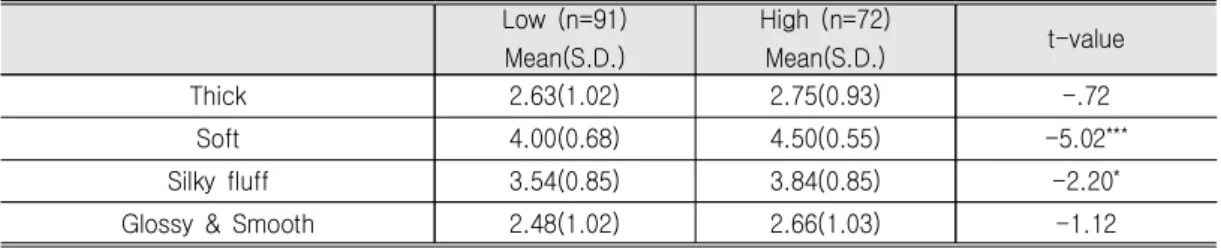
Table 1. Differences in Texture Preferences according to Psychological Comfort Low (n=91)

Mean(S.D.)

High (n=72)

Mean(S.D.) t-value

Thick 2.63(1.02) 2.75(0.93) -.72

Soft 4.00(0.68) 4.50(0.55) -5.02

***

Silky fluff 3.54(0.85) 3.84(0.85) -2.20

*

Glossy & Smooth 2.48(1.02) 2.66(1.03) -1.12

*p<.05 ***p<.001 Thick: Thick and bulky, Wet: Silky fluff The high psychological comfort group showed a significant difference in soft and wet (material having a fluffy down) in terms of their texture preferences according to psychological comfort (see Table 1). As people get older, physiological changes occur and the secretion and discharge of sweat get reduced, which makes skin dry and rough with dead cells. This is why both groups preferred soft material the most. The high psychological comfort group considered texture to be particularly important. Regarding their preference for texture, Jo (as cited in Choi, 2012) reports that women in their 60s prefer soft the most, which coheres with Kim’s (2007) finding that women in their 50s, 60s, and 70s all prefer soft the most. As physical and physiological changes occur regardless of age, time, or society, women come to prefer soft texture that is least irritating to their skin. Also, Kim (2001) reported that women tended to feel more comfort and practicality of soft materials.

Thus, the new senior women also tend to prefer comfort and practicality of clothing material.

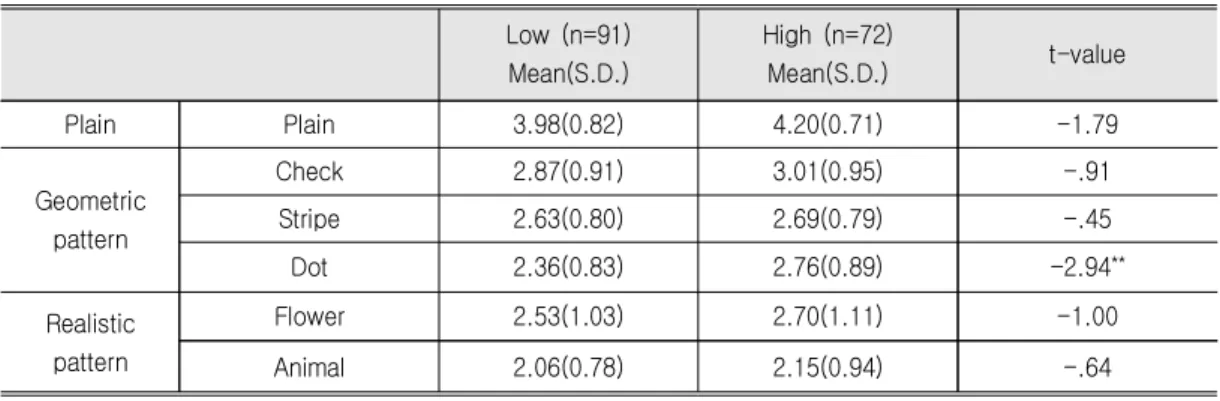
Concerning the differences in their pattern

preferences according to psychological comfort,

the dot pattern showed a significant difference

(p<.01),but both groups preferred the plain

pattern the most(see Table 2). This corresponds

to previous research results suggesting that

elderly women preferred the patternless single

color the most (Choi, 2012; Kim, 2009; Nam, Choi

(9)

Table 2. Differences in Pattern Preferences according to Psychological Comfort Low (n=91)

Mean(S.D.)

High (n=72)

Mean(S.D.) t-value

Plain Plain 3.98(0.82) 4.20(0.71) -1.79

Geometric pattern

Check 2.87(0.91) 3.01(0.95) -.91

Stripe 2.63(0.80) 2.69(0.79) -.45

Dot 2.36(0.83) 2.76(0.89) -2.94

**

Realistic pattern

Flower 2.53(1.03) 2.70(1.11) -1.00

Animal 2.06(0.78) 2.15(0.94) -.64

**p<.01

& Kim, 2013; Seo & Lee, 1995); also, the elderly women’s preference for apparel patterns appears to be not much influenced by time. Also, Kim (1996) stated that the elderly women preferred the patternless single color and ,particularly, the group showing a high life satisfaction preferred the dot pattern.

No differences were found in chromatic color preferences between the groups (see Table 3).

While the high psychological comfort group preferred, in the order of preference, navy &

purple (18%), red purple (13%), red & orange (12%), and brown (9%), the low psychological comfort group preferred, in the order of preference, brown(17%), navy & purple (15%), and red purple & red & orange(12%). As concerns achromatic colors, both preferred black the most; however, the high psychological comfort group preferred gray and white color more than the other group. In their research of the preferences of adult women in their 20s to 50s for the colors of outdoor brands, Jeong and Choi (2012) found that those in their 50s preferred purple as the top color and black as the bottom color the most, which coheres with our results. Concerning neutral, warm r, and cold colors, Kim (as cited in Lee & Kim, 2002)

studied differences in color preferences by age and reported that the y women’s preference was changed from cold to warm colors with the increase of their age. However, in our results, both groups preferred warm colors over cold colors. Also, the high psychological comfort group preferred, in the order of preference, neutral (39%), warm (39%), and cold colors (22%), while the low group preferred warm (42%), neutral (36%), and cold colors (22%); thus, there was a difference between the two groups in their color preferences of functional material.

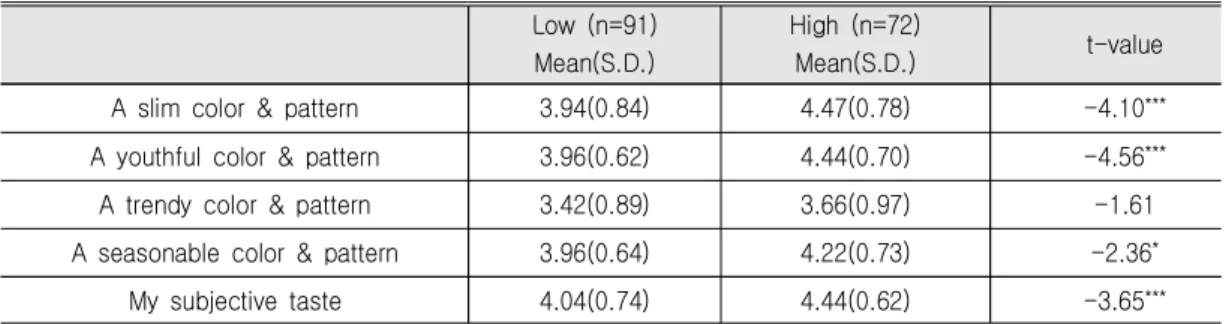
In differences in design preferences by psychological comfort when selecting color and pattern of clothes, the high psychological comfort group showed a higher difference in every item than the low psychological comfort group. In particular, there was a significant difference in the items excluding trendy colors &

patterns (see Table 4). The high psychological

comfort group preferred colors and patterns that

made them look slimmer, while the low group

preferred colors and patterns fitting their

subjective tastes. The high psychological comfort

group was keenly interested in their appearance

in terms of clothing, and this corresponds with

the results of Seo and Koo (2014) who reported

(10)

Table 3. Differences in Color Preferences according to Psychological Comfort

Low group (n=91) High group(n=72)

χ ²=4.844

χ ²=0.883

Table 4. Differences in Design Preferences by Psychological Comfort when Selecting Color and Pattern of Clothes (N= 163)

Low (n=91) Mean(S.D.)

High (n=72)

Mean(S.D.) t-value

A slim color & pattern 3.94(0.84) 4.47(0.78) -4.10

***

A youthful color & pattern 3.96(0.62) 4.44(0.70) -4.56

***

A trendy color & pattern 3.42(0.89) 3.66(0.97) -1.61

A seasonable color & pattern 3.96(0.64) 4.22(0.73) -2.36

*

My subjective taste 4.04(0.74) 4.44(0.62) -3.65

***

**p<.01 ***p<.001

that the new senior women pursuing textile material’s psychological comfort were highly interested in their appearance (anti-aging).

Moreover, the high psychological comfort

group seemed to select the clothing material

with colors and patterns fitting themselves by figuring

(11)

out their strengths and weaknesses correctly and expressing themselves to be young and slim rather than to follow the trends or go along with others. This corresponded to Choi’s (2012) stating that the Baby Boomers (at the age of 49 to 59) selected not only colors, but also diverse materials to express themselves uniquely in their clothing life based on their subjective values.

In differences in importance of clothing purchase factors according to psychological comfort, a significant difference was found in colors, patterns, price, material, and quality, and material’s functionality, activity & wearing sensation (see Table 5). Especially, the high psychological comfort group showed the mean value over 4.5 in material’s quality, functionality, color, design, and activity and wearing sensation. Therefore, they attached importance to material’s functionality & activity and aesthetic characteristics. This finding coheres with Kim’s

Table 5. Differences in Importance of Clothing Purchase Factors according to Psychological Comfort (N= 163)

Factors Low (n=91)

Mean(S.D.)

High (n=72)

Mean(S.D.) t-value

Color 4.39(0.66) 4.70(0.45) -3.40

***

Pattern 3.94(0.89) 4.23(0.74) -2.21

*

Design 4.37(0.62) 4.70(0.48) -3.72

***

Price 4.13(0.73) 4.44(0.68) -2.77

**

Materials and quality 4.20(0.62) 4.75(0.46) -6.12

***

Functionality of materials 4.24(0.67) 4.76(0.42) -5.73

***

Activity and Wearing sensation 4.31(0.69) 4.68(0.46) -3.77

***

Brand 3.51(0.84) 3.37(0.95) 1.00

Laundry and

Ease of management 4.15(0.74) 4.30(0.72) -1.30

Trend 3.45(0.98) 3.47(0.91) -.14

A/S 4.16(0.74) 4.11(0.83) -43

*p<.05 **p<.01

(2006) mentioning that the new senior consider reasonable consumption and aesthetic factors to be more important than the previous senior.

Preference on trends and famous brands was relatively less important in the two groups, in line with many other studies reporting that trend and brand were the least important criteria for elderly women to purchase clothes, as compared to color, design, and material (Kim, 2007).

Therefore, good design, wearing sensation, and practicality based on high-quality functional material are essential for the clothing design for the new silver women.

3. Psychological comfort by demographic characteristics

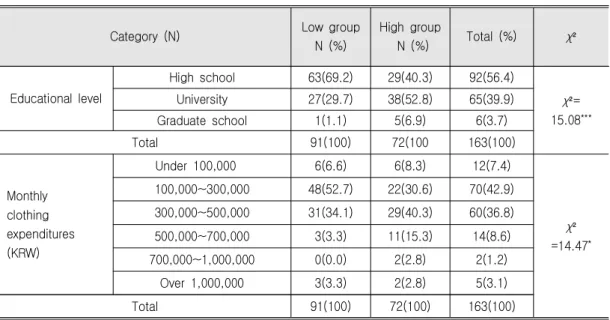
There was a significant difference between the

high and low psychological comfort groups in

terms of educational level and clothing expenditure

(12)

Table 6. Differences in Demographic Characteristics between Psychological Comfort Groups (%)

Category (N) Low group

N (%)

High group

N (%) Total (%) χ ²

Educational level

High school 63(69.2) 29(40.3) 92(56.4)

χ ²=

15.08

***

University 27(29.7) 38(52.8) 65(39.9)

Graduate school 1(1.1) 5(6.9) 6(3.7)

Total 91(100) 72(100 163(100)

Monthly clothing expenditures (KRW)

Under 100,000 6(6.6) 6(8.3) 12(7.4)

χ ²

=14.47

*

100,000~300,000 48(52.7) 22(30.6) 70(42.9)

300,000~500,000 31(34.1) 29(40.3) 60(36.8)

500,000~700,000 3(3.3) 11(15.3) 14(8.6)

700,000~1,000,000 0(0.0) 2(2.8) 2(1.2)

Over 1,000,000 3(3.3) 2(2.8) 5(3.1)

Total 91(100) 72(100) 163(100)

*p<.05 ***p<.001

(see Table 6). This coheres with the results of previous studies (Eom & Lee, 2010; ; Huh et al., 2012; Kim et al., 2011; Namkoong, 2008).

Therefore, with their higher educational level and higher monthly clothing expenditures, the new senior consider psychological comfort to be the most salient aspect of clothing.

. Conclusion

With the increase of the new silver generation pursuing healthy and comfortable life, there is a growing demand for healthy, comfortable, and functional material for clothing. In the present study, the new senior women were divided into the high and low psychological comfort groups.

Furthermore, we sought to establish the differences between these two groups in terms of their preferences for colors, textures, and patterns of outdoor clothing. The purpose of this

study was to provide foundational data to develop the material in consideration of not only the functional, but also of aesthetic aspects of clothing l. The results of our analysis are as follows.

First, concerning the difference in their

preferences for texture according to psychological

comfort, both groups preferred soft texture the

most. The high psychological comfort group

particularly preferred soft texture and highly

evaluated material texture. Second, regarding the

difference in their preferences of the patterns

according to psychological comfort, both groups

mostly preferred the plain pattern and the high

psychological comfort group preferred the dot

pattern more. In general, the high psychological

comfort group preferred patterns more than the

low psychological comfort group. Third, no

difference was observed in the preference for

chromatic colors between the two groups. While

the high psychological comfort group preferred

(13)

(in the order of preference) navy & purple, red purple & red & orange, and brown, the low psychological comfort group preferred (in the order of preference) brown, navy & purple, and red purple & red & orange. As to achromatic colors, both groups preferred black the most and the high psychological comfort group preferred gray and white more than the other group. Regarding neutral, warm r, and cold colors, both groups preferred warm colors to cold colors. The high psychological comfort group preferred (in the order of preference) neutral, warm, and cold colors, while the low psychological comfort group preferred (in the order of preference) warm, neutral, and cold colors in order. Fourth, concerning the differences in preferences for styles in choosing colors & patterns of clothing material according to psychological comfort, the high psychological comfort group showed higher evaluation points in all factors, as compared to the low psychological comfort group. The high psychological comfort group preferred colors &

patterns that made them look slimmer the most, while the low psychological comfort group highly preferred colors & patterns fitting their subjective appreciation. Fifth, regarding the differences in important considerations for purchasing decisions, the high psychological comfort group highly evaluated material quality, function, color, design, activity, and wearing sensation;

therefore, material’s functionality, comfort, and aesthetic characteristics were prioritized. Sixth, the high psychological comfort group showed a higher educational level and a higher rate of monthly clothing expenditures than the low psychological comfort group.

In conclusion, the results of the present study provide evidence that the new senior women show a interest not only in the material function

of clothing, but also in design. The new silver women particularly valued psychological comfort in colors over patterns in textile design. Also, as they valued psychological comfort when they selected the colors and patterns of clothing, they showed more interest in their appearance.

Therefore, it is important that color combinations and patterns of clothing for this consumer group make them look younger and slimmer. Therefore, further research is necessary on color in a textile design when developing functional material. In terms of color preferences, this study was limited to only vivid tones, as suggested by the functional material clothing that had been previously sold in the market, as well as by previous research. Therefore, in further studies, it will be necessary to perform a more in-depth research with diverse tones currently used in general clothing, color combinations, and colors used in different seasons and items.

The limitation of this study is that the new senior women are defined as age(55-64), high educational level(over high school) and high purchasing power. Thus this study needs to be careful when you try to extensively apply to the cases of the educational institutions and academic fields.

References

An, S. H. (2011. March 24). Three Key Words of the new senior generation]. Samsung Economic Institute. Retrieved May 13, 2015, from http://www.seri.org

An, S. K. (1995). Concepts of clothing comfort

and evaluation of fabric heat and moisture

transfer characteristics. Journal of the Korean

Society of Textile Engineers and Chemists,

(14)

32(6), 527-531.

Baek, S. M. (2004). A study on color utilization for the silver generation with web environment. The Korean Society of Illustration Research. 9. 115-129.

Bang, H. Y., & Kim, H. E. (2013). Assessment of the clothing wear comfort for elderly women based on rectal temperature, melatonin and cortisol analyses. Fashion &

Textile Research Journal, 15(3), 277-285.

Retrieved from http://doi:10.5805/SFTI.2013.

15.2.277

Bang, H. Y. (2013). Evaluation of wearing comfort for the elderly woman's clothing through biochemical and physiological response analysis. (Unpublished master's thesis). Kyungpook National University, Daegu, Korea.

Cha, H. J. (2004). Design preference tendency of mountain-climbing garments. (Unpublished master's thesis). Kyung Hee University, Seoul, Korea.

Cho, A. L. (2014). A design development for the outdoor wear for new senior generation.

(Unpublished master's thesis). Ewha Womans University, Seoul, Korea.

Choi, C. S. (2012). A study on jacket making according to design preference analysis for Korean baby-boom generation women.

(Unpublished master's thesis). Konkuk University, Seoul, Korea.

Choi, L. Y. Jeon, E. K., & Yoo, H. S. (2009).

Effects of consumer knowledge and expectation of functional materials for apparel on university students' behavioral intention.

Fashion & Textile Research Journal, 11(2),.

262-270.

Choi, S. H. (1990). A study on the relationship between self-actualization and preference in clothing design of adult women. (Unpublished

master's thesis). Gyeongsang National University, Jinju, Korea.

Eom, K. H., & Lee, J. S. (2010). A study on new silver generation's purchasing behavior of the health care textile design products: Focus on new silver generation in Gangnam-gu.

Journal of Korea Digital Design, 10(3), 173-184.

Han, H. J., & Kim, M. S. (2014). Pursued images and color preferences as determined by mountain gear benefits sought. The Korean Society of Design Culture. 20(3), 667-682.

Han, N. K. (2011). An empirical study on development of adaptive clothing designs for elderly women : Focused on natural dyed fabrics. (Unpublished doctoral dissertation).

Chung-Ang University, Seoul, Korea.

Hong, K. H. & Choi, I. R. (2009). A study of older consumers` seeking benefits and purchase intentions for and their attitudes towards functional materials. The Research Journal of the Costume Culture, 17(1), 149-159.

Hong, K. H., & Hong S. A. (1998). The measurement and application of clothing comfort. Textile Science and Engineering. 8, 451-469.

'Household financial and welfare survey results'(2014, November 14). Statistics Korea.

Retrieved April 14, 2015, from http://kostat.go.kr

Huh. W. H., Hong, S. K., Han, W. S., & Kim, W.

S. (2012). A study about emotional value factors of new silver generation. Design Convergence Study, 11(3), 3-12.

Jo, Y. J. (2011). The influence of male

consumers' clothing benefits sought on

purchase intention of functional clothing :

Focused on well-being health consciousness

and age. Fashion & Textile Research Journal,

(15)

13(6), 900-908.

Jung, J. L. & Kim, H. E. (2009). Assessment of the wear comfort of outdoorwear by ECG and EEG analyses. Journal of the Korean Society of Clothing and Textiles, 33(10), 1665-1672.

Jung, S. J. & Choi, S. J. (2012). Investigation of consumers` color preference towards outdoor wear brands. The Korean Society of Design Culture. 18(3). 489-499.

Kim, E. A., Kim, H. K., Na, Y. J., Shin, Y. S., Oh, K. H., Yoo, H. K., Jeon, Y. J., & Hong, K. A. (2000). Fashion material planning and information. Seoul: GyoMoonsa.

Kang, E. M., & Park, E. J. (2009). Effects of cognitive age on perceived service quality, satisfaction, and repurchase intentions across the elderly's life style types in apparel stores.

Journal of the Korean Society of Clothing and Textiles. 33(3), 355-365.

Kim, J. H. (1996). Fabric properties and subjective wearing comfort. (Unpublished doctoral dissertation). Sookmyung Women's University, Seoul, Korea.

Kim, J. H. (2011). Comparison of clothes behaviors with clothes preference of senior females according to their ages. (Unpublished doctoral dissertation). Kyungsung University, Busan, Korea.

Kim, J. M. (2010). (A) wareness and wearing of functional fabrics related with health and exercise life of silver generation. (Unpublished master's thesis). Hanyang University, Seoul, Korea.

Kim, J. S. (2007). A study on the spending behaviors, related to the cognitive age of the consumers in the elderly generation: Mainly on the aspects of the propensity to purchase and different types of lifestyles. (Unpublished master's thesis). Sookmyung Women's University, Seoul, Korea.

Kim, J. S. (2009). Study on the clothing behaviors, related to the real age of the female consumers in the elderly generation and different types of lifestyles. Journal of Korea Design Forum, 22. 321-334.

Kim, J. S., Kim, E. J., & Kim, H. N. (2011).

Segmentation of aging group for the development and research of universal design:

Focused on lifestyle (VALS). The Korean Society of Design Culture. 17(1), 116-129.

Kim, J. W., & Oh, H. S. (2013). The color preference of outdoor wears on fashion interest and entertainer conformity. The Treatise on The Plastic Media, 16(3), 43-54.

Kim, M. J. J. (2001). A study on the human sensibility measurement technology of texture coordination. Korea Fashion & Costume Design Association, 4. 47-55.

Kim, S. A., & Choi, H. S. (2006). An Analysis of Body Shapes in Aged Abdominal Obese Women for Apparel Pattern Design. Journal of the Korean Society of Clothing and Textiles, 30(12), 1690-1696.

Kim, S. K. (2006). The act of purchasing clothes according to the type of leisure and self-perception for a new elderly generation.

(Unpublished master's thesis). Ewha Womans University, Seoul, Korea.

Kim, Y, L., & Na, Y. J. (2008). Climbing sportswear purchase and satisfaction according to silver consumer age. Korean Journal of the science of Emotion &

sensibility, 11(2), 181-192.

Lee, E. H. (2010). A study on the suitability of outdoor wear among female trekkers in their twenties and thirties. Journal of the Korean Society of Clothing and Textiles, 34(9), 1470-1478.

Lee, M. H., & Kim, M. Y. (2001). Analysis of

previous color study : Focused on study

(16)

category and color preference study. Journal of the Korean Society of Costume, 51(3), 33-49.

Lee, M. H., & Kim, M. Y. (2002). The differences in color preference and possession of apparel color preference by influential factors: Focusing on fashion involvement, age, body size and body-cathexis. Journal of the Korean Society of Clothing and Textiles, 27(2), 188-199.

Lee, S. Y., Kim. J. H., & Lee, J. S. (2010).

Needs and Sensibility of Functional Fabrics for Outdoor Sportswear. Textile Science and Engineering, 47(3), 163-172.

Lee, Y. J.(2011). Research on dining out expenditures according to value expense pursuit of silver generation -Focused around individual’s value. Unpublished doctoral dissertation, Kyonggi University, Kyonggi, Korea.

Namkoong, M. J. (2008). A study on the senior fashion market and the preference of the senior women. (Unpublished master's thesis).

Seoul Women's University, Seoul, Korea.

Nam, M. L., Kim, C. J., & Lim, H. S. (2011).

Color preference study for mountain-climbing wear according to gender. Journal of the Korean Society of Costume, 61(10), 16-31.

Nam, Y. R., Choi, H. S., & Kim E. K. (2013). A comparative study on the clothing wearing conditions and fit for middle-aged women in their 40s and 50s. Journal of the Korea Fashion & Costume Design Association, 15(3), 137-156.

Park, M. J., Kim, J. M., & Park, J. O. (2010).

Wearing behavior of the active silver generation to functional textiles related with gender and age. The Research Journal of the Costume Culture, 18(6), 1063-1075.

Park, W. M., Park, C. D., Lee, G. R., & Ra, J.

E. (2002). Design process of outdoor-wear for improvement of comfort and appearance.

Journal of the Korean Society of Costume, 52(8), 29-39.

Ryou, E. J. (1997). Clothing evaluation processes based on means-end chain theory.

(Unpublished doctoral dissertation). Ewha Womans University, Seoul, Korea.

Seo, M. A., & Lee, S. H. (1995). A study of clothing design preference & clothing satisfaction for older women. The Research Journal of the Costume Culture, 3(1), 41-64.

Seo, M. N., & Koo, Y. S (2014). A study on recognition and preference of healthy and functional textile according to psychological comfort of the silver generation. Fashion &

Textile Research Journal, 16(5), 811-821.

Retrieved from http://doi:10.5805/SFTI.2014.

16.5.811

Seo, J. H. (2011). Characteristic of New Silver Generation's Color Preference. Journal of Korea Design Forum. 31(5), 97-106.

Yoo, H. S. (2013). Consumer perception, expectation and satisfaction levels of wear comfort of hiking gear. Korean Journal of Human Ecology. 22(4), 637-650.

Received (November 29, 2015)

Revised (February 16, 2016; April 14, 2016)

Accepted (May 20, 2016)

수치

Table  1.  Differences  in  Texture  Preferences  according  to  Psychological  Comfort    Low  (n=91) Mean(S.D.) High  (n=72)Mean(S.D.) t-value Thick  2.63(1.02) 2.75(0.93) -.72 Soft  4.00(0.68) 4.50(0.55) -5.02 *** Silky  fluff  3.54(0.85) 3.84(0.85) -2.
Table  2.  Differences  in  Pattern  Preferences  according  to  Psychological  Comfort    Low  (n=91) Mean(S.D.) High  (n=72)Mean(S.D.) t-value Plain Plain 3.98(0.82) 4.20(0.71) -1.79 Geometric  pattern Check  2.87(0.91) 3.01(0.95) -.91Stripe 2.63(0.80)2.
Table  4.  Differences  in  Design  Preferences  by  Psychological  Comfort  when  Selecting  Color  and                                    Pattern  of  Clothes
Table  5.  Differences  in  Importance  of  Clothing  Purchase  Factors  according  to  Psychological  Comfort
+2

참조

관련 문서

Finally, after analyzing the differences according to training period, there were significant differences in positive and negative guidance of guiding behavior

The purpose of the present study was to investigate whether there are any differences in Korean high school students ’ reading comprehension of English texts according to

Sixth, the analysis of differences in living satisfaction according to the frequency of exercise of participants through living sports showed that there

Changes in body, flexibility, and physical strength levels of women participating in Pilates have a significant influence on psychological chan ges.. Summarizing

Second, in the results of examining the difference in the cognition, preference and demand for the clothing chapter of the Middle School’s Technology and Home Economics

In this Thesis, an empirical study on the Influence of Consumer's Preferences and Satisfaction on Purchase Intention of Korean Automobile in Vietnamese Consumers

The study conducted a study of literature and research, and in literature, the study of cosmetic behavior, nail behavior, self esteem, and

The analysis results of differences in tenacity according to the career of winning a prize indicate some differences in desire for victory, fighting spirit,