234
* Faculty of Wind Energy Engineering Graduate School, Jeju National University
* Dept. of Electronic Engineering, Jeju National University
★Corresponding author
E-mail: [email protected], Tel: +82-64-754-366
※ Acknowledgment
This research was supported by the 2017 scientific promotion program funded by Jeju National University.
Manuscript received, May. 14, 2018; revised , May. 29, 2018 ; accepted , Jun. 22, 2018 This is an Open-Access article distributed under the terms of the Creative Commons Attribution Non-Commercial License
(http://creativecommons.org/licenses/by-nc/3.0) which permits unrestricted non-commercial use, distribution, and reproduction in any medium, provided the original work is properly cited.
Adaptive maximum power point tracking control of wind turbine system based on wind speed estimation
Jong-Ho Hyun
*, Kyung-Youn Kim
*★Abstract
In the variable-speed wind energy system, to achieve maximum power point tracking (MPPT), the wind turbine should run close to its optimal angular speed according to the wind speed. Non-linear control methods that consider the dynamic behavior of wind speed are generally used to provide maximum power and improved efficiency. In this perspective, the mechanical power is estimated using Kalman filter. And then, from the estimated mechanical power, the wind speed is estimated with Newton-Raphson method to achieve maximum power without anemometer. However, the blade shape and air density get changed with time and the generator efficiency is also degraded. This results in incorrect estimation of wind speed and MPPT. It causes not only the power loss but also incorrect wind resource assessment of site.
In this paper, the adaptive maximum power point tracking control algorithm for wind turbine system based on the estimation of wind speed is proposed. The proposed method applies correction factor to wind turbine system to have accurate wind speed estimation for exact MPPT. The proposed method is validated with numerical simulations and the results show an improved performance.
Key words: wind speed estimation, maximum power point tracking, wind turbine system, tip speed ratio, hill climbing search, Kalman filter
---
Adaptive maximum power point tracking control of wind 235 turbine system based on wind speed estimation
I. Introduction
With the advent of increasing concerns on global energy and environment, renewable energy systems such as wind-energy systems have been finding great attention. Wind energy systems are classified as fixed-speed and variable-speed. Variable-speed systems are beneficial compared to fixed-speed systems for their ability to operate at different wind speeds. Variable-speed system is controlled by angular speed control with power electronic converter thus it produces maximum power and minimizes drive-train loads. MPPT (maximum power point tracking) control allows wind turbine to operate at different speeds with good efficiency [1]-[15].
The purpose of the MPPT is to convert wind energy with a maximum electrical energy in wind turbine system. Several methods exist in literature through which MPPT can be achieved. Typical MPPT control methods of wind turbine system includes TSR (tip speed ratio) control, OTC (optimal torque control) and HCS (hill climbing search). The TSR control method uses speed controller for angular speed of generator by measuring wind speed considering optimal tip speed ratio [2]-[5]. OTC performs MPPT control using parameter K or lookup table which decides the maximum power in wind turbine system with torque controller [3]-[6]. HCS performs MPPT control by deciding the step change that is used as an input according to the change in
power and angular speed of generator [3],[5],[7]-[13]. In addition, there are various hybrid MPPT methods depending on wind turbine system to improve the limitations of each MPPT method. To compensate the drawback of HCS method, an algorithm is suggested in [7] by applying HCS to wind turbine system with torque control. A hybrid MPPT algorithm that is computationally fast and is self-tuned with wind speed control as compared to conventional HCS control method is suggested in [12]. An adaptive MPPT algorithm using parameter K which decides the maximum power in wind turbine system with speed control considering micro grid is proposed in [13]. It makes wind turbine control more robust using MPPT mode and non-MPPT mode as compared to conventional MPPT algorithm.
TSR based control considers optimal TSR to achieve maximum power control by regulating the angular speed of generator. For this, estimated mechanical power and angular speed from Kalman filter are used in wind speed estimation using Newton-Raphson method [14],[15]. However, the parameters that are used in control of wind turbine system change for various reasons. For example, air density, generator performance and blade shape [16].
These parameters when are used as fixed values for wind turbine system control it can lead to problems. The changed blade shape, the changed air density and the performance
degradation of the generator will lead to inaccurate estimation of wind speed. And also, it leads to power loss in wind turbine system.
In this paper, an adaptive MPPT control algorithm is proposed, which corrects the estimated wind speed to attain more exact MPPT. A correction factor is introduced to consider the changes in blade shape, air density and generator efficiency. The correction factor reduces error in the estimated tip speed ratio thereby estimating the wind speed with better accuracy. Also, maximum power point is tracked. Simulations with constant and variable wind speed are performed using Matlab/Simulink to evaluate the performance of proposed control method.
2. Wind turbine system 2.1 Wind energy
Mechanical power which is theoretically produced by wind energy conversion system is given by [17]
2 3
1 ( , )
m 2 p
P = π ρR C λ β v (1) where R is the die radius of blade, ρ is air density, v is the wind speed, Cp( , )λ β is power coefficient which depends on tip speed ratio λ and pitch angle of blade β. Tip speed ratio is defined as the ratio of blade tip speed to wind speed v
R r
v
λ = ω (2)
where ω is angular speed of the rotor. r
Considering region 2 in the MPPT control, with pitch angle of blade as zero ( β = ) the0 mechanical power has the form
3 5
3
1 ( )
2
r
m p
P π ρR C λ ω
= λ (3)
Fig.1. Power coefficient curve according to tip speed ratio
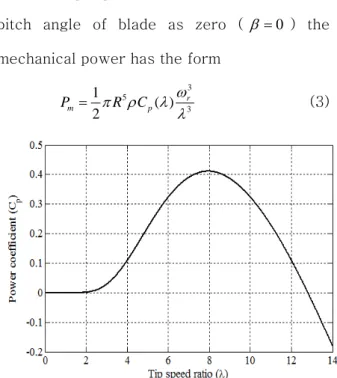
Fig. 1 shows power coefficient according to tip speed ratio for a given blade shape of wind turbine. Power coefficient is maximum value when tip speed ratio is about 7.954. Maximum power coefficient is 0.41096.
2.2 Wind turbine system model
The mechanical energy from the wind is transformed into electrical energy using PMSG (permanent magnet synchronous generator).
The topology of PMSG with MSC (machine side converter) is shown in Fig. 2 [13].
Fig. 2. Drive-train and PMSG system with machine side converter
Adaptive maximum power point tracking control of wind 237 turbine system based on wind speed estimation
Wind turbine system control without grid control comprises of gear box, PMSG and MSC as shown in Fig. 2. As the main focus is laid on machine side converter control, grid side converter control is not considered. Voltage equation for IPSMG (interior permanent magnet synchronous generator) model is given by [17]
d s d d d e q q
u R i L di L i dt ω
= + − (4)
q s q q q e d d e f
u R i L d i L i
dt ω ω φ
= + + + (5)
where u ,d uq are the generator voltages on the d, q axis, R is stator resistance on the d,s q axis, i ,d iq are the currents of the generator on the d, q axis, L ,d Lq are the synchronous inductances of the generator on the d, q axis, respectively,
φ is permanent magnetic flux f
and ω is electric rotating speed that is e defined as
e p g
ω = ω (6)
where ω is angular speed of generator and g p is pole-pairs of the generator.
Electromagnetic torque of IPMSG (Tg) can be calculated from
3 ( )
g 2 q f d q d q
T = piφ + L −L i i (7) Gear ratio
ng is defined as the ratio of mechanical torque T of low-speed shaft tor the mechanical torque T of high speed shaftm and it is given by
r g g
m r
n T T
ω
= =ω (8)
The dynamic model of drive-train in wind turbine system is represented by the following equation
g
g m g
T T Jd B
dt
ω ω
− = + (9)
where J is equivalent rotational inertia and B is the damping coefficient.
2.3. Estimation of mechanical power using Kalman filter
The response of electromagnetic torque is different from mechanical torque in transient state. The response of electromagnetic torque which can be obtained by (7) is fluctuating than the response of mechanical torque. Therefore, there is need to estimate the mechanical torque with good accuracy. This is achieved using Kalman filter. For applying Kalman filter, dynamic model should be formulated. Using (9), the state-space form for wind turbine system is represented as follows [14],[15]
1 1
0
0 0 0 1
g
g
g m m
d B
dt J J J T w
dT T dt ω
ω
− −
= + +
(10)
[
1 0]
gm
y T
ω γ
= +
(11)
where w is process noise and γ is measurement noise. Using the state-space representation given in (10) and (11) the state parameters, mechanical torque Tm and angular speed of generator ω are estimated g
(464) using Kalman filter. From the estimated state variables, the mechanical power and rotor angular speed are determined by
_
m est m g
P =T ω (12)
_ g r est
ng
ω =ω
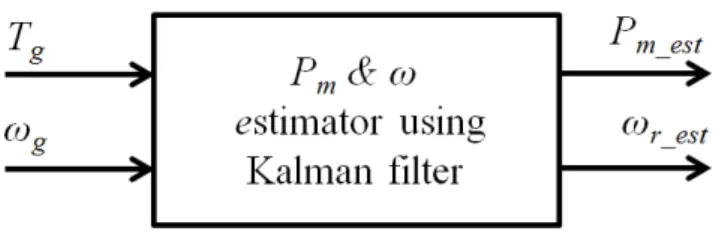
(13) Fig. 3 is block diagram of estimator using Kalman filter. Using estimated torque T andm angular speed ω , estimated mechanical g power Pm est_ and estimated angular speed
_ r est
ω are calculated by (12), (13) which are used for tip speed ratio estimation.
Fig. 3. The block diagram of estimator using Kalman filter
2.4. Tip speed ratio estimation with Newton-Raphson method
Power coefficient curve depends on parameters of the blade shape. Power coefficient of wind turbine is a function of tip speed ratio and blade pitch angle. Here, the blade pitch angle is taken as zero for region 2 therefore the power coefficient can be represented as a function of tip speed ratio alone that is of the form [18],[19]
2
0 1 2
( ) n
p p p p pn
C λ =C +C λ+C λ + + C λ (14)
where Cp0,,Cpn are the coefficients of nth-polynomial which can be obtained by interpolation method. Using (14) in (3) and rearranging (3), it can be written as a function of tip speed ratio as
_ _
5 3 3
( ) 1 ( ) 0
0.5 r est
m est
p
f P C
λ R λ
ρπ ω λ
= − = (15)
By solving the above equation (15), the tip speed ratio can be obtained. To solve (15), Newton-Raphson method is used which is of the form [14, 15, 19]
1
( )
i i '( ) f f λ λ λ
+ = − λ (16)
Using (15) in (16), tip speed ratio λ is determined iteratively.
2.5. The conventional tip speed ratio control based on wind speed estimation
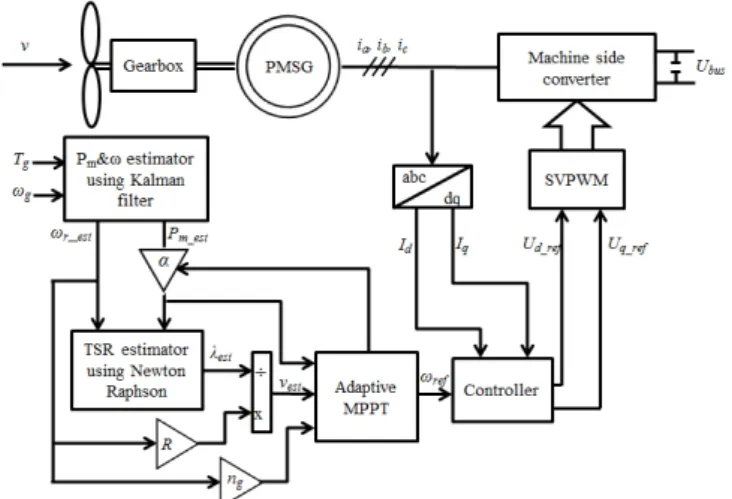
The conventional tip speed ratio control uses Kalman filter to estimate the mechanical power of generator and the estimated mechanical power is used in Newton-Raphson method to estimate the wind speed to have maximum power point tracking without anemometer [14],[15]. Fig. 4 shows wind turbine control system with MSC based on SVPWM (space vector pulse width modulation). Pm est_ and
_ r est
ω are estimated by P & m ω estimator using Kalman filter with
Tg and
ω used as g
inputs. TSR estimator using Newton-Raphson is then used to estimate tip speed ratio λ . est Considering (2) and (8), estimated wind speed
Adaptive maximum power point tracking control of wind 239 turbine system based on wind speed estimation
vest and angular reference speed ωref are calculated, which are then used as an input for speed controller. The current of the generator is controlled according to switching sequence by SVPWM with two-level IGBT converter [20]-[22].
Fig. 4. The TSR controller based on conventional wind speed estimation
3. Adaptive MPPT controller based on wind speed estimation
In the wind turbine system, the parameters such as blade shape, air density get changed with operation time. The generator efficiency is also found to get degraded with time. These affect the accuracy of wind speed estimation.
Therefore, adaptive MPPT control algorithm is proposed for improving the accuracy of wind speed estimation. Correction factor is introduced which is determined using hill climb search (HCS). The computed correction factor reduces the error between actual and estimated wind speed. Fig. 5 shows the block
diagram for adaptive MPPT algorithm.
Fig. 5. The adaptive MPPT control algorithm based on wind speed estimation
Correction factor α is added to the conventional tip speed ratio control based on wind speed estimation. From the estimated wind speed vest using Newton-Raphson method, correction factor α is computed in the adaptive MPPT block. The correction factor is then used as an input in TSR estimator to correct the wind speed estimation. From (15), when λ is optimal TSR and Cp( )λ is maximum power coefficient, the correction factor which is the reciprocal of efficiency can be represented as
_ 3
5 3
_ _ max
( )1 0.5
m est
r est p f
P
R C
α π ω ρ = λ (17)
where
ρ is the fixed air density value which f
is the existing parameter used in traditional wind turbine system based on wind estimation.
The correction factor α is defined by
1
c g b
f
α η η ρ ρ
= (18)
where η is the efficiency for performance g degradation, η is efficiency for the changed b blade shape and ρ is the current air density. c
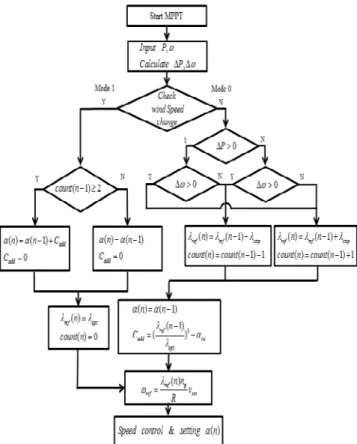
Fig. 6. The adaptive MPPT algorithm based on wind speed estimation
Fig. 6 shows the flow chart for adaptive MPPT algorithm based on wind speed estimation. By checking the wind speed change, mode of operation is decided. When wind speed is changed, MPPT is operated as mode 1. In constant wind speed, MPPT is operated as mode 0. Mode 0 performs HCS method repeatedly by checking P∆ and ∆ω to track maximum power point. Using HCS method, λref
is determined which is then used to compute ω for speed controller. In case of change in ref
wind speed, Mode 1 sets λ to opt λ and it is ref used to determine angular reference speed
ω . When mode 0 is switched to mode 1, ref
λ is set as ref λ , opt (λref /λopt)3 is defined as correction factor α , the parameter Cadd which is used in updating correction factor α is calculated as
3 ref
add ini
opt
C λ
λ α
= −
(19)
where α is initial correction factor. In mode ini 0, the computed parameter Cadd is added to
(n 1)
α − to get the updated ( )α n . In mode 1,
Cadd is set as 0 for next Mode 0. The updated correction factor ( )α n in Mode 1 is then used in wind turbine control system for adaptive MPPT. By applying the correction factor ( )α n , it is possible to have an accurate estimation of wind speed.
( )
count n is used to decide whether to apply correction factor α in mode 1. As HCS is performed in mode 0, when both change in power and angular speed are positive or negative then λstep is added to λref and
( )
count n is increased by 1. Otherwise, λ is step subtracted from λref and count n( ) is decreased by 1. After that, in mode 1, if
( 1)
count n− is greater than or equal to 2, α is applied to wind turbine system. If count n( −1)
is less than 2, α is not applied to avoid unnecessary correction.
The proposed algorithm is to estimate the change in wind speed without anemometer.
The evaluation of wind speed change is decided by the following conditions
est ref Errλ
λ −λ < (20)
3 1
( ) ( 1)
( 1)
est ref est v
v n v n v Err
α n
− − < − (21)
where Errλ is allowable error. If (20) and (21) are valid then the wind speed is not changed and is kept constant. However, if the difference in estimated and reference tip speed ratio is greater than the allowable error Errλ, then the wind speed is changed. If actual wind speed is increased, estimated power and estimated wind speed in wind turbine system is increased by equation (1). Here, the noise of
estimated power and estimated wind speed is increased according to estimated power and estimated wind speed. For this reason, v isest3 used in (21) considering the relationship between wind speed and mechanical power.
Moreover, in order to fix the allowable error, 1 / (α − is used after applying the correctionn 1) factor α . By considering it,
(
1 / ( 1))
3v est
Err α n− v is not changed regardless of correction factor α and is just changed according to wind speed.
4. Results and discussion
In this section, numerical simulation results for MPPT control and wind speed estimation are presented. To obtain the simulation results, variable-speed wind turbine system is modeled in Matlab/Simulink.
241 Adaptive maximum power point tracking control of wind
turbine system based on wind speed estimation
Fig. 7. The adaptive MPPT block diagram based on wind speed estimation in Matlab/Simulink The Simulink model is shown in Fig. 7. The
block diagram of the adaptive MPPT algorithm based on wind speed estimation is composed of mechanical power estimator using Kalman filter, TSR estimator using Newton-Raphson method, adaptive MPPT algorithm, speed
controller, rectifier, PMSG model, mechanical model of drive train, wind energy conversion system model and wind speed model. Table 1 has the parameters that are used in simulation of wind turbine system control.
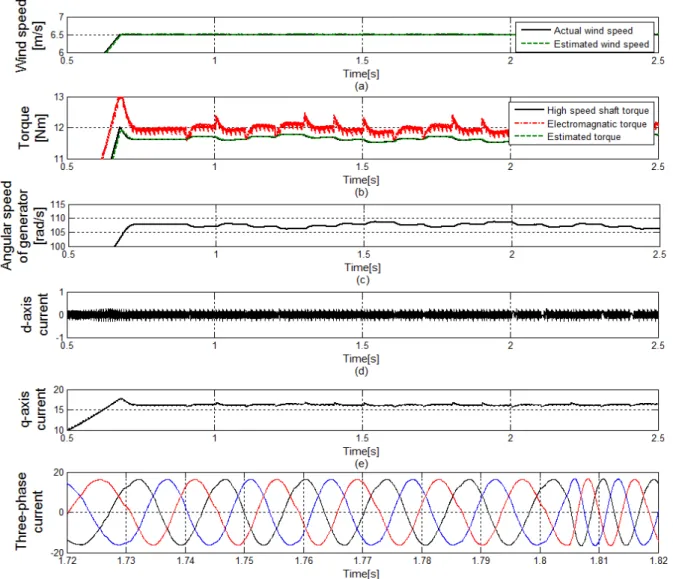
Fig. 8. The performance of estimator with Kalman filter and Newton Raphson method in wind turbine system based on wind speed estimation with SVPWM
The estimator performance based on wind speed estimation with Kalman filter and Newton Raphson method is shown in Fig. 8.
The wind speed estimation is shown in Fig.
8(a). It is noticed that the estimated wind speed
is tracked close to actual wind speed. Fig. 8(b) shows the estimated torque by Kalman filter with angular speed of generator in Fig. 8(c).
The estimated torque shows dynamic response as high speed shaft torque and is different with electromagnetic torque. By using Kalman filter, input power close to mechanical power is estimated using the proposed algorithm to improve performance. Also, it acts as a filter to reduce the noise and harmonics caused by switching converter control. Fig. 8(d) and 8(e) show the d axis current and q axis current by switching converter control using SVPWM. Fig.
8(f) shows three phase current of generator which d axis current q axis current are transformed to from 1.72 to 1.82 seconds. The current sine wave has distortion caused by harmonics. By wind speed estimation with Kalman filter and Newton Raphson method, MPPT control of Wind turbine system is achieved.
For the simulation, it is assumed that generator efficiency due to performance degradation ηg is 0.98, efficiency for performance degradation of blade η is 0.94 and current air density b ρc is 1.125. In the adaptive MPPT algorithm proposed in this paper, TSR step length λstep which is used in HCS method is set as 0.05 and initial correction factor α is set as 1. ini
4.1. Numerical results
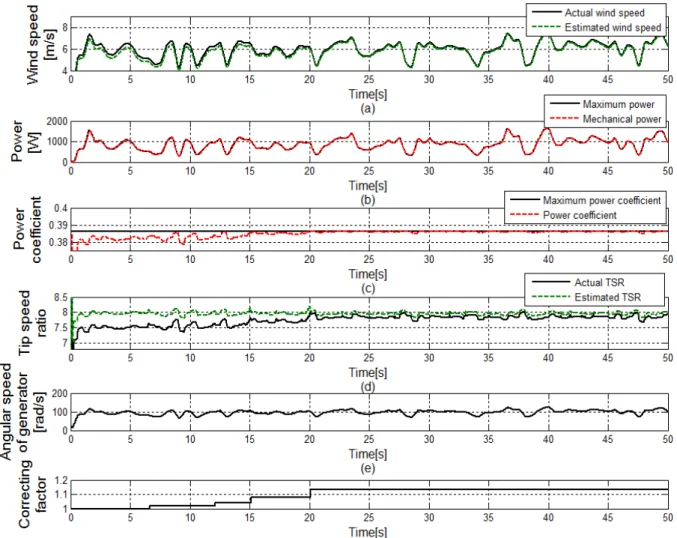
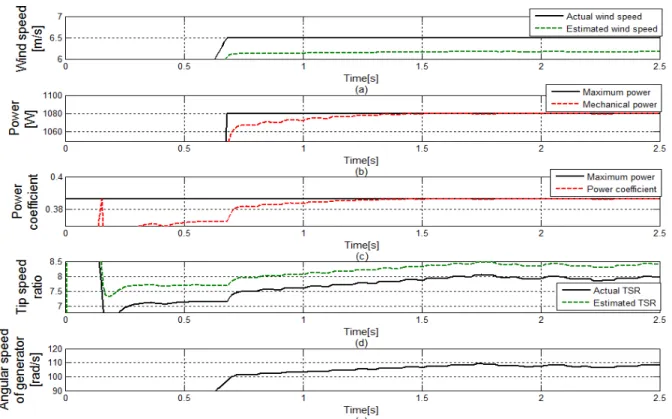
Mechanical power and power coefficient are the amount of energy that is converted from the available wind energy therefore it is considered as standard in evaluating the performance of MPPT control. Fig. 9 shows the performance of the adaptive MPPT control based on wind speed estimation in case of constant wind speed.
Fig. 9. The performance of the adaptive MPPT control based on wind speed estimation in constant wind 243 Adaptive maximum power point tracking control of wind
turbine system based on wind speed estimation
Fig. 9(a) shows comparative result between actual wind speed and estimated wind speed.
The maximum power and mechanical power are compared in Fig. 9(b). Fig 9(c) shows power coefficient C and maximum powerp coefficient for constant wind speed. The estimated TSR λ and actual TSR λ are est shown in Fig. 9(d). In constant wind speed, Mode 0 is operated by comparing P∆ and ∆ω. TSR is found to increase gradually by HCS and remains constant after 0.7 seconds. It can be noticed that mechanical power is able to track maximum power point after 1.4 seconds with
estimation of TSR λ ≅est 8.4 in Fig. 9(b). Power coefficient C is also reached to maximump power coefficient in Fig. 9(c). Fig. 9(e) shows that
ω is changed in wind turbine system g
according to TSR step λstep . As a result, maximum power point is tracked in 1.4 seconds through HCS method of Mode 0. However, there is still error that exists between the estimated and actual wind speed (Fig. 9(a)).
The error is due to the fact that the calculated correction factor α is not updated.
Correction factor is applied in Mode 1.
Fig. 10. The performance of the adaptive MPPT control based on wind speed estimation with case 1 wind speed change
Two different cases are considered for the evaluation of proposed method where the wind speed change is considered. Fig. 10 shows the performance evaluation for wind speed change with case 1. From about 1 to 1.8 seconds, reference TSR λ is changed by HCS method ref to track maximum power point. As wind speed is changed in about 1.8 seconds, error between estimated TSR and actual TSR is reduced by applying the calculated correction factor α to wind turbine system as shown Fig. 10(d). The wind speed estimation is found to have tracked the actual wind speed after 1.8 seconds in Fig.
10(a) with correction factor α close to 1.182 in Fig. 10(f). Also, Fig. 10(b) shows that the wind turbine system is controlled as the mechanical power is found to reach maximum power point. Fig. 10(c) shows that power coefficient has reached to maximum power and the performance is improved. The angular speed of generator is detected and is given in Fig. 10(e). Here, relatively small error between actual wind speed and estimated wind speed still exist after 1.8 seconds. The more maximum power point is reached, the more there is not a remarkable change of mechanical power according TSR step. Because, the change in power becomes less as it approaches maximum power (Fig. 9(b)). The above results show that with the proposed method, the wind turbine system has accurate wind speed estimation with more exact MPPT.
Table 1. The parameter of wind turbine system used in simulation [23]
Parameter Symbol Value and units Die radius of
blade R
2.4
Fixed air
density f
ρ 1.225
Rotational
inertia J 0.0048
Damping
coefficient B
0.0030
Gear ratio ng 5
d, q axis stator
resistance s
R 0.180
d axis synchronous
inductance
Ld 0.002
q axis synchronous
inductance
Lq 0.002
Permanent
magnetic flux f
φ 0.123
Pole-pairs of the generator
p 4
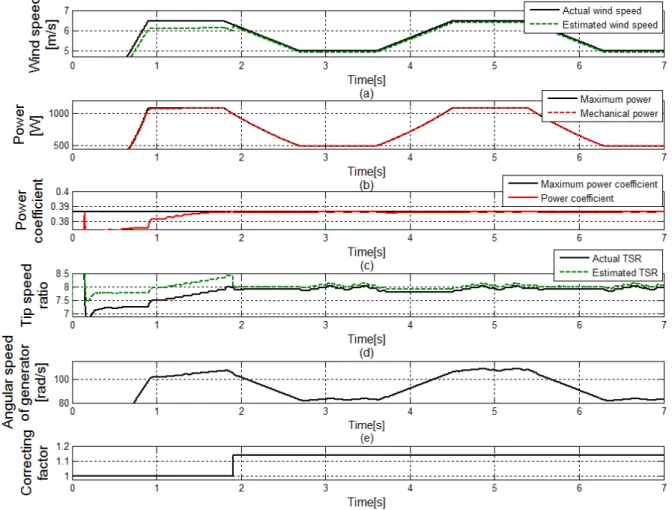
Fig. 11 shows that the performance of the adaptive MPPT control based on wind speed estimation for changed wind speed with case 2.
When an actual wind speed is changed as shown Fig. 11(a), mechanical power and angular speed of generator are changed in Fig 245 Adaptive maximum power point tracking control of wind
turbine system based on wind speed estimation
11(b) and Fig. 11(e). Fig.11(c) shows that power coefficient is changed over time. Fig.
11(d) shows estimated TSR and actual TSR are changed by the proposed algorithm. Fig. 11(f) shows the change of correction factor, which is calculated in mode 0 and applied to mode 1.
Although there is error between estimated TSR and actual TSR at the beginning, with
α
close to 1.182 obtained in 20 seconds, the estimated TSR is almost close to the actual
TSR. Also, the estimated wind speed is found to approach the actual wind speed and it is tracked well after 20 seconds. Also, power coefficient is reached to maximum power coefficient in 20 seconds. From the simulation studies, it was noticed that the adaptive MPPT control estimates the wind speed exactly thereby controls the wind turbine to achieve more exact MPPT.
Fig. 11. The performance of the adaptive MPPT control based on wind speed estimation in case 2 wind speed change
5. Conclusion
Because of the changed blade shape, changed air density, and performance degradation of the generator, conventional TSR control based on wind speed estimation not only causes the problem for MPPT but also estimates incorrect wind speed. It leads to inexact wind resource assessment of site. To solve this problem, the adaptive MPPT control based on wind speed estimation in wind turbine system is proposed.
In this paper, the adaptive MPPT control algorithm is developed considering wind turbine system with machine side converter control. The proposed algorithm applies the updated correction factor to adaptive MPPT control. The adaptive MPPT control is performed properly by tracking maximum power point. Furthermore, as the error between estimated and actual tip speed ratio is reduced, more exact wind speed is estimated.
Simulation studies with Matlab/Simulink are performed with constant and variable wind speed. The results show that the adaptive MPPT control has better estimation of wind speed from the correction factor that is computed.
References
[1] E. Iyasere, M. Salah, D. Dawson, J. Wagner,
“ Optimum seeking-based non-linear controller to maximise energy capture in a variable speed wind turbine,” IET Control
Theory Appl. 6 (4), 526-532, 2012.
DOI:http://dx.doi.org/10.1049/iet-cta.2010.0689 [2] J. Hui, A. Bakhshai, “Adaptive algorithm for fast maximum power point tracking in wind energy systems,” 2008 34th Annual Conference of Industrial Electronics, (2008),2119-2124.
DOI:http://dx.doi.org/10.1109/iecon.2008.4758284 [3] M, A, Abdullah, A, H. M. Yatim, C. W. Tan, R. Saidur, “A review of maximum power point tracking algorithms for wind energy systems,”
Renewable and Sustainable Energy Reviews.
16 (5), 3220-3227, 2012.
DOI:http://dx.doi.org/10.1016/j.rser.2012.02.016 [4] M. Nasiri, J. Milimonfared, S. H. Fathi,
“ Modeling, analysis and comparison of TSR and OTC methods for MPPT and power smoothing in permanent magnet synchronous generator-based wind turbines, ” Energy Conversion and Management. 86, 892–900, 2014 .DOI:http://dx.doi.org/10.1016/j.enconman .2014.06.055
[5] J. S. Thongam, M. Ouhrouche, MPPT control methods in wind energy conversion systems, Dr. Rupp carriveau (Ed), fundamental and advanced topics in wind power, InTech, (2011), 339-359
DOI:http://dx.doi.org/10.5772/21657
[6] C. Patsios, A. Chaniotis, A. Kladas, “ A hybrid maximum power point tracking system for grid-connected variable speed wind-generators,” 2008 IEEE Power Electronics Specialists Conference (2008), 1749-1754.
DOI:http://dx.doi.org/10.1109/pesc.2008.4592196 247 Adaptive maximum power point tracking control of wind
turbine system based on wind speed estimation
[7] J. M. Kwon, J. H. Kim, S. H. Kwak, H. H. Lee,
“Optimal power extraction algorithm for dtc in wind power generation systems,” 2008 IEEE International Conference on Sustainable Energy Technologies (2008), 639–643.
DOI:http://dx.doi.org/10.1109/icset.2008.4747085 [8] T. Tanaka, T. Toumiya, T. Suzuki, “Output control by hill-climbing method for a small-scale wind power generating system, ” Renewable Energy. 12 (4) (1997), 387-400.
DOI:http://dx. doi.org/10.1016/s0960-1481(97) 00055-4
[9] J. S. Thongam, P. Bouchard, H. Ezzaidi, M.
Ouhrouche, “Wind speed sensorless maximum power point tracking control of variable speed wind energy conversion systems,” 2009 IEEE International Electric Machines and Drives Conference (2009), 1832-1837.
DOI:http://dx.doi.org/10.1109/iemdc.2009.5075452 [10] M. Shirazi, A.H. Viki, O. Babayi, “ A Comparative study of maximum power extraction strategies in PMSG wind turbine system,” 2009 IEEE Electrical Power &
Energy Conference (EPEC) (2009),1-6 DOI:http://dx.doi.org/10.1109/epec.2009.5420931 [11] Q. Wang, L. Chang, “ An Intelligent maximum power extraction algorithm for inverter-based variable speed wind turbine systems,” IEEE Trans. Power Electron. 19.5, 1242–1249, 2004.
DOI:http://dx.doi.org/10.1109/tpel.2004.83349 [12] S. M. R. Kazmi, H. Goto, H. J. Guo, O.
Ichinokura, “ A novel algorithm for fast and
efficient Speed-sensorless maximum power point tracking in wind Energy conversion systems,” 2008 IEEE International Conference on Sustainable Energy Technologies (2008), 29-36.
DOI:http://dx.doi.org/10.1109/icset.2008.4747083 [13] L. He, Y. Li, R. Harley, Novel adaptive power control of a direct-drive PM wind generation system in a micro grid, 2012 IEEE Power Electronics and Machines in Wind Applications, 1-8, 2012. DOI:http://dx.doi.org /10.1109/pemwa.2012.6316393
[14] D. Bourlis, J. A. M. Bleijs, “A wind speed estimation method using adaptive Kalman filtering for a variable speed stall regulated wind turbine,” 2010 IEEE 11th International Conference on Probabilistic Methods Applied to Power Systems (2010), 89-94.
DOI:http://dx.doi.org/10.1109/pmaps.2010.55 28980
[15] B. Boukhezzar, H. Siguerdidjane,
“ Nonlinear control of variable speed wind turbines without wind speed measurement, ” Proceedings of the 44th IEEE Conference on Decision and Control (2005), 3456-3461.
DOI:http://dx.doi.org/10.1109/cdc.2005.1582697 [16] H. Salem, A. Diab, Z. Ghoneim, “ CFD Simulation and analysis of performance degradation of wind turbine blades in dusty environments,” 2013 International Conference on Renewable Energy Research and Applications (ICRERA) (2013), 827 –832.
DOI:http://dx.doi.org/10.1109/icrera.2013.674 9867
[17] A. Rolan, A. Luna, G. Vazquez, D. Aguilar,
“Modeling of a variable speed wind turbine with a permanent magnet synchronous generator,” 2009 IEEE International Symposium on Industrial Electronics (2009), 734-739.
DOI:http://dx.doi.org/10.1109/isie.2009.5218120 [18] C. Shao, X. Chen, Z. Liang, “Application research of maximum wind energy tracing controller based adaptive control strategy in WECS,” 2006 5th International Power Electronics and Motion Control Conference (2006), 1-5.
DOI:http://dx.doi.org/10.1109/ipemc.2006.4778055 [19] S. Bhowmik, R. Spee, J. H. R. Enslin,
“Performance optimization for doubly fed wind power generation systems,” IEEE Trans. on Ind. Applicat. 35(4) (1999), 949-958.
DOI:http://dx.doi.org/10.1109/28.777205) [20] B. Wu, Y. Lang, N. Zargari, S. Kouro, Power conversion and control of wind energy systems, ch4.(2011), 87-152. DOI:http://dx.doi.
org/10.1002/9781118029008.ch4)
[21] S. Li, T. A. Haskew, R. P. Swatloski, W.
Gathings, “Optimal and direct-current vector Control of direct-driven PMSG wind turbines,”
IEEE Trans. Power Electron, 27 (5), 2325-2337, 2012. DOI:http://dx.doi.org/10.1109/tpel.2011.
2174254)
[22] M. Pucci, “ Induction machines sensors-less wind generator with integrated intelligent maximum power point tracking and electric losses minimisation technique,” IET Control Theory & Applications. 9 (12), 1831-1838, 2015.
DOI:http://dx.doi.org/10.1049/iet-cta.2014.1049) [23] A. Cimpoeru, K. Lu, “Encoderless Vector Control of PMSG for wind turbine applications,” Institute of energy technology, Institute of Energy Technology, AALBORG University, M. Sc Thesis (2010)
BIOGRAPHY
Jong Ho Hyun (Member)
2013 : BS degree in Electronic Engineering, Jeju National University.
2015 : MS degree in Faculty of Wind Energy Engineering, Jeju National University.
<Research interests: wind energy, wind turbine, blade aerodynamics, Data acquisition and control>
Kyung Youn Kim (Member)
1983 : BS degree in Electronic Engineering, Kyungpook National University.
1986 : MS degree in Electronic Engineering, Kyungpook
National Universtiy.
1990 : PhD degree in Electronic Engineering, Kyungpook National University.
1990~Present : Professor, Department of Electronic Engineering, Jeju National Unviersity.
2017~Present : Dean of Engineering College, Jeju National University
<Research Interests: Inverse problem, Optimal control, Estimation Theory, Electrical impedance tomography>
249 Adaptive maximum power point tracking control of wind
turbine system based on wind speed estimation
![Table 1. The parameter of wind turbine system used in simulation [23]](https://thumb-ap.123doks.com/thumbv2/123dokinfo/4670475.500244/12.892.472.807.207.946/table-parameter-wind-turbine-used-simulation.webp)