1. 서 론1)
2015 개정 정보과 교육과정에서는 컴퓨터과학의 기본 개념 과 원리 및 기술을 바탕으로 실생활과 다양한 학문 분야의 문 제를 창의적이고 효율적으로 해결할 수 있는 능력을 강조하였
†종신회원 : 안동대학교 컴퓨터교육과 교수 Manuscript Received : November 9, 2018 Accepted : January 28, 2019
* Corresponding Author : Kang Oh Han([email protected])
다. 이 교육과정에서 정보 과목의 내용 체계는 4개의 대영역인 정보 문화, 자료와 정보, 문제 해결과 프로그래밍, 컴퓨팅 시스 템으로 구성된다[1]. 세 번째 대영역인 ‘문제 해결과 프로그래 밍’의 목표는 컴퓨터과학의 기본 개념과 원리에 따라 실생활의 문제를 추상화하여 해법을 설계하고 프로그래밍 과정을 통해 소프트웨어로 구현하여 자동화할 수 있는 능력을 기르는 것으 로 되어있다[2]. 정보과 교육과정의 내용 체계에서 가장 큰 변 화 중의 하나는 소프트웨어 중심으로 교육 내용을 확대 개편 된 것이다. 예를 들면, 2009 개정 정보과 교육과정의 ‘문제 해
Analysis on the Aspect of Learners’ Explorations Reflected in High School Informatics Textbooks Based on
the 2015 Revised National Curriculum
Oh-Han Kang†
ABSTRACT
In this research, one common chapter, Problem Solving and Programming, in seven different types of high school informatics textbooks was analyzed in terms of the aspect of learners’ explorations. These textbooks were newly developed based on the 2015 revised national curriculum. Romey’s analysis was used to the textbooks along with four analytic elements: texts, data, activities, and evaluation. The study results showed that the textbooks can highly encourage learners’ further explorations according to the four analytic elements reflected in the seven textbooks: one out of the six textbooks well designed for texts, three for data, six for activities, two for evaluation.
In terms of Romey’s involvement index points, six of the seven textbooks had low indexes of texts, ranging from 0.175 to 0.393. Data indexes were extremely low in four out of the seven textbooks, ranging from 0.058 to 0.226. Five out of the seven textbooks had very high indexes of evaluation in the broad range of 2 to 6.333 points. Furthermore, these newly designed textbooks can more greatly facilitate students’ explorations than previously existing textbooks in three elements: texts, data, and activities. Evaluation indexes significantly increased in these new textbooks from 0.916 to 3.914, which had excessive points in terms of promoting students’
explorations. Further methods to improve the textbook quality is proposed based on the results from this analysis.
Keywords : Curriculum, Informatics Subject, Textbook, Inquisitive Tendency, Romey Analysis
2015 개정 교육과정에 근거한 고등학교 정보 교과서의 탐구성 분석
강 오 한†
요 약
본 연구에서는 2015 개정 교육과정에 기초하여 개발된 고등학교 ‘정보’ 교과서의 ‘문제 해결과 프로그래밍’ 단원에 대한 탐구성을 분석하였 다. 7종 교과서에 Romey 분석법을 적용하였으며, 4개 분석항목인 본문, 자료, 활동, 평가에 대한 분석을 수행하였다. 연구 결과에 따르면, 본문, 자료, 활동, 평가의 항목에서 각각 1종, 3종, 6종, 2종의 교과서가 탐구성이 높은 것으로 나타났다. 그리고 Romey 평가지수를 기준으로 6종 교 과서의 본문이 0.175∼0.393로 낮게 분포되었으며, 자료 항목에서 4종 교과서가 0.058∼0.226로 매우 낮았다. 평가 항목은 5종 교과서가 2∼
6.333로 매우 높게 분포되었으며, 교과서 간의 편차도 큰 것으로 나타났다. 그리고 새로운 교과서가 본문, 자료, 활동의 3개 분석항목에서 이전 교과서보다 탐구성이 향상되었으며, 평가 분석항목은 Romey 지수가 0.916에서 3.194로 크게 증가하여 탐구성이 과도한 것으로 나타났다. 본 연구에서는 이러한 분석 결과를 토대로 교과서의 개선 방안을 제안하였다.
키워드 : 교육과정, 정보교과, 교과서, 탐구성, Romey 분석법
※ This is an Open Access article distributed under the terms of the Creative Commons Attribution Non-Commercial License (http://creativecommons.org/ licenses/by-nc/3.0/) which permits unrestricted non-commercial use, distribution, and reproduction in any medium, provided the original work is properly cited.
결 방법과 절차’ 영역은 ‘문제 해결과 프로그래밍’ 영역으로 전 환하여 강화하였고, 세부 단계가 컴퓨팅 사고력 함양을 위한 내용으로 구체화되었다. 이를 위해 핵심 개념으로 추상화가 도 입되었으며, 컴퓨팅 사고력 기반 문제 해결 과정이 추상화, 알 고리즘, 프로그래밍으로 단계별로 제시되었다.
교육과정에 근거하여 제작된 교과서는 학습자의 학습에 도움을 주고 교과의 교육 목표 달성이 가능하도록 내용이 구 성되어야 한다. 탐구 활동 중심의 교과서 내용 구성은 자료를 수집하고 분석하는 과정을 통해 학습자 중심의 수업이 가능 하다. 학생들은 탐구 과정 중에 문제를 해결할 수 있는 방법 과 원리를 발견하게 되고, 창의적 사고력 신장과 논리적 사고 력 개발 등의 효과를 경험할 수 있다[3]. 따라서 새로운 교육 과정의 변화를 수용하여 제작된 정보 교과서의 내용은 학생 들의 효율적인 학습과 탐구 활동을 지원함으로써 문제해결 능력을 신장시키고 컴퓨팅 사고력 이 향상될 수 있도록 구성 되어야 한다.
이러한 이유로 정보 교과서의 ‘문제 해결과 프로그래밍’ 영 역에 대한 분석은 탐구성에 근거한 Romey 분석법[4]을 적용 하는 것이 타당하다. 2009 개정 교육과정 에 기초하여 개발된 고등학교 정보 교과서는 본문과 자료에서 학생의 참여가 부 족한 형태로 구성되어 탐구성이 낮은 것으로 나타났다[5]. 본 연구에서는 Romey의 분석법을 적용하여 2015 개정 교육과정 에 기초하여 만들어진 고등학교 정보 교과서의 탐구성을 조 사하고 분석한다. 이와 함께 2015 개정 교육과정에 기초하여 개발된 교과서와 이전에 사용된 교과서에 대한 탐구성을 비 교하여 어떤 변화가 있는지 분석한다. 본 연구의 목적은 이러 한 분석 결과를 바탕으로 탐구성이 부족한 부분을 확인하고 개선 방안을 제안함으로써 향후 학습자의 탐구성 배양과 함
께 문제해결 능력을 신장시키고, 컴퓨팅 사고력 향상에 기여 할 수 있는 교과서가 개발되도록 하는 것이다.
본 논문의 구성은 다음과 같다. 2장에서는 정보 교과서의 탐구성 분석과 관련된 선행 연구를 요약한다. 3장에서는 교과 서 분석 방법 및 기준을 설명한다. 4장에서는 교과서 구성과 탐구성 분석에 대한 연구 결과를 기술한다. 5장에서 연구 결 과에 대한 논의와 결론을 맺는다.
2. 관련 연구
교과서의 내용은 교과의 교육과정에 근거하여 제작된다.
Table 1은 2015 개정 교육과정에서 제시한 고등학교 정보 과 목의 내용 체계에서 영역과 핵심개념을 나타낸 것이다. 정보 과목의 내용 체계는 4개 대영역으로 구성되며, 각 대영역은 중영역으로 구분된 핵심 개념을 포함한다.
본 연구에서 분석할 대영역인 ‘문제 해결과 프로그래밍’은 3개의 중영역인 추상화, 알고리즘, 프로그래밍으로 분류된다.
일반적으로 교육과정의 대영역은 교과서의 대단원으로 구성
Large Unit Core Concepts
Information culture Information society, Information ethics Data and
information
Representation of data and information, Analysis of data and information Problem solving
and programming Abstraction, Algorithm, Programming Computing system Action principal of computing system,
Physical computing
Table 1. Units and Core Concepts of Informatics Subject
Curriculum Ref. Method Contents
2007 revised
[9] Romey Quantitative analysis of the exploratory tendencies of the composition of 'expression and management of information'
[10] Romey Quantitative analysis of trends in creative problem solving literacy in the area of 'problem solving methods and procedures'
[11] Romey Analyzing the inquiry trends in the section of 'problem-solving method and process' for four textbooks. And proposed to describe the textbook objectively
[12] Romey Quantitative analysis of the inquiry tendencies in the 'composition and operation of information equipment' section for four textbooks
[15] Hutteman &
Romey
Based on the two methods, the selection criterion for analyzing informatics textbooks was developed and analyzed quantitatively
2009 revised
[3] Romey After analyzing existing textbooks, it is suggested that new textbooks based on the 2015 revised curriculum should be written as activities-centered.
[6] Romey Quantitative analysis of the exploratory trends in the section of 'composition and operation of information equipment'
[7] Romey
Analyzing the exploratory nature of the 'information science and information ethics' field of 6 kinds middle school informatics textbooks. And suggests ways to improve areas where exploration is excessive or insufficient.
[5] Romey Analyzing the exploratory nature of the 'problem solving methods and procedures' unit of the high school informatics textbook, and suggesting improvement measures for each analysis element [13] Romey Analyzing the inquisitive tendency of 'problem solving method and procedure' unit of 6 high school
informatics textbooks
2015 revised [8] Romey Analysis of the exploratory nature of the 'problem solving and programming' section of the 3 kinds middle school informatics textbook and suggests improvement
Table 2. Preliminary Research on Informatics Textbooks
되고, 중영역인 핵심 개념은 중단원으로 구성된다.
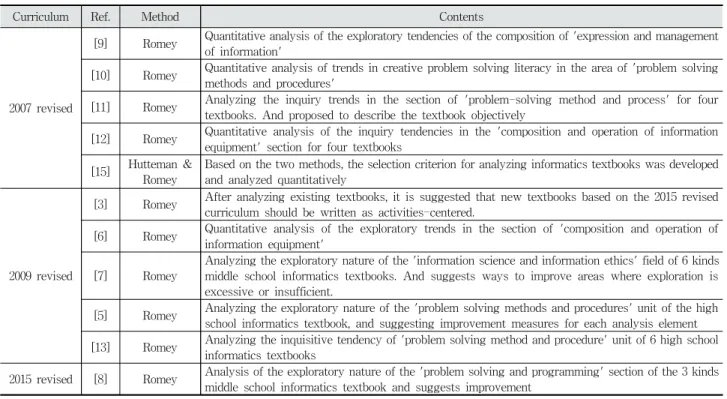
2007 개정 교육과정에서 2015 개정 교육과정까지 교육과 정의 변화에 따라 새로운 교과서가 제작되었으며, 교과서 분 석에 대한 다양한 연구들이 발표되었다[5-16]. 이들은 교과서 의 탐구성 분석, 교과서의 구성체계 분석, 교과서 선택준거 개발, 컴퓨팅 사고력 분석 등에 관한 것이다. 교과서 분석을 수행한 다수의 연구들은 정량적 분석 방법인 Romey 분석법 을 사용하여 탐구성을 분석하였다[5-13].
정보 교과에서는 교과서 내용이 활동 및 학습자 중심적으 로 구성되고, 문제 해결 방법과 원리를 찾는 과정을 통한 학 습자의 사고능력 신장을 강조한다는 측면에서 Romey 분석법 을 적용한 선행 연구들이 수행되었다. 선행 연구에서는 교과 서 분석을 통해 정보 교과서가 탐구적이어야 함을 강조하고 다양한 개선 방안을 제안하였다. Table 2는 Romey 분석법을 적용하여 중등학교 정보 교과서를 분석한 연구를 교육과정별 로 분류하여 나타낸 것이다.
2015 개정 교육과정에 기초하여 개발된 고등학교 정보 교 과서는 2017년에 7종이 인정 승인을 받아 사용되고 있다[17].
본 연구에서는 이들 7종 교과서를 연구 대상으로 하였다.
2015 개정 교육과정에 기초하여 개발된 정보 교과서의 탐구 성을 분석한 연구[8]가 최근에 발표되었으나 중학교 정보 교 과서라는 점에서 본 연구와 차이점이 있다. 그리고 본 연구와 같이 고등학교 교과서를 대상으로 탐구성을 분석한 연구[5]
가 발표되었으나 교과서에 적용된 교육과정 측면에서 본 연 구와 차이점이 있다.
3. 연구 방법
3.1 Romey 분석법을 적용한 교과서 분석
Romey는 교과서의 탐구성을 분석하기 위해 평가지수를
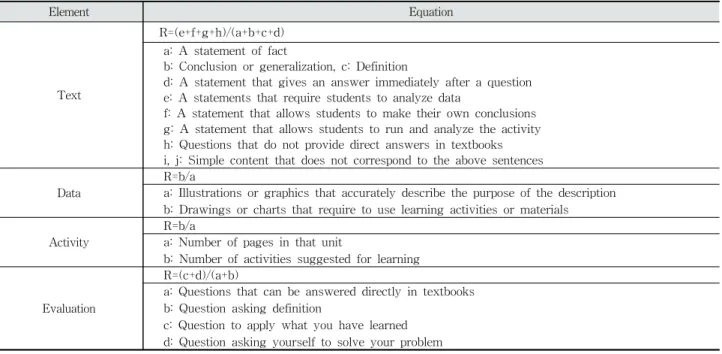
사용한 정량적 분석 방법을 제시하였다. 탐구의 개념은 초기 에 과학 교과에서 주로 사용되었다. Romey 분석법은 교과서 가 학습자의 탐구 활동을 유도하고, 탐구의 기회를 제공하는 정도에 대해 정량적으로 분석하는 방법이다. 교과서 구성에 서 분석항목은 본문, 자료, 활동, 평가로 분류되며, 각각에 대 한 Romey 평가지수의 산출 식은 Table 3과 같다.
Romey 분석법에서는 분석항목에 대한 수식을 정의하고, Romey 평가지수를 산출하여 이를 기준으로 교과서가 권위적 인지 탐구적인 것인지를 판별한다. 평가지수(R)가 0이면 학 생의 참여나 활동이 전혀 없는 권위적인 교과서이다. 평가지 수가 (0<R≤0.5)이면 학생의 활동이 부분적으로 이루어지지 만 권위적인 교과서이다. 평가지수가 (0.5<R≤1.5)이면 탐구 적인 교과서로 탐구성이 높은 가장 바람직한 교과서이다. 평 가지수가 (R>1.5)이면 탐구적인 경향이 과다하여 학습에 대 한 자료가 부족한 교과서이다[5].
3.2 교과서 분석 기준
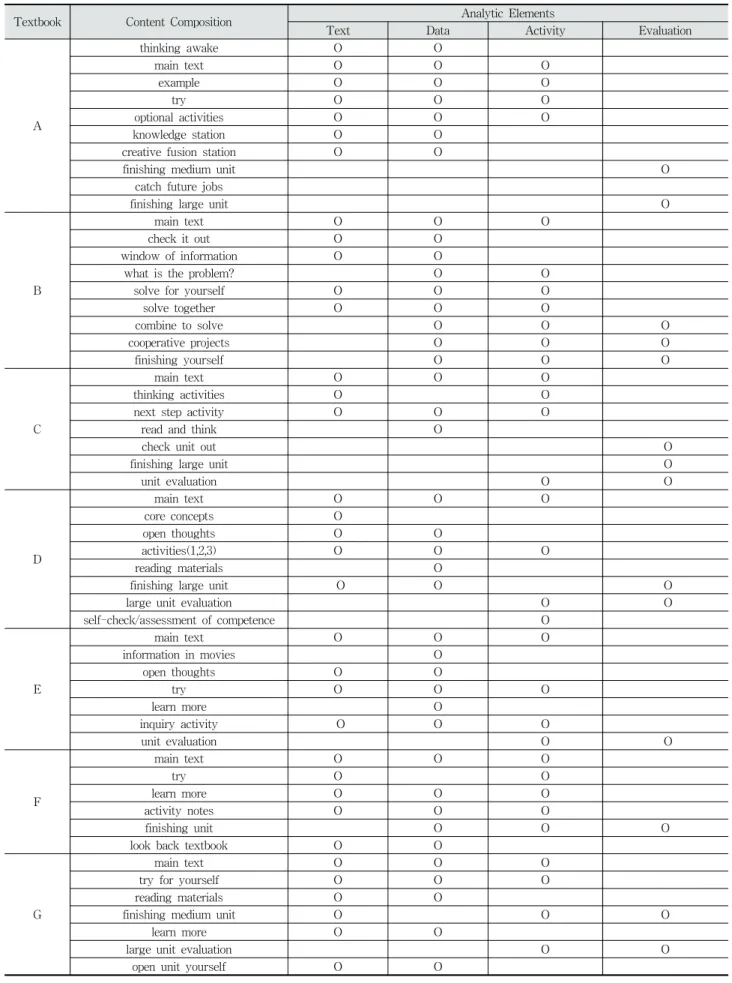
교과서의 탐구성 분석을 위한 4가지 분석항목은 본문, 자 료, 활동, 평가로 구성된다. Table 4는 최근 교육과정에 기반 하여 개발된 7종 교과서의 내용 구성에 대하여 분석항목의 적용 유무를 나타낸 것이다. Table 4의 각 분석항목에서 ‘O’
로 표시된 것은 분석을 수행하는 것을 의미한다. 예를 들면, 각 교과서의 구성 내용 중에서 본문은 본문, 자료, 활동의 3 개 분석항목에 대하여 분석이 이루어진다.
교과서들은 정보 교과 교육과정의 내용체계에 근거하여 서로 다른 차별화된 형태로 내용을 구성하고 있다. 따라서 본 연구에서는 구성된 내용의 성격을 파악한 후 4가지 분석항목 의 적용 여부를 판단한다.
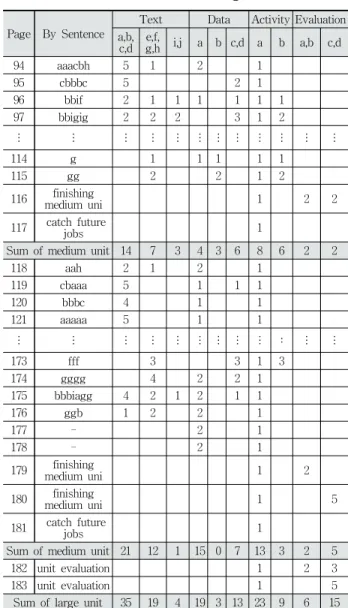
Table 5는 교과서의 일부 페이지를 문장 단위로 분석하여 나타낸 예시이다. Table 5에서 a∼j 문자의 의미는 Table 3에
Element Equation
Text
R=(e+f+g+h)/(a+b+c+d) a: A statement of fact
b: Conclusion or generalization, c: Definition
d: A statement that gives an answer immediately after a question e: A statements that require students to analyze data
f: A statement that allows students to make their own conclusions g: A statement that allows students to run and analyze the activity h: Questions that do not provide direct answers in textbooks i, j: Simple content that does not correspond to the above sentences Data
R=b/a
a: Illustrations or graphics that accurately describe the purpose of the description b: Drawings or charts that require to use learning activities or materials Activity
R=b/a
a: Number of pages in that unit
b: Number of activities suggested for learning
Evaluation
R=(c+d)/(a+b)
a: Questions that can be answered directly in textbooks b: Question asking definition
c: Question to apply what you have learned d: Question asking yourself to solve your problem
Table 3. Application of Romey Analysis for Each Element
Textbook Content Composition Analytic Elements
Text Data Activity Evaluation
A
thinking awake O O
main text O O O
example O O O
try O O O
optional activities O O O
knowledge station O O
creative fusion station O O
finishing medium unit O
catch future jobs
finishing large unit O
B
main text O O O
check it out O O
window of information O O
what is the problem? O O
solve for yourself O O O
solve together O O O
combine to solve O O O
cooperative projects O O O
finishing yourself O O O
C
main text O O O
thinking activities O O
next step activity O O O
read and think O
check unit out O
finishing large unit O
unit evaluation O O
D
main text O O O
core concepts O
open thoughts O O
activities(1,2,3) O O O
reading materials O
finishing large unit O O O
large unit evaluation O O
self-check/assessment of competence O
E
main text O O O
information in movies O
open thoughts O O
try O O O
learn more O
inquiry activity O O O
unit evaluation O O
F
main text O O O
try O O
learn more O O O
activity notes O O O
finishing unit O O O
look back textbook O O
G
main text O O O
try for yourself O O O
reading materials O O
finishing medium unit O O O
learn more O O
large unit evaluation O O
open unit yourself O O
Table 4. Availability of Factors for Different Contents onto which Romey Analysis is Applied
있는 설명과 같다. Romey 분석법은 평가지수 산출을 위해 교과서 내용 구성이 어떤 분석항목에 해당하는지 판단한 후 문장 단위로 분석한다. 교과서 내용 구성에서 분석항목별로 해당하는 개수를 파악한 후 중영역 단위로 합계를 구한다. 그 리고 이 결과를 Romey 평가지수 산출 식에 적용하여 평가지 수를 구한다.
Page By Sentence
Text Data Activity Evaluation a,b,c,d e,f,
g,h i,j a b c,d a b a,b c,d
94 aaacbh 5 1 2 1
95 cbbbc 5 2 1
96 bbif 2 1 1 1 1 1 1
97 bbigig 2 2 2 3 1 2
··· ··· ··· ··· ··· ··· ··· ··· ··· ··· ··· ···
114 g 1 1 1 1 1
115 gg 2 2 1 2
116 finishing
medium uni 1 2 2
117 catch future
jobs 1
Sum of medium unit 14 7 3 4 3 6 8 6 2 2
118 aah 2 1 2 1
119 cbaaa 5 1 1 1
120 bbbc 4 1 1
121 aaaaa 5 1 1
··· ··· ··· ··· ··· ··· ··· ··· ··· ·· ··· ···
173 fff 3 3 1 3
174 gggg 4 2 2 1
175 bbbiagg 4 2 1 2 1 1
176 ggb 1 2 2 1
177 - 2 1
178 - 2 1
179 finishing
medium uni 1 2
180 finishing
medium uni 1 5
181 catch future
jobs 1
Sum of medium unit 21 12 1 15 0 7 13 3 2 5
182 unit evaluation 1 2 3
183 unit evaluation 1 5
Sum of large unit 35 19 4 19 3 13 23 9 6 15
Table 5. An Example of Romey Analysis Conducted for Each
Sentence in Different Pages
4. 연구 결과
4.1 단원별 페이지 구성 분석
Table 6은 교육과정에서 제시한 ‘문제 해결과 프로그래밍’
대영역에 대한 7종 인정 교과서의 단원 구성과 단원별 페이 지 수를 나타낸 것이다.
대영역인 ‘문제 해결과 프로그래밍’에 대한 교과서의 구성 은 대단원과 중단원의 수에서 서로 다른 형태로 이루어졌다.
B, C, E 교과서는 교육과정의 내용 체계와 일치하게 대단원
1개로 구성하고 이를 3개의 중단원으로 분류하였다. 반면에 A 교과서는 1개 대단원을 중단원 2개로 구성하였고, D 교과 서는 중단원을 구분하지 않고 대단원 1개로 구성하였다. 그리 고 F, G 교과서는 추상화와 알고리즘을 하나의 대단원으로 하고, 프로그래밍을 별도의 대단원으로 분류하여 2개의 대단 원으로 구성하였다. 본 연구에서는 Table 6에 나타난 각 교과 서의 단원 구성을 기준으로 Romey 분석법을 적용하였다.
문제 해결과 프로그래밍’ 대영역에 대한 7종 교과서의 평 균 분량은 85페이지이며, D 교과서는 가장 많은 91페이지, E 교과서는 가장 적은 79페이지로 구성되었다. 따라서 ‘문제 해 결과 프로그래밍’ 대영역의 페이지 분량은 교과서별로 큰 차 이가 없음을 알 수 있다. 그러나 중단원별 페이지 수에서는 모든 교과서에서 프로그래밍 단원의 분량이 다른 두 개 단원 보다 많은 것으로 나타났다.
Textbook
Unit A B C D E F G
Large
Medium Abstraction
23 16 16 91
14 22 30
Medium Algorithm 14 11 20
Medium Programming 63 58 59 45 - -
Large - Programming - - - - - 63 53
Sum 86 88 86 91 79 85 83
Table 6. The Comparison of Textbook Organization
4.2 교과서의 Romey 지수 분석
본 논문에서는 7종 교과서(A∼G)의 ‘문제 해결과 프로그 래밍’ 대단원에 대한 탐구성을 분석하였다. Table 7은 각 교 과서에서 단원별로 본문에 대한 탐구성을 분석한 결과이며, Fig. 1은 3개 단원의 평균을 비교한 것이다.
본문에서 질문을 통해 학생들에게 활동을 실행하고 자료 분석을 요구하거나 학생들에게 자신의 결론을 만들게 하는 진술은 탐구성이 높은 문장으로 분류된다[5]. 본문을 분석한 결과, E 교과서의 평가지수가 0.655로 탐구적인 바람직한 형 태로 구성된 것을 알 수 있다. 나머지 6종 교과서의 평가지수 가 (0<R≤0.5)이어서 학생의 활동이 부분적으로 이루어지며, 다소 권위적인 형태로 구성된 것을 알 수 있다. 특히 B 교과 서의 평가지수가 0.175로 가장 낮게 나타나 본문이 매우 권위 적으로 구성된 것으로 판단된다.
Table 8은 각 교과서에서 그림이나 도표와 같은 학습 자료 에 대한 탐구성을 단원별로 분석한 결과이다. Fig. 2는 교과 서별로 중단원의 평균을 구한 것으로 대단원에 대한 평가지 수를 비교한 것이다.
학습 자료의 탐구성을 분석한 결과, 교과서 A, B, C의 평 가지수가 각각 0.586, 0.877, 0.780인 것으로 나타났다. 따라서 이들 교과서의 학습 자료들은 탐구성이 높게 구성된 것으로 판단된다. 이를 제외한 4종의 교과서에서는 그림이나 도표를 단순 설명을 위한 용도로 사용하는 것이어서 학습활동이나 자료로 활용되는 것이 부족한 것임을 알 수 있다.
Table 9는 각 교과서에서 학습 활동에 대한 탐구성을 단원별 로 분석한 결과이며, Fig. 3은 3개 단원의 평균을 비교한 것이다.
Textbook
Unit A B C D E F G
1 0.551 0.208 0.268 0.331 0.500 0.373 0.258 2 0.235 0.141 0.481 x 0.253 0.254 0.457
3 x 0.222 0.110 x 1.213 x x
Table 7. Evaluation Index by Unit for the Text Element
Fig. 1. The Romey Index of Text Element in Textbooks
Textbook
Unit A B C D E F G
1 0.895 0.636 1.667 0.058 0.308 0.077 0.333 2 0.277 0.875 0.625 x 0.130 0.043 0.119
3 x 1.119 0.049 x 0.096 x x
Table 8. Evaluation Index by Unit for the Data Element
Fig. 2. The Romey Index of Data Element in Textbooks
Textbook
Unit A B C D E F G
1 0.917 0.688 0.714 0.542 1.286 1.227 0.472 2 0.439 0.929 0.615 x 0.600 0.773 0.446
3 x 0.883 0.368 x 0.600 x x
Table 9. Evaluation Index by Unit for the Activity Element
Fig. 3. The Romey Index of Activity Element in Textbooks
활동 분석항목의 탐구성을 분석한 결과, G 교과서를 제외 한 모든 교과서의 평가지수가 (0.5<R≤1.5)를 보여줌으로써 활동 중심으로 탐구성이 높은 형태로 구성된 것을 알 수 있 다. 이들 중에서 B, E, F 교과서는 모든 중단원에서 탐구성이 높게 나타났으며, C와 D 교과서는 상대적으로 낮은 지수를 나타내었다.
Table 10은 각 교과서에서 단원별로 평가에 대한 탐구성 을 분석한 결과이며, Fig. 4는 3개 단원의 평균을 비교한 것 이다. 교과서의 중단원과 대단원 끝에 제시된 평가문항은 본 문에서 학습한 내용을 응용하도록 하고, 다양한 자료를 활용 하여 스스로 해결하도록 구성할 필요가 있다.
평가 분석항목에 대한 탐구성을 분석한 결과, E, F 교과서 의 평가지수가 탐구적인 교과서로 가장 바람직한 지수인 (0.5<R≤1.5)를 보여줌으로써 탐구성이 높은 것으로 나타났 다. 그러나 A, B, C, D, G 교과서는 평가지수가 1.5보다 크게
Textbook
Unit A B C D E F G
1 1.000 7.000 4.000 4.000 2.000 0.571 3.500 2 3.250 4.500 6.000 x 1.000 1.500 0.500
3 x 5.600 9.000 x 0.500 x x
Table 10. Evaluation Index by Unit for the Evaluation Element
Fig. 4. The Romey Index of Evaluation Element in Textbooks
나타나 탐구적인 경향이 과다한 것을 알 수 있다. 이는 새로 운 교육과정의 취지에 따라 개방형 문제의 평가 항목이 많아 진 것에 기인한 것으로 판단된다.
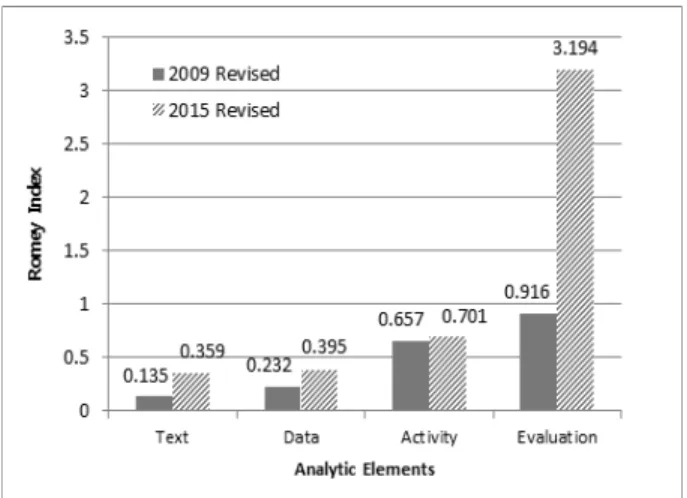
Fig. 5는 2009와 2015 개정 교육과정에 근거하여 제작된 고등학교 정보 교과서의 Romey 지수를 비교한 것이다. 2009 개정 교육과정에 근거한 교과서의 평가지수는 Kang & Kim [5]의 연구에서 제시한 6종의 고등학교 정보 교과서에 대한 평균을 사용하였다.
Fig. 5. Comparison of Textbooks with Changes in Curriculum
2015 개정 교육과정에 근거하여 제작된 교과서는 이전 교 과서보다 4개 분석항목에서 평가지수가 향상된 것으로 나타 났다. 활동 분석항목에서는 큰 변화가 없으나 본문과 자료 분 석항목에서 향상된 것을 알 수 있다. 이것은 교과서의 내용 구성에서 본문, 자료, 활동의 탐구성이 높아진 것을 나타내는 것으로 의미 있는 변화라고 할 수 있다. 그러나 평가 영역에 서는 지수가 과도하게 증가된 것으로 나타났다. 이것은 단원 마무리에 있는 개방형 문제의 풀이를 위한 학습 자료가 부족 하게 제시되었거나 문항의 난이도가 학습자의 수준을 넘어선 것에 기인한 것으로 판단된다.
5. 결론 및 논의
본 연구에서는 2015년 개정 교육과정에 근거하여 제작되 고, 2018학년도부터 사용되고 있는 고등학교 정보 교과서의 탐구성을 분석하였다. 7종의 교과서를 대상으로 ‘문제 해결과 프로그래밍’ 영역에 Romey 분석법을 적용하였다.
교과서를 분석한 결과, 본문, 자료, 활동, 평가의 4가지 분 석항목에서 각각 1종, 3종, 6종, 2종 교과서의 평가지수가 (0.5<R≤1.5)인 것으로 확인되었다. 따라서 이들 영역은 탐구 적인 교과서로 가장 바람직하게 구성된 것으로 판단된다. 그 러나 6종 교과서의 본문 구성이 탐구성이 낮았으며, 평가 분 석항목에서는 5종 교과서가 탐구성이 과다한 것으로 확인되 었다. 이러한 결과를 교과서별로 구분하면, 본문의 경우 E 교 과서의 평가지수가 0.655로 탐구적인 바람직한 형태로 구성
되었다. 나머지 6종 교과서는 평가지수가 (0<R≤0.5)이어서 학생의 활동이 부분적으로 이루어지는 형태로 구성된 것으로 확인되었다. 특히 B 교과서의 경우 평가지수가 0.175로 매우 낮게 나타나 본문이 매우 권위적으로 구성된 것으로 판단된 다. 이와 함께 평가 분석항목의 경우 E, F 교과서의 평가지수 가 탐구적인 교과서로 가장 바람직한 지수인 (0.5<R≤1.5)를 보여줌으로써 탐구성이 높은 것으로 나타났다. 그러나 A, B, C, D, G 교과서는 평가지수가 1.5보다 크게 나타나 탐구성이 과다한 것을 확인하였다.
2009 개정 교육과정에 근거한 교과서에 비해 새로운 교과 서가 4개 모든 분석항목에서 평가지수가 향상된 것으로 나타 났다. 이러한 결과는 새로운 교과서가 탐구성이 높은 바람직 한 형태로 개선된 것으로 판단할 수 있다. 그러나 평가 분석 항목의 경우 지수는 3배 이상 과도하게 증가된 것으로 나타 났다. 이것은 개방형 문항의 비율이 늘어나면서 문항 풀이를 위한 자료 제시가 부족하거나 문항의 난이도가 높은데 기인 한 것으로 판단된다. 평가 영역에서 지수가 과도하게 높게 나 타난 3종의 교과서에 대해 개선이 필요한 것으로 판단된다.
연구 대상 교과서들에서 분석항목 별로 탐구성이 낮거나 과도하게 높은 단원의 구성을 보완할 필요가 있다. 탐구성이 낮은 본문의 경우, 학습자가 본문을 통해 학습한 내용에 대해 활동을 하거나 실행할 수 있도록 정보를 제공해야 하며, 학습 자가 능동적으로 수업에 참여할 수 있도록 내용을 구성하고 기술할 필요가 있다. 또한 교과서에 수록된 그림이나 도표와 같은 자료는 학습 활동과 문제 해결 과정에 활용될 수 있도 록 해야 한다. 평가 분석항목에서 탐구성이 과도한 것으로 나 타난 교과서의 경우, 문항 풀이에 필요한 추가 자료를 제공하 거나 하나의 문항을 풀이 순서나 난이도에 따라 단계별로 구 분하여 제시할 필요가 있다.
본 연구는 2015 개정 교육과정에 기초하여 개발된 고등학 교 정보 교과서의 탐구성을 분석한 첫 번째 결과라는 것에 의미가 있다. 본 연구 결과를 반영한 개선을 통해 정보 교과 서가 학습자의 탐구성 배양과 문제해결 능력을 신장시키고, 컴퓨팅 사고력 향상에 기여할 수 있기를 기대한다.
References
[1] Ministry of Education, “Practical arts(technology⋅home economics)/informatics curriculum,” Vol. 2015-74, Appendix 10, 2015.
[2] E. K. Lee, “Perspectives and Challenges of Informatics Education: Suggestions for the Informatics Curriculum Revision,” The Journal of Korean Association of Computer Education, Vol.21, No.2, pp.3-10, 2018.
[3] B. G. Yu, J. M. Kim, and W. G. Lee, “Implication for Construction Computing System Unit of the 2015 Revised Curriculum,” The Journal of Korean Association of Computer Education, Vol.19, No.2, pp.31-40, 2016.
[4] W. D. Romey (S. H. Kim and Y. D. Lim), “Inquiry techniques
for teaching science,” Seoul: Radio Science Co., 1982.
[5] O. H. Kang and B. S. Kim, “The Analysis of Inquisitive Tendency of 'Problem-Solving Method and Process' Section in High School Informatics Textbooks,” The Journal of Korean Association of Computer Education, Vol.16, No.4, pp.51-59, 2012.
[6] O. H. Kang, “Analysis of Inquisitive Tendency of 2009 Revised Middle School Informatics Textbooks,” KIPS Tr.
Comp. and Comm. Sys., Vol.4, No.7, pp.231-238, 2015.
[7] O. H. Kang, “The analysis of inquisitive tendency of
’Information Science and Information Ethics’ section in 2009 revised middle school informatics textbooks,” The Journal of Korean Association of Computer Education, Vol.17, No.2, pp.1-10, 2014.
[8] O. H. Kang and J. I. Choi, “Analysis of Inquisitive Tendency in the 2015 Revised Middle School Informatics Textbooks,”
in Proceedings of the KACE, Vol.22, No.1, pp.143-146, 2018.
[9] J. M. Kim, J. K. Shim, G. M. Kim, W. G. Lee, and D. S. Park,
“Analysis of inquiry tendency in the ‘Information representation and management’ sections in middle school informatics textbooks,” The Journal of the KIPS, Vol.19-A, No.1, pp.9-16, 2012.
[10] Y. D. Kim, G. S. Choi, and J. Y. Lee, “Analysis of creative problem solving literacy in problem-solving methods and procedures parts presented in informatics textbooks in middle schools,” The Journal of Korean Association of Computer Education, Vol.11, No.1, pp.1-11, 2012.
[11] J. M. Kim, I. K. Yoon, Y. C. Kim, J. Y. Choi, and W. G. Lee,
“Analysis of inquiry tendency in ‘problem-solving method and process’ sections in the 2009 authorized informatics textbooks,” The Journal of Korean Association of Information Education, Vol.15, No.2, pp.253-264, 2011.
[12] J. M. Kim, H. A. No, and W. G. Lee, “Analysis of inquiry tendency in the ‘information equipment’ sections of infor- matics textbooks from a perspective of modern curriculum,”
The Journal of Korean Association of Computer Education,
Vol.14, No.5, pp.1-12, 2011.
[13] O. H. Kang, “The analysis of ‘General Computer’ textbooks in commerce・information high schools,” The Journal of the KIPS TCCS, Vol.1, No.1, pp.21-28, 2012.
[14] Y. H. Jin, M. Huh, and Y. S. Kim, “Comparative content analysis of middle school informatics textbooks and suggestions for improvement,” The Journal of Korean Association of Computer Education, Vol.13, No.3, pp.25-34, 2010.
[15] G. S. Choi, Y. J. Kim, and J. Y. Lee, “Development of selection criteria for informatics textbooks in middle school,” The Journal of Korean Association of Computer Education, Vol.13, No.5, pp.1-14, 2010.
[16] S. H. Kim, “Analysis of abstraction contents in informatics textbooks of middle school according to 2015 revised curriculum,” The Journal of Korean Association of Computer Education, Vol.21, No.5, pp.1-10, 2018.
[17] Korea Authorized & Approved Textbook Association, [Internet], http://www.ktbook.com/Shop/Online/BuyMain List.asp?BookGroup=11641&GroupName=%C1%A4%BA%B 8(15%B0%B3%C1%A4).
강 오 한
http://orcid.org/0000-0001-6654-0104