Optimized Recovery Study for Ilmenite and Zircon from Beach Sand of Dunjang Area
Wan-Tae Kim
1), Hee-Young Shin
1)*, Ho-Seok Jeon
1), Se-Won Chang
2)and Kang-Sup Chung
1)둔장지역 해안사로부터 일메나이트 및 저어콘의 회수를 위한 연구
김완태 신희영* 전호석 장세원 정강섭
요 약: 전라남도 둔장지역의 해안사로부터 일메나이트 및 저어콘의 회수를 위한 최적공정의 확립을 위해 물리적
선별 및 분리된 산물의 광물학적 평가를 수행하였다 시료의 입자크기와 중광물의 함량과는 밀접한 관련이 있었으.
며 중광물은 대부분150 이하의 입자에 분포하고 있음을 알 수 있었다 중광물의 농축을 위해 스파이럴 및.
요동테이블을 이용한 비중선별을 행하였으며 주로 석영으로 이루어진 경광물 및 조립광물을 제거함으로써 중광
물이 농축된 정광을 얻을 수 있었다 이 비중정광으로부터 자성입자를 분리하기 위해 고밀도 자력선별기를 사용하.
였으며 분리된 자성입자는 유도자력선별기를 이용하여 자성입자들이 가지는 자력감응도에 따라 고감응 저감응,
및 미감응 자성입자를 각각 분리하였다 그 결과 일메나이트 및 함 일메나이트 광물은 대부분 고감응 자성입자로.
농축되었으며 이때 산물의TiO2 함량은43.9wt.%로 나타났다 반면 저어콘 및 함 저어콘 광물은 비자성 입자. 및 미감응 입자로 분리되었으며ZrO2함량은 각각6.8wt.%및3.1wt.%로 나타났으며 대부분 체질을 통해 회수할 수 있었다.
주요어 : 해안사 비중정광 자력감응도 일메나이트 저어콘, , , ,
Abstract : In order to establish the optimized recovery process for ilmenite and zircon from beach sand of Dunjang area, Chonnam Province, the physical beneficiation and subsequent mineralogical characterization of the separated minerals were conducted. There was a clear relationship between particle size and heavy mineral content that the heavy minerals were mostly concentrated in the particles sized below 150 m. Gravity separation using spiral separator andμ shaking table separator made it possible to pre-concentrate the heavy minerals by rejecting light and coarse particles consist mainly of quartz. High-intensity magnetic separator and induced magnetic separator were used to separate the magnetic particles from non-magnetic particles of gravity concentrate and subsequently to fractionate the magnetic particles into three fractions, high susceptible, less susceptible and magnetic-others according to their magnetic susceptibility. Most of ilmenite and ilmenite-rich particles was finally concentrated in the high susceptible magnetic fraction and the content of TiO2was 43.9wt.%. On the other hand, zircon and zircon-rich particles were concentrated in the non-magnetic fraction and magnetic-others showing ZrO2 contents of 6.8wt.% and 3.1wt.%, respectively. The zircon and zircon-rich particles were further beneficiated by screening that most of them could be recovered.
Key words :Beach sand, Gravity concentrate, Magnetic susceptibility, Ilmenite, zircon
Introduction
Demand on new resources has been increased in recent
years because of not only outbreak of new industries but also rapid expansion of advanced technologies.
Especially, heavy minerals recovered from beach or sea sand have been gaining much attention because of rapid growth of electric, electronic and ceramic in- dustries. Generally, the term heavy minerals refers to minerals with a specific gravity (S.G.) greater than that of quartz (S.G. 2.7g/cm3). In addition, these heavy minerals are chemically stable and mechanically resistant enough to persist into beach accumulates. These types of deposits are predominantly mined for their titanium-
년 월 일 접수 년 월 일 채택
2006 8 21 , 2006 9 19
한국지질자원연구원 자원활용소재연구부 1)
한국지질자원연구원 석유해저자원연구부 2)
*Corresponding Author 신희영( ) E-mail; [email protected]
Address; Korea Institute of Geoscience and Mineral Re- sources, 30, Gajeong-dong, Yuseong-gu, Daejeon, Korea, 305-350
연구논문
bearing minerals such as ilmenite and rutile to supply titanium feedstock for the production of titanium metal.
An important co-product of this industry is zircon, which is mainly used in ceramic industry for the production of opacifiers (Reyneke and Westhuizen, 2001). It is well known that ilmenite and zircon are found in a variety of igneous, metamorphic and sedimentary rocks. In many of these rocks, concentrations of these valuable minerals are low or they cannot be fully re- covered. Fortunately, however, these minerals are common in beach sand deposits where they have been concentrated to such a degree that they can be econo- mically exploited.
Recently, we surveyed the mineralogical occurrences and chemical compositions of beach sand deposits contain economic concentrations of ilmenite, rutile and zircon along the west side of Korean peninsular. This work presents one of the optimized processes for the recovery of heavy minerals from Korean beach sands.
In order to establish the optimized recovery process, we investigated the fundamental physical separation techniques such as gravity separation and magnetic separation followed by mineralogical characterization.
This paper will also discuss the performance and effectiveness of these separation techniques in order to provide experimental information for further development of beach sand processing.
Sample and procedure
The beach sand of Dunjang which is located in the northwest of Jaeun Island, Shinan-gun was used in this study. Our preliminary examination revealed that the sand sample of this area was found to have relatively finer particles and higher contents of TiO2 and ZrO2
compare to those of other neighboring sampling sites.
Table 1 shows the chemical composition of major elements of raw sample obtained from XRF analysis.
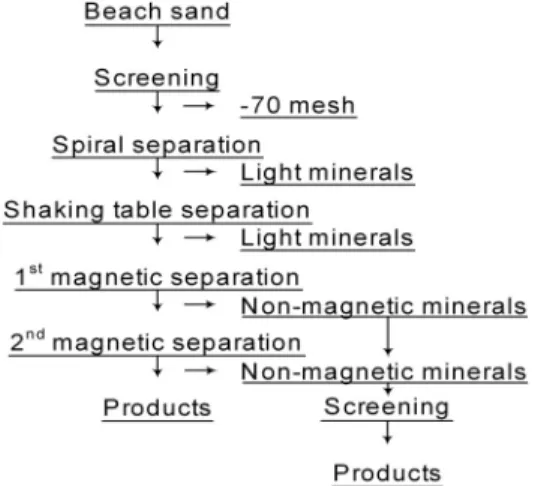
Fig. 1 illustrates the schematic diagram of sample treatment of this work. The sand sample was screened
and coarse fractions sized above 212 m regarded asμ usually non-valuable minerals were rejected. The fine fractions were subjected to gravity separation using a spiral separator (Humphreys, LC3700) and a shaking table separator (Wilfley, 13A) in order to obtain the heavy mineral-bearing pre-concentrate. Subsequently, the concentrate was magnetically fractionated using a laboratory scale high-intensity permanent magnetic roll separator (International Process Systems, L/P10-30) and a induced magnetic roll separator (Eriez, 3IN H.C.B.) at field strength settings of 9000 and 12000Gauss. The former was used to recover all the magnetic particles from pre-concentrate and the latter to separate the magnetic particles into three fractions, namely, high susceptible magnetic, less susceptible magnetic and magnetic-others according to their magnetic susceptibility.
The non-magnetic particles and magnetic-others separated from both magnetic separations were finally subjected to screening together to produce zircon-rich fraction from them.
Results and discussion
Screening
Among the conventional mineral processing techniques,
Table 1. Chemical composition of major elements of sample
SiO2 Al2O3 K2O3 Fe2O3 Na2O CaO MgO TiO2 ZrO2 Total
Wt.% 91.57 3.36 1.06 1.10 0.41 0.56 0.07 0.85 0.037 99.02
Fig. 1. Schematic diagram for the sample treatment.
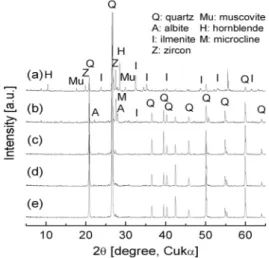
screening is perhaps one of the most efficient and simple. The screening has not only been utilized to prepare a uniformly sized feed to certain process, but also to upgrade the content of target minerals to be recovered. Fig. 2 shows the XRD patterns of the fractionated particles obtained from screening of raw sand. From the XRD profile, the peaks of quartz,
microcline and albite are observed as the major peaks of the particles fractionated above 212 m whereas theμ peaks of ilmenite and zircon are in the particles fractionated below 150 m although the peak intensitiesμ are low. Table 2 and 3 show the major component minerals and chemical compositions of the fractionated particles obtained from XRD and XRF analyses together with their weight values. From these brief summaries, it could be possible to say that there is a clear relationship between particle size and heavy mineral content of the sand sample. It implies that the amount of heavy minerals was increased as the particle size of the sand sample decreases although the total weight value of fine fractions below 150 m was much lowerμ than that of coarse fractions. Consequently, it is suggested that the pre-elimination of coarse fractions by simple screening prior to further beneficiation would be needed.
Spiral separation
In many of the gravity separators, the spiral con- centrator has traditionally been recognized as a low cost and environmentally friendly process for the separation of minerals. Its relatively simplicity and high efficiency compared to other gravity separators led to its widespread use under a variety of circuit con- figurations (Atasoy and Spottiswood, 1995). In this work, the sand sample fractionated below 212 m wasμ fed into the spiral separator. The separator employed in this work has a large diameter, flatter profile with a shallow pitch and seven turns. It was fitted with two splitters at discharge splitter box. Thus the separated three streams were connected via hoses to the separated samplers from which the sand collected into the middling sampler was returned to the slurry tank for Fig. 2. XRD profiles of the fractionated particles obtained
by screening ((a) -106 m, (b) -150/+106 m, (c) -212/+μ μ 150 m, (d) -300/+212 m, (e) +300 m).μ μ μ
Table 2. Major component minerals of the fractionated particles
Size( m)μ Component minerals Wt.%
+300 Quartz, Microcline, Albite 3.6 -300/+212 Quartz, Microcline, Albite 40.1 -212/+150 Quartz, Microcline, Albite 48.7 -150/+106 Quartz, Microcline, Albite,
Muscovite, Ilmenite 6.4 -106 Quartz, Microcline, Albite,
Muscovite, Ilmenite, Zircon 1.2
Table 3. Chemical compositions of the fractionated particles
Size( m)μ Chemical composition (wt.%)
SiO2 Al2O3 K2O Fe2O3 Na2O CaO MgO TiO2 ZrO2
+300 95.77 1.77 0.66 0.35 0.26 0.34 - 0.08 0.006
-300/+212 96.73 1.56 0.65 0.21 0.22 0.21 - 0.07 0.005
-212/+150 92.35 3.65 1.22 0.71 0.37 0.51 0.06 0.43 0.001
-150/+106 74.94 9.26 2.10 4.35 0.92 2.47 0.41 3.93 0.008
-106 40.98 4.91 0.59 20.30 0.56 2.30 0.58 27.36 0.128
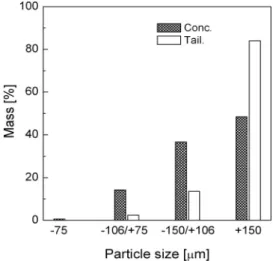
further beneficiation. The final concentrate and tailing after spiral separation were separately screened by a set of screens consisting of 150, 106 and 75 m sieves andμ each size fraction was subjected to XRD analysis. Fig.
3 shows the weight values of fractionated particles of concentrate and tailing obtained from spiral separation.
It can be seen that most of tailing which was collected in the outer region of spiral consists of coarse fraction above 106 m. This finding implies that finer andμ
heavier particles could be concentrated in the inner region of spiral since the coarse and light particles would move towards the outer region of spiral when the residence time of the feed on the spiral flow increases (Richards et al., 2000). Fig. 4 shows the XRD profiles of concentrate and tailing with the same size fraction ranged from below 150 m to above 106 m.μ μ It is noted that the tailing (light particles) is mostly consisted of quartz whereas the concentrate (heavy particles) shows the variety of minerals such as epidote, microcline and ilmenite as expected.
Shaking table separation
It is well known that the motion of a certain particle in fluids such as air or water is dependent not only on the particle’s density but also on its size and shape, large particles being affected more than smaller ones (Chatterjee, 1998). So, in practice, close size control of feed to gravity processes is strongly required especially when a shaking table separator is used as a cleaner. In this work, a 13A Standard Wilfley Concentrating Table was used for subsequent cleaning of concentrated rougher feed obtained from spiral separation. The deck inclination, stroke length and dressing water flow for the operation of the shaking table separator are previously adjusted to the optimum operating conditions in order to reduce the size effect and make the relative motion of the particles specific gravity dependent.
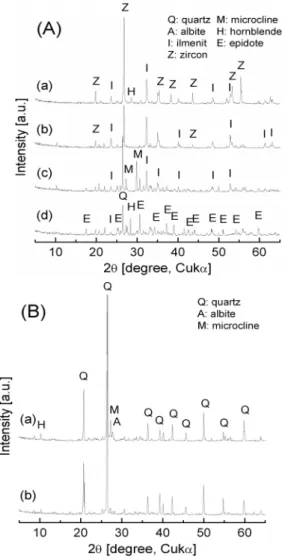
Fig. 5(A) and 5(B) show the XRD profiles of fract- ionated particles. The peaks of ilmenite and zircon are clearly observed as the particle size becomes smaller in the XRD profile in Fig. 5(A), while no peaks of heavy minerals are detected in the XRD profile in Fig. 5(B) although the size distributions of both fractionated particles are superposed on the region from below 150μ m to above 106 m.μ
Magnetic separation
There have been many advances in the design and operation of high-intensity magnetic separators, mainly as a result of the introduction of rare earth alloy permanent magnets capable of providing very high magnetic field strengths and gradients (Arvidson and Henderson, 1997). In this work, the use of high- intensity magnetic separator made it possible to separate Fig. 3. Weight percent of each size fraction obtained from
spiral separation.
Fig. 4. XRD profiles of the particles separated by spiral separation((a) Tailing, (b) Concentrate).
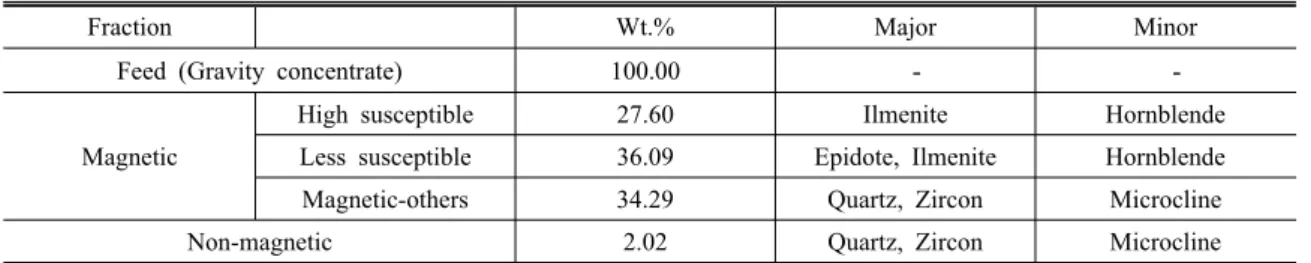
most of magnetic and ferrous particles from heavy mineral-bearing concentrate obtained from gravity separations. Fig. 6 shows the XRD profiles of magnetic and non-magnetic particles which were separated by high-intensity magnetic separator. It can be seen that quartz, zircon and microcline were main minerals of non-magnetic particles. Although only 2.02wt.% of gravity concentrate was separated into non-magnetic particles as shown in Table 4, most of zircon seemed to be recovered. Magnetic particles once collected by high-intensity magnetic separator were further fractionated
by induced magnetic separator subsequently. It also can be seen that the induced magnetic separation could be achievable at least for the following three mineral groups.
Ilmenite particles with high magnetic susceptibility (9,000Gauss magnetic)
Magnetic particles with relatively less magnetic susceptibility (12,000Gauss magnetic)
Magnetic-others (12,000Gauss non-magnetic) As shown in Fig. 7, ilmenite is main peak of the particles which were separated at the magnetic field strength of 9000Gauss, suggesting that ilmenite and high susceptible ilmenite-bearing particles were almost recovered at this separation condition. Table 4 and 5 show the mineralogical and chemical compositions of the fractionated particles by both magnetic separations.
It can be seen that high susceptible particles consisted mainly of ilmenite exhibit TiO2 content of 43.98wt.%
whereas magnetic-others exhibit TiO2 content of 8.45 wt.%. It is also noticeable that zircon and quartz are the main components in the non-magnetic particles as well as magnetic-others which are not fractionated into magnetic particles at magnetic field strength of 12000 Gauss. Their mineralogical compositions are also reflected in TiO2 and ZrO2 contents of 17.63wt.% and 6.78wt.% in the non-magnetic particles and 16.52wt.%
Fig. 5. XRD profiles of each size fraction obtained from shaking table separation((A): Concentrate, (a) -75 m, (b)μ -106/+75 m, (c) -150/+106 m, (d) +150 m, (B): Tailing,μ μ μ (a) -150/+106 m, (d) +150 m).μ μ
Fig. 6. XRD profiles of non-magnetic and magnetic par- ticles separated by high-intensity magnetic separation ((a) Non-magnetic particles, (b) Magnetic particles).
and 3.11wt.% in the magnetic-others, respectively.
However, it is also estimable that contents of TiO2, Al2O3 and CaO are still high in non-magnetic and magnetic-others. It strongly implies that these particles would contain appreciable amounts of rutile, garnet and sillimanite as minor heavy minerals although the peaks of them were not detected in the XRD profiles. Further investigations involving an optical microscopic particle
Fig. 7. XRD profiles of fractionated magnetic particles by induced magnetic separation((a) Magnetic-others, (b) 1200 Gauss, (c) 9000Gauss).
counting and EDS analysis would be needed to obtain quantitative information on the different species present in these fractions.
Separation of zircon
Based on the result as shown in Fig. 5(A) and Table 4, the assessment of mineral composition indicated that screening becomes available for the recovery of zircon.
Fig. 8. XRD profiles of the fractionated particles by screening of zircon-bearing fractions((a) +106 m, (b)μ -106 m).μ
Table 4. Mineralogical composition of the magnetically fractionated particles
Fraction Wt.% Major Minor
Feed (Gravity concentrate) 100.00 - -
Magnetic
High susceptible 27.60 Ilmenite Hornblende
Less susceptible 36.09 Epidote, Ilmenite Hornblende
Magnetic-others 34.29 Quartz, Zircon Microcline
Non-magnetic 2.02 Quartz, Zircon Microcline
Table 5. Chemical composition of the magnetically fractionated particles.
SiO2 Al2O3 K2O Fe2O3 Na2O CaO MgO TiO2 ZrO2
Feed 30.26 13.95 0.36 15.45 0.12 8.43 0.89 20.74 1.10
High susceptiblef 5.54 2.59 009 31.60 0.01 0.82 0.48 43.98 0.05
Less susceptible 33.60 21.71 0.17 15.13 0.08 15.59 1.30 8.45 0.06
Magnetic-others 48.17 13.49 0.83 2.51 0.31 5.87 0.68 16.52 3.11
Non-magnetic 43.30 13.49 0.50 0.56 0.12 1.25 0.21 17.63 6.78
Actually, the simplicity of this process makes it possible to recover most of zircon from non-magnetic particles as well as magnetic-others. Fig. 8 shows the XRD profiles of the fractionated particles by screening of zircon-bearing fractions collected into non-magnetic and magnetic-others by both magnetic separations. The result clearly indicates that zircon is mostly con- centrated in the fine fraction sized below 106 m.μ
Conclusion
1. Particle size analysis revealed that there was a clear relationship between particle size and heavy mineral content. The heavy minerals were mostly con- centrated in the particles sized below 150 m. Screeningμ was performed in order to reject above 212 m fractionμ are mainly composed of quartz and to make uniformly sized feed to subsequent gravity separations.
2. Spiral separation and subsequent shaking table separation made it possible to concentrate heavy minerals by rejecting non-valuable minerals consist mainly of quartz and other light minerals. About 6.6wt.% of feed was collected into final gravity concentrate and the recovery performance and effectiveness of both gravity separations were confirmed by the assessment of min- eralogical and chemical compositions of the products.
3. Most of particles with magnetic susceptibility were recovered by high-intensity magnetic separator. The induced magnetic separator was subsequently applied to fractionate the magnetic particles into three fractions according to their magnetic susceptibility. TiO2 content of high magnetic susceptible particles was 44.0wt.%
while those of less magnetic susceptible particles and magnetic-others were 8.5wt.% and 16.5wt.%, respectively.
4. The mineralogical and chemical compositions of non-magnetic particles and magnetic- others separated by both magnetic separators are similar. They consist mainly of zircon and exhibit ZrO2contents of 6.78wt.%
and 3.11wt.%, respectively. Since zircon was mostly concentrated in the particles below 106 m, it could beμ simply recovered by screening.
Acknowledgements
The authors would like to express appreciation to the Ministry of Maritime Affairs and Fisheries of Korea for the financial support of this research project.
References
Arvidson, B. R. and Henderson. D., 1997, “Rare-earth magnetic separation equipment and applications develo- pments”, Minerals Engineering, Vol. 10, No. 2, pp.
127-137.
Atasoy, T. and Spottiswood, D. J., 1995, “A study of particle separation in a spiral concentrator”, Minerals Engineering, Vol. 8, No. 10, pp. 1197-1208.
Chatterjee, A., 1998, “Role of particle size in mineral processing at Tata Steel”, Int. J. Miner. Process., Vol.
53, No. 1-2, pp. 1-14.
Reyneke, L. and Van Der Westhuizen, W. G., 2001,
“Characterization of a heavy mineral- bearing sample from India and the relevance of intrinsic mineralogical features to mineral beneficiation”, Minerals Engineering, Vol. 14, No. 12, pp. 1589-1600.
Richards, R. G., MacHunter, D. M., Gates, P. J. and Palmer, M. K., 2000, “Gravity separation of ultra-fine (-0.1mm) minerals using spiral separators”, Minerals Engineering, Vol. 13, No. 1, pp. 65-77.
김 완 태 신 희 영
현재 한국지질자원연구원 자원활용소재연구부 선임연구원 (本 學會誌 第 券 第 号 參照41 4 )
현재 한국지질자원연구원 자원활용소재연구부 책임연구원 (本 學會誌 第 券 第 号 參照41 4 )
전 호 석 장 세 원
년 강원대학교 대학원 자원공학과 공 1990
학석사
년 강원대학교 대학원 자원공학과 공 1994
학박사
현재 한국지질자원연구원 자원활용소재연구부 선임연구원 (E-mail; [email protected])
현재 한국지질자원연구원 석유해저자원연구부 책임연구원 (E-mail; [email protected])
정 강 섭
현재 한국지질자원연구원 자원활용소재연구부 책임연구원 (本 學會誌 第 券 第 号 參照42 5 ))