http://dx.doi.org/10.7236/JIIBC.2015.15.4.119
JIIBC 2015-4-15
다중 셀 MIMO 네트워크를 위한
Hadamard
행렬Interstream
전송 기반Blind
채널 추정Blind Channel Estimation based on Hadamard Matrix Interstream Transmission for Multi-Cell MIMO Networks
양재승 * , 모하마드 아부 하니프 ** , 박주용 *** , 이문호 ****
Jae-Seung Yang * , Mohammad Abu Hanif ** , Ju-Yong Park *** , Moon-Ho Lee ****
요 약
본 논문에서는 다중 셀 MIMO (multiple-input and multiple-output) 네트워크를 위한 Hadamard 행렬 인터스트 림 (interstream) 전송기반 blind 채널추정을 소개한다 . 제안 방법은 다중 셀로 된 이동 단말 네트워크를 기반으로 연구 된다 . MS (mobile station) 는 양 셀로부터 신호를 받는 것으로 가정한다 . 가까운 셀로부터 받은 신호는 원하는 신호 로 간주되고 , 다른 셀로부터 받은 신호는 간섭신호로 간주된다 . 채널은 blind 이기 때문에 채널을 추정하기 위해 Hadamard 행렬 패턴의 파일럿 (pilot) 스트림 (stream) 을 전송하면 , 대규모 MIMO 채널에 대해 보다 쉽고 빠른 채널 추정이 가능하게 된다 . Hadamard 행렬 기반시스템의 계산은 오직 복소 가산 (complex addition) 만 필요하기 때문에 , 복소 승산 (complex multiplication) 이 필요한 Fourier 변환을 이용한 방법보다 복잡도가 훨씬 줄어든다 . 수치적 분석 을 통해 본 결과 제안한 방법이 완벽함을 보여준다 .
Abstract In this paper, we introduce a Hadamard matrix interstream transmission based blind channel estimation for multi-cells multiple-input and multiple-output (MIMO) networks. The proposed scheme is based on a network with mobile stations (MS) which are deployed with multi cells. We assume that the MS have the signals from both cells. The signal from near cell are considered as desired signal and the signals from the other cells are interference signal. Since the channel is blind, so that we transmit Hadamard matrix pattern pilot stream to estimate the channel; that gives easier and fast channel estimation for large scale MIMO channel. The computation of Hadamard based system takes only complex additions, and thus the complexity of which is much lower than the scheme with Fourier transform since complex multiplications are not needed. The numerical analysis will give perfection of proposed channel estimation.
Key Words : Blind Channel Estimation, Hadamard Matrix, Multi Cell, Hadamard Interatrial Sequence.
* 정회원, 대진대학교 컴퓨터공학과
** 정회원, 전북대학교 전자정보공학부
*** 정회원, 신경대학교 인터넷정보통신학과
**** 정회원, 전북대학교 전자정보공학부(교신저자) 접수일자 2015년 2월 12일, 수정완료 2015년 6월 17일 게재확정일자 2015년 8월 7일
Received: 12 February, 2015 / Revised: 17 June, 2015 / Accepted: 7 August, 2015
**** Corresponding Author: [email protected]
Dept: Division of Electronic Engineering, Chonbuk National
University
Ⅰ. Introduction
Due to the extremely growth in wireless communication services in the last decade, there has been an increasing demand of new resources.
Multiple-antenna communications systems have generated a great deal of interest since they are capable of considerably increasing the capacity of a wireless link. Recently, coordinated multiple point has been considered as an efficient technology to eliminate the inter-cell interference [1].
Small Cells networks have introduced to describe the characteristics of all sorts of radio cells such as femto, micro, pico-cells. The channel estimation in small-cell networks are becomes an important issue to the researcher throughout the world. Channel estimation is one of vital parts of mobile wireless channel. Channel estimation is a method used to significantly improve the performance of the system, especially for 4G Long Term Evolution (LTE) [2] . Since the channel is assumed to be blind in this paper, the base stations (eNBs) must transmit training sequences; being orthogonal among the antennas of different sectors and sites.
In order to estimate the channels of interferers, the base stations (BSs) must transmit training sequences being orthogonal among the antennas of different sectors and sites. On the other hand, quite a lot of these channels must be estimated to combat the interference until the noise floor is reached. The more interferer channels are distinguishable, the more orthogonal pilots must be transmitted. This consumes a large fraction of the potential capacity gain. In this paper, In this paper, we propose a Hadamard matrix intersteram transmission based blind channel estimation for multi-cells networks. Hadamard matrix pattern gives easier and fast channel estimation for large scale MIMO channel. Our proposed scheme does not consume any more pilots than in current systems.
But it enables mobile terminals to distinguish the more of the strong interference channels the slower they are moved in the service area. Hence, without increasing
the pilot overhead, low-mobility terminals can take most benefit of advanced interference mitigation schemes.
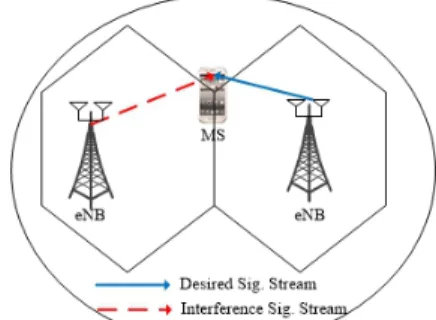
그림 1. 한개의 MS와 두개의 eNB를 갖는 두 셀의 예. 두 eNB 모두 Hadamard 패턴 파일럿을 MS에 전송 Fig. 1. A two-cell example with one mobile
station (MS) and two enhance base station (eNB). Both eNB transmits Hadamard pattern pilot stream to MS.
The rest of the paper is organized as follows. In Section Ⅱ, we introduce the proposed system models.
In subsection of Ⅱ, proposed channel estimation is introduced. We provide simulation results comparing the conventional scheme in Section V, and close by discussing conclusions in Section VI.
Ⅱ. System Model
We consider a multi-cell downlink system with multiple a base station(eNB) in each cell. There are N cells comprising with K mobile user (MS). As an example, two-cell and single user system is shown in Fig. 1. As shown in Fig. 1 a mobile user are receiving signal from both cells eNB. According to the Fig. 1, the received signal at MS in i-th time slot using Alamouti scheme [3] is written as
*
1 d 1 I 2 1
y = h x − h x + z , (1)
*
2 d 1 I 2 2
y = h x + h x + z , (2)
where y
1and y
2are the received signal at time slot
t = T and t = 2 T , h
dand h
Iare the channel
coefficient from desired and interference cell eNBs respectively, and z 1 and z 2 are the white gaussian noise with zero mean and variance N
0, namely,
~ ( 0 ,
0)
n
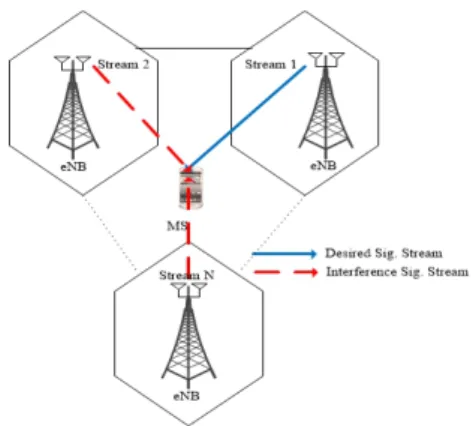
iCN N . For the multi cells system we do the same thing as above. The multi cells transmission scheme is shown in Fig. 2.
그림 2. 각 다중 셀에 하나의 MS와 enB를 갖는 다중셀의 예. 각 셀의 eNB는 Hadamard 패턴 파일럿 스트 림을 MS에 전송
Fig. 2 A multi-cell example with one mobile station (MS) and eNB in each cells. Each cells eNB transmits Hadamard pattern pilot stream to MS.
A. Hadamard Pattern Pailot Transmission For the blind channel, (i. e.) the transmitter does not have the channel state information (CSI), the pilot symbol is transmitted using Hadamard pattern for the channel estimation. In the similar way as (1) and (2), the pilot symbols received at the receiver at time slot
t = T and t = 2 T can be calculated as
1 = d 1 + I 2 + 1
P H S H S N (3)
2 = d 1 − I 2 + 2
P H S H S N (4)
where H d and H I is the real part of channel coefficient of h
dand h
I. From (3) and (4) the Hadamard matrix pilot sequence
11 22⎛ ⎞
⎜ − ⎟
⎝ ⎠
S S
S S is used. In this part, to simplify the channel estimation we ignore the noise part in (3) and (4). Adding (3) and (4) we
have the pilot symbol P 1 + P 2 = 2 H S d 1 . Now the estimated channel can be written as
1 2
2 1 d
= +
% P P
H S (5)
where H %
dis the estimated channel between desired eNB and MS. Similar way as (5), the estimated channel between interference eNB and MS can be calculated as
1 2
2 2
I= −
% P P
H S (6)
For the multi-cell we extend the Hadamard matrix using the Kronecker product theory as [4]
1 1
1
1 1
2 2
2 2 2
2 2
k k
k k
k k
H H
H H H
H H
− −
−
− −
⎛ ⎞
= ⎜ ⎝ − ⎟ ⎠ = ⊗
As an example of Hadamard interstream blind channel estimation for higher order Hadamard matrix we consider 8 × 8 Hadamard matrix here. In this case, we suggest to apply Hadamard Stream sequences spread over the time domain from slot to slot with a maximum sequence length of 8. Here, each row of a block-orthogonal sequence matrix is orthogonal to all other rows of the same matrix with full correlation length, i.e. rr H
=I . Note that the suggested scheme can be easily extended to the case of larger order Hadamard matrix length. Let us now see how Hadamard matrix work. To do the estimation we use dimensional Hadamard transform. Assuming we deploy enough pilots, the LS estimation of channel transfer function, and each stream can be assembled into an M L × matrix in frequency and time domain for two-dimensional Hadamard Transform.
After the first dimensional Hadamard Transform in frequency domain, energy of the channel tends to concentrate on the low end of the transform domain.
Since HT is a linear transform, the energy of white
Gaussian noise after HT remains uniformly
distributed. In order to represent the two dimensional
Hadamard Transform in a matrix form, the channel
transfer function matrix in time and frequency domains need to be converted to a long vector. The LS estimation vectors of channel can be written as
( ,1 ,2 , 1 )
ˆ T T T T
l m m m L
H = h
hL
h− (7)
The first dimensional Hadamard Transform of H ˆ l in LS has now become:
ˆ (1 ) ˆ
l m l
H = Γ ⋅ H (8) where
1 1 0 0
1 1 0 1 1
1 1
0
0 0 1 1
1 1
m
⎛ ⎛ ⎞ ⎞
⎜ ⎜ ⎝ − ⎟ ⎠ ⎟
⎜ ⎟
⎜ ⎛ ⎞ ⎟
⎜ ⎜ ⎟ ⎟
Γ = ⎜ ⎝ − ⎠ ⎟
⎜ ⎟
⎜ ⎟
⎜ ⎛ ⎞ ⎟
⎜ ⎜ ⎟ ⎟
⎜ ⎝ − ⎠ ⎟
⎝ ⎠
L
M
M O
L (9)
is a block diagonal matrix. In this case,
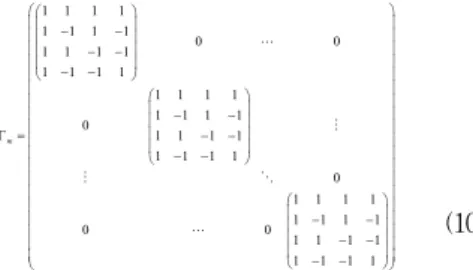
⎛⎜⎝11 −11⎞⎟⎠could be a matrix of order n. Each block Hadamard sequence is represent in each cell sequence. As an example of
4 4 × Hdamard sequence (9) can be represent as
1 1 1 1
1 1 1 1
0 0
1 1 1 1
1 1 1 1
1 1 1 1
1 1 1 1
0 1 1 1 1
1 1 1 1
0
1 1 1 1
1 1 1 1
0 0
1 1 1 1
1 1 1 1
m
⎛ ⎛ ⎞ ⎞
⎜ ⎜ − − ⎟ ⎟
⎜ ⎜ ⎟ ⎟
⎜ ⎜ − − ⎟ ⎟
⎜ ⎜ − − ⎟ ⎟
⎜ ⎝ ⎠ ⎟
⎜ ⎛ ⎞ ⎟
⎜ ⎜ ⎟ ⎟
⎜ ⎜ − − ⎟ ⎟
⎜ ⎜ ⎟ ⎟
Γ = ⎜ ⎜ ⎜ ⎜ ⎝ − − − − ⎟ ⎠ ⎟ ⎟ ⎟
⎜ ⎟
⎜ ⎛ ⎞ ⎟
⎜ ⎜ ⎟ ⎟
⎜ ⎜ − − ⎟ ⎟
⎜ ⎜ − − ⎟ ⎟
⎜ ⎜ ⎟ ⎟
⎜ ⎝ − − ⎠ ⎟
⎝ ⎠
L
M
M O
L (10)
For n − th cells we will use n n × block Hadamard stream sequence. We simplify the equation (10) as
1 1
1
0 0
0
0
0 0
m
ω ω
ω
⎛ ⎞
⎜ ⎟
⎜ ⎟
Γ = ⎜ ⎟
⎜ ⎟
⎝ ⎠
L M
M O
L , (11)
where ω 1 n − th order block diagonal Hadamard matrix and ω
1is the N N × real symmetric core matrix.
그림 3. 직교코드 시퀀스에 기반한 파일럿 재사용 패턴.
3-fold 섹터의 셀룰러 시스템에서 Hadamard의 예
Fig. 3. Pilot reuse pattern based on orthogonal code sequence, e.g. Hadamard, in a 3-fold sectorized cellular system.
In Fig. 3 the decimal numbers indicate the sector index. The Hadamard sequences spread over space (rows) and time (columns) domain. Hex-base numbers indicate sites with the same virtual pilot sequence. It is not difficult to show the orthogonality of H
n,
1,2, ,
n = L n that is n − th order Hadamard transform. The 2-D Hadamard Transform can be written as
Y = H X H n n
X = H Y H n n . (12) Now the first order estimated channel can be written as
ˆ
(1 )ˆ
l m l
H = Γ ⋅ H . (13)
Then, in (8) H ˆ
l(1)is interleaved for the Hadamard Transform, as
( 2 ) (1 )
ˆ ˆ
l l
H = K H ⋅ . (14)
where K is a sparse matrix, with the element
1
, { 0
k i j = . (15)
Consequently, the 2-D Hadamard Transform has now become
( 2 ) ( 2 )
ˆ d ˆ
l L l
H = Γ ⋅ H , (16)
where
2 2
2
0 0
0 ,
0
0 0
L
ω ω
ω
⎛ ⎞
⎜ ⎟
⎜ ⎟
Γ = ⎜ ⎟
⎜ ⎟
⎝ ⎠
L M
M O
L (17)
is also a n th − order block diagonal Hadamard matrix and ω 2 is the N N × real symmetric core matrix of one-D Hadamard Transform.
After the MMSE weighting in the 2D Hadamard Transform domain, and the 2D Inverse Hadamard Transform, the channel transfer function in frequency domain becomes
, ,
ˆ T T ˆ
mmse m n L n L m l
H =Γ K Γ Γ Γ Q K H (18)
where Γ
m n,= Γ
mis a block diagonal matrix for the 2D Inverse Hadamard Transform, Γ
L n,= Γ
Lis a block diagonal matrix for the first-dimensional Inverse Hadamard Transform and Q = d ia g q ( ) diagonal weighting matrix for MMSE weighting.
B. Covarience estimation based Hadamard interstream transmission
Now we estimate our system based on covarience matrix for Hadamard interstream transmission. One may think of two simple mechanisms to estimate the desired matrix. Now, we can simplify (1) and (2) as vector form as
d d I I
= + +
y h x h x z (19)
where y = [ y
1y
2]
T, x
d= [ x
1− x
2*]
T, and x I = [ x x 2 1 * ] T . On the one hand it is possible to obtain this knowledge by estimating the covariance matrix Q
y y= E [ y y
†] of the received signal vector y using several subsequently received data symbols. The Hermitian transpose and expectation operators are denoted by
( ) ⋅
†and E [ ] ⋅ , respectively. For proper application it is necessary to know the system’s covariance matrix defined as
†
†
† † † † †
[ ]
[( )( ) ]
[ ] [ ] [ ]
yy
d d I I d d I I
d d d d I I I I
=
= + + + +
= + +
yy
h x h x z h x h x z h x x h h x x h zz E
E
E E E
Q
(20)
C. Hadamard Sequence compared with the Least Square (LS) and Minimum Mean Square Estimation(MMSE)
Here we consider MS is close to the interference cell. Considering the interference signal and the desired signal from the both of the cells, we can simplify (1) and (2) as vector form as
d d I I
= + +
y h x h x z . (21)
where y = [ y 1 y 2 ] T , x d = [ x 1 − x * 2 ] T , and x I = [ x x 2 1 * ] T . Since, MS is close to the interference eNB, we can ignore the interference cells signal and we can write (7) as
d d
= +
y h x z (22)
The LS estimation of h
dis to minimize the squared difference between observation, y , and the model output without noise [5] . Now the LS estimation can be calculated as
arg min || || 2
LS = h − d d
h % y h x . (23)
The MMSE estimation is provided reasonably good performance with less statistical information. The goal is to estimate the channel h
dfrom the knowledge of y and x d . Consider the linear model in (8) where the sequence x d is known, and after some mathematical manipulation the MMSE estimation is given by
1 1
ˆ = d H ( R
h−+ d H d )
−h yx x x , (24)
where R
his the autocorrelation of
h. Now the mean square estimation error can be calculated as
2 1 1
|| ˆ || ( H )
MMSE tr R − d d −
Γ = E h h − = h + x x (25)
그림 4. Hadamard 인터스트림 시퀀스 추정을 이용한 LS, MMSE, WLS의 MSE 비교
Fig. 4. The comparison of mean square error of LS, MMSE, and WLS with Hadamard Interstream Sequence Estimation.
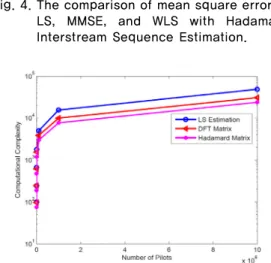
그림 5. LS, DFT, Hadamard 행렬 인터스트림 시퀀스의 복잡도 계산량 비교
Fig. 5. Computational Complexity of LS, DFT and Hadamard matrix interstream sequence.
Ⅲ. Simulation
In the simulation, we perform the monte-carlo simulation to show the performance of our proposed scheme with compare to some well-known channel estimation techniques. In Fig. 2, we can see the performance of proposed Hadamard sequence that is with the conventional LS and MMSE estimation along with Weighted Least Square (WLS) estimation. In Fig.
3, Computation Complexity of Hadamard based estimation and LS Estimation is compared. It is shown
that, the Hadamard sequence estimation is more better performance than that of LS estimation while the MMSE is till perform better. But the computation complexity of Hadamard sequence is less than that of LS estimation and Hadamard matrix will become more practical channel estimation scheme.
Ⅳ. Conclusion
In this paper, we introduce a Hadamard matrix interstream transmission based blind channel estimation for multi-cells multiple-input and multiple-output (MIMO) networks. We expect that the proposed algorithm based on Hadamard sequence will become more practical channel estimation scheme for OFDM systems.
References
[1] D. Lee, H. Seo, B. Clerckx, E. Hardouin, D.
Mazzarese, S. Nagata, K. Sayana, “Coordinated Multipoint Transmission and Reception in LTE-Advanced: Deployment Scenarios and Operational Challenges,” IEEE Communications Magazine, vol. 50, no. 2, pp. 148-155, 2012.
[2] D. Knisely, T. Yoshizawa, F. Favichia,
“Standardization of femtocells in 3GPP,” IEEE Comm. Magazine, vol. 47, no. 9, pp. 68-75, Sept.
2009.
[3] S. M. Alamouti, “A simple transmit diversity technique for wireless communications,” IEEE J. Select. Areas Commun., vol. 16, no. 8, pp.
1451 1458, Oct. 1998.
[4] M. H. Lee, Constructions and Its Applications for Fast Cooperative Wireless Signal Processing, LAP LAMBENT, Nov. 2012, Germany.
[5] J. Choi, Optimal Combining and Detection,
Cambridge university press 2012.
※ This work was supported by MEST, 2015R1A2A1A05000977, NRF Korea.
[6] Y. Li and N.R. Sollenberger, “Clustered OFDM With Channel Estimation for High Rate Wireless Data,” IEEE Trans. Commun. vol. 49, 2001, pp.
2071-2076.
[7] F. Rusek, D. Persson, B. K. Lau, E. G. Larsson, T. L. Marzetta, O. Edfors, and F. Tufvesson,
“Scaling up MIMO: opportunities and challenges with very large arrays,” IEEE Signal Process.
Mag., accepted. Available: arXiv:1201.3210v1 [cs.IT], 16 Jan 2012.
[8] Y. S. Cho, J. Kim, W. Y. Yang, and C. Kang, MIMO-OFDM Wireless Communication with MATLAB, John Wiley Sons (Asia) Pte Ltd.
[9] Y. S. Im, E. Y. Kang, "MPEG-2 Video Watermarking in Quantized DCT Domain," The Journal of The Institute of Internet, Broadcasting and Communication(JIIBC), Vol.
11, No. 1, pp. 81-86, 2011.
[10] I. Jeon, S. Kang, H. Yang, “Development of Security Quality Evaluate Basis and Measurement of Intrusion Prevention System,”
Journal of the Korea Academia-Industrial cooperation Society(JKAIS), Vol. 11, No. 1, pp.
81-86, 2010.
저자 소개
양 재 승(정회원)
∙1988년 연세대학교 금속공학과 학사
∙1995년 연세대학교 산업정보 석사
∙2010년 전북대학교 정보보호공학 박 사
∙1989년~1999년 한국UNISYS 차장
∙2000년~2002년 SEEC Inc. 한국 지 사장
∙2000년~2010년 제이에스 정보 이사
∙2011년 3월~현재 대진대학교 컴퓨터공학과 강사 <주관심분야 : Polar Code, 정보보안>
모하마드 아부 하니프(준회원)
∙2001년~2005년 Asian University of Bangladesh, Bangladesh
(방글라데시아시안 대학)
∙2010년 2월 전북대학교 전자공학부 석사과정 졸업
∙2010년 3월 전북대학교 전자공학부 박사과정 재학
<주관심분야 : 무선이동통신, 이동통신 TH Precoding 설계>
박 주 용(정회원)
∙1982년 전북대학교 전자공학과 석사
∙1994년 전북대학교 전자공학과 박사
∙1991년 3월~2007년 2월 서남대학교 전자공학부 부교수
∙2007년 3월~현재 신경대학교 인터 넷정보통신학과 부교수
<주관심분야 : 무선이동통신>
이 문 호(정회원)