ISSN 1225-6552, eISSN 2287-7630 https://doi.org/10.7853/kjvs.2016.39.4.247
< Original Article >
Veterinary Service
Available online at http://kjves.org
*Corresponding author: Jun Hyung Sohn, Tel. +82-54-850-3319, Fax. +82-54-850-3248, E-mail. [email protected]
돼지유래 Salmonella 속 균의 동정을 위한 MALDI TOF MS 활용
손준형
*ㆍ전우진ㆍ이영미ㆍ김선수
경북동물위생시험소 북부지소
MALDI TOF MS for the identification of Salmonella spp. from swine
Jun Hyung Sohn*, Woo Jin Jeon, Young Mi Lee, Seon Soo Kim
North Branch, Gyeongbuk Veterinary Service Laboratory, Andong 36621, Korea
(Received 28 November 2016; revised 26 December 2016; accepted 26 December 2016)
Abstract
Salmonella is one of the most common bacteria that causes heavy losses in swine industry and major causative pathogen of food poisoning in public health. Various methods for the identification of Salmonella such as Gram staining, agglutination test, enzyme-linked immunosorbent assay (ELISA), pol- ymerase chain reaction (PCR) have been used. Several studies have demonstrated that Matrix Assisted Laser Desorption Ionization Time of Flight (MALDI TOF) Mass Spectrometry (MS) identification is an efficient and inexpensive method for the rapid and routine identification of isolated bacteria. In this study, MALDI TOF MS could provide rapid, accurate identification of Salmonella spp. from swine compared with end point PCR and real time PCR.
Key words : Idendification, MALDI TOF MS, End point PCR, Real time PCR, Salmonella
서 론
Salmonella속 균은 Gram 음성의 아포를 형성하지 않는 간균으로 균체 표면 항원인 O-antigen과 편모항 원인 H-antigen, virulence에 영향을 주는 Vi-antigen 등 의 다양성에 근거하여 혈청형을 결정할 수 있음을 보 고한 이래, O-antigen의 혈청형에 따라 A, B, C, D, E 등의 group으로 구분하며, 현재까지 약 2,500여 종 이 상의 serotype이 보고되었다(Baggesen 등, 2000; Hah 등, 2011). 위장관염, 패혈증 등 다양한 질병을 일으 키는 원인체로 주요 식중독 원인 세균으로 공중보건 학적으로 매우 중요하며 사람에서 뿐만 아니라 소, 돼지, 닭, 염소 등 매우 광범위한 숙주역을 가지는 병 원성 세균이다(Steven 등, 2012; Thorns, 2000). 돼지에 살모넬라가 감염되면 설사, 탈수, 유산, 폐사 등의 임 상증상을 보이는데 무증상인 경우도 많으며 치료 후
임상증상이 호전될 경우에도 무증상 매개체가 되어 지속적인 균 배출을 통한 농장 내 질병 전파의 원인 이 되고, 도축장에서는 수송과 계류 스트레스로 인한 균 배출로 식육을 오염시키는 주요 원인이 된다(Hurd 등, 2002; Kang 등, 2015).
전통적인 세균 분리-동정, 항원-항체 응집반응, 생 화학 검사 뿐 아니라 근래에는 enzyme-linked immu- nosorbent assay (ELISA), plasmid profiling, phage typ- ing과 pulsed-field gel electrophoresis (PFGE), polymer- ase chain reaction (PCR) 등이 Salmonella속 균의 연구 에 널리 사용되고 있다(Guerra 등, 2000; Cho 등, 2011).
이 중 최근 고분자 물질의 질량분석법인 MALDI TOF MS (Matrix Assisted Laser Desorption Ionization Time of Flight Mass Spectroscopy)에 대한 연구가 활 발하게 진행되고 있는데 MALDI TOF MS는 질량분 석법 중 하나로 1980년대에 개발되었으며, 최근 항원 항체반응, DNA hybridization, 생체 적합성 시험에 의 한 단백질 흡착등 생체물질 특이성을 분석하는 방법
으로 응용되면서 세균 동정 등 생물정보학 분야 전반 에 걸쳐 널리 활용되고 있다(Kim 등, 2012). 이 방법 에서 matrix와 시료 화합물에 laser가 조사되면 matrix 가 빠르게 증발하면서 양전하를 띠는 protein이 방출 되는데 이런 이온들이 진공 튜브를 통해 각각의 질량 에 따라 다른 flight time을 보이며 detector에 도달한 다. 이를 정확하게 측정하여 정확한 분자량으로 변환 하고 system상에서 기존에 구축되어 있는 database의 정보와 자동으로 비교하는데 이러한 질량 분포는 각 각의 미생물에서 종 특이적으로 나타나기 때문에 분 자 지문으로 해석될 수 있어서 미생물 동정에 사용할 수 있다(Konnerth 등, 2014; Kuddirkiene 등, 2015;
McElvania TeKippe 등, 2014). 따라서 이번 연구에서 는 돼지 임상시료에서 분리한
Salmonella속 균을
MALDI TOF MS법에 의한 결과와 기존의 연구에서 널리 사용되고 있는 end point PCR, real time PCR법 에 의한 결과를 비교하여 동정법으로서 MALDI TOF MS법의 효용성에 대해 알아보고자 한다.재료 및 방법
공시재료
2011년 6월에서 2016년 5월까지 경상북도 동물위 생시험소로 의뢰된 양돈장 임상시료에서 분리하여 생화학적 분자유전학적 검사를 실시하여
Salmonella
속 균으로 최종 진단된 균주 60주를 실험에 사용하였 다. 설사, 폐사 등의 임상증상으로 의뢰된 돼지의 소 장, 대장, 분변 및 환경시료에서 세균을 분리하였고 catalase test, oxidase test, H2S산생능 등 생화학 검사 와 함께 end point PCR법 혹은 real time PCR법으로 특이 유전자를 확인하였다. 이 균주들은 실험을 실시 할 때까지 −70oC에서 냉동ㆍ보관하였고 상온에서 해 동한 후 혈액배지에 도말하여 37oC, 24시간 배양하였 다. 배양된 균주의 성상을 확인하고 Salmonella test kit (Oxoid, Austria)로 응집반응을 실시하여 양성으로 확인한 후 농림축산검역본부 동물질병 표준진단요령 에 따라 boiling법으로 end point PCR과 real time PCR 을 수행하기 위한 DNA를 추출하였다.검사방법
End point PCR: 60주의 Salmonella속 균 동정을 위
하여 상품화된 VeTeKTM SAL Detection kit (iNtRON Biotechnology, Korea)를 사용하여 제조사에서 공급하 는 매뉴얼에 따라 end point PCR법으로 검사를 실시 하였다. boiling법으로 추출한 DNA와 positive con- trol을 각각의 PCR premix tube에 2 L씩 분주하고 negative control은 RNase-free water을 2 L 분주한 후 18 L의 DNase/RNase free water를 첨가하였다.
Biometra사의 T1 Thermocycler 장비를 사용하여 initial denaturation (94oC, 5 min) 1 cycle 후, denaturation (94oC, 30 sec), annealing (50oC, 30 sec), extention (72oC, 40 sec) 40 cycle, final extention (72oC, 5 min) 1 cycle 로 PCR법을 실시한 후 증폭산물을 ethidium bromide (EtBr)를 첨가한 1.5% agarose gel상에서 전기영동하 여 UV transilluminator (Bio-rad, USA)에서 특이밴드 (246 bp)를 확인하였다.
Real time PCR: MALDI TOF MS법과의 비교를 위 하여 추가로 실시한 real time PCR법은 PowerCheckTM
Salmonella spp. Real-time PCR Kit (Kogenebiotechnology,
Korea)를 사용하여 제조사의 매뉴얼에 따라 수행하였 다. Boiling법으로 추출한 DNA와 negative control (DNase/RNase free water), positive control을 real time PCR premix가 15 L 포함되어 있는 각각의 strip tube 에 5 L씩 분주하고 전용 cap으로 strip tube를 닫고 기포가 생기지 않게 가볍게 흔들어 반응액과 DNA를 혼합한 후 spin down하여 혼합액이 튜브 중심으로 모 이게 하였다. fluorophore는 VIC, target gene은 invA로 CFX 96 (Bio-rad, USA)장비를 사용하여 50oC, 2 min, 1 cycle, 95oC, 10 min, 1 cycle 후 95oC, 15 sec, 60oC, 1 min 각 35 cycle 실시하여 실시간 증폭곡선으로 결 과를 판독하여 Ct value가 33이하에서 증폭이 일어났 을 때 양성으로 판정하였다.MALDI TOF MS: 검사를 실시하기 위하여 먼저 absolute acetonitrile 500 L, deionizes water 475 L와 absolute trifluoroacrtic acid 25 L를 혼합하여 organic solvent (OS)를 만들고 OS 250 L으로 vortex하여 녹인 다음 spin down하여 matrix solution을 준비하였다. 먼저 direct transfer (DT)법을 실시하였는데 장비 내의 target plate에 single colony를 얇게 펴서 바르고 준비된 matrix solution 1 L를 첨가한 후 상온에서 건조하였다. 이렇 게 준비한 target plate를 MALDI Biotyper (BRUKER, Germany) 장비를 사용하여 제조사에서 제공한 flexControl를 실행하고 target plate를 장비에 장착한 다음 MALDI Biotyper RTC 소프트웨어를 실행하여 분석할 sample 위치와 수량을 지정한 다음 자동화된
Table 1. Comparison with identification methods of Salmonella spp. from swine
Real-time PCR End point PCR
Positive Negative Positive Negative
MALDI TOF MS (DT, eDT)
Positive 59 0 59 0
Negative 1 0 0 1
Fig. 1.Gel electrophoresis of Salmonella spp. specific gene by end point PCR. Lane M: 100 bp molecular ladder. Lane 1, 2, 3, 4, 5, 6: samples (no. 55∼60), Lane NC:
negative contol, Lane PC: positive control.
Fig. 2.Amplification curve Sal- monella spp. from swine by real time PCR.
순서에 따라 동정을 실시하였다. DT법으로 동정되지 않은 균주는 extended direct transfer (eDT)법으로 동정 을 실시하였다. 추가적으로 제조사에서 제공하는 for- mic acid extraction (EX)법은 효모와 같이 단단한 세 포벽을 가진 미생물 동정에 적용하는 것을 추천하고 있어서 이번 실험에서는 사용하지 않았다. 실험결과 의 판독은 결과값이 2.300∼3.000인 경우 highly prob- able species identification, 2.000∼2.299는 secure genus identification, probable species identification, 1.700∼
1.999는 probable genus identification이며 1.699 이하는 not reliable identification으로 자동으로 처리된다.
결 과
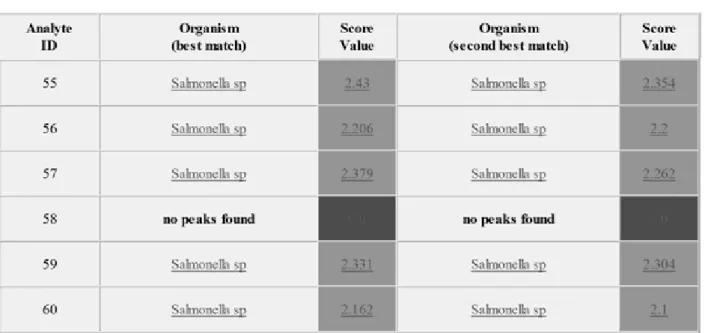
돼지에서 분리한 Salmonella spp. 60주를 대상으로 실시한 end point PCR 결과 58번 sample의 경우 증폭
산물의 전기영동 결과 246 bp에서 특이밴드를 확인 할 수 없어서 음성 판정하였으며 이로 인하여 98.3%
(59/60)의 검출률을 보였다. real time point PCR법의 경우 60개 모두 양성으로 확인하였으며 MALDI TOF MS를 이용한 동정결과는 end point PCR법을 실시한 경우와 동일하게 58번 sampl 1개 균주에서만 질량분 석 결과 특정 분자량이 밀집하는 peak지점이 없는
“no peak found” 판정으로 음성으로 확인되어 98.3%
(59/60)의 검출률을 나타내었다(Table 1, Figs. 1∼3).
고 찰
MALDI TOF MS는 기존은 동정방법과 달리 검체 자체의 이온을 검출하고 그 질량을 알아내는 시스템 이다. 이온화 과정에서 분자구조가 깨어지지 않아 안 정적으로 분자량 측정이 가능하며 여러 종류가 혼재
Fig. 3. Result overview of Salmonella spp. (sample 55∼60) from swine by MALDI TOF MS.
되어 있어도 동시에 분석이 가능하다는 장점이 있다.
MALDI-TOF MS를 이용한 미생물의 동정법은 비교 적 새로운 동정법으로 최근 들어
Burkholderia cepa- cia, Clostridium species, Erwinia species, Escherichia coli, Listeria species, Staphylococcus aureus, Yersinia enterocolitica 등 다양한 종의 미생물에 대한 동정 연
구가 이루어지고 있다. 특히 Hsieh 등(2008)은 병원성 미생물의 분류와 동정에 MALDITOF MS의 효율 성 을 검증하기 위하여 S. aureus, E. coli, Klebsiella, Sal-monella 등을 동정하고, classification model을 검증하
였는데, 높은 신뢰도와 빠른 동정이 가능하며, 혼합 시료에서 여러 종류의 세균을 동시에 검출할 수 있으 며, 낮은 검출한계를 가지고 있다고 보고하였다(Hsieh 등, 2008; Vanlaere 등, 2008; Parisi 등, 2008; Grosse-Her- renthey 등, 2008; Barbuddhe 등, 2008; Du 등, 2002;Szabados 등, 2010).
다른 동정법은 sample의 수가 증가할수록 추가적인 비용이 발생하고 시간이 늘어나는데 비하여 MALDI TOF MS에서는 추가비용의 부담이 없으며 최대 96개 까지 6∼8분 이내에 높은 정확성으로 동정할 수 있 다. 이번 연구에서도 end point PCR법의 경우 DNA추 출과정부터 전기영동까지 약 210분, real time PCR법 이 약 150분 정도가 소요되고 각각의 과정에서 실험 자의 개입이 필요하였으나 MALDI TOF MS를 활용 한 경우 60주의 Salmonella single colony 채취에서 동 정까지 30분 이내에 완료할 수 있었다. 또한 end point PCR과 같은 98.3%의 높은 정확성으로 real time
PCR법보다 훨씬 빠르게 결과를 확인할 수 있어
Salmonella속 균을 동정하는 데 매우 저렴하고 신속ㆍ
정확한 방법임을 알 수 있었다.결 론
Salmonella속 균은 돼지에서 질병을 일으킬 뿐만 아니라 사람에서도 식중독을 일으키는 주요 병원체 이기 때문에 신속하고 정확한 동정법이 매우 중요하 다고 할 수 있다. 현재 생화학적 특성을 이용한 동정 법(API kit, VITEK 등), PCR 등 다양한 동정방법이 사용되고 있으며 이전보다 더 신속하고 정확한 동정 법에 대한 연구가 지속적으로 이루어지고 있다. MALDI TOF MS를 이용한 동정법은 다른 방법에 비해 비교 적 새로운 것으로 짧은 동정시간과 비교적 저렴한 비 용, 그리고 낮은 숙련도 요구 등의 장점을 가지고 있 다. 또한 높은 정확도를 가지고 있으므로 salmonella 속 균의 동정법으로 활용하기 적합하다고 할 수 있 다. 하지만 다른 미생물 동정법으로 광범위하게 적용 하기에는 상대적으로 적은 database, 검출감도 변화, 염분이나 계면활성제 등이 감도에 영향을 미치는 인 자로 작용하는 등에 대한 단점이 있기 때문에 연구 개발이 지속적으로 이루어져야 하며 이러한 단점이 지속적으로 보완된다면 일차적으로 신속하고 정확한 동정법으로 활용할 수 있을 것으로 판단한다.
REFERENCES
Baggesen DL, Sandvang D, Aarestrup FM. 2000. Charaterization of Salmonella enterica serovar Typhimurium DT104 iso- lated from Denmark and comparison with isolates from Europe and the United States. J Clin Mirobiol 38:
1581-1586.
Barbuddhe SB, Maier T, Schwarz G, Kostrzewa M, Hof H, Domann E, Chakraborty T, Hain T. 2008. Rapid identi- fication and typing of listeria species by matrix-assisted laser desorption ionization-time of flight mass spec- trometry. Appl Environ Microbiol 74: 5402-5407.
Böhme K, Morandi S, Cremonesi P, Fernández No IC, Barros- Velázquez J, Castiglioni B, Brasca M, Cañas B, Calo-Mata P. 2012. Characterization of Staphylococcus aureus strains isolated from Italian dairy products by MALDI-TOF mass fingerprinting. Electrophoresis 33:
2355-2364.
Dallagassa CB, Huergo LF, Stets MI, Pedrosa FO, Souza EM, Cruz LM, Assis FE, Wolf S, Volanski W, Picheth G, Pigatto-Denardi CP, Farah SM, Fadel-Picheth CM. 2014.
Matrix-assisted laser desorption ionization-time of flight mass spectrometry analysis of Escherichia coli categories.
Genet Mol Res 13: 716-722.
Du Z, Yang R, Guo Z, Song Y, Wang J. 2002. Identification of Staphylococcus aureus and determination of its methi- cillin resistance by matrix-assisted laser desorption/ion- ization time-of-flight mass spectrometry. Anal Chem 74:
5487-5491.
Cho JK, Kang MS, Kim KS. 2011. Serotypes, antimicrobial re- sistance of Salmonella spp. and plasmid profiles, phage types, PFGE of S. Enteritidis and S. Typhimurium iso- lated from ducks in Daegu-Gyeongbuk province. Korean J Vet Serv 34: 217-226.
Grosse-Herrenthey A, Maier T, Gessler F, Schaumann R, Böhnel H, Kostrzewa M, Krüger M. 2008. Challenging the prob- lem of clostridial identification with matrix-assisted laser desorption and ionization-time-of-flight mass spectrome- try (MALDI-TOF MS). Anaerobe 14: 242-249.
Guerra B, Schrörs P, Mendoza MC. 2000. Application of PFGE performed with XbaI to an epidemiological and phyloge- netic study of Salmonella serotype typhimurium. Relations between genetic types and phage types. New Microbiol 23: 11-20.
Hah DY, Ji DH, Jo SR, Park AR, Jung EH, Pakr DY, Lee KC, Yang JW, Kim JS, Kim HJ, Jung JH, Song IH, Kim AR, Lee JY, Kim YH. 2011. Prevalence of the antimicrobial resistance and resistance associated gene in Salmonella spp. isolated from swines and cattle in slaughterhouse.
Korean J Vet Serv 34: 45-54.
Hsieh SY, Tseng CL, Lee YS, Kuo AJ, Sun CF, Lin YH, Chen JK. 2008. Highly efficient classification and identi- fication of human pathogenic bacteria by MALDI-TOF MS. Mol Cell Proteomics 7: 448-456.
Hurd HS, McKean JD, Griffith RW, Wesley IV, Rostagno MH.
2002. Salmonella enterica infections in market swine with and without transport and holding. Appl Environ Microbiol 68: 2376-2381.
Kang MS, Lee SJ, Shin YS. 2015. Prevalence and antimicrobial resistance of Salmonella isolated in poultry farms.
Korean J Vet Serv 38: 95-100.
Khot PD, Couturier MR, Wilson A, Croft A, Fisher MA. 2012.
Optimization of matrix-assisted laser desorption ioniza- tion-time of flight mass spectrometry analysis for bacte- rial identification. J Clin Microbiol 50: 3845-3852.
Kim HW, Ham JS, Seol KH, Han SH, Park BY, Oh MH. 2012.
MALDI-TOF MS System for the identification of Microorganisms in Milk and Dairy Products. Korean J Dairy Sci Technol 30: 131-137.
Konnerth S, Rademacher G, Suerbaum S, Ziesing S, Sedlacek L, Vonberg RP. 2014. Identification of pathogens from blood culture bottles in spiked and clinical samples us- ing matrix-assisted laser desorption ionization time-of- flight mass-spectrometry analysis. BMC Res Notes 27:
405.
Kudirkiene Egle, Welker Martin, Knudsen Nanna R, Bojesen Anders M. 2015. Rapid and accurate identification of Streptococcus equi subspecies by MALDI-TOF MS. Syst Appl Microbiol 38: 315-322.
McElvania TeKippe E, Burnham CA. 2014. Evaluation of the Bruker Biotyper and VITEK MS MALDI-TOF MS sys- tems for the identification of unusual and/or diffi- cult-to-identify microorganisms isolated from clinical specimens. Eur J Clin Microbiol Infect Dis 33: 2163- 2171.
Parisi D, Magliulo M, Nanni P, Casale M, Forina M, Roda A.
2008. Analysis and classification of bacteria by ma- trix-assisted laser desorption/ionization time-of-flight mass spectrometry and a chemometric approach. Anal Bioanal Chem 391: 2127-2134.
Steven AC, Alison EB, Ronald WG. 2012. Salmonellosis. pp.
821-833. In: Jeffrey J. Zimmerman, Locke A, Karriker, Alejandro Ramirez, Kent J. Schwartz, Gregory W. Ste- venson(ed.). Disease of Swine. 10th ed. A John Wiley
& Sons. Ames, Iowa.
Szabados F, Woloszyn J, Richter C, Kaase M, Gatermann S.
2010. Identification of molecularly defined Staphylococcus aureus strains using matrix-assisted laser desorption/ion- ization time of flight mass spectrometry and the Biotyper 2.0 database. J Med Microbiol 59: 787-790.
Thorns CJ. 2000. Bacterial food-borne zoonoses. Rev Sci Tech 19: 226-239.
Vanlaere E, Sergeant K, Dawyndt P, Kallow W, Erhard M, Sutton H, Dare D, Devreese B, Samyn B, Vandamme P.
2008. Matrix-assisted laser desorption ionisation-time-of of-flight mass spectrometry of intact cells allows rapid identification of Burkholderia cepacia complex. J Microbiol Methods: 75: 279-286.