1. 서 론
무기체계 분야는 분야의 특수성으로 다양한 Technical Paper DOI: http://dx.doi.org/10.6108/KSPE.2018.22.2.152
핀틀이 적용된 고온 가스 밸브의 비정상상태
해석 기법에 관한 연구
이경욱
a ․ 허선욱
b ․ 권세진
b ․ 이종광
a , *
Study on Transient Analysis of Hot Gas Valve with Pintle
Kyungwook Lee
a ․ Seonuk Heo
b ․ Sejin Kwon
b ․ Jongkwang Lee
a, *
a
Department of Mechanical Engineering, Hanbat National University, Korea
b
Department of Aerospace Engineering, Korea Advanced Institute of Science and Technology, Korea
*
ABSTRACT
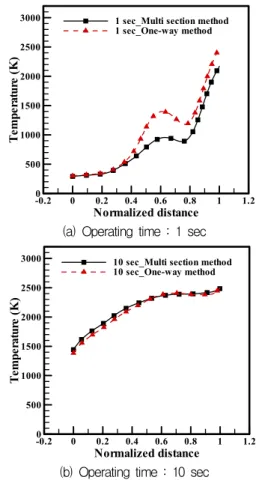
A numerical simulation was conducted to establish the analysis methods of the unsteady conjugated heat transfer with a hot gas valve. Two methods are proposed to reduce the computational cost and analysis time of the unsteady conjugate heat transfer; namely, the multi-section analysis method and the one-way analysis method. The multi-section analysis method exhibits relatively high reliability. In the one-way analysis method, the unsteady conjugate heat transfer from the fluid domain to the solid domain was simulated from the analysis results of the steady-state flowfield. The incipient accuracy of the analysis results obtained by the one-way analysis method was slightly lower than that of the results obtained by the multi-section analysis method. However, the discrepancy became smaller with time, as the analysis progressed.
초 록
고온밸브의 비정상상태 복합열전달 해석 기법을 확립하기 위한 연구를 수행하였다. 장시간 작동하 는 고온밸브의 특성과 해석의 경제성을 고려하여 두 가지 해석 기법을 제시하였다. 발달순서에 따라 구간을 나누고 구간별로 시간간격을 증가시켜 해석을 수행하는 다 구간 해석 기법과 정상상태 유동 장 해석결과를 비정상상태 해석의 초기 값으로 사용하는 one-way 해석 기법을 제시 하였다. 다 구간 해석 기법의 경우 신뢰도가 높은 해석이 수행 가능하지만 경제적인 측면에서 설계 단계의 해석 기법 으로는 부적합하였다. one-way 해석 기법의 경우 초기 신뢰도는 떨어지나 기민한 설계 변수 연구가 가능한 경제적인 해석 수행이 가능하였다.
Key Words: Pintle(핀틀), Hot Gas Valve(고온밸브), CFD(전산유체역학)
Received 22 November 2017 / Revised 25 January 2018 / Accepted 30 January 2018 Copyright Ⓒ The Korean Society of Propulsion Engineers pISSN 1226-6027 / eISSN 2288-4548
This is an Open-Access article distributed under the terms of the Creative Commons Attribution Non-Commercial License(http://creativecommons.org
/licenses/by-nc/3.0) which permits unrestricted non-commercial use, distribution, and reproduction in any medium, provided the original work is properly cited.