38(4) : 403 408 (2007)
403
배무채 ( × Brassicoraphanus ) 의 화학성분 분리
이연희1·안규석1·이수성2·박영두3·유시용4·김성훈1*
1경희대학교한의과대학
,
2중앙대학교창업보육센터바이오브리딩,
3경희대학교원예학과,
4한국화학연구원Isolation of Chemical Compounds from x Brassicoraphanus
Yun-Hee Rhee
1, Kyoo-Seok Ahn
1, Soo-Seong Lee
2, Young-Doo Park
3, Shi-Yong Ryu
4and Sung-Hoon Kim
1*1
Oriental Medical College, Kyunghee University, Seoul 130-701
2
BBI, Business Incubator Center, Chungang University Ansan 456-756
3
Department of Horticultural Biotechnology, Kyunghee University 449-70
4
Korea Research Institute of Chemical Technology, Daejeon 305-764
Abstract
−xBrassicoraphanus is an intergenic breed crossed between Brassica campetris L. ssp. pekinensis and Raphanus sati- vus L. that have been daily consumed. x Brassicoraphanus was known to have good tastes and biological activities. Nev- ertheless, its constituetnts were not elucidated yet. Thus, in the present study, to indirectly evaluate the biological activity of xBrassicoraphanus , 12 compounds were isolated from leaves and roots of xBrassicoraphanus . On the basis of spectroscopic evidences, the structures of these compounds isolated from leaves of xBrassicoraphanus . were identified as
β-sitosterol, indole- 3-acetonitrile, ferulic acid, methyl ferulate, linolenic acid methyl ester, linolenic acid and coniferyl alcohol, while the chemical structures of compounds isolated from the roots of were xBrassicoraphanus were characterized as
β-sitosterol, indole-3-ace- tonitrile, ferulic acid, methyl ferulate, linolenic acid methyl ester, 1-methoxyindole-3-acetonitrile, goitrin, 4-hydroxycinnamyl alcohol, coniferyl alcohol, palmitic acid and daucosterol. These can be classified as three steroids, two indole cyanides, two cin- namic acid derivatives, one cinnamyl alcohol derivative, three fatty acid derivatives one isothiocyanate. These results suggest that the compounds isolated from xBrassicoraphanus were almost identical with known components of Brassica campetris L.
ssp pekinensis or Raphanus sativus L. However, it is necessary to investigate more about the difference of amounts of con- stituents according to harvest time and variant species amounts.
Key words
−xBrassicoraphanus , Steroid, Indole, Cinnamic acid, Fatty acid, Isothiocyanate
배추
( Brassica campestris L. ssp. pekinensis [Lour.] Rupr.)
는십자화과
(Cruciferae)
에속하는두해살이풀로써,
영어명은
Chinese cabbage,
또는Celery cabbage,
중국명은菜,
白菜
,
大白菜로,
우리나라에서는숭,
숭채,
백숭,
백채,
배추,
배차
,
배채등으로불리우고있다.
1)원산지는중국북부지방이나그기원은지중해연안에자 생하는잡초성의유채
(
油菜)
라고전해지고있다.
지중해,
중앙아시아지역을거쳐서중국에전파되었고그후
7
세기경 중국 북부지방에서 재배되고 있던 순무
( Brassica campestris L. ssp. rapa Metzg : turnip,
蕪菁,
蔓菁)
와남부지방에서재배되고있던숭
(
某)
이자연교잡되어배추의원시형이나타났고이후
16
세기에반결구배추, 18
세기에결구배추로발전되어왔다
.
순무는배추와마찬가지로십자화과(
배추과; Cruciferae)
에속하는두해살이풀로서뿌리와잎을식용하는채소이다
.
1,2)원산지는중앙아시아와유럽남부지방이며기원은배추와마찬가지로지중해연안에자생하는 유채
(
油菜, Brassica campestris L)
라고알려져있다.
현재우리나라에서는강화도등지에서특산물로널리재배되고 있으며주로김치의원료로활용되고있다
.
3,4)한편
,
배무채( xBrassicaraphanus )
는무와배추의교배와약배양을통해육성된새로운속간식물이다
. ‘
배무채’
는배추와무의염색체를모두가지고있고
, 90
일이상재배하면배추와같이통이앉으며속잎이노랗고소형무정도비대 한뿌리를가지는특성이있다
. ‘
배무채’
는저온장일에서꽃눈이형성되고고온장일에서추대되므로봄과여름에는 성숙식물체재배가어려우나열무와같이이용할경우재
*교신저자(E-mail):[email protected] (FAX):02-964-1074
배가가능하여무가온시설이나노지에서는겨울을제외한 연중재배가가능하다
.
또한‘
배무채’
의맛은무,
배추와다른매운맛이나며김치를담그면중륵부분에수분함량이 많아시원하면서아삭아삭하여김치재료로사용이가능하 다고알려져있다
.
5)이와같이동일한기원을가지고있는배추및무우등이 우리식단에서빼놓을수없는중요한식품소재임에도불구 하고이들식물들의화학성분에대한연구로는최근본연 구진에의하여이들식물의화학성분특히
dichloromethane
및
ethyl acetate
가용성분군에대한 성분연구4,6) 외에는미진한실정이다
.
이에본연구진은교배종인배무채의성분연구를배추와비교하여함유성분의차이점을살펴보고자 하였다
.
재료 및 방법
시약 및 기기 −본연구에사용된시약은모두특급
(GR)
및
1
급(EP)
급시약을사용하였으며지방산표준품은Aldrich
사로부터구입하였다
.
융점은Haakebuchler
미량융점측정기를이용하여측정하였으며측정치는따로보정하지아니 하였다
.
선광도[
α]
D는JASCO DIP-4 digital polarimeter
를Low resolution MS (70 eV)
는JEOL
사의JMS-DX 303 mass spectrometer,
각종proton
및carbon NMR spectra
는Bruker
의AM-300
및AMX-500
을이용하여측정하였다. Column chromatography
는silica gel (70-230 mesh, Merck), Lichroprep RP-18 (40-63u, Merck)
를사용하였으며preparative TLC
는Kiesel gel 60 F plate (0.5 mm, Merck)
를사용하였다
.
실험재료 −실험에사용된배무채는중앙대학교안성캠 퍼스 바이오브리딩
(
주)
에서공급받은배무채의지상부와지하부를따로따로분리하여음건시킨후실험에사용하였 으며
voucher specimen
은경희대학교한의과대학병리학교실에보관되어있다
.
추출 및 용매분획 −뿌리부분을제거한배무채의지상부
(
습중량100 kg)
를일주일간음건한후건조시료를5
일동안
MeOH
에냉침시켰다.
냉침액을감압농축하여조MeOH
추출물
1,800 g
을얻었다.
이MeOH
추출물을20 L
의증류수에현탁시킨후분액여두에서동량의
EtOAc
로수차례추출하여
EtOAc
가용분획18 g
을얻었다.
잔류수층은BuOH
로추출하여
BuOH
가용분획16 g
을얻었다.
7)또
,
습중량50 kg
의뿌리부분을따로잘게썰어일주일간음건한후
5
일동안MeOH
에냉침시켰다.
냉침액을감압농축하여
MeOH
추출물920 g
을얻었다.
이MeOH
엑스를같은요령으로
10 L
의증류수에현탁시킨후분액여두에넣고동량의
EtOAc
로수차례추출하여EtOAc
가용분획4 g
을얻었다
.
잔류수층은BuOH
로추출하여BuOH
가용분획
19 g
을얻었다.
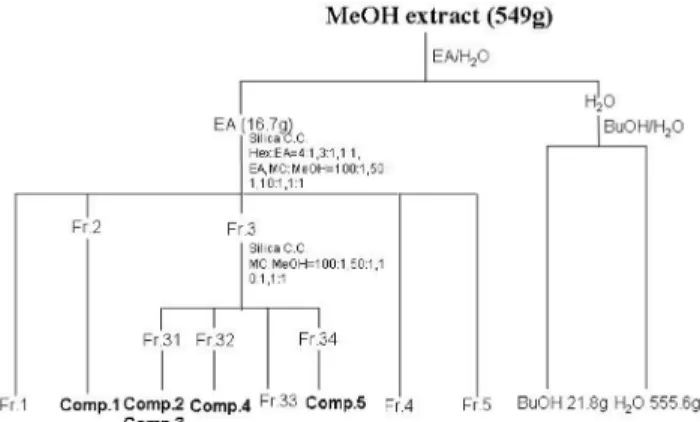
배무채 지상부 EtOAc 용매분획으로부터 함유성분의 분
리 −배무채지상부
MeOH
추출물을전술한방법에준하여용매분획한
EtOAc
가용분획10 g
을취하여n -hex/EtOAc
=4:1, 3:1, 2:1, 1:1, EtOAc, 50% CH
2Cl
2/ MeOH
의용출용매 순으로
silica gel (70-230 mesh, 750 g) column (Ø=5.0
×100 cm) chromatography
를실시하여Fr. 1 (0.8 g), Fr. 2 (1.8 g), Fr. 3 (2.7 g), Fr. 4 (2.4 g)
및Fr. 5 (4.9 g)
등총
5
개의분획으로나누었다.
그중Fr. 2
으로부터120 mg
의무색침상결정이석출되었다
(
화합물1). Fr. 3
은용출용매
;CH
2Cl
2:MeOH 100:1, 50:1, 10:1, 1:1
를사용하여재차
silica gel column chromatography
를실시하여총5
개의소분획
(Fr. 31-Fr. 35)
으로나누었다.
이중Fr. 31
을다시40% MeOH
을 용출용매로 하여RP-18 column
chromatography
를실시하여화합물 2(10 mg)
과화합물 4(16 mg)
을각각분리하였다. Fr. 32 (56 mg)
를50% MeOH
을용출용매로하여
RP-18 column chromatography
를실시하여
20 mg
의무색침상결정(
화합물 3)
을분리하였다. Fr.
34 (580 mg)
를RP-18 column chromatography
를실시하여240 mg
의oil
상물질화합물 5를분리하였다.
배무채 지하부 EtOAc 용매분획으로부터 함유성분의 분
리 −배무채지하부
MeOH
추출물을전술한방법에준하여용매분획한
EtOAc
가용분획EtOAc
층4 g
을n -hexane/
EtOAc
혼합용매를용출용매로사용하여기울기용리방식으로
silica gel column chromatography
를실시하여Fr. 1- Fr. 8
등총8
개의분획으로나누었다.
이중Fr. 1
로부터oil
상태의 화합물 5
(1.2 g)
을 분리하였다.
한편Fr. 2
를n - hexane/EtOAc
혼합용매에방치한결과14 mg
의무색분말이석출되었다
(
화합물 11).
또, Fr. 3
을MeOH
에녹여방치한결과무색침상결정화합물 1
(23 mg)
이석출되었다.
화합물 1을 여과하고 남은 결정여액은
RP-18 column chromatography (
용출용매:MeOH in water
기울기용리방식)
를실시하여
Fr. 321, Fr. 322, Fr. 323
으로나누었으며Fr.
322
으로부터7 mg
의화합물7을분리하였다.
또,
같은방법으로
Fr. 5
를RP-18 column chromatography (
용출용매: MeOH in water
기울기용리방식)
를시행하여6
개의소분획(Fr. 51-Fr. 56)
으로나누었다.
이중Fr. 53
에서화합물2(4 mg)
과Fr. 55
에서화합물 6(110 mg)
을분리하였다.
한편
Fr. 6 (0.9 g)
을MCI gel column chromatography (
용출용매
:MeOH in water
기울기용리방식)
를실시한결과화합물 8
(22 mg),
화합물 9(8 mg)
및화합물10(4 mg)
을얻었다
.
또한Fr. 7 (8 g)
을RP-18 column chromatography (
용출용매
: MeOH in water
기울기용리방식)
및silica gel column chromatography
를반복실시한결과무색분말화합물 12
(45 mg)
을얻었다.
Compound
1 무색침상결정(MeOH), mp. 140
oC,
C
29H
50O, EIMS m/z; M
+: 414.72, [
α]
D=
−37
o(c 0.1 CHCl
3),
1H-NMR (300 MHz, CDCl
3) :
δ5.32 (1H, m, H- 6), 3.49 (1H, m, H-3), 0.98 (3H, s, H-19), 0.89 (3H, d, J
=6.5 Hz, H-21), 0.64 (3H, s, H-18).
13C-NMR (125 MHz, CDCl
3) :
δ11.8 (C-29), 11.9 (C-18), 18.8 (C-21), 19.0 (C-27), 19.4 (C-19), 19.8 (C-26), 21.1 (C-11), 23.0 (C-28), 24.3 (C-15), 26.3 (C-23), 28.2 (C-16), 29.1 (C-25), 31.6 (C-2), 31.8 (C-8), 31.9 (C-7), 33.9 (C-22), 36.1 (C-20), 36.5 (C-10), 37.2 (C-1), 39.7 (C-12), 42.3 (C-4), 45.8 (C- 13), 50.1 (C-24), 56.0 (C-9), 56.1 (C-17), 56.7 (C-14), 71.8 (C-3), 121.7 (C-6), 140.7 (C-5)
Compound
2White powder, mp 37
oC, C
10H
8N
2, 1H- NMR (300 MHz, CDCl
3) :
δ8.35 (1H, brs, NH), 7.52 (1H, d, J =7.9 Hz), 7.38 (1H, d, J =7.9 Hz), 7.15 (2H, m, H-5,6), 7.12 (1H, s, H-2), 3.78 (2H, s, H-10).
13C-NMR (125 MHz, CDCl
3) :
δ14.4 (C-10), 104.8 (C-3), 111.5, 118.1 (CN), 120.3 (
×2), 122.9, 123.2, 125.9 (C-9), 136.3 (C-8)
Compound
3mp. 174
oC, C
10H
10O
4, 13C-NMR (125 MHz, (CD
3)
2CO- d
6) :
δ127.7, 110.5, 147.1, 146.4, 115.3, 121.9, 141.3, 121.1, 175.8, 55.6.
Compound
4mp. 63
oC, C
11H
12O
4, 1H-NMR (300 MHz, CDCl
3) :
δ7.55 (1H, d, J =15.9 Hz, H-7), 7.19 (1H, d, J
=2.4 Hz, H-2), 6.99 (1H, dd, J =8.1, 2.4 Hz, H-6), 6.84 (1H, d, J =8.1 Hz, H-5), 6.22 (1H, d, J = 15.9 Hz, H-8), 3.86 (3H, s, -OCH
3), 3.72 (3H, s, -OCH
3)
Compound
5colorless oil, C
21H
36O
4, 1H-NMR (300 MHz, CDCl
3) :
δ0.99 (3H, t, H-18'), 1.33 (8H, m), 1.65 (2H, m, H-3'), 2.09 (4H, m, H-8',17'), 2.36 (2H, t, H-2'), 2.82 (4H, m, H-11',14'), 3.68 (2H, m, H-3), 3.95 (1H, m, H-2), 4.19 (2H, m, H-1), 5.38 (6H, m, H-9',10',12', 13',15',16'),
13C-NMR (125 MHz, CDCl
3) :
δ14.2 (C-18'), 20.5 (C-17'), 24.8, 25.5, 25.6, 27.2, 29.0 (
×2), 29.1, 29.5, 34.1, 63.6 (C-1), 65.1 (C-3), 70.2 (C-2), 127.1, 127.7, 128.2, 128.3, 130.2, 131.9, 174.3 (C=O)
Compound
6colorless oil, C
19H
34O
2,
1H-NMR (300 MHz, CDCl
3)
δ: 0.90 (3H, t, terminal -CH
3), 1.20 ((CH
2)
n, m), 1.54 (2H, m), 1.98 (4H, m), 2.22 (2H, t), 2.74 (2H, m), 3.59 (3H, OCH
3), 5.30 (4H, m, H-olefinic protons)
Compound
7C
11H
10N
2O,
1H-NMR (300 MHz, CDCl
3)
δ
: 3.69 (2H, s, H-10), 3.98 (3H, s, -OCH
3), 7.08 (1H, m), 7.18(1H, s, H-2), 7.21 (1H, m), 7.37 (1H, d, J =7.8 Hz), 7.47 (1H, d, J =7.8 Hz)
13C-NMR (125 MHz, CDCl
3)
δ: 14.2 (C-10), 66.0 (OCH
3), 100.2 (C-3), 108.5, 117.8 (CN), 118.2, 120.3, 121.6, 122.3, 123.1, 132.2.
Compound
8 무색분말, mp 50
oC, C
5H
7NOS,
1H-NMR (300 MHz, CDCl
3)
δ: 3.46 (1H, dd, J =9.6, 9.6 Hz, H-4a), 3.85 (1H, dd, J =9.6, 9.6 Hz, H-4b), 5.31 (3H, m, H-2', 5), 5.91 (1H, m, H-1'), 7.60 (1H, brs, NH)
13C-NMR (125 MHz, CDCl
3)
δ: 49.1(C-4), 83.7(C-5), 120.5(C-2'), 132.9(C-1'), 189.5(C-2).
Compound
9C
9H
11O
2,
1H-NMR (300 MHz, CDCl
3)
δ: 4.07 (2H, d, J = 5.0 Hz, H-3'), 6.15 (1H, m, H-2'), 6.42 (1H, d, J =15.9 Hz, H-1'), 6.70 (2H, d, J =8.4 Hz, H-3,5), 7.23 (2H, d, J =8.4 Hz, H-2,6)
Compound
10 무색분말, mp 74-75
oC, C
10H
12O
3,
1H- NMR (300 MHz, CDCl
3)
δ: 3.81 (3H, s, OCH
3), 4.22 (2H, d, J =6Hz, H-3'), 6.15 (1H, m, H-2'), 6.45 (1H, d, J
= 15.9 Hz, H-1'), 6.81 (3H, m, aromatic H).
Compound
11 무정형분말, mp 63-64
oC C
16H
32O
2 1H- NMR (300 MHz, CDCl
3)
δ: 0.83 (3H, t, terminal -CH
3), 1.18 ((CH
2)
n, m), 1.58 (2H, m), 2.30 (2H, t)
Compound
12무색분말, mp 270~272
oC, C
35H
60O
6,
1H- NMR (300 MHz, DMSO- d
6)
δ: 0.83 (3H, s, H-18), 0.99 (3H, s, H-19), 4.40 (1H, d, J =7.7 Hz, anomeric H), 5.52 (1H, m, H-6).
결과 및 고찰
배무채의지상부
(100 Kg)
와지하부(50 Kg)
를따로따로음건한후
MeOH
로5
일간상온에서각각추출한결과배무채의지상부의경우
1,800 g,
지하부의경우920 g
의MeOH
추출물을얻었으며수득율은지상부및지하부모두원시료
의습중량대비
1.8%
정도로나타나배추의경우(
습중량대비
1.0%)
와비슷한결과를얻을수있었다.
배무채의지상부 및지하부의 함수율을 약
90%
로가정하였을경우MeOH
추출물의수득율은각각약18%
정도인것으로나타났다
.
이지상부
MeOH
추출물을통상의방법에따라증류수에현탁시킨후
EtOAc, BuOH
순으로용매분획하여본결과원시료습중량대비
0.018%
의EtOAc
가용분획(18 g)
과원시료습중량대비
0.016%
의BuOH
가용분획(16 g)
을얻었다
.
즉,
배무채지상부MeOH
추출물을통상의방법에따라용매분획을실시할경우추출물의
98%
이상이모두최종수층에잔류되는점으로보아배무채지상부는거의대
부분
(98%
이상)
이탄수화물등수용성물질들로구성되어져있음을짐작할수있으며유기용매에이행되는지용성
성분군은원시료중량대비
0.05%
미만으로극히소량만이존재함을알수있었다
.
지하부
MeOH
추출물도같은요령으로증류수에현탁시킨후
EtOAc, BuOH
순으로용매분획하여본결과원시료습중량대비
0.009%
의EtOAc
가용분획(4 g)
과원시료습중량 대비
0.038%
의BuOH
가용분획(19 g)
을얻었다.
따라서배무채지하부
MeOH
추출물의경우에도추출물의거의대부분
(98%
이상)
이탄수화물등수용성물질들로구성되어져있으며유기용매에이행되는지용성성분군은아 주소량이었다
.
한편배무채의지상부와지하부의
MeOH
추출물을전술한방법에따라용매분획하여얻어진
EtOAc
분획물각각으로부터함유성분의분리를시도하기에앞서
EtOAc
분획물들의
TLC
를실행하여TLC pattern
및profile
을배무추지상부및지하부와배추의
EtOAc
분획물의그것들과비교하여보았다
. (Fig 1).
그결과로보아 배무채지상부의경우에는
TLC pattern
이배추지상부의
TLC pattern
과거의비슷하나더다른성분을함유하고잇는것으로보이며
,
지하부의경우도배추와다른
TLC pattern
을보였다(Fig 1).
따라서Fig 1
에서관찰된
TLC pattern
의소견으로보아배추의지상부에존재하는대부분의성분들을배무채의지상부는모두함유하 면서배무채의지하부도지상부와다른여러성분을함유하 고있음을알수있었다
.
결론적으로배추와무의교잡으로만들어진배무채는배추에비해 지용성성분들의경우에 는대체로비슷하지만보다다양한성분의종류및함량이 있을것으로추정된다
.
한편배추의경우와동일한방법으로배무채지상부의지 용성성분군즉
EtOAc
가용분획을Scheme. 1
과같은방식으로
silica gel column chromatography
와RP-18 column chromatography
를반복적으로실시하여정제한결과2
종의steroid
계화합물(
1,
6), 1
종의indole
계cyanide
화합물(
2), phenylpropanoid
에속하는2
종의cinnamic acid
유도체(
3,
4
)
및다량의지방산linolenic acid (
10)
및그유도체(
5)
등총
6
종의화합물을순수분리하였다(Scheme. 2).
또
,
동일한방법으로배무채지하부의지용성성분군즉EtOAc
가용분획을Scheme. 2
과 같은방식으로silica gel column chromatography, RP-18 column chromatography
를반복적으로실시한결과
isothiocyanate
화합물1
종(
8), 2
종의
steroid
계화합물(
1,
12), 2
종의indole
계cyanide
화합물(
2,
7), 2
종의cinnamic acid
유도체(
3,
4), 1
종의cinnamyl alcohol
유도체(
9)
및3
종의지방산및그유도체(
5,
10,
11
)
등총10
종의화합물을분리하였다.
특히EtOAc
가용분획의경우절반이상이
linoleic acid
등지방산혹은지방산유도체로구성되고있음을알수있었다
.
8,9)배무채지상부및지하부의
EtOAc
가용분획으로부터분리된각화합물들은각각의물리화학적성상
,
1H-NMR
및13
C-NMR spectral data
를종합검토하고10)기존의관련실험을비교하여본결과
,
4,11)이들은각각 β-sitosterol (
1), indole- 3-acetonitrile (
2), ferulic acid (
3), methyl ferulate (
4), linolenic acid methyl ester (
5), linolenic acid (
6), 1- methoxyindole-3-acetonitrile (
7), goitrin (
8), 4-hydroxy- cinnamyl alcohol (
9), coniferyl alcohol (
10), palmitic acid (
11)
및daucosterol (
12)
로동정할수있었다. (Fig. 2)
이중β
-sitosterol (
1)
및daucosterol (
12)
은배추를비롯한십자화과식물및여러초본식물에광범위하게존재하
Fig 1. SiO
2TLC profile of the EtOAc fractions of xBrassicoraphanus developing solvent: n -hexane/EtOAc=1:1, detection: H
2SO
4Scheme. 1. Isolation of compounds 1 ~ 5 from the MeOH extract of the aerial part of xBrassicoraphanus.
Scheme. 2. Isolation of compounds from the MeOH extract of
the underground part of xBrassicoraphanus.
는대표적인식물
steroid
화합물로서식물성장에필수적으로요구되는성분이며항암활성및고지혈증의개선등의 약리효능이보고되고있다
.
또,
화합물indole-3-acetonitrile (
2)
및1-methoxyindole-3-acetonitrile (
7)
는배추및십자화과채소류에널리 함유된유기황배당체화합물
(glucosi- nolate)
의분해산물로서glucosinolate
가추출도중유기용매에의하여혹은식물세포에존재하는효소인
myrosinase
의작용에의하여분해된
nitrile
산물로서항암활성및식물성장호르몬으로작용한다고알려져있다
.
또, goitrin (5-vinyl-
2-thiooxazolidone)
역시glucosinolate
가 유기용매 혹은myrosinase
의작용에의하여분해된isothiocyanate
화합물의유도체로서순무의쓴맛을나타내는성분의일종으로서 항균작용을나타낸다고보고되고있다
.
12)또, ferulic acid (
3), 4-hydroxy-3-methoxycinnamic acid methyl ester (methyl ferulate,
4)
는sinapic acid methyl ester
와함께십자화과식물에널리 분포하는
phenolic acid
계성분으로서항암활성
,
항산화작용,
소염작용등다양한생리활성을나타내는성분으로알려져있다
.
한편, linolenic acid methyl
Fig. 2. Structure of compounds 1 ~ 12 isolated from the extract of xBrassicoraphanus.
ester (
5)
는십자화과식물및여러식물에서분리보고되고있으며특히배추에서는지방산중
linolenic acid
가풍부하게함유되어있다고보고되고있다
.
13)한편배무채지상부및지하부의
MeOH
추출물중추출물의총중량의대부분을차지하고있으며
EtOAc, BuOH
등유기용매분획으로이행되지않고최종수층에잔류되는분 획에대하여는별도로성분연구를시행하여본결과대부 분의성분들이단당류
(glucose), 2
당류(maltose)
및다당류등탄소화물군과미확인
phenolic polymer
등으로구성되고있음을알수있었다
.
그러나배무채의구성성분의함량은배추나무가가지고있는함량차이가있을것으로사료 되며
,
배무채의새로운품종과채취시기에따른함량차이연구도필요할것으로사료된다
.
결 론
본연구의대상인배무채는우리식단에서다용되는배추 와무우간의속간잡종으로그맛과생리활성이비교적우 수하나그에대한성분연구는아직이루어지지않았다
.
따라서본연구에서는배무채의생리활성을간접적으로평가 하기 위한 일환으로
,
배무채지상부와 지하부로부터 β- sitosterol, indole-3-acetonitrile, ferulic acid, methyl ferulate, linolenic acid methyl ester, 1-methoxyindole-3-acetonitrile , goitrin, 4-hydroxycinnamyl alcohol, coniferyl alcohol, palmitic acid and daucosterol
등총12
종의성분을분리하여보고하는바이다
.
이상의성분으로보아배무채는배추와무우에서이미알려진성분을대체로함유하고있는것 으로보이나
,
그변종과채취시기에따른함량의차이의연구도필요할것으로사료된다
.
감사의 글
본연구는바이오그린
21
연구비지원에수행되었는바감사드립니다