ISSN 2005-8063 2016. 3.31.
Vol.8 No.1 pp. 45-51
말소리와 음성과학
http://dx.doi.org/10.13064/KSSS.2016.8.1.045
Patterns of consonant deletion in the word-internal onset position: Evidence from spontaneous Seoul Korean speech
*Kim, Jungsun · Yun, Weonhee** · Kang, Ducksoo
Abstract
This study examined the deletion of onset consonant in the word-internal structure in spontaneous Seoul Korean speech. It used the dataset of speakers in their 20s extracted from the Korean Corpus of Spontaneous Speech (Yun et al., 2015). The proportion of deletion of word-internal onset consonants was analyzed using the linear mixed-effects regression model. The factors that promoted the deletion of onsets were primarily the types of consonants and their phonetic contexts. The results showed that onset deletion was more likely to occur for a lenis velar stop [k] than the other consonants, and in the phonetic contexts, when the preceding vowel was a low central vowel [a]. Moreover, some speakers tended to more frequently delete onset consonants (e.g., [k] and [n]) than other speakers, which re- flected individual differences. This study implies that word-internal onsets undergo a process of gradient reduction within individuals’ articulatory strategies.
Keywords: deletion, reduction, word-internal onset consonant, spontaneous Seoul Korean speech
1. Introduction
This study aims to investigate pronunciation variability, focusing on the deletion of onset consonant in the word-internal position. It classifies the types of onset consonant and their environments when they undergo deletion, which is one variation in the reduction process, in spontaneous Seoul Korean speech. Regarding the deletion of onset consonant, the words in (1) show the phonetic transcriptions of citation forms and their reduced forms after the deletion of onset consonant. This was extracted from the Korean Corpus of Spontaneous Speech (Yun et al., 2015). The reduced forms exhibit the deletion of a velar stop in (1a), an alveolar nasal in (1b), and a syllabic-initial liquid in (1c) from their citation forms. In (1d), the syllabic-final coda bilabial stop was resyllabified and deleted as the onset of the following syllable.
(1) Citation forms Reduced forms Gloss a. [tʃi.kɨm] [tʃi.ɨm] ‘now’
b. [ma.ni] [ma.i] ‘many’
c. [kɨ.rɛ.sə] [kɨ.ɛ.sə] ‘(and) so’
d. [tʃi.pe] [tʃi.e] ‘at home’
As shown in (1), we collected the words (marked as “phrasal words” in Yun et al., 2015) that underwent the deletion of only one onset consonant from the Korean Corpus of Spontaneous Speech.
This investigation concerns one variation in the process of reduction, providing the patterns of onset consonant deleted in the word-internal position. In other words, the segment-count measure between the actual pronunciation form and citation form was employed as in Johnson (2003) and Dilts (2013).
The pronunciation variation in spontaneous American English speech has been well documented by researchers (Cruttenden, 1994;
Keating, 1998; Johnson, 2003; Raymond et al., 2006; Bell et al.,
* This work was supported by the National Research Foundation of Korea Grant funded by the Korean Government (NRF-2012S1A5A2A03034027).
** Keimyung University, [email protected], corresponding author
Received 11 February 2016; Revised 11 March 2016; Accepted 14 March 2016
2009; Yao, 2011; Dilts, 2013). Johnson (2003) indicated that there is evidence about some of the extremely reduced forms from the phonetic transcription of citation forms based on the Buckeye Speech Corpus. For example, the citation form [hɪlɛriʌs] ‘hilarious’
in the phonetic transcription was transcribed as [hlɛrɛs] in the actual pronunciation form, including the deletion of the vowel [ɪ] and the coalescence as [ɛ] instead of [iʌ]. This case exhibited one of the processes of vowel reduction, but there were examples that showed the promotion of deletion of consonants such as [l] and [j] (e.g., the citation form: [phəthɪkhjəlɚ] ‘particular’, the reduced form:
[phthɪkhɚ]). These reduced forms in phonetic transcription, suggested by Johnson (2013), showed the segments counted for each word compared to the corresponding segments found in the citation forms.
Dilts (2013) analyzed the number of deleted segments from the citation forms in the Buckeye Speech Corpus and revealed that only a single segment deleted from the 29,888 word tokens was 80%.
When considering the patterns of segments deleted in conversational speech (i.e., spontaneous speech), we focused on one variation process about the absence versus presence of word-internal onset consonants in spontaneous Seoul Korean speech. The onset deletion in the syllable structure of Korean (e.g., CV or CVC), except for glottal fricative [h], has been rarely studied in previous studies. In the case of spontaneous American English speech, Raymond et al. (2006) found that word-internal onset stops were more frequently deleted than coda stops when their preceding segment was a vowel although onset stops in previous studies were not reasonably supposed to be deleted. Specifically, post-vocalic alveolar stops as onsets in the word-internal structure were deleted in a flapping context (Raymond et al., 2006). Rhodes (1992) confirmed that the reduction process of alveolar stops was more extreme for deletion than flapping. Additionally, Raymond et al.
(2006) revealed a consistent result with the study of Rhodes (1992) in that voiced alveolar stops were more likely to be deleted than voiceless alveolar stops in post-vocalic flapping environments.
Moreover, deletion rates were higher in the post-consonantal position (e.g., nasals), which induces flapping, than in the non-homorganic and non-sonorant consonants. From this viewpoint, Raymond et al. (2006) proposed that the word-internal onset position triggering flapping promoted the deletion of alveolar stops, reflecting gradient lenition. However, the tokens in onsets, when the following context was a vowel, did play a role in increasing deletion rates (Raymond et al., 2006).
In addition to the study of Raymond et al. (2006), research on preceding and following contexts governing onset deletion in the word-internal position is not without precedent. Alternatively, many studies (e.g., Lass & Anderson, 1975; Kirchner, 1998) have investigated the intervocalic position that favors the reduction process of consonants. Kirchner (1998) demonstrated that consonants naturally undergo a reduction process in the intervocalic position.
For instance, voiced stops often undergo spirantization in Germanic (Bennett, 1980). Voiceless velar stops undergo voicing lenition and glides are subject to deletion in Kannada (Chisum, 1975; Schiffman, 1983). Moreover, Romero (1996) observed that, in Andalusian Spanish, when one of the preceding or following vowels was low, the degree for the reduction of voiced stops was more extreme. In light of these observations, Kirchner (1998) proposed the aperture scale that shows what promotes reduction: low vowels > mid vowels > high vowels > {glides, liquids} > stops …> full or partial geminates. In other words, when intervocalic contexts are low
vowels, the consonant is more likely to reduce than when they are high vowels. Kirchner (1998) claimed that lenition, including the process of reduction, is driven to minimize articulatory effort.
Browman and Goldstein (1992) and Lindblom (1990) also suggested that the reduced articulatory effort could be featured as the reduction of segments.
The other factor that influences the process of reduction is often said to be the range of speakers’ speaking styles, which is a general distinction between clear speech and casual speech. Kirchner (1998) mentioned that the process of reduction (i.e., lenition) is more likely to occur in the faster or casual speech. Regarding citation forms, the speech of speakers has relatively slower speaking rates and longer durations (Liverly et al., 1993; Moon & Lindblom, 1994; Bond and Moore, 1994). Dilts (2013) found that in spontaneous American English speech, the speaking rates of speakers played a crucial role in promoting the deletion of segments although some studies (Patternson et al., 2003; Pluymaekers et al., 2005) showed that faster speaking rates had no critical effect on promoting the deletion of segments. Based on speakers’ speaking styles, there might be such a difference in individual speakers’ influence on the deletion of consonants in the word-internal onset position in spontaneous speech.
The dataset of the current study was extracted from the Korean Corpus of Spontaneous Speech (Yun et al., 2015). Yun et al. (2015) showed the corpus statistics, indicating that regarding the number of syllables in the pronounced forms, the number of monosyllabic tokens was 24%, disyllabic tokens, 33%, trisyllabic tokens, 26%, tetrasyllabic tokens, 12%, and over pentasyllabic tokens, 6%.
Regarding the types of consonants, the number of stops was 18%, nasals, 17%, liquids, 6%, fricatives, 5%, and affricates, 5%. The current study focuses on the subset of the corpus from speakers in their 20s. The mean phrasal words produced by speakers in their 20s were 6021 for males and 4728 for females. Male speakers produced more phrasal words than female speakers. Based on this dataset, the current study aims to provide the patterns driven from the proportion of consonant deletion in the word-internal onset position.
This study has the following three research questions: (1) Does the number of syllables trigger the deletion of onsets in the word-internal position? (2) Which type of consonants is more likely to be deleted than others? (3) Does the deletion of onset consonants affect their surrounding contexts? These questions will provide the reasons that govern the proportion of onset deletion in the word-internal structure.
2. Experimental method
2.1. Subjects
Ten subjects (five male and five female) were chosen from the Korean Corpus of Spontaneous Speech (for more details, see Yun et al., 2015). Their age ranged from 20 to 29 years. They were native speakers of Seoul Korean, recruited from Seoul and Gyeonggi province. The subjects were born either in or around Seoul and Gyeonggi province. They were paid for their participation in the work of the Korean Corpus of Spontaneous Speech.
2.2. Speech materials
Speech data was extracted from the subset of the Korean Corpus of Spontaneous Speech. This corpus was used in the sociolinguistic
interview method as employed in the Buckeye Speech Corpus (Pitt et al., 2007). It provides two types of transcribed forms, including actual pronunciation forms and orthographic forms. The speech data was transcribed in the Korean alphabet (i.e., Hangul). The data was collected from the words marked as phrasal words in the Korean Corpus of Spontaneous Speech. This study analyzed the deletion of onset consonant in the sequence of segments in 485 transcribed words, excluding the glottal fricative [h] in onset position. For instance, Figure 1 shows the citation form and reduced form (i.e., deletion) in the target words extracted from the corpus. The first tier shows the Korean phonemes transcribed as roman symbols for labeling and the second tier shows the pronounced form transcribed in the Korean alphabet (i.e., Hangul). Specifically, as shown in Figure 1, the citation word 지금 (i.e., [tʃi.kɨm], ‘now’) for (1a) did not undergo any pronunciation processes for reducing, whereas the word 지음 (i.e., [tʃi.ɨm], ‘now’) for (1b) underwent the deletion of a lenis velar stop [k] in the word-internal onset position. In Figure (1b), a lenis velar stop [k] was not seen in the waveform and spectrogram, unlike in Figure (1a). Therefore, the reduced forms that reflected the deletion of one consonant in the word-internal onset position were extracted for the analysis in the current study.
Figure 1. Consonant reduction (i.e., deletion) in the word-internal onset position extracted from the Korean Corpus of Spontaneous Speech. The lenis velar stop [k] in the citation form 지금
(i.e., [tʃi.kɨm] ‘now’) in (1a) was deleted in the reduced form 지음 (i.e., [tʃi.ɨm] ‘now’) in (1b).
With respect to labeling consistency in the Korean Corpus of Spontaneous Speech, Yun et al. (2015) verified that the percent agreement for all segments performed among the nine labelers is 98.1%. More specifically, as for consonants, the percent agreement for stops is 99.1%, for fricatives, 98.6%, for affricates, 98.3%, for nasals, 96.6%, and for liquid, 99.5%. The percent agreement of vowels is 97.7%. The transcribers’ agreements of the Korean Corpus of Spontaneous Speech showed high percentages appropriated to examine the goal of the current study.
2.3. Data analysis
A linear regression analysis was used as a statistical tool to predict an outcome variable from several predictor variables. However, this linear regression model fails to capture individual differences among subjects: that is, one subject may be more likely to delete the word-internal onset consonant than the other subject. To treat such individual variance as random in nature, a mixed-effect linear regression model was employed using the lmer function in the lme4 package (Bates et al., 2015) in R (version 3. 2. 2.). The fixed-effects predictor was the number of syllables, consonant types, and phonetic contexts. The random-effects predictor was subjects. The individual differences were assessed as the values of the intercept within the mixed-effect model.
3. Results
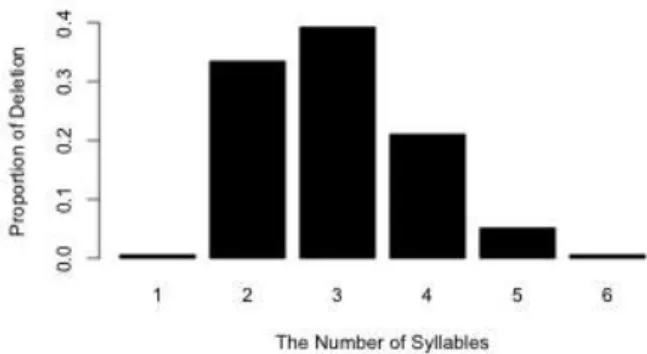
3.1. Deletion patterns relative to the number of syllables In the current study, the first variable predicting the deletion of consonants in spoken words is the number of syllables. The linear mixed-effects regression model revealed that the proportion of deletion significantly differed across disyllabic and trisyllabic words (i.e., β = 3.278e-02, t = 3.106, p < 0.01 for disyllabic words, and β = 3.856e-02, t = 3.653, p < 0.001 for trisyllabic words). On the other hand, the proportion of deletion in monosyllabic, tetrasyllabic, pentasyllabic, and hexasyllabic words was not statistically different.
As shown in Figure 2, the bar plot distribution exhibits a higher proportion of deletion in disyllabic and trisyllabic words than in other words. More specifically, the deletion proportion in disyllabic words was 0.33 and in trisyllabic, 0.39, whereas in monosyllabic, 0.006, in tetrasyllabic, 0.21, in pentasyllabic, 0.05, and in hexasyllabic, 0.006.
Figure 2. Proportion of deletion relative to the number of syllables.
3.2. Deletion patterns relative to consonant types
3.2.1. Individual differences in the overall proportion of deleted consonants
Regarding overall consonants in the current dataset, Figure 3 shows the proportion of deletion associated with all subjects. The overall deletion proportion for consonants showed individual differences among the subjects (F1: 0.05, F2: 0.01, F3: 0.1, F4: 0.06, F5: 0.07, M1: 0.02, M2: 0.04, M3: 0.03, M4: 0.31, M5: 0.21). The subject M4 had the highest proportion of deletion and M5 had the second highest proportion when predicting deletion among males. F3 had the highest proportion among females, but it was not as high as that of M4 and M5. The other subjects showed a much lower proportion of deletion than these three subjects. Based on these proportions, it
was found that some subjects had prevalent deletion proportions.
Figure 3. Proportion of deletion relative to overall consonants for ten subjects (‘F’ means female and ‘M’ means male).
Based on the linear mixed-effects regression model, this study found differences of values for intercept among the subjects. As shown in Figure 4, the values of intercept were over zero for three subjects (M4: 0.017, M5: 0.009, F3: 0.001) and below zero for the others (F5: -0.001, F4: -0.002, M2: -0.00356, F1: -0.0036, M3:
-0.004, M1: -0.0055, F2: -0.006). The highest value of intercept was 0.017 for M4, and the lowest was -0.006 for F2. These values of intercept confirm that some subjects were more likely to delete some consonants than others.
Figure 4. Intercept for all subjects related to the deletion of overall consonants.
3.2.2. Variability in deleted consonant types
This study assumed that the proportion of deletion might differ depending on the types of consonants. In other words, some consonants may be more frequently deleted than other consonants.
The linear mixed-effects regression analysis found differences among the types of consonants that underwent deletion in the word-internal onset position. The deleted consonant types were a lenis velar stop [k], a bilabial nasal [m], an alveolar nasal [n], a lenis bilabial stop [p], a syllable-initial liquid [r], an alveolar fricative [s], a lenis alveolar stop [t], and a palato-alveolar affricate [tʃ]. The result revealed that the proportion of deletion significantly differed among the deleted consonant types. Specifically, the deletion proportion of a lenis velar stop [k] was significantly different from that of [n] (β = -0.034, t = -2.678, p < 0.01), [r] (β = -0.047, t = -3.745, p < 0.001), [m] (β = -0.06, t = -4.669, p < 0.001), [p] (β = -0.059, t = -4.652, p < 0.001), [s] (β = -0.058, t = -4.600, p < 0.001), [t] (β = -0.06, t = -4.722, p < 0.001), and [tʃ] (β = -0.058, t = -4.565, p < 0.001). The proportion of deletion of [k] was prevalent compared to the other deleted consonant types. As shown in Figure 5, the deletion of [k] tended to more frequently occur across the subjects (especially for M4: 0.18, M5: 0.17, F3: 0.08, F4: 0.05, M2:
0.04). Regarding the proportion of deletion of [n], the subject M4 tended to more frequently delete [n] than the other subjects. This [n]-deletion for M4 was idiosyncratic among the subjects, but M4 also showed the highest proportion of [k]-deletion. The other consonants, including [r], as shown in Figure 5, revealed lower proportion of deletion than [k]. Therefore, interestingly, the consonant that most frequently underwent deletion in spontaneous speech was [k].
3.3. Deletion patterns relative to phonetic contexts 3.3.1. Preceding contexts
The preceding contexts that promote deletion can be classified into vowels, consonants, and word-initial positions. When the preceding context was a vowel, the proportion of deletion was 0.85, when it was a consonant, 0.08, and when it was a word-initial position, 0.06.
Vowels were the predominant features that predicted deletion.
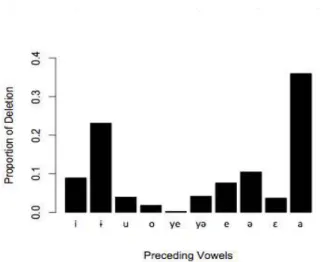
Based on this fact, we specifically examined the deletion. Based on this fact, we specifically examined the proportion of deletion when the preceding context was a vowel. As shown in Figure 6, the proportion of deletion for [a] was 0.36, which was the highest proportion. The second highest proportion of deletion was for [ɨ], which was 0.23. The proportion of deletion for [a] did not statistically differ with that of [ɨ] (β = 0.013, t = -1.745, p = 0.084).
Figure 5. Proportion of deletion of consonant types. A lenis velar stop was marked as [k], an alveolar nasal, [n], and a syllable-initial liquid, [r].
The vowels [a] and [ɨ] seemed to play a crucial role in inducing the deletion of consonants. On the other hand, the proportion of deletion for other vowels was significantly different than that for [a] ([i]: β = -0.027, t = -3.669, p < 0.001, [ə]: β = -0.025, t = -3.455, p < 0.001, [e]: β = -0.028, t = -3.847, p < 0.001, [ɛ]: β = -0.033, t = -4.417, p < 0.001, [o]: β = -0.034, t = -4.630, p < 0.001, [u]: β = -0.032, t = -4.345, p < 0.001, [yə]: β = -0.032, t = -4.320, p
< 0.001, [ye]: β = -0.036, t = -4.844, p < 0.001). Based on this fact, the vowel [a] tended to more frequently predict the deletion of consonants than any other vowels.
Figure 6. Proportion of deletion when the preceding context is a vowel
Figure 7. Proportion of deletion when the following context is a vowel
3.3.2. Following contexts
Regarding the deletion of consonants in the word-internal onset position, the following context was a vowel. Figure 7 exhibits the distribution of proportion of predicting the deletion of onset consonants when the following context was a vowel. The vowel [a]
in the following context did not show a significant difference with these vowels - [i]: p = 0.23, [ɨ]: p = 0.6, [ə]: p = 0.17. The p-value for [ɛ] was not less than the significance level (i.e., p = 0.054). On the other hand, [a] showed a significant difference with the following vowels - [e]: β = -0.017, t = -2.226, p < 0.05, [o]: β = -0.017, t = -2.196, p < 0.05, [u]: β = -0.015, t = -2.018, p < 0.05, [ya]: β = -0.018, t = -2.434, p < 0.05. Based on this fact, there were differences in these vowels in their predictions of onset consonant
deletion. As shown in Figure 7, the proportion of deletion for [i]
was 0.30 and the second highest proportion of deletion was for [a], 0.20. However, there was no statistical evidence between [i] and [a]. Unlike [a] as the preceding vowel, which most frequently predicted the deletion of consonants, [a] in the following context did not play a crucial role among the vowels in inducing the deletion. The vowels [i], [a], [ɨ], and [ə] tended to more frequently predict the deletion of consonants than the other vowels: [e], [o], [u], and [ya].
4. Discussion
This study concerns the variability of onset deletion in the word-internal position in spontaneous Seoul Korean speech. The main findings of this study are as follows. First, this study found that the deletion of onset consonants was significant for disyllabic-words and trisyllabic-words, more or less consistent with the overall proportion of syllable numbers for tokens suggested in Yun et al. (2006). Second, we found that the proportion of deletion of the lenis velar stop [k] was the highest among the onset consonants, and the second highest deletion rate was for nasals.
Finally, with respect to phonetic contexts, the proportion of onset deletion highly increased when the preceding vowel was the low vowel [a]. When the following context was a vowel, there were differences across vowels, but when followed by the vowels [i], [a], [ɨ], and [ə], the onsets were more likely to be deleted than when followed by the other vowels. The following sections provide a more detailed discussion of these findings.
4.1. Consonant type effects
The results indicate that onset deletion in the word-internal position differs depending on the types of onset consonants. The types of onset consonants that were deleted were mostly found in disyllbic and trisyllabic words. The number of syllables was a factor that promoted the proportion of onset deletion, indicating that there were a higher proportion of tokens and types for disyllabic and trisyllabic words than for other words in the pronounced forms in Yun et al.(2015). In this study, these two syllable types played a crucial role in analyzing the proportion of onset deletion in the word-internal position.
The proportion of deletion of consonant types also significantly differed among the onset consonants. The velar stop [k] was the most prominently deleted one among the word-initial onset consonants. According to the corpus statistics in Yun et al. (2015), among consonants in the Korean Corpus of Spontaneous Speech, the number of stops was the highest at 18% although the corpus statistics did not provide specific classification for stops. Among the stops, it is uncertain whether the lenis velar stop in Korean can be readily deleted in the word-internal onset position, except for the phonetic contexts that will be discussed in the next section (4.2.). But Lee reported that lenis velar stops tended to more often reduce intervocalically than other stops (Lee, 1996). Considering other languages, the velar stops often undergo spirantization or voicing lenition depending on phonetic contexts, namely intervocalic contexts (Kirchner, 1998). The lenis velar stop in Korean seemed to be deleted at the extreme stage through the process of reduction, especially in spontaneous speech. Regarding individual differences in the proportion of deletion, the deletion of
a velar stop occurred across the subjects in the current study although the proportion of deletion for the subjects M4, M5, and F3 was more than that for the other subjects. Besides the deletion of a velar stop, the proportion of deletion of an alveolar nasal was the second highest among the onset consonants. The corpus statistics of Yun et al. (2015) showed that the number of nasals was at 17% although there was no distinction between alveolar nasals and bilabial nasals as onset consonants. Nasals as well as stops were the common consonant class produced by speakers in spontaneous Seoul Korean speech. Regarding the prevalent emergence of nasals and stops in the Korean Corpus of Spontaneous Speech, generally speaking, it is assumed that as the production of certain consonants increases, the proportion of deletion of those consonants also increases. However, this phenomenon needs to be more specifically investigated in future research. In the case of deletion of an alveolar nasal, the deletion proportion for the subject M4 was distinctive compared to that of the other subjects. For the subject M4, the proportion of deletion of both a velar stop and an alveolar nasal was prominent, reflecting the idiosyncratic speaking styles that need to be examined in future research. The syllabic-initial liquid [r] was not distinguished across the subjects. Additionally, the proportion of deletion of other onsets, including a syllabic-initial liquid, showed a prevalent difference with that of a velar stop.
To a significant extent, there were individual differences in the proportion of onset deletion in the word-internal position. The male subjects M4 and M5 tended to more distinctively delete onset consonants than the other subjects. The linear mixed-effects regression model indicated that the values of intercept for M4 was the highest and that for F2 was the lowest. This study regarded individual differences as a factor that promotes the deletion of onset consonants in the word-internal position.
4.2. Phonetic context effects
This study found that word-internal onset consonants are more likely to be deleted when the preceding and following contexts are vowels. For the most part of the phonetic contexts, vowels were a strong factor that promoted the deletion of onset consonants. The types of consonants in the post-vocalic condition tended to be readily deleted than the post-consonantal condition or word-initial position. Among the preceding vowels, the low central vowel [a] in Korean was especially the most distinctive factor that led to the deletion in the word-internal onset position. The second highest vowel that predicted the deletion of onsets was a high central vowel [ɨ]. The vowel types [a] and [ɨ] did not show a statistical difference in promoting the deletion of onset consonants in the word-internal position. However, the proportion of deletion was higher for [a] than for [ɨ]. With respect to other vowels, [a]
significantly differed in predicting the deletion of onset consonants. Following the aperture scale of Kirchner (1998), low vowels are more likely to promote reduction of consonants when vowels are flanked than mid or high vowels. The vowel [a] seemed to play a prominent role in the deletion of onsets in the word-medial position. Even in the prevocalic condition, the onset consonants tended to be deleted, showing some variance among the vowel types. The vowels [i], [a], [ɨ], and [ə] did not show a significant difference in onset deletion compared to the other vowels although the high front vowel [i] had the highest proportion of deletion of onsets. Assuming that post-vocalic deletion of onset
stops in the word-internal structure is an extreme form for the process of reduction (Rhodes, 1992; Raymond et al., 2006), the types of consonants tended to be more frequently deleted than any other environments. The deletion of onsets occurs in the intervocalic position although the onsets are more likely to be deleted when the preceding vowel is [a]. It is assumed that the onsets in the intervocalic position are required to minimize the effort of articulatory gestures (Lindblom, 1990; Browman and Goldstein, 1992; Kirchner, 1998). For example, it is generally known that the stops in Korean become voiced in the intervocalic position. The prominent deletion of lenis velar stops in the current study can be regarded as an extreme version of the reduction process, as proposed in Rhodes (1992) and Raymond et al. (2006), although articulatory strategies need to be investigated in more detail in future research.
5. Conclusion
This paper found that, in spontaneous Seoul Korean speech, the deletion of onset consonants in the word-internal structure depends on the types of consonants. The proportion of deletion of a lenis velar stop interestingly was the highest among other onset consonants. Furthermore, the phonetic contexts played a critical role in promoting the deletion of onsets. In other words, the onsets with preceding vowel [a] were subject to deletion regardless of the variances of the following vowels. Future research should investigate the various factors (e.g., lexical, phonological, and extra-linguistic factors) that induce the process of reduction for consonants, employing specific analyses from the dataset of the Korean Corpus of Spontaneous Speech.
References
Bates, D., Maechler, M.., Bolker, B., & Walker, S. (2015). Fitting linear mixed-effects models using lme4. Journal of Statistical Software, 67, 1-48.
Bell, A., Jurafsky, D., Fosler-Lussier, E., Girand, C., Gregory, M., &
Gildea, D. (2003). Effects of disfluencies, predictability, and utterance position on word form variation in English conversation. The Journal of the Acoustical Society of America, 113, 1001-1024.
Bennett, W. (1980). An introduction to the Gothic language, New York: The Modern Language Association.
Bond, Z. S. & Moor, T. J. (1994). A note on the acoustic-phonetic characteristics of inadvertently clear speech. Speech Communication, 14, 325-337.
Browman, G. & Goldstein, L. (1992). Articulatory phonology: An overview, Phonetica, 49, 155-180.
Chisum, G. (1975). Systematic phonology of the Kannada noun. In H. Schiffman & C. Eastman (Eds.), Dravidian phonological systems (pp. 197-205). Seattle: University of Washington Press.
Cruttenden, A. (1994). Gimson’s Pronunciation of English (5thed.).
London: Edward Arnold.
Dilts, P. (2013). Modelling phonetic reduction in a corpus of spoken English using random forests and mixed-effects regression. Ph.D.
Dissertation, University of Alberta.
Johnson, K. (2008). Massive reduction in conversational American English. In K. Yoneyama & K. Maekawa (Eds.), Spontaneous speech: Data and analysis. Proceedings of the 1st session of the
10th International Symposium (pp. 29-54). Tokyo, Japan: The National International Institute for Japanese Language.
Keating, P. (1998). Word-level phonetic variation in large speech corpora, In A. Alexiadow, N. Fuhrhop, U. Kleinhenz, & P. Law (Eds.), ZAS Working Papers in Linguistics, 11, 35-50.
Kirchner, R. M. (1998). An effort-based approach to consonant lenition. Ph.D. Dissertation, University of California at Los Angeles.
Lass, R. & Anderson, J. (1975). Old English phonology, Cambridge:
Cambridge University Press.
Lee, S. H. (1996). Gestural overlap analysis of lenis stop reduction in Korean. Journal of the Acoustical Society of America, 99, 2551-2574.
Lindblom, B. (1990). Explaining phonetic variation: A sketch of the H&H theory, In W. Hardcastle & A. Marchal (Eds.), Speech production and speech modelling (pp. 403-439). Dordrecht, Netherlands: Kluwer Academic Publishers.
Lively, S. E., Pisoni, D. B., Summers, W. V., & Bernacki, R. H.
(1993). Effects of cognitive workload on speech production. The Journal of the Acoustical Society of America, 93, 2962-2973.
Moon, S. & Lindblom, B. (1994). Interaction between duration, context, and speaking style in English stressed vowels. The Journal of the Acoustical Society of America, 96, 40-55.
Patterrson, D., LoCasto, P. C., & Connine, C. M. (2003). Corpora analyses of frequency of schwa deletion in conversational American English. Phonetica, 60, 45-69.
Pitt, M. A., Dilley, L., Johnson, K., Kiesling, S., Raymond, W., Hume, E., & Fosler-Lussier, E. (2007). Buckeye Corpus of
cnversational speech (2nd release)
[www.buckeyecorpus.osu.edu] Columbus, OH: Department of Psychology, Ohio State University.
Pluymaekers, M., Ernestus, M., & Baayen, R. H. (2005).
Articulatory planning is continuous and sensitive to informational redundancy. Phonetica, 62, 146-159.
Raymond, W. D., Dautricourt, R., & Hume, E. (2006). Word-internal /t, d/ deletion in spontaneous speech: Modeling the effects of extra-linguistic, lexical, and phonological factors. Language Variation and Change, 18, 55-97.
Rhodes, R. A. (1992). Flapping in American English. In W. U.
Dressler, M. Prinzhorn, & J. R. Dennison (Eds.), Proceedings of the 7th International Phonology Meeting (pp. 271-232). Torino:
Rosenburg and Sellier.
Romero, J. (1996). Gestural organization in Spanish: An experimental study of spirantization and aspiration, Ph.D.
Dissertation, University of Connecticut.
Schiffman, H. F. (1983). A reference grammar of spoken Kannada, Seattle: University of Washington Press.
Yao, Y. (2011). The effects of phonological neighborhoods on pronunciation variation in conversational speech. Ph.D.
Dissertation, University of California.
Yun, W., Yoon, K., Park, S., Lee, J., Cho, S., Kang, D., Byun, K., Hahn, H., & Kim, J. (2015). The Korean Corpus of spontaneous speech, Phonetics and Speech Sciences, 7, 103-109.
∙Kim, Jungsun, main author Department of General Education Yeungnam University
280 Daehak-ro, Gyeongsan, Gyeongbuk, South Korea
Email: [email protected]
∙Yun, Weonhee, corresponding author Department of English Language and Literature Keimyung University
1095 Dalgubeol-daero, Dalseo-gu, Daegu South Korea
Email: [email protected]
∙Kang, Ducksoo Department of Russian
Hankuk University of Foreign Studies 107 Imun-ro, Dongdaemun-gu, Seoul South Korea
Email: [email protected]
![Figure 5. Proportion of deletion of consonant types. A lenis velar stop was marked as [k], an alveolar nasal, [n], and a syllable-initial liquid, [r].](https://thumb-ap.123doks.com/thumbv2/123dokinfo/5311820.382959/4.892.101.782.911.1067/figure-proportion-deletion-consonant-marked-alveolar-syllable-initial.webp)