비료제조공장 인근 지역의 담배특이니트로사민 환경 노출
하재나* · 윤미라* · 장준영* · 고도현**
,*** · 신호상**** · 김수향***** · 이철우* · 이보은*
†· 김정수**
†*국립환경과학원 환경건강연구부 환경보건연구과, **협동조합 환경안전건강연구소, ***시민과학연구소,
****공주대학교 환경교육과, *****주식회사 선일이앤씨
Environmental Exposure to Tobacco-specific Nitrosamines in an Area Near a Fertilizer Plant
Jae-Na Ha*, Mi-Ra Yoon*, Jun Young Chang*, Dohyun Koh**
,***, Ho-Sang Shin****, Suhyang Kim*****, Chul-Woo Lee*, Bo-Eun Lee*
†, and Jeong-Soo Kim**
†*Environmental Research Department, National Institute of Environmental Research
**Institute for Environmental Safety and Health
***Citizen Science Institute
****Department of Environmental Education, Kongju National University
*****Sunil Engineering and Consultant, Corporation
ABSTRACT
Objectives: This study aimed to evaluate environmental exposure to tobacco-specific nitrosamines (TSNAs) by conducting an analysis of the concentration of TSNAs in deposited dust collected from a fertilizer plant and the surrounding village, a simulation of high-temperature drying of tobacco waste, and CALPUFF modeling.
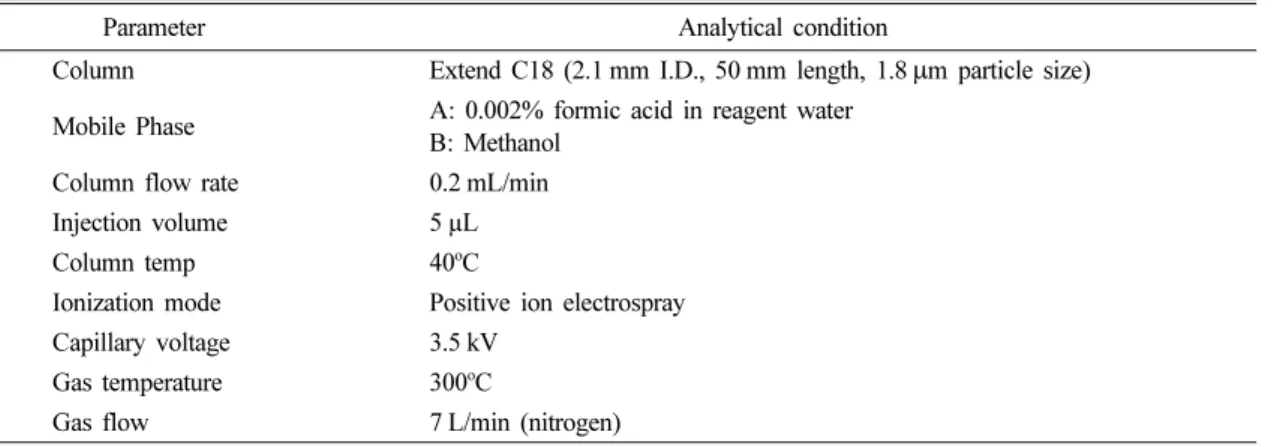
Methods: The raw materials of the products, deposited dust (inside and outside the plant and residential area), soil, and wastewater were sampled and the TSNA concentrations were analyzed by LC-MS/MS. As the plant was closed down before the investigation, simulation tests were conducted to confirm the substances discharged during high-temperature (300
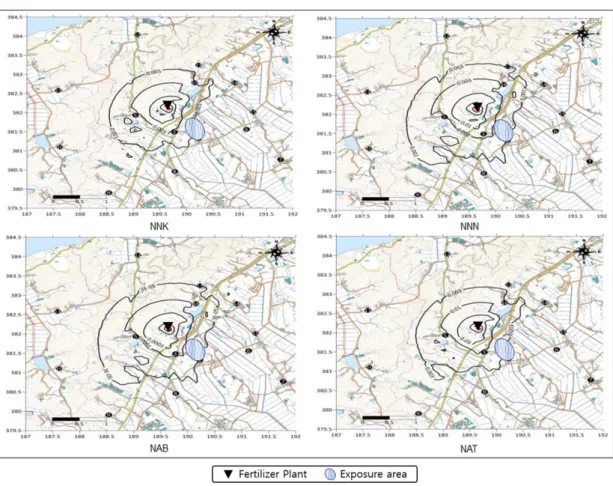
oC) drying of tobacco waste. CALPUFF modeling was performed to identify the area of influence due to exposure to TSNAs.
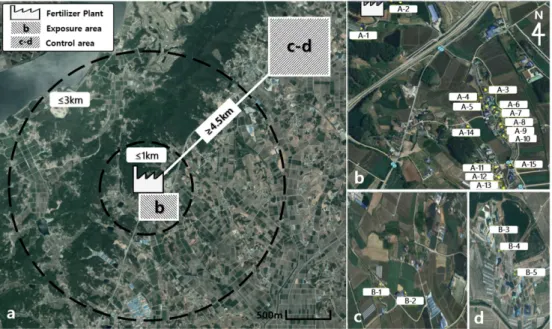
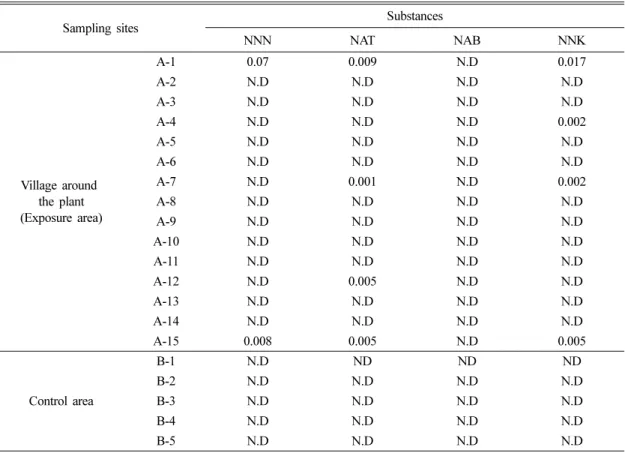
Results: TSNAs were detected in organic fertilizers estimated to contain tobacco waste, deposited dust, and soil collected from inside and outside the plant. N'-nitrosonornicotine (NNN), 4-(methylnitrosoamino)-1-(3-pyridyl)- 1-butanone (NNK), and N'-nitrosoanatabine (NAT) components were detected in five of 15 deposited dust samples collected from the residential area around the plant, while TSNAs were not detected in the five sampling points in the control area. Also, the simulation test for the high temperature drying of tobacco waste found emissions of TSNAs. The CALPUFF modeling results showed that the survey area was likely to be included in the area of influence of TSNA emissions from the plant.
Conclusions: It is estimated that harmful tobacco ingredients such as TSNAs were dispersed in nearby areas due to the illegal use of tobacco waste as a raw material to produce organic fertilizers at the plant. These findings assume that the residents have been exposed to TSNAs and suggest that the need for the establishment of measures to manage environmental health.
Key words: Tobacco-specific nitrosamines (TSNAs), fertilizer plant, environmental exposure, health effects assessment
†