2010년도 춘계 학술발표회 논문집 대한방사선방어학회
170_http://www.karp.or.kr
Analysis of Alpha Spectra for SiC Neutron Detectors due to their Structural Differences
Jang Ho HA1),*․Han Soo KIM1)․Se-Hwan PARK1)․Cheol Ho LEE2)․Sang Mook KANG2)
1)Korea Atomic Energy Research Institute
2)Department of Nuclear Engineering, Hanyang University
E-mail: [email protected] Key words : SiC, Alpha particle, Neutron, 6LiF
Introduction
The harsh radiation environments such as a nuclear reactor core, high-energy physics experiments, or outer space can cause radiation damage to semiconductor radiation detectors. But, semiconductor radiation detectors based on silicon carbide (SiC), aluminum nitride (AlN), and boron nitride (BN), which have large energy band gap, are the most promising ionizing radiation detectors for high temperature and in harsh radiation fields . SiC semiconductor high bandgap energy (from 2.2 to 3.2 eV for the most common polytypes) and high displacement threshold energy (21.8 eV) should lead to a radiation detector capable of operating at high temperature and in harsh radiation fields [1, 2].
Semiconductor radiation detectors based on PIN-type SiC were fabricated in two types for detection fast neutron and thermal neutron. For thermal neutron detection, 6LiF were evaporated on the surface of a SiC semiconductor. In this study, 5.5 MeV alpha spectra were measured with two types of SiC neutron detectors. And alpha responses were also analyzed due to their structural differences as preliminary test of neutron detection.
Materials and Methods
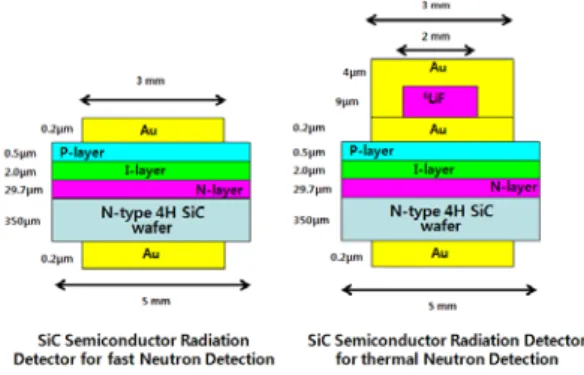
PIN-type SiC wafer from Cree was used to fabrication of neutron detectors. Design schematic and the fabricated SiC semiconductor radiation detectors are shown in figure 1 and 2, respectively.
All fabrication processes were performed in 1000 class clean room. For 6LiF capsulation in Au electrode, Au was evaporated at 4 μm thickness in consideration of different thermal expansion between two materials. A SiC detector for thermal neutron detection was 13 μm thicker than a SiC detector for fast neutron detection.
5.5 MeV alpha particles from 25.4 nCi 241Am were measured with two different SiC radiation detectors as preliminary test. A Cremat CR-110 hybrid-type preamplifier, an Ortec 572 Amp, and Ortec 919 MCA were used.
Fig. 1. Design schematic of two different SiC neutron detectors
2010년도 춘계 학술발표회 논문집 대한방사선방어학회
대한방사선방어학회_171
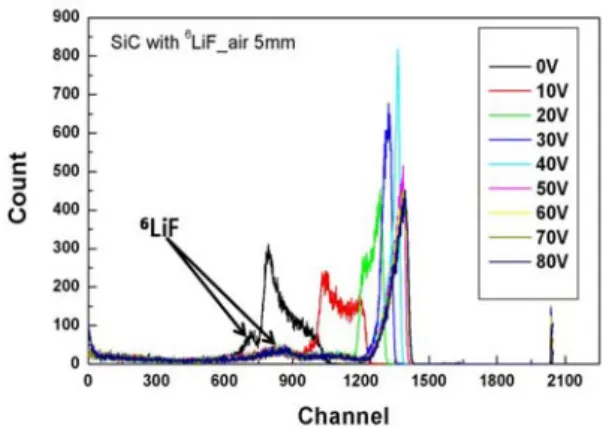
Fig. 4. Alpha responses of a SiC thermal neutron detector with respect to detector biases.
Fig. 2. Fabricated SiC radiation detectors for fast neutron (left) and thermal neutron (right)
Results and Discussion
Alpha responses of SiC radiation detectors for fast neutron and for thermal neutron detection with respect to detector biases are shown in figure 3 and 4. Energy loss of a SiC fast neutron detector and due to 4 μm-thick Au electrode is 1.39 MeV at 5.5 MeV alpha particles. And Energy loss of a SiC thermal neutron detector due to 8 μm-thick Au electrode and 6 μm-thick 6LiF was 3.39 MeV at 5.5 MeV alpha particle by SRIM-2010 stopping power simulator.
At high detector bias, energy spectrum was formed more sharp than at low detector bias owing to fast electron movement to the signal electrode. Low alpha energy peak due to 6LiF was observed in figure 4. Energy resolutions in air were approximately 34 keV (figure 3) and 38 keV (figure 4) at 5.5 MeV alpha particles.
Fig. 3. Alpha responses of a SiC fast neutron detector with respect to detector biases.
Conclusion
Two types of SiC neutron detectors were designed and fabricated. Alpha particles were well detected even if zero detector bias. Low energy peak was observed in case of a SiC thermal neutron detector due to 6LiF. To apply the fabricated SiC detectors in harsh environment, radiation hardness and neutron response are scheduled to study.
* ACKNOWLEDGMENTS
This work has been carried out under the nuclear R&D program of the Ministry of Education, Science and Technology (MEST).
Reference
1. Dulloo, A.R., Ruddy, F.H. Seidel, J.G. Adams, J.
M., Nico, J.s., Gilliam, D.M., 2003, "The thermal neutron response of miniature silicon carbide semiconductor detectors, Nucl. Instrum.
Methods Phys. Res. A 498, pp. 415-423, 2003 2. J.H. Ha et al., "Schottky barrier heights of
semi-insulating 6H-SiC irradiated by high dose gamma-rays", Nucl. Instrum. Methods Phys. Res. A 580, pp. 416-418, 2007