식물병연구
Res. Plant Dis. 17(1) : 82-85 (2011)
Research in Plant Disease
© The Korean Society of Plant Pathology
피에서 분리한 Fusarium fujikuroi의 동정 및 벼 키다리병의 전염원 가능성
최효원*·이용환1·홍성기·김완규·이영기·천세철2
국립농업과학원 작물보호과, 1농촌진흥청 지식정보화담당관실, 2건국대학교 생명환경과학대학
Identification of Fusarium fujikuroi Isolated from Barnyard Grass and Possibility of Inoculum Source of Bakanae Disease on Rice
Hyo-Won Choi*, Yong-Hwan Lee1, Sung Kee Hong, Wan Gyu Kim, Young Kee Lee and Se-Chul Chun2
Crop Protection Division, National Academy of Agricultural Science, RDA, Suwon 441-707, Korea
1Knowledge & Information Officer, RDA, Suwon 441-707, Korea
2College of Life & Environmental Science, Konkuk University, Seoul 143-701, Korea (Received on February 28, 2011; Accepted on March 28, 2011)
Bakanae disease symptom were observed in barnyard grass in paddy field in Heanam, Jeonnam. The infected plants were blighted and white mass of spore were formed on the stem. Fusarium species were isolated from infected stem and the isolates were identified as Fusarium fujikuroi based on their morphological and molecular characteristics. The isolates of F. fujikuroi were assigned to reference of F. fujikuroi among related Fusarium species based on the translation elongation factor 1-alpha gene sequence. Pathogenicity of the fungal isolates was confirmed on seedlings of rice and barnyard grass by artificial inoculation. The results indicated that barnyard grass can be inoculum source of Bakanae disease on rice. Thus, effective weed management is necessary to Bakanae disease control and healthy seed production.
Keywords : Barnyard grass, Bakanae disease, Fusarium fujikuroi
벼 키다리병은 Fusarium fujikuroi Nirenberg에 의해 발 생하는 대표적인 종자전염성 병해로, 일반적으로 벼에서 만 발생하는 것으로 보고되었으나, 2002년 미국 캘리포 니아의 벼 재배 지역에서 키다리병의 전형적인 병징을 나 타내는 피(Echinochloa spp.)가 발견된 바 있다(Carter 등, 2008). 피는 화본과에 속하는 대표적인 잡초로서, 논에는 주로 물피(Echinochloa crus-galli var. echinata), 강피(E.
oryzoides), 돌피(E. crus-galli) 등이 발생한다. Fishcer 등 (2000)은 논에 발생한 피가 제초제 저항성을 나타내는 경 우, 수량의 50% 이상이 감소할 수 있기 때문에 잡초 방 제가 필요하다고 보고하였다. 또한 잡초는 병원균의 중간 기주나 서식처가 될 수 있으며, 전염원으로 작용할 수 있 기 때문에 병해 방제 측면에서 잡초 관리의 중요성을 설
명하였다(Kwon 등, 2000; Melouk 등, 1992).
본 연구에서는 2009년 전남 해남지역의 논에서 벼 키 다리병과 유사한 병징을 나타내는 피를 채집하여 병원균 을 분리, 배양하고 균학적 특징과 유전자 염기서열 분석 을 통해 동정하였으며, 벼 키다리병의 전염원으로서의 가 능성을 조사하여 그 결과를 보고한다.
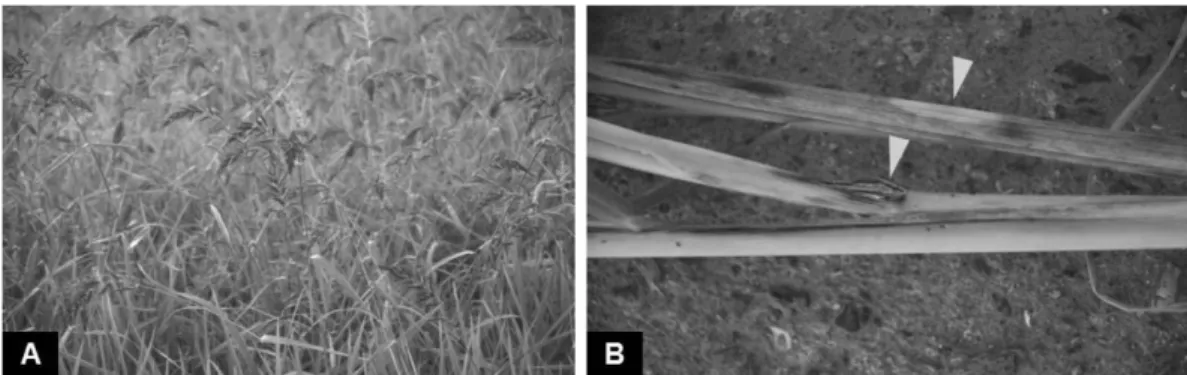
병징. 피가 많이 발생한 전남 해남 지역의 논에서 정 상적인 피에 비해 생육이 저조하고, 위축된 이상증상을 나타내는 피를 관찰하였다(Fig. 1A). 위축 증상을 보이는 줄기 표면에 흰가루 모양의 포자가 형성되었고 마디 부 분이 갈변되는 증상을 나타냈으며, 흰색의 포자가 관찰되 었다(Fig. 1B). 하지만 위축 증상을 보인 피에서 벼 줄무 늬잎마름병 바이러스도 검출이 되어(자료 미제시) 위축 증상이 키다리병에 의한 증상인지에 대한 여부는 향후 검 토가 필요할 것으로 생각된다.
균학적 특성 및 염기서열 분석. 피 줄기에 형성된 포 자에서 직접 단포자를 분리하여 potato dextrose agar(PDA)
*Corresponding author
Phone) +82-31-290-0413, Fax) +82-31-290-8488 Email) [email protected]
DOI: 10.5423/RPD.2011.17.1.082 단보 Open Access
피에서 분리한 Fusarium fujikuroi의 동정 및 벼 키다리병의 전염원 가능성 83
와 synthetic low nutrient agar(SNA) 사면배지에 배양하고, 10oC에서 냉장보관하면서 실험에 사용하였다. 분리한 균 의 균학적 특성은 PDA, carnation leaf agar(CLA) 및 SNA 에 배양하여 형태적 특성과 배양적 특성을 조사하였다.
PDA상에서 균총의 생장은 8.4~9.6 mm/day로 빠른 편 이었고, 흰색에서 옅은 분홍색의 기중균사를 풍부하게 형 성하였다. CLA와 SNA상에서 경자(phialide)는 대부분 단 경자(monophialide)이나 간혹 다경자(polyphialide)가 형성 되었고, 소형분생포자가 사슬(chain)로 형성되었다. 소형 분생포자의 모양은 끝이 평평한 곤봉형이고, 크기는 5.3~12.5×2.5~3.4 µm이었다. 분생자좌(sporodochia)는 오
렌지색으로 주로 CLA의 카네이션 잎 위에 형성되었다.
대형분생포자는 가늘면서 곧게 뻗었고, 주로 3~5개의 격 막을 가지며, 크기는 33.9~52.3×3.5~5.1 µm이었다. 후막 포자는 형성하지 않았다. 이와 같은 병원균의 균학적 특 성은 Gerlach와 Nirenberg(1982)가 기술한 F. fujikuroi와 일 치하였다(Table 1).
분리균의 염기서열 분석은 translation elongation factor 1-alpha(TEF) 유전자를 대상으로 수행하였다(O'Donell 등, 1998b). 분석된 염기서열은 Clustal W 소프트웨어를 이용 하여 정렬하였고, 계통수는 MEGA 4.0 프로그램(Tamura 등, 2007)을 이용하여 neighbor-joining법(Saitou와 Nei, Fig. 1. Barnyard grass and symptom of the plants. A, barnyard grass in a paddy field (Haenam, Jeonnam, 2009); B: blighted stems of barnyard grass and massed of sporulation on the stem (arrowhead).
Table 1. Comparison of mycological characteristics between the present isolate obtained from barnyard grass and F. fujikuroi described previously
Characteristicsa Present isolates F. fujikuroib
Growth rate fast, 8.4~9.6 mm/d fast, 7~8 mm/d
Aerial mycelium abundance abundant abundant
color whitish to pale pink whitish to pale pink
Colony texture fluffy, powdery fluffy, lanuginose, not felt-like Phialides type mostly monophialides,
sometimes polyphialides
mostly monophialides, sometimes polyphialides Microconidia shape clavate with a flattened base clavate with a flattened base
size 0-sept.
5.3~12.5× 2.5~3.4 µm 0-sept. 8× 2.9 µm (5~13× 2.1~4.7 µm)
Sporodochia abundance abundant abundant
color orange pale orange
Macroconidia shape slender, straight slender, straight septate usually, 3~5 septate usually, 3~5 septate
size 3~5-sept.
33.9~52.3× 3.5~5.1 µm 3-sep. 40× 3.6 µm (22~59× 2.5~4.7 µm)
Chlamydospores absent absent
aGrowth rate, aerial mycelium and colony texture were investigated on potato dextrose agar plates incubated in darkness at 25oC for a week.
Other characteristics were investigated on carnation leaf agar and synthetic low nutrient agar plates incubated in alternating cycles of 12 h near ultraviolet light and 12 h darkness at 22oC for 2 weeks.
bDescribed by Gerlach and Nirenberg (1982).
84 최효원·이용환·홍성기·김완규·이영기·천세철
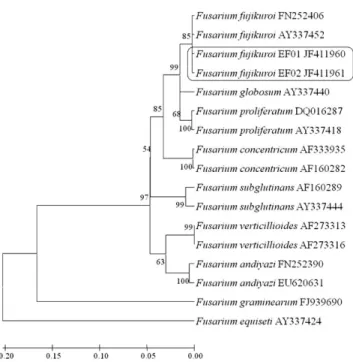
1987)에 의해 작성하였다. 피에서 분리한 EF01과 EF02 균주의 TEF 유전자 염기서열 분석 결과, GenBank에 기 등록된 F. fujikuroi 균주와 98%의 상동성을 나타냈다. 또 한, F. fujikuroi와 형태적으로 유사한 Gibberella fujikuroi 종 복합체에 속하는 균을 대상으로 계통수를 작성한 결 과, F. fujikuroi와 동일한 그룹에 속하는 것으로 나타났다 (Fig. 2). 분석한 EF01과 EF02 균주의 염기서열을 GenBank 에 등록하였고, 각각 JF411960과 JF411961이라는 accession number를 부여받았다. F. fujikuroi는 G. fujikuroi 종 복합 체에 속하는 균으로서 균학적 특성뿐 아니라 분자계통학 적 특성을 접목시켜 분류에 대한 재해석을 시도하였고,
여러 가지 유전적 마커 중에서 TEF 유전자가 Fusarium 균의 종간 구별에 적당하다고 평가되고 있다(O'Donnell 등, 1998a; Geiser 등, 2004).
병원성 검정. 분리된 병원균을 피와 벼에 접종하여 각 각의 병원성을 확인하였다. 피와 벼(품종: 주남벼) 종자는 1% 차아염소산나트륨(NaOCl) 용액에 10분간 침지하여 소 독한 후, 멸균수로 2~3회 세척하여 건조하였다. 분리한 병원균은 PDA에 5일간 배양한 후, 멸균수를 사용하여 포 자현탁액을 만들어 4겹의 거즈로 거르고 포자 농도를 106conidia/ml로 조절하였다. 포자현탁액에 피와 벼 종자 를 48시간 침지하여 접종하였고, 무처리는 멸균수를 사용 하였다. 접종한 피 종자는 멸균한 토양이 담긴 포트에 20 립씩 파종하였고, 접종한 벼 종자는 0.5% water agar 10 ml 이 담긴 시험관(직경 30 mm)에 3립씩 파종하였다. 파종 한 포트와 시험관은 28oC의 온도에, 12 h/12 h 광조건의 생장상에 넣어 병징을 관찰하였다. 피는 파종 3주 후, 벼 는 파종 2주 후 발병정도와 생체중(mg)을 조사하였다 (Table 2). 피는 접종 초기에 대조구와 비슷하게 발아하였 고, 생육에도 큰 차이가 없었으나 약 10일 후부터 접종구 에서 잎의 색이 황록화 되고 연약해지면서 생육이 억제 되는 것이 관찰되었다. 벼에서도 접종 초기에는 대조구와 비슷하게 발아하였으나, 약 7일 후부터 접종구에서 전체 적으로 위축되면서 줄기 부위에 곰팡이가 자라기 시작하였다.
벼 키다리병은 최근 발생이 증가하여 2003년과 2004년 에 각각 2.9%, 4.3%의 발병율을 나타냈으며(명 등, 2005), 2006년에는 발병이 급격히 증가하여 전국에서 28.8%의 필지에서 발생한 것으로 보고되었다(Han, 2007). 이 병의 방제를 위해서는 종자소독을 철저히 하고, 건전종자를 채 종하여 사용해야 한다. 하지만 종자감염이 심한 경우에는 prochloraz를 이용한 종자소독에도 불구하고 완전한 방제 가 이루어지지 않아 문제시 되고 있는 병이다(박 등, 2008).
벼 키다리병은 못자리뿐만 아니라 본답에서도 피해를 주 는데, 생육 중기 이후에 관찰되는 벼 줄기에 형성된 병원 균은 전염원으로 작용하게 된다(Furuta, 1970). Carter 등 Fig. 2. Phylogenetic tree of EF01 and EF02 isolates from
barnyard grass and related Fusarium species based on the translation elongation factor 1-alpha gene sequences. The tree was constructed by the neighbor-joining method supported by 1,000 bootstrap replications using MEGA 4.0 software. Number of capital letters with Fusarium species are accession numbers found in the GenBank database.
Table 2. Pathogenicity tests of F. fujikuroi isolates from barnyard grass to rice and barnyard grass by artificial inoculation
Isolates Ricea Barnyard grassb
Disease severity (%) Weight (mg) Disease severity (%) Weight (mg)
EF01 100 176.1 ± 11.2 85.2 73.3 ± 4.0
EF02 100 164.3 ± 10.0 74.4 88.2 ± 5.4
Control 0 248.5 ± 9.0 0 153.8 ± 6.1
aRice seeds were soaked in spore suspension of F. fujikuroi isolates at 25oC for 2 days. Inoculated seeds were sown in test tubes containing 10 ml of 0.5% water agar. Disease severity and weight were measured 2 weeks after sowing, and 10 seeds were used as a replication.
bBarnyard grass seeds were soaked in spore suspension of F. fujikuroi isolates at 25oC for 2 days. Inoculated seeds were sown in plastic pot containing 100 g of sterilized soil. Disease severity and weight were measured 3 weeks after sowing, and 20 seeds were used as a replication.
피에서 분리한 Fusarium fujikuroi의 동정 및 벼 키다리병의 전염원 가능성 85 (2008)은 미국 캘리포니아 지역의 벼와 피에서 분리한 F.
fujikuroi 균주의 체세포화합성, 교배형, AFLP 분석을 통 해 두 기주에서 분리한 균이 하나의 clone이기 때문에 피 가 벼 키다리병 발생에 전염원으로서의 가능성을 제시하 였지만, 피 분리균의 벼에 대한 병원성 검정은 확인하지 못하였다. 하지만 본 연구에서는 생육 중기 이후의 논에 발생한 피 줄기에서 F. fujikuroi를 분리하였고, 분리된 균 은 피와 벼에서 모두 병원성을 나타내었다. 또한 피 줄기 에 키다리병균의 포자 형성이 관찰된 시점이 벼 출수기 와 일치하였고, 이것은 피가 벼 키다리병의 전염원으로 중요한 역할을 할 수 있음을 의미한다. 따라서 벼 키다리 병의 방제와 건전종자의 채종을 위해서는 논에 발생한 이 병식물체뿐 아니라 전염원으로 작용할 수 있는 피를 제 거해야 하며, 병원균의 잠재적 기주가 될 수 있는 논 주 변의 다른 화본과 잡초의 키다리병 감염 여부에 대한 조 사되어야 할 것으로 생각된다.
요 약
2009년 전남 해남 지역의 논에서 벼 키다리병과 유사 한 병징을 나타내는 피를 채집하여 병원균을 분리하였다.
이병 식물체는 줄기가 고사하여 하얗게 말라 죽고, 줄기 표면에 흰가루 모양의 포자가 형성되었다. 분리균은 균학 적 특성과 분자생물학적 특성에 따라 Fusarium fujikuroi 로 동정되었다. Translation elongation factor 1-alpha 유전 자의 염기서열 분석 결과, GenBank에 등록된 F. fujikuroi 와 상동성을 나타내었다. 벼와 피를 대상으로 침지접종에 의해 병원성을 확인하였으며, 이는 피가 벼 키다리병의 전염원으로서의 역할을 할 수 있음을 의미한다. 따라서 벼 키다리병의 방제와 건전종자의 채종을 위해서는 논에 발생한 이병식물체뿐 아니라 전염원으로 작용할 수 있는 피를 제거해야 할 것으로 생각된다.
Acknowledgements
This work was supported by the Rural Development Administration fund PJ006942.
참고문헌
명인식, 박경석, 홍성기, 박진우, 심홍식, 이영기, 이상엽, 이승돈,
이수헌, 최홍수, 최효원, 허성기, 신동범, 나동수, 예완해, 조 원대. 2005. 2004년 주요 농작물 병해 발생개황. 식물병연구 11: 89-92.
박우식, 예완해, 이세원, 한성숙, 이준성, 임춘근, 이용환. 2008.
온탕소독과 prochloraz 침지소독이 벼 종자에 감염된 Fusarium fujikuroi의 포자와 균사의 형태에 미치는 영향에 대한 전자 현미경적 연구. 식물병연구 14: 176-181.
Carter, L. L. A., Leslie, J. F. and Webster, R. K. 2008. Population structure of Fusarium fujikuroi from California rice and water grass. Phytopathology 98: 992-998.
Fishcer, A. J., Ateh, C. M., Bayer, D. E. and Hill, J. E. 2000.
Herbicide-resistant Echinochloa oryzoides and E. phyllopogon in California Oryza sativa fields. Weed Sci. 48: 225-230.
Furuta, T. 1970. Problems on the infection and control of rice bakanae disease. Plant Prot. Japan. 24: 141-144.
Geiser, D. M., Jimnez-Gasco, M. M., Kang, S., Makalowska, I., Veeraraghavan, N., Ward, T. J., Zhang, N., Kuldau, G. A. and O'Donnell, K. 2004. Fusarium-ID v. 1.0: A DNA sequence database for identifying Fusarium. Eur. J. Plant Pathol. 110:
473-479.
Gerlach, W. and Nirenberg, H. 1982. The genus Fusarium - a pictorial atlas. Mitteilungen aus der Biologischen Bundesanstalt fr Land-und Forstwirtschaft (Berlin-Dahlem) 209: 305-308.
Han, S. 2007. Review of disease occurrence of major crops in Korea in 2007. Proc. Annu. Fall Meeting Symp. KSPP. 19-20.
Kwon, S.-J., Choi, H.-S., Han, J.-H., La, Y.-J. and Kim, K.-H.
2000. Three different viruses isolated from typical weed plants that grown adjacent to common crop fields. Plant Pathol. J.
16: 297-305.
Melouk, H. A., Damicone, J. P. and Jackson, K. E. 1992. Eclipta prostrata, a new weed host for Sclerotinia minor. Plant Dis.
76: 101.
O'Donnell, K., Cigelnik, E. and Nirenberg, H. 1998a. Molecular systematics and phylogeography of the Gibberella fujikuroi species complex. Mycologia 90: 465-493.
O'Donnell, K., Kistler, H. C., Cigelnik, E. and Ploetz, R. C.
1998b. Multiple evolutionary origins of the fungus causing Panama disease of banana: Concordant evidence from nuclear and mitochondrial gene genealogies. Proc. Natl. Acad. Sci.
USA 95: 2044-2049.
Saitou, N. and Nei, M. 1987. The neighbor-joining method: a new method for reconstructing phylogenetic trees. Mol. Biol. Evol.
4: 406-425.
Tamura, K., Dudley, J., Nei, M. and Kumar, S. 2007. MEGA4:
Molecular Evolutionary Genetics Analysis (MEGA) software version 4.0. Mol. Biol. Evol. 24: 1596-2599.