한국임상약학회지 제28권 제4호
Korean J Clin Pharm, Vol. 28, No. 4, 2018
320 Original Article
Korean Journal of Clinical Pharmacy Official Journal of
Korean College of Clinical Pharmacy pISSN 1226-6051 eISSN 2508-786X https://doi.org/10.24304/kjcp.2018.28.4.320 Korean journal of clinical pharmacy (Online) URL: http://www.ekjcp.org
SLCO1B1 T521C가 스타틴에 의한 근육독성 발생에 미치는 영향:
체계적 문헌고찰 및 메타분석
이영숙
1 ·
천부순2 *
계명대학교 약학대학
1, 인제대학교 약학대학 인제약학연구소
2(2018 년 8 월 23 일 접수 · 2018 년 9 월 27 일 수정 · 2018 년 10 월 6 일 승인 )
Effect of SLCO1B1 T521C on Statin-induced Myotoxicity: A Systematic Review and Meta-analysis
Young Sook Lee 1 and Pusoon Chun 2 *
1
College of Pharmacy, Keimyung University, Daegu 42601, Republic of Korea
2
College of Pharmacy and Inje Institute of Pharmaceutical Sciences and Research, Inje University, Gyeongnam 50834, Republic of Korea (Received August 23, 2018 · Revised September 27, 2018 · Accepted October 6, 2018)
Statins, 3-hydroxy-3-methyl-glutaryl coenzyme A (HMG- CoA) reductase inhibitors, are among the most commonly used drugs for preventing and treating cardiovascular diseases.
It is widely known that statins markedly reduce low-density lipoprotein cholesterol (LDL-C) levels and prevent stroke and coronary artery diseases, leading to remarkable decrease in cardiovascular morbidity and mortality.
1)
Thus far, seven statins (atorvastatin, fluvastatin, lovastatin, pitavastatin, pravastatin,rosuvastatin, and simvastatin) have been approved by the United States Food and Drug Administration (U.S. FDA) as lipid-lowering agents, and are frequently prescribed for patients with hyperlipidemia, including high level of LDL-C, total cholesterol (TC), and/or triglyceride (TG) in blood.
2,3)
The lipid-lowering effects of statins are attributed to the competitive inhibition of HMG-CoA reductase that catalyzes the conversion of HMG-CoA to mevalonate, an early rate-ABSTRACT
Background: This study was performed to clarify the effect of SLCO1B1 T521C on statin-induced myotoxicity. Methods: The
PubMed, Embase, Ovid, and Cochrane Library databases were searched for all published studies between database inception and April 2018. Using Review Manager 5, the pooled odds ratio (OR) and corresponding 95% confidence interval (CI) were determined to assess the effect of SLCO1B1 T521C on statin-induced myotoxicity by using different genetic models.
Results: Elevenobservational studies and one randomized controlled trial were included in the meta-analysis. The pooled analysis showed that the incidence of statin-induced myotoxicity was significantly associated with the SLCO1B1 521C variant allele. Among patients using statins, the incidence of myotoxicity was higher in those carrying the 521TC or 521CC variant than in those carrying the 521TT variant in the dominant model (TC + CC vs TT, OR: 1.57; 95% CI: 1.20, 2.05; p = 0.001). The 521TC genotype was associated with a higher risk of myotoxicity than the 521TT genotype (OR: 1.42; 95% CI: 1.09, 1.86; p = 0.009). Furthermore, the incidence of myotoxicity was higher in 521CC carriers than in 521TC carriers (OR: 1.40; 95% CI: 1.06, 1.83; p = 0.02) and noticeably higher in 521CC carriers than in 521TT carriers (OR: 2.26; 95% CI: 1.23, 4.17; p = 0.009).
Conclusion: The identification of individuals with theSLCO1B1 521C variant allele prior to the initiation of statin therapy might be useful to predict the risk of toxicity development, determine the individual dose, and prevent myotoxicity.
KEY WORDS: SLCO1B1 T521C polymorphism, statin, myotoxicity
*Correspondence to: Pusoon Chun, College of Pharmacy and Inje Institute of Pharmaceutical Sciences and Research, Inje University, 197 Inje-ro, Gimhae, Gyeongnam 50834, Republic of Korea
Tel: +82-55-320-3886, Fax: +82-55-320-3940
E-mail: [email protected]
Effect of SLCO1B1 T521C on Statin-induced Myotoxicity / 321
limiting step in cholesterol synthesis.
4)
By inhibiting the mevalonate pathway, statins also suppress the production of proinflammatory cytokines and consequently increase the production of endothelial nitric oxide synthase (eNOS), stabilize atherosclerotic plaque, and inhibit inflammation and thrombosis.This allows statins to significantly reduce cardiovascular events and mortality.
5-7)
Despite the beneficial cardioprotective effect, the adverse effects of statins are the major reasons for non-adherence and/or discontinuation. Myotoxicity is one of the major reasons for discontinuation, presenting as myalgia, myositis, and rhabdomyolysis, with an incidence rate of 7~29%.8,9)
The underlying mechanisms have not been clearly elucidated and multiple mechanisms are considered to be involved in pathogenesis of statin-induced myotoxicity. Firstly, the depletion of coenzyme Q10 (CoQ10, ubiquinone) caused by statin-induced reduction in mevalonate, a precursor of both cholesterol and CoQ10, has been shown to be involved in myotoxicity. The depletion of CoQ10 in myocyte mitochondria may impede ATP production and subsequently cause myotoxicity.However, the effect of CoQ10 supplementation on myotoxicity is inconsistent.
10,11)
In addition, statins enhance skeletal muscle apoptosis in a dose-dependent manner secondary to the inhibition of geranylgeranyl prenylation and activation of small GTPases with subsequent RhoA/AKT inhibition and activation of caspase 3 and caspase 9.9)
Furthermore, statins increase cytosolic Ca2+
increasing mitochondrial Ca2+
permeability and Ca2+
release from the sarcoplasmic reticulum (SR), leading to mitochondrial membrane depolarization.12)
Moreover, statins reduce the resting chloride channel conductance in the sarcoplasma, causing fatigue, cramps, and myalgia.9)
There are many risk factors for statin-induced myotoxicity, including use of high-doses, advanced age (>80 years), female sex, Asian descent, low body mass index, impaired renal or hepatic function, hypothyroidism, and vitamin D deficiency.13)
Coadministered drugs can also increase the incidence of myotoxicity, such as organic anion transporting polypeptide (OATP) inhibitors (e.g., cyclosporine), CYP3A4 inhibitors (e.g. amiodarone), CYP3A4 substrates (e.g. protease inhibitors), macrolide antibiotics, azole antifungal agents, and fibrates.14-16)
Many studies have reported the effects of genetic polymorphisms of drug transporters on the incidence of statin-associated adverse effects. Solute carrier organic anion transporter family member 1B1 (SLCO1B1), also known as organic anion-transporting polypeptide 1B1 (OATP1B1), OATP2, organic anion-transporting polypeptide-C (OATPC), or liver-specific transporter 1 (LST1),is one of the most extensively studied drug transporters. The SLCO1B1 transporter is encoded by the SLCO1B1 gene located in chromosome 12, and is exclusively expressed in the liver. On the sinusoidal membrane of human hepatocytes, SLCO1B1 plays a key role in hepatic uptake of various endogenous and exogenous organic anions, including statins.
17,18)
SLCO1B1 T521C (rs4149056, 174Va l> Ala) is a non- synonymous single nucleotide polymorphism (SNP) and located on exon 5. In many pharmacokinetic studies, 521CC produced a higher area under the plasma concentration-time curve (AUC) of statins compared to that associated with 521TT or 521TC by reducing the activity and membrane expression of SLCO1B1.19)
However, the results from the studies that examined the association between SLCO1B1 T521C polymorphism and the incidence of statin-induced myotoxicity are inconsistent. In a meta-analysis conducted by Hou et al., patients carrying a SLCO1B1 521C allele had a two-fold times higher risk for statin-induced myotoxicity than patients carrying the 521TT allele.20)
In contrast, in the randomized controlled trial (RCT) in which 4,404 subjects were analyzed, no association was found between SLCO1B1 T521C polymorphism and statin-induced myotoxicity.21)
Since then, four more studies reporting the effect of the 521C allele on statin-induced myotoxicity have been published. Because statin-associated adverse effects occur in a dose-dependent manner and 5.2% of the events can be prevented, before initiating statin therapy, the importance of evaluating risk factors for myotoxicity and determining individualized doses cannot be emphasized enough.22)
In this study, therefore, we investigated the association between SLCO1B1 T521C polymorphism and the incidence of statin-induced myotoxicity through a comprehensive systematic review and meta-analysis analyzing the results from 12 studies.
METHODS Literature search
A systematic literature search was performed to identify publications reporting the effect of SLCO1B1 T521C polymorphism on the incidence of statin-induced myotoxicity.
The PubMed, Embase, Ovid, and Cochrane Library databases were searched for all published studies from inception to April 2018. We also examined several review articles for additional pertinent publications. There was no limitation of publication
322 / Korean J Clin Pharm, Vol. 2 8 , No. 4 , 201 8
language. The terms of “solute carrier organic anion transporter 1b1,” “SLCO1B1,” and “OATP1B1” were combined with
“statin,” “HMG-CoA reductase inhibitor,” or “3-hydroxy-3- methyl-glutaryl coenzyme A reductase inhibitor” and then the combined terms were used for keywords.
Study selection and data extraction
Myotoxicity was defined as follows: myalgia, myositis, myopathy, rhabdomyolysis, or acute elevation of creatine kinase (CK) greater than 10 times the upper limit of normal (ULN).
20,23,24)
To be included, original studies needed to fulfill the following criteria: (1) investigation of the effect of SLCO1B1 T521C on the incidence of statin-induced myotoxicity;and (2) reporting of sufficient data for odds ratio (OR) determination. Articles were excluded if they fulfilled the following criteria: (1) reviews, conference abstract or paper, editorial, letter, supplement, case report; (2) studies without genotype frequency for OR; (3) studies investigating the elevation of CK and reporting events of CK elevation greater than 3 times the ULN irrespective of muscle symptoms. We extracted the following information from the selected articles:
age, body mass index (BMI), and ethnicity of statin users;
generic names and doses of statins used in each study; frequency of SLCO1B1 T521C polymorphism; and incidence of statin- induced myotoxicity in each genotype. Two investigators (PC and YL) independently identified relevant studies and extracted detailed information from each study. Any discrepancies were resolved by consensus after discussion.
Quality assessment
The quality of the observational studies was assessed using the nine-star Newcastle-Ottawa Scale (NOS).
25)
The NOS assigns up to a maximum of 9 points for the least risk of bias:4 for selection, 2 for comparability, and 3 for assessment of outcome (for cohort study) or exposure (for case-control study). Studies with points 0-3, 4-6, and 7-9 were rated as
“low quality,” “moderate quality,” and “high quality,”
respectively.
26)
For quality evaluation of RCT, Cochrane’s risk of bias (ROB) tool was used. Each study was evaluated for 6 domains of bias: risk of selection bias in relation to adequate or inadequate random sequence generation; risk of selection bias with regard to allocation concealment; risk of performance bias in terms of blinding of participants and personnel; risk of detection bias in relation to blinding of outcome assessment;risk of attrition bias due to incomplete outcome data; and
ROB from selective reporting of outcomes. The RCT was assessed for each domain and judged as “low risk,” “unclear risk,” or “high risk” based on the following definitions: ‘low’
risk, plausible bias unlikely to alter the results; ‘unclear’ risk, plausible bias that raises some doubt about the results; ‘high’
risk, plausible bias that seriously weakens confidence in the results.
27)
The assessments were independently performed by two researchers (PC and YL) and any disagreements were resolved by a consensus.Statistical analysis
Statistical analyses were performed using Review Manager version 5.1 (Cochrane Collaboration, Oxford, United Kingdom).
To assess the association between the SLCO1B1 T521C polymorphism and statin-induced myotoxicity, the weighted pooled estimates of the odds ratios (ORs) and 95% confidence intervals (CIs) were calculated in different genetic models:
dominant model (TC + CC vs TT), heterozygote contrast model (TC vs TT, CC vs TC), and homozygote contrast model (CC vs TT). If the incidences of myotoxicity were reported separately according to symptom presentation and the numbers of the subjects monitored for each symptom were different in one study, the incidences of each symptom were considered as independent outcomes from separate studies. Two-sided p values less than 0.05 were considered statistically significant.
Study heterogeneity was estimated with the I
2
statistic, with values of 25, 50, and 75% representing “low,” “moderate,”and “high,” respectively.
28)
When the studies with an I2
statistic of >50% were considered to have substantial heterogeneity, a random-effects model analysis was used. Otherwise, a fixed- effect model was employed.29)
Publication bias was evaluated by visual inspection of a funnel plot. When asymmetry was found in funnel plots, a sensitivity analysis was performed by outlier elimination to assess the influence of the outliers on the overall results of this meta-analysis.30)
RESULTS Literature search
The process of study selection is outlined in Fig. 1. Of the 419 records identified in the database search, 266 articles were considered potentially relevant. After further review of their full text, one RCT,
21)
three prospective cohort studies,31-33)
one retrospective cohort study,34)
and seven case-control studies35-41)
met the inclusion and exclusion criteria of theEffect of SLCO1B1 T521C on Statin-induced Myotoxicity / 323
present meta-analysis.
Study characteristics
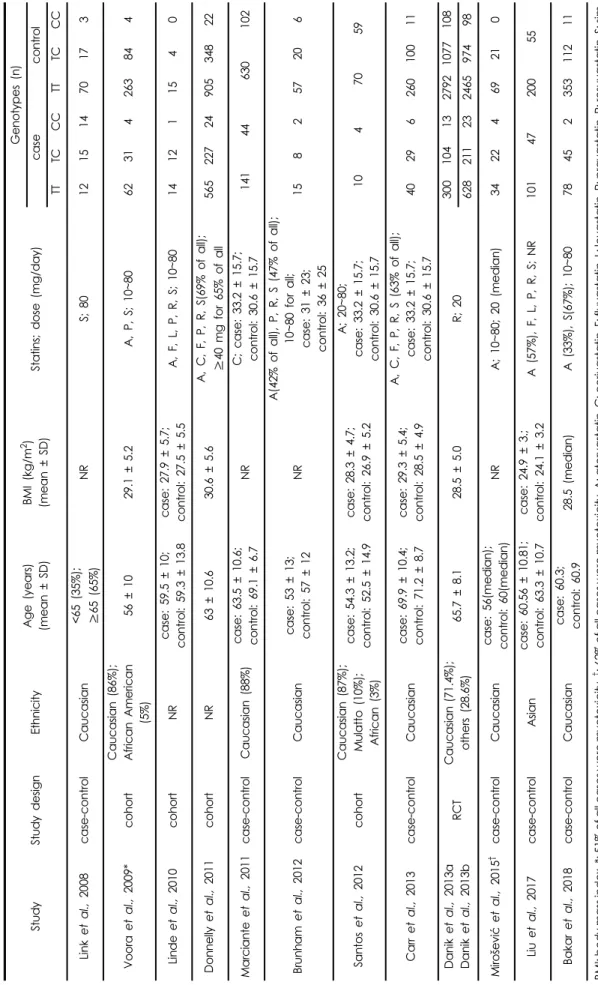
The characteristics of the included studies are summarized in Table 1. A total of 14,277 subjects were analyzed and statin-induced myotoxicity was observed in 20.3% of these subjects. Of the total subjects, 40.7% had the 521C allele.
Among the carriers of the 521C allele, 21.6% experienced myotoxicity, whereas 19.7% of the 521TT carriers developed the toxicity. More than 63.3% of the total subjects were Caucasian, whereas 2.8% of the total were Asian. Statins produced myotoxicity in 30.4% of the Caucasians and 30.8%
of the events were observed in the subjects carrying the 521C allele. A variety of statins were taken and the daily doses varied from less than 10 to 160 mg. The range of the participants’
mean age was 52-71 years. The subjects’ BMI suggested that no study was conducted in subjects with a high risk for myotoxicity.
Quality assessment
The assessment of the quality of 11 observational studies indicated that two studies met the criteria of moderate quality while nine were assessed as having high quality: five stars for two studies
32,36)
; seven stars for three studies31,34,38)
; eight stars for three studies33,35,40)
; and nine stars for three studies37,39,41)
(Supplementary Table S1). The ROB of one RCT was evaluated and the study was rated as “low risk” for all domains.21)
Effect of SLCO1B1 T521C on the incidence of statin- induced myotoxicity
A total of 11 observational studies and one RCT were included in the present meta-analysis. The SLCO1B1 521C allele was significantly associated with statin-induced myotoxicity.
A significantly higher incidence rate of statin-induced myotoxicity was observed in the 521TC- or 521CC-carrying users than in the 521TT-carrysing users under the dominant genetic model
Fig. 1. Flow of the study selection process for a systematic review and meta-analysis
Effect of SLCO1B1 T521C on Statin-induced Myotoxicity / 324
Ta bl e 1. C h ar act e ri st ic s of the inclu d e d st udies and geno type f re q uenc ie s of SLCO 1 B1 T52 1 C po ly mo rp his m in st at in u ser s St u d y Stu dy de si g n Et h n ic ity Age (y ear s) (m ean ± SD) BMI (kg/m
2) (m ean ± SD) Stat ins; d o se ( m g/day)
Geno types ( n ) ca se c o n tr o l TT TC C C TT TC C C Link et al. , 2 008 cas e -c o n tr o l Cau c asian <65 ( 3 5%); ≥ 6 5 ( 65% ) N R S; 80 12 15 14 70 1 7 3 Vo or a et al ., 2 009* c o ho rt Cau c asian (86%); Af ric a n Am er ic an (5%) 5 6 ± 10 29.1 ± 5. 2 A , P , S; 10~80 62 31 4 2 6 3 8 4 4 Lind e et al. , 201 0 c oho rt N R c a se: 59. 5 ± 10; c o n tro l: 5 9 .3 ± 1 3 .8
case: 27 .9 ± 5 .7; c o n tro l: 2 7 .5 ± 5 .5 A, F, L, P, R, S; 10~80 14 12 1 1 5 4 0 Don n ell y et al ., 2 011 c o ho rt NR 63 ± 1 0 .6 30.6 ± 5. 6 A, C , F, P , R, S( 6 9 % o f al l); ≥ 4 0 m g f o r 6 5 % o f a ll 565 22 7 2 4 9 0 5 34 8 2 2 Mar c iante et al ., 2 0 1 1 c a se -c on tr ol Ca u c a si a n ( 8 8% ) c a se : 6 3 .5 ± 1 0 .6 ; co nt ro l: 6 9 .1 ± 6. 7 NR C; c a se: 33. 2 ± 15. 7; c o n tr o l: 30. 6 ± 15.7 141 44 63 0 1 0 2 Br unh am et al. , 201 2 c as e- co nt ro l C au casian c a se: 53 ± 1 3 ; c o ntr o l: 57 ± 1 2 NR A( 42% of all) , P, R, S ( 4 7 % of all) ; 1 0 ~ 8 0 f o r all; case: 31 ± 23; co nt ro l: 36 ± 25
15 8 2 57 2 0 6 Sant o s et al ., 2 012 c o ho rt Cau c asian (87%); Mu la tt o (10%); Af rican (3%)
c a se : 5 4 .3 ± 1 3 .2 ; c o n tro l: 5 2 .5 ± 1 4 .9 case: 28 .3 ± 4 .7; c o n tro l: 2 6 .9 ± 5 .2
A; 20 ~ 8 0 ; c a se: 33. 2 ± 15. 7 ; c o n tr o l: 30. 6 ± 15.7 10 4 7 0 5 9 Carr et al. , 20 13 cas e -c o n tr o l Cau c asian c a se : 6 9 .9 ± 1 0 .4 ; co nt ro l: 7 1 .2 ± 8. 7 case: 29 .3 ± 5 .4; c o n tro l: 2 8 .5 ± 4 .9
A, C, F, P, R, S (63% o f all) ; c a se: 33. 2 ± 15. 7 ; c o n tr o l: 30. 6 ± 15.7 40 29 6 2 6 0 10 0 1 1 Da n ik et al. , 2013 a Da ni k et al. , 2013b RC T C a uc asian (71. 4% ); o ther s (28. 6 % ) 65 .7 ± 8.1 28.5 ± 5. 0 R ; 20 300 10 4 1 3 279 2 1 0 7 7 1 0 8 628 21 1 2 3 246 5 9 7 4 9 8 M irošević et a l., 20 15
†cas e -c o n tr o l Cau c asian c a se: 56(me d ian); c o ntr o l: 60(m e d ian) N R A; 10~80; 20 (m edi a n) 34 22 4 6 9 2 1 0 Li u et a l., 20 17 cas e -c o n tr o l Asian case: 60 .56 ± 1 0 .81; c o n tro l: 6 3 .3 ± 1 0 .7 case : 2 4 .9 ± 3 .; c o n tro l: 2 4 .1 ± 3 .2 A (57% ), F, L , P , R , S; NR 101 47 20 0 5 5 Ba ka r et al. , 2 018 cas e -c o n tr o l Cau c asian case : 6 0 .3 ; co nt ro l: 6 0 .9 2 8 .5 ( m edian) A ( 3 3%), S (67 %); 1 0 ~ 8 0 7 8 4 5 2 35 3 1 1 2 1 1 B M I: bo d y m ass ind e x , *: 51% of a ll ca ses w e re m y o to xi c ity,
†: 62% of a ll c a se s w e re m y o to xi c ity, A: ato rva statin, C : ce rivasta tin, F: fluvas ta tin, L: lo vastatin, P: pravasta ti n, R : ro suva st at in , S: s im - vasta ti n , RC T: rand o m ized c o ntrolled tr ial, D a n ik et al. , 2013a fo r m y a lg ia; D a nik et al. 201 3b fo r m u sc le w e akn e ss, stiffness, o r pa in, NR : not re po rt e d
Effect of SLCO1B1 T521C on Statin-induced Myotoxicity / 325
(TC + CC vs TT, OR: 1.57; 95% CI: 1.20, 2.05; p = 0.001; I
2
: 82%) (Fig. 2). Compared to the 521TT carriers, the 521TC carriers had a higher incidence rate of myotoxicity under the heterozygote contrast model (TC vs TT, OR: 1.42; 95% CI:1.09, 1.86; p = 0.009; I
2
: 77%) (Fig. 3). Similarly, a higher incidence rate was associated with the 521CC genotype than with the 521TC genotype (CC vs TC, OR: 1.40; 95% CI:1.06, 1.83; p = 0.02; I
2
: 8%) (Fig. 4). A markedly higher incidence rate of myotoxicity was observed in the 521CC- carrying users than in the 521TT-carrying users under homozygote contrast model (CC vs TT, OR: 2.26; 95% CI:1.23, 4.17; p = 0.009; I
2
: 70%) (Fig. 5). High levels ofheterogeneity were found in the dominant, heterozygote contrast (TC vs TT), and homozygote contrast models, whereas low level of heterogeneity was found in the heterozygote contrast model (CC vs TC).
Publication bias and sensitivity analysis
Some asymmetry was found in the funnel plots of the analysis for the dominant, heterozygote contrast (TC vs TT), and homozygote contrast models (Fig. 6). Because the study by Link et al.
35)
was one of the factors that contributed to the asymmetry as an outlier, a sensitivity analysis was performed by outlier elimination. Although the asymmetry improvedFig. 2. Forest plots of the association between SLCO1B1 T521C polymorphism and statin-induced myotoxicity under the dominant genetic model. Squares represent study-specific OR; horizontal lines represent 95% CIs; diamond represents a summary odds ratio estimate with corresponding 95% CI
Fig. 3. Forest plots of the association between SLCO1B1 T521C polymorphism and statin-induced myotoxicity under the heterozy-
gote contrast model (TC vs TT). Squares represent study-specific OR; horizontal lines represent 95% CIs; diamond represents a sum-
mary odds ratio estimate with corresponding 95% CI
326 / Korean J Clin Pharm, Vol. 2 8 , No. 4 , 201 8
after the exclusion of the study by Link et al., a publication bias was still detected. In the analyses for the dominant and homozygote contrast models, few studies resided in the bottom part, indicating that some smaller studies might have been missed. In the analysis for the heterozygote contrast (TC vs TT) model, no studies resided in the bottom-left part, implying that some smaller studies reporting negative results might have been missed (Fig. 7). On the other hand, the funnel plot of the analysis for the heterozygote contrast model (CC vs TC) had no outlier. However, in the analysis, few studies resided in the bottom part, suggesting that some smaller studies might have been missed (Fig. 8). In the sensitivity analysis performed after excluding the study by Link et al., which reported a remarkably high incidence, a
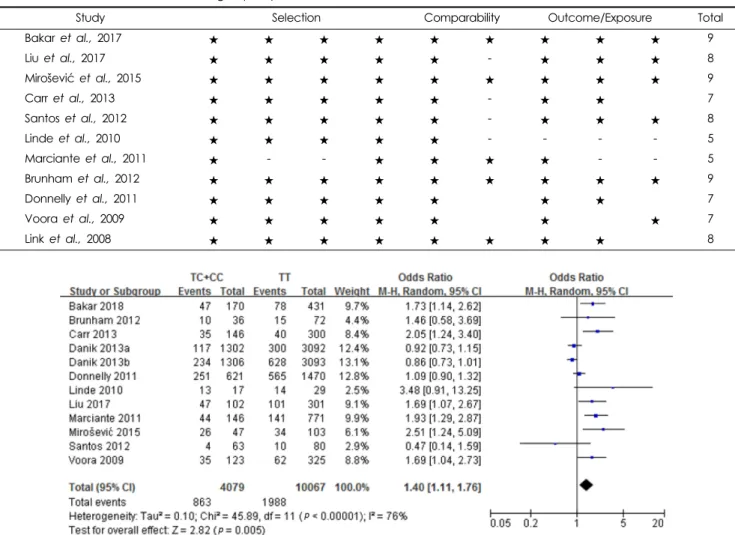
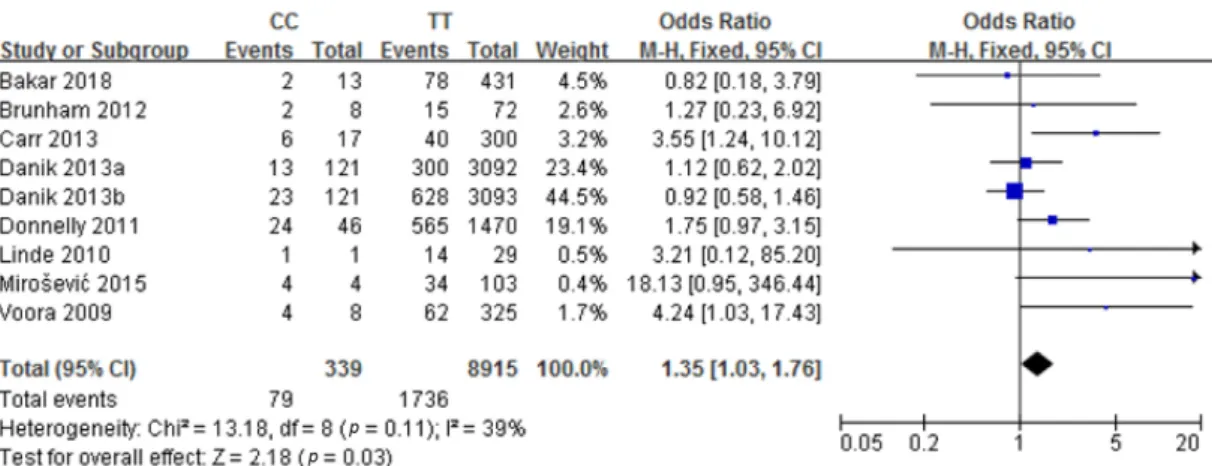
significant association between the SLCO1B1 521C allele and statin-induced myotoxicity was still found (TC + CC vs TT, OR: 1.40; 95% CI: 1.11, 1.76; p = 0.005; I
2
: 76%; TC vs TT, OR: 1.28; 95% CI: 1.01, 1.63; p = 0.04; I2
: 71%; CC vs TT, OR: 1.35; 95% CI: 1.03, 1.76; p = 0.009; I2
: 39%) (Supplementary Fig. S1, S2, S3).DISCUSSION
The results of the present meta-analysis demonstrated that the incidence of statin-induced myotoxicity was 1.57 times higher in the carriers of SLCO1B1 521C allele than in the carriers of the 521TT allele. This result is consistent with the result from a previous study by Hou et al.
20)
, in which theFig. 4. Forest plots of the association between SLCO1B1 T521C polymorphism and statin-induced myotoxicity under the heterozy- gote contrast model (CC vs TC). Squares represent study-specific OR; horizontal lines represent 95% CIs; diamond represents a sum- mary odds ratio estimate with corresponding 95% CI
Fig. 5. Forest plots of the association between SLCO1B1 T521C polymorphism and statin-induced myotoxicity under the homozygote
contrast model. Squares represent study-specific OR; horizontal lines represent 95% CIs; diamond represents a summary odds ratio
estimate with corresponding 95% CI
Effect of SLCO1B1 T521C on Statin-induced Myotoxicity / 327
521C allele increased the incidence 2.09 times to that associated with the 521TT allele.
This meta-analysis analyzed the results of three case-control studies and one RCT that had been published after the meta- analysis by Hou et al. However, the study by Ferrari et al.
42)
was excluded in this meta-analysis. The reason is that most clinical trials used CK elevation of greater than 10 times the ULN to define statin-associated myopathy,43,44)
but Ferrari et al., in contrast, reported the events of CK elevation greater than 3 times the ULN irrespective of muscle symptoms.Despite the differences in the studies included in each meta- analysis, the results of this study coincide with the results of the previous meta-analysis by Hoe et al. Similarly, Jiang et al.
reported 1.85 times higher risk for statin associated adverse drug reactions in the carriers of the 521C allele than in the 521TT carriers.
45)
These results are supported those of the pharmacokinetic studies in which the 521C allele was associated with a significantly increased statin AUC.19,43)
There are some limitations in this meta-analysis. First, we did not consider the effects of OATP2B1 and OATP1B3 on the hepatic uptake of statins, although SLCO1B1 plays a key role in the transport of hydrophilic statins such as pravastatin and rosuvastatin. In addition, atorvastatin is a substrate for OATP2B1 as well as SLCO1B1, while fluvastatin and pitavastatin are substrates for OATP1B3 and OATP2B1 in addition to SLCO1B1.
46-48)
Furthermore, although statin-associated myotoxicity occurs in a dose-dependent manner and the use of high doses is one of the risk factors,
49)
in this meta-analysis, we could not conduct a subgroup analysis stratified by statin doses because the daily doses were varied and most of studies did not report the doses according to the SLCO1B1 T521C polymorphism.In addition, the incidence of myotoxicity is also affected by medical conditions, concurrent medications, and food,
15,16,50)
and it is difficult to believe that all these factors were controlled because most of the studies included in the meta-Fig. 6. Funnel plots for publication bias of the included studies for
the effects of SLCO1B1 T521C on statin-induced myotoxicity
under the different genetic models: (A) dominant genetic
model, (B) heterozygote contrast (TC vs TT) model, (C) homozy-
gote contrast model
328 / Korean J Clin Pharm, Vol. 2 8 , No. 4 , 201 8
analysis were retrospective studies. Lastly, this study failed to examine the effect of ethnicity on the incidence of myotoxicity because more than 63% of the participants were Caucasian and only 2.8% were Asian.
In the present meta-analysis, a significantly higher incidence rate of statin-induced myotoxicity was observed in the carriers of the SLCO1B1 521C allele. Based on the results of this study, 41% of the total users were 521C carriers and 20% of them experienced myotoxicity.
CONCLUSION
Taking these factors into consideration, before the initiation of statin therapy, identification of individuals with the SLCO1B1 521C allele might be useful in predicting the risk for toxicity development, determining individualized doses, and preventing myotoxicity.