Res. Plant Dis. 15(3) : 175-182 (2009) ©The Korean Society of Plant Pathology
ZYMV 감염시기가 오이 생육 및 수량에 미치는 영향
고숙주*·김도익·강범용·김선곤·이용환1·최홍수1 전남농업기술원 친환경연구소
,
1국립농업과학원 농업미생물과Effect of the Infection Times by Zucchini yellow mosaic virus on the Yield and Growth in Cucumber
Sug-Ju Ko
*, Do-Ik Kim, Beom-Ryong Kang, Seon-Gon Kim, Yong Hwan Lee
1and Hong-Soo Choi
1Environment-Friendly Agricultural Research Instiute, Jeollanamdo Agricultural Research and Extension Services, Naju 520-715, Korea
1Agricultural Microbiology Division, National Academy of Agricultural Science, Suwon 441-707, Korea
(Received on September 17, 2009; Accepted on October 21, 2009)
We investigated the effect of the infection times and infection degrees at transplanting time of
Zucchini yellow mosaic virus(ZYMV) on the growth and yield of cucumber plants at the semi-forcing and the retarding cul- ture in 2007. When cucumber was inoculated with ZYMV at transplanting time, 15, 30, 45, 60, and 75 days after transplanting, vine length, internode length, number of leaf of the plants and marketable yield largely decreased as the cucumber infected earlier. The regression models were obtained between the disease inci- dence levels at 20 days after transplanting as the inoculation degrees and the marketable yield of cucumber:
y = 9333.1e
−0.0317x(R
2= 0.8946) at the semi-forcing culture and y = 14695e
−0.0303x(R
2= 0.8735) at the retarding culture. And the cucumber yield loss regression models between the symptoms incidence days from the final harvesting time and the rates of yield decrease were expressed as y=1.0851x
−6.7067 (R
2= 0.9567) at the semi-forcing culture andy=1.0439x + 2.1321 (R
2= 0.9674) at the retarding culture.
Keywords
: Cucumber, Infection times, Yield, ZYMV
오이
(
Cucumis sativusL.)
는 과채류 중에서 큰 비중을차지하는 작물이다
.
전국재배면적은4,893 ha
로서그 가운데 시설재배면적이
78%
를 차지하고 있다(http://www.
naqs.go.kr).
오이에 발생하는 바이러스는 충매전염성인 Cucumber mosaic virus
(CMV),
Papaya ring spot virus(PRSV),
Watermelon mosaic virus 2(WMV-2),
Zucchini yellow mosaic virus(ZYMV)
등이 알려져 있고,
종자및 토양전염성인 Cucumber green mottle mosaic virus
(CGMMV),
Kyuri green mottle mosaic virus(KGMMV)
등이 있다(Choi, 2001; Ko
등, 2006; Ullman
등1991; Yuki
등, 2000).
최근에는 충매전염성바이러스인potyvirus
발생이높은 편이며
,
그중에서도ZYMV
가 발생비중이 높은 것으로 보고되어 있다
(Ko
등, 2006).
ZYMV
는potyvirus
에 속하며 약750 nm
길이의 사상형입자로서복숭아혹진딧물
(
Myzus persicae)
을포함한약10
종 이상의진딧물에 의해 비영속적으로 전염된다(Lisa
와
Lecoq, 1984; Yuan
과Ullman, 1996).
이 바이러스는1984
년Lisa
와Lecoq
에 의해 쥬키니호박에서 처음 보고된 이래 세계적으로 많은 박과작물에서 분리동정되었으 며
,
호박과 오이에서ZYMV
가 보고되었다(
최, 1995;
김등
, 1995). ZYMV
에 감염된 오이는잎에 엽맥투명 증상을 보이다가 모자이크증상으로 발전하면서 요철증상을 동반하거나 엽맥녹대증상을 보이기도 하며
,
열매는 요철모자이크증상을보여기형과를 유발시켜 큰피해를초래
한다
.
하지만ZYMV
에 대한 발생생태와 피해해석에 대한 연구가거의 부재한실정으로이 시험은오이에발생
하는
ZYMV
의 감염시기가 수량및 생육에 미치는 영향을 구명하고자 하였다
.
*Corresponding author
Phone) +82-61-330-2514, Fax) +82-61-336-4076 Email) [email protected]
재료 및 방법
재배관리. 본 시험은 전남농업기술원 채소연구시험장 내 시험포장에서 실시하였다
.
오이는 장형낙합을 반촉성작형은
3
월21
일에억제작형은9
월12
일에 정식하여 재배하였다
.
재식거리는15
×180 cm
으로 정식하여 수확기간은 반촉성작형은
4
월26
일부터6
월27
일,
억제작형은10
월19
일부터12
월26
일까지 각각 수확하였다.
비배관리는 정식 전 완효성복합비료를 밑거름으로
10a
당9.2- 10.3-8.1(N-P-K)
을 질소기준으로 계산하고,
추비는 정식20
일부터5
일간격으로10a
당N, K
를각각1 kg
수준으로 계산하여 총량을
1
회전량 시비하였다.
바이러스 접종 및 조사.
ZYMV
감염시기가 오이 생육 및 수량에 미치는 영향을 구명하기 위해 생육시기별 로바이러스를접종하였다
.
접종은0.01 M
인산완충액(pH 7.0)
에ZYMV
접종원을넣고(1:5, w/v)
마쇄한 후최상위엽에
carborundum(400 mesh)
을 이용하여 골고루 문질러처리하였다
.
접종시기는정식기,
정식후15
일, 30
일, 45
일
, 60
일, 75
일까지15
일 간격으로 구당전체 주를 대상으로접종하였다
.
또한바이러스발병정도에따른수량감수 정도를 조사하기위하여 정식기에 접종주 비율을 반
촉성작형은
25%, 50%, 100%,
억제작형는10%, 25%, 50%,
100%
수준별로 접종하였다.
시험구 배치는난괴법3
반복으로하였으며
,
각처리별로만장,
엽수,
절간장,
경경,
엽장
,
엽폭,
전체수확과수,
수량,
상품과율을 조사하였다(
농촌진흥청
, 2003).
결과 및 고찰
접종 시기 및 정식기 접종 수준에 따른 ZYMV 발생 변화. 접종시기에 따른 바이러스 발병소장은 반촉성재 배의 경우 정식기와 정식
15
일 후 접종의 경우 초기 발병율이
50%
수준으로낮았고,
정식30
일, 45
일, 60
일, 75
일 후 접종구들은
60~80%
의 초기 발병율을 보였다.
억제재배의경우는모든처리구에서초기발병율이
90%
이상이었다
.
따라서 정식기 접종의상품수량이 억제재배는낮은반면반촉성재배는 조금높은경향을 보였다
.
정식기 접종수준별 발병소장을 보면 반촉성재배에서는 초기 발병수준이
6.9%, 23.7%, 48.3%
로각각시작해서생육후기까지 지속적으로 가파른 상승으로 모두
100%
발병을보인 반면
,
억제재배에서는 초기발병수준8.5%, 18.3%,
49.1%, 85.0%
에서생육후기까지완만히 증가하는패턴을Fig. 1. Cumulative incidence on ZYMV inoculated at different growth stages during semi-forcing (upper) and retarding (lower) culture in cucumber greenhouse.
보여후기발병율은각각
78.1%, 91.7%, 98.7%, 100%
로바이러스 확산패턴이상이하게나타났다
(Fig. 2).
이는반촉성재배는 생육초기에서 후기로 갈수록 바이러스를 전 반하는진딧물 유시충밀도가 높아지고
,
온도가상승함에따라 바이러스 발현기간이 짧아지는
2
가지 요인의 작용으로 추정된다
.
반면 억제재배는유시충밀도가낮아지며,
온도도 낮아지기 때문으로 판단된다
.
감염시기에 따른오이생육 특성.
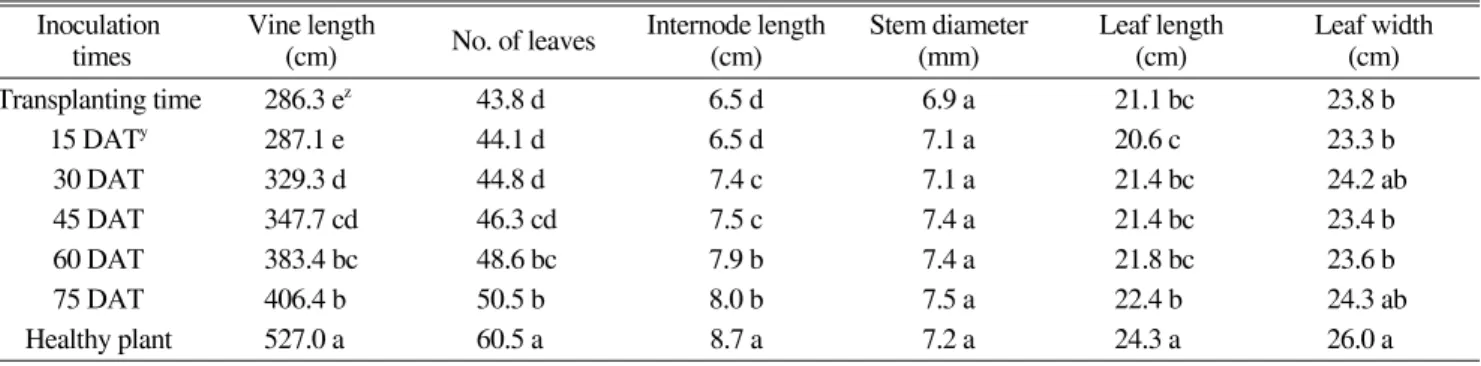
ZYMV
감염시기에따른생육특성을 보면바이러스 접종시기가빠를수록 생 장이늦어지는경향을보였다
.
반촉성작형에서정식기 접종시
286 cm,
정식15
일후접종287 cm, 30
일후329 cm,
45
일후348 cm, 60
일후383 cm, 75
일 후406 cm,
무처리
527 cm
로 조사되었다(Table 1).
억제작형에서는정식기 접종시
227 cm,
정식15
일 후 접종282 cm, 30
일 후354 cm, 45
일후383 cm, 60
일후397 cm, 75
일후401 cm,
무처리
444 cm
로 조사되었다(Table 2).
이는 정식초기에접종할수록 생육에영향을 주어 만장이짧아지는 경향이 었고
,
통계적으로유의차가 처리별로인정되었다.
엽수와절간장도비슷한 경향을보였다
.
하지만경경은처리간에차이를보이지 않았으며
,
엽장과 엽폭은바이러스접종구와건전구간에차이가인정되었다
.
이러한 결과는반촉성작형과 억제작형모두비슷한 경향이었다
(Table 1, 2).
이Fig. 2. Cumulative incidence of levels by infected with ZYMV at transplanting time during semi-forcing (upper) and retarding (lower) culture in cucumber.
Table 1. Effect of ZYMV infection at different growth stages on the growth of cucumber in semi-forcing culture Inoculation
times Vine length
(cm) No. of leaves Internode length
(cm) Stem diameter
(mm) Leaf length
(cm) Leaf width (cm) Transplanting time 286.3 ez 43.8 d 6.5 d 6.9 a 21.1 bc 23.8 b 15 DATy 287.1 e 44.1 d 6.5 d 7.1 a 20.6 c 23.3 b 30 DAT 329.3 d 44.8 d 7.4 c 7.1 a 21.4 bc 24.2 ab 45 DAT 347.7 cd 46.3 cd 7.5 c 7.4 a 21.4 bc 23.4 b 60 DAT 383.4 bc 48.6 bc 7.9 b 7.4 a 21.8 bc 23.6 b 75 DAT 406.4 b 50.5 b 8.0 b 7.5 a 22.4 b 24.3 ab Healthy plant 527.0 a 60.5 a 8.7 a 7.2 a 24.3 a 26.0 a
y It was days after transplanting time.
z Means followed by a common letter are not significantly different at the 5% by DMRT.
는
ZYMV
에감염되면생육이둔화되므로 감염시기가빠를수록 생육이 불량해지기 때문으로 판단되었다
.
고 등(2004)
은오이에서CGMMV
접종시기에 따라만장은 무처리에비해정식기접종은
35.3%,
첫개화기접종은20.9%
감소한다고 하였다
.
이처럼 본시험과 달리만장 감소율차이가 크지않은것은 바이러스종류보다는 재배기간이 짧아서 차이가 적은것으로 사료되었다
.
감염시기 및 정식기 접종 수준에 따른수량 비교. 시
기별로
ZYMV
를접종하여수량에 미치는 영향을조사한결과반촉성작형에서 상품수량은무처리
12,150 kg/10a
에비해정식기접종은
2,271 kg
으로18.7%
수준이었다.
정식15
일후접종은4,306 kg
으로무처리의35.5%,
정식후30
일 접종은
5,080 kg
으로 무처리의41.9%,
정식 후45
일접종은
5,662 kg
으로무처리의46.6%,
정식후60
일접종은
9,037 kg
으로 무처리의74.4%,
정식 후75
일 접종은9,076 kg
으로 무처리의77.2%
수준이었다(Table 3).
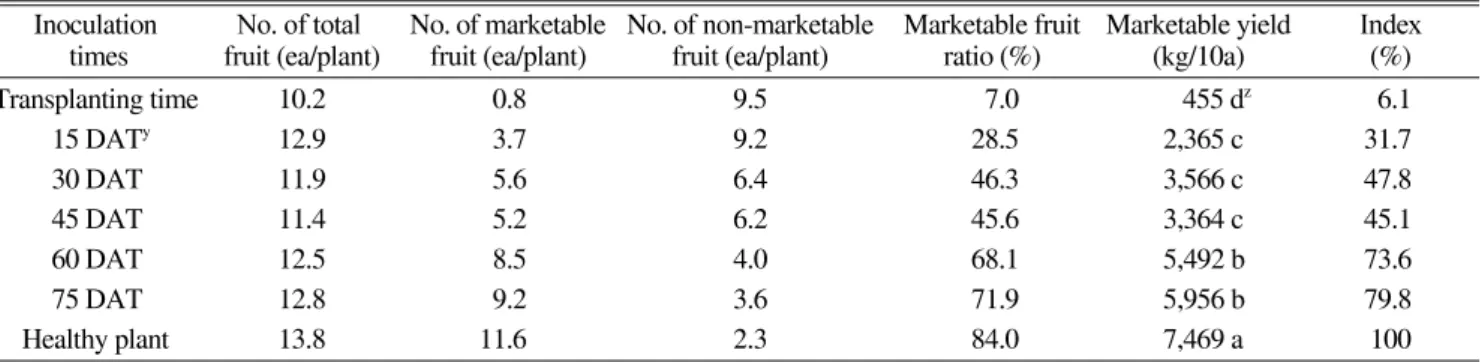
억제작형에서정식기상품수량은
455 kg
으로무처리7,469 kg
에비해
6.1%
수준이었고,
정식15
일후접종은2,365 kg
Table 2. Effect of ZYMV infection at different growth stages on the growth of cucumber in retarding culture Inoculation
times Vine length
(cm) No. of leaves Internode length
(cm) Stem diameter
(mm) Leaf length
(cm) Leaf width
(cm) Transplanting time 227.3 ez 33.5 d 6.9 d 6.0 c 22.3 c 21.7 b 15 DATy 282.4 d 41.3 c 6.8 d 6.3 abc 21.3 c 20.3 b 30 DAT 354.0 c 43.2 bc 8.2 c 6.4 abc 22.0 c 20.9 b 45 DAT 383.4 b 45.1 bc 8.5 bc 6.2 bc 22.3 c 21.6 b 60 DAT 396.8 b 45.9 ab 8.7 abc 6.8 a 24.8 b 24.1 a 75 DAT 401.2 b 45.7 ab 8.8 ab 6.7 ab 25.4 ab 24.8 a Healthy plant 444.1 a 49.1 a 9.0 a 6.5 abc 26.9 a 25.7 a
y It was days after transplanting time.
z Means followed by a common letter are not significantly different at the 5% by DMRT.
Table 3. Effect of ZYMV infection at different growth stages on yield of cucumber in semi-forcing culture Inoculation
times No. of total fruit
(ea/plant) No. of marketable
fruit (ea/plant) No. of non-marketable
fruit (ea/plant) Marketable fruit
ratio (%) Marketable yield
(kg/10a) Index
(%) Transplanting time 21.6 3.6 18.1 16.3 2,271 dz 18.7
15 DATy 22.9 6.7 16.2 29.1 4,306 c 35.5
30 DAT 23.1 7.9 15.2 34.1 5,080 c 41.9
45 DAT 24.5 8.8 15.8 35.7 5,662 c 46.6
60 DAT 24.0 14.0 10.0 58.3 9,037 b 74.4
75 DAT 23.2 14.5 8.7 62.5 9,376 b 77.2
Healthy plant 24.0 18.8 5.3 78.2 12,150 a 100
y It was days after transplanting time.
z Means followed by a common letter are not significantly different at the 5% by DMRT.
Table 4. Effect of ZYMV infection at different growth stages on yield of cucumber in retarding culture Inoculation
times No. of total
fruit (ea/plant) No. of marketable
fruit (ea/plant) No. of non-marketable
fruit (ea/plant) Marketable fruit
ratio (%) Marketable yield
(kg/10a) Index
(%) Transplanting time 10.2 0.8 9.5 7.0 455 dz 6.1
15 DATy 12.9 3.7 9.2 28.5 2,365 c 31.7
30 DAT 11.9 5.6 6.4 46.3 3,566 c 47.8
45 DAT 11.4 5.2 6.2 45.6 3,364 c 45.1
60 DAT 12.5 8.5 4.0 68.1 5,492 b 73.6
75 DAT 12.8 9.2 3.6 71.9 5,956 b 79.8
Healthy plant 13.8 11.6 2.3 84.0 7,469 a 100
y It was days after transplanting time.
z Means followed by a common letter are not significantly different at the 5% by DMRT.
Table 5. Effect of ZYMV with infected level at first harvesting time on yield of cucumber in semi-forcing culturey
Infected level
at first harvest time No. of total
fruit (ea/plant) No. of marketable
fruit (ea/plant) No. of non-marketable
fruit (ea/plant) Marketable
fruit ratio (%) Marketable
yield (kg/10a) Index
(%)
TP I22.0 9.5 12.5 43.2 6,138 cz 50.6
TP II 22.4 5.9 16.6 26.1 3,782 b 31.2
TP III 21.6 3.6 18.1 16.3 2,271 a 18.7
Healthy plant 24.0 18.8 5.3 78.2 12,150 d 100
yHarvesting period : Apr. 26 - Jun. 27, incidence of ZYMV at the first harvesting time : transplanting time I 15.3%, II 37.3%, III 66.7%.
z Means followed by a common letter are not significantly different at the 5% by DMRT.
Table 6. Effect of ZYMV with infected level at first harvesting time on yield of cucumber in retarding culturey
Infected level at
first harvest time No. of total
fruit (ea/plant) No. of marketable
fruit(ea/plant) No. of non-marketable
fruit (ea/plant) Marketable fruit ratio
(%) Marketable yield
(kg/10a) Index
(%)
TP I11.1 7.1 4.1 63.8 4,582 bz 61.4
TP II 10.6 6.2 4.5 58.3 3,998 bc 53.6
TP III 10.7 4.4 6.4 40.4 2,788 c 37.4
TP IV 10.2 0.8 9.5 7.0 455 d 6.1
Healthy plant 13.8 11.6 2.3 84.0 7,469 a 100
yHarvesting period : Oct. 19 - Dec. 27, incidence of ZYMV at the first harvesting time : transplanting time I 11.8%, II 25.0%, III 56.0%, IV 96.7%.
z Means followed by a common letter are not significantly different at the 5% by DMRT.
Fig. 3. Cumulative yield of levels by infected with ZYMV at transplanting time during semi-forcing (upper) and retarding (lower) culture in cucumber.
으로 무처리의
31.7%,
정식 후30
일 접종은3,566 kg
으로 무처리의
47.8%,
정식 후45
일 접종은3,364 kg
으로무처리의
45.1%,
정식 후60
일 접종은5,492 kg
으로 무처리의
73.6%,
정식 후75
일 접종은5,956 kg
으로 무처리의
79.8%
수준이었다(Table 4).
따라서 접종시기가 빠를수록 전체 수확과수도 적어지고 상품과율도 낮아졌으 며
,
상품수량도떨어지는 경향이었다.
바이러스 감염수준별수량분석은 첫수확기때발병율을 기준으로실시하였다
.
반촉성작형에서수량은첫수확기때15.3%
발병시 무처리대비49.4%
감소하였고, 37.3%
발병시
68.8%, 66.7%
발병시81.3%
감소하였다(Table 5).
억제작형은
11.8%
발병시38.6%
감소하였고, 25%
발병시
46.4%, 56%
발병시62.6%, 96.7%
발병시93.9%
수량이 감소하였다
(Table 6).
초기 발병율이 높을수록 수량감소율이 높은 것으로 나타났으며
,
통계적으로 유의차가인정되었다
.
접종수준에 따른 누적상품수량을 보면반촉성작형에 서 바이러스 누적발병율이
100%
에 도달할수록 수량 증가율은 점점
0%
에가까워지는경향을 보였다.
그러나억제작형에서는바이러스 발병증가율이완만하였고
4
개접종구 중
3
개 처리구는100%
에 도달하지 못하였다.
따라서수량증가율도완만하였으나
0%
에도달한것은바이러스 발병율이
100%
인 처리구에서만 나타났다(Fig.
2~4).
바이러스발병율이100%
에 도달한 시점과수량증가율이
0%
가되는 시점이반촉성은약10
일정도,
억제작형은
15
일 정도의 차이가 있었는데,
이는 바이러스 발병후 오이열매수확시기가반촉성작형은고온기간으로 짧 아지고
,
억제작형은 저온기간으로 길어지기 때문으로 추정되었다
.
바이러스 발병과 회귀분석. 정식기에
ZYMV
접종수준에따라정식
20
일후 바이러스발병율을 기준으로 수량과의 회귀분석하여 초기 발병수준이 높을수록 수량이 낮아지는회귀식을 산출하였다
.
회귀식은반촉성작형y = 9333.1e
−0.0317x(R
2= 0.8946),
억제작형y = 14695e
−0.0303x(R
2= 0.8735)
이었다(Fig. 5).
또한 최종수확일로부터 바이러스최초 발생 시기에 따른 수량감소율을 산정하여 최종 수 확일까지 잔여일수와수량감소율간의 회귀분석을통하여 바이러스에 의한 수량감소 모델식을 얻었다
.
반촉성작형Fig. 4. Cumulative yield on ZYMV inoculated at different growth stages on cucumber of semi-forcing culture (upper) and retarding culture (lower).
의 회귀식은
y = 1.0851x
−6.7067(R
2= 0.9567),
억제작형은
y = 1.0439x + 2.1321(R
2= 0.9674)
이었다(Fig. 6).
이수 량감소염되었을모델식을때발병시기에통하여 시설오이따라수량감소율을재배시 바이러스에예측하여 감이Fig. 5. Relationship between initial incidence of ZYMV and yield on cucumber of semi-forcing culture (upper) and retarding culture (lower).
Fig. 6. Relationship between days from final harvesting time and rate of yield decreased with ZYMV infection on cucumber of semi-forc- ing culture (upper) and retarding culture (lower).
병주 제거나 재 정식 여부 등의 포장 관리를 결정할 수 있는자료로 활용될수있을것으로판단된다
.
물론바이러스의 화학적 방제법은 없기때문에 바이러스에감염되 면 물리적으로 이병주를 초기에 빨리 제거하는 것이 최 선의방법이다
.
이병주 제거는2
차전염을 차단하는가장확실한 방법이기 때문이다
.
따라서생육초기에 바이러스가 포장에 발생하면 이병주제거가 최우선적이지만 생육 후기의 경우는 발생율이 높을 경우 제거보다는 수량 감 소를예상하고 노동력을 절감하는차원에서 이병주를 제 거하지 않고 후기 수확을 지속적으로 관리하는 것이 경 제적일 것으로 판단된다
.
요 약
본 연구는 시설오이의
ZYMV
감염시기 및 정식기 감염수준이 생육 및 수량에 미치는 영향을 조사하고자 실 시하였다
.
정식기부터15
일 간격으로 정식 후75
일까지접종하였을 때접종시기가빠를수록 생육이 크게영향을 받아만장
,
절간장,
엽수가 무처리에 비해크게떨어지는경향을 보였다
.
수량도 접종시기가빠를수록 무처리에비해 감소율이 높은 경향이었다
.
정식기 접종수준에 따른정식
20
일 후 바이러스발병율과 수량간의 회귀분석 결과 반촉성작형은
y = 9333.1e
−0.0317x(R
2= 0.8946),
억제작형은
y = 14695e
−0.0303x(R
2= 0.8735)
의 회귀식을 구할 수 있었다
.
또한최종수확일로부터최초바이러스발생시기에따른 수량감소율을 계산하여 최종 수확일까지 잔여일수 와 수량감소율간의 회귀분석을 통하여 반촉성작형은
y = 1.0851x
−6.7067(R
2= 0.9567),
억제작형은y = 1.0439x + 2.1321(R
2= 0.9674)
의 회귀식을 산정하였다.
감사의 글
본 연구는 농촌진흥청 공동연구사업
(
과제번호: 20071390000000001)
의 지원에 의해 이루어진 것임.
참고문헌
Choi, G. S. 2001. Occurrence of two tobamovirus diseases in cucurbits and control measures in Korea. Plant Pathol. J. 17:
243-248.
최충원. 1995. 오이(Cucumis sativus L.)에서분리한 tobamo- 및
potyvirus의생물적특성에관한연구. 강원대석사학위논문 김정수, 윤무경, 최홍수, 이금희, 최국선, 김진영, 조점덕. 1995.
호박에서분리동정한Zucchini yellow mosaic virus. 농업과
학논문집(작물보호편) 37: 352-362.
고숙주, 이용환, 이태선, 양광열, 박진우, 최홍수. 2004. CGMMV
감염시기가수박과오이의생육및품질에미치는영향. 식 물병연구 10: 48-52.
Ko, S. J., Lee, Y. H., Cha, K. H., Lee, S. H., Choi, H. S., Choi, Y.
S., Lim, G. C. and Kim, K. H. 2006. Incidence and Distribution of Virus Diseases on Cucumber in Jeonnam Province during 1999-2002. Plant Pathol. J. 22: 147-151.
Lisa, V. and Lecoq, H. 1984. Zucchini yellow mosaic virus. CMI/
AAB Descriptions of plant viruses. No. 282.
농촌진흥청. 2003. 농업과학기술연구조사분석기준. 838 pp.
Ullman, D. E., Cho, J. J. and German, T. L. 1991. Occurrence and distribution of ciucurbit viruses in the Hawaiian Islands. Plant Dis. 75: 367-370.
Yuki, V. A., Rezende, J. A. M., Kitajima, E. W., Barroso, P. A. V., Kuniyuki, H., Groppo, G. A. and Pavan, M. A. 2000.
Occurrence, distribution, and relative incidence of five viruses infecting cucurbits in the state of So Paulo, Brazil. Plant Dis.
84: 516-520.
Yuan, C. and Ullman, D. E. 1996. Comprison of efficiency and propensity as measures of vector importance in Zucchini yellow mosaic potyvirus transmission by Aphis gossypii and A.
craccivora. Phytopathology 86: 698-703.