This is an Open Access article distributed under the terms of the Creative Commons Attribution Non-Commercial License (http: //creativecommons.org/licenses/by- nc/4.0/) which permits unrestricted non-commercial use, distribution, and reproduction in any medium, provided the original work is properly cited.
Copyright: © 2021 Korean Journal of Agrcultural Science
ANIMAL
Estimation of the genetic parameters of 24- and 30-month carcass traits for sire selection
Dae Jung Kim
1,†, Hyung Jun Song
2,†, Seok Hyun Lee
2,†, Jung Jae Lee
3,†, Shil Jin
4, Sang Rae Cho
4, Sung Sik Kang
4, Jeong Il Won
4,†,*1
Hanwoo Improvement Center, NHABGROUP, Seosan 31948, Korea
2
Dairy Cattle Improvement Center, NHABGROUP, Goyang 10292, Korea
3
Department of Animal Science and Technology, College of Biotechnology and Natural Resources, Chung-Ang University, Anseong 17546, Korea
4
Hanwoo Research Institute, National Institute of Animal Science, RDA, Pyeongchang 25340, Korea
†
These authors equally contributed to this study as first author.
*
Corresponding author: [email protected]
Abstract
This study investigated the possibility of performing selection using 30-month carcass traits by estimating the genetic parameters of 24- and 30-month carcass traits. Data used in this study were the carcass traits of 13,151 heads slaughter at the age of 24 and 30 months. As a result of the study, the heritability of backfat thickness, carcass weight, eye muscle area and marbling score at 24 months of age were estimated to be 0.588, 0.354, 0.467 and 0.587, respectively.
The heritability of backfat thickness, carcass weight, eye muscle area and marbling score at 30 months of age were estimated to be 0.498, 0.577, 0.505 and 0.530, respectively. The ranking correlation was 0.516 between the carcass selection indices of 24 and 30 months of age. By providing a 30-month selection index, it is possible to use semen suitable for farm profits, and more semen information can be provided to farms than previously. Furthermore, studies on a selection index based on 30-month carcass traits are needed to provide highly accurate information.
Keywords: carcass traits, genetic parameters, Hanwoo, slaughter age
Introduction
한우 산업의 성장을 위한 육종목표 설정과 개량사업은 1980년대 당, 후대 검정에 의한 씨 수소 선발을 통해 시작하게 되었으며, 선발을 위한 주요 형질로 도체형질의 육량 및 육질에 중점을 두고 지속적인 개량의 성과를 나타내고 있다. 또한, 최근 축산선진국과의 FTA (Free Trade Agreement) 체결을 통해 들어오는 수입산 쇠고기로부터 국내 농가의 안정적인 수익창 출과 경쟁력확보를 위해 한우의 개량은 필수적으로 고려 및 연구가 이루어져야 한다.
한우 농가의 안정적인 수익창출은 농가 수익성을 나타내는 한우가격으로 표현되어질 수 있으며, 이러한 한우가격은 축산물품질평가원(Korea Institute for Animal Products Quality
OPEN ACCESS
Accepted: July 09, 2021 Revised: June 21, 2021 Received: April 23, 2021
Citation: Kim DJ, Song HJ, Lee SH, Lee JJ, Jin S, Cho SR, Kang SS, Won JI. Estimation of the genetic parameters of 24- and 30-month carcass traits for sire selection. Korean Journal of Agricultural Science 48:527-534.
https://doi.org/10.7744/kjoas.20210042
Evaluation)에 의해 평가되는 도체중 및 근내지방도 성적에 의한 기여도가 가장 큰 것으로 조사되었다(Lee et al., 2011; Sun et al., 2012; Kong et al., 2016; Kim et al., 2017; Kang et al., 2019). 또한, 한우 농가 수익의 극대화를 위 해 최적의 도축시기와 도체형질 변화를 연구하고자 초음파 측정기와 성장곡선 추정을 통해 도체형질의 월령에 따 른 변화를 추정하였다(Lee et al., 2008; 2014; Jeon et al., 2018). 초음파 정보를 활용한 도체형질 변화는 24개월령 과 30개월령 사이에 근내지방도, 등심단면적 및 등지방 두께가 변화하는 것으로 보고했으며, Cho et al. (2009)은 비육기간의 증가는 고기 속 지방 함유 증가에 따른 근내지방도가 상승되는 반면, 고기의 질긴 정도를 나타내는 전 단력의 수치가 감소하는 것으로 보고하였다.
따라서, 본 연구는 24, 30개월령의 도체형질에 대한 유전모수 추정과 보증씨수소 선발을 위한 선발지수에 적 용함으로써 한우농가의 도축시점과 가까운 30개월령 도체형질의 유전능력평가 활용 가능성에 대한 연구를 수행 하였다.
Materials and Methods
공시재료
본 연구에 이용된 자료는 2003년부터 2017년 사이에 태어나고, 24개월령에 도축 되어진 5,430두 및 2005 년부터 2018년 사이에 태어나고, 30개월령에 도축 되어진 7,721두의 농협중앙회 한우개량사업소 자료를 이용 하였다(Fig. 1). 또한, 분석에 이용되어진 개체, 부모 및 혈통 정보는 Table 1에 나타냈다. 또한, 24, 30개월령 등지 방 두께(BFT, backfat thickness), 도체중(CWT, carcass weight), 등심단면적(EMA, eye muscle area) 및 근내지방도(MS,
marbling score) 4개 도체 형질을 분석에 이용하였으며, 각 도체형질의 측정 방법은 Table 2에 나타냈다.
Table 1. Data information used in study.
Inbreeding coefficient 24 months 30 months
N % N %
0 19,685 78.18 17,886 71.87
0 - 6.25 5,290 21.01 6,793 27.30
6.25 - 12.50 130 0.52 145 0.58
12.50 - 18.75 15 0.06 18 0.07
18.75 - 25.00 54 0.21 43 0.17
25.00 ≤ 5 0.02 1 0.00
Average Inb % 0.350 0.386
Num. of animal 5,430 7,721
Num. of sire 638 554
Num. of dam 5,210 5,862
Unknown parent 4 727
N, number of animal; Inb, inbreeding coefficient; Num, number.
Table 2. Descriptions of the measurements, scores analyzed in the study (Do et al., 2016).
Carcass traits Description Attribute Unit, scale
Backfat thickness The left side of each carcass was cut between the last rib and the first lumbar
vertebrae and measured for eye muscle area and backfat thickness Measurements mm
Eye muscle area Measurements cm
2Carcass weight Cold carcass weight after 24 h-chill period Measurements kg
통계분석
24, 30개월령 도체형질에 영향을 미치는 환경요인으로 출생 년도-계절의 동기우군(contemporary group) 및 도 축일령을 공변이로 설정하였다. SAS 9.4 (SAS Institute Inc., Cary, NC, USA)에서 제공되는 GLM (generalized linear
model) procedure를 이용하여 형질에 대한 분산분석을 실시하였으며, 고려 된 환경요인은 24, 30개월령 도체형질 에 유의성을 나타내는 것으로 나타났다. 따라서, 24, 30개월령 도체형질 유전모수(genetic parameters) 추정을 위한 통계 모형은 다음과 같다.
y = μ + YSi + Covi(sage) + ai + ei (1) 여기서, y는 24, 30개월령 도체형질에 대한 관측치, μ는 전체 평균, YSi는 i번째 출생년도-계절 효과(fixed effect), Covi(sage)는 도축일령에 대한 공변이(covariate), ai는 개체에 대한 임의 효과, ei는 임의 오차 효과이다.
분석에 이용된 행렬 방정식의 표기는 다음과 같다.
y = Xb + Zu + e (2)
여기서, y는 24, 30개월령 도축자료에 대한 관측치 벡터, b와 u는 각각 고정효과와 임의효과에 대한 추정치 벡 터, X와 Z는 b와 u에 대한 계수 행렬, e는 잔차에 대한 벡터이며, 행렬 방정식의 혼합모형식(MME, mixed model
equation)은 다음과 같다.
Z R
uX R
R y X R X
X
Z Z R Z A
X R y
1
Z
1
1 1
1 1
b
1+ =
- -
-
- -
-
l
-
l l
l l t
= G G =
t > H (3)여기서, A, R은 u와 e의 분산-공분산 행렬, bt와 ut 은 β와 u의 best linear unbiased estimates와 prediction이다.
유전 모수 추정을 위한 분석은 EM-REML 알고리즘 기반의 BLUPF90 Family (Misztal et al., 2002)의 REMLF90 을 이용하여 추정하였으며, 수렴척도(convergence criteria)는 오차분산이 10-12 이하로 수렴될 때까지 반복 추정하 였다.
Fig. 1. Number of animal by birth year.
Results and Discussion
24, 30개월령 도체형질 일반성적
국내 한우 수소 집단의 주요 경제형질에 대한 평균 및 표준편차를 Table 3에 나타냈다. 24개월령 도체 형질의 형 질별 평균은 등지방두께, 도체중, 등심단면적 및 근내지방도가 각각 9.89 ± 3.97, 369.76 ± 42.85, 81.40 ± 8.99 및
3.53 ± 1.64를 나타냈다. Lee et al. (2016)의 24개월령 도체형질에 대한 연구에서 등지방두께, 도체중, 등심단면적 및 근내지방도를 각각 8.60 ± 3.74, 340.98 ± 45.42, 78.72 ± 9.20 및 3.25 ± 1.60으로 보고하였으며, 이는 본 연구 에 비해 낮은 수치를 나타냈다. 30개월령 도체형질의 경우 12.89 ± 4.85, 446.59 ± 49.66, 93.33 ± 11.40 및 4.86 ± 1.88로 24개월령 도체형질에 비해 상승된 결과를 나타냈다. 근내지방도의 경우 장기비육을 통한 지방 함유의 증 대에 따라 상승된 것으로 사료된다(Cho et al., 2009). Bhuiyan et al. (2017)은 30개월령 거세우의 등지방두께, 도체중, 등심단면적 및 근내도를 각각 13.00 ± 5.14, 428.20 ± 46.30, 87.38 ± 8.54 및 5.21 ± 1.56으로 보고하였으며, Roh et al. (2010)이 당대검정 종료 후 후보씨수소 선발에서 탈락 후 12개월령에 거세 후 30개월령까지 비육한 개체에 대 한 도체형질의 연구에서 30개월령 등지방두께, 도체중, 등심단면적 및 근내지방도를 각각 14.07 ± 5.52, 440.48 ± 39.25, 88.7 ± 9.95 및 4.21 ± 1.79으로 보고하였다. 기존 연구에 비해 24, 30개월령이 높게 나타난 것은 보증 씨수소 선발을 위한 선발지수에 24개월령 도체형질이 포함되어져 있고, 이를 활용한 한우 개량이 지속적으로 진행되었기 때문에 본 연구의 더 높은 표현형 성적을 나타내는 것으로 사료된다(Fig. 2). 또한, 24, 30개월령 도체형질의 차이는 한우 암소 초음파 측정을 통한 도체형질의 성장곡선 추정 결과 24, 30개월령 시점에 지속적인 성장을 하는 결과와 일치하는 것으로 나타났다(Lee et al., 2008; Lee et al., 2014; Jeon et al., 2018).
Table 3. Summary statistics for carcass traits for 24, 30 months Hanwoo.
Traits 24 months 30 months
BFT CWT EMA MS BFT CWT EMA MS
Mean 9.89 369.76 81.40 3.53 12.89 446.59 93.33 4.86
Std 3.97 42.85 8.99 1.64 4.85 49.66 11.40 1.88
Min 1.00 160.00 41.00 1.00 1.00 201.00 45.00 1.00
Max 35.00 562.00 130.00 9.00 47.00 650.00 154.00 9.00
BFT, backfat thickness; CWT, carcass weight; EMA, eye muscle area; MS, marbling score; Std, standard deviation; Min, minimum; Max,
maximum.
유전모수 추정
본 연구에서 24, 30개월령 도체형질을 이용한 표현형 상관, 유전상관 및 유전력은 Table 4에 나타냈다. 24개 월령 도체형질인 등지방 두께, 도체중, 등심단면적 그리고 근내지방도에 대한 유전력은 0.588, 0.354, 0.467 및 0.587로 추정되었으며, 30개월령 도체형질인 등지방 두께, 도체중, 등심단면적 및 근내지방도에 대한 유전력은 0.498, 0.577, 0.505 및 0.530으로 추정되었다. Roh et al. (2010) 및 Roh et al. (2017)은 24개월령 당대 및 후대 검정우를 대상으로 등지방 두께에 대한 유전력을 0.44 - 0.51, 도체중에 대한 유전력을 0.33 - 0.37, 등심단면적에 대한 유전력은 0.40 - 0.51 및 근내지방도에 대한 유전력은 0.52 - 0.57로 보고하였으며, 이는 본 연구결과와 유사 한 경향을 나타냈다. Do et al. (2016)은 한우 암소, 수소 및 거세우에 대한 등지방두께, 도체중, 등심단면적 및 근내 지방도에 대한 유전력을 0.20, 0.28, 0.23 및 0.28로 보고하였으며, Sun et al. (2012)은 경남지역에서 사육되어진 한우를 대상으로 등지방 두께, 도체중, 등심단면적 및 근내지방도에 대한 유전력을 0.33, 0.39, 0.30 및 0.62로 보 고하였다. 또한, Son et al. (2020)은 전국 한우농가의 거세우를 대상으로 등지방 두께, 도체중, 등심단면적 및 근내 지방도에 대한 유전력을 각각 0.35, 0.28, 0.28 및 0.48로 본 연구에 비해 낮게 추정되었는데, 이는 일반농가에서 사육되어지는 한우는 사육환경에 대한 영향을 많이 받는 반면, 본 연구의 자료는 환경적 요인을 최대한 줄이기 위 해 제한적인 환경 및 동일한 조건에 사육되기 때문에 차이가 발생한 것으로 사료된다.
도체중과 등심단면적의 유전상관은 24개월령에서 0.540, 30개월령에서 0.578의 유전상관을 나타냈으며, 반 면 등지방 두께와 등심단면적의 유전상관은 24개월령과 30개월령에서 각각 -0.211, -0.092로 부의 상관을 나타 냈다. 한우가격 결정에 있어 중요 요인으로 보고된 도체중 및 근내지방도(Kim et al., 2017)의 유전상관은 24개월 령에서 0.269, 30개월령에서 0.176의 유전상관과 24, 30개월령에서 각각 0.236, 0.254의 표현형 상관을 나타 냈다.
Roh et al. (2017)은 수소 정보를 활용한 도체중과 등심단면적, 근내지방도 및 등지방두께와 유전상관은 각 0.64, 0.36 및 0.12으로 보고하였으며, Hwang et al. (2008)은 거세우의 정보를 활용한 도체중 및 등심단면적, 근내지방 도 및 등지방두께의 유전상관은 경우 0.63, 0.06 및 0.17로 보고하였으며, Lee et al. (2020)은 강원 지역 암소에 대한 도체중 및 등심단면적, 근내지방도 및 등지방두께의 유전상관을 각 0.59, 0.11 및 0.32로 보고하였다.
순위 상관
현재 국가 단위 씨수소 선발을 위해 24개월령 도체형질 육종가의 선발지수(selection index, 도체중 표준화육종가 + 등심단면적 표준화육종가 - 등지방두께 표준화육종가 + [6 × 근내지방도 표준화육종가])에 따라 계산이 되고, 이는 농가에서 사용될 정액의 선택 기준이 되고 있다. 하지만, 농가 수익의 극대화를 위해 씨수소가 선발지수가 상 위에 포함되거나 근내지방도 능력이 우수한 개체를 선호하기 때문에 한우 정액 쏠림 현상이 발생하고 있다. 이에
Table 4. Genetic parameters for carcass traits (24, 30 months).
Traits 24 months 30 months
BFT CWT EMA MS BFT CWT EMA MS
BFT 0.588 0.396 0.064 0.181 0.498 0.357 0.060 0.196
CWT 0.197 0.354 0.562 0.236 0.273 0.577 0.551 0.254
EMA -0.211 0.540 0.467 0.253 -0.092 0.578 0.505 0.353
MS 0.049 0.269 0.413 0.587 0.012 0.176 0.413 0.530
Upper diagonal = phenotype correlation, below diagonal = genetic correlation, diagonal = heritability (bold type font).
BFT, backfat thickness; CWT, carcass weight; EMA, eye muscle area; MS, marbling score.
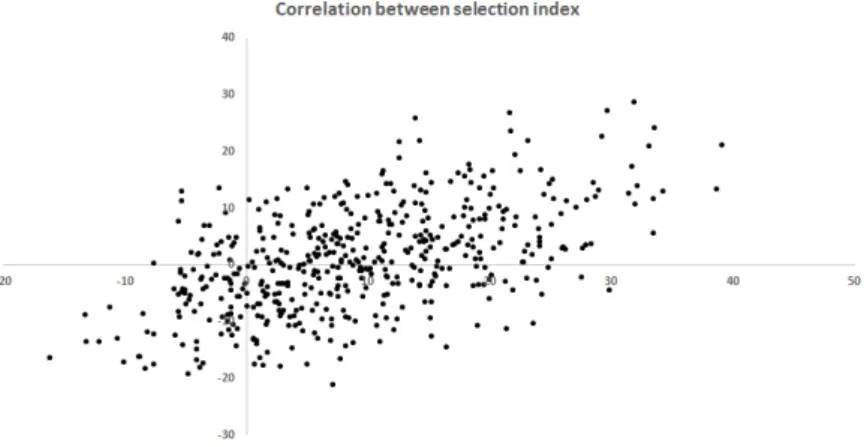
대한 문제점을 보안하기 위해 본 연구에서는 30개월령 도체형질 선발지수의 정보를 제공함으로 농가의 선택폭 향상과 농가 수익 구조에 적합한 한우 정액 선택이 가능하도록 24, 30개월령 도체형질 선발지수에 대한 순위상관
(ranking correlation)을 Fig. 3에 나타냈다. 24, 30개월령 선발지수의 순위상관은 0.516을 나타냈다. 또한, 각 24, 30개 월 각 도체형질의 순위 상관은 0.53 - 0.55를 나타냈다. 따라서, 현재 한우 거세우 도체월령이 평균 30.3 월령인 것으 로 미루어 볼 때(KAPE, 2020), 30개월령 도체형질의 자료를 활용한 육종가 추정, 선발지수 적용, 보증씨수소 선발 및 정액 공급은 실제 한우 농가 출하 시기와 일치하는 정보에 기반하기 때문에 한우 농가 생산성 및 정확도 향상에 도움이 될 것으로 사료된다. 또한, 기존의 선발지수의 계산을 위해 24개월령 도체형질이 활용되었기 때문에, 다양 성과 정확도를 위해 30개월령 도체형질을 활용한 선발지수 설정이 필요할 것으로 사료된다.
Fig. 3. Correlation between selection index (24, 30 months).
Conclusion
한우 30개월령 도체형질 정보를 활용한 선발과 정액공급은 현재 한우 사양 농가에 정액 선정 다양성 및 수익 창 출 구조 상황에 부합하는 정보제공을 통해 수익성 향상에 기여될 수 있을 것으로 사료된다. 추후, 해당 형질의 높 은 선발 정확도를 위해 다양한 genotyping platform (Illumina, Affymetrix etc..)을 통해 수집되는 유전체 정보(genomic information)의 활용은 도체형질에 영향하는 QTL (quantitative trait locus)의 발굴, 기존의 QTL 영역으로 고려되는 위치에 대한 정보 수정 및 기존 genotyping platform에 QTL의 추가를 통한 평가는 유전체 육종가(genomic-enhanced EBVs)의 정확도 및 유전적 개량량 상승에 크게 기여할 수 있을 것으로 사료된다.
Conflict of Interests
No potential conflict of interest relevant to this article was reported.
Acknowledgements
본 연구는 농촌진흥청 연구사업(세부과제명: ICT 활용 한우 사료이용성 형질 개량을 위한 빅데이터 수집 및 유 전특성 구명 연구, 세부과제번호: PJ01432101)에 의해 수행되었습니다.
Authors Information
Dae Jung Kim, https://orcid.org/0000-0002-8477-8842 Hyung Jun Song, https://orcid.org/0000-0003-1691-2234 Seok Hyun Lee, https://orcid.org/0000-0002-8202-4676 Jung Jae Lee, https://orcid.org/0000-0002-6145-8862 Shil Jin, https://orcid.org/0000-0003-1120-3631 Sang Rae Cho, https://orcid.org/0000-0003-0209-6248 Sung Sik Kang, https://orcid.org/0000-0002-9453-5377 Jeong Il Won, https://orcid.org/0000-0003-3151-7144