비디오 시퀀스에서 움직임 정보를 이용한 침입탐지 알고리즘
Intrusion Detection Algorithm based on Motion Information in Video Sequence
알라 킴*, 김윤호* Alla Kim*, Yoon-Ho Kim*
요 약
비디오 감시 장치는 사회안전망 구축분야에서 다양하게 응용되고 있다. 본 논문은 고정 카메라에서 취득된 시각정보를 이용한 침입 탐지 알고리즘을 제안하였다. 제안한 알고리즘은 비디오 시퀀스에서 AMF를 이용하여 모델링된 배경으로부터 물체 프레임 후보를 찾아내고, 감지된 물체는 움직임 정보의 분석으로 계산된다. 움직 임 검출은 RGB 공간에서 2D 물체의 상대적 크기로 결정하였으며 물체 감지를 위한 임계값은 실험적인 방법으 로 결정하였다. 실험 결과, 시․공간적 후보 정보들이 급격히 변화할 때, 물체 감지의 성능이 우수함을 확인할 수 있었다.
Abstract
Video surveillance is widely used in establishing the societal security network. In this paper, intrusion detection based on visual information acquired by static camera is proposed. Proposed approach uses background model constructed by approximated median filter(AMF) to find a foreground candidate, and detected object is calculated by analyzing motion information. Motion detection is determined by the relative size of 2D object in RGB space, finally, the threshold value for detecting object is determined by heuristic method. Experimental results showed that the performance of intrusion detection is better one when the spatio-temporal candidate informations change abruptly.
Key words : intrusion detection, AMF, detected object
* Division of Computer Engineering, Mokwon University.
‧ 1저자(First Author) : Alla Kim ‧ 교신저자(Corresponding Author) : Yoon-Ho Kim ‧ 투고일자 : 2010년 3월 29일
‧ 심사(수정)일자 : 2010년 3월 30일 (수정일자 : 2010년 4월 21일) ‧ 게재일자 : 2010년 4월 30일
I. Introduction
Video surveillance is used to maintain social control and prevent different anomalies such as crime, an abnormal human position or behavior and traffic violation by using different techniques. Especially, the 8'th international meeting of ISO/TC 223 Societal Security have potentially reviewed and reported the new work
item proposals [1]. Intrusion detection is a complex problem that can be solved by using visual applications.
It is a challenging problem due to some factors: human can be in different clothes, take different poses and have class variations. Once human is detected, depending on the application, the surveillance system can go into the details of understanding the human activity [2].
A proposed approach uses motion information from
video sequence to detect intrusion. Background subtraction techniques finds the foreground object from the video. The background model uses Approximated Median Filter (AMF) in RGB space at each pixel for constructing background scene that is continually updated [3]. Pixels detected by algorithm are considered as region of interest. When new object detected, frames would be captured for blob analysing and constructing boundaries for tracking. At this stage additional procedure can be included if require.
The organization of the paper is as follows: in section Ⅱ a description of research is given. In section
Ⅲ, results of approach are presented. Finally section Ⅳ is devoted to conclusion.
Ⅱ. Proposed intrusion detection method in a video sequence
The main goal of proposed method is to detect new object in filmed video sequences. Therefor all frames goes through special validation procedure where we check them for new object presence. In order to cut down validation time and detect motion, input information is reduced by separating foreground and background scene. An overall description of algorithm is given below.
Initialization.
X is a test sequences in RGB space.
B is a description of background scene in RGB space.
F is foreground object in RGB space.
W - width, H- height DI - dilation image 1) Background modelling.
B={}
2) Foreground detection.
FOR x=1 to width FOR y=1 to height
IF all pixels of test sequence are within distance of corresponding background value B(x,y) THEN
F(x,y)=0 ELSE F(x,y)=X(x,y)
Initialization.
X is a test sequences in RGB space.
B is a description of background scene in RGB space.
F is foreground object in RGB space.
W - width, H- height DI - dilation image 1) Background modelling.
B={}
2) Foreground detection.
FOR x=1 to width FOR y=1 to height
IF all pixels of test sequence are within distance of corresponding background value B(x,y) THEN
F(x,y)=0 ELSE F(x,y)=X(x,y) 3) Background updating.
IF a pixel value in the current frame has a value larger than the corresponding background pixel THEN B(x,y) is incremented by one ELSE
B(x,y) is decremented by one.
4) F converted to binary image.
5) Morphological operation:
a) Dilation with structural element ,
IF overlaps 1-valued pixels in the frame
ELSE
b) Filling holes
IF pixel is on the border of
ELSE
c)
6) IF detected object < 15000 pixels THEN remove it
ELSE construct boundaries
The separation was done by background subtraction.
Input frames are compared with background model and classified as foreground and background. We have used an assumption that region of interest is moving relative to it's background, while background remains stationary. Therefor foreground pixel can be defined as in eq. 1. The foreground pixel are detected by calculating the Euclidean norm at time t:
∥ ∥ (1)
where is the pixel intensity value, is the background intensity value at time t and is the foreground threshold.
(2) where, R, G, B are components of a color image.
The most tricky thing here is handling background.
[4]. The background description can be done in several ways and the most primitive and simple way is taking a snapshot of scene without any foreground object. The method is used in frame differencing but it is not appropriate for complex scene because background can change over time.
We have implemented an approach in which background can adopt to its changing through time, background modelling was based on Approximated Median filter (AMF). AMF had been previously used for classification system and urban traffic monitoring [5]-[6].
AMF maintains a background model by using next simple procedure:
i f (3) If a pixel value in the current frame has a value larger than the corresponding background pixel, the background pixel is incremented by 1.
Otherwise the background is decremented by one. In this way input data comes to a state when half of pixels are greater then the background and half are less than the background.
The foreground threshold determined experimentally. The parameter is adaptive, if the object
movements are fast, then can be kept small, otherwise should be kept large [7-10]. For human motion in-doors sequence .
In further step we obtained binary blobs and analyzed their area. Some additional morphological operations are done to improve output of background subtraction.
A dilation procedure is applied to detected objects and holes are filled according to eq. 3
if
(4)
If blob's area (connected components) is less then 15 000 pixel we suppose that it is a false object and remove it. All isolated pixel (individual 1's that are surrounded by 0's) were removed.
Ⅲ. Experimental Results
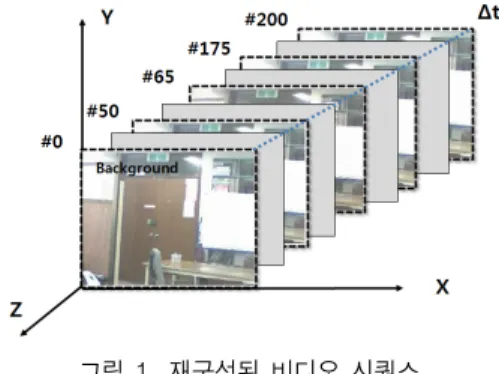
Intrusion detection was conducted by using Matlab Image Acquisition toolbox, test was performed on Intel Processor 2.83 GHz. We acquired RGB video sequence with one and two human motion in-doors reconstructed video sequence in fig. 1.
그림 1. 재구성된 비디오 시퀀스 Fig. 1. Reconstructed video sequences
Changes that were detected by detection procedure were represented in Fig. 3. The background scene modelling was implemented by using approximated
(a) frame #100 (b) frame #180 median filter (AMF), though it has a good performance
it adapts very slowly to large changes in background and is sensitive to environmental noise.
Since the amount of background update (+1 or -1) is independent of the foreground pixels, it is robust enough to perform our tasks. The only drawback is that it adapts slowly toward a large change in background the camera should be carefully positioned. All others motion segmentation details are described in a section Ⅱ and III.
Fig. 2 illustrates extracted frames from an acquired video sequences. Frames #50, 65, 175 and 200 are example of frames with object, namely, no object and two objects (or human) in frame.
(a) frame #50 (b) frame #65
(c) frame #175 (d) frame #200 그림 2. 비디오시퀀스의 샘플 프레임 Fig. 2. The samples of video sequence
(a) frame #50 (b) frame #65
(c) frame #175 (d) frame #200 그림 3. 물체검출 결과
Fig. 3. The result of object detection
Fig. 3 shows detected changes in these frames with constructed bounding box . The result of one detected human in-doors is represented in frame #175. For detected changes whose area more then 15000 pixels boundaries is constructed, fig. 3.
In fig. 4 detected area is considered as intrusion if object's area is more then 15,000 pixel. First frames is equal to zero, that means that frames don't contain any objects. Output of these frames is black screen (all pixel's values are equal to zero) as in fig. 2 (frame# 50).
그림. 4. 비디오 프레임에서 물체출현 영역 Fig. 4. Appearance area of object in video frames
Large changes detected in video sequence in frames
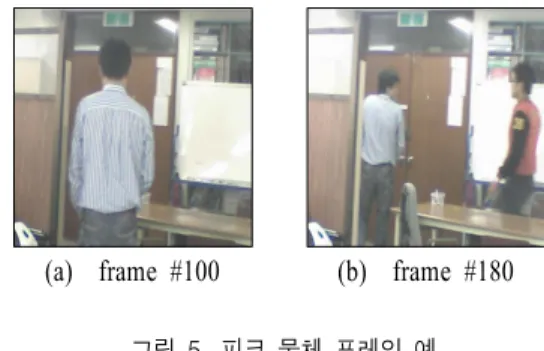
#50-150 represent a large object that was relatively close to camera (static camera was positioned too low, a walking human closed all scene) fig. 4 (first peak). In fig. 5 frame #100 illustrates first peak in Fig. 4. Another peak is reported in fig. 5, frame #180.
그림 5. 피크 물체 프레임 예 Fig. 5. Examples of peak object frame
Ⅳ. Conclusion
In this paper we have developed an intrusion detection approach in RGB video sequences. Approach includes AMF techniques to model background. Objects detection was based on background subtraction procedure. After motion pixels had been defined bounding box construction was implemented, all changes were captured for further processing.
Acknowledgement
This work was partly supported by the RIC/PoDIT program in Mokwon University, 2010.
References
[1] ISO/TC 223 Societal Security, "Resolutions 96 to 107 taken at 8th meeting of ISO/TC 223 2009-11-18 in Ekurhuleni, RSA.
[2] A. Ogale "A survey of techniques for human detection from video"
[3] Alla Kim, Yoon-Ho Kim, "RGB Motion segmentation using Background subtraction based on AMF", Journal of Korea Institute of Information Electronic Communication Technology Sciences, 2009
[4] Swantje Johnsen and Ashkey Tews, “Real-Time Object Tracking and Classification Using a Static Camera”, Proceedings of the IEEE ICRA 2009, Workshop on People Detection and Tracking, Kobe, Japan, May, 2009.
[5] Alla Kim, Yoon-Ho Kim, "Fire detection algorithm based on Color and Motion Information", The Korea Navigation Institute, 2009
[6] N. McFarlane and C. Shofield, “Segmentation and tracking of piglets in images”, Machine Vision and Applications, Springer, Vol. 8, no.3, 1995.
[7] David Moore, "A real-world system for human motion
detection and tracking", California Institute of Technology, 2003
[8] Hui-Xing Jia, Yu-Jin Zhang, "Human Detection in Static Images", Tsinghua University, Beijing, China [9] Muhammed Usman Ghani Khan, Atif Saeed, "Human
detection in Videos", Journal of Theoretical and Applied Information Technology
[10] Ish Rishabh, Arjun Satish, "Human detection in RGB images"
Alla Kim
received B. S. degree in economics and management field in Tashkent Univ. of Information Technologies in 2008, Uzbekistan. Now Master degree student in Mokwon Univ., dept. of IT engineering.
She is currently focused on image processing and computer vision.
Yoon-Ho Kim
In 1992, he joined the faculty member of the Mokwon Univ.. He is currently a professor in the Dept.
of Computer Engineering, Mokwon Univ.. From 2005 to 2006, he was with Univ. of Auckland, where he served as a research fellow. He has been working as Korea Delegate in ISO/TC223 since 2008. His research interests focus on image processing, including pattern recognition, computer vision, fuzzy technologies. He is a member of the IEEE, and IEEE Computer Society, IEEK, KICS and KIIT.