1. Introduction
1.1. Research background
Development of modern game production, based on the improved computing system for the both hardware and software technologies, has been evolved with an effective educational
developing system focusing on approachable curriculum to the world-wide universities. The huge growth of game market, which made the developing processes comparatively easier than the console game development, also increased the number of educational demand from both students and professional instructers along with the enhanced system of game development
A Usability Study on Game Development using University Curriculum
Duck-ki Ahn 1 , Jean-Hun Chung 2*
1
Ph.D, Dept. of Multimedia, Graduate School of Digital Image and Contents, Dongguk University,
2
Professor, Dept. of Multimedia, Graduate School of Digital Image and Contents, Dongguk University
대학 커리큘럼을 통한 게임개발의 사용성 연구
안덕기 1 , 정진헌 2*
1
동국대학교 영상대학원 멀티미디어학과 박사과정,
2동국대학교 영상대학원 멀티미디어학과 교수
Abstract This study is analytical prototype and usability studies centering on game development for game major in university curriculum by the collaboration of professor and students. The study set up the assumption of successful game development throughout the school curriculum initialized by fifteen weeks of time period. In the previous study, we defined the responsibility of positional personnel, and possibilities of current game majored school from both USA and Korea. The study aimed to analyze the productional guideline for the game development courses by conducting a usability survey from the groups of potential participants.
Key Words : Game Development, University Curriculum, Productional Guideline, Potential Participants, Usability Survey
요 약 본 연구는 콘솔 게임개발에 비하여 상대적으로 개발 가능성이 수월한 게임개발 사례를 중심으로, 15주의 대학 과정 커리큘럼을 게임개발 기간으로 지정, 교수와 학생 그룹의 수업 적용 활용 가능성을 분석하였다. 이를 위한 선행연 구로, 효율성 검증을 위한 개발인원의 업무적 책임역량을 지정하고, 한국과 북미의 게임개발 학과들의 가능성 사례의 검증과정을 조사하였다. 또한 향후 대학 커리큘럼을 통한 단계별 제작 가이드라인의 활용성을 위하여, 게임 프로토타입 의 진행과 더불어 학생과 교수 집단을 구분, 참여의사 서베이를 통하여 잠재적 참여자들의 사용성 평가를 진행하였다.
본 연구는 게임개발의 단계별 제작 가이드라인과 활용성을 제시함에 연구의 목적과 의의를 가진다.
주제어 : 게임개발, 대학과정 커리큘럼, 단계별 제작 가인드라인, 잠재적 참여자, 사용성 평가
*Corresponding Author : Jean-Hun Chung([email protected])
Received May 3, 2019 Revised June 5, 2019
Accepted July 20, 2019 Published July 28, 2019
courses. Therefore, universities focused on practical game development curriculum in the game department, thus majors are divided into the specific game design field where game story design is required in humanity study, the game graphic field where producing characters and background, and game programming field where building the game engine for game-play[1].
The possibility of game development from the educational curriculum, which was only considered for a adult users in the previous developing generation, is now expanding the opportunities to young students as a teaching tool even for the elementary school[2].
Accordingly, usability of the educational curriculum received higher attention to game development majors to convey practical experience toward the senior level of students while the junior level students focused the learning process for developing knowledge. In this study, we analyzed the game development to provide the effective process through the potential collaboration project within the limited time and manpower resources related to the school curriculum.
The purpose of the study is to verify the possibility of game process curriculum and usability evaluation from potential participants by investigating the approachable game development combined by the number of a professor and two different majors' students within one semester of timeline. The study has its meaning to verify the executable game development courses by conducting the participation group's feedback survey since convergence education for game design and engineering[3] is required for the corresponsive curriculum as a feasible guideline.
1.2. Scope and method of research
In order to analysis an effective curriculum for the game development course through the
collaboration project using Unity3D engine[4]
system, successful case-study was designed along with most preferred engine between Korean developers for future curriculum study[5].
Previous academic and industry related research was based on the game graphic design, which occupied the visual aspect of the game, is a combined element of technology and design[6] to conduct this study's compatibility for educational system. Therefore the study conducted the usability survey of quantitative evaluation from the four groups of professors and students who plan to participate the game development courses in the future.
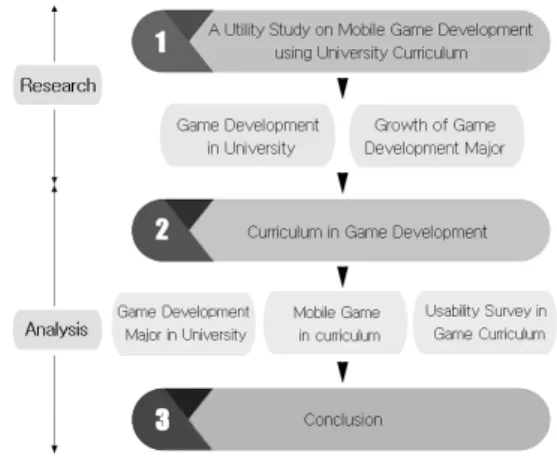
The following Fig. 1 is a summary of the scope in research through the overall analysis study.
Fig. 1. Research procedure
2. Game Development in University
2.1. Configuration of game development
Game development is a hybrid field of computer science, mathematics, and art production, where many universities tried to embrace with their curriculum system[7].
However, the game development in universities
were evaluated as a difficult convergence course
since the actual game production required both
theoretical and practical developing environment even the curriculum structure was not prepared by the lack of both insufficient materials and limited number of instructors. Therefore, the game business was only considered as a viable option for professional specialists through the previous game developing generation.
However, a growth of modern game business made effective management for the quality perspective for the game production, which also encouraged the effective game pipeline to school curriculum by optimizing the collaboration project composed of game designer, graphic artist, and engine programmer[8].
The following Fig. 2 is a image of the relationship between three role positions that should be collaborated to each other during the game development curriculum through the overall analysis study.
Fig. 2. Interrelationship between positions
In the study, the role positions of game developers were designated for talents who understand the concept of development by game design as a multi-player described as person who diverse academic expertise and problem solving abilities[9] to provide a sufficient basis for expanding access to knowledgable personnels.
2.2. Growth of game development major
Global game industry had begun to gain attention from global universities with a turnover of over $124.3 billion revenue in 2016 since there are massive growth in game market over the past decade by the technological distribution
of computer, internet, and smart-phones[10]. In addition, there are various online game-show 'Game Award' competitions[11] which supported emerging game development throughout the team or individuals from university students in the world. Therefore, it was understood as the educational courses of game development received the higher attention because the both trend of job market and level of opportunities were engaged to motivate the university students.
The positive effect of the game development using university's curriculum has resulted in an efficient industry-like collaboration work between the majors of game design and programming to produce the game projects[12].
Furthermore, game development through proper curriculum can motivate students to experience the practical game publishment.
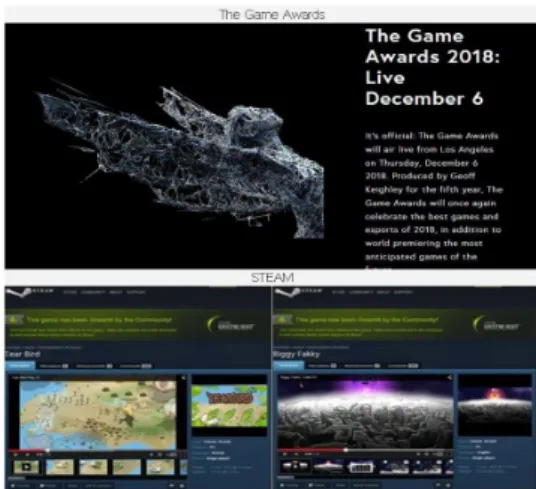
The following Fig. 3 is an example of products from game major students which were verified by both 'Game Award' and global game store system 'Steam'.
Fig. 3. Example of games by game major
3. Curriculum in Game Development 3.1. Game development major in universities
The study initiated research into the game
development major in universities from both United States and Republic of Korea where they actively educated students in the game curriculum. Then the study selected twenty universities based on the online reputation research forum to verify the names of major from each universities by visiting the each school's online web-site. So the study analyzed those game majors by extracting the preparation elements of applicable requirements for the specific case-study from the curriculum plan by semester.
There were two research conditions required for the analysis as the study's qualification. The first condition was the granted courses of game development major in the distribution of the university since students are required to learn the basic theory of both programming knowledge and graphic work-flow to acquire the graduation degree. The second condition was the senior project result of game application whether the both individual or collaboration implementation works, because students are already exposed to the computing tools by the practical utilization of game engine, programing, and graphic softwares.
The following Table 1. is the list of universities with game development major which is arranged in alphabetic order to be referred by the further study.
The above table‘s most universities are conveyed game development by the both theoretical and practical design in the curriculum, and the educational directions are based on the both strategic role division, actual production experience system, and enhancing creative educational environment[13]. which is supported for the school's students as the diversification from the majors between game engineering and game design. Therefore, the study focused on the majors into three referable criteria based on the procedure curriculum which is classified into major subjects by universities: Graphic design major, programming major, and combination of graphic design and programming major.
Logo School Name and Major (USA)
1
University of Southern California - Game Design and Development
2
Carnegie Mellon University - Game Design
3
DigiPen institute of Technology - Game Design
4
Rochester Institute of Technology - Game Design and Development
5 University of Utah
- Entertainment Arts and Engineering
6
Rensselaer Polytechnic Institute - Game and Simulation Arts and Sciences
7
Michigan State University - Game Design and Development
8
New York University - Game Design
9
Georgia Institute of Technology - Computational Media
10
Savannah College of Art and Design - Interactive Design and Game Development Logo School Name and Major (Korea)
11
Sangmyung University - Department of Game
12
Dongyang University - School of Game
13
Tongmyong University - Game Engineering
14
Dongseo University - School of Digital Contents
15
Pai Chai University - Game Engineering
16
Woosong University - Game Multimedia
17
Korea Polytechnic University - Department of Game and Multimedia
18
Honam University - Internet Contents
19
Hoseo University - Game Contents Track
20
Hongik University
- School of Games
Table 1. List of schools with game major
In the case of graphic design major(GM), a few of programming courses were selectively added within the graphic curriculum, therefore most students can only learn basic programming skill sets in order to develop the game project.
However, insufficient information of programming education caused lack of alternatives to the engine implementation rather than focusing on visual improvement from overall game graphic quality.
In the case of game programming major(PM), a few of graphic courses were selectively added within the programming curriculum, therefore most students can only learn basic graphic tools in order to develop the game project. However, insufficient graphic developing information caused low quality graphical output due to the lack of graphic skills to utilize the game engine.
In the case of both graphic design and programming majors(GPM), two departments' students were enable to collaborate the quality of game by converging the relevant knowledges.
Therefore, the group of students could utilize the game engine for the game publishment compare to the other single majors.
Course description
Utilization of game engine
GM
PM
GPM
Table 2. Responsibility in developer's position
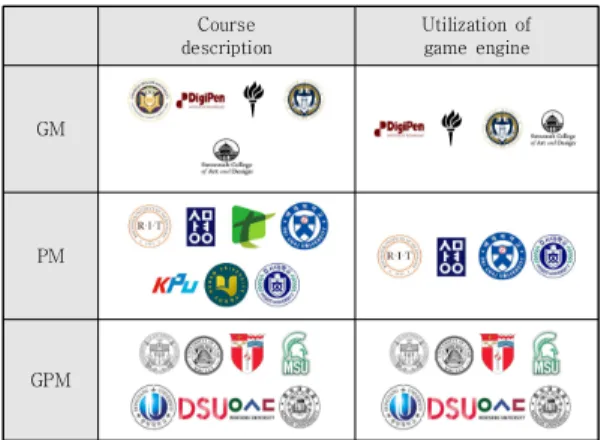
The summary Table 2. is the classification result of belonging twenty universities, which is divided into the course description and utilization of game engine, which were necessary
to verify the utilization of study's curriculum.
Therefore, a few of certain type of elements are required to colligate as a summary result of the Table 2. which were identify between graphic major, programming major, and combination of both majors in the game development courses.
It was analyzed that most combination of both graphic and programming majors were able to utilize the game engine, while half of programming majors were able to utilize the game engine without graphic resources. It also verified that most of the domestic game major departments were composed of game programming mainly, since the convergence education was still lacking the subject of game development planning in curriculum[14].
3.2. Game production in curriculum
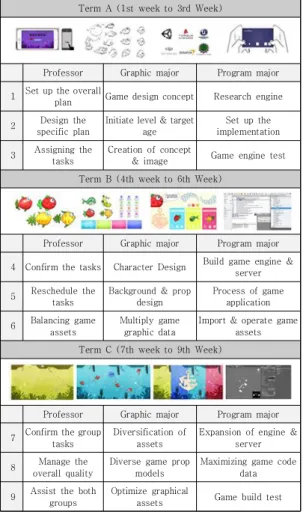
The main procedure of the study is to be analyze the practical production of actual game production to prove the hypothesis of the study, which is approachable game developing process requiring the three developers in curriculum system. Therefore we evaluated the case-study of game by the groups of professor, graphic student, and programming student through the period of five productional developing terms of fifteen weeks.
During the period of the ‘Term A’ which is the 1st to 3rd weeks of the course, curriculum included pre-production pipeline to the initial game design, game level, and game-play concept based on technical discussion by three members.
The game programming major student needed to
research the implementable process for both
game engine and sharable server to prepare a
basic system of game engine’s framework aside
sharing data server. For the advising professor,
planning overall work process was required to
organize the periodical schedule to obtain the
efficient resources for the necessary materials
through the curriculum.
During the period of the 'Term B' which is the 4th to 6th weeks of the course, curriculum plan was maintained the early-production pipeline to create actual game assets such as characters, background, and props based on reliable schedule. The game programming major student was required to set the game engine and sever through the various designating assets of graphic resources with implementation. For the advising professor, ensuring the collaboration of graphic and programming roles were needed to confirm the effective development through the curriculum.
During the period of the 'Term C' which is the 7th to 9th weeks of the course, curriculum plan was proceeded for the mid-production pipeline to multiply different levels of data resources into the game engine, thus graphic major student was able to maximize the both quality and quantity with asset optimization. The game programming major student needed to apply the various art resources into the extensional volume of server and engine while testing improved game build.
For the advising professor, coordinating between the effective procedure and efficient time management were required to conduct the stable game build.
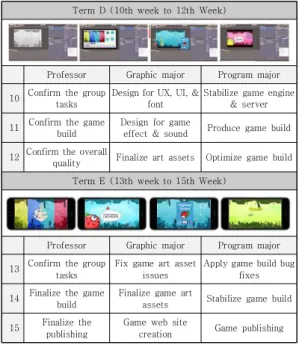
During the period of the 'Term D' which is the 10th to 12th weeks of the course, curriculum plan included the late-production of the pipeline to synthesize the graphic resource data including font, visual effect, sound design, and UI design by graphic major student. The game programming major student needs to maintain the stability of the game build by parallel assemble optimization of the build. For the advising professor, both improving the quality of build and confirm the overall quality were required to comply the tasks for both graphic and programming students.
During the period of the 'Term E' which is the final 13th to 15th weeks of the course, curriculum plan should be finalized the post-production pipeline to finalize the game publishing to the online application store, so
graphic major student needs to fix potential art issues from every latest version of game build.
The game programming major student needed to lock down the game engine to establish the final build until all the critical issues were resolved at the submission stage. For the advising professor, registering the final version of release build need to be evaluated at the end of the game development during this educational curriculum. Therefore the study focused on the interactive ability for amicable communication from positions[15].
Term A (1st week to 3rd Week)
Professor Graphic major Program major 1 Set up the overall
plan Game design concept Research engine 2 Design the
specific plan
Initiate level & target age
Set up the implementation 3 Assigning the
tasks
Creation of concept
& image Game engine test Term B (4th week to 6th Week)
Professor Graphic major Program major 4 Confirm the tasks Character Design Build game engine &
server 5 Reschedule the
tasks
Background & prop design
Process of game application 6 Balancing game
assets
Multiply game graphic data
Import & operate game assets Term C (7th week to 9th Week)
Professor Graphic major Program major 7 Confirm the group
tasks
Diversification of assets
Expansion of engine &
server 8 Manage the
overall quality
Diverse game prop models
Maximizing game code data 9 Assist the both
groups
Optimize graphical
assets Game build test
Table 3. Summary of terminal developing process
Term D (10th week to 12th Week)
Professor Graphic major Program major 10 Confirm the group
tasks
Design for UX, UI, &
font
Stabilize game engine
& server 11 Confirm the game
build
Design for game
effect & sound Produce game build 12 Confirm the overall
quality Finalize art assets Optimize game build Term E (13th week to 15th Week)
Professor Graphic major Program major 13 Confirm the group
tasks
Fix game art asset issues
Apply game build bug fixes 14 Finalize the game
build
Finalize game art
assets Stabilize game build 15 Finalize the
publishing
Game web site
creation Game publishing
In the following study 3.3, we conduct a usability survey by quantitative evaluation method for the applicable curriculum feedback from potential groups.
3.3. Usability survey from potential participants
The study proceeded the prototype of fifteen weeks game development based on a curriculum proposal. Then the usability survey was evaluated to find the level of capability through the potential groups of participants, which were divided into four groups (A, B, C, D) of professors, graphic students, and programming students, to ask six questionaries for the possibility of development. Table 4. shows the color sets with satisfaction level based on the scale.
Extremely negative Scale 0.0 ~ 1.9
Negative Scale 2.0 ~ 3.9
Neutral Scale 4.0 ~ 5.9
Positive Scale 6.0 ~ 7.9
Extremely positive Scale 8.0 ~ 9.9 Table 4. Chart of usability evaluation
Group of professors marked higher average scale between 5 to 6.5 from the listed items. It is noticeable result of "Self-motivation" question which was given by 6.5 with highest value out of all the six questionaries. It seemed the professors’
group had appliable confidence to complete the game production since there are zero number of negative values. The "Possibility of development"
received the lowest average of 5, which was predicted as the limited time of period of a single semester left uncertainty.
Evaluation item lists A B C D Average
1. Possibility of development 4 6 4 6 5
2. Number of developers 6 4 5 5 5
3. Efficiency of environment 5 7 6 6 6
4. Self-motivation 6 7 6 7 6.5
5. Conformity of positions 7 6 4 6 5.75
6. Intention to participate 6 6 4 7 5.75
Table 5. Evaluation scale from professors
Group of graphic students marked average scale between 3.5 to 5.75 from the listed items. It showed the average scale of "Number of developers" received the lowest score of 3.5, since the graphic students felt the creation of graphic assets were difficult task to digest by a single artist. However, they marked the highest 5.75 to the "Conformity of position" they seemed conformity on the process of their tasks. The survey also showed graphic students felt neutral certainty on the "Intention to participate" in a single semester.
Evaluation item lists A B C D Average
1. Possibility of development 3 5 4 4 4
2. Number of developers 4 3 3 4 3.5
3. Efficiency of environment 4 4 5 5 4.5
4. Self-motivation 3 7 6 5 5.25
5. Conformity of positions 6 6 5 6 5.75
6. Intention to participate 4 5 6 5 5
Table 6. Evaluation scale from graphic students
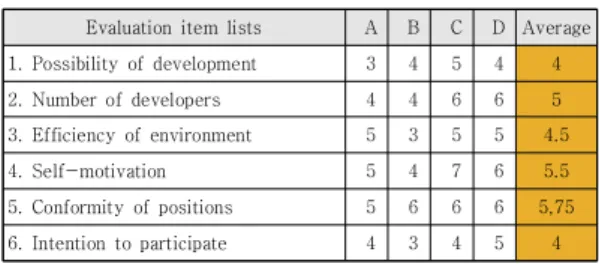
Group of programming students marked average scale between 4 to 5.75 from the listed items. It is analyzed that the average scale of "Intention to participate" received the lowest score of 4 since they concerned about the time limitation of a single semester, but the highest scale of 5.75 for the "Conformity of position" explained the program students seemed comfortable on their positional tasks based on this type of project.
Evaluation item lists A B C D Average
1. Possibility of development 3 4 5 4 4
2. Number of developers 4 4 6 6 5
3. Efficiency of environment 5 3 5 5 4.5
4. Self-motivation 5 4 7 6 5.5
5. Conformity of positions 5 6 6 6 5,75
6. Intention to participate 4 3 4 5 4
Table 7. Evaluation scale from program students
4. Conclusion
In the modern educational game development industry, computer technologies were easily provided for faster developing processes to university level of senior group members.
However, previous study showed there were a few school majors actively required the completion of game production project as a degree acquisition. Other research analyzed the requirements for cultivate manpower from game graphic designers[16] and programmers to improve human resource training from educational system, since there were limited resources of members and developing time period. In this study, we proceeded the prototype of game production in one semester period. Then the study conducted survey of usability evaluation for the groups of professors, graphic students, and program students to prove the interesting levels of potential participants. The study noticed group of professors marked higher average scores on most of the questionaries than the groups of two
different major students. Graphic students group was affected more pressure on the "Numbers of developers" as they marked lowest value of 3.5 while the program students group marked the lowest value on the "Intention to participate" of 4. However, both student groups showed higher interest on the "Conformity of position" value of 5.75 since they were able to anticipate their tasks for this collaboration project. In addition, the study was able to expect both flexible curriculum schedule and grading reward system could be motivate the positive confidence for both "Possibility of development" and "Number of developers" in the future development curriculum.
This study's evaluation has its importance of the research not only verifying the case study of game development, but also analysing the list of usability survey based on potential participant groups. Meanwhile, the result of the survey analysis is only focused on the possible game development for the game major's curriculum which is limited by both time and scope within the single semester. Therefore the study can be extended to consecutive analysis, combined by both multi semester periods and association of multiple majors, with flexible time schedule and number of developers in the future study.
REFERENCES
[1] Y. M. Kown. (2013). A Case Study on the Game Industry Optimized Human Resource Development Program. Journal of Korea Game Society, 13(2), 71-80. DOI: 10.7583/JKGS.2013.13.2.71
[2] N. Y. Kim. (2015). Game Development Methodology as a Teaching Tool for Elementary School. Journal of Korea Game Society, 15(2), 53-62. DOI: 10.7583/JKGS. 2015.15.2.53 [3] S. H. Jung. (2012). Design and Engineering
Convergence Education, Korean Society for Engineering Education, 19(1), 23-27. ISSN: 2093-2677 [4] Unity3D. https://unity3d.com/kr
[5] M. J. Lee. (2013). A Study on Game production
Education through recent trend analysis of 3D game
engine. Journal of the Korea convergence Society,
4(1), 15-20. DOI: 10.5539/jel.v1n2p282
[6] H. S. Shin. (2017). A Status Analysis of the Education Game Graphic Design in the Universities. The Korea Contents Society, 17(5), 114-121.
[7] J. W. Park & H. D. Baek. (2014). Analysis and Improvement on the College Convergence Education with Game Departments. Journal of Engineering Education Research. 17(2). 68-74. DOI: 10.18108/jeer.2014.17.2.68 [8] R. Coleman & M. Krembs. (2005). Game Design &
Programming concentration within the Computer Science Curriculum. ACM SIGCSE Bulletin, 37(1), 545-550. DOI: 10.1145/1047344.1047514
[9] Y. S. Jeon & K. H. Lee. (2012). Educational Program Plan to Train The Multi Professional Person. Journal of Engineering Education Research, 15(1), 26-31.
[10] Game Industry White Paper. (2017). Industry Promotion Policy Division. Korea Creative Content Agency, (1), 59.
[11] The Game Awards. https://thegameawards.com/student [12] T. Jiravansirikul, T. Dheandhanoo & M. Chantamas.
(2017). University-industry collaboration for game curriculum: The open innovation model. International Conference on Information Technology and Electrical Engineering(IEEE), 1-4. DOI: 10.1109/ICITEED.2017.8250501 [13] Y. J. Kim & M. J. Kang. (2007). Problems and Improvement Direction of Educating Game Manpower. The Korea Contents Association, 5(1), 25-31. DOI: 10.20924/CCTHBL.2007.5.1.025 [14] H. J. Kim. (2005), The Research of Development
Direction for the Professional Human Resource Education in University, Journal of The Korean Society for Computer Game, (6) , 50-55.
[15] S. K. Kim & C. J. Jung, (2005), The Study on Curriculum of Digital Game Design, Korean Society of Basic Design & Art, 6(2), 15-23.
[16] W. B. Lee & S. H. Ryu, (2017), Specialized Manpower Training System for Technology-friendly Game Graphic Designer. Journal of the Korea Convergence Society, 8(11), 257-262. DOI: 10.15207/JKCS.2017.8.11.257
안 덕 기(Duck-Ki Ahn) [정회원]
․ 2003년 3월 : Savannah College of Art and Design(SCAD), Computer Art (BFA)
․ 2004년 3월 : Savannah College of Art and Design(SCAD), Computer Art (MA)
․ 2013년 3월 ~ 현재 : 홍익대학교 게임 학부 게임그래픽디자인전공 교수
․ 2016년 3월 ~ 현재 : 동국대학교 영상대학원 박사과정
․ 관심분야 : Game Graphic Design, 3D Computer Animation, Character Design, VR Graphic 등.
․ E-Mail : [email protected]
정 진 헌(Jean-Hun Chung) [정회원]