한국컴퓨터정보학회 동계학술대회 논문집 제19권 제1호 (2011. 1)
233
3D Game Development For Dementia Prevention
Guan-Feng He○, Sun-Kyung Kang*, Wuk-Ho Choi** Sung-Tae Jung*
○*Dept. of Computer Engineering, Wonkwang University
**Neovision Co. LTD
치매 예방을 위한 3D 게임 개발
하관봉○, 강선경*, 최욱호**, 정성태*
○*원광대학교 컴퓨터공학과
**(주)네오비젼
e-mail: [email protected], [email protected], [email protected], [email protected]
● 요 약 ●
This paper proposes to use gesture recognition technology to develop 3D game for prevention of dementia. In the game, the user can choose camera mode or mouse mode to play game. In the game design, We focused on the characteristics of dementia, Developed four types of games, Including Memory training game, Math game, Logical training game and 3D visual sense training game. Each type of game is composed by a number of small games.
Common feature of all the game is random, This ensures that when user play games, Basically the game will not have the same situation. For the older elderly, If can take 10 minutes a day to play the game and has always insisted on playing, For dementia preventive have a positive effect.
키워드: dementia prevention, 3D Game, gesture recognition
I. Introduction
Because the decline in birth rate and the extension of human life, The degree of population aging is rising in Asia.
The incidence of dementia increased year by year. The Dementia also called Alzheimer’s disease (AD). It will be the 21st century, threats to health of the elderly the most serious diseases.
Dementia is a disease of brain cells rapidly degrade, As the disease advances, symptoms include confusion, irritability and aggression, mood swings, language breakdown, long-term memory loss, and the general withdrawal of the sufferer as their senses decline.[1][2]
Currently, Dementia have not generally effective treatment.
But the earlier prevention and treatment can control the disease, delay memory decline, reduce the burden on caregivers and medical costs.
Because of this, this game was developed. The game has a total of four categories: Memory training game, Math game, Logical training game, 3D visual sense training game.
II. 3D Game Engine Library
3D game engine library is to produce a 3D game the necessary tools, we made a lightweight game engine library, used it to help me develop 3D games. The game engine library is developed using C++ and DirectX. Game engine architecture is very simple, try to keep it simple and practical style, and not loss the performance.
III. Introduction The 3D Game
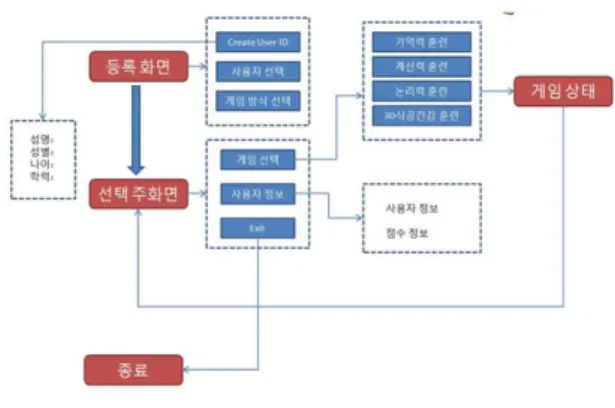
The design of the game system, The game include five parts: the login page, home page, user information page, game selection page, game page.
In the login page, user can create new user ID, select the existent user ID and select the game mode.
In the home page, user can view their information and enter the game selection page.
In the user information page, user can check their scores.
In the game selection page, User can choose one that you are interested game.
한국컴퓨터정보학회 동계학술대회 논문집 제19권 제1호 (2011. 1)
234
Fig. 1. Game Diagram
3.1. Game Page
3.1.1 Memory training game
Beginning of the game, user has 5 seconds to remember the location of animals. 5 seconds later, all animals would be hidden in a wooden box. User need to find all of the same animals in order to pass the game. Every times, the game will randomly generate the location of animals.
Fig. 2. Memory training game
3.1.2 Logical training game
In a certain period of time, User need to find the mushroom at the end of maze to win the game. Every times, the game will randomly generated maze.
Fig. 3. Logical training game
3.1.3 Math game
Penguin can move in four directions: front, back, right and left direction. Every move, Penguin will eat the number above the box. After the move, The penguin stand before the box will be flooded. If the number sum of penguin to eat, and it is equal to the target value, the user will win. If the number sum is greater than the target value, the user will fail.
Every times, the game will randomly generated the numbers.
And there will be a number path to meet the conditions for victory.
Fig. 4. Math game
3.1.4 3D visual sense training game
This is a constantly rotating cube, Cube formed by the three colors. You need to find the correct projection that the arrow point to the projection. In the four projection, you only one chance to select the correct answer. Every times, the game will randomly generated the cube.
Fig. 5. 3D visual sense training game
IV. Image Process
Different from other brain training games, this is a brain training game combines physical training. So this game used motion recognition and gesture recognition technology.
한국컴퓨터정보학회 동계학술대회 논문집 제19권 제1호 (2011. 1)
235 4.1. Motion Recogntion System
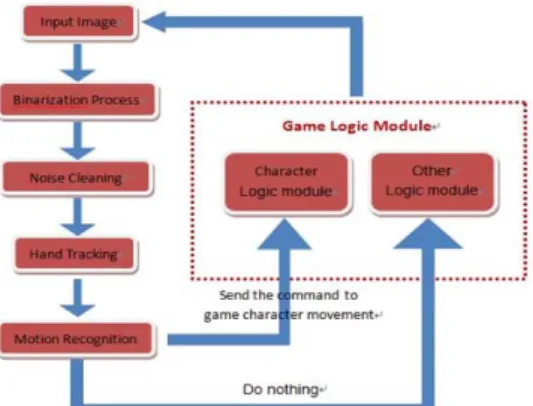
Motion recognition system diagram:
Fig. 6. Motion recognition system diagram
4.1.1 Input image
If we capture images by OpenCV function cvCapture, In the game runtime, the average frames is 15 per second.
In the same environment, If capture images by DirectShow, In the game runtime, the average frames is 40 per second, So the DiretShow is more efficient.
Fig. 7. Input image
4.1.2 Binarization process
First, the image format to HSV. Second, extract the Hue channel.
The RGB format image is converted to HSV format by the Formula 1.
cos
min
Formula. 1.
Finally, use pre-set histogram to calculate the back projection image.
The final image shown in Figure 8.
Fig. 8. Binarization process final image
4.1.3 Noise cleaning
Because the clothes color and the glove color is similar, so the back projection image have some noise. The noise will affect the detection of the hand, The error image shown in Figure 9. By image processing method erosion can remove the noise. The final image shown in Figure 10.
Erosion: In the binarization processed image, the following algorithm can generate a new image. First, determine the pixel value of mask location is 1. If meet the requirements, then determine its surrounding 8 pixels(P1-P8) value, if the eight values are 1, P pixels value is 1, otherwise the P pixels value is 0.
P=P1∧P2∧P3∧P4∧P5∧P6∧P7∧P8
Fig. 9. Error image
Fig. 10. Noise cleaned image
한국컴퓨터정보학회 동계학술대회 논문집 제19권 제1호 (2011. 1)
236
4.1.4 Hand Tracking
By "continuously adaptive mean-shift" method to track hand.[3]
mean-shift algorithm is a method of finding local extremum value in a set of data's density distribution.
mean-shift algorithm steps:
(1)Select search window
the initial position of the window the type of the window
the shape of the window the window size
(2)Calculation window's centre of gravity
(3)The center of the window set in the calculated center of gravity.
(4)Return (2)step until the window does change the position.
4.1.5 Motion Recognition
In the input image around, we created a blue safety box, Determine which safety box, Determine which safety line was hit to recognition the hand direction of the movement.
When that happens, the red track box will return the test center and waiting for the next recognition.
V. Conclusion
When the elderly retire, A substantial reduction in complex operations. In life, Out of the daily stress. And the easy life in the long term, These will reduce the use of brain. Play this game every day for 15 minutes, improve attention and memory, the brain active. This prevention of dementia for the elderly has a positive preventive effect.
For the patient in the early stages of dementia, Through this game exercise the brain, delay the disease from various.
For instance: match up game can help patients decrease memory forgetting rate. The maze game can exercise the patients logic ability. The penguin math game can improve mathematical computations. The magic cube game can improve spatial cognition and observation ability. These games are very meaningful for the patients.
Acknowledgment
“This work was supported by the Grant of the Korean Ministry of Education, Science and Technology"
(The Regional Core Research Program/Center for Healthcare Technology Development)
References
[1] Waldemar G, Dubois B, Emre M, et al. (January 2007).
“Recommendations for the diagnosis and management of Alzheimer's disease and other disorders associated with dementia: EFNS guideline”. Eur J Neurol 14 (1): e1~26 [2] Tabert MH, Liu X, Doty RL, Serby M, Zamora D, Pelton
GH, Marder K, Albers MW, Stern Y, Devanand DP (2005). “A 10-item smell identification scale related to risk for Alzheimer's disease”. Ann. Neurol. 58(1):155~160 [3] Dorin Comaniciu, Visvanathan Ramesh, Peter Meer
(2000). “Real-Time Tracking of Non-Rigid Objects using Mean Shift”. IEEE conference on Computer Vision and Pattern Recognition(vol.2, pp.142~149) 2000.