Microorganisms are known to produce and release various types of enzymes into their envi- ronments. Some of those extracellular enzymes play a key role in decomposition of large organic molecules and hence affect nutrient cycles in a substantial way (Chróst, 1992). For example, phosphatase activities have intensively studied in relation to the regeneration of inorganic phos- phorus and eutrophication in aquatic ecosystem (Ahn and Choi, 1992). In wetland ecosystems, roles of extracellular enzymes in biogeochemical reactions have recently been revealed (Freeman
et al., 1997). However, the origin and the statusof enzymes in wetland matrix have rarely been elucidated.
Unlike the aquatic ecosystems, the origin and longevity of enzymes in soils are more compli- cated due to the stabilising effects of the soil matrix on enzymes released from microbial or plant cells. Many studies have been conducted to
determine the origin and state of soil enzymes (e.g., Burns, 1982). The simplest approach in- volves eliminating enzyme sources from the soil, and chasing the change of soil enzymes. For this purpose, toluene (Frankenberger and Johanson, 1986),
γ-radiation (Lensi et al., 1991), antibioticsor fungicides (Nakasa et al., 1987) or autoclaving (Frankenberger and Tabatabai, 1991) have been applied. The ideal method should eliminate tar- get sources without affecting any other compo- nents in the soil. Each method adopted to-date, however, has shortcomings. For example, toluene addition can eliminate microorganisms by chang- ing the permeability of their membranes, but could also be used as a carbon source for certain species of bacteria (Kaplan and Hartenstein, 1979). Therefore toluene is not an appropriate treatment for a long-term study. Likewise, γ- radiation, which could terminate all living organisms in soil, has been reported to change
─
─ 326 ──
Sources and Variations of Extracellular Enzymes in a Wetland Soil
Kang, Hojeong*and Chris Freeman1
(Department of Environmental Science and Engineering, Ewha Womans University, Seoul, Korea
1School of Biological Sciences, University of Wales, Bangor, LL57 2UW, UK)
A wetland soil was sterilised by two methods and changes in microbial enzyme activities were assessed. The short--term effects were determined by toluene addi- tion, while the longer--term effects of elimination was monitored by γγ--radiation. The changes in ββ-- glucosidase, ββ-- xylosidase, cellobiohydrolase, phosphatase, arylsul- phatase, and N-- acetylglucosaminidase activities were determined by using methylumbelliferyl model substrates and comparing with the activities of control samples. Toluene addition induced different responses of enzymes. For example, phosphatase activity increased by the treatment while ββ--glucosidase and arylsul- phatase activities decreased. In contrast, γγ--radiation decreased all enzyme activities compared to control by 40--80%. The overall results of the toluene and γγ--radiation experiments indicate that the large amounts of enzymes are stabilised outside of living cells, at least in the short term, but that the persistence of enzymes is main- tained by de--novo synthesis of microbes.
Key words : soil enzyme, sterilisation, peatland, and bacteria
* Corresponding Author: Tel: 02) 3277-3916, Fax: 02) 3277-3275, E-mail: [email protected]
the physicochemical structure of soils (DaSilva et
al., 1997). The radiation could produce varioustypes of chemically active free radicals, which may react with other chemicals resulting in sub- stantial changes in humic compositions. Antibio- tics or fungicides have been widely adopted in soils, but the efficiency of the sterilisation is questionable (e.g., Nowak and Wronkowska, 1991). Finally, although autoclaving is an effici- ent and simple way to sterilise soils, the method changes the physical structure of the soil, and hence destabilises the associated immobilised enzymes.
Our aims were to determine what proportions of enzyme activities may 1) persist after microor- ganisms had been eliminated and 2) be affiliated with microbial cells. For this, enzyme activities were determined after wetland soil was sterilised by toluene or
γ-radiation. The toluene additionwas used to determine what proportion of enzy- mes are affiliated with intact microbial cell walls or stabilised outside the microbes. Secondly, the
γ-radiation was applied to assess how long enzy- me activities may persist without the source (i.e., microbes).
Soil samples were collected from a wetland in Ogwen valley in North Wales, UK. The site is domimated by Sphagnum spp. and Juncus spp., of which pH is 3.8-4.3. Soil organic matter con- tent is 94.4% and bulk density is 0.029 g cm
-3. The samples were collected to 10 cm depth from the surface and transferred on ice. Ten cm3 of soil was gently homogenised for 30 seconds with 50 mL of deionised water in a Seward Colworth model 400 stomacher to obtain homogeneous slurry samples.
To find out the origin of the enzymes, toluene was applied to determine short-term effects of microbial elimination. For this, 0.3 ml of toluene (i.e., ca. 3% final concentration) or deionized wa- ter (for control) was added to 10 ml of peat slurry (1 : 10 v/v) in 30 minutes prior to the enzyme assay. This concentration of toluene has been reported to be sufficient to disrupt cells but with minimal interference to immobilised enzymes (e.g., Burton and McGill, 1989). Since toluene dissolves the membrane of microorganisms and changes their permeability, the differences be- tween the control and the treatment may repre- sent enzyme components, which require intact microbial cells.
To assess the long-term effect of bacterial re-
moval, the peat sample was treated with 4 MGy of
γ-radiation (Isotron PLC, Swindon, Wiltshire,UK), and then maintained in airtight plastic bags at 4� C for 2 months. This radiation dose has been reported to be sufficient to sterilise peat (Brown, 1981). The two-month incubation after the radiation was applied to stabilise the sample (Ramsay and Bawden, 1983) and to provide enough time for degradation of the non-stabilis- ed enzymes. This experiment was to determine the importance of the microorganisms as an en- zyme source, and to estimate how much enzyme activities could exist without the source in the long-term.
Methylumbelliferyl (MUF) compounds were employed as a model substrate for enzyme assay (Kang and Freeman, 1998). MUF-glucopyrano- side, MUF-xyloside, MUF-cellobiose, MUF- phosphate, MUF-sulphate, and MUF-N-acetyl- glucosamine were employed to assess β-gluco- sidase,
β-xylosidase, cellobiohydrolase, phospha-tase, arylsulphatase, and N-acetylglucosami- nidase, respectively. In brief, 10 mL of slurry was added with 5 mL of each specified concentration of MUF substrates. After a 60-minute incuba- tion at 15� C, 1.5 mL of reactant was pipetted into a centrifuge vial and centrifuged at 10,000 rpm for 5 minutes. Fluorescence in the supernatant was determined with a Perkin-Elmer LS50 fluorometer at 450 nm emission and 330 nm
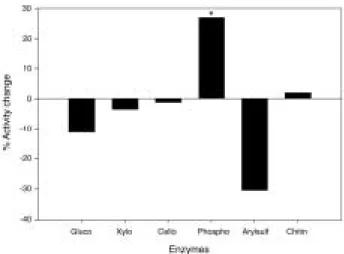
Fig. 1. Effects of toluene on the enzyme activities. *repre- sents significant differences from the control at P⁄0.05 (n = 3). Gluco: β-glucosidase, Xylo: β- xylosidase, Cello: cellobiohydrolase, Phospho: pho- sphatase, Arylsulf: arylsulphatase, and Chitin: N- acetylglucosaminidase.
excitation wavelength with slit setting 2.5. A calibration curve was prepared to using 0-100
µM of MUF free acid solution in soil slurry to correct interference of phenolics and adsorption of product to soil matrix. Differences between control and treatment were determined by two sample t-test at P⁄0.05 level.
Addition of toluene decreased
β-glucosidaseand arylsulphatase activities by 11% and 30%, respectively (Fig. 1). In contrast, phosphatase activity increased by 26%. All these changes were significant at P⁄0.05. However, cellobio- hydrolase,
β-xylosidase and N-acetylglucosami-nidase activities did not change significantly (P
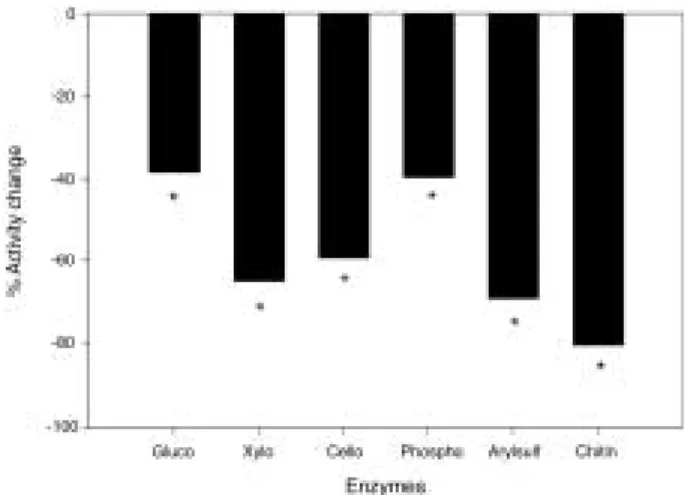
¤0.05). Gamma-radiation treatment reduced all enzyme activities, to extents ranging from appro- ximately 40% (phosphatase and
β-glucosidase),60-70% (xylosidase and cellobiohydrolase), and around 80% (arylsulfatase and chitinase) (all significant at P⁄0.05) (Fig. 2).
The decreased activities of
β-glucosidase andarylsulphatase by toluene treatment imply that much of their activities can be attributed to endocellular enzyme or that at least they require intact cell membrane for their activities. Both endocellular and extracelullar
β-glucosidasehave been reported from soil microorganisms (Burns, 1982), and toluene treatment might decrease or terminate the endocellular
β-gluco-sidase activity. The decrease of arylsulphatase
was unexpected as arylsulphatase has been re- ported as an extracellular or exoenzyme (Speir and Ross, 1978). Even exoenzymes, however, may depend on an intact microbial cells, if they are embedded in outer membrane or glycopro- teins (Chrost, 1992). Large quantities of phosph- atase are believed to exist in the periplasmic space of Gram-negative bacteria (Burns, 1982), which might be released or exposed to substrates by toluene treatment in this study. Another possibility is that a certain proportion of the phosphatase was released from algae or zoo- plankton. The absence of an effect of toluene on
β-xylosidase, cellobiohydrolase, and N-acetyl-glucosaminidase activities suggests that these enzyme activities are true exoenzymes. It is con- cluded from the toluene experiment that a large proportion of the enzymes function outside of microbial cells.
The results, however, do not necessarily mean that the activities of soil enzymes are indepen- dent of microbial cells. Even stabilised enzymes are degraded gradually by proteinase or harsh conditions (e.g., pH change, denaturation by high temperature, or lack of cofactors). Therefore, soil enzyme activities would not persist in the long term without continuous de-novo synthesis by microbial cells. For example, by using toluene and kinetic analysis, Burton and McGill (1989) have shown that even a relatively stable com- ponent of the total soil enzyme activity may gra- dually decrease, although the rate is generally far slower than a labile component (i.e., enzyme component dependent upon living microbes).
This was confirmed by the
γ-radiation experi-ment in this study.
All the activities decreased including phos- phatase activity, with a range from 38.5% (
β- glucosidase) to 80.4% (N-ase) (P⁄0.05). Brown (1981) has reported comparable changes of en- zyme activities by 4MGy
γ-radiation. In thatexperiment, about 60% of
β-glucosidase andphosphatase, and 50% of N-acetylglucosami- nidase and arylsulphatase activities remained after the radiation. In a similar time-series ex- periment with a mineral soil,
β-glucosidase acti-vity decreased rapidly in a week after the radia- tion, then showed a steady rate of disappearance for at least 8 weeks (Lensi et al., 1991). It is sug- gested that the remaining activities in the pre- sent study would represent the true abiontic enzymes (i.e., stable component of soil enzymes,
Fig. 2. Effects of γ-radiation on the enzyme activities.
*represents significant differences from the con- trol at P⁄0.05 (n = 3). Gluco: β-glucosidase, Xylo:
β-xylosidase, Cello: cellobiohydrolase, Phospho:
phosphatase, Arylsulf: arylsulphatase, and Chitin:
N-acetylglucosaminidase.
which is not affiliated with microorganisms) in the soil. The results of the toluene and
γ-radia-tion experiments indicate that the large amounts of enzymes are stabilised outside of living cells, at least in the short term, but that the per- sistence of enzymes is maintained by de-novo synthesis of microbes.
ACKNOWLEDGEMENTS
This research was supported by a grant (5-4- 1) from Sustainable Water Resources Research Center of 21st Century Frontier Research Pro- gram.
REFERENCES
Ahn, T-S. and S. Choi. 1992. Phosphatase activities in Lake Soyang, Proceedings of the 6th Interna- tional Symposium on River and Lake Environ- ment, ISRLE: 145-152.
Brown, K.A. 1981. Biochemical activities in peat sterilized by gamma-irradiation. Soil Biol. Bio- chem. 13: 469-474.
Burns, R.G. 1982. Enzyme activity in soil: Location and a possible role in microbial ecology. Soil Biol.
Biochem. 14: 423-427.
Burton, D.L. and W.B. McGill. 1989. Role of enzyme stability in controlling histidine deaminating acti- vity in soil. Soil Biol. Biochem. 21: 903-910.
Chróst, R.J. 1992. Significance of bacterial ectoen- zymes in aquatic environments. Hydrobiologia 230: 1-10.
DaSilva, W.T.L., S.C. DaSilva and M.O.D. Rezende.
1997. Influence of gamma-radiation on the be- havior of humic acids from peat and tropical soil.
J. Radioanal. Nuclear Chem. 222: 29-34.
Frankenberger, W.T.Jr. and J.B. Johanson. 1986.
Use of plasmolytic agents and antiseptics in soil enzyme assays. Soil Biol. Biochem. 18: 209-213.
Frankenberger, W.T. Jr. and M.A. Tabatabai. 1991.
L-glutaminase activity of soils. Soil Biol. Bio- chem. 23: 869-874.
Freeman, C., G. Liska. N.J. Ostle, M.A. Lock, S.
Hughes, B. Reynolds and J. Hudson. 1997. En- zymes and biogeochemical cycling in wetlands during a simulated drought. Biogeochemistry 39:
177-187.
Kang, H. and C. Freeman. 1998. Measurement of cellulase and xylosidase activities in peat using a sensitive fluorogenic compound assay. Commun.
Soil Sci. Plant Anal. 29: 2769-2774.
Kaplan, D.L. and R. Hartenstein. 1979. Problems with toluene and the determination of extracel- lular enzyme activity in soils. Soil Biol. Biochem.
11: 335-338.
Lensi, R., C. Lescure, C. Steinberg, J.-M. Savoie and G. Faurie. 1991. Dynamics of residual enzyme activities, denitrification potential, and physico- chemical properties in a γ-sterilized soil. Soil Biol. Biochem. 23: 367-373.
Nakasa, J.P., W.D. Gould and D.A. Klein. 1987.
Origin and expression of phosphatase activity in a semi-arid grassland soil. Soil Biol. Biochem. 19:
13-18.
Nowak, A. and H. Wronkowska. 1991. On the effici- ency of soil sterilization in autoclave, combined with addition of antibiotics. Zentralblatt Mikro- biol. 146: 267-270.
Ramsay, A.J. and A.D. Bawden. 1983. Effects of sterilization and storage on respiration, nitrogen status and direct counts of soil bacteria using acridine-orange. Soil Biol. Biochem. 15: 263-268.
Speir, T.W. and D.J. Ross. 1978. Soil phosphatase and sulphatase. In Soil Enzymes (Ed. Burns, R.
G.), pp. 198-250. Academic Press, London.
(Received 9 Aug. 2002, Manuscript accepted 10 Dec. 2002)
⁄ ¤
습지 토양에서 체외효소의 근원과 변화
강 호 정*∙
Chris Freeman
1(이화여자대학교 환경학과, 1School of Biological Sciences, University of Wales, Bangor LL57 2UW, UK)
습지토양을 두 가지 방법으로 멸균한 후, 미생물 효소활성도의 변화를 알아보았다. 단기 멸균의 효 과는 톨루엔을 가하여 알아 보았고, 장기적인 효과는 감마선 조사를 이용하였다. 처리된 시료에서
β-glucosidase, β-xylosidase, cellobiohydrolase, phosphatase, arylsulfatase, N-acetylglu-
cosaminidase 활성도를methylumbelliferyl 계열의 인공기질을 사용하여 측정한 후 공시료와 비교 하였다. 톨루엔을 가한 경우 효소에 따라 다른 반응을 보였다. 예를 들어, 처리에 의하여 phosphatase의 활성은 증가하였으나 반대로 β-glucosidase와 arylsulfatasem의 활성도는 감소하 였다. 감마선 조사는 모든 효소의 활성을40-80% 정도 감소시켰다. 본 연구의 전반적인 결과에 의 하면, 적어도 단기적으로는 다량의 효소가 미생물 체외에서 안정적으로 존재하나, 장기적으로는 de-novo 합성이 중요함을 알 수 있었다.