• 검색 결과가 없습니다.

Characterization of Hydrangea Accessions Based on Morphological and Molecular Markers

N/A
N/A
Protected

Academic year: 2021

Share "Characterization of Hydrangea Accessions Based on Morphological and Molecular Markers"

Copied!
8
0
0

로드 중.... (전체 텍스트 보기)

전체 글

(1)

Received: December 29, 2017 Revised: March 19, 2018 Accepted: March 19, 2018

OPEN ACCESS

HORTICULTURAL SCIENCE and TECHNOLOGY 36(4):598-605, 2018

URL: http://www.kjhst.org pISSN : 1226-8763 eISSN : 2465-8588

This is an Open Access article distributed under the terms of the Creative Commons Attribution Non-Commercial License which permits unrestricted non-commercial use, distribution, and reproduction in any medium, provided the original work is properly cited.

Copyrightⓒ2018 Korean Society for Horticultural Science.

This research was supported by the Export Promotion Technology Development program (315041-05), Ministry of Agriculture, Food and

Characterization of Hydrangea Accessions Based on Morphological and Molecular Markers

May Thinn Khaing 1 , Hyo Jin Jung 1,2 , Jong Bo Kim 3 , and Tae-Ho Han 1,2*

1

Department of Horticulture, Chonnam National University, Gwangju 61186, Korea

2

GARDENPLANT(Co., Ltd.), Gwangju 61186, Korea

3
Department of Biotechnology, Konkuk University, Chungju 27478, Korea

*Corresponding author: [email protected]

Abstract

Hydrangea (Hydrangea spp.) is commonly cultivated as an ornamental plant for its attractive characteristics. While numerous hydrangea cultivars are available as genetic resources, they cannot be utilized effectively for breeding purposes because of a lack of information on their genetic relationship and breeding compatibility. In this study, genetic relationships within a collection of 34 accessions consisting of 4 species of hydrangea (H. macrophylla, H. paniculata, H. serrata, and H.

arborescens) were evaluated using random amplified polymorphic DNA (RAPD) markers. The hydrangea cultivars were maintained in the greenhouse at Chonnam National University. The dendogram of the genetic relationship was subjected to a clustering analysis in the PAST program using the unweighted pair group method with arithmetic mean (UPGMA) method to estimate the genetic distances and relatedness among the species. Based on RAPD analysis, H. macrophylla was separated into two major groups with high levels of genetic similarity among the cultivars. H.

paniculata accessions were classified into one major group with ‘Womseuredeu’ genetically distant from the other cultivars. H. serrata and H. arborescens were divided into two separated groups. The dendrogram suggests that H. macrophylla and H. serrata are genetically similar therefore the chance of hybridization between this species may be greater than that between more distantly related species. The present study provides useful information for the breeding of hydrangea cultivars.

Additional key words: breeding programs, genetic relationships, hydrangea cultivars, identification, RAPD

Introduction

Hydrangea is known for a number of attractive characteristics, and it is commonly cultivated for

both landscape and ornamental plants. The genus Hydrangea is in the Hydrangeaceae family and

consists of 23 species with a distribution in both the temperate and tropical regions of eastern Asia,

eastern North America, and South America, and it comprises a high ornamental value and diverse

growth forms (McClintock, 1957). Among them, H. macrophylla is the most popular species and one

of the most commercially important flowering shrubs (Dirr, 2004; van Gelderen, 2004). Although

(2)

floral characteristics, and disease susceptibility (Dirr, 2002). New sources of genetic diversity are needed to develop cultivars with improved disease resistance and flowering characteristics.

The genetic diversity among the H. macrophylla cultivars is limited due to the restricted native distribution and the multiple breeding programs that utilize the same taxa and employ similar breeding goals (Haworth-Booth, 1984; van Gelderen, 2004). Breeding efforts to improve H. paniculata, H. arborescens, and H. quercifolia are also needed. Though many hydrangea cultivars are available as genetic resources, they cannot be utilized effectively for breeding purposes because of a lack of information on their genetic relationship and compatibility. In addition, investigation of interspecific relationships, genetic diversity, and genetic-similarity clustering will provide important information for the selection of parents for a wide range of hybridization studies.

Compared to observation of morphological characteristics, which can vary depending on environmental conditions, molecular markers provide more definitive results regarding the relatedness or hybridity of a group of plants and cultivar identity (Morell et al.,1995). Molecular markers are valuable tools for the identification of genetic relationship between the species and assessment of the genetic diversity among and within species. Several types of molecular markers have been used to evaluate genetic diversity and to examine hybridization patterns (Wolfe et al., 1998). Random amplification of polymorphic DNA (RAPD) has been widely used to study the genetic relationships in many plant species because this technique is simple and it is economical (Williams et al., 1990). RAPD markers also used to detect virus resistant lines in Cucurbita spp. (Kim, 2016). Due to the ease of their use, RAPD markers are utilized for the identification of Hydrangeaceae accessions (Joung et al., 2010) and interspecific hybrid confirmations in Hydrangea species (Kudo et al., 2008).

The objective of this study was to evaluate the genetic relationships among H. macrophylla, H. paniculata, H. serrata, and H. arborescens to provide information for hydrangea breeding. Accordingly, the results will demonstrate the usefulness of the RAPD loci for species identification and future hydrangea breeding, particularly in the creation of interspecific hybrids. South Korea is one of the origins of H. serrata, but most of the commercial cultivars are imported from other geographic regions such as Europe. An improvement of the local germplasm and germplasm collected from other countries is required to develop a hydrangea breeding program in South Korea.

Materials and Methods

Morphological Characteristics

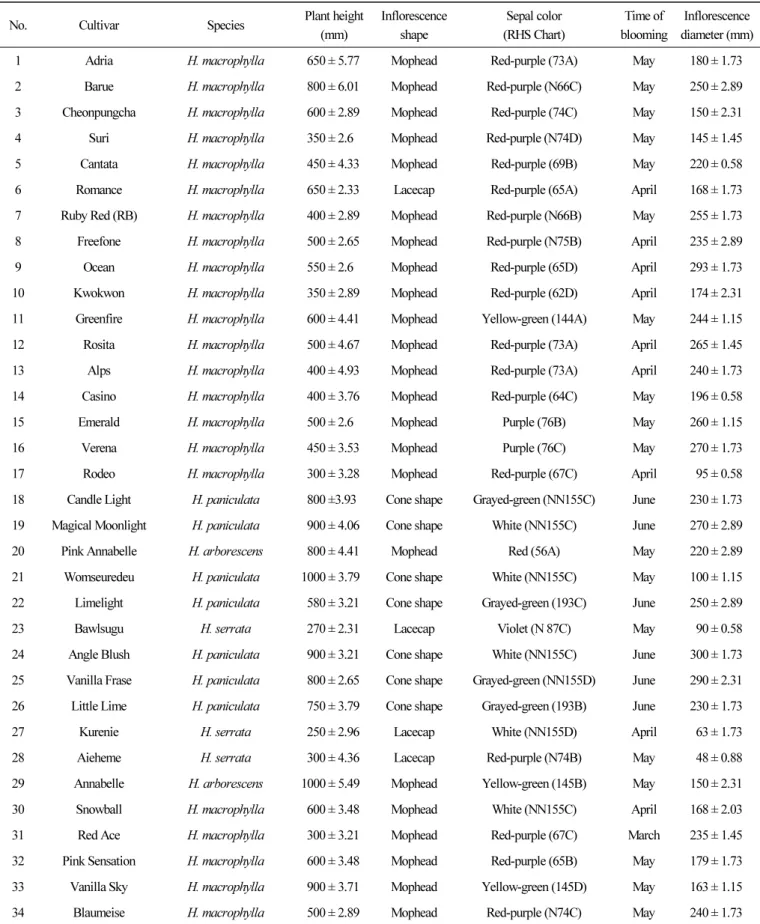
Morphological characteristics, including plant height, inflorescence shape and diameter, and sepal color, were measured from three mature plants per cultivar grown in a greenhouse at Chonnam National University during the full blooming season of April to June, 2016 (Table 1) . Flower color was determined visually with the aid of the Royal Horticultural Society (RHS) Color Chart.

Plant Materials and DNA Extraction

The samples for DNA extraction was collected from 34 accessions comprising 4 species of hydrangea. Genomic DNA

was extracted from 0.1g of fresh leaf tissue using a Qiagen Plant Mini Kit (Qiagen, USA).

(3)

Table 1. List of Hydrangea cultivars evaluated by the random amplification of polymorphic DNA (RAPD) analysis and their morphological characteristics

No. Cultivar Species Plant height

(mm)

Inflorescence shape

Sepal color (RHS Chart)

Time of blooming

Inflorescence diameter (mm)

1 Adria H. macrophylla 650 ± 5.77 Mophead Red-purple (73A) May 180 ± 1.73

2 Barue H. macrophylla 800 ± 6.01 Mophead Red-purple (N66C) May 250 ± 2.89

3 Cheonpungcha H. macrophylla 600 ± 2.89 Mophead Red-purple (74C) May 150 ± 2.31

4 Suri H. macrophylla 350 ± 2.6 Mophead Red-purple (N74D) May 145 ± 1.45

5 Cantata H. macrophylla 450 ± 4.33 Mophead Red-purple (69B) May 220 ± 0.58

6 Romance H. macrophylla 650 ± 2.33 Lacecap Red-purple (65A) April 168 ± 1.73

7 Ruby Red (RB) H. macrophylla 400 ± 2.89 Mophead Red-purple (N66B) May 255 ± 1.73

8 Freefone H. macrophylla 500 ± 2.65 Mophead Red-purple (N75B) April 235 ± 2.89

9 Ocean H. macrophylla 550 ± 2.6 Mophead Red-purple (65D) April 293 ± 1.73

10 Kwokwon H. macrophylla 350 ± 2.89 Mophead Red-purple (62D) April 174 ± 2.31

11 Greenfire H. macrophylla 600 ± 4.41 Mophead Yellow-green (144A) May 244 ± 1.15

12 Rosita H. macrophylla 500 ± 4.67 Mophead Red-purple (73A) April 265 ± 1.45

13 Alps H. macrophylla 400 ± 4.93 Mophead Red-purple (73A) April 240 ± 1.73

14 Casino H. macrophylla 400 ± 3.76 Mophead Red-purple (64C) May 196 ± 0.58

15 Emerald H. macrophylla 500 ± 2.6 Mophead Purple (76B) May 260 ± 1.15

16 Verena H. macrophylla 450 ± 3.53 Mophead Purple (76C) May 270 ± 1.73

17 Rodeo H. macrophylla 300 ± 3.28 Mophead Red-purple (67C) April 95 ± 0.58

18 Candle Light H. paniculata 800 ±3.93 Cone shape Grayed-green (NN155C) June 230 ± 1.73 19 Magical Moonlight H. paniculata 900 ± 4.06 Cone shape White (NN155C) June 270 ± 2.89

20 Pink Annabelle H. arborescens 800 ± 4.41 Mophead Red (56A) May 220 ± 2.89

21 Womseuredeu H. paniculata 1000 ± 3.79 Cone shape White (NN155C) May 100 ± 1.15

22 Limelight H. paniculata 580 ± 3.21 Cone shape Grayed-green (193C) June 250 ± 2.89

23 Bawlsugu H. serrata 270 ± 2.31 Lacecap Violet (N 87C) May 90 ± 0.58

24 Angle Blush H. paniculata 900 ± 3.21 Cone shape White (NN155C) June 300 ± 1.73

25 Vanilla Frase H. paniculata 800 ± 2.65 Cone shape Grayed-green (NN155D) June 290 ± 2.31 26 Little Lime H. paniculata 750 ± 3.79 Cone shape Grayed-green (193B) June 230 ± 1.73

27 Kurenie H. serrata 250 ± 2.96 Lacecap White (NN155D) April 63 ± 1.73

28 Aieheme H. serrata 300 ± 4.36 Lacecap Red-purple (N74B) May 48 ± 0.88

29 Annabelle H. arborescens 1000 ± 5.49 Mophead Yellow-green (145B) May 150 ± 2.31

30 Snowball H. macrophylla 600 ± 3.48 Mophead White (NN155C) April 168 ± 2.03

31 Red Ace H. macrophylla 300 ± 3.21 Mophead Red-purple (67C) March 235 ± 1.45

32 Pink Sensation H. macrophylla 600 ± 3.48 Mophead Red-purple (65B) May 179 ± 1.73

33 Vanilla Sky H. macrophylla 900 ± 3.71 Mophead Yellow-green (145D) May 163 ± 1.15

(4)

RAPD Analysis

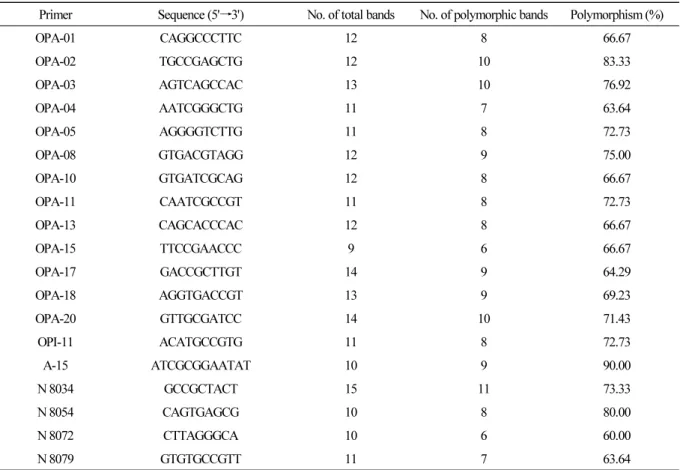
A total of 38 random 10-mer primers were used for polymerase chain reaction (PCR) (Table 2) . PCR was carried out in a total reaction volume of 20 mL containing 10 × Taq buffer, 10 ng of genomic DNA, 10-mM deoxynucleotide triphosphates (dNTPs), 10-pM primers, and 1unit of Taq DNA polymerase (SolGent, South Korea).The DNA fragments were amplified with an initial denaturation of 3 min at 95°C, followed by 40 cycles of 30 s at 95°C, 1 min at 39°C and 2 min at 72°C, and a final extension of 5 min at 72°C. Electrophoresis was conducted for 1hr at 100 V using a 2% (w/v) agarose gel in 1xTris-acetate-EDTA (TAE) buffer with 5 µL of the PCR product from each sample.

Table 2. List of random amplification of polymorphic DNA (RAPD) primers used to detect polymorphisms

Primer Sequence (5' →3') No. of total bands No. of polymorphic bands Polymorphism (%)

OPA-01 CAGGCCCTTC 12 8 66.67

OPA-02 TGCCGAGCTG 12 10 83.33

OPA-03 AGTCAGCCAC 13 10 76.92

OPA-04 AATCGGGCTG 11 7 63.64

OPA-05 AGGGGTCTTG 11 8 72.73

OPA-08 GTGACGTAGG 12 9 75.00

OPA-10 GTGATCGCAG 12 8 66.67

OPA-11 CAATCGCCGT 11 8 72.73

OPA-13 CAGCACCCAC 12 8 66.67

OPA-15 TTCCGAACCC 9 6 66.67

OPA-17 GACCGCTTGT 14 9 64.29

OPA-18 AGGTGACCGT 13 9 69.23

OPA-20 GTTGCGATCC 14 10 71.43

OPI-11 ACATGCCGTG 11 8 72.73

A-15 ATCGCGGAATAT 10 9 90.00

N 8034 GCCGCTACT 15 11 73.33

N 8054 CAGTGAGCG 10 8 80.00

N 8072 CTTAGGGCA 10 6 60.00

N 8079 GTGTGCCGTT 11 7 63.64

Data Analysis

The DNA profiles were scored visually from gel photographs. The presence of a band was designated as (1) and, an

absence was designated as (0). The data that were obtained from the RAPD scoring were subjected to the calculation of

a similarity matrix using the Jaccard coefficients (Jaccard, 1901). The genetic distances between individual samples were

calculated using allele sharing for the creation of a distance matrix (Jukes and Cantor, 1969). The dendogram was

subjected to a clustering analysis using the unweighted pair group method with arithmetic mean (UPGMA) method to

estimate the genetic distance and relatedness among the species in version 3.15 of the PAST (Paleonto Logical Statistics)

program (Ryan et al., 1995). The statistical-support estimates for the resultant clusters were obtained from the UPGMA

bootstrap analysis with 1,000 replications. The principal coordinate analysis (PCoA) was performed using PAST.

(5)

Results and Discussion

Morphological Characteristics

Morphological characterization of the collected germplasm was performed during the full blooming period to record plant height and flowers characteristics, which differed according to the species. Different growth habits, different flowering times, and various flower shapes and colors were found among the cultivars even under controlled environmental conditions (Table 1) . The tallest plants belonged to H. paniculatas species, the shortest plants belonged to H. serrata, and most of the cultivars possessed mophead-type inflorescences. The cultivars that produced the lacecap-type inflorescences have large, imperfect flowers and deep-green foliage. Most of the accessions bloomed in May, and the late flowering time of H. Paniculata occurred in June. The biggest inflorescences were found in H. macrophylla, whereas the smallest inflorescences were observed in H. serrata accessions. The sepal color of H. macrophylla was in the red-purple group, but the other species occupied the white group, the violet group, or the grayed-green group (Table 1) .

Principal Coordinate Analysis (PCoA)

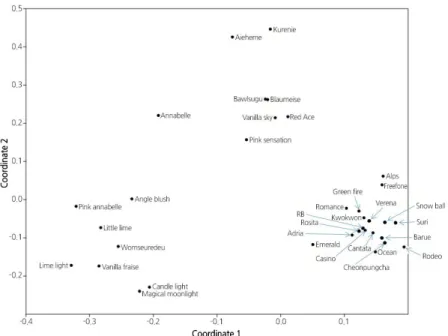
PCoA was used to demonstrate the inter-cultivar genetic relationships and is based on the genetic frequencies of all of the samples. The PCoA results accounted for 31.43% of the total variation. The following four main demarcated clusters resulted: two groups containing H. macrophylla, one group of H. paniculata, and a final group containing H. serrata (Fig.

1) . Hydrangea macrophylla was separated into two clusters, and one cluster was close to H. serrata. ‘Bawlsugu’ of H.

serrata was clustered together with one of the H. macrophylla groups (Fig. 1) . This cultivar may be a hybrid between H.

macrophylla and H. serrata. The two cultivars of H. arborescens, ‘Annabella’ and ‘Pink Annabelle’ were separated and

‘Pink Annabelle’ clustered close to H. paniculata, suggesting that one of the parents of ‘Pink Annabelle’ descended from H. paniculata.

Fig. 1. Two-dimensional (2D) principal coordinate analysis (PCoA) grouping of 34 hydrangea genotypes based on the

(6)

RAPD Analysis

The number of polymorphic bands that were produced varied from 6 to 11, depending upon the markers. Primer A 15 produced the most polymorphisms (90%), whereas primer N 8072 produced the least polymorphisms (60%). All primers produced above 60 % of polymorphisms (Table 2) .

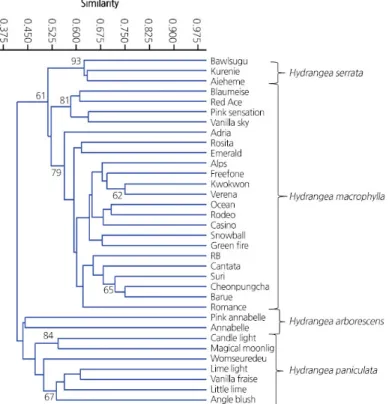
A total of 38 RAPD markers were used in all of the individuals, with only 19 of the markers being polymorphic; a total of 125 RAPD polymorphic bands were generated with the 19 markers. The size of the amplified DNA fragments ranged from 300 to 2,000 base pairs. The UPGMA dendogram indicates that all of the individuals were separated into four major groups, which agrees with their morphological classifications (Table 1 and Fig. 2) . Based on the RAPD analysis, H.

macrophylla samples were segregated into two groups with a similarity value of 0.6 (Fig. 2) . The samples including

‘Blaumeise’, ‘Pink Sensation, ‘Red Ace’, and ‘Vanilla Sky’ occupied one small group with a high bootstrap support (81%). The large group of H. macrophylla was divided into six subgroups with high similarity value among these cultivars. In this species, the flowers of ‘Romance’ were incomplete and different within the same subgroup. The flowers of ‘Rosita’ and ‘Emerald’ were genetically similar to each other, but they were distantly related to the other subgroups.

‘Adria’ was classified into a separate group of this species and it is distantly related to the other cultivars.

Generally, the H. macrophylla cultivars showed high levels of genetic similarity compared with the other cultivars (Fig.

2) . This might be because most of the H. macrophylla cultivars were developed using a small number of native and imported cultivars. H. paniculata occurred in one major group where in ‘Candlelight’ and ‘Magical Moonlight’ were in subgroups with a high bootstrap value (84%). ‘Womseuredeu’ separated into another subgroup. The growth habit and

Fig. 2. Unweighted pair group method with arithmetic mean (UPGMA) dendrogram based on the similarities calculated

from the random amplification of polymorphic DNA (RAPD) data of 34 cultivars of the Hydrangea. The bootstrap values

(%) out of 1,000 replications are shown when they are more than 60.

(7)

flower type of this cultivar is different from those of the other cultivars in the same species. H. serrata separated into a group consisting of the ‘Bawlsugu’, ‘Kurenie’, and ‘Aieheme’ with a high bootstrap support (93%). A group consisting of ‘Annabelle’ and ‘Pink Annabelle’ indicated that H. arborescens with a similarity value of 0.45. The dendrogram suggested that H. macrophylla and H. serrata are genetically similar with a similarity value of 0.5. The chance of a successful hybridization within these species may be greater than more distantly related species. For example, ‘Aieheme’

and ‘Kurenie’ were classified as H. serrata and which can be crossed successfully with the H. macrophylla group for interspecific hybridization. In H. macrophylla, intraspecific hybridization among the same subgroup could be easier than crossing among the different subgroups because of the high genetic similarity within a subgroup. In addition, there are many subgroups, particularly in H. macrophylla that may have different plant types and inflorescence forms.

Genetic Distance

The genetic-distance measurements for each cultivar ranged from 0.28 to 0.71 (Table 3) , and it seems that the genetic diversity among the tested cultivars is greatly different. The genetic distances between the same species of ‘Snowball’, and ‘Cheonpungcha’ with ‘Emerald’ were 0.28. But the genetic distance between different species such as ‘Pink Annabelle’ and ‘Cheonpungcha’ was 0.71, suggesting a significant genetic divergence between them. The results of the DNA analysis indicated that genetic distance within the same species especially H. macrophylla, where the genetic distance is very low compared with those of the other species, due to long term breeding with a limited gene pool.

Hybridization between the accessions with lower genetic distances will be more successful than hybridization between the accessions with greater genetic distances. In this study, ‘Emerald’ should be crossed with ‘Snow ball’ as opposed to

‘Cheonpungcha’ for intraspecific hybridization. And also interspecific hybridization of ‘Snow ball’ with ‘Angle blush’

may be more achievable than ‘Lime light’ because of the low genetic distance between them.

There are two interpretations of the taxonomic positions of H. macrophylla and H. serrate. One interpretation is that these taxa should be treated as different species (Haworth-Booth, 1984; Ohba, 2001; Wilson, 1923; Zonneveld, 2004).

The other is that H. serrata var. serrata should be categorized as a subspecies of macrophylla (Makino, 1929;

McClintock, 1957; Reed and Rinehart, 2007; Rinehart et al., 2006). The results of this study revealed the division of H.

macrophylla and H. serrata into two different groups; however, the genetic distance between these two species is shorter Table 3. Genetic distances between the Hydrangea species (higher values indicate a greater genetic distance between the

individuals, and lower values suggest a greater genetic similarity)

  Snowball Emerald Cheonpun

gcha Limelight Angle Blush

Pink

Annabelle Annabelle Kurenie Bawlsugu

H. macrophylla ‘Snowball’ 0              

‘Emerald’ 0.28 0              

‘Cheonpungcha’ 0.30 0.28 0            

H. paniculata ‘Limelight’ 0.67 0.52 0.62 0          

‘Angle Blush’ 0.55 0.50 0.53 0.42 0        

H. arborescens ‘Pink Annabelle’ 0.69 0.57 0.71 0.48 0.49 0      

‘Annabelle’ 0.61 0.53 0.61 0.48 0.51 0.49 0    

H. serrata ‘Kurenie’ 0.44 0.43 0.45 0.63 0.56 0.69 0.47 0  

(8)

when compared with other species (Fig. 1 and Table 3) . In plant breeding, wide hybridization between the different species is a productive method where the offspring possesses the best features of both parents. The results presented in this study are valuable to hydrangea breeding programs and, the cultivars studied here could be selected for hybridization and more wide hybrids are expected to be released.

In conclusion, we performed an evaluation of the genetic relationships among the Hydrangea species using RAPD markers. However, more cultivars and further morphological studies, as well as an analysis with more genomic information, are needed to confirm the morphology and the genetic diversity of this species. This study provided useful information for the verification of intraspecific hybrids, interspecific hybrids, and germplasm conservation in terms of hydrangea breeding to develop new and improved forms of the Hydrangea cultivars.

Literature Cited

Dirr MA (2002) In search of a perfect Hydrangea. Nursery Mgt Production 18:16-17, 95-96 Dirr MA (2004) Hydrangeas for American Gardens. Portland, OR: Timber Press

Haworth-Booth M (1984) The hydrangeas, 5th ed. Constable, London, UK

Jaccard P (1901) Étude comparative de la distribution floraledansune portion des Alpes et des Jura. Bulletin de la Societe Vaudoise des Sciences Naturelles 37:547-579. doi:10.5169/seals-266450

Joung YH, Roh MS (2010) Identification of Hydrangeaceae accessions of wild origin from Jeju, Korea, using molecular markers. Plant Genet Resour: 8:235-241. doi:10.1017/S1479262110000286

Jukes TH, Cantor CR (1969) Evolution of protein molecules. In HN Munro, ed, Mammalian Protein Metabolism. Academic Press, New York, USA, pp 21-132. doi:10.1016/B978-1-4832-3211-9.50009-7

Kim DK, Seo SG, Kwon SB, Park YD (2016). Development of RAPD and SCAR Markers related to watermelon mosaic virus and zucchini yellow mosaic virus resistance in Cucurbita moschata. Hortic Environ Biotechnol 57:61-68. doi:10.1007/S13580-016-0090-0 KudoN, Matsui T, Okada T (2008) A novel interspecific hybrid plant between Hydrangea scandens ssp. Chinensis and H. macrophylla via

ovule culture. Plant Biotechnol 25:529-533. doi:10.5511/plant biotechnology.25.529 Makino T (1929) A contribution to the knowledge of the flora of Japan. J Jap Bot 6:11-12 McClintock E (1957) A monograph of the genus Hydrangea. Proc Calif Acad Sci 29:147-256

Morell MK, Peakall R, Appels R, Preston LR, Lloyd HL (1995) DNA profiling techniques for plant variety identification. Aust J Exp Agric 35:807-819. doi:10.1071/EA9950807

Ohba H (2001) Hydrangea Gronov. ex L. In K Iwatsuki, DE Boufford, H Ohba, eds, Flora of Japan, 2b. Kodansha, Tokyo, Japan pp 84-94 Reed SM, Rinehart TA (2007) SSR marker analysis of genetic relationships within Hydrangea macrophylla. J Am Soc Hortic Sci

132:341-351

RHS Colour Chart (2015) Royal Horticultural Society (RHS) Color Chart, 6th ed. RHS, London, UK

Rinehart TA, Scheffler BE, Reed SM (2006) Genetic diversity estimates for the genus Hydrangea and development of a molecular key based on SSR. J Am Soc Hortic Sci 131:787-797

Ryan PD, Harper DAT, Whalley JS (1995) PALSTAT, Statistics for Palaeontologists. Chapman& Hall, London, UK van Gelderen CJ, van Gelderen DM (2004) Encyclopedia of Hydrangeas. Timber Press, Portland, Oregon, USA

Williams JGK, Kubelik AR, Livak KJ, Rafalski JA, Tingey SV (1990) DNA polymorphisms amplified by arbitrary primers are useful as genetic markers. Nucleic Acids Res18:6531-6535. doi:10.1093/nar/18.22.6531

Wilson EH (1923) The hortensias: Hydrangea macrophylla DC. and Hydrangea serrata DC. J Arnold Arbor 4:233-246

Wolfe AD, Xiang Q-Y, Hephart SR (1998) Assessing hybridization in natural populations of Penstemon (Scrophulariaceae) using hyper variable inter simple sequence repeat (ISSR) bands. Mol Ecol 7:1107-1125. doi:10.1046/j.1365-294x.1998.00425.x

Zonneveld BJM (2004) Genome size in Hydrangea, In CJ van Gelderen,DM van Gelderen, eds, Encyclopedia of Hydrangeas. Timber Press,

Portland, Oregon, USA. pp 245-251

수치

Table 1. List of Hydrangea cultivars evaluated by the random amplification of polymorphic DNA (RAPD) analysis and their morphological  characteristics
Table 2. List of random amplification of polymorphic DNA (RAPD) primers used to detect polymorphisms
Fig. 1. Two-dimensional (2D) principal coordinate analysis (PCoA) grouping of 34 hydrangea genotypes based on the
Fig. 2. Unweighted pair group method with arithmetic mean (UPGMA) dendrogram based on the similarities calculated  from the random amplification of polymorphic DNA (RAPD) data of 34 cultivars of the Hydrangea

참조

관련 문서

Based on the parametric study on the characteristic of solid NaBH 4 hydrolysis using the NaHCO 3 agent, a prototype of the hydrogen generation system was developed

In this study, using concept mapping of a variety of learning techniques in the area of science, especially biology, has a positive effect on learning

In this paper, defect of nuclear energy pipe and composite material were, measured using dual-beam shearography and infrared thermography, quantitatively

Based on the results of this study, some implications for classes using online reading programs for elementary school students' English reading were

근래에 연구되는 격자형 모델은 각 경계범위에서 각기 다른 변수의 영향을 정확 하게 산출하지 못하고 있으나 , 수용모델링을 병행하는 경우 높은 정확도를 추정할

The <Taebaeksanmaek> reflects dialects of eastern area of Jeollanamdo sincerely, and this study examines phonological and morphological aspects of the

In the present study, 10 study stations were established, and seasonal changes for various ecological aspects of the community such as species composition, number of

“Evaluation of R&D investments in wind power in Korea using real option.” Renewable and Sustainable Energy Reviews. "Real Option Valuation of a Wind Power Project Based