Comparison of Single-Incision Robotic Cholecystectomy, Single- Incision Laparoscopic Cholecystectomy and 3-Port Laparoscopic Cholecystectomy - Postoperative Pain, Cosmetic Outcome and Surgeon’s Workload
Hyeong Seok Kim, M.D., Youngmin Han, M.S., Jae Seung Kang, M.D., Doo-ho Lee, M.D., Jae Ri Kim, M.D., M.S., Wooil Kwon, M.D., Ph.D., Sun-Whe Kim, M.D., Ph.D., Jin-Young Jang, M.D., Ph.D.
Department of Surgery and Cancer Research Institute, Seoul National University College of Medicine, Seoul, Korea
Purpose:
Robotic-associated minimally invasive surgery is a novel method for overcoming some limitations of laparoscopic surgery. This study aimed to evaluate the outcomes (postoperative pain, cosmesis, surgeon’s workload) of single-incision robotic cholecystectomy (SIRC) vs. single-incision laparoscopic cholecystectomy (SILC) vs. conventional three-port laparoscopic cholecystectomy (3PLC).Methods:
134 patients who underwent laparoscopic or robotic cholecystectomy at a single center during 2016~2017 were enrolled. Prospectively collected data included demographics, operative outcomes, questionnaire regarding pain and cosmesis, and NASA-Task Load Index (NASA-TLX) scores for surgeon’s workload.Results:
55 patients underwent SIRC, 29 SILC, and 50 3PLC during the same period. 3PLC patient group was older than the others (SIRC vs. SILC vs. 3PLC: 48.1 vs. 42.2 vs. 54.1 years, p<0.001).Operative time was shortest with 3PLC (44.1 vs. 38.8 vs. 25.4 min, p<0.001). Estimated blood loss, postoperative complications, and postoperative stay were similar among the groups. Pain control was lowest in the 3PLC group (98.2% vs. 100% vs. 84.0%, p=0.004), however, at 2 weeks postoperatively there were no differences among the groups (p=0.374). Cosmesis scores were also worst after 3PLC (17.5 vs. 18.4 vs. 13.3, p<0.001). NASA-TLX score was highest in the SILC group (21.9 vs. 44.3 vs. 25.2, p<0.001).
Conclusion:
Although SIRC and SILC take longer than 3PLC, they produce superior cosmetic outcomes. Compared with SILC, SIRC is more ergonomic, lowering the surgeon’s workload. Despite of higher cost, SIRC could be an alternative for treating gallbladder disease in selected patients.Keywords:
Robotic Cholecystectomy, Laparoscopic Cholecystectomy, Pain, Body image, WorkloadReceived July 2, 2018 Revised August 16, 2018 Accepted August 24, 2018
Corresponding author Jin-Young Jang
Department of Surgery, Seoul National University College of Medicine, 101, Daehak-ro, Jongro- gu, Seoul 03080, Korea
Tel: +82-2-2072-2194 Fax: +82-2-766-3975 E-mail: [email protected] ORCID:
http://orcid.org/0000-0003-3312-0503
This is an Open Access article distributed under the terms of the Creative Commons Attribution Non-Commercial License (http://
creativecommons.org/licenses/by-nc/4.0/) which permits unrestricted non-commercial use, distribution, and reproduction in any medium, provided the original work is properly cited.
Copyright © 2018 The Journal of Minimally Invasive Surgery. All rights reserved.
Journal of Minimally Invasive Surgery
J Minim Invasive Surg 2018;21(4):168-176
INTRODUCTION
Laparoscopic cholecystectomy has been a standard pro-
cedure for treating benign gallbladder diseases, such as cho-
lelithiasis, gallbladder polyps, and cholecystitis.
1Recently,
however, interest in cosmesis and minimizing incision-related
complications has been increasing, with the result that single- port incision laparoscopic surgery (SILS) has been performed more widely to accomplish cholecystectomy, appendectomy, proctocolectomy, and gastrectomy.
2-4Advantages of single- port laparoscopic surgery via an umbilical incision include less postoperative pain, decreased postoperative vomiting, minimal incision (resulting in only a small scar), and better cosmetic outcomes.
5-7Although the safety and feasibility of single-port laparoscopic cholecystectomy (SILC) have been reported in previous studies, there has been lack of reports dealing with the surgeons ’ workload. Generally, SILS is associated with more physical and mental stress than is engendered with con- ventional laparoscopic surgery because of the limited range of motion and impedance due to the camera’s presence, result- ing from the small size of the single-port incision.
8Therefore, single-port robotic cholecystectomy (SIRC) has emerged as a new method that maintains the advantages of SILC and over- comes its disadvantages. SIRC allows operators to experience less fatigue and provides good ergonomics. Moreover, the sur- gery can be performed with the wrist movements undertaken while sitting at the console, providing more precise manipula- tion.
This study was designed to evaluate the advantages of SIRC in terms of patients’ postoperative pain and cosmetic outcomes and the workload for surgeon. In addition, we aimed to com- pare SIRC with SILC and three-port laparoscopic cholecys- tectomy (3PLC).
MATERIALS AND METHODS
Patients
Among the patients who underwent SIRC, SILC, or 3PLC at Seoul National University Hospital Seoul between January 2016 and July 2017, we enrolled 134 patients in this study after they gave informed consent. Following explanations of the characteristics and costs of each method, the patients them- selves chose the operation to be performed. All patients were at least 18 years of age. Patients with the following were ex- cluded: acute cholecystitis; combined common bile duct stone;
suspicious malignancy; bleeding tendency; obesity; pregnancy.
Clinicopathologic data were collected prospectively accord- ing to the protocol of the institution and were recorded in an electronic medical database. Parameters recorded included the patient ’s age, sex, body mass index, indication for operation, preoperative symptoms, preoperative laboratory results (white blood cell count and albumin, total bilirubin, and C-reactive protein levels), operative time, estimated blood loss (EBL), and complications. This study was approved by the institutional review board (IRB no. 1602-077-740).
Surgical procedure
Robotic cholecystectomy
Detailed surgical procedures of robotic cholecystectomy were described in a previous study.
9A 2-cm umbilical skin incision was made for the single port and extended to 2.5~3.0 cm at the level of the fascia. The peritoneal cavity was ap- proached using an open technique, and a Glove port
®was in- serted (NELIS Medical, Bucheon, South Korea). After robotic platform docking, surgeons started the operation at a console.
With the assistant grasping the gallbladder fundus by forceps, Calot’s triangle was visualized safely and clearly. The cystic duct and artery were then dissected and ligated with clips.
The gallbladder was dissected from the liver bed and removed through the umbilical port. The fascia and skin were closed with absorbable interrupted sutures.
Single-incision laparoscopic cholecystectomy
For SILC, a 2-cm skin incision was made through the umbilicus, deepening to the peritoneal cavity, and extend- ing to 2.5~3.0 cm at the level of the fascia. Lapsingle
®(Sejong Medical, Paju, South Korea), a port for SILC, was inserted. It consisted of four ports that would accommodate a camera and an operator (Fig. 1). Instruments included graspers and a mo- nopolar hook (straight-type), the same as used for 3PLC. The rest of the cholecystectomy procedure was similar to that for SIRC. The specimen, held in the left-hand grasper, is removed together with the glove port.
Fig. 1. Lapsingle® (Sejong Medical, Paju, South Korea) used for single-
port laparoscopic cholecystectomy.
Three-port laparoscopic cholecystectomy
For 3PLC, a subumbilical incision was made through the umbilicus, and a 12-mm trocar was inserted to accommodate a camera. Two more 5-mm trocars were inserted into the epigastric area and right upper quadrant, respectively, for the operator. The gallbladder infundibulum was retracted with the left-handed forceps, and Calot ’s triangle was dissected. The rest of the cholecystectomy procedure was similar to that of SIRC. The specimen, encased in a Lapbag
®(Sejong Medical, South Korea), was removed via the umbilicus.
Postoperative pain evaluation and management
Postoperative pain was evaluated using a numeric rating scale (NRS) and a visual analogue scale (VAS).
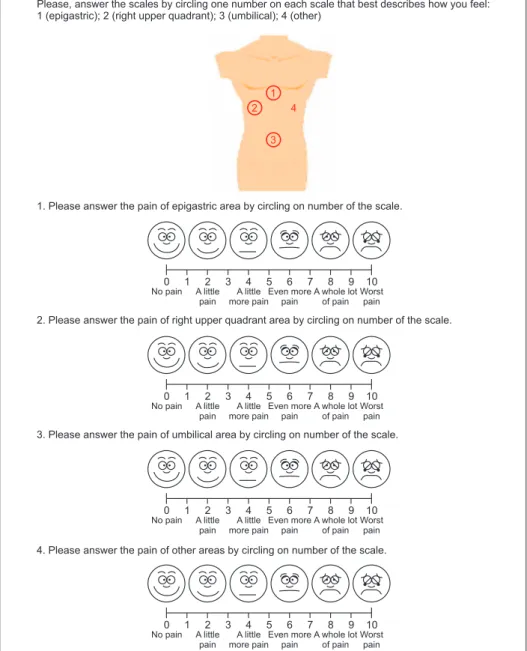
10The NRS was checked on the day of the operation and on postoperative day (POD) 1. Intravenous opioids and nonsteroidal anti-in- flammatory drugs were given to patients on demand and were calculated as the number of injections. When the patients vis- ited the outpatient clinic 2 weeks postoperatively, the patients underwent a VAS check for epigastric, right upper quadrant, umbilical, and other-site pain by completing a questionnaire (Fig. 2).
Do you have pain?
Please, answer the scales by circling one number on each scale that best describes how you feel:
1 (epigastric); 2 (right upper quadrant); 3 (umbilical); 4 (other)
1. Please answer the pain of epigastric area by circling on number of the scale.
2. Please answer the pain of right upper quadrant area by circling on number of the scale.
3. Please answer the pain of umbilical area by circling on number of the scale.
4. Please answer the pain of other areas by circling on number of the scale.
0 1 2 3 4 5 6 7 8 9 10
No pain A little pain
A little more pain
Even more pain
A whole lot of pain
Worst pain
0 1 2 3 4 5 6 7 8 9 10
No pain A little pain
A little more pain
Even more pain
A whole lot of pain
Worst pain
0 1 2 3 4 5 6 7 8 9 10
No pain A little pain
A little more pain
Even more pain
A whole lot of pain
Worst pain
0 1 2 3 4 5 6 7 8 9 10
No pain A little pain
A little more pain
Even more pain
A whole lot of pain
Worst pain 1
2 4
3
Fig. 2. Postoperative pain questionnaire
consisting of four areas (English version).
Body image and cosmetic evaluation
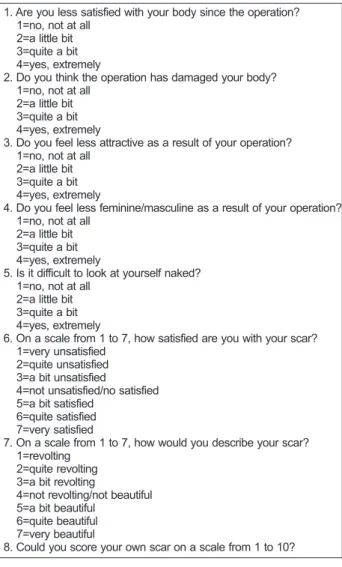
Postoperative body image and cosmetic conditions were evaluated using a questionnaire survey at the outpatient visit 2 weeks after surgery (Fig. 3). The questionnaire consisted of questions investigating the attitude of patients toward their body appearance (body image scale items 1~5) and their de- gree of satisfaction with the appearance of the scar (cosmesis scale items 6~8).
11The body image scale consisted of five questions that could result in a total score ranging from 5 to 20. A lower score indicated greater satisfaction on the body image scale. The cosmetic scale consisted of three questions, which resulted in a total score ranging from 3 to 24. A higher score indicated greater satisfaction on the cosmetic scale.
Surgeon’s workload evaluation
The surgeon ’s workload was evaluated using a questionnaire survey after each operation. Workload was measured using the National Aeronautics and Space Administration Task Load Index (NASA-TLX) score. The survey consists of an overall index of mental workload and the relative contributions of six subscales: mental, physical, and temporal task demands plus effort, frustration, and perceived performance.
12Many previ- ous studies have used this scale to estimate the effect of pro- cedures on the surgeon ’s workload.
13-15Statistical analysis
All statistical analyses were performed with SPSS ver- sion 21.0 (SPSS Inc., Chicago, IL, USA). Nominal data were compared with the χ
2test. Continuous data were expressed as means±SDs and compared with one-way analysis of variance test. Values of p<0.05 were considered to indicate statistical significance.
RESULTS
Demographic and operative outcomes and medical cost
Among the 134 patients (45 men, 89 women; mean age 49.1
±11.7 years) who underwent cholecystectomy, 55 patients un- derwent SIRC, 29 underwent SILC, and 50 underwent 3PLC.
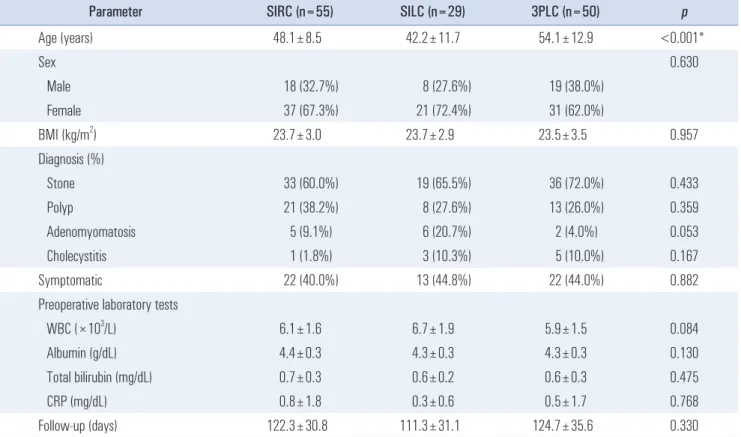
The patients’ demographics are summarized in Table 1. Pa- tients in the 3PLC group were significantly older than those in the other two groups (SIRC vs. SILC vs. 3PLC: 48.1±8.5 vs.
42.2±11.7 vs. 54.1±12.9 years, p<0.001). There were no other significant differences in the demographics.
Operative outcomes are summarized in Table 2. Operative time was significantly shorter in the 3PLC group than in the other groups (SIRC vs. SILC vs. 3PLC: 44.1±13.9 vs. 38.8±
13.3 vs. 25.4±10.6 min, p<0.001). There were no significant differences among the groups for the EBL (8.8±23.2 vs. 12.1±
20.6 vs. 16.5±34.8 ml, p=0.366) or postoperative complications (0% vs. 0% vs. 2.0%, p=0.429). Postoperative hospital stay also did not differ among the groups (1.1±0.2 vs. 1.1±0.3 vs. 1.2±
0.4 days, p=0.200). Mean total medical cost during the hospital stay were significantly higher in the SIRC group compared with that in laparoscopic groups (5,542.5±435.0 vs 3,031.3±
308.0 vs 3,038.1±471.6 US dollars, p=0.006).
Postoperative pain outcomes
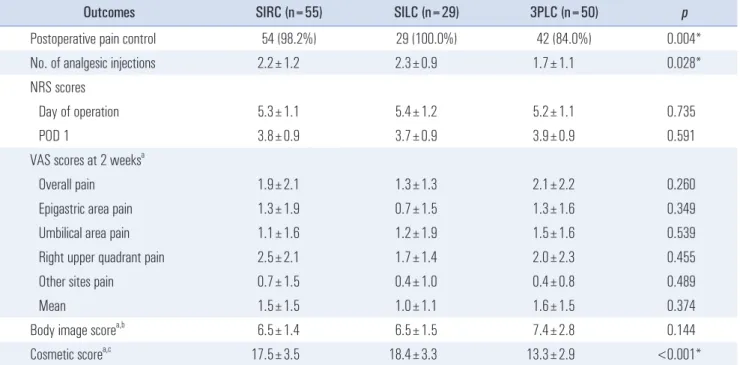
Postoperative pain outcomes are summarized in Table 3.
1. Are you less satisfied with your body since the operation?
1=no, not at all 2=a little bit 3=quite a bit 4=yes, extremely
2. Do you think the operation has damaged your body?
1=revolting 2=quite revolting 3=a bit revolting
4=not revolting/not beautiful 5=a bit beautiful
6=quite beautiful 7=very beautiful
8. Could you score your own scar on a scale from 1 to 10?
1=no, not at all 2=a little bit 3=quite a bit 4=yes, extremely
3. Do you feel less attractive as a result of your operation?
1=no, not at all 2=a little bit 3=quite a bit 4=yes, extremely
4. Do you feel less feminine/masculine as a result of your operation?
1=no, not at all 2=a little bit 3=quite a bit 4=yes, extremely
5. Is it difficult to look at yourself naked?
1=no, not at all 2=a little bit 3=quite a bit 4=yes, extremely
6. On a scale from 1 to 7, how satisfied are you with your scar?
1=very unsatisfied 2=quite unsatisfied 3=a bit unsatisfied
4=not unsatisfied/no satisfied 5=a bit satisfied
6=quite satisfied 7=very satisfied
7. On a scale from 1 to 7, how would you describe your scar?
Fig. 3. Body image questionnaire consisting of a body image score (items
1~5) and a cosmetic score (items 6~8).
The proportion of patients who required intravenous anal- gesics was significantly lower in the 3PLC group than in the other two groups (SIRC vs. SILC vs. 3PLC: 98.2% vs. 100.0%
vs. 84.0%, p=0.004). There was no significant difference in the NRS scores on the day of the operation and POD 1 among the groups (5.3±1.1 vs. 5.4±1.2 vs. 5.2±1.1, p=0.735; 3.8±0.9 vs. 3.7
±0.9 vs. 3.9±0.9 p=0.591, respectively).
In all, 26 patients in the SIRC group, 20 in the SILC group, and 50 in the 3PLC group answered the questionnaire at the
outpatient clinic 2 weeks after surgery (Table 3). None of the VAS scores differed among the groups (SIRC vs. SILC vs.
3PLC: 1.5±1.5 vs. 1.6±1.5 vs. 1.0±1.1, p=0.374).
Body image and cosmetic outcomes
The outcomes regarding body image and cosmesis are sum- marized in Table 3. The body image score did not differ sig- nificantly among groups, but the total score in the 3PLC group Table 1. Patients' demographics for the SIRC, SILC, and 3PLC groups
Parameter SIRC (n=55) SILC (n=29) 3PLC (n=50) p
Age (years) 48.1±8.5 42.2±11.7 54.1±12.9 <0.001*
Sex 0.630
Male 18 (32.7%) 8 (27.6%) 19 (38.0%)
Female 37 (67.3%) 21 (72.4%) 31 (62.0%)
BMI (kg/m
2) 23.7±3.0 23.7±2.9 23.5±3.5 0.957
Diagnosis (%)
Stone 33 (60.0%) 19 (65.5%) 36 (72.0%) 0.433
Polyp 21 (38.2%) 8 (27.6%) 13 (26.0%) 0.359
Adenomyomatosis 5 (9.1%) 6 (20.7%) 2 (4.0%) 0.053
Cholecystitis 1 (1.8%) 3 (10.3%) 5 (10.0%) 0.167
Symptomatic 22 (40.0%) 13 (44.8%) 22 (44.0%) 0.882
Preoperative laboratory tests
WBC (×10
3/L) 6.1±1.6 6.7±1.9 5.9±1.5 0.084
Albumin (g/dL) 4.4±0.3 4.3±0.3 4.3±0.3 0.130
Total bilirubin (mg/dL) 0.7±0.3 0.6±0.2 0.6±0.3 0.475
CRP (mg/dL) 0.8±1.8 0.3±0.6 0.5±1.7 0.768
Follow-up (days) 122.3±30.8 111.3±31.1 124.7±35.6 0.330
Results are given as the mean±SD or the number (%). SIRC = single-incision robotic cholecystectomy; SILC = single-incision laparoscopic cholecystecto- my; 3PLC = three-port laparoscopic cholecystectomy; BMI = body mass index; WBC = white blood cell count; CRP = C-reactive protein. *Statistically significant.
Table 2. Operative and postoperative outcomes for the SIRC, SILC, and 3PLC groups
Outcomes SIRC (n=55) SILC (n=29) 3PLC (n=50) p
Operation time (min) 44.1±13.9 38.8±13.3 25.4±10.6 <0.001*
EBL (ml) 8.8±23.2 12.1±20.6 16.5±34.8 0.366
Complications (no.) 0 0 1 (2.0%) 0.429
Postoperative stay (days) 1.1±0.2 1.1±0.3 1.2±0.4 0.200
Medical cost ($) 5,542.5±435.0 3,031.3±308.0 3,038.1±471.6 0.006*
Results are given as the mean±SD or the number (%). SIRC = single-incision robotic cholecystectomy; SILC = single-incision laparoscopic cholecystec-
tomy; 3PLC = 3-port laparoscopic cholecystectomy; SD = standard deviation; EBL = estimated blood loss; $ = US dollars. *Statistically significant.
tended to indicate a poorer outcome (SIRC vs. SILC vs. 3PLC:
6.5±1.4 vs. 6.5±1.5 vs. 7.4±2.8, p=0.144). The cosmetic score was better in the SIRC and SILC groups than that for the 3PLC group (17.5±3.5 vs. 18.4±3.3 vs. 13.3±2.9, p<0.001).
Workload for surgeon
Workloads for the surgeons are summarized in Table 4. The SILC group showed significantly poorer NASA-TLX scores
than the SIRC and 3PLC groups (SIRC vs. SILC vs. 3PLC:
21.9±11.1 vs. 44.3±22.5 vs. 25.2±11.6, p<0.001). When the six subscales were analyzed separately, all subscales except item 4 were significantly higher in the SILC group.
DISCUSSION
Laparoscopic cholecystectomy has become the gold stan- dard operation for treating benign gallbladder disease. Re- Table 3. Postoperative pain, body image, and cosmetic outcomes for the SIRC, SILC, and 3PLC groups
Outcomes SIRC (n=55) SILC (n=29) 3PLC (n=50) p
Postoperative pain control 54 (98.2%) 29 (100.0%) 42 (84.0%) 0.004*
No. of analgesic injections 2.2±1.2 2.3±0.9 1.7±1.1 0.028*
NRS scores
Day of operation 5.3±1.1 5.4±1.2 5.2±1.1 0.735
POD 1 3.8±0.9 3.7±0.9 3.9±0.9 0.591
VAS scores at 2 weeks
aOverall pain 1.9±2.1 1.3±1.3 2.1±2.2 0.260
Epigastric area pain 1.3±1.9 0.7±1.5 1.3±1.6 0.349
Umbilical area pain 1.1±1.6 1.2±1.9 1.5±1.6 0.539
Right upper quadrant pain 2.5±2.1 1.7±1.4 2.0±2.3 0.455
Other sites pain 0.7±1.5 0.4±1.0 0.4±0.8 0.489
Mean 1.5±1.5 1.0±1.1 1.6±1.5 0.374
Body image score
a,b6.5±1.4 6.5±1.5 7.4±2.8 0.144
Cosmetic score
a,c17.5±3.5 18.4±3.3 13.3±2.9 <0.001*
Results are given as the mean±SD or the number (%). SIRC = single-incision robotic cholecystectomy; SILC = single-incision laparoscopic cholecystecto- my; 3PLC = three-port laparoscopic cholecystectomy; NRS = numeric rating scale; POD = postoperative day; VAS = visual analogue scale.
aAltogether, 26 patients in the SIRC group, 20 in the SILC group, and 50 in the 3PLC group answered the questionnaire.
bLower score indicates greater satisfaction in the body image scale.
cHigher score indicates greater satisfaction in the cosmetic scale. *Statistically significant.
Table 4. NASA-TLX scores for the SIRC, SILC, and 3PLC groups
NASA-TLX subscales SIRC (n=55) SILC (n=29) 3PLC (n=50) p
Mental demand 3.9±2.0 7.7±4.5 4.2±2.0 <0.001*
Physical demand 3.4±1.7 7.2±4.1 4.0±1.8 <0.001*
Temporal demand 3.9±2.1 9.2±5.6 4.4±2.2 <0.001*
Performance 3.3±2.0 4.3±2.7 3.7±1.8 0.110
Effort 3.8±2.0 8.3±4.7 4.7±2.2 <0.001*
Frustration 3.6±1.9 7.8±5.4 4.2±2.3 0.001*
Total 21.9±11.1 44.5±23.5 25.2±11.6 <0.001*
Results are given as the mean±SD. NASA-TLX = NASA Task Load Index; SIRC = single-incision robotic cholecystectomy; SILC = single-incision laparo-
scopic cholecystectomy; 3PLC = three-port laparoscopic cholecystectomy. *Statistically significant.
cently, however, with the advances in equipment and surgical techniques, the use of single-incision surgery (including the SILC and SIRC) is increasing.
This study evaluated the operative outcomes
—postoperative pain, body image, and cosmesis (patient outcomes) and work- load for the surgeon
—among SIRC, SILC, and 3PLC groups.
We found that SIRC showed comparable operative outcomes, similar postoperative pain, better body image, and cosmetic outcome when compared with the 3PLC group, and a superior surgeon’s workload outcome compared with the SILC group.
The reason for the longer operative time for SIRC group than for 3PLC was thought to be due to the time required for robot-docking, although most operations in the SIRC group were completed within an hour. Moreover, there was no dif- ference in other operative outcomes (e.g., EBL, immediately postoperative complications, long-term postoperative compli- cations as evidenced on sonographic follow-up examinations at 3 months). Similar to the present results, previous studies demonstrated the safety and feasibility of SIRC compared with SILC or 3PLC.
16-18Although it was difficult to obtain a critical view of safety (CVS) in some SILC cases because of limitation of cross movement of instruments, the CVS was obtained in all the cases and then the surgery was proceeded.
Total medical cost was significantly higher in the SIRC group than in other two groups. Previous studies also reported that robotic cholecystectomy required more medical cost than laparoscopic cholecystectomy, and there may be differences in the total medical cost among other countries.
17,18As mentioned before, the costs of the routine preoperative examinations and hospital fees are the same between robotic and laparoscopic groups.
9Efforts will be needed to reduce the surgery-related costs in SIRC through the development of various robotic sys- tems and their competitions.
In the present study, the proportion of patients who needed a medication to control postoperative pain and the number of analgesic injections were significantly lower in the 3PLC group than in the other two groups. The NRS scores on the day of the operation and POD 1, however, did not differ among the three groups, nor did the VAS scores at 2 weeks after the surgery. Other previous studies reported debatable outcomes regarding postoperative pain. Some studies reported that SIRC or SILC was associated with less postoperative pain than 3PLC or four-port laparoscopic cholecystectomy (4PLC).
18-20Contrary to these results, however, other studies reported that 3PLC and 4PLC each produced better postoperative pain outcomes than SIRC or SILC because of the larger umbilical fascial incision and movements within that space and the greater pressure.
21,22The exact mechanism has not yet been established, and the pain is subjective to the individual, making it difficult to com- pare among patients. Further studies are needed to compare
the postoperative pain among the three groups.
One of the major strengths of SILS is its cosmetic ad- vantage. Also, previous studies have shown better outcomes with SILC than with conventional laparoscopic cholecystec- tomy.
23-25In the present study, SIRC and SILC tended to pro- duce better body image scores than 3PLC and a significantly higher cosmetic score than 3PLC. The completion rate for the questionnaire was low in some groups, however, so further studies with a higher questionnaire completion rate are needed to strengthen these results. Moreover, comparison of long- term cosmetic outcomes such as 3 months or 1 year after the operation is also necessary, regarding the healing process of the wound. In any case, along with the increasing interest in cosmesis, the demand for single-incision surgery is increasing, with the expectation that it will gradually replace the conven- tional surgery.
To our knowledge, this is the first study to compare the surgeon’s workload among SIRC, SILC, and 3PLC in a clinical setting. SILC and SIRC showed similar operative and cosmetic outcomes, but the complex movements within the confined area using the single umbilical port cause surgeon fatigue. In the present study, the surgeon’s workload associated with SILC was significantly higher than that associated with SIRC or 3PLC. Although laparoscopic cholecystectomy is a relatively simple operation in the field of abdominal operations, a high workload could provoke a lower capacity for dealing with unexpected events, resulting in performance errors.
26Previ- ous studies demonstrated the surgeon ’s workload according to the NASA-TLX score. Abdelrahman et al., in addition to the NASA-TLX score, showed increased heart rate and salivary cortisol levels in the surgeons, indicating stress.
27,28SIRC over- comes these disadvantages of SILC because it allows more ergonomic positioning, and it has swapping control of crossed instruments, as described previously.
9To strengthen these re- sults, future studies using the objective assessment such as the change of physiologic parameters as well as the subject assess- ment will be required.
This study has some limitations. First, the sample size was
small, and the completion rate for the questionnaire on body
image and cosmesis was low. Therefore, a study with more
cases and a higher questionnaire completion rate is required
to strengthen our results. Second, the patients with acute
cholecystitis were excluded. For the additional comparison of
the safety of the procedures, further research including these
patients will be necessary. Third, trocar position, or the size
of trocar insertion sites would be the confounding factors in
terms of cosmetic or pain outcomes. Some studies revealed
that 3PLC with mini-instruments had better cosmetic and less
painful outcomes than the conventional 3PLC.
29-32However,
this bias would be minimized in the present study because all
the patients in the 3PLC group underwent conventional 3PLC with same-sized trocars. Finally, all the operations were per- formed by two highly qualified surgeons. Hence, further re- search is required to determine whether these results could be generalized to less-qualified operators.
In conclusion, SIRC is more expensive, but more convenient method for treating benign gallbladder diseases than either SILC or 3PLC. It also showed superior cosmetic outcomes compared with those achieved by 3PLC and a diminished sur- geon’s workload compared with that obtained with SILC. Our results thus appear to indicate that the use of SIRC will likely increase in the near future.
REFERENCES
1) Begos DG, Modlin IM. Laparoscopic cholecystectomy: from gim- mick to gold standard. J Clin Gastroenterol 1994;19:325-330.
2) Frutos MD, Abrisqueta J, Lujan J, Abellan I, Parrilla P. Ran- domized prospective study to compare laparoscopic appendec- tomy versus umbilical single-incision appendectomy. Ann Surg 2013;257:413-418.
3) Hirano Y, Hattori M, Douden K, Ishiyama Y, Hashizume Y.
Single-incision laparoscopic surgery for colorectal cancer. World J Gastrointest Surg 2016;8:95-100.
4) Omori T, Oyama T, Akamatsu H, Tori M, Ueshima S, Nishida T.
Transumbilical single-incision laparoscopic distal gastrectomy for early gastric cancer. Surg Endosc 2011;25:2400-2404.
5) Lurje G, Raptis DA, Steinemann DC, et al. Cosmesis and Body Image in Patients Undergoing Single-port Versus Conven- tional Laparoscopic Cholecystectomy: A Multicenter Double- blinded Randomized Controlled Trial (SPOCC-trial). Ann Surg 2015;262:728-734; discussion 734-725.
6) Jørgensen LN, Rosenberg J, Al-Tayar H, Assaadzadeh S, Hel- gstrand F, Bisgaard T. Randomized clinical trial of single- versus multi-incision laparoscopic cholecystectomy. Br J Surg 2014;101:347-355.
7) Qiu J, Yuan H, Chen S, He Z, Han P, Wu H. Single-port versus conventional multiport laparoscopic cholecystectomy: a meta- analysis of randomized controlled trials and nonrandomized stud- ies. J Laparoendosc Adv Surg Tech A 2013;23:815-831.
8) Scerbo MW, Britt RC, Stefanidis D. Differences in mental work- load between traditional and single-incision laparoscopic proce- dures measured with a secondary task. Am J Surg 2017;213:244- 248.
9) Lee H, Lee DH, Kim H, Han Y, Kim SW, Jang JY. Single-inci- sion robotic cholecystectomy: A special emphasis on utilization of transparent glove ports to overcome limitations of single-site port.
Int J Med Robot 2017;13.
10) Hartrick CT, Kovan JP, Shapiro S. The numeric rating scale for clinical pain measurement: a ratio measure? Pain Pract
2003;3:310-316.
11) Dunker MS, Stiggelbout AM, van Hogezand RA, Ringers J, Grif- fioen G, Bemelman WA. Cosmesis and body image after laparo- scopic-assisted and open ileocolic resection for Crohn’s disease.
Surg Endosc 1998;12:1334-1340.
12) Hart SG, Staveland LE. Development of NASA-TLX (Task Load Index): Results of empirical and theoretical research. In: Hancock PA, Meshkati N, editors. Human mental workload. Amsterdam:
Elsevier; 1988.
13) Yurko YY, Scerbo MW, Prabhu AS, Acker CE, Stefanidis D.
Higher mental workload is associated with poorer laparoscopic performance as measured by the NASA-TLX tool. Simul Healthc 2010;5:267-271.
14) Stefanidis D, Wang F, Korndorffer JR, Jr., Dunne JB, Scott DJ.
Robotic assistance improves intracorporeal suturing performance and safety in the operating room while decreasing operator work- load. Surg Endosc 2010;24:377-382.
15) Dulan G, Rege RV, Hogg DC, et al. Proficiency-based training for robotic surgery: construct validity, workload, and expert levels for nine inanimate exercises. Surg Endosc 2012;26:1516-1521.
16) Gonzalez A, Murcia CH, Romero R, et al. A multicenter study of initial experience with single-incision robotic cholecystectomies (SIRC) demonstrating a high success rate in 465 cases. Surg En- dosc 2016;30:2951-2960.
17) Strosberg DS, Nguyen MC, Muscarella P, 2nd, Narula VK. A retrospective comparison of robotic cholecystectomy versus lapa- roscopic cholecystectomy: operative outcomes and cost analysis.
Surg Endosc 2017;31:1436-1441.
18) Gustafson M, Lescouflair T, Kimball R, Daoud I. A comparison of robotic single-incision and traditional single-incision laparoscopic cholecystectomy. Surg Endosc 2016;30:2276-2280.
19) Sodergren MH, Aslanyan A, McGregor CG, et al. Pain, well- being, body image and cosmesis: a comparison of single-port and four-port laparoscopic cholecystectomy. Minim Invasive Ther Allied Technol 2014;23:223-229.
20) Asakuma M, Hayashi M, Komeda K, et al. Impact of single-port cholecystectomy on postoperative pain. Br J Surg 2011;98:991- 995.
21) Phillips MS, Marks JM, Roberts K, et al. Intermediate results of a prospective randomized controlled trial of traditional four-port laparoscopic cholecystectomy versus single-incision laparoscopic cholecystectomy. Surg Endosc 2012;26:1296-1303.
22) Balachandran B, Hufford TA, Mustafa T, Kochar K, Sulo S, Khor- sand J. A Comparative Study of Outcomes Between Single-Site Robotic and Multi-port Laparoscopic Cholecystectomy: An Ex- perience from a Tertiary Care Center. World J Surg 2017;41:1246- 1253.
23) Kudsi OY, Castellanos A, Kaza S, et al. Cosmesis, patient satisfac- tion, and quality of life after da Vinci Single-Site cholecystectomy and multiport laparoscopic cholecystectomy: short-term results
from a prospective, multicenter, randomized, controlled trial. Surg Endosc 2017;31:3242-3250.
24) Marks JM, Phillips MS, Tacchino R, et al. Single-incision lapa- roscopic cholecystectomy is associated with improved cosmesis scoring at the cost of significantly higher hernia rates: 1-year results of a prospective randomized, multicenter, single-blinded trial of traditional multiport laparoscopic cholecystectomy vs single-incision laparoscopic cholecystectomy. J Am Coll Surg 2013;216:1037-1047; discussion 1047-1038.
25) Lai EC, Yang GP, Tang CN, Yih PC, Chan OC, Li MK. Prospec- tive randomized comparative study of single incision laparoscopic cholecystectomy versus conventional four-port laparoscopic cho- lecystectomy. Am J Surg 2011;202:254-258.
26) Ruiz-Rabelo JF, Navarro-Rodriguez E, Di-Stasi LL, et al. Vali- dation of the NASA-TLX Score in Ongoing Assessment of Men- tal Workload During a Laparoscopic Learning Curve in Bariatric Surgery. Obes Surg 2015;25:2451-2456.
27) Montero PN, Acker CE, Heniford BT, Stefanidis D. Single inci- sion laparoscopic surgery (SILS) is associated with poorer perfor- mance and increased surgeon workload compared with standard laparoscopy. Am Surg 2011;77:73-77.
28) Abdelrahman AM, Bingener J, Yu D, et al. Impact of single- incision laparoscopic cholecystectomy (SILC) versus conventional laparoscopic cholecystectomy (CLC) procedures on surgeon stress and workload: a randomized controlled trial. Surg Endosc 2016;30:1205-1211.
29) Sarli L, Iusco D, Gobbi S, Porrini C, Ferro M, Roncoroni L. Ran- domized clinical trial of laparoscopic cholecystectomy performed with mini-instruments. Br J Surg 2003;90:1345-1348.
30) Novitsky YW, Kercher KW, Czerniach DR, et al. Advantages of mini-laparoscopic vs conventional laparoscopic cholecys- tectomy: results of a prospective randomized trial. Arch Surg 2005;140:1178-1183.
31) Bisgaard T, Klarskov B, Trap R, Kehlet H, Rosenberg J. Microlap- aroscopic vs conventional laparoscopic cholecystectomy: a pro- spective randomized double-blind trial. Surg Endosc 2002;16:458- 464.
32) Jeong JY, M.d, Choi EH, et al. Early Experience of Single Port Laparoscopic Cholecystectomy & Comparisons of Single Port and Three Port Laparoscopic Cholecystectomy. J Minim Invasive Surg 2010;13:17-21.