http://dx.doi.org/10.12925/jkocs.2017.34.4.974
국내 차량 인증시험용 표준연료(경유) 도입 필요성 검토 연구
황인하*
․
강형규․
성상래․
송호영․
하종한․
나병기✝한국석유관리원
*, 충북대학교 화학공학과
✝(2017년 11월 16일 접수: 2017년 11월 28일 수정: 2017년 12월 10일 채택)
A feasibility study on Introducing Reference Fuel(Diesel) for Testing Vehicles in South Korea
Inha Hwang
*․Hyungkyu Kang․Sangrae Seong․Hoyoung Song․Jonghan Ha․Byungki Na
✝*
Korea Petroleum Quality & Distribution Authority, Department of Chemical Engineering, Chungbuk National University
✝(Received November 162017; Revised November 28, 2017; Accepted December 10, 2017)
요 약 : 2016년 기준 국내 자동차 등록대수는 약 2,200만대를 육박하고 있으나[1], 국내 자동차용 표준 연료에 대한 기준은 부재한 상황이다. 자동차용 표준연료(Reference Fuel)는 차량의 연비와 배출가스를 인증하거나 새로운 자동차를 개발할 때 차량의 성능 등을 평가하기 위해 사용하는 연료를 의미한다. 현재 국내에는 차량의 배출가스, 성능, 연비시험 등을 위해 유통연료를 사용하고 있으며, 유통연료는 석유 및 석유대체연료사업법과 대기환경보전법 상의 품질기준을 만족하지만 각 제조사의 원료와 공정 등에 따라 연료의 물성 차이가 있어 차량 시험 시 편차가 발생할 수 있다. 본 연구에서는 국내 유통되는 자동차용 경유 품질모니터링 분석결과를 바탕으로 자동차용 경유의 시험용 표준연료 기준(안)을 설정하고, CRDI 방식의 차량에 적용하여 표준연료 기준(안)을 평가하였다.
주제어 : 표준연료, 경유, 경유 품질모니터링, 연비, 배출가스
Abstract : Although the number of registered cars in South Korea is about 22million but, there is no national standard for automobile reference fuel in South Korea. Reference fuel is the fuel used for certificating vehicle performance, emissions and fuel economy. Now, domestic market fuels are used as reference fuel. However, the quality of domestic market fuel is constantly changing by seasonal and fuel manufacturers. It may effect vehicle performance, emissions and fuel efficiency test result. On this study, market diesel fuel quality was monitored and reference fuel standard(draft) was set by reflecting market fuel monitoring result. Reference fuel standard(draft) was applied to CRDI engine.
Keywords : Diesel, Reference fuel, Diesel quality monitoring, Fuel Economy, Emissions
✝
Corresponding author
(E-mail: [email protected])
1. 서 론
자동차 표준연료는 자동차의 연비, 증발가스, 배출 가스 등 인증시험에 사용하는 연료로서 미국, 유럽, 일본, 중국 등 자동차 선진국에서는 자동차 표준연 료의 품질 기준을 법으로 정하고 있으며 자국의 유 통 품질기준보다 강화된 형태로 운영하고 있다. 국 내의 경우에는 인증시험에 사용하는 표준연료의 기 준이 없으며, 석유 및 석유대체연료사업법과 대기환 경보전법 기준을 충족하는 유통 연료를 사용하도록 규정하고 있다[2-4]. 그러나 국내 유통연료의 품질 기준은 계절적 특성(동절기, 하절기)에 따라 일부 항 목이 다르게 규정되어 있고[3-4], 연료 제조사별 원 유, 생산 공정, 배합기제 수급 등의 차이에 따라 연료 의 품질 차이가 발생한다. 이러한 유통연료를 사용 하여 인증시험을 진행할 경우, 자동차의 연비와 배 출가스 시험 결과 등의 편차가 발생할 가능성이 상 존한다. 본 연구에서는 국내 유통되는 자동차용경유 의 품질모니터링 결과를 바탕으로 경유 인증시험용 표준연료 기준(안)을 설정하였으며, 이 기준(안)을 검증하기 위해 경유 연료 3종을 CRDI (common rail direct injection engine, 커먼레일엔진) 방식의 국내 제작차량에 적용하여 연비, 배출가스, PM(Particle Matter, 입자상물질), PN(Particle Number, 입자개수)등에 대해 비교 평가하였다.
2. 국내 자동차 인증시험용 경유 표준연료 기준(안) 설정
2.1. 해외 자동차용 표준연료 기준
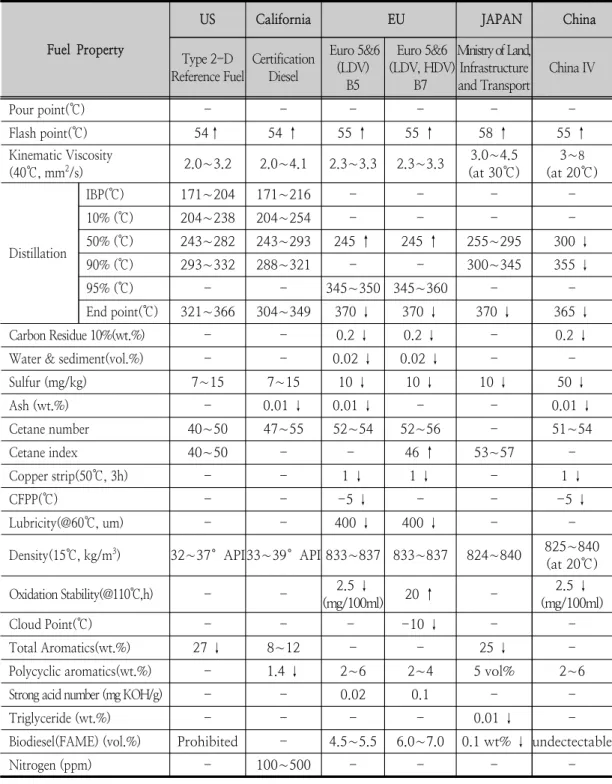
각 국가에서는 자국의 경유 유통연료를 반영한 표 준연료를 선정하여 사용하고 있다. 유럽은 자동차용 경유에 바이오디젤이 일정 혼합된 B5(바이오디젤 5%). B7(바이오디젤 7%)를 사용하고 있어, EURO 5, EURO 6의 표준연료로서 B5, B7를 표준연료로 사용하고 있다[5]. 미국, 캘리포니아, 일본, 중국의 경우 바이오디젤이 포함되지 않는 경유를 표준연료 로 사용하고 있으며, 각국의 대표적인 경유 표준연 료 기준을 Table 1에 나타내었다[6]∼[8].
2.2. 국내 유통 품질 모니터링
표준연료가 유통연료의 품질을 반영하지 못한다 면, 인증시험에서 측정되는 공인 연비와 배출가스는 소비자들이 실 도로를 운행할 때의 연비와 차이가 발생할 수 있다. 따라서 표준연료의 기준은 현재 유
통되는 연료의 품질분석 결과를 반영하여 기준이 설 정되어야 한다.
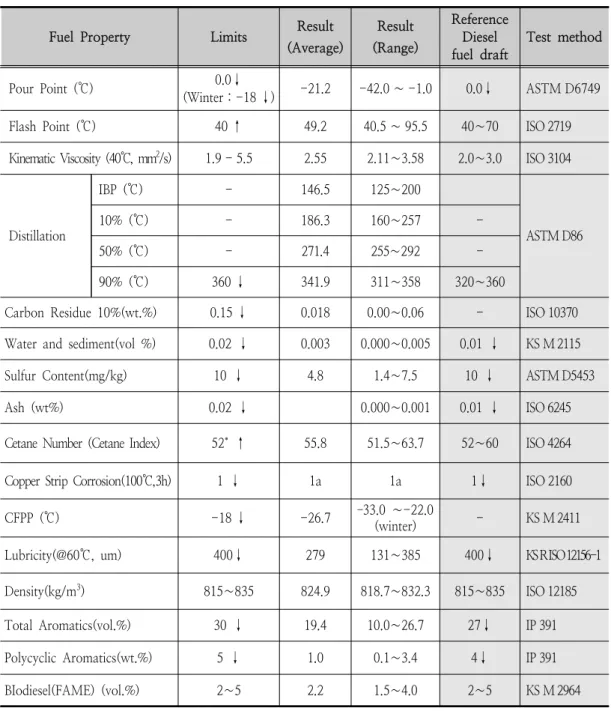
이에 국내 유통되는 자동차용 경유의 품질을 분석 하기 위해 국내 6개 정유사(A∼)에서 생산되는 경유 를 2014년 1월부터 2015년 12월까지 월 1회씩 시료 를 확보하여 『석유 및 석유대체연료 사업법』에서 규정하는 품질기준 항목 등을 분석하였다[3]. 각 사 별 연간 품질 변화추이는 Fig. 1에 나타냈으며. 항목 별 품질기준 및 분석결과를 Table 2에 나타내었다
2.3. 표준연료 기준(안) 설정
표준연료의 연비와 배출가스 등이 유통연료와의 편차를 최소화하기 위해 국내 유통연료의 품질모니 터링 분석결과를 바탕으로 표준연료 기준(안)을 설 정하였다. 인화점, 동점도, 90% 유출온도, 세탄가 (지수), 밀도, 바이오디젤은 유통 범위 내에서 상한 과 하한 기준을 설정했으며, 유동점, 물과 침전물, 회 분, 황분, 동판부식. 윤활성, 방향족함량 기준은 유통 품질 범위 및 석대법 품질기준을 고려하여 각각 상 한 또는 하한 기준만을 설정하였다. 이 기준(안)은 유통품질 범위 및 현행 품질기준, 자동차제작사 및 정유사의 자문위원과의 협의를 통해 품질기준별 차 량 영향성과 정유사 제조 가능성 등을 종합적으로 검토하여 설정하였다. 표준연료 기준(안)과 유통연 료의 품질 범위를 비교하기 위해 항목별 품질기준 (Limit), 평균값(Average), 유통범위(Range), 표준 연료 기준(안)(Reference fuel draft), 시험방법(Test method)을 Table 2에 나타내었다.
3. 표준연료 및 시험조건
3.1. 표준연료 제조 및 분석
표준연료의 기준을 평가하기 위해 총 3종의 경유
시험연료를 선정하였다. 우선 국내 경유자동차의 연
비 및 배출가스 시험방법 등이 유럽 기준을 따르고
있어 유럽 경유 표준연료로서 EURO 5 B5(바이오디
젤 5% 함유 경유) (A)를 선정하였다. 나머지 2종은
국내 표준연료 기준(안)을 평가하기 위해 품질기준
을 만족하는 표준연료(B, C)를 선정하였으며, 정유
사의 정상경유에 경유 원료를 혼합하여 2종을 제조
하였다. 이 3종의 표준연료에 대하여 석유 및 석유대
체연료 사업법상의 경유의 품질기준 16개 항목을 분
석하였으며, 그 분석결과 및 시험방법[9∼19]은
Table 3에 나타내었다.
Table 1. Foreign automobile reference fuel(Diesel) specifications
Fuel Property
US California EU JAPAN China
Type 2-D
Reference Fuel Certification Diesel
Euro 5&6 (LDV)
B5
Euro 5&6 (LDV, HDV)
B7
Ministry of Land, Infrastructure
and Transport China IV
Pour point(℃) - - - - - -
Flash point(℃) 54↑ 54 ↑ 55 ↑ 55 ↑ 58 ↑ 55 ↑
Kinematic Viscosity
(40℃, mm
2/s) 2.0 ∼ 3.2 2.0 ∼ 4.1 2.3 ∼ 3.3 2.3 ∼ 3.3 3.0 ∼ 4.5
(at 30℃) 3 ∼8 (at 20℃)
Distillation
IBP(℃) 171 ∼ 204 171 ∼ 216 - - - -
10% (℃) 204 ∼ 238 204 ∼ 254 - - - -
50% (℃) 243 ∼ 282 243 ∼ 293 245 ↑ 245 ↑ 255 ∼ 295 300 ↓ 90% (℃) 293 ∼ 332 288 ∼ 321 - - 300 ∼ 345 355 ↓
95% (℃) - - 345 ∼ 350 345 ∼ 360 - -
End point(℃) 321 ∼ 366 304 ∼ 349 370 ↓ 370 ↓ 370 ↓ 365 ↓ Carbon Residue 10%(wt.%) - - 0.2 ↓ 0.2 ↓ - 0.2 ↓ Water & sediment(vol.%) - - 0.02 ↓ 0.02 ↓ - - Sulfur (mg/kg) 7 ∼ 15 7 ∼ 15 10 ↓ 10 ↓ 10 ↓ 50 ↓
Ash (wt.%) - 0.01 ↓ 0.01 ↓ - - 0.01 ↓
Cetane number 40 ∼ 50 47 ∼ 55 52 ∼ 54 52 ∼ 56 - 51 ∼ 54
Cetane index 40 ∼ 50 - - 46 ↑ 53 ∼ 57 -
Copper strip(50℃, 3h) - - 1 ↓ 1 ↓ - 1 ↓
CFPP(℃) - - -5 ↓ - - -5 ↓
Lubricity(@60℃, um) - - 400 ↓ 400 ↓ - -
Density(15℃, kg/m
3) 32 ∼ 37°API33 ∼ 39°API 833 ∼ 837 833 ∼ 837 824 ∼ 840 825 ∼ 840 (at 20℃) Oxidation Stability(@110℃,h) - - 2.5 ↓
(mg/100ml) 20 ↑ - 2.5 ↓ (mg/100ml)
Cloud Point(℃) - - - -10 ↓ - -
Total Aromatics(wt.%) 27 ↓ 8 ∼ 12 - - 25 ↓ -
Polycyclic aromatics(wt.%) - 1.4 ↓ 2 ∼ 6 2 ∼ 4 5 vol% 2 ∼ 6
Strong acid number (mg KOH/g) - - 0.02 0.1 - -
Triglyceride (wt.%) - - - - 0.01 ↓ -
Biodiesel(FAME) (vol.%) Prohibited - 4.5 ∼ 5.5 6.0 ∼ 7.0 0.1 wt% ↓ undectectable
Nitrogen (ppm) - 100 ∼ 500 - - - -
Four Point (℃) Flash point (℃)
Kinematic Viscosity(mm
2/s) Sulfur Content (mg/kg)
Cetane Index Distillation_90% evaporated (℃)
Lubricity (@60℃, um) Density (kg/m
3)
Total Aromatic Content (wt.%) Polycyclic aromatics(wt.%)
Biodiesel(FAME) (vol.%) CFPP(℃)
Fig. 1. Results of quality monitoring on Automotive Diesel in 2014∼2015.
Table 2. Motor Diesel specification, Test Result, Test method and Reference fuel draft
Fuel Property Limits Result (Average)
Result (Range)
Reference Diesel
fuel draft Test method Pour Point (℃) 0.0↓
(Winter : -18 ↓) -21.2 -42.0 ∼ -1.0 0.0↓ ASTM D6749 Flash Point (℃) 40 ↑ 49.2 40.5 ∼ 95.5 40∼70 ISO 2719 Kinematic Viscosity (40℃, mm
2/s) 1.9 - 5.5 2.55 2.11∼3.58 2.0∼3.0 ISO 3104
Distillation
IBP (℃) - 146.5 125∼200
ASTM D86
10% (℃) - 186.3 160∼257 -
50% (℃) - 271.4 255∼292 -
90% (℃) 360 ↓ 341.9 311∼358 320∼360
Carbon Residue 10%(wt.%) 0.15 ↓ 0.018 0.00∼0.06 - ISO 10370 Water and sediment(vol %) 0.02 ↓ 0.003 0.000∼0.005 0.01 ↓ KS M 2115 Sulfur Content(mg/kg) 10 ↓ 4.8 1.4∼7.5 10 ↓ ASTM D5453
Ash (wt%) 0.02 ↓ 0.000∼0.001 0.01 ↓ ISO 6245
Cetane Number (Cetane Index) 52
⁕↑ 55.8 51.5∼63.7 52∼60 ISO 4264 Copper Strip Corrosion(100℃,3h) 1 ↓ 1a 1a 1↓ ISO 2160
CFPP (℃) -18 ↓ -26.7 – 33.0 ∼-22.0
(winter) - KS M 2411
Lubricity(@60℃, um) 400↓ 279 131∼385 400↓ KS R ISO 12156-1
Density(kg/m
3) 815∼835 824.9 818.7∼832.3 815∼835 ISO 12185
Total Aromatics(vol.%) 30 ↓ 19.4 10.0∼26.7 27↓ IP 391
Polycyclic Aromatics(wt.%) 5 ↓ 1.0 0.1∼3.4 4↓ IP 391
BIodiesel(FAME) (vol.%) 2∼5 2.2 1.5∼4.0 2∼5 KS M 2964
*Winter(11.15∼2.28) : 48↑
Table 3. Result of test fuel analysis
Fuel Property Reference Diesel fuel draft
Test Fuel Analysis Result
Test method (EURO 5 B5) A B C
Pour Point (℃) 0.0↓ -30 -40.0 -21.0 ASTM D6749
Flash Point (℃) 40∼70 72 44 48 ISO 2719
Kinematic Viscosity (40℃, mm
2/s) 2.0∼3.0 2.96 2.1 2.7 ISO 3104
Distillation
10% (℃) - 203 176 181
ASTM D86
50% (℃) - 272 254 286
90% (℃) 320∼360 336 327 347
Carbon Residue 10%(wt.%) - 0.11 0.02 0.03 ISO 10370 Water and sediment(vol %) 0.01 ↓ 0.005 ↓ 0.005 ↓ 0.005↓ KS M 2115
Sulfur Content(mg/kg) 10 ↓ 0.2 5 6 ASTM D5453
Ash (wt%) 0.01 ↓ 0.001 ↓ 0.001 ↓ 0.001 ↓ ISO 6245 Cetane Number (Cetane Index) 52∼60 53.2 54 56 ISO 4264 Copper Strip Corrosion(100℃,3h) 1↓ 1a 1a 1a ISO 2160
CFPP (℃) - -37 -26 -17 KS M 2411
Lubricity(@60℃, um) 400↓ 190 187 175 KS R ISO 12156-1
Density(kg/m
3) 815∼835 834 818 830 ISO 12185
Total Aromatics(vol.%) 27↓ 12 23 11 IP 391
Polycyclic Aromatics(wt.%) 4↓ 4 1.6 0.9 IP 391
Biodiesel(FAME) (vol.%) 2∼5 5 2 5 KS M 2964
Gross Heating Value(MJ/kg) - 45.837 45.849 45.681 ASTM D240
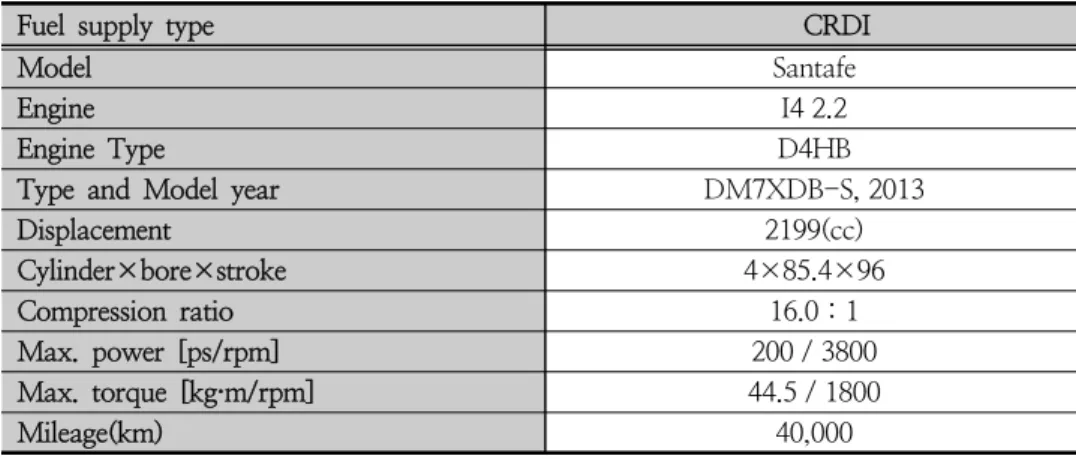
Table 4. Specifications of test vehicles
Fuel supply type CRDI
Model Santafe
Engine I4 2.2
Engine Type D4HB
Type and Model year DM7XDB-S, 2013
Displacement 2199(cc)
Cylinder×bore×stroke 4×85.4×96
Compression ratio 16.0 : 1
Max. power [ps/rpm] 200 / 3800
Max. torque [kg·m/rpm] 44.5 / 1800
Mileage(km) 40,000
Fig. 2. Schematic diagram of gasoline vehicle emission measurement system.
3.2. 시험 차량 및 시험모드
시험 차량은 CRDI(Common Rail Direct Injection) 방식의 차량 1대를 선정하였고, 상세 제원 은 Table 4에 나타내었다. 시험은 FTP-75(도심모 드)와 HWFET(Highway Fuel Economy Test, 고속 모드), 유럽의 NEDC(New European Driving Cycle) Mode를 적용하여 비교하였다. 차량 데이터 의 신뢰성 확보를 위해 각 유종별 최소 3회 이상의 시험을 실시하여 평균값을 적용하였다. 그리고 시험 결과의 최대 및 최소 범위는 error bar로 표시하였 다.
3.3 분석 장치
시험분석에 사용된 차대동력계 및 배출가스 측정 장치의 전체적인 개략도를 Fig. 2에 나타내었다[20].
3.3.1 차대동력계
차대동력계는 자동차가 실제 도로를 주행할 때 정 지, 가속, 정속, 감속 등을 반복하는 과정을 대표화한 실측 주행모드를 사용하여 주행할 수 있도록 자동차 에 부하를 걸어주는 장치이다. 차대동력계, 관성중 량(Inertia weight), 동력흡수계(Power absorption unit), 제어기(Controller)로 구성되어 있으며, 차대 동력계는 B.E.P.사의 M4500 model 장비를 사용하 였다.
3.3.2 배출가스 분석기
배출가스 분석기는 시험자동차가 차대동력계의 롤 러 위에서 주행할 때 배기관으로부터 배출되는 가스 를 정용량 시료채취장치(CVS, Constant volume
sampler)로 일정량의 공기를 희석한 후, 채취백에 채 취한 배출가스를 분석하는 장치이다. 배출가스 분석 기(HORIBA사 MEXA-7200H)는 자동차의 배출 가스 중 CO, THC, NOx, CO
2, CH
4를 분석할 수 있는 장치로서, CO와 CO
2는 비분산적외선분석법 (NDIR, Nondispersive Infrared), THC는 열식불꽃 이온화검출기법 (HFID, Heated Flame Ionization Detector), NOx는 화학발광법 (CLD, Chemical Luminescence Detector), CH
4는 GC-FID (Gas chroomatography-FID)를 적용하고 있다.
3.3.3 입자상물질(PM) 측정
PM(Particulate matter)은 국내 배출가스 인증시 험모드인 FTP-75 모드 수행 중에 51.7 ℃ 이하의 공 기로 희석되어 필터에 포집된 자동차 배출성분 중 응축수분을 제외한 모든 배출성분(Fines, Dust, Soot, Mist, Fog, Smog 등이 포함됨)을 필터에 포집 된 PM의 중량을 측정하여 산출한다.
3.3.4 입자개수(PN) 측정
2.5 ㎛ 이하의 입자직경을 갖는 PM의 개수인 PN 측정은 TSI사의 CPC 3790 model의 GPMS(Golden PM measurement system : CPC, Diluter, vacuum pump) 장비를 사용하였다.
4. 시험결과
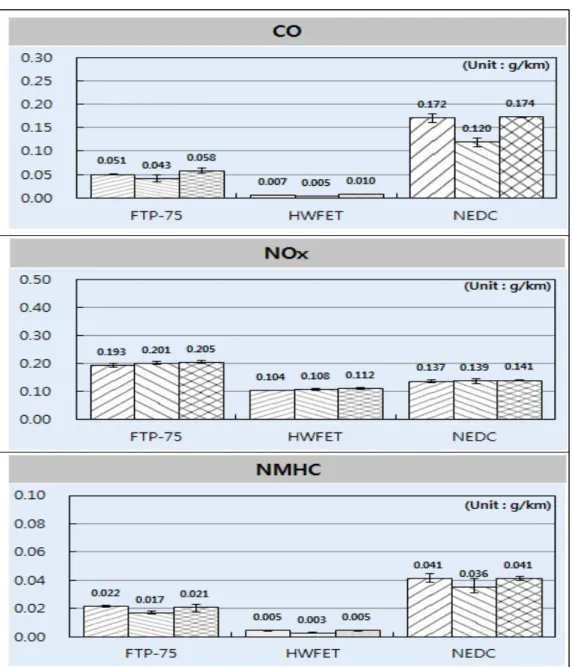
경유표준연료 3종을 동일 차량에서 FTP-75
Fig. 3. CO, NOx, NMHC of vehicle test of A, B, C Reference diesel at FTP-75, HWFET, NEDC Mode for using the Santafe(CRDi)
Mode(도심모드), HWFET(Highway Fuel Economy Test) Mode(고속모드), NEDC(New European Driving Cycle) Mode별로 적용하였으며.
CO, NOx, NMHC(Non-Methane Hydro- Carbon), CH
4, CO
2, PM, PN, Fuel Economy 시험 결과를 Fig. 3.∼Fig. 5에 나타냈다. 경유의 해외 표
준연료로 EURO 5 B5를 A( ), 국내 경유표 준연료 기준(안)의 연료를 B( )와 C
( )로 표시하였다.
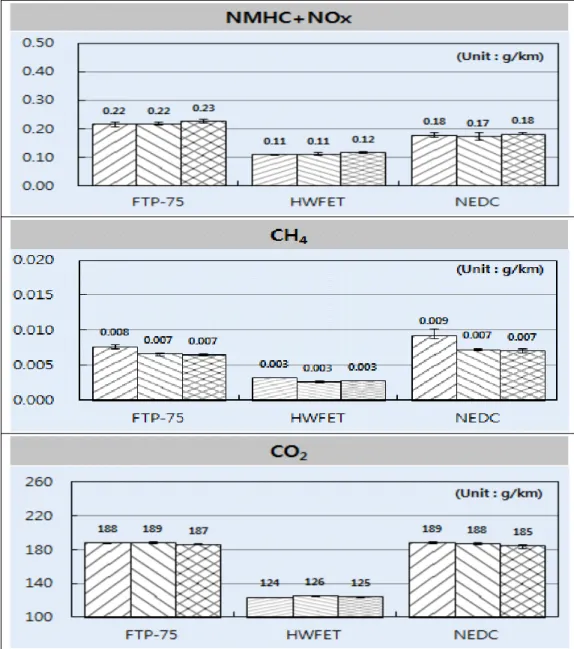
Fig. 4. NMHC+NOx, CH4, CO
2of vehicle test of A, B, C Reference diesel at FTP-75, HWFET, NEDC Mode for using the Santafe(CRDi)
1. CO, NOx, NMHC는 FTP-75 Mode에서 평균 각각 0.051 g/km, 0.200 g/km, 0.020 g/km를 나타내며, HWFET 모드에서 0.007 g/km, 0.108 g/km, 0.004 g/km, NEDC 모드에서 약 0.155 g/km, 0.139 g/km, 0.039 g/km 를 나타 내고 있다. 이는 국내 제작차 배출허용 기준인 (NEDC Mode, 2013년) CO 0.74 g/km, 이하,
NOx 0.28 g/km 이하를 만족하고 있으며, 동일 모드 내 연료 간 배출가스는 미세한 차이를 나타 냈다.
2. NMHC+NOx, CH
4, CO
2는 FTP-75 Mode에
서 평균 각각 0.220 g/km, 0.007 g/km, 188
g/km를 나타내며, HWFET 모드에서 0.11
g/km, 0.003 g/km, 125 g/km, NEDC 모드에
Fig. 5. PM, PN, Fuel Economy of vehicle test of A, B, C Reference diesel at FTP-75, HWFET, NEDC Mode for using the Santafe(CRDi)
서 약 0.18 g/km, 0.008 g/km, 187 g/km 를 나 타내고 있다. 국내 제작차 배출허용 기준인 (NEDC Mode, 2013년) NMHC+NOx 0.35 이하를 만족하고 있으며, 동일모드 내 연료 간 배출가스 차이는 보이지 않았다. 국내 온실가스 배출량 산정기준인 복합 CO
2배출량 (FTP-75 Mode CO
2배출량×0.55 + HWFET Mode
CO
2배출량×0.45)은 연료 간 최대 1.0% 이내 로 미세한 차이를 나타냈으며. 온실가스 사후관 리 기준인 +5%인 기준으로 봤을 때 연료에 의 한 온실가스 편차가 작음을 알 수 있다.
3. PM(Particle matter), PN(Particle Number), 연
비(Fuel Economy)는 FTP-75 Mode에서 평균
각각 0.0007 g/km, 4.2×10
11g/km, 14.3 km/L를 나타내며, HWFET 모드에서 0.0003 g/km, 2.5×10
11g/km, 21.6 km/L, NEDC 모 드에서 약 0.0011 g/km, 4.6×10
11g/km, 14.0 km/L 를 나타내고 있다. 국내 PM 배출기준 FTP-75 mode모드에서 PM 0.005 g/km 이하 를 만족하고 있으며, 동일모드 내 PM 차이는 배 출기준 대비 미세한 차이를 나타냈다. 특히 연비 의 경우 FTP-75 mode 및 HWFET mode에서 국내 연료 간 각각 1.2%, 0.7%로 미세한 차이를 나타냈다.
CRDI(산타페,2013) 차량 시험결과를 요약하자면 1. 국내 제작차 배출허용 기준인(NEDC Mode,
g/km) CO 0.74 이하, NOx 0.28 이하, NMHC+NOx 0.35 이하, PM 0.005 이하를 3 종의 연료(A, B, C) 모두 만족하고 있다.
2. 각 모드 내에서 해외 표준연료(A) 및 국내 표준 연료(B, C) 간 CO, NOx, NMHC, CH
4, PM, PN의 결과에서 큰 차이가 없었다. 특히, 연비의 경우에는 연료 간 최대 약 1.2%의 미세한 차이 로 연료에 따른 차이가 거의 없는 것으로 나타났 다. 이는 해외 표준연료(A)와 국내 표준연료(B, C)의 연료 품질이(발열량, 황분, 방향족, 바이오 디젤 등) 비슷하여 나타난 결과로 보인다.
5. 결 론
본 연구에서는 국내 자동차용 경유 표준연료 도입 을 위한 상세 표준연료 기준(안)을 설정하고 이를 평 가하였다.
국내 경유의 품질 모니터링 결과 및 자동차제작사 및 정유사의 자문위원의 의견을 바탕으로 경유 표준 연료 기준(안)을 설정했으며, 이를 평가하기 위해 해 외 표준연료 1종(Euro 5 B5), 국내 표준연료 2종 등 총 3종의 연료를 차량(CRDI)에 적용하여 연비 및 배출가스를 평가한 결과, 표준연료(3종) 간 배출가 스는 유의미한 차이를 보이지 않았으며 차량의 연비 는 1.2%로 이내의 미미한 차이를 나타냈다.
본 연구는 환경부와 오토오일위원회의 ‘5차년도 한 국형 오토오일 사업’으로 수행됐으며, 국내 유통되 는 자동차용 경유의 품질모니터링 결과를 바탕으로 경유 표준연료 기준을 설정·검증함으로써 표준연료
제도 도입을 위한 기초 자료로 활용가능하며, 이러 한 기준은 향후 유통유의 트렌드 변화, 표준연료 생 산 기관 및 사용자의 의견 등을 반영하여 보완하는 절차가 필요할 것이다.
References