• 검색 결과가 없습니다.

Allometry, Biomass and Productivity of Quercus Forests in Korea: A Literature-based Review

N/A
N/A
Protected

Academic year: 2021

Share "Allometry, Biomass and Productivity of Quercus Forests in Korea: A Literature-based Review"

Copied!
10
0
0

로드 중.... (전체 텍스트 보기)

전체 글

(1)

Jour. Korean For. Soc. Vol. 99, No. 5, pp. 726~735 (2010)

726

J OURNAL OF K OREAN

F OREST S OCIETY

Allometry, Biomass and Productivity of Quercus Forests in Korea: A Literature-based Review

Xiaodong Li

1

, Myong Jong Yi

1

* , Yowhan Son

2

, Guangze Jin

3

, Kyeong Hak Lee

4

, Yeong Mo Son

4

and Rae Hyun Kim

4

1

Department of Forest Resources, Kangwon National University, Chuncheon 200-701, Korea

2

Division of Environmental Science and Ecological Engineering, Korea University, Seoul 136-701, Korea

3

School of Forestry, Northeast Forestry University, Harbin 150040, China

4
Korean Forest Research Institute, Seoul 130-712, Korea

Abstract : Publications with the data on allometric equation, biomass and productivity of major oak forests in Korea were reviewed. Different allometric equations of major oak species showed site- or species- specific dependences. The biomass of major oak forests varied with age, dominant species, and location.

Aboveground tree biomass over the different oak species was expressed as a power equation of the stand age. The proportion of tree component (stem, branch and leaf) to total aboveground biomass differed among oak species, however, biomass ranked stem > branch > leaf in general. The leaf biomass allocation over the different oak species was expressed as a power equation of total aboveground biomass while there were no significant patterns of biomass allocation from stem and branch to the aboveground biomass. Tree root biomass continuously increased with the aboveground biomass for the major oak forests. The relationship between the root to shoot ratio and the aboveground tree biomass was expressed by a logarithmic equation for major oak forests in Korea. Thirteen sets of data were used for estimating the net primary production (NPP) and net ecosystem production (NEP) of oak forests. The mean NPP and NEP across different oak forests was 10.2 and 1.9 Mg C ha

−1

year

−1

. The results in biomass allocation, NPP and NEP generally make Korean oak forests an important carbon sinks.

Key words : allometric equation, living biomass increment, net ecosystem production, net primary produc- tion, root to shoot ratio

1. Introduction

Oak species as a most dominant species are widely found in natural deciduous and mixed forests throughout Korea (Son et al ., 2004a, 2007; Park et al ., 2005b;

Kwon and Lee, 2006a; Noh et al ., 2007). The oaks play an important role in ecological, social and economic aspects in terms of increase in biodiversity, cultural significance and wood production across this country. The most common six species are Quercus mongolica Fisch., Q. variabilis Bl., Q. acutissima Carruth., Q. dentata Thunb., Q. serrata Thunb., and Q. aliena Bl., whereas the five evergreen oak species ( Q. acuta Thunb., Q. gilva Bl., Q. glauca Thunb., Q.

myrsinaefolia Bl., and Q. salicina Bl.) are found along the southern coasts and islands (Son et al ., 2004a; 2004b; Noh et al ., 2007).

Over the past several decades, the data on biomass and

productivity of deciduous oak forests using the allometric method have been published with the large accumulation of field survey data, particularly focusing on the species of Quercus mongolica and Q. variabilis (Song et al ., 1997; Park et al ., 2003, 2005b; Son et al ., 2004b). Some studies also examined the carbon fluxes in the oak forest ecosystems, which includes litter production and carbon emissions from soil respiration (Son et al ., 2007). In Quercus forests, the bulk of NPP stands for the annual litter production and the rates of growth increment in stem, branch, leaf and root. NEP is usually used to judge carbon fixation from NPP and the rate of soil respiration.

This review discussed the present status of studies on allometric equations, biomass allocation, and productivity of major oak forests in Korea. This review also showed some examples of oak forests for estimating the NPP and NEP.

Allometric Equation

According to the basic theory of allometric relationships,

*Corresponding author

E-mail: [email protected]

(2)

Allometry, Biomass and Productivity of Quercus Forests in Korea: A Literature-based Review 727

Table 1. Allometric models and parameters for Quercus mongolica (Qm), Q. variabilis (Qv), Q. serrata (Qs), Q. acutissima (Qa) and Q. dentata (Qd) based on DBH or DBH

2

H (DBH: diameter at breast height, H: height, Ws: stem dry weight in kg or g, Wa: aboveground tree dry weight in kg or g, Wr: tree roots dry weight in kg or g).

Species Location Equation Tree

samples a b c R

2

Reference

Qm

Chuncheon LogWa = a+bLog(DBH) 10 2.076 2.579 0.969 Park et al . 2003;

Son et al . 2007

Kwangyang Wa = a(DBH)

b

9 1.909 2.410 0.98 Park 2003

Pyungchang 9 1.745 2.587 0.99

Youngdong 9 1.865 2.486 0.98

Chungju Wa = a(DBH)

b

H

c

10 1.002 3.866 -2.746 0.98 Song and Lee 1996

Suncheong LogWa = a+bLog(DBH) 10 1.982 2.546 0.97 Park and Moon 1994

Kwangju LogWa = a+bLog(DBH) 10 2.144 2.366 0.994 Park et al . 1996 Pyungchang LogWa = a+bLog(DBH

2

H) 7 1.391 0.976 0.99 Lee and Kwon 2006

6 1.197 1.028 0.99

Jecheon 10 1.531 0.920 0.93

Pyungchang LogWs = a+bLog(DBH

2

H) 7 5.600 1.002 0.99 Kwon and Lee 2006a

6 5.397 1.045 0.98

7 5.691 0.974 0.99

6 5.464 1.034 0.99

6 5.765 0.949 0.99

5 5.522 1.035 0.99

Gwangyang LogWs = a+bLog(DBH

2

H) 6 0.823 1.134 0.99 Kwon and Lee 2006b

9 1.101 1.071 0.98

Jeju 5 0.923 1.117 0.98

5 0.928 1.109 0.98

Pyeongchang LogWa = a+bLog(DBH

2

H) 18 1.243 1.013 0.97 Kwon and Lee 2006c Gwangju

Jecheon Kwangyang

Jeju Gwangyang LogWa = a+bLog(DBH) 10 2.102 2.360 0.979 Park et al . 2005a

Seoul LogWa = a+bLog(DBH) 10 2.339 2.381 0.996 Park et al . 2005b

Chungju LogWa = a+bLog(DBH) 10 1.632 2.505 0.980 Park 1999

Gwangju LogWs = a+bLog(DBH

2

H) 10 -1.285 0.901 0.978 Lee and Park 1987 Chungju Wa = a(DBH)

b

H

c

10 1.002 4.320 -3.624 0.985 Song et al 1997

Pyoengchang LogWs = a+bLog(DBH

2

H) -2.029 1.096 Kwak and Kim 1992

Gwangju LogWa = a+bLog(DBH) 10 2.340 2.390 0.955 Son et al . 2004b

Qv

Chuncheon LogWa = a+bLog(DBH) 10 2.030 2.560 0.976 Park et al . 2003;

Son et al . 2007

Gongju Wa = a(DBH)

b

10 1.702 2.678 0.990 Park and Lee 2001

Pohang 10 1.571 2.759 0.990

Yangyang 10 1.329 2.823 0.980

Sancheong LogWs = a+bLog(DBH) 12 1.606 0.868 0.952 Kim and Jeong 1985

Jinju 12 1.000 1.124 0.985

Chungju Wa = a(DBH)

b

H

c

10 1.000 2.925 -1.638 0.980 Song and Lee 1996 Suncheong LogWa = a+bLog(DBH) 10 1.916 2.377 0.968 Choi and Park 1993 Suncheong LogWa = a+bLog(DBH) 10 2.063 2.445 0.990 Park and Moon 1994 Kwangju LogWa = a+bLog(DBH) 10 1.944 2.470 0.991 Park et al . 1996 Gwangyang LogWa = a+bLog(DBH) 10 1.905 2.545 0.962 Park et al . 2005a Gwangju LogWa = a+bLog(DBH) 10 2.234 2.518 0.988 Son et al . 2004b

Chungju LogWa = a+bLog(DBH) 10 1.443 2.645 0.990 Park 1999

Chungju Wa = a(DBH)

b

H

c

10 1.000 3.244 -2.340 0.985 Song et al . 1997

Qs Kwangyang Wa = a(DBH)

b

9 1.904 2.519 0.99 Park and Lee 2002

Muju 9 2.300 2.257 0.99

Pohang 9 1.869 2.602 0.99

Suncheong LogWa = a+bLog(DBH) 10 2.116 2.446 0.99 Park and Moon 1994

Qa Suncheong LogWa = a+bLog(DBH) 10 2.094 2.417 0.99 Park and Moon 1994

Kwangju LogWa = a+bLog(DBH) 10 1.799 2.693 0.994 Park et al . 1996 Chungju LogWa = a+bLog(DBH) 15 -1.009 1.772 0.986 Noh et al . 2007

LogWr = a+bLog(DBH) 7 -0.634 1.772 0.962

Qd Gwangju LogWa = a+bLog(DBH) 10 1.883 2.560 0.99 Park et al . 1996

(3)

728 Jour. Korean For. Soc. Vol. 99, No. 5 (2010)

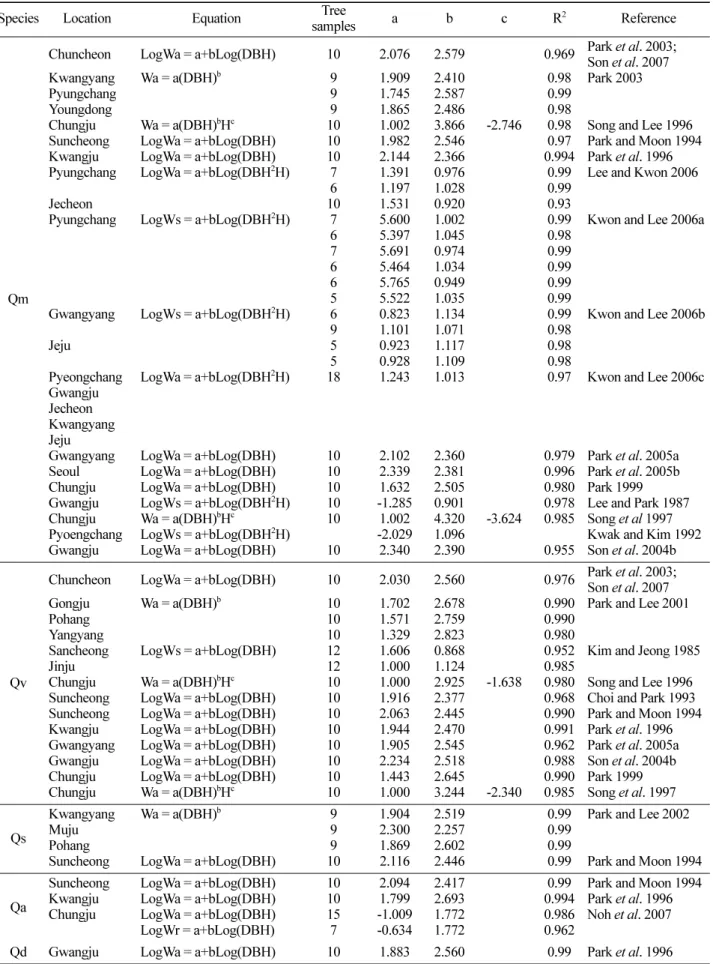
the growth rate of one part of a tree is proportional to that of another. Therefore, the diameter at breast height (DBH) of a tree, for example, is highly correlated with tree stem weight. A regression equation can be deduced for predicting tree weight when a range of tree dimensions is measured. Allometric relationships for major oak species have been developed for several decades to estimate biomass and subsequent growth in Korea (Table 1). Most studies used the destructive harvest method to develop allometric equations. The commonly used equations for estimating the biomass of different oak species are the following forms:

W = a(DBH)

b

or LogW = a + bLog(DBH) (1) W = a(DBH

2

H)

b

or LogW = a + bLog(DBH

2

H) (2) W = a(DBH)

b

H

c

or LogW = a + bLog(DBH) + cLogH (3) where W, X, and H are component biomass (kg or g), trunk diameter (cm), and tree height (m), respectively, and a and b are constants for a site or specific species.

Since biomass is strongly related to the DBH and H, the allometric equation is useful for estimating the whole or partial weight of a tree from DBH or DBH and height together (Kim and Jeong, 1985; Park et al ., 1996; Kwon and Lee, 2006a). Constants in each equation form often showed site- or species-specific dependences, and coefficient of determination (R

2

) showed relatively high value (over 0.93) for each oak species (Table 1). Comparisons of different equation forms were reported in the literature (Choi and Park, 1993; Park and Moon, 1994; Song and Lee, 1996; Song et al . 1997). While some studies reported that the equation form of W = a(DBH)

b

H

c

was more adequate than the other forms for Q. mongolica and Q.

variabilis (Song and Lee, 1996; Song et al . 1997), other studies suggested that there was little difference in accuracy among the three equation forms for oak species (Choi and Park, 1993; Park and Moon, 1994).

These contradictory results in literature may be due to the measuring error of tree sizes and differences in various biotic and abiotic factors among locations. For example, Son et al . (2007) compared the three equation forms for Q.

mongolica , and suggested that there is priority for using the equation form of W = a(DBH)

b

when the measuring error of tree stem height and tree crown height, and estimate of stem productivity based on radial growth were taken into account. In addition, Park and Moon (1994) proposed the use of a common allometric equation for Quercus species to overcome the disadvantage of both the species- and site-specific allometric relationship.

Biomass Allocation

The data from literature on biomass of major oak species

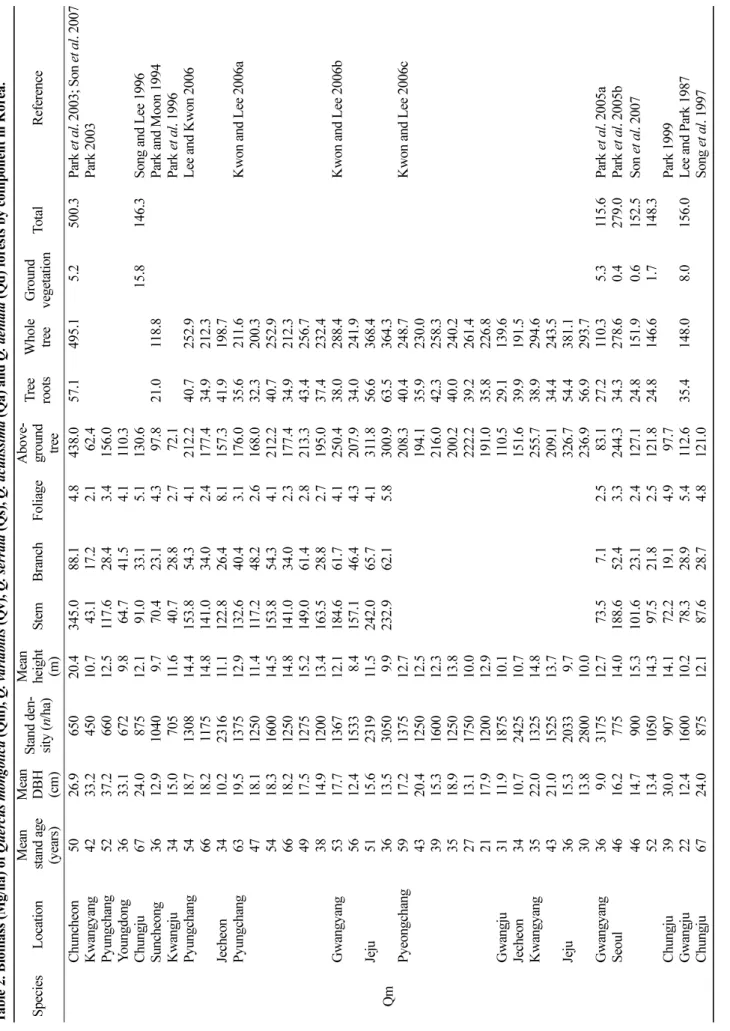
are listed in Table 2. Most studies dealt with both above- ground and belowground tree biomass, and only 15 focused on ground vegetation (shrub plus herb) biomass. Above- ground tree biomass over the different oak species was expressed as a power equation of the stand age (Figure 1). Aboveground tree biomass (Mg/ha) for Q. mongolica ranged from 62.4 in a 42-year-old stand of Kwangyang area to 438.0 in a 50-year-old stand of Chuncheon area.

Aboveground tree biomass (Mg/ha) for Q. variabilis ranged from 38.5 in a 19-year-old stand of Sancheong area to 279.9 in a 49-year-old stand of Chuncheon area.

Aboveground tree biomass (Mg/ha) for Q. serrata ranged from 42.0 in a 25-year-old stand of Muju area to 97.2 in a 29-year-old stand of Suncheong area. Aboveground tree biomass (Mg/ha) for Q. acutissima ranged from 66.0 in an 11-year-old stand to 237.1 in a 44-year-old stand of Chungju area (Table 2). Total biomass seemed to be significantly different among oak species. Park et al . (2005a) investigated the total biomass of three stands in Q. mongolica and Q. variabilis forests with similar ages.

Although the three stands were regenerated in a similar environment, the measured values of total biomass varied from approximately 108.4 Mg/ha in a Q. variabilis forest stand to 132.0 Mg/ha in a Q. mongolica forest stand.

Son et al . (2004b) reported that the total biomass stored in a Q. variabilis mixed with Q. mongolica forests stand was 253.3 Mg/ha, which was almost twice greater than 138.8 Mg/ha stored in a Q. variabilis forest stand with same ages. In this study, 15 data sets of ground vegetation biomass were only found in Q. variabilis and Q. mongolica forests, ranging from 0.4 for a 46-year-old Q. mongolica forest stand to 25.1 Mg/ha for a Q. variabilis forest stand. Mean ground vegetation biomass (5.3 Mg/ha) in Q. mongolica forest seemed to be slightly lower than 8.8 Mg/ha in Q. variabilis forest.

The pattern of biomass allocation to the aboveground components (stem, branch and leaf) of Quercus stands is presented in Figure 2. The leaf biomass allocation over the different oak species was expressed as a power equation of total aboveground biomass (R

2

=0.47, p<0.0001), while there were no significant patterns of biomass allocation from stem and branch to the aboveground biomass. Stem contained approximately more than 50% of aboveground tree biomass. The proportion of each tree component to total aboveground biomass differed among oak species, however, biomass ranked stem > branch > leaf in general.

The mean proportion of stem, branch and leaf to total aboveground biomass over major oak species was 76.1, 20.6 and 3.0%, respectively, which was very close to the results reported by Son et al . (2004a).

Direct field measurements of the root biomass are dif-

ficult and time consuming. In practice, the root biomass

is usually estimated from the aboveground tree biomass

(4)

A l l o m e t r y , B i o m a s s a n d P r o d u c t i v i t y o f Q u e r c u s F o r e s t s i n K o r e a : A L i t e r a t u r e - b a s e d R e v i e w 7 2 9

Ta ble 2 . Bi om ass ( M g/ha ) of Qu erc us mo ng olic a (Qm), Q. va riab ilis (Qv ), Q. serra ta (Qs ), Q. ac utis sima (Qa ) an d Q. de ntat a (Q d) f ore sts b y c om po ne nt in Ko rea . Species Locati on M ean st an d ag e (years) Me an DB H (cm ) Stand den- sity ( n /ha) Mea n

height (m Stem Branch Foliage )

Above- ground Tr ee W hole tree root s tre e

Ground vegetat

ion To tal Refer ence Qm

Chuncheon 50 26.9 65 0 20. 4 34 5.0 88. 1 4.8 438.0 57. 1 495. 1 5.2 500.3 Park et al . 2003; S on et al . 2007 Kwangy ang 42 33.2 45 0 10. 7 43.1 17. 2 2.1 62.4 Park 2003 Py ungchang 52 37.2 66 0 12. 5 11 7.6 28. 4 3.4 156.0 Youngdong 36 33.1 67 2 9.8 64.7 41. 5 4.1 110.3 Chungj u 67 24.0 87 5 12. 1 91.0 33. 1 5.1 130.6 15.8 146.3 Song and L ee 19 96 Suncheong 36 12.9 104 0 9.7 70 .4 23. 1 4.3 97.8 21. 0 118. 8 Park and M oon 1994 Kwangj u 34 15.0 70 5 11 .6 40 .7 28. 8 2.7 72.1 Park et al . 1996 Py ungchang 54 18.7 130 8 14. 4 15 3.8 54. 3 4.1 212.2 40. 7 252. 9 Lee and Kwon 2006 66 18.2 117 5 14. 8 14 1.0 34. 0 2.4 177.4 34. 9 212. 3 Jec he on 34 10.2 231 6 11. 1 12 2.8 26. 4 8.1 157.3 41. 9 198. 7 Py ungchang 63 19.5 137 5 12. 9 13 2.6 40. 4 3.1 176.0 35. 6 21 1.6 Kwon and Le e 2006 a 47 18.1 125 0 11. 4 11 7.2 48. 2 2.6 168.0 32. 3 200. 3 54 18.3 160 0 14. 5 15 3.8 54. 3 4.1 212.2 40. 7 252. 9 66 18.2 125 0 14. 8 14 1.0 34. 0 2.3 177.4 34. 9 212. 3 49 17.5 127 5 15. 2 14 9.0 61. 4 2.8 213.3 43. 4 256. 7 38 14.9 120 0 13. 4 16 3.5 28. 8 2.7 195.0 37. 4 232. 4 Gwangy ang 53 17.7 136 7 12. 1 18 4.6 61. 7 4.1 250.4 38. 0 288. 4 Kwon and Le e 2006 b 56 12.4 153 3 8.4 15 7.1 46. 4 4.3 207.9 34. 0 241. 9 Jej u 51 15.6 231 9 11. 5 24 2.0 65. 7 4.1 31 1.8 56. 6 368. 4 36 13.5 305 0 9.9 23 2.9 62. 1 5.8 300.9 63. 5 364. 3 Py eongchang 59 17.2 137 5 12. 7 208.3 40. 4 248. 7 Kwon and Le e 2006 c 43 20.4 125 0 12. 5 194.1 35. 9 230. 0 39 15.3 160 0 12. 3 216.0 42. 3 258. 3 35 18.9 125 0 13. 8 200.2 40. 0 240. 2 27 13.1 175 0 10. 0 222.2 39. 2 261. 4 21 17.9 120 0 12. 9 191.0 35. 8 226. 8 Gwangj u 31 11.9 187 5 10. 1 110.5 29. 1 139. 6 Jec he on 34 10.7 242 5 10. 7 151.6 39. 9 191. 5 Kwangy ang 35 22.0 132 5 14. 8 255.7 38. 9 294. 6 43 21.0 152 5 13. 7 209.1 34. 4 243. 5 Jej u 36 15.3 203 3 9.7 326.7 54. 4 381. 1 30 13.8 280 0 10. 0 236.9 56. 9 293. 7 Gwangy ang 36 9.0 317 5 12. 7 73.5 7.1 2.5 83.1 27. 2 110. 3 5.3 115.6 Park et al . 2005a Seoul 46 16.2 77 5 14. 0 18 8.6 52. 4 3.3 244.3 34. 3 278. 6 0.4 279.0 Park et al . 2005b 46 14.7 90 0 15. 3 10 1.6 23. 1 2.4 127.1 24. 8 151. 9 0.6 152.5 Son et al . 2007 52 13.4 105 0 14. 3 97.5 21. 8 2.5 121.8 24. 8 146. 6 1.7 148.3 Chungj u 39 30.0 90 7 14. 1 72.2 19. 1 4.9 97.7 Park 1999 Gwangj u 22 12.4 160 0 10. 2 78.3 28. 9 5.4 112.6 35. 4 148. 0 8.0 156.0 Lee and Park 1987 Chungj u 67 24.0 87 5 12. 1 87.6 28. 7 4.8 121.0 Song et a l . 1997

(5)

7 3 0 J o u r . K o r e a n F o r . S o c . V o l . 9 9 , N o . 5 ( 2 0 1 0 )

Ta ble 2 . C ontin ue d. Sp ec ies Locati on M ean st an d ag e (years) Mean DBH (cm

) Stand density ( n /ha) Mea n

height (m Stem Branch Foli ag e )

Above- ground Tr ee W hole tree root s tre e

Ground vegetat

ion To tal Ref erence Qv

Chuncheon 49 21.4 82 5 18. 1 22 7.7 49 .4 2.8 279.9 37. 5 317. 5 3.7 321. 2 Park et al . 2003; S on et al . 2007 Gongj u 41 26.8 113 7 14. 4 76.6 12.6 2.1 91.3 Park and Lee 2001 Pohang 45 36.9 77 8 15. 3 17 2.9 32 .2 2.5 207.6 Ya ngy ang 54 30.0 87 3 12. 5 58.8 10.5 2.1 71.4 Sancheong 19 5.1 660 0 7.0 29 .4 6.6 2.5 38.5 Kim an d Jeong 1985 Jinj u 20 9.2 430 0 8.1 45 .0 6.2 2.8 53.9 Chungj u 62 24.0 88 3 11 .8 10 0.7 27.2 3.8 137.4 25.1 162. 5 Song and L ee 19 96 Suncheong 20 11 .3 98 3 9.2 22 .0 7.3 2.0 31.3 Choi and Par k 199 3 Suncheong 28 14.6 128 0 11. 1 95.3 31.3 8.3 134.9 24. 0 158. 9 Park and m oon 1994 Kwangj u 32 14.9 112 9 14. 4 72.3 12.5 2.2 87.0 Park et al . 1996 Gwangj u 33 11.8 98 0 13. 0 50.0 8.4 3.2 61.6 Lee and Ki m 1997 Gwangy ang 37 9.2 245 0 10. 3 61.5 7.6 1.7 70.8 18. 7 89. 5 18.9 108. 4 Park et al . 2005a 38 10.2 290 0 14. 3 87.6 10.7 2.4 100.7 26. 4 127. 1 4.3 132. 0 Gwangj u 34 16.6 52 5 17. 7 98.3 18.7 2.5 119.5 13. 4 132. 9 5.9 138. 8 Son et al . 2004 b 31 12.1 142 5 18. 7 15 4.3 32 .9 4.1 191.2 22. 6 213. 8 2.4 216. 2 33 13.7 147 5 18. 3 18 4.9 34 .5 4.7 224.1 27. 0 251. 2 2.2 253. 3 Chuncheon 44 18.3 105 0 18. 9 21 7.0 44 .4 2.6 264.1 36. 7 300. 8 7.9 308. 7 Son et al . 2007 Chungj u 40 30.0 83 5 13. 5 89.8 19.2 3.4 115.0 Park 1999 Chungj u 62 24.0 88 3 11 .8 96 .9 23 .7 3.8 124.4 Song et a l . 1997 Qs Kwangy ang 34 33.3 41 3 14. 1 40.7 13.7 1.6 56.1 Park and Lee 2002 Muj u 25 29.3 33 9 12. 8 31.2 9.3 1.5 42.0 Pohang 37 29.5 46 9 13. 6 63.1 23.8 1.4 88.3 Suncheong 29 12.6 112 0 10. 8 68.8 23.9 4.5 97.2 18. 1 115. 3 Park and M oon 1994 Qa

Suncheong 26 14.3 141 0 11. 5 99.8 31.6 8.7 140.1 23. 9 164. 0 Park and M oon 1994 Kwangj u 38 21.3 43 7 15. 3 94.8 26.1 1.9 122.7 Park et al . 1996 Chungj u 11 7.9 210 0 49.6 12.1 4.3 66.0 22. 7 88. 7 Noh et al . 2007 38 17.1 80 0 85 .3 32 .2 6.3 123.8 31. 1 154. 9 44 20.7 73 3 17 0.5 58.0 8.6 237.1 41. 0 278. 1 Qd Kwangj u 38 11.7 78 9 9.7 22.2 14.5 1.9 38.6 Park et al . 1996

(6)

Allometry, Biomass and Productivity of Quercus Forests in Korea: A Literature-based Review 731

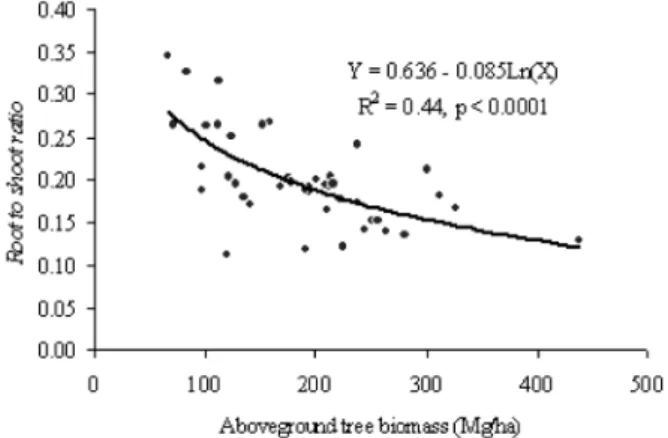
based on the root to shoot ratio (shoot including stem, branch and leaf) or an allometric relationship between the aboveground tree biomass and root biomass (Cairns et al ., 1997; Fang et al ., 2005). In this study, the root biomass continuously increased with the aboveground biomass for the major oak forests (Figure 3). The relationship between the root to shoot ratio and the aboveground tree biomass was expressed by a logarith- mic equation for major oak forests in Korea (Figure 4).

NPP and NEP are fundamental property of ecosystems.

Woodwell and Whittaker (1968) firstly defined NEP as

the difference between the amount of organic carbon photosynthesized by green plant in an ecosystem (gross primary production, or GPP) and total ecosystem respiration (autotrophic respiration plus heterotrophic respiration).

According to Luyssaert et al . (2007), NPP consists of two different ecosystem components: living biomass increment (LB, including increments in tree and ground vegetation) and litter production (LP). NPP also includes a number of additional components that are difficult to measure and often ignored, such as volatile organic com- pounds (VOC), methane (CH

4

) and exudates exuded from roots or transferred to mycorrhizae, whereas biomass removal by harvest, insects and mammals should be taken into account. In this paper, NPP of oak forests denotes the sum of LB and LP because of rare measurement for additional components. NEP is equal to the result of NPP minus heterotrophic respiration (R

h

).

LB of major oak forests was estimated by the allometric equations (Table 3). Aboveground tree biomass increment (Mg ha

−1

year

−1

) were different among oak species, ranging from 3.5 for a 38-year-old Q. dentata stand to 22.5 for a 26-year-old Q. acutissima stand. Aboveground tree biomass increment seemed to change with stand age.

Living biomass increment of aboveground tree increased with aboveground tree biomass over oak species, and the relationship was expressed as a power equation (Figure 5). Our findings were very close to the results reported by Son et al . (2004a). 13 studies estimated biomass increment in ground vegetation, and ranged from 0.1 for two 46- year-old Q. mongolica stands to 4.8 Mg ha

−1

year

−1

for a 37-year-old Q. acutissima stand. Therefore, ground vegetation may considerably contribute to the carbon pool of oak forests.

Thirteen sets of data were used for estimating NPP and NEP of oak forests (Table 4). NPP ranged from a low of 5.95 Mg C ha

−1

year

−1

in a 46-year-old Q. mongolica stand to a relatively high value of 18.19 Mg C ha

−1

year

−1

in Figure 1. Relationship between aboveground tree biomass

and stand age for major oak forests in Korea.

Figure 2. Aboveground tree biomass allocation to each component of major oak species in Korea.

Figure 3. Relationship between tree root biomass and aboveground tree biomass for major oak forests in Korea.

Figure 4. Relationship between root to shoot ratio and

aboveground tree biomass for major oak forests in Korea.

(7)

732 Jour. Korean For. Soc. Vol. 99, No. 5 (2010)

Table 3. Living biomass increment (Mg ha

−1

year

−1

) of Quercus mongolica (Qm), Q. variabilis (Qv), Q. serrata (Qs), Q.

acutissima (Qa) and Q. dentata (Qd) forests by component in Korea.

Species Location Mean stand age

(years) Stem Branch Foliage Above- ground

tree Tree

roots Whole

tree Ground vegeta-

tion Total Reference

Qm

Chuncheon 50 8.9 4.1 4.8 17.8 1.7 19.5 2.4 21.9 Park et al . 2003;

Son et al . 2007

Kwangyang 42 1.4 2.4 2.1 5.8 Park 2003

Pyungchang 52 3.5 3.4 3.4 10.3

Youngdong 36 3.7 3.5 4.1 11.4

Chungju 67 2.3 2.6 5.1 10.0 Song and Lee 1996

Suncheong 36 5.3 1.5 4.3 11.1 1.5 12.6 Park and Moon 1994

Kwangju 34 2.7 2.2 2.7 7.5 Park et al . 1996

Pyungchang 54 7.2 3.3 4.1 14.5 2.8 17.3 Lee and Kwon 2006

66 7.6 2.0 2.4 11.9 2.3 14.2

Jecheon 34 7.0 1.6 8.1 16.8 4.4 21.2

Pyungchang 63 5.6 1.9 3.1 10.5 2.2 12.7 Kwon and Lee 2006a

47 6.3 2.8 2.6 11.7 2.3 14.0

54 7.2 3.3 4.1 14.5 2.8 17.3

66 7.6 1.9 2.3 11.9 2.3 14.2

49 6.4 2.8 2.8 12.0 2.4 14.5

38 8.0 1.7 2.7 12.3 2.3 14.6

Gwangyang 53 10.3 3.6 4.1 18.0 2.7 20.8 Kwon and Lee 2006b

56 8.3 2.6 4.3 15.2 2.5 17.7

Jeju 51 9.4 2.6 4.1 16.1 2.9 19.1

36 9.3 2.5 5.8 17.5 3.7 21.3

Gwangyang 36 4.6 1.7 2.5 8.8 2.1 10.9 1.6 12.6 Park et al . 2005a

Seoul 46 4.5 2.2 3.3 10.1 1.0 11.1 0.1 11.1 Park et al . 2005b

46 2.5 1.2 2.4 6.1 0.8 6.9 0.1 7.0 Son et al . 2007

52 2.4 1.2 2.5 6.1 0.8 6.9 0.2 7.1

Chungju 39 3.0 3.6 4.9 11.5 Park 1999

Gwangju 22 5.9 2.7 5.4 14.1 4.4 18.5 1.9 20.4 Lee and Park 1987

Chungju 67 2.2 2.6 4.8 9.6 Song et al . 1997

Pyungchang 5.5 0.3 3.8 9.7 1.4 11.0 Kwak and Kim 1992

Qv

Chuncheon 49 9.0 2.6 2.8 14.4 1.6 15.9 1.4 17.3 Park et al . 2003;

Son et al . 2007

Gongju 41 3.2 2.5 2.1 7.8 Park and Lee 2001

Pohang 45 5.4 3.7 2.5 11.5

Yangyang 54 3.1 1.2 2.1 6.4

Sancheong 19 3.7 0.5 2.5 6.7 Kim and Jeong 1985

Jinju 20 5.9 0.3 2.8 9.0

Chungju 62 2.7 2.1 3.8 8.6 Song and Lee 1996

Suncheong 20 1.7 0.6 2.0 4.3 Choi and Park 1993

Suncheong 28 9.5 3.0 8.3 20.8 2.4 23.2 Park and moon 1994

Kwangju 32 3.4 0.8 2.2 6.5 Park et al . 1996

Gwangyang 37 3.3 0.9 1.7 5.8 1.1 7.0 4.8 11.7 Park et al . 2005a

38 4.6 1.3 2.4 8.3 1.6 9.9 1.2 11.1

Gwangju 34 4.7 1.3 2.5 8.5 0.7 9.2 2.0 11.2 Son et al . 2004b

31 7.7 2.5 4.1 14.2 1.2 15.5 1.2 16.6

33 9.2 2.7 4.7 16.6 1.5 18.0 1.7 19.7

Chuncheon 44 8.5 2.4 2.6 13.5 1.5 15.0 2.3 17.3 Son et al . 2007

Chungju 40 4.3 2.2 3.4 9.9 Park 1999

Chungju 62 2.7 2.1 3.8 8.6 Song et al . 1997

Qs

Kwangyang 34 2.3 2.3 1.6 6.2 Park and Lee 2002

Muju 25 2.2 2.8 1.5 6.5

Pohang 37 4.0 2.3 1.4 7.7

Suncheong 29 6.4 1.9 4.6 12.9 1.6 14.5 Park and Moon 1994

Qa Suncheong 26 10.4 3.4 8.7 22.5 2.5 25.0 Park and Moon 1994

Kwangju 38 3.2 1.0 1.9 6.1 Park et al . 1996

Qd Kwangju 38 0.9 0.7 1.9 3.5 Park et al . 1996

(8)

Allometry, Biomass and Productivity of Quercus Forests in Korea: A Literature-based Review 733

a 35-year-old Q. acutissima stand. The contribution of LB to NPP across the three oak forests was (71.9%) higher than that (28.1%) of LP to NPP. Mean NPP across the three oak forests was 10.2 Mg C ha

−1

year

−1

, which was slight higher than the mean value of 7.1 Mg C ha

−1

year

−1

in temperate forests reported by Pregitzer and Euskirchen (2004). For a better understanding of estimation of NPP, we must refer to belowground litter.

Few studies have examined the production of belowground litter, especially the litter production of fine root, which

is very difficult to study and therefore poses a major obstacle in obtaining a total understanding of NPP in oak forests. The amount of R

h

from micro- and macro- organisms in the soil must also be estimated in order to estimate the NEP (Table 4). In this study, it is impossible to separate R

h

from root respiration in the soil because of lack of data. The mean R

h

across the three oak forests was 8.3 Mg C ha

−1

year

−1

, which ranged within the values of 2.8-9.7 Mg C ha

−1

year

−1

in temperate forests (Pregitzer and Euskirchen, 2004). The NEP varied widely, from -3.27 in a 46-year-old Q. mongolica stand to 6.95 Mg C ha

−1

year

−1

in a 35-year-old Q. acutissima stand. The mean NEP across all age classes was 1.9 Mg C ha

−1

year

−1

, which was slightly higher than the mean value (1.13 Mg C ha

−1

year

−1

) of NEP across different methods (inventory, ecological site and vegetation model) in the European forest reported by Luyssaert et al . (2010). According to Pregitzer and Euskirchen (2004), the values of NEP vary with forest age, and are high in 30- to 120-year-old stands while may be negative (-1.9 Mg C ha

−1

year

−1

) in 0- to 10-year-old stands. In our study, the mean NEP in three stands showed negative values (source of carbon dioxide) from -3.27 to -0.29 Mg C ha

-1

year

-1

while the stand ages were over 10 years. Deficiency of data on the root respiration and belowground litter may contribute to Figure 5. Relationship between living biomass increment

of aboveground tree and aboveground tree biomass for major oak forests in Korea.

Table 4. Estimation of net primary production (NPP, Mg C ha

−1

year

−1

) and net ecosystem production (NEP, Mg C ha

−1

year

−1

) of oak ( Quercus ) forests in Korea.

Forest type Location Mean stand age

(years)

Living biomass increment

(Mg C ha

−1

year

−1

)

Litter production

(Mg C

ha

−1

year

−1

) NPP Heterotrophic respiration

(Mg C

ha

−1

year

−1

) NEP Reference Q. variabilis Chuncheon 44 8.63 2.69 11.32 8.86 2.45 Son et al . 2007; Yi 2003

Q. variabilis 49 8.66 2.51 11.16 9.52 1.64 Son et al . 2007; Yi 2003;

Park et al . 2003

Q. variabilis Gwangju 34 5.86 2.86 8.72 6.76 1.95 Son et al . 2007

Q. variabilis

+ Q. mongolica 31 6.28 3.06 9.34 7.06 2.28 Son et al . 2004b

Q. variabilis

+ Q. mongolica 33 5.56 3.06 8.61 7.15 1.47

Q. variabilis Gwangyang 37 5.60 1.57 7.17 8.32 -1.15 Son et al . 2007;

Park et al . 2005b

Q. variabilis 38 9.84 1.53 11.36 8.78 2.58

Q. mongolica Seoul 46 5.56 3.10 8.66 8.05 0.61 Son et al . 2007

Q. mongolica 46 3.48 2.47 5.95 9.22 -3.27

Q. mongolica 52 3.57 2.99 6.55 6.85 -0.29

Q. mongolica Chuncheon 50 10.94 3.80 14.74 9.33 5.41 Son et al . 2007; Yi 2003;

Park et al . 2003 Q. mongolica Gwangyang 36 8.32 2.15 10.47 6.44 4.04 Son et al . 2007;

Park et al . 2005b

Q. acutissima Kongju 35 15.84* 2.35 18.19 11.24 6.95 Lee and Mun 2005

*Excluding ground vegetation.

NPP = Living biomass increment + Litter production; NEP = NPP – Heterotrophic respiration.

A factor of 0.5 was used to convert carbon content from biomass.

(9)

734 Jour. Korean For. Soc. Vol. 99, No. 5 (2010)

the variability in NEP.

Our findings suggest that oak forests are generally carbon sinks and play a key role in the carbon cycle in Korean forest. However, future studies should cover detailed measurement on each component of carbon fluxes, especially the dynamics of the belowground fraction including fine roots.

Acknowledgements

This work was supported in part by Forest Science and Technology Project (No. S1107L0101) provided by Korea Forest Service.

Literature Cited

1. Cairns, M.A., Brown, S., Helmer, E.H. and Baumgard- ner, G.A. 1997. Root biomass allocation in the world’s upland forests. Oecologia 111: 1-11.

2. Choi, Y.C. and Park, I.H. 1993. Biomass and net pro- duction of a natural Quercus variabilis forest and a Populus alba × P. glandulosa plantation at Mt. Mohu area in Chonnam. Journal of Korean Forest Society 82(2): 188-194.

3. Fang, J.Y., Oikawa, T., Kato, T., Mo, W. and Wang, Z.H.

2005. Biomass carbon accumulation by Japan’s forests from 1947 to 1995. Global Biogeochemical Cycles 19, GB2004, doi: 10.1029/2004GB002253.

4. Kim, S.K. and Jeong, J.Y. 1985. A study on the pro- duction structure and biomass productivity of Quercus variabilis natural forest. Journal of Korean Forest Soci- ety 70: 91-102.

5. Kwak, Y.-S. and Kim, J.-H. 1992. Nutrient cyclings in Mongolian oak ( Quercus mongolica ) forest. Journal of Ecology and Field Biology 15: 35-46.

6. Kwon, K.-C. and Lee, D.K. 2006a. Biomass and annual net production of Quercus mongolica stands in Mt.

Joongwang with respect to altitude and aspect. Journal of Korean Forest Society 95(4): 398-404.

7. Kwon, K.-C. and Lee, D.K. 2006b. Biomass and energy content of Quercus mongolica stands in Gwangyang and Jeju areas. Journal of Korean Wood Science Soci- ety 34: 54-65.

8. Kwon, K.-C. and Lee, D.K. 2006c. Above- and below- ground biomass and energy content of Quercus mon- golica . Journal of Korean Forest Energy Society 25:

31-38.

9. Lee, D.K. and Kim, G.T. 1997. Tree form and biomass allocation of Quercus species, Larix leptolepis (Sieb. et Zucc.) Gordon and Pinus koraiensis Sieb. et Zucc. in Kwangju-gun, Kyunggi-do. Journal of Korean Forest Society 86(2): 208-213.

10. Lee, D.K. and Kwon, K.-C. 2006. Biomass and net pri-

mary production of Quercus mongolica stands in Pyungchang and Jecheon areas. Journal of Korean For- est Society 95(3): 309-315.

11. Lee, K.-J. and Mun, H.-T. 2005. Organic carbon distribution in an oak forest. Journal of Ecology and Field Biology 28: 265-270.

12. Lee, K.J. and Park, I.H. 1987. Primary production and nutrients distribution in 22-year-old Pinus koraiensis and Quercus mongolica stands in Kwangju. Journal of Korean Forest Energy Society 7: 11-21.

13. Luyssaert, S., Inglima, I., Jung, M., Richardson, A.D., Reichsteins, M., Papale, D., Piao, S.L., Schulze, E.D., Wingate, L., Matteucci, G., Aragao, L.E.O.C., Aubinet, M., Beers, C., Bernhofer, C., Black, G.K., Bonal, D., Bonnefond, J.M., Chambers, J., Ciais, P., Cook, B., Davis, K.S., Dolman, A.J., Gielen, B., Goulden, M., Granier, A., Grelle, A., Griffis, T., Grunwald, T., Guidolotti, G., Hanson, P., Harding, R., Hollinger, D.Y., Hutyra, L.R., Kolari, P., Kruijt, B., Kutsch, W.L., Lagergren, F., Laurila, T., Law, B., Le Maire, G., Lindroth, A., Loustau, D., Malhi, Y., Mateu, J., Migliavacca, M., Misson, L., Montagnani, L., Moncrieff, J., Moors, E., Munger, J.W., Nikinmaa, E., Ollinger, S.V., Pita, G., Rebmann, C., Roupsard, O, Saigusa, N., Sanz, M.J., Seufert, G., Sierra, C., Smith, M.-L., Tang, J., Valentini, R., Vesala, T. and Janssens, I.A. 2007. CO

2

balance of boreal, temperate and trop- ical forests derived from a global database. Global Change Biology 13: 2509-2537.

14. Luyssaert, S., Ciais, P., Piao, S.L., Schulze, E.D., Jung, M., Zaehle, S., Schelhaas, M.J., Reichstein, M., Churkina, G., Papale, D., Abril, G., Beer, C., Grace, J., Loustau, D., Matteucci, G., Magnani, F., Nabuurs, G.J., Verbeeck, H., Sulkava, M., Van Der Werf, G.R., Janssens, I.A. and members of the CARBOEUROPE-IP Synthesis Team.

2010. The European carbon balance. Part 3: forests.

Global Change Biology 16: 1429-1450.

15. Noh, N.J., Son, Y., Kim, R.H., Seo, K.W., Koo, J.W., Park, I.H., Lee, K.H. and Son, Y.M. 2007. Biomass accumulations and the distribution of nitrogen and phosphorus within three Quercus acutissima stands in central Korea. Journal of Plant Biology 50: 461-466.

16. Park, G.-S. 1999. Aboveground and soil carbon storages in Quercus mongolica and Quercus variabilis natural forest ecosystems in Chungju. Journal of Korean Forest Society 88(1): 93-100.

17. Park, G.-S. 2003. Biomass and net primary production of Quercus mongolica stands in Kwangyang, Pyungchang, and Youngdong areas. Journal of Korean Forest Society 92(6): 567-574.

18. Park, G.-S. and Lee, S.-W. 2001. Biomass and net pri- mary production of Quercus variabilis natural forest ecosystems in Gongju, Pohang, and Yangyang areas.

Journal of Korean Forest Society 90(6): 692-698.

19. Park, G.-S. and Lee, S.-W. 2002. Biomass and net pri-

(10)

Allometry, Biomass and Productivity of Quercus Forests in Korea: A Literature-based Review 735

mary production of Quercus serrata natural stands in Kwangyang, Muju, and Pohang areas. Journal of Korean Forest Society 91(6): 714-721.

20. Park, I.H., Kim, D.-Y., Son, Y., Yi, M.-J., Jin, H.-O and Choi, Y.-H. 2005b. Biomass and net production of a natural Quercus mongolica forest in Namsan, Seoul.

Korean Society of Environment and Ecology 19: 299- 304.

21. Park, I.H., Lee, D.K., Lee, K.J. and Moon, G.S. 1996.

Growth, biomass and net production of Quercus spe- cies (1)-With reference to natural stands of Quercus variabilis , Q. acutissima , Q. dentata , and Q. mongolica in Kwangju, Kyonggi-do. Journal of Korean Forest Society 85(1): 76-83.

22. Park, I.H. and Moon, G.S. 1994. Biomass, net produc- tion and biomass estimation equations in some natural Quercus forests. Journal of Korean Forest Society 83(2): 246-253.

23. Park, I.H., Seo, Y.K., Kim, D.Y., Son, Y., Yi, M.J. and Jin, H.O. 2003. Biomass and net production of a Quer- cus mongolica stand and a Quercus variabilis stand in Chuncheon, Kangwon-do. Journal of Korean Forest Society 92(1): 52-57.

24. Park, I.H., Son, Y., Kim, D.Y., Jin, H.O., Yi, M.J., Kim, R.H. and Hwang, J.O. 2005a. Biomass and production of a naturally regenerated oak forest in southern Korea.

Ecological Research 20: 227-231.

25. Pregitzer, K.S. and Euskirchen, E.S. 2004. Carbon cycling and storage in world forests: biome patterns related to forest age. Global Change Biology 10: 2052- 2077.

26. Song, C.Y. and Lee, S.W. 1996. Biomass and net pri-

mary production in natural forests of Quercus mongol- ica and Quercus variabilis . Journal of Korean Forest Society 85(3): 443-452.

27. Song, C.-Y., Chang, K.S., Park, K.S. and Lee, S.W.

1997. Analysis of carbon fixation in natural forests of Quercus mongolica and Quercus variabilis . Journal of Korean Forest Society 86(1): 35-45.

28. Son, Y., Kim, D.Y., Park, I.H., Yi, M.J. and Jin, H.O.

2007. Production and nutrient cycling of oak forests in Korea: A case study of Quercus mongolica and Q.

variabilis stands. Kangwon National University Press.

Chuncheon, Korea. pp. 51-149.

29. Son, Y., Park, I.H., Jin, H.O., Yi, M.J., Kim, D.Y., Kim, R.H. and Hwang, J.O. 2004a. Biomass and nutrient cycling of natural oak forests in Korea. pp. 217-232.

In: Hong, S.K., Lee, J.A., Ihm, B.S., Farina, A., Son, Y., Kim, E.S. and Choe, J.C. (Ed.), Ecological Issues in a Changing World – Status, Response and Strategy.

Kluwer Publishing, Dordrecht.

30. Son, Y., Park, I.H., Yi, M.J., Jin, H.O., Kim, D.Y., Kim, R.H. and Hwang, J.O. 2004b. Biomass, production and nutrient distribution of a natural oak forest in central Korea. Ecological Research 19: 21-28.

31. Woodwell, G.M. and Whittaker, R.H. 1968. Primary production in terrestrial ecosystems. American Zoolo- gist 8: 19-30.

32. Yi, M.-J. 2003. Soil CO

2

evolution in Quercus variabilis and Quercus mongolica forests in Chunchon, Kangwon Province. Journal of Korean Forest Society 92(3): 263- 269.

(Received July 28, 2010; Accepted September 28, 2010)

수치

Table 1. Allometric models and parameters for  Quercus mongolica  (Qm),  Q. variabilis  (Qv),  Q
Table 2. Biomass (Mg/ha) ofQuercusmongolica (Qm), Q. variabilis (Qv), Q. serrata (Qs), Q
Table 2. Continued. SpeciesLocationMean stand age  (years)Mean DBH (cm
Figure 2. Aboveground tree biomass allocation to each component of major oak species in Korea.
+3

참조

관련 문서

As a result of performing a compound exercise of spinning and Zumba for 8 weeks, the change in α-amylase showed a significant difference in the exercise group (p&lt;.01), and

• Biomass and energy – thermal conversion to heat and electricity or syngas and hydrolysis/bioprocesses to liquid and gaseous fuels.. • Biomass

Life Cycle GWP and Energy Balance for Biomass Gasification / Reforming using Energy Crop Biomass. Net energy ratio = (123 MJ + 80 MJ) / 6

• Integration of biomass gasifiers w/ existing

There was no significant difference between the groups in problems of eating habits, but the obesity group considered overeating as a problem while the normal

In the control group, lifestyle-related factors were significantly different only in blood glucose (p &lt;.01) and there was no significant difference in

The cell growth rate, biomass productivity, oil content and fatty acid composition of T.. oculata, candidates for biodiesel production were measured using

In the change of active oxygen, As a result of the active oxygen change between the two groups, there was a statistically significant difference according