야학회지 제
29권 제
6호
375~379 (1985) Yakhak Hoeji Vol. 29,
No. 6가스크로마토그라피에 의한 아미노산 光學異性體의 分離 I 光學活性 N-Benzoyl-L-Valine 유도체의 固定相으로의 응용
朴 萬 基 •柳 載 夏 •姜 鍾 聲
서 울:大學校 藥學ᄎ學 (Received October 22,1985)
Separation of Amino Acid Enantiomers by Gas Chromatography I W ith Optically Active N-Benzoyl-L-Valine Derivative as Stationary Phase
Man Ki Park, Jae Ha Ryu and Jong Seong Kang
College of Pharmacy, Seoul National University, Seoul 151,KoreaA bstract—The gas chromatographic behavior of optically active N- (N-benzoyl-L-valyl) -anilide used as
stationary phase is described. N- (N-benzoyl-L-valyl) -anilide has been synthesized with good yield under mild condition via Schotten-Bauman process and coated on the Chromosorb W AW (80〜 lOOmesh) for the purpose of enantiomer separation. The behavior of this compound as optically active stationary phase for
the separation of the enantiomers of N-TFA-D, L-amino acid isopropyl esters has been examined withrespect to the correlation between the separation factors and column temperatures. A ll amino acid enantio
mers examined were eluted within one hour and the elution pattern showed retention times increasing in the order of alanine, valine, leucine, threonine, proline and methionine.
'
최 근
G C를 이 용한
enantiom er(특히 아미 노산)의 분리 법 이 많이 연구되 고 있는데 이 들 방법 은 크게 두 가지 로 나눠 지 며,그 중 하나는 광학활성물질을 이용하여
diastereomer형 태의 유도체 를
합성한 후 일반 칼람에서 분리하는 방법이며
1"'6)다른 하나는 광학적 불활성물질로 유도체를 합
성 하여 광학활성인 칼람에 서 분리 하는 방법 이 다
•ᄊ
10J두번째 방법은
G il- A v 8,9,n)등에 의해 처음으로 시도되었고
N-trifiuoroacetyl (N - T F A )- L - isoleucine lau ry l ester등의 고정 상이 합성 되 어 이 용되 었 다
.최 근
Rogers12), G ro m a n n등
13}에 의 해 고정 상의
am ide부분이 시 료와 수소결 합을 하여
D ,L enantiom er각각이 서 로 다른 안정 도의 결합체를 형성함으로써 분리됨이 보고되었다
.시료의 에스테르化에 사용되는 알콜의 영향에 대
해서는
G il- A v 9)등에 의해 연구되었으며
1급 ,
2급,
3급으로 변함에 따라 분리도가 양호해지고
T FA -am ino acid isopropyl ester
가 가장 많이 사용된다
.이 실험 에서는 광학활성 고정 상으로, 아미노산
enantiomer유도체 와 수소결 합을 형 성하기 위
해 필요한
amide결합을 두개 가진
N - (N -benzoyl-L -valyl)-anilide를 합성하여
80〜
lOOmesh Chromosorb W A W에 被膜한 후
3. 2mm I.D . x 2 , lm유리 제 칼람에 充墳하여 아미 노산
enantiomer분리에 사용하였다
.376 박만기 • 류재하 • 강총성
실 험 방 법
시료 및 시 약ᅳ
Benzoyl chloride, dim ethyl formamide, aniline, triethylamine, isopropanol둥은 시 판 특급을 사용하였다 . Diethyl phosphorocyanidate 는 Yamada 둥의 방법에 따라 14) 합성하여 사 용하였으며 trifluoroacetic anhydride 는 Pierce Chemical 사의 GC 분석용을 사용하였다 . 아미노산
(alanine, valine, leucine, threonine, proline, m ethionine) enantiomer는
Sigm a제 특급을 사용하 였다 .
N- (N-Benzoyl-L-Valyl) -Anilide 고정 상의 조제一 L-Valine 약 5g 을 5N-NaOH 용액 17m /에 녹인 후 이 용액에 benzoyl chloride 약 5m /를 천천히 적가하고 상온에서 계속 1 시 간 정도 반응 을 진행시 킨 후 2N-HC1 용액을 가하여 생성 된 침전 (N-benzoyl-L-valine ) 을 여과하였다 .
반응계 를 질소가스로 充填하고 N-benzoyl-L-valine 용액 (약 lg/8mf DMF ) 을 ice-bath 에서 냉 각 한 후 aniline 용액 (약 0. 5g/8m^ DME), diethyl phosphorocyanidate (DEPC) 용액 (약 0.7g/6m^
DMF) 및 triethylamine 용액 (약 0. 4g/6mZ DMF) 을 차례 로 적 가하고 ice-bath 에 서 2 시 간,상온에 서 48 시 간 계속 반응을 진행하였다 . 반응을 종결한 후 반응용액을 분액 깔때기에 옮기고 에 칠 아세테 이트 450mZ 를 가한 후 10 분간 강하게 진탕하고 20% HC1 용액 20m /로 10 회,물 25m /로 10 회,포 화 NaCl 용액 25mf 로 2 회 , 포화 sod. bicarbonate 용액 2mZ 로 10 회 , 물 2mZ 로 5 회 , 포화 NaCl 용액 25mZ 로 5 회 각각 씻었다 . 남은 용액을 감압하에서 증발농축시킨 후 메탄올과 물로 재결정하였 다 . 이 생성물에.대해 NMR, IR, MS 를 이용하여 동정하였다 .
M M R ( 1 0 % soln. in CDC13) 8; 9. 3 4 ( lH , S, H N - C 6H 5), 7. 48(10H, m , arom. )• 1 .0 5 ( 6 H ,d ,J =
6. 6Hz, 2-CH3)
I R cm-1; 3300(N - H ), 1640( C = 0 ) , 760( = C H arom.)
M S (m /e ) ; 296 (M +) , 176 (M +- C O N H C 6H 5) , 105(C+O C 6H 5) 43(+C H ( C H 3) 2)
N-TFA-D,L-amino acid 의 이소프 로필 에스테르의 조 제 ᅳ D , L -아 미 노산 약 5 mg 을 3N-HC1 이소프로파놀 용액 5mWl 녹인 후 테프론 튜브에 密封하여 80oC 로 2 시 간 반응시킨 후 질소가스를 이 용하여 완전농죽시 켰다 . 잔류물을 메 칠렌 클로라이드 lmZ 로 녹이 고 trifluoroacetic anhydride (TFAA) lmZ 를 가한 후 상온에서 2 시 간 방치하고 질소가스로 완전 농축시킨 후 남은 oil 像의 잔 류물을 클로로포름 lm /에 녹여 이를 GC 에 적용하였다 .
가스크로마토그라피一고정상 140mg 을 메 탄올 30mZ 에 녹여 250mZ 둥근바닥 플라스크에 넣고 Chromosorb W AW (80 〜 lOOmesh) 7g 을 서서히 가했다 . 약간 가열하면서 rotary evaporator 에서 용매를 완전히 제거하고, 100oC 수욕상에서 1 시간 계속 방치하였다 .
코일 형 유리 제 칼람 (3. 2mm I.D. X2. lm) 을 물 , 메 탄올 , 아세 톤順으로 세 척 하고 건조시 킨 다음 위에서 조제한 充填物을 充填하고 150oC 에서 24 시간 conditioning 한 후 분석에 사용하였다 .
칼람 온도는
80oC〜
140oC였고 주입부 및
flame ionization detector검출부의 온도는
250oC로 하였다
.기체의 유량은
N 2 50 m //m in ., H 2 0. 85kg/cm 2, A ir 1. 05kg/cm2로 하였으며 시료 주입 량 은 였다
.장치一 기기는
flame ionization detector가 부착된
gas chromatograph (Shim adzu G C - R lA ) , mass spectrometer (Hewleff-Packard M odel 59858), N M R (V arian M odel F Tᅳ
80 A ), I R (Beckm ann IR 20 A ) , U V (U nicam SP 1750)등을 사용하였다
.가스크로
4
토그라피에 의한 아口i
노산 광학이성체의 분리37?
실 험 결 과 및 고 찰
이 실험 에서 합성 하여 사용한 고정 상은 합성 과정 이
m ild하여
racem ization의 가능성 이 적 었으
며,지 금까지 사용되 어 온
enantiomer분리 용 고정 상은 주로
N - T F A peptide ester로서 직 선 상의 가지를 가지고 있으므로 낮은 온도에서도
conform ation을 변화시켜
enantiom er분리에 필요한
diastereomeric association complex를 쉼게 형 성 한다고 보고하였으나, 이 실험 에서 사용한 고정 상
은 부피가 큰
N-benzoyl基를 가지고 있으므로 공유결합 주위로 자유회전이 제한되어 적절한
diastereomeric association
을 이 루기 위해서는 이 미 가 필요하였으며
, 150oC까지
bleeding없이 분석이 개의 아미노산을 결합하여 조제하였으나 이 실 험 의
anilide고정 상은
L-valine의
N-말단과
C-말단에 각각
amide결합을 도입하였다
.특히 비 교적 큰
separation factor (a)와 분석 시간이 짧은(대개
1시간 이하
)利點이 있고 아미 노산
enantiomer의 유도체 가
N - T F A基를
가짐으로 인해 열안정성과 휘발성을 증가시
켰다
.A n ilid e
고정 상을 이 용하여 아미 노산을 분석 한 결과 칼람에서의 유출순서는
alanine, valine, leucine, threonine, proline, m ethionine및
phenylalanine의 順이 었으며
tyrosine, serine, cysteine
과
tryptophan의
enantiomer는 분 리되지 않았다
.대부분 아미노산의 경우 칼람 온도가 낮아질수록
a값이 커지 나
leucine의 경 우는
100oC〜
120oC의 온도범위에서 변화가 거 의 없었고
threonine의 경우는
110oC보다
120oC일 때
, proline은
100oC보다
110oC일 때 가 더 큰 « 값을 나타내 었다
. A la n in e은
80oC에 서 가장 작은 « 값을 나타내었다
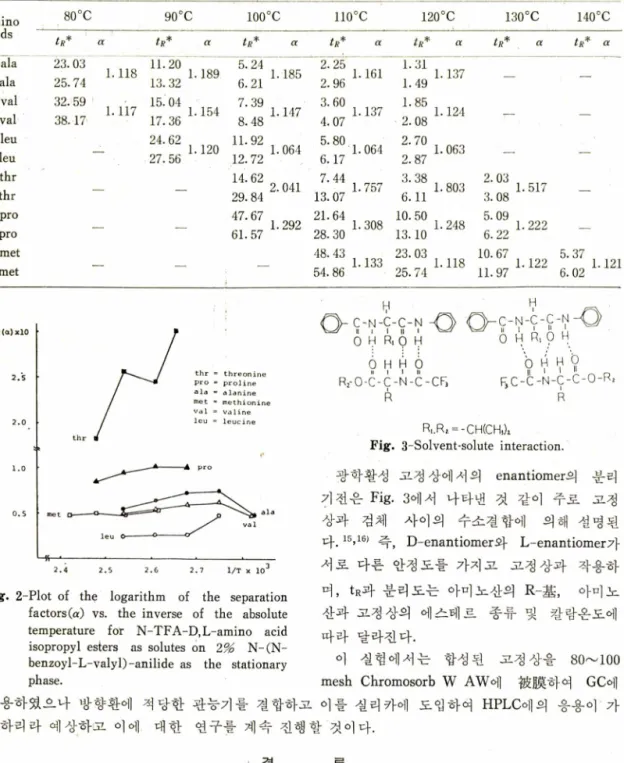
(Table I) .칼 람 온도와 « 값과의 관계 는
Fig. 2에 나타내 었
다
. A la nin e은 높은 온도에서도 완전한 피이
크 분리를 나타내 었고
threonine은 넓은 온도
범위에서 양호한 분리도를 나타내었다
.« 치는
leucine,valine, alanine, proline, threoninej頃으 로 커지고 칼람 유줄 순서는 지금까지 보고된 다른 고정상의 경 우와 동일하였 다
.더 긴 칼람 또는
capillary칼람을 이용하면
여 러 아미노산
enantiomer의 동시분리 가 가능
할 것 으로 예 상된 다
.보고된 다른 고정 상에 비 하여 좀더 높은 온도 가능하였다
.일 반적 으로
diam ide고정 상은 두
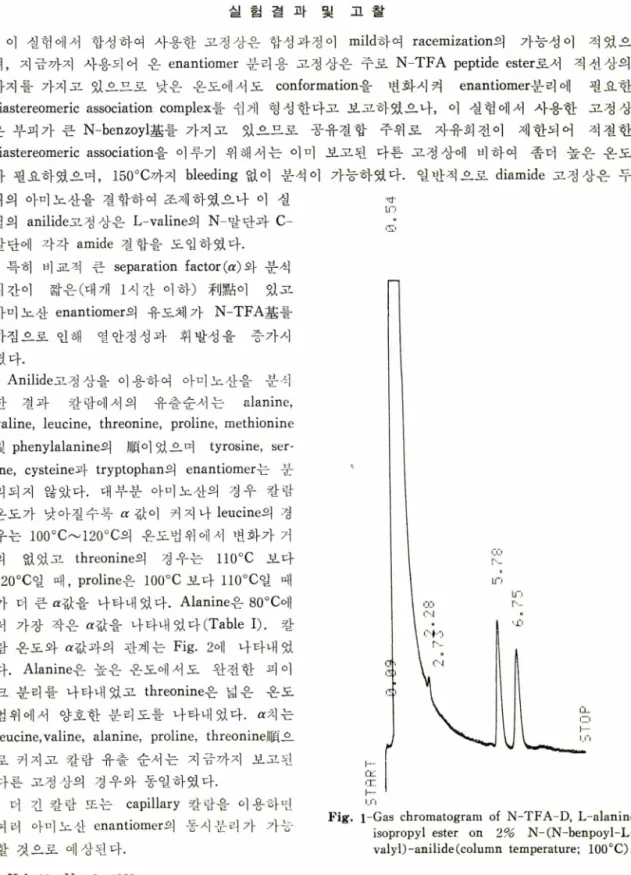
Fig. l-Gas chromatogram of N-TFA-D, L-alanine isopropyl ester on
2%N- (N-benpoyl-L- valyl) -anilide (column temperature; 100°C).
,
3^8
바만기• 휴재하•강총성
Table I
ᅳ
Corrected retention times and separation factors for N-TFA-D, L-amino acid isopropyl esters.amino acids
80 °C 90°C 100°C 110°C 120°C 130°C 140°C
//? * a tR * a tR * a tR * a tR * a tR * a tR * a
D-ala L-ala
23.03 1.118 25.74
11.20
13.32 1.189 5. 24
6. 21 1.185 2.25
2.96 1.161 1.31
1.49 1.137 - —
D-val L-val
32.59
38.17 7
15.04
17.36 *154 7. 39
8.48 1.147 3.60
4.07 1.137 1.85
2. 08 1.124 - —
D-leu
L-leu —
24. 62
27.56 .120 11.92
12.72 1.064 5.80
6.17 1.064 2.70
2.87 1.063 - —
D-thr
L-thr — —
14.62
29.84 2.041 7. 44
13. 07 1.757 3. 38
6.11 1.803 2.03
3. 08 1.517 — D-pro
L-pro — —
47.67
61.57 1.292 21.64
28. 30 1.308 10. 50
13.10 1.248 5.09
6.22 1.222 — D-met
L-met — — - 48. 43
54. 86 1.133 23. 03
25.74 1.118 10.67
11.97 1.122 5.37
^ 에 1 .1 2 1 6. 02
F ig . 2-Plot of the logarithm of the separation factors (a) vs. the inverse of the absolute temperature for N-TFA-D, L-amino acid isopropyl esters as solutes on 2% N-(N- benzoyl-L-valyl) -anilide as the stationary phase.
적용하였으나 방향환에 적 당한 관능기를 결합하고
능하리라 예상하고 이에 대한 연구를 계속 진행할 것이다
.O -C - N - C - C - N hQ
0 y R. 0 M o H Ri o H
0 H H 0 0 H H o
ii i I li |1 ' ' n
R2- 0 - C - C - N - C - C F 3 F3C - C - N - C - C - 0 - B 2
R R
R..Rz = -CH(CH,)i
Fig. 3-Solvent-solute interaction.광학활성 고정 상에 서 의
enantiomer의 분리
71
전은
Fig. 3에서 나타낸 것 같이 주로 고정
상과 검체 사이의 수소결합에 의해 설명된
다
. 15.16)즉,
D-enantiomer와
L-enantiom er가 서 로 다른 안정 도를 가지 고 고정상과 작용하 며
, tR과 분리도는 아미노산의
R -基
,아미노 산과 고정상의 에 스테 르 종류 및 칼람온도에 따라 달라진다
.이 실험 에서는 합성 된 고정상을
80~100mesh Chromosorb W A W
에 被膜하여
G C에 이 를 실리 카에 도입 하여
H P L C에 의 응용이 ᅵ 가
결 론
1. L-V aline, benzoyl chloride
및
a n ilin e을 이 용하여
N -(N -benzoyl-L-valyl)-anilide를 높은 수 율로 합상하였다
.-2..-1.
에 서 합 성 한
.물질을
Chromosorb W A W (80 ~ 10 0m esh)담체에 被膜하여
F ID를 이용한
가스크로마토그라피에 의한 아미노산 광학이성체:의 .'분라
가스크로마토그라피틀 행한 결과 N-TFA-D, L-아미노산(alanine, valine, leucine, threonine, proline, methionine ) 의 이소프로필 에스테르 형태의 enantiomer 를 분허할 수 있었다 .
3.
아미노산 외에도
am ide결합을 형성할 수 있는 화합물에의 응용이■가능하리라 思 料 된 다
.4. capillary 칼람을 이용하여 다수의 아미노산 enantiomer 에 대한 동시분리의 가능성을 제시 하 였다 .
문 헌
1. E. Gil-Av, R. Charles and G. Fischer, Resolution of amino acids by gas chromatography,
J. Gas Chromatogr. 17,408 (1965).2. B. Halpern and J.W . Westley, High sensitivity optical resolution of DL-amino acids by gas chromat
ography,
Biochem. and Biophys. Res. Comm.19, 361 (1965).
3. G.E. Pollock, H.I. Oyama and R.J. Johnson, Resolution of racemic amino acids by gas chromatography,
J. Gas Chromatogr.3,174 (1965).
4. B. Halpern and J.W. Westley, High sensitivity optical resolution of DL-amino acids by gas chromat
ography,
Chem. Comm.12, 246 (1965).
5. J.R. Steven, V.L. Alfons, A. Robert and I.K. Robert, Gas chromatography and GC-MS analysis of diastereomeric acyclic isoprenoid esters using fused-silica capillary columns,
J. Chromatogr.312, 395 (1984).
6. D. Miral and G.S. Michael, Separation of dipeptide diastereomers by high resolution GC,
J. Chromatogr.244
,
293 (1982).7. N. Oi, M. Horiba and H. Kitahara, Gas chromatographic separation of amino acid amide .: enantiomers on optically active stationary phases,
J. Chromatogr.202,299 (1980).
8. H. Su and K. Bernauer, Quantitation of the enantiomers of hydroxy amino acids by gas chromatographic resolution on an optically active packed column,
J. Chromatogr.301, 461 (1984).
9. S. Nakaparksin, P. Birrell, J. Oro and E. Gil-Av, Gas chromatography with optically active stationary phases: resoulation of amino acids,
J. Chromatogr. Sci.7, 177 (1970).
10. W. Koenig, W. Parr, H. Lichtenstein, E. Bayer and J. Oro, Gas chromatographic separation of amino acids and their enantiomers: non polar stationary phases and a new optically active phase,
J. Chromatogr. Sci.
7, 183 (1970).
11. E. Gil-Av, B. Feibush and R.Charles, Separation of enantiomers by gas liquid chromatography with an optically active stationary phase,
Tetrahedron Lett.1099 (1966).
12. J.A. Corbin, J.E. Rhoad and L.B. Rogers, Effects of structure of peptide stationary phases on gas chromatographic separations of amino acid enantiomers,
Anal. Chem.43, 327 (1971).
13. K. Gromann and W. Parr, Solid-phase peptide synthesis on an inorganic matrix having organic groups
on
the
surface, Chromatographia. 5, 18 (1972). .
14. S. Yamada, Y. Kasai and T. Shioiri, Diethyl phosphoryl cyanide. New reagent for synthesis of amides,
Tetrahedron Lett.1595 (1973).
15. C.H. Lochmuller and R.W. Souter, Chromatographic resolution of enantiomers: Selective review,
J.Chromatogr.