J. H. Choi ・ P. S. Choi ( ) 남부대학교 한방제약개발학과
(Department of Medicinal Plant Resources, Nambu University, Gwangju 506-824, Korea)
e-mail: [email protected] S. Y. Kwon
한국생명공학연구원
(Korea Research Institute of Bioscience and Biotechnology (KRIBB), 52 Eoeun-dong, Daejeon 305606, Korea)
동백나무 미숙배 배양으로부터 비정상 체세포배 형성과 식물체 재생
최종혜 ・ 권석윤 ・ 최필선
Anomalous somatic embryos formation and plant regeneration from the cultures of immature embryos of Camellia japonica L.
Jong Hye Choi ・ Suk Yoon Kwon ・ Pil Son Choi
Received: 12 October 2011 / Accepted: 28 October 2011
ⓒKorean Society for Plant Biotechnology
Abstract Embryogenic callus was induced from the cultures of immature embryos of Camellia japonica L. on Murashige
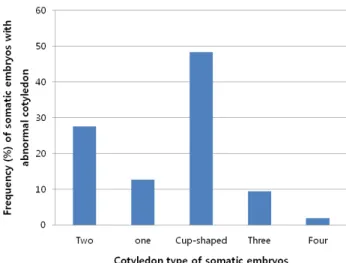
& Skoog’s (MS) solid medium supplemented with 1 mg/L 2,4-dichlorophenoxy acetic acid (2,4-D), and then the embryogenic callus was proliferated on same medium for 4 weeks over. The embryogenic callus was sub-cultured on MS basal medium without 2,4-D to produce coyledonary stage of somatic embryo. The frequency (%) of somatic embryogenesis was 25.1%, and the majority of somatic embryos formed had a abnormal morphology with cup- shaped cotyledon (48.3%), one cotyledon (12.6%), three cotyledons (9.4%), four cotyledons (1.9%), whereas was only normal morphology with two cotyledon (27.5%). When the somatic embryos with normal or abnormal cotyledons transfer to MS basal medium or ½ MS medium with/or without plant growth regulators (GA3, IBA) for regeneration, the frequency (%) of two-cotyledon embryos regenerated into plantlets was higher 11.1% than one cotyledon (0.0~8.3
%), three cotyledons (0.0~5.8%), four cotyledons (0.0%), cup-shaped (0.3~4.2%). These results demonstrated that the anomalous cotyledons of somatic embryos could caused to decrease the rate of plant regeneration.
Keywords Abnormal cotyledon, plant regeneration, somatic embryos
서 론
동백나무 (Camellia japonica L.)는 차나무과 동백나무속에 속하며 원산지는 우리나라를 포함한 아시아에 주로 분포 하는 교목성 활엽상록수로서 동절기부터 초봄에 이르기 까지 개화하며, 한 개의 과에 3~5개의 종자를 맺는 것으 로 알려져 있다 (Kang et al. 1998). 예로부터 동백유는 식 용유, 화장품 원료, 머리 기름으로 사용하여 왔으며, 한의 학 관점에서 건조한 잎은 토혈증상에 처방하거나 이뇨작 용에 널리 이용되어 왔고 (Kim et al. 2005), 스테롤과 토코 페롤 등의 오일성분과 triterpene, tannin, benzenoid, steroid, flavonoid 등의 인체 유용한 생리활성물질이 함유되어 있 어 (Pedroso and Pais 1993) 경제적 가치가 높은 목본식물 로 알려져 왔다. 동백나무는 전통적으로 삽목이나 실생 법을 통하여 개체증식이 이루어져 왔고, 최근 기내 조직 배양에 의한 대량증식 연구가 국내외에서도 활발하게 진 행되고 있다 (Mondal et al. 1998; Sandal et al. 2001; Kim et al. 2005). 특히 체세포배 발생을 통한 식물체 재분화 연 구는 성숙한 자엽 절편이나 잎 절편을 이용하여 보고되 어 왔지만 (Barciela and Vieitez 1993; Pedroso and pais 1993;
Kim et al. 2005), 체세포배로부터 식물체로의 전이 빈도 는 높지 않은 것으로 알려져 있다.
Buchheim 등 (1989)은 식물의 배양과정에서 체세포배 는 접합자배와 다른 형태가 발생되어 식물체 재생빈도를 감소시킨다고 하였으며, 조직학적 관찰을 통해 비정상적 인 자엽 형태의 발생은 비정상적인 경단분열조직의 형성 과 밀접한 관계가 있음을 시사한 바 있다 (Isabelle et al.
DOI:http://dx.doi.org/10.5010/JPB.2011.38.4.258 Research Article
1993; Soh et al. 2001). 또한 이러한 체세포배의 자엽 변이 는 배지에 첨가되는 식물생장조절제, 즉 2,4-dichlorophenoxy- acetic acid (Choi et al. 1994), abscisic acid (Lee and Soh 1994), cytokinins (Lee and Soh 1993b) 등이 원인이 될 수 있으며, 이는 식물체 재생빈도를 증가 (Lee and Soh 1993a) 또는 감 소 (Dos Santos et al. 1983; Isabelle et al. 1993) 시킬 수 있다 고 보고하였다. 따라서 동백의 체세포배 발생을 통한 식 물체 대량증식이나 형질전환체 생산 연구를 성공적으로 수행하기 위해서는 기내 배양과정에서 발생되는 체세포 배의 형태적 변이와 발생빈도를 파악해야 할 것이고, 각 비정상적인 체세포배의 식물체 재생빈도와 자엽의 형태 적 변이와의 상관관계를 이해해야 할 것이다. 본 연구에 서는 동백나무 미숙배 배양으로부터 발생되는 체세포배 의 자엽변이 형태, 발생빈도 및 식물체로의 발아율을 대 두 (Buchheim et al. 1989)와 더덕 (Soh et al. 2001)에서 제 시한 기준에 따라 조사함으로 그 상관관계를 이해하고자 수행하였다.
재료 및 방법
식물재료 및 배발생 캘러스 유도
광주광역시 남부대학교 캠퍼스에 자라고 있는 동백나무 로부터 2010년 8~9월경에 열매를 채취하여 > 10 mm크기 의 미숙배를 얻어 실험재료로 사용하였다. 미숙배는 70%
알코올로 3회 표면 살균한 열매로부터 무균적으로 조심 스럽게 분리하여 배발생 캘러스 유도배지 (MS salts, Eriksson’s vitamins, Thiamine-HCl, 1 mg/L 2,4-D, 3% sucrose, 100 mg/L myo-inositol, 0.8% Phyto agar, pH 5.8)에 치상한 후 24℃에 서 4주 이상 암 배양 하면서 배발생 캘러스를 유도하였 다. 이때 동백나무 미숙배로부터 형성된 배발생 캘러스 및 체세포배를 갖는 미숙배 절편 수를 조사하여 체세포 배 형성빈도를 조사하였다. 미숙배 배양은 3회 이상 반복 하여 수행하였다.
체세포배 유도 및 식물체 재분화
동백나무 미숙배로부터 왕성하게 자라는 연한 노란색의 배발생 캘러스를 선발하여 동일배지에 4주 간격으로 계 대 배양하면서 증식하였다. 배양 8주 후 배발생 캘러스로 부터 자엽기의 체세포배를 유도하기 위하여 2,4-D가 첨 가되지 않은 MS기본배지 (MS salts, Eriksson’s vitamins, Thiamine-HCl, 3% sucrose, 100 mg/L myo-inositol, 0.8% Phyto agar, pH 5.8, Murashige & Skoog 1962)에 옮겨 24℃로 조절 되는 배양실에서 광주기 (46 μmol m-2s-1의 16 hr)하에서 약 3주 이상 배양하였으며, 배양 4주째 각 배발생 캘러스
로부터 발생된 자엽기 체세포배에서 (300개 이상/회) 2개 의 자엽을 갖는 정상적인 체세포배와 비정상 자엽형태를 갖는 체세포배, 즉 1개 자엽, 3개자엽, 4개 이상의 자엽 그리고 Cup모양 자엽을 갖는 체세포배로 분류하여 (Buchheim et al. 1989; Soh et al. 2001) 각각의 발생빈도를 조사하였다.
또한 동백 배발생 캘러스로부터 형성된 2개의 자엽을 갖는 체세포배와 1개, 3개, 4개 이상 및 Cup 모양의 자엽 을 갖는 비정상적인 체세포배를 각각 분리하여 MS기본 배지, ½MS배지, 0.1 mg/L GA3가 첨가된 ½MS배지 및 0.1 mg/L IBA와 GA3가 조합첨가된 ½MS배지에 치상하여 식 물체 재생빈도를 측정하였다. 식물체 재생 기준은 1차엽 을 갖는 유경과 유근이 발생되었을 때 그리고 배양 6 주 후 조사하였다. 배양은 24℃로 조절되는 배양실에서 광 도 46 μmol m-2s-1의 16 시간 광주기하에서 배양 하였고, 유식물체는 토양으로 옮겨 온실에서 순화하였다.
결과 및 고찰
동백나무의 미숙배는 배양 2주 후부터 자엽 부위가 팽창 되고, 자엽 가장자리로 부터 연한 노란색의 캘러스가 느 리게 형성되기 시작하였으며, 배양 4주째에는 연한 노란 색의 단단한 배발생 캘러스가 얻어졌다 (Fig. 1A, B). 해부 현미경하에서 자엽부위로부터 형성된 배발생 캘러스를 조심스럽게 선발한 후 동일배지에 옮겨 8주 이상 배양한 결과 초기 배발생 캘러스보다는 약간 부드럽고 구형기의 체세포배를 포함한 배발생 캘러스가 왕성하게 증식되었 다 (Fig. 1C). 3회의 반복실험을 통하여 총 1,057개의 미숙 배를 배양한 결과 배발생 캘러스를 갖는 미숙배의 수는 265개로 약 25.1%의 체세포배 발생빈도를 보여 주었다 (데이터 미제시). 식물에 따라 체세포배 발생빈도는 식물 의 종, 식물재료, 성숙도, 배지, 호르몬의 조건에 따라 달 라질 수 있다. 특히 체세포배 발생이 어려운 종일수록 식 물의 재료는 매우 중요한 요인이 될 수 있기 때문에 세포 분화능이 높은 것으로 알려진 미성숙 배를 이용하는 경 우가 많다 (Choi et al. 2002; Cho et al. 2005). 또한 체세포 배 발생에서 식물호르몬의 영향도 중요한데, 그 중에서 식물 종에 따라 다른 호르몬이 효과적일 수 있지만 (Barciela and Vieitez 1993) 일반적으로 2,4-D를 사용하는 경우가 많 다 (Choi et al. 2002; Cho et al. 2005). 본 연구에서도 동백 의 미숙배로 부터 체세포배 발생 및 배발생 캘러스 유도 에 2,4-D첨가는 효과적이었으나, Barciela와 Vieitez (1993) 이 보고한 발생빈도 (75%)에 비하면 비교적 낮은 발생빈 도 (25.1%)를 보여 주었다. 이러한 차이는 호르몬으로서 2,4-D대신 1.0 mg/L BAP를 사용하였고, 고체배지 대신 액 체배양을 하였기 때문인 것으로 추정된다. 반면 식물호 르몬으로서 1.0 mg/L 2,4-D가 첨가된 MS배지에서 동백
Fig. 1 Somatic embryogenesis and anomalous cotyledons of somatic embryos developed from the cultures of immature embryos of Camellia Japonica L. A, B: Callus induction and somatic embryos formed from immature embryos after cultures of 2 - 3 weeks, C, D: Proliferation of embryogenic callus and development of somatic embryos with globular to heart stage from embryogenic callus, E-I: Cotyledonary somatic embryo with two cotyledons (E), one cotyledons (F), cup-shaped cotyledon (G), three cotyledons (H), multi-cotyledons (I), J-L:
Growth of shoot and plantlet developed from somatic embryos with two cotyledons, M: Plantlet grown in soil
자엽 절편을 배양하였을 때 9 ~ 36%의 발생빈도를 보여 준 결과와 배양 재료로서 잎과 줄기와 같은 분화된 조직 보다는 세포 분화능이 높은 자엽 절편을 사용하는 것이 중요하다고 보고한 (Kim et al. 2005) 결과와는 일치하고 있음을 보여 주었다.
초기 배발생 캘러스를 동일배지에 8주 이상 배양한 결 과 배양 초기에 얻어진 단단한 배발생 캘러스 보다는 구 형기 체세포배가 포함된 부드럽고 연한 노란색의 배발생 캘러스가 증식되었다 (Fig. 1D). 이러한 배발생 캘러스로 부터 체세포배를 유도하기 위하여 호르몬이 첨가되지 않 은 MS기본배지에 옮겨 3주 이상 배양한 결과 자엽기의 체세포배를 대량으로 얻을 수 있었다. 자엽기 체세포배 의 자엽 수를 관찰 한 결과 2개의 자엽을 갖는 정상적인 체세포배외에도 1개, 3개, 4개 이상 및 cup모양의 자엽을 갖는 비정상적인 체세포배가 관찰되었으며 (Fig. 1 E-I), 전체 903개의 체세포배중에서 2개의 자엽을 갖는 체세포 배는 27.5%였고, 나머지 비정상 형태의 체세포배가 72.5%
였다. 특히 비정상 체세포배중에서 1개 자엽은 12.6%, 3
개 자엽은 9.4%, 4개 이상의 자엽은 1.9%로 자엽의 수가 증가함에 따라 점점 감소하였고, cup모양의 자엽을 갖는 체세포배는 48.3%로 가장 높은 빈도를 나타냈다 (Fig. 2).
일반적으로 식물 조직배양과정에서 발생되는 체세포배 중에는 자엽의 형태적 변이가 발생될 수 있음을 보고 하 였고 (Ammirato 1987), 그 원인은 배지에 첨가되는 식물호 르몬의 종류와 농도, 탄수화물, 오옥신 이동억제제 등이 원인이 될 수 있다 (Komatsuda 1992; Liu et al. 1993; Soh et al. 2001). 특히 2,4-D는 강력한 세포분열 촉진제 일뿐 아니라 체세포발생에 필수 성분으로서 대두 미숙배를 고 농도 (2,4-D)로 첨가된 배지에 배양 할 경우 다자엽 형태 를 갖는 체세포배가 발생될 수 있고 (Choi et al. 1994), 고 농도 sucrose가 첨가된 배지에서 더덕 및 대두의 미숙배 를 배양할 경우 1개, 3개, 4개 이상 및 cup모양의 자엽을 갖는 비정상 체세포배 발생이 일어날 수 있음을 보고 한 (Komatsuda 1992; Soh et al. 2001) 결과와 유사한 경향을 보여 주었다. 이와 같이 기 연구의 보고와 마찬가지로 본 연구에서도 동백의 체세포배 중에는 비정상 체세포배가 높
Fig. 2 Frequency (%) of somatic embryos with normal or abnormal cotyledons developed from the cultures of immature embryos of Camellia japonica L
Fig. 3 Plant regeneration from somatic embryos with normal or abnormal cotyledons on MS basal medium (A), ½ MS medium (B),
½ MS medium with 0.1 mg/L GA3 (C), and ½ MS medium supplemented with combination of 0.1 mg/L of GA3 and IBA (D)
은 빈도로 발생됨을 알 수 있었고, 이러한 현상은 구형기 체세포배로부터 자엽 초기발달시기에 내재 오옥신의 극성 이동이 불균등하게 일어남으로써 생긴 현상이라고 추측할 수 있다 (Liu et al. 1993; Ramesar-Fortner and Yeung 2001).
자엽기의 체세포배를 해부현미경하에서 2개, 1개, 3개, 4개 이상 및 cup모양의 자엽을 갖는 체세포배를 분류하 여 MS기본배지, ½MS배지, 0.1 mg/L GA3 가 단독첨가된
½MS배지 그리고 0.1 mg/L IBA와 GA3가 조합 첨가된 ½ MS배지에서 각각 식물체 재생빈도를 조사하였다. 배양 3주 후 2개의 자엽을 갖는 정상 체세포배와 비정상 체세 포배 모두 0.1 mg/L IBA와 GA3가 조합첨가된 ½ MS배지 에서 가장 높은 식물체 재생빈도를 보여 주었고, MS기본 배지에서는 거의 식물체로의 재생이 이루어지지 않아 0.1 mg/L IBA와 GA3가 식물체 재생에 효과적임을 알 수 있었다. 또한 2개의 자엽을 갖는 정상 체세포배는 1개, 3 개, 4개 이상 및 cup모양의 자엽을 갖는 비정상 체세포배 에 비하여 모든 배지에서 높은 식물체 재생빈도를 보여 주었으며, 특히 cup모양은 최대 4.2%, 1개 자엽은 8.3%, 3개 자엽은 5.8%로 낮은 식물체 재생빈도를 나타냈다 (Fig. 3).
유경과 유근이 발달된 유식물체는 토양으로 옮겼을 때 정상적인 건강한 식물체로 자랐다 (Fig. 1J-M). 비정상 체 세포배의 경우 2개의 자엽을 갖는 체세포배에 비하여 발 아율이 높을 수 있다는 상반된 연구 결과가 있지만 (Lee and Soh 1993a), 대부분의 연구에서는 비정상 자엽을 갖 는 체세포배의 경우 비정상적인 정단분열조직을 형성함 으로서 식물체로의 재생빈도를 감소시킨다고 보고 하고 있다 (Faure 1990; Isabelle et al. 1993). 이와 같이 기존의 연구와 마찬가지로 2개의 자엽을 갖는 정상 체세포배에 비하여 비정상 체세포배가 식물체로의 낮은 재생율을 보 여 준 것은 비정상적인 정단분열조직의 발달에 기인한
것으로 추정되며, 이는 근본적으로 배양액 첨가는 탄수 화물이나 식물호르몬의 불균등한 분포에 의하여 일어난 현상으로 추정할 수 있었다. 따라서 동백을 포함한 많은 식물에서 고빈도의 식물체체 재생빈도를 증가시키고, 향 후 식물형질전환을 위한 재분화시스템으로 이용하고자 할 때는 비정상 체세포배의 발생빈도를 줄일 수 있는 배 양조건의 규명이 선행 되어야 할 것으로 사료된다.
적 요
동백의 배발생 캘러스는 1 mg/L 2,4-D가 첨가된 MS배지 에서 미숙배 배양을 통해 유도하였으며, 동일배지에 계 대 배양하여 4주 이상 증식시켰다. 배발생 캘러스로부터 자엽기 체세포배를 생산하기 위하여 2,4-D가 첨가되지 않은 MS기본배지 배양하였다. 동백 미숙배로부터 체세 포배 발생율은 25.1%였으며, 형성된 대부분의 체세포배 중에서 48.3%가 cup모양, 12.6%가 1개 자엽, 9.4%가 3개 자엽, 1.9%가 4개 자엽을 갖는 비정상적인 형태의 체세포 배였으며, 반면 2개의 자엽을 갖는 정상적인 체세포배는 27.5%였다. 정상 및 비정상형태의 체세포배를 MS기본배 지, ½MS배지, 0.1 mg/L GA3가 첨가된 ½MS배지 및 0.1 mg/L IBA와 GA3가 조합 첨가된 ½MS배지에 치상하였을 때 2개의 자엽을 갖는 정상체세포배의 식물체 재생율이 11.1%로 0.0 ~ 8.3%를 나타내는 1개 자엽 (0.0 ~ 8.3%), 3개 자엽 (0.0 ~ 5.8%), 4개 자엽 (0.0%) 및 cup 모양 (0.3 ~ 4.2%) 보다 높았다. 이러한 결과로 볼 때 비정상 자엽을 갖는 체세포배 빈도가 높을수록 식물체 재생빈도가 감소될 수 있음을 알 수 있었다.
사 사
본 논문은 농촌진흥청 차세대 바이오그린21사업 (식물분 자육종사업단 과제번호: PJ008103)의 지원에 의해 이루어 진 것임.
인용문헌
Ammirato PV (1987) Organizational events during somatic embryogenesis. In: Green CE (ed), Plant Tissue and Cell Culture, Alan R Liss, New York, pp 57-81
Barciela J, Vieitez AM (1993) Anatomical sequence and morphometric analysis during somatic embryogenesis on cultured cotyledon explats of Camellia japonica L. Ann Bot 71:395-404
Buchheim JA, Colnurn SM, Ranch JP (1989) maturation of soybean somatic embryos and the transition to plant growth.
Plant Physiol 89:768-775
Cho MA, Park YO, Kim JS, Park KJ, Min HK, Liu JR, Choi PS (2005) Yellowish friable embryogenic callus (YFEC) pro- duction and plant regeneration from immature embryo cultures of domestic maize cultivars and genotypes (Zea may L.).
Korean J Plant Biotechnol 32:117-121
Choi PS, Komatsuda T, Kim MH, Choi KM, Choi DW, Liu JR (2002) Screening of soybean recombinant lines for high competence somatic embryogenesis. Korean J Plant Biotechnol 29:135-138
Choi PS, Soh WY, Cho DY, Liu JR (1994) Somatic embryogenesis on cultures of Korean soybean (Glycine max L.) cultivars and effects of 2,4-dichlorophenoxyacetic acid. Kor J Plant Tiss Cult 21:7-13
Dos Santos AVP, Cutter EG, Davey MR (1983) Origin and development of somatic embryos in Medicago sativa L.
(Alfalfa). Protoplasma 117:107-115
Faure O (1990) Embruons somatiques de Vitis rupestris et embryons zygotiques de Vitis sp.: morphologie, histology, histochimie et development. Can J Bot 68:2305-2315
Isabelle GT, Mauro MC, Sossountzov L, Miginiac E, Deloire A (1993) Arrest of somatic embryo development in grapevine:
histological characterization and effect of ABA, BAP and zeatin in stimulating plantlet development. Plant Cell Tiss
Org Cult 33:91-103
Kang SK, Kim YD, Choi OJ (1998) Proximate, saponin and amino acid compositions in camellia (Camellia japonica L.) seeds and defatted camellia seeds. J Korean Soc Food Sci 27:
227-231
Kim KS, Hwang SJ, Pyo BS, Kim SM (2005) Adventitious bud induction and plant regeneration from cotyledon explants of Camellia japonica L. Korean J Medicinal Crop Sci 13:
105-108
Komatsuda T (1992) Research on somatic embryogenesis and plant regeneration in soybean. Natl Inst Agrobiol Resources (Japan) Ann Rep: 71-78
Lee KS, Soh WY (1993a) Somatic embryogenesis and structural aberrancy of embryos in tissue cultures of Aralia cordata Thumb. Kor J Plant Tiss Cult 20:77-84
Lee KS, Soh WY (1993b) Effects of cytokinins on the number of cotyledons of somatic embryos from cultured cells of Aralia cordata Thumb. Kor J Plant Tiss Cult 20:171-175
Lee KS, Soh (1994) Effects of ABA on the number of somatic embryo cotyledons in tissue cultures of Aralia cordata Thunb.
Korean J Plant Tiss Cult 21:287-291
Liu CM, Xu ZH, Chua NH (1993) Auxin polar transport is essential for the establishment of bilateral symmetry during early plant embryogenesis. Plant Cell 5:621-630
Mondal TK, Bhattacharya A, Sood A, Ahuja PS (1998) Micropropagation of tea (Camellia sinensis L., O. Kuntze) using thidiazuron. Plant Growth Regulation 26:57-61 Murashige T, Skoog F (1962) A revised medium for rapid growth
and bioassay with tobacco tissue cultures. Physiol Plant 15:
473-497
Pedroso MC, Pais MS (1993) Direct embryo formation in leaves of Camellia japonica L. Plant Cell Rep 12:639-643
Ramesar-Fortner NS, Yeung EC (2001) Tri-iodobenzoic acid affects shoot apical meristem formation and function in zygotic embryos of Brassica napus cv. Topas. Can J Bot 79:
265-273
Sandal I, Bhattacharya A, Ahuja PS (2001) An efficient liquid culture system for tea shoot proliferation. Plant Cell Tiss Org Cult 65:75-80
Soh WY, Choi PS, Cho DY, Liu JR (2001) Plant regeneration from somatic embryos with anomalous cotyledons formed in cell cultures of Codonopsis lanceolata. Phytomorphology Golden Jubilee Issue 327-336