가소화된 Poly(vinyl chloride)-g-Poly(oxyethylene methacrylate) 가지형 고분자 전해질막 제조 및 분석
서 진 아·고 종 관·고 주 환·김 종 학
† 연세대학교 화공생명공학과(2011년 6월 28일 접수, 2011년 8월 3일 수정, 2011년 8월 3일 채택)
Preparation and Characterization of Plasticized Poly(vinyl chloride)-g-Poly(oxyethylene methacrylate) Graft Copolymer Electrolyte Membranes
Jin Ah Seo, Jong Kwan Koh, Joo Hwan Koh, and Jong Hak Kim†
Department of Chemical and Biomolecular Engineering, Yonsei University, 262 Seongsanno, Seodaemun-gu, Seoul 120-749, Korea
(Received June 28, 2011, Revised August 3, 2011, Accepted August 3, 2011)
요 약: Poly(vinyl chloride)-g-poly(oxyethylene methacrylate) (PVC-g-POEM) 가지형 공중합체를 원자전달라디칼 중합 을 통해 합성하여 전기변색소자의 전해질에 적용하였다. 가소화된 고분자 전해질은 가소제로서 propylene carbonate (PC)/ethylene carbonate (EC) 혼합물을 도입하여 제조하였으며, Lithium tetrafluoroborate (LiBF
4), lithium perchlorate (LiClO
4), lithium iodide (LiI) and lithium bistrifluoromethanesulfonimide (LiTFSI)를 사용하여 염의 종류에 따른 영향을 조 사하였다. 광각 x-선 산란(WAXS)과 시차주사 열량법(DSC) 측정 결과 고분자 전해질의 구조와 유리전이온도(T
g)가 변하였 고, 이는 POEM 내의 에테르의 산소와 리튬염 사이의 상호작용으로 인해 변했다는 것을 FT-IR 분광법을 통하여 확인하였 다. 투과전자현미경(TEM) 측정 결과 PVC-g-POEM 가지형 공중합체의 미세상분리 구조가 PC/EC와 리튬염의 도입에도 변 하지 않는 것을 관찰하였다. 가소화된 고분자 전해질은 poly(3-hexylthiophene) (P3HT) 전도성 고분자를 이용한 전기변색 소자에 적용되었다.
Abstract: Poly(vinyl chloride)-g-poly(oxyethylene methacrylate) (PVC-g-POEM) graft copolymer was synthesized via atom transfer radical polymerization (ATRP) and used as an electrolyte for electrochromic device. Plasticized polymer elec- trolytes were prepared by the introduction of propylene carbonate (PC)/ethylene carbonate (EC) mixture as a plasticizer. The effect of salt was systematically investigated using lithium tetrafluoroborate (LiBF
4), lithium perchlorate (LiClO
4), lithium io- dide (LiI) and lithium bistrifluoromethanesulfonimide (LiTFSI). Wide angle X-ray scattering (WAXS) and differential scan- ning calorimetry (DSC) measurements showed that the structure and glass transition temperature (T
g) of polymer electrolytes were changed due to the coordinative interactions between the ether oxygens of POEM and the lithium salts, as supported by FT-IR spectroscopy. Transmission electron microscopy (TEM) showed that the microphase-separated structure of PVC-g-POEM was not greatly disrupted by the introduction of PC/EC and lithium salt. The plasticized polymer electrolyte was applied to the electrochromic device employing poly(3-hexylthiophene) (P3HT) conducting polymer.
Keywords: atom transfer radical polymerization, graft copolymer, electrochromic device, polymer electrolyte, conducting polymer
1. Introduction
1)
Recently, polymer electrolyte membranes have re- ceived much attention due to their unique properties in
†교신저자(e-mail: [email protected])
various areas such as lithium batteries [1], polymer
electrolyte membrane fuel cells [2], facilitated transport
membranes [3], dye-sensitized solar cells [4] and elec-
trochromic devices [5]. Electrochromic devices exhibit
redox states with distinct electronic absorption spectra
generally investigated as a thin film on electrode surfa- ces [9]. Liquid electrolytes can provide high ionic con- ductivity to electrochromic devices. However, solid polymer electrolytes are advantageous in terms of good mechanical properties, the flexible design of electro- chromic device, ease of thin films formation with de- sirable sizes and no problems associated with the leak- age or evaporation of solvent [10,11].
Poly(ethylene oxide) (PEO) is a representative poly- mer which is commonly used in polymer electrolytes due to its good complex formation capability with met- al salt and ionic liquid. However, the ionic con- ductivity of PEO-based polymer electrolyte has been limited due to the high crystallinity of PEO [12].
Poly(oxyethylene methacrylate) (POEM) is a well-known amorphous PEO that possesses a high ionic con- ductivity but poor mechanical properties. In order to improve mechanical properties, POEM has been modi- fied using crosslinking and copolymerization methods [13,14].
In this study, poly(vinyl chloride)-g-poly(oxyethylene methacrylate) (PVC-g-POEM) graft copolymer was synthesized via atom transfer radical polymerization (ATRP) and plasticized with propylene carbonate (PC)/ethylene carbonate (EC) mixture. The effect of salt was systematically investigated using lithium tetra- fluoroborate (LiBF
4), lithium perchlorate (LiClO
4), lith- ium iodide (LiI) and lithium bistrifluoromethanesulfonimide (LiTFSI). Wide angle X-ray scattering (WAXS), differ- ential scanning calorimetry (DSC), FT-IR spectroscopy and transmission electron microscopy (TEM) were used to characterize the structures and morphologies of the polymer electrolytes. The properties of electrochromic device fabricated with the plasticized polymer electro- lyte and a conducting polymer, i.e. P3HT are also reported.
= 55,000 g/mol), poly(oxyethylene methacrylate) (POEM, poly(ethylene glycol) methyl ether methacrylate, M
n= 475 g/mol), lithium tetrafluoroborate (LiBF
4, 99.998%), lithium perchlorate (LiClO
4, 99.99%), lithium iodide (LiI, 99.9%), lithium bistrifluoromethanesulfonimide (LiTFSI, 99.95%), poly(3-hexylthiophene) (P3HT, re- gioregular), propylene carbonate (PC) and ethylene car- bonate (EC) were purchased from Aldrich and used as received without further purification.
2.2. Synthesis of PVC-g-POEM Graft Copolymer PVC-g-POEM graft copolymer was synthesized ac- cording to the previously reported method [15]. In brief, 3 g of PVC was dissolved in 40 ml of N-methyl pyrrolidone (NMP) while stirring at 60°C. Then, 18 g of POEM, 0.24 g of CuCl and 0.66 mL of HMTETA were added to the solution. The reaction flask was sealed with a rubber septum and purged with nitrogen gas for 30min. Then the flask was immersed in an oil bath for 24 h at 90°C. After passing the solution through a column with activated Al
2O
3to remove the catalyst, it was precipitated into methanol. The polymer was purified by redissolving in THF and reprecipitating in methanol for several times. Finally, the polymer was dried in a vacuum oven overnight at room temperature.
2.3. Preparation of Polymer Electrolytes
Appropriate amount of PVC-g-POEM graft copoly- mer was dissolved in tetrahydrofuran (THF) to make 30 wt% polymer solution. After complete dissolution, PC and EC were added to this solution as a plasticizer with PVC-g-POEM : PC : EC = 8 : 1 : 1 weight ratio.
Five kinds of lithium salt were added at 0.1 M to the
as-prepared solution. These polymer electrolyte sol-
utions were stirred for overnight to make homogeneous
solutions. Then, the solutions were casted on the
Teflon-coated dish and dried in a drying oven and vac-
uum oven successively at 40°C for 24 h.
Scheme 1. Chemical structure of PVC-g-POEM graft co- polymer, PC and EC.
Fig. 1. FT-IR spectra of pristine PVC, PVC-g-POEM and PVC-g-POEM/PC/EC.
2.4. Fabrication of Electrochromic Device
First, P3HT was dissolved in monochloromethane and then spin-coated on the indium tin oxide (ITO) conducting glass at 1,000 rpm for 20 sec and dried at room temperature. Polymer electrolyte solutions were directly casted on the ITO glass and sandwiched with P3HT-coated ITO glass. Electrochromic device was dried at 40°C for 24 h.
2.5. Characterization
FT-IR spectra of samples were collected using Excalibur Series FTIR (DIGLAB Co.) instrument be- tween the frequency ranges of 4,000 to 400 cm
-1using ATR facility. WAXS measurements were performed with a Rigaku D/max-RB apparatus (Tokyo, Japan).
Data were collected from 5° to 60° at rate of 1°/min.
DSC (DSC 2920, TA Instruments, INC.) was used to characterize the materials at a heating rate of 20°C/min under a N
2environment. TEM pictures were obtained from a Philips CM30 microscope operating at 300 kV.
For TEM measurements, the polymer was dissolved in THF and then a drop of these samples was placed on- to a standard copper grid. Tensile evaluation was per- formed on universal testing machine (UTM, a LR10
KPlus Series) at a speed of 5 mm/min. Ionic con- ductivity was measured under a dry atmosphere using an impedance analyzer (IM6, ZAHNER, Germany) and a lab-made 2-probe conductivity cell. The impedance spectra of electrolytes were used to generate Nyquist plots, and the ionic conductivity was calculated from the plots. CHI624B (CH Instruments) potentiostat was used for source-drain voltage application and ampero- metric detection.
3. Results and Discussion
The chemical structures of PVC-g-POEM graft co- polymer, PC and EC are presented in Scheme 1.
Polymerization of PVC-g-POEM graft copolymer was
carried out at 90°C for 24 h using CuCl and HMTETA
as catalyst and ligand, respectively. The PC/EC mix-
ture functioned as a plasticizer to increase the ionic
conductivity of polymer electrolytes. Fig. 1 shows the
FT-IR spectra of the pristine PVC, PVC-g-POEM and
PVC-g-POEM/PC/EC. PVC-g-POEM graft copolymer
exhibited absorption bands at 1,727 and 1,097 cm
-1, as-
signed to the stretching vibration of C = O and C-O-C
group in POEM domain, respectively [14]. Upon the in-
troduction of PC/EC mixture, a new absorption band at
1805 cm
-1appeared, attributed to the C = O bond of
PC/EC. The absorption bands of C = O and C-O-C
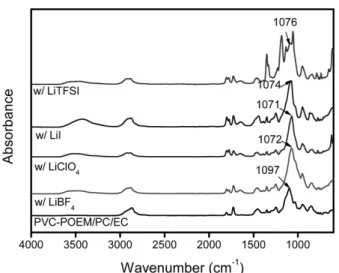
Fig. 2. FT-IR spectra of PVC-g-POEM/PC/EC electrolytes with and without Li salt.
Fig. 3. WAXS patterns of PVC-g-POEM and PVC-g- POEM/PC/EC electrolytes with and without Li salt.
group in PVC-g-POEM graft copolymer were almost unchanged, indicating weak interactions between PVC- g-POEM and PC/EC.
To investigate interaction between the lithium salts and PVC-g-POEM/PC/EC, the FT-IR spectra of PVC- g-POEM/PC/EC with and without various lithium salts were measured and presented in Fig. 2. When the salts were added to the graft copolymer, the ether peak of PVC-g-POEM was shifted to a lower wavenumber, in- dicating the coordinative interaction between the lith- ium ions and the ether oxygen in POEM. In the case of PVC-g-POEM/PC/EC/LiClO
4, the peak shift was the largest (from 1,097 to 1,071 cm
-1), indicating the stron- gest interactions.
The changes in d-spacing and structure of polymer electrolyte were investigated using WAXS analysis.
The WAXS patterns for PVC-g-POEM, PVC-g-POEM/PC/EC and PVC-g-POEM/PC/EC/LiX (X = BF
4, ClO
4, I and TFSI) electrolytes are shown in Fig. 3. The intensity of X-ray scattering was plotted against the diffraction angle (2 θ). Pristine PVC-g-POEM graft copolymer showed a broad amorphous peak at 19.7° due to the lack of crystallinity. Upon the introduction of PC/EC as a plasticizer, there was no significant change in WAXS pattern, indicating negligible interaction be- tween PVC-g-POEM and PC/EC. When lithium salts such as LiBF
4, LiClO
4and LiI were introduced into
PVC-g-POEM/PC/EC, the shape became asymmetric and an additional shoulder peak appeared at around 24°, which resulted in the decrease of d-spacing ac- cording to the Bragg’s equation ( λ = 2dsinθ). It aris- es from the structural contraction of polymeric chains due to coordinative interactions between lithium ions and polymer matrix. For PVC-g-POEM/PC/EC/LiTFSI electrolyte, interestingly, the main peak at 19.7° was shifted to 18.7° and a shoulder peak appeared at 13.9°.
The increase of d-spacing in LiTFSI-based polymer electrolyte might be due to chain repulsion due to the large size of TFSI
-anions.
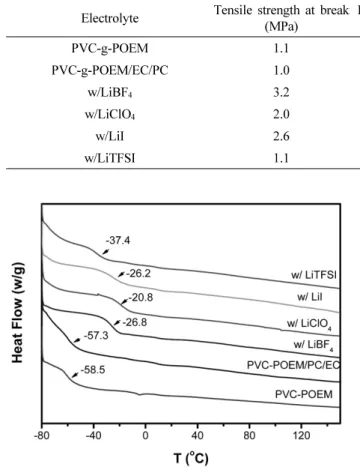
DSC measurement is an effective tool to determine the glass transition temperature (T
g) of polymer. The DSC curves for pristine PVC-g-POEM, PVC-g-POEM/
PC/EC and its electrolytes with four lithium salts are
shown in Fig. 4. In the pristine PVC-g-POEM graft
copolymer, the T
gat -58.5°C was observed, attributable
to rubbery POEM side chains. However, the T
gof
glassy PVC main chains was not clearly observed pre-
sumably due to high grafting degree. In the PVC-g-
POEM/PC/EC system, there was no significant peak
shift, indicating negligible interactions between PVC-g-
POEM and PC/EC, which is consistent with FT-IR and
WAXS data. Upon the introduction of lithium salt, the
T
gof POEM was always increased but strongly de-
pendent on the kind of salt. It may be due to different
Fig. 4. DSC curves of PVC-g-POEM and PVC-g-POEM/
PC/EC electrolytes with and without Li salt.
Fig. 5. TEM images of (a) PVC-g-POEM/PC/EC/LiI and (b) PVC-g-POEM/PC/EC/LiTFSI.
Table 1. Ionic Conductivities and UTM Data of PVC-g-POEM/PC/EC/Li Salt Polymer Electrolytes
Electrolyte Tensile strength at break(MPa)
Elongation at break (%)
Young’s modulus (MPa)
Conductivity (S/cm)
PVC-g-POEM 1.1 179.2 0.9 -
PVC-g-POEM/EC/PC 1.0 108.9 1.1 -
w/LiBF4 3.2 117.1 35.5 3.1 × 10⁻⁵
w/LiClO4 2.0 141.0 11.2 4.1 × 10⁻⁵
w/LiI 2.6 204.0 13.9 3.8 × 10⁻⁵
w/LiTFSI 1.1 163.8 1.5 3.3 × 10⁻⁵