• 검색 결과가 없습니다.

Condylar Hyperplasia with Long-standing Temporomandibular Joint Dislocation

N/A
N/A
Protected

Academic year: 2021

Share "Condylar Hyperplasia with Long-standing Temporomandibular Joint Dislocation"

Copied!
5
0
0

로드 중.... (전체 텍스트 보기)

전체 글

(1)

pISSN: 1225-4207 eISSN: 2233-7296

Case Report

RECEIVED September 16, 2013, REVISED October 23, 2013, ACCEPTED December 3, 2013 Correspondence to Il-Kyu Kim

Department of Oral and Maxillofacial Surgery, Section of Dentistry, Inha University Hospital 27 Inhang-ro, Jung-gu, Incheon 400-711, Korea

Tel: 82-32-890-2470, Fax: 82-32-890-2475, E-mail: [email protected]

CC

This is an open access article distributed under the terms of the Creative Commons Attribution Non-Commercial License (http://creativecommons.org/licenses/

by-nc/3.0) which permits unrestricted non-commercial use, distribution, and reproduction in any medium, provided the original work is properly cited.

Condylar Hyperplasia with Long-standing Temporomandibular Joint Dislocation

Il-Kyu Kim, Hyun-Young Cho, Bum-Sang Jung, Sang-Pill Pae, Hyun-Woo Cho, Ji-Hoon Seo

Department of Oral and Maxillofacial Surgery, Section of Dentistry, Inha University School of Medicine

Abstract

Mandibular condylar hyperplasia is an uncommon condition of excessive unilateral growth of the condyle causing facial asymmetry and occlusal alterations. The etiology of condylar hyperplasia is unclear, but several factors are suspected, including previous trauma, hormonal disturbances, and abnormal functional loadings. Acute or chronic recurrent dislocation of temporomandibular joint (TMJ) is common, but long-standing dislocation is rare. We present two cases of the exophytic condylar hyperplasia that lasted for over 20 years with TMJ dislocation. In both cases, we performed a condyloplasty to restore normal occlusion and facial symmetry, with satisfactory results.

Key words: Condylar hyperplasia, Temporomandibular joint disc, Dislocation, Codyloplasty

Introduction

Condylar hyperplasia is a rare pathology first described in 1836 as an overgrowth of the mandible condyle[1]. This condition is more common in younger age groups[2], and usually causes facial asymmetry and derangement of occlusion. Additionally, patients may present with symp- toms such as joint sounds, pain and occlusal dis- turbances[1,3].

Temporomandibular joint (TMJ) dislocation is defined as a displacement of the condyle anteriorly beyond the articular eminence[4]. This condition can be classified into three categories: acute, habitual, and long standing dis- location[5]. Acute dislocation is defined as an anteriorly displaced condyle that cannot be reduced by the patient.

Habitual dislocation or chronic recurrent dislocation is de-

fined as a repeated dislocation becoming more frequent, with the patient able to relocate the condyle into its normal position. Long-standing dislocation or protracted dis- location is defined as a dislocation that is not relocated immediately[6].

An 82-year-old woman and a 64-year-old man visited

Inha University Hospital with a chief complaint of mandible

deviation with facial asymmetry for over 20 years. By clin-

ical and radiographic examinations, we found an exophytic

condylar hyperplasia with TMJ dislocation and severe

malocclusion. We performed condyloplasty and resection

of the exophytic portion of the condylar head, and obtained

satisfactory functional and esthetic results. This paper pres-

ents the authors’ experience of managing condylar hyper-

plasia with long-standing TMJ dislocation, and describes

the surgical management of this problem.

(2)

Fig. 1. Pre-operative intraoral photograph. Deviation of mandibular dental midline (arrows) to the left side with anterior and left posterior crossbite.

Fig. 2. Pre-operative radiograph. (A) Pre-operative panorama reveals a hyperplastic condylar head (arrows) with mandibular midline deviation (arrowheads). (B) Horizontal view of computed tomography scan reveals a hyperplasia of right condylar head (arrows) with anterior dislocation from mandibluar fossa (*).

Fig. 3. Post-operative radiograph re- veals the reshaped right condylar head with coronoidectomy (arrowhead) and relocation of the condylar head to the mandibular fossa (arrows). (A) Panorama X-ray. (B) Coronal view of computed tomography (CT) with 3-dimensional- facial CT.

Case Report

1. Case 1

An 82-year-old woman was referred to our clinic on November 2008. Her chief complaint was a deviation of her mandible on the left side and facial asymmetry, lasting for about 30 years. She did not remember the causes of the mandible deviation. On clinical examination, her lower face was deviated to the left side and facial asymmetry was visible but the overlying skin in the right preauricular area appeared normal. Maximum mouth opening was 40 mm with a deviation of the mandible to the right side.

There were joint sounds on the right side at the mouth opening but no pain on the bilateral side. An intraoral examination showed a left anterior and posterior complete cross-bite, missing most occlusal contacts, although oc- clusal canting was not observed. The lower midline had deviated 20 mm from the maxillary dental midline to the left side (Fig. 1). A panoramic radiograph demonstrated a predominantly radiopaque image at the right dis- located-condylar head (Fig. 2A). Computed tomography (CT) scans showed an irregular shape of bone lesion in the infra-temporal fossa area. This mass anteriorly, superi- orly and medially extended from the condyle. The condylar head was also anteriorly displaced from the articular emi- nence and seated to the infra-temporal fossa (Fig. 2B).

The patient was hospitalized for a resection of the bony

mass and a reshaping of the right condylar head in

December 2008. Under general anesthesia, the right con-

dylar head was totally exposed by a preauricular approach,

and a condyloplasty accompanied with the resection of

a hyperplastic and exophytic bony mass on condylar head

was carried out. A coronoidectomy was also performed

through an intraoral and preauricular approach, expecting

easy condylar head reduction. During the operation, ease

of manual condylar head reduction was confirmed, since

there was no contralateral mandibular osteotomy. After

intermaxillary fixation, the condylar head was repositioned

(3)

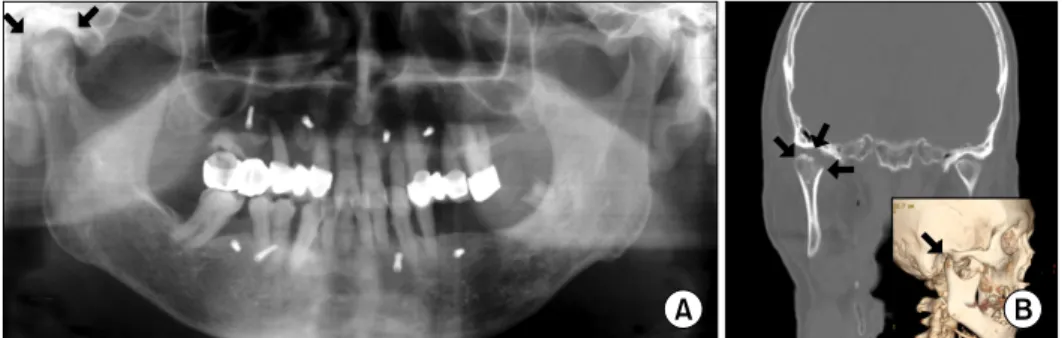
Fig. 6. Pre-operative radiograph. (A) Panoramic view reveals a hyper- plastic condylar head (arrows) with mandibular midline deviation (arrow- heads). (B) Horizontal view of com- puted tomography (CT) with 3-di- mensional-facial CT reveals a hyper- plasia of right condylar head (ar- rows) with anterior dislocation from mandibluar fossa.

Fig. 4. Hyperplasia with reactive woven bone formation (H&E,

×40). Fig. 5. Pre-operative intraoral photograph. Deviation of mandibular

dental midline to the left side (arrows).

to the mandibular fossa. The translation of the condyle immediately following surgery showed a good relationship with the articular eminence (Fig. 3). Pathologic changes of intra-articular components were not noted, but hyper- plasia with reactive woven bone formation was found on biopsy of the excised bone (Fig. 4). The panoramic view taken at the six-month exam showed the condylar head moved to the articular eminence and a 5 mm-mandibular deviation to the left side. However, the patient had sat- isfactory functional and esthetic results with 45 mm mouth opening and no facial paralysis.

2. Case 2

A 64-year-old man was referred to our clinic on March 2010. His chief complaint was a deviation of mandible and an unstable occlusion for about 20 years. He did not remember the causes of the mandible deviation. The clin- ical examination disclosed a facial asymmetry and chin deviated to the left side. Upon mouth opening, the man- dible deviated to the right side. There was an articular

crepitus on both sides of the TMJ at the mouth opening but no pain. An intraoral examination yielded a left anterior and posterior cross-bite without occlusal canting. The low- er dental midline deviated 15 mm to the left side (Fig.

5). A panoramic radiograph showed a radiopaque image at the anterior and posterior area of the right condylar head (Fig. 6A). CT scans showed an irregularly exophytic, lobulated bony mass on the connected posterior-me- dial-anterior portion of the condyle head of the right man- dible with the condylar dislocation (Fig. 6B). A pre- operative diagnosis of the right exophytic condylar hyper- plasia with a chronic persistent dislocation of the condylar head was made by a clinical examination and radiologic studies.

The patient underwent a condyloplasty by a pre-auric- ular approach under general anesthesia in March 2010.

A hyperplastic, exophytic bony mass on the condylar head

was resected. During the operation, manual condylar head

reduction was easy as there was no contralateral man-

dibular osteotomy (Fig. 7). The articular components in-

volving the disk were intact to the naked eye, and the

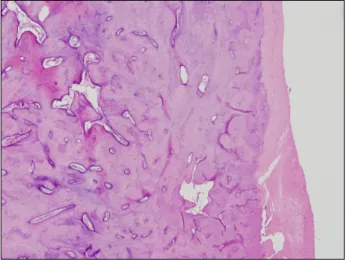
bone biopsy finding was localized irregular thickening of

(4)

Fig. 7. Post-operative radiograph re- veals the reshaped right condylar head and relocated to the man- dibular fossa (arrows). (A) Panorama X-ray. (B) Coronal view of computed tomography (CT) with 3-dimen- sional-facial CT.

Fig. 8. Localized irregular thickening of trabecular bone (H&E,

×40).

the trabecular bone (Fig. 8). In the final panoramic view, the mandibular fossa was shallow, and the articular emi- nence and condylar head were flattened. However, the patient obtained satisfactory functional and esthetic results, despite the slight mandibular deviation to the right side, with a 45 mm-mouth opening.

Discussion

Condylar hyperplasia is a pathologic condition resulting in an overgrowth involving both the shape and size of the condylar head and neck. Condylar hyperplasia is classi- fied on the basis of clinical and histological studies[2,7,8].

The first type occurs in adolescent or young adults and can be considered an idiopathic exaggerated manifestation of the normal growth and maturation process. The second type, occurring at an older age, represents a reactive hyper- plasia, sometimes with an identifiable etiology such as physical trauma. The decision to proceed with surgery is based on evidence of active changes or severe disfigure-

ment of the hyperplastic condyle, and the final pathologic diagnosis could be included chondroma, osteoma, os- teochondroma or other alterations such as simple bony hyperplasia.

In our cases, the patients were older than 60 years and showed exophytic over-growth of their unilateral condylar head with facial asymmetry and occlusal disturbance.

Because of the chronic persistent dislocation of TMJ for over 20 years, our cases were classified as the second type.

The etiology of condylar hyperplasia is uncertain[2,7,9].

One theory is that the condyle is the primary growth center controlling mandibular growth, and another is that the con- dyle is simply a local site that influences regional growth for mandible[10]. Based on these theories, factors such as infection, arthrosis, previous trauma, hormonal dis- turbances, hypervascularity, and abnormal loadings are considered etiologic factors of this pathosis[2,7,9].

In our cases, both patients had dislocations of the con- dyle anteriorly beyond the articular eminence from the mandibular fossa for over 20 years. This long-standing TMJ dislocation can cause extrinsic stimulation of the perichon- driun and muscles, and the mechanical stress may generate chondrogenesis or osteogenesis of the condylar head and neck.

A long-standing or protracted dislocation is defined when the dislocation is left untreated or inadequately treat- ed for more than 72 hours[6]. Sometimes the dislocation is not noticed, so it may not be restored for several weeks or months. It may become fixed by a muscle spasm with an adjacent tissue injury, making it very hard to reduce.

Many factors have been implicated in the onset of con-

dylar dislocation including occlusal factors, severe tooth

abrasion, a loss of tooth, condyle hypermobility associated

with general disorders, neurologic disorders, and trau-

ma[4]. Myrhaug[11] suggests that a deep over-bite is asso-

(5)

ciated with a steep articular eminence, possibly causing dislocation. TMJ dislocation may occur during maximum mouth opening such as tooth extraction, yawning, im- pression taking, or general anesthesia with endotracheal intubation. In our cases, although the patients had a long history of dislocation, the causes of the dislocation of man- dible could not be identified in either case.

Kummoona[12] presented six cases of chronic persistent dislocation of TMJ and suggested a treatment strategy via a duration of TMJ dislocation. If the dislocation period is less than three weeks, a closed reduction should be tried first. However, if this method fails, the surgeon can retry a closed reduction under deep sedation of general anesthesia. When the dislocation period is 4 to 12 weeks, the surgeon may have to try open reduction of the condyle with wire or a retractor to pull the mandible downward after stripping the periosteum of the mandible ramus area under general anesthesia. When the dislocation lasts over six months, most cases require surgical procedures like a condylectomy, condylotomy, myotomy and TMJ prosthesis.

Chin et al .[13] report a case of chronic persistent man- dibular dislocation lasting over 10 months that was treated with a bilateral coronoidectomy, suprahyoid myotomy, and a high condylectomy because satisfactory mandible move- ment and occlusion could not be achieved by con- dylectomy alone. Kim and Kim[14] also recommended sur- gical treatment of chronic TMJ dislocation that lasted for six months with complete dislocation.

In our cases, condylar hyperplasia associated with un- known-origin long-standing TMJ dislocation for 20 or 30 years was found in panoramic view and CT scan, with chief complaints of facial asymmetry and malfunction due to the cross-bite. The preoperative diagnosis of condylar hyperplasia was made by observing the panoramic view and CT scan, while final histopathological diagnosis re- quires a postoperative biopsy. After surgery, postoperative biopsy results presented no remarkable histopathological conditions except hyperplastic bone formation, so the final

diagnosis was confirmed to be condylar hyperplasia.

Acknowledgements

This work was supported by Inha University Research Grant.

References

1. Norman JE, Painter DM. Hyperplasia of the mandibular condyle. A historical review of important early cases with a presentation and analysis of twelve patients. J Maxillofac Surg 1980;8:161-75.

2. Slootweg PJ, Müller H. Condylar hyperplasia. A clinico-patho- logical analysis of 22 cases. J Maxillofac Surg 1986;14:209-14.

3. Bruce RA, Hayward JR. Condylar hyperplasia and mandibular asymmetry: a review. J Oral Surg 1968;26:281-90.

4. Shorey CW, Campbell JH. Dislocation of the tempor- omandibular joint. Oral Surg Oral Med Oral Pathol Oral Radiol Endod 2000;89:662-8.

5. Wijmenga JP, Boering G, Blankestijn J. Protracted dislocation of the temporomandibular joint. Int J Oral Maxillofac Surg 1986;15:380-8.

6. Huang IY, Chen CM, Kao YH, Chen CM, Wu CW. Management of long-standing mandibular dislocation. Int J Oral Maxillofac Surg 2011;40:810-4.

7. Gray RJ, Sloan P, Quayle AA, Carter DH. Histopathological and scintigraphic features of condylar hyperplasia. Int J Oral Maxillofac Surg 1990;19:65-71.

8. Nitzan DW, Katsnelson A, Bermanis I, Brin I, Casap N. The clinical characteristics of condylar hyperplasia: experience with 61 patients. J Oral Maxillofac Surg 2008;66:312-8.

9. Egyedi P. Aetiology of condylar hyperplasia. Aust Dent J 1969;14:12-7.

10. Sicher H. The growth of the mandible. Am J Orthod 1947;

33:30-5.

11. Myrhaug H. A new method of operation for habitual dis- location of the mandible; review of former methods of treatment. Acta Odontol Scand 1951;9:247-60.

12. Kummoona R. Surgical reconstruction of the temporomandibular joint for chronic subluxation and dislocation. Int J Oral Maxillofac Surg 2001;30:344-8.

13. Chin RS, Gropp H, Beirne OR. Long-standing mandibular dis- location: report of a case. J Oral Maxillofac Surg 1988;46:693-6.

14. Kim CH, Kim DH. Chronic dislocation of temporomandibular

joint persisting for 6 months: a case report. J Korean Assoc

Oral Maxillofac Surg 2012;38:305-9.

수치

Fig. 1. Pre-operative intraoral photograph. Deviation of mandibular dental midline (arrows) to the left side with anterior and left posterior crossbite.
Fig. 6. Pre-operative radiograph. (A) Panoramic view reveals a  hyper-plastic condylar head (arrows) with mandibular midline deviation  (arrow-heads)
Fig. 8. Localized irregular thickening of trabecular bone (H&E,

참조

관련 문서