1. INTRODUCTION
Bamboo resources in Indonesia is abundant and have a big potential for new products
developement. Bamboo plantation in Indonesia in 2000 was 2,104,000 ha, consisted of 690,000 ha in permanent forest and 1,414,000 ha in non-forest areas (FAO and INBAR, 2005).
Original Article
Effects of Steam Treatment on Physical and
Mechanical Properties of Bamboo Oriented Strand Board
1Sena Maulana
2⋅Imam Busyra
2⋅Adesna Fatrawana
2⋅Wahyu Hidayat
3⋅Rita Kartika Sari
2⋅ Ihak Sumardi
4⋅I Nyoman Jaya Wistara
2⋅Seung Hwan Lee
5⋅Nam Hun Kim
5,†⋅Fauzi Febrianto
2,†ABSTRACT
The objective of this study was to evaluate the properties of bamboo oriented strand board (B-OSB) from an- dong (Gigantochloa psedoarundinacea) and betung (Dendrocalamus asper) with and without steam treatment.
Strands were steam-treated at 126℃ for 1 h under 0.14 MPa pressure. The extractive content of bamboo strands before and after steam treatment were determined according to a standard (TAPPI T 204 om-88). Three-layer B-OSB with the core layer perpendicular to the surface and back layers were formed and binded with 8% of phenol formaldehyde (PF) resin with the addition of 1% of wax. The evaluation of physical and mechanical properties of the boards were conducted in accordance with the JIS A 5908:2003 standard. The results showed that steam treatment of bamboo strands significantly reduced the extractive content. Steam treatment tended to increase the dimensional stability and mechanical properties of B-OSB from andong and betung. The results showed that the dimensional stability and bending strength of B-OSB from betung was higher than those of andong. The internal bond strength of B-OSB from andong was higher than betung owing to a greater amount of extractives dissolved during the steam treatment.
Keywords : bamboo, Dendrocalamus asper, Gigantochloa psedoarundinacea, oriented strand board, steam treatment
1Date Received October 16, 2017, Date Accepted November 16, 2017
2Department of Forest Products, Faculty of Forestry, Bogor Agricultural University, IPB Dramaga Campus, Bogor, 16680, Indonesia
3Department of Forestry, Faculty of Agriculture, University of Lampung, Jalan Sumantri Brojonegoro 1, Bandar Lampung 35145, Indonesia
4School of Life Sciences and Technology, Institut Teknologi Bandung, Jalan Ganesha 10 Bandung 40132, Indonesia 5Department of Forest Biomaterials Engineering, College of Forest and Environmental Science, Kangwon National University,
Chuncheon 24341, Republic of Korea
†Corresponding author: Author:Fauzi Febrianto(e-mail: [email protected], ORCID: 0000-0002-0964-2179)
†Corresponding author:Author:Nam Hun Kim (e-mail: [email protected],ORCID: 0000-0002-4416-0554)
Widjaya (2012) reported that there were 160 bamboo species consisted of 122 endemic spe- cies and 38 exotic species. Compared to wood, bamboo has fast growth rate, abundant potency, short cycle, and adaptable to most of soil types except soil in the beach area. In addition, the tensile strength of bamboo is comparable to wood. Due to its advantages, bamboo has been used as raw materials for industry, construction, furniture, household equipment, and handicrafts.
However, bamboo also has some limitations when they are used for construction material, particularly due to its diameter. The small di- ameter and thin culm of bamboo made the solid bamboo difficult to be used for panel products that generally needed a long and wide dimensions. In addition, bamboo also has low modulus of rupture and high variability of physical properties, particularly the density in the bottom, middle, and upper parts.
Composite products can be used as alter- natives to increase the efficient utilization of bamboo for structural and non-structural applications. Oriented strand board (OSB) is one of the structural composite panels that has been used as a substitution for plywood products. Structural Board Association (2005) defined OSB as structural composite panel made from long and thin strand with the core layer alligned perpendicularly to the back and surface layers and compacted using hot pressing. Our previous studies revealed that the physical and mechanical properties of bamboo OSB (B-OSB) were higher than those of OSB from wood, and met the standard requirement
for commercial OSB (Febrianto and Hadi, 2010; Febrianto and Arinana, 2012; Febrianto et al., 2012; Adrin et al., 2013; Febrianto et al., 2013; Febrianto et al., 2014).
The properties of particleboard and OSB are affected by wood species, density, strand di- mensions, strand pre-treatment, particle ori- entation, resin type and content, layer ori- entation, pressing parameters, moisture content and board density, and density profile of the board (Maloney, 1993). The extractive content of bamboo, particularly the carbohydrates and sugars content is relatively higher than wood (Fatriasari and Hermiati, 2008; Zhang, 1995).
Carbohydrates and sugars are food sources for wood-damaging agents such as wood-decaying fungi, moulds, wood-destroying insects or ma- rine borers which make bamboo susceptible to be attacked by such damaging agents (Febrianto et al., 2013). Pretreatment on strands can be applied to solve the problem, such as steam treatment.
Conventionally, steam treatment is generally applied for solid bamboo during the production of bending products to soften its tissues, hence bamboo becomes easier to be bended into de- sired form. Steam treatment could improve the durability of bamboo againts degrading agents (Liese, 1987). During steam process, free sugars in lignocellulosic materials is converted into in- termediate furane and furane resin to improve the board properties (Rowell et al., 2002).
Steam treatment of strands has been reported to
improve the properties of OSB from sentang
(Melia excelsa) wood (Iswanto et al., 2010). In
our previous study, we reported the properties of B-OSB from steam-treated bamboostrand binded with isocyanate resin (Febrianto et al., 2015). However, the effects of strand steam treatment on the properties of B-OSB binded with formaldehyde-based resin has not been reported. Therefore, the objective of this study is to evaluate the properties of B-OSB with and without steam treatment, using PF resins as adhesives.
2. MATERIALS and METHODS 2.1. Materials
Two bamboo species, i.e. andong (Gigantochloa psedoarundinacea) and Betung (Dendrocalamus asper) were obtained from 3-year-old bamboo plantation in Sukabumi, West Java, Indonesia. PF resin was used as a binder. Chemical reagents were used for the de- termination of differeent extractive contens.
Main equipments used in this study are band saw, circular saw, planer, disk flaker, kiln dry- ing furnace, shieve, water bath, oven drier, digi- tal weight scale, moisture meter, glue blending drum, spray gun, strand orienter, forming de- vice, caliper, hot press, and universal testing machine (UTM) instron.
2.2. Methods
2.2.1. Strand Preparation and B-OSB Manufacture
Bamboo culms without internodes were con- verted into strands using disk flaker. The
strands were treated with steam at 126 ℃ for 1 h under a pressure of 0.14 MPpa. Strands were air dried for a week then oven dried at 60-80 ℃ for 3 days until reaching moisture content of less than 5%. Three-layer B-OSBs were made with the dimension of 30 × 30 × 0.9 cm
3(length × width × thickness) using a face-to-core layer ratio of 1 : 1 : 1 ( → change this to a face to core rartio such as 60 : 40, 55 : 45). The tar- get board density was 0.7 g/cm
3. PF resin was used as a binder with the solid content of 42%
and resin content of 8%. An addition of 1%
wax was used. The strands were then hot press- ed at 135 ℃ under a pressure of 25 kgf/cm
2. The resulted B-OSBs were conditioned for two weeks under room temperature (25-30 ℃) until reaching a constant weight.
2.2.2. Strand Geometry Measurement
Strand geometry was measured using 100 strands that obtained randomly. Dimensions of strands such as length, width, and thickness were measured. The slenderness ratio (SR) and aspect ratio (AR) of the strands were de- termined according to the method described by Maloney (1993).
2.2.3. Extractive Isolation
The extractive content of bamboo strands be-
fore and after steam treatment was analyzed in
accordance with TAPPI standards. Samples
were extracted using alcohol-benzene solvent
following the procedure of TAPPI T 204 om-88
(TAPPI 1991).
2.2.4. Physical and Mechanical Properties Evaluation
The physical and mechanical properties of B-OSB were evaluated according to the proce- dure of JIS A 5908-2003 (JIS 2003) for particleboards. The physical properties evaluated were density, moisture content (MC), water ab- sorption (WA), and thickness swelling (TS), while mechanical properties evaluated were modulus of rupture (MOR), modulus of elas- ticity (MOE), and internal bond (IB) strength.
3. RESULTS and DISCUSSION 3.1. Geometry of Bamboo Strands
Strand geometry is a prime parameter affect- ing both board properties and its manufacturing process. Suchsland and Woodson (1990) sug- gested that strand geometry is of greater sig- nificance in the development of board proper- ties than the actual mechanical properties of the strands themselves. It has a definite relationship with the compression ratio, and thus it will in- fluence the density of composite board. The strands manufactured have satisfactory geome- try, showing high values of slenderness ratio (SR) and aspect rato (AR) as shown in Fig. 1.
The average SR of strands from andong and betung were higher than 100 and classified as high SR (Febrianto et al., 2015). Strands with high values of SR affected on a better contact between strands and improved strength proper- ties of the boards (Maloney, 1993). The average AR of strands from andong and betung were
greater than 3. Maloney (1993) stated that wood strand having aspect ratio greater than one are easily oriented during forming process.
According to Shuler et al. (1976) and Kuklewski et al. (1985), strand aspect ratio of two is enough to produce OSB with superior properties.
3.2. Extractive content
The results of extractive analysis showed that the extractive content of andong and betung de- creased by steam treatment (Table 1). Steam treatment caused the loosening and softening of cell walls, resulted in the reduction of ex- tractive content. Donohoe (2008) stated that during steam process, the heat and pressure ap- plied increased the porosity of cell walls (Donohoe, 2008). Miranda et al. (1978) added that steam could cause depolymeration and repolymeration of lignin. This caused the extraction of extractive decreased in the bamboo strands.
3.3. Physical properties of B-OSB
The density of particleboard is affected by
the density of the raw materials, which makes a
contribution to the physical and mechanical
propeties of the board (Tsoumis, 1991). The
densities of the manufactured B-OSBs were
ranging between 0.70-0.73 g/cm
3and 0.71-0.72
g/cm
3for andong and betung, respectively. The
results of analysis of variance (ANOVA) at a
significance level of 0.05 showed no significant
density difference between bamboo species and
strand treatment.
The moisture content (MC) values of B-OSBs from andong were ranging between 9.38% and 10.38%, while betung between 9.38% and 10.33%. B-OSBs of both bamboo species were relatively homogeneous, showing no significant
differences in the MC values between species and strand treatment.
Water absorption (WA) and thickness swel- ling (TS) are of the important parameters to evaluate the dimensional stability of composite panels. WA shows the ability of board to ab-
(A) (A)
. . . . . . ...
(A) (A)
(B) (B)
. . . . . . . . . . .
(B) (B)
Fig. 1. Aspect ratio and slenderness ratio of the strands from andong (A) and betung (B) bamboo.
Bamboo species Extractive type Strand treatment
Control Steam
Water-soluble (%) 4.29 3.95
Hot water-soluble (%) 5.81 5.64
Andong 1% NaOH soluble (%) 22.57 19.29
Ethanol-benzene-soluble (%) 3.20 3.11
Betung
Water-soluble (%) 5.63 4.62
Hot water-soluble (%) 7.64 6.45
1% NaOH soluble (%) 19.43 18.51
Ethanol-benzene-soluble (%) 9.09 8.89
Table 1. Extractive content of andong and betung bamboos before and after the steam treatment
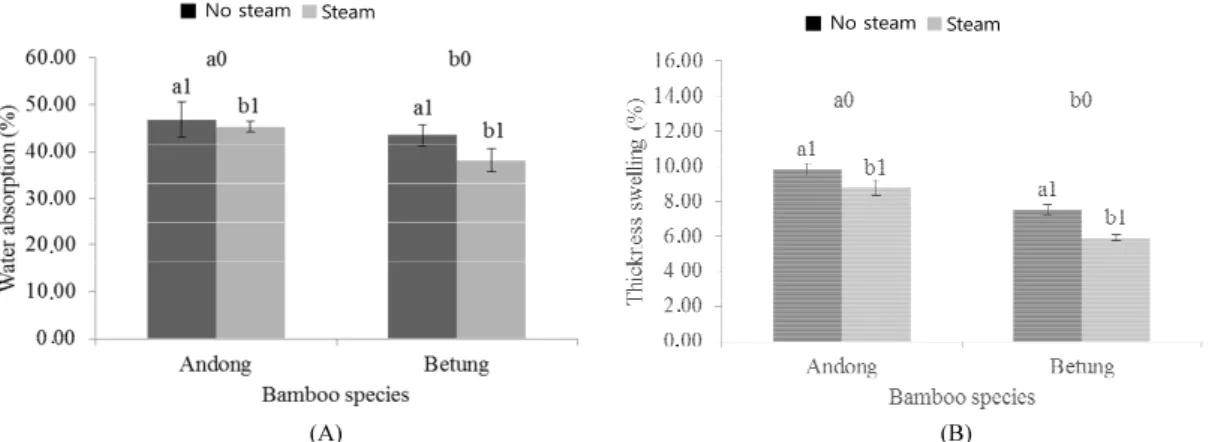
sorp water due to adsoption force, which is the captive force of water molecules in the hydro- gen bonds located in cellulose, hemicellulose and lignin. WA values after 24 h of water im- mersion were ranging between 45.35-46.82%
and 38.18-43.56% for B-OSBs from andong and betung, respectively (Fig. 2a). The results of ANOVA revealed that bamboo species and strand treatment contributed significant effects on the WA property, while the interaction be- tween species and strand treatment showed no significant effect. TS values after 24 h of water immersion were ranging between 8.77-9.82%
and 5.91-7.50% for B-OSBs from andong and betung, respectively (Fig. 2b). The results of ANOVA revealed that bamboo species and strand treatment contributed significant effects on TS values, while the interaction between species and strand treatment showed no sig- nificant effect.
Steam treatment of strands reduced the WA and TS of the B-OSBs from andong and betung. It was believed that the removal of ex-
tractives in bamboo due to steam treatment im- proved the penetration of resin into the strand.
The improved bondability of strands resulted in a decrease in the WA of B-OSBs. B-OSBs from betung had lower WA and TS values compared to those of andong due to distinctive anatomical structures between these two species. Andong has vascular bundle type III, while betung has vascular bundle type IV with a relatively higher content of holocellulose and lignin (Liese, 1998). Lignin in the structure of wood and other lignocellulosic materials acts as a thermo- plastic binder that can enhance the bond between fibers, and improves the dimensional stability of composite panels. In addition, the extractive contents in andong and betung might also be ascribed to the hygroscopic behaviour of the B-OSBs.
3.4. Mechanical Properties of B-OSB from Andong and Betung
MOE shows the ability of a material to main-
■ No steam Steam ■ No steam Steam
(A) (B)
. . . . . . .
. . . . . .
. .
(A) (B)
Fig. 2. Water absorption (A) and thickness swelling (B) of B-OSBs from andong and betung with and without steam treatment; different letter showed a significant difference; 0: bamboo species; 1: strand treatment.
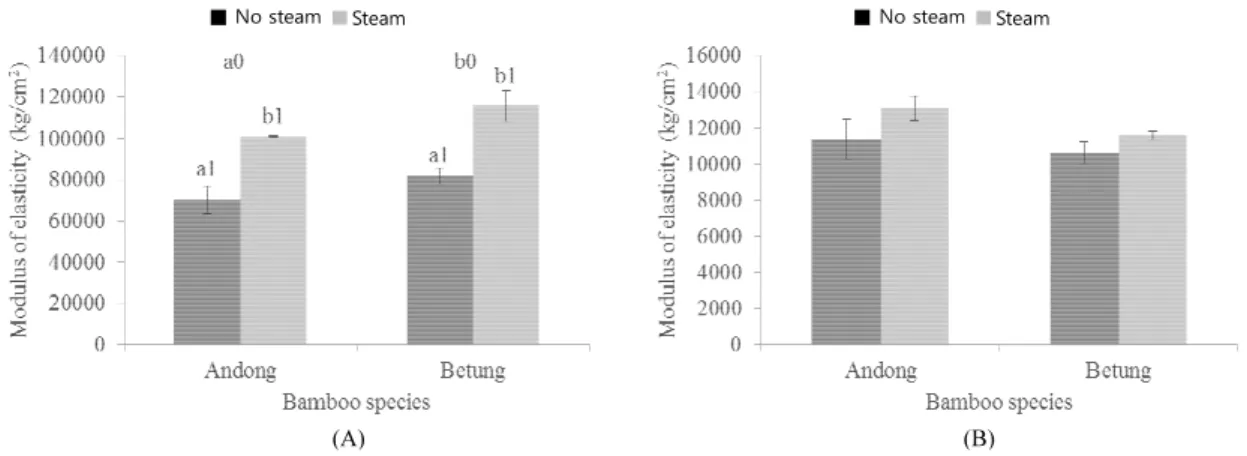
tain its original form during loading. MOE val- ues parallel to the grain direction of B-OSBs were ranging between 70131-100965 kg/cm
2and 81831-115610 kg/cm
2for andong and betung, respectively (Fig. 3a). By contrast, the MOE values perpendicular to the grain direction of B-OSBs were ranging between 11407-13097 kg/cm
2and 10662-11625 kg/cm
2for andong and betung, respectively (Fig. 3b). The results of ANOVA showed that bamboo species and strand treatment had significant effects to MOE values in both parallel and perpendicular direc- tion, while the interaction between species and strand treatment was insignificant.
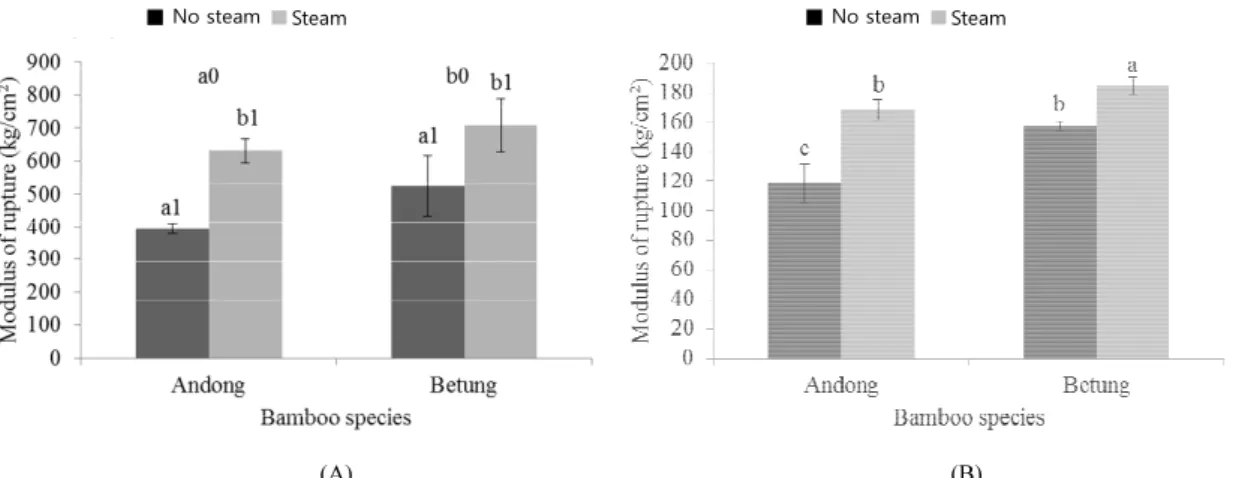
MOR shows the maximum load that can withstand by a materials. MOR values parallel to the grain of B-OSBs were ranging between 394-696 kg/cm
2and 524-763 kg/cm
2for andong and betung, respectively (Fig. 4a). The results from ANOVA showed that bamboo species and strand treatment contributed significant effects
on MOR values parallel to the grain direction.
MOR values perpendicular to the grain of B-OSBs were ranging between 119-211 kg/cm
2and 157-242 kg/cm
2(Fig. 4b). The ANOVA re- sults showed that the interaction between spe- cies and strand treatment had significant ef- fects on MOR values perpendicular to the grain direction. The results revealed that bamboo spe- cies and strand treatment affected the bending strength of B-OSBs including MOE and MOR.
Steam treatment decreased the extractive con- tent of andong and betung (Table 1), resulting in a better strand adhession. Maloney (1993) explained that extractives could interrupt the penetration of adhessive into materials, causing a decrease of mechanical properties.
Steam treatment of strands improved the bending strength parallel and perpendicular to the grain of B-OSBs from andong and betung.
B-OSBs from betung strands showed better bending strength compared to andong due to
■ No steam Steam ■ No steam Steam
(A) (B)
(A) (B)
Fig. 3. MOE parallel (A) and MOE perpendicular (B) to the grain of B-OSBs from andong and betung bamboo with and without the steam treatment; different letters showed a significant difference; 0: bamboo species;
1: strand treatment.
the differences in anatomical structure and the initial density of the bamboos. As described earlier in this paper, andong has vascular bun- dle type III, while betung has vascular bundle type IV. Latif et al. (1990) and Nuryatin (2012) reported that vascular bundle attributed to the values of MOE and MOR. The initial density of andong and betung were 0.72 g/cm
3and 0.66 g/cm
3, respectively. With the target B-OSB density of 0.7 g/cm
3, the compression ratio of B-OSB from betung was significantly higher than that of B-OSB from andong, resulting in a better bending strength values. The results were in a good agreement with those of Sumardi et al. (2006) that evaluated the relationship be- tween compression ratio and bending strength of OSB from moso (Phyllostachys pubescens) bamboo.
IB strength, or the tensile strength perpendic- ular to the plane of the panel is one of the im- portant strength properties of composite panels.
The IB strength values were ranging between 4.01-5.62 kg/cm
2and 3.89-4.73 kg/cm
2for B-OSBs from andong and betung, respectively (Fig. 5). The results of ANOVA showed that bamboo species and strand treatment had significant effects on the IB strength values of B-OSBs. Steam treatment of the strands improved the IB values of B-OSBs from andong and betung. Steam treatment could con- vert free sugars in woody materials into furan intermediates, which can be further converted into furan resins, causing an improvement of mechanical properties and the dimensional stabilization of boards (Rowell et al., 2002).
According to Maloney (1993), the extractive in woody materials can cause a problem during particleboard production due to its negative ef- fect on the penetration of adhessive into particles. Steam treatment effectively reduced the extractive content of andong and betung, re- sulting in a better penetration of adhesive into
■ No steam Steam ■ No steam Steam
(A) (B)
(A) (B)
Fig. 4. MOR parallel to the grain (a) and MOR perpendicular to the grain (B) of B-OSBs from andong and betung with and without steam treatment; different letter showed a significant difference; 0: bamboo species;
1: strand treatment.
strands and an improvement of strength proper- ties of B-OSBs. The increase of IB values of B-OSB from andong with steam was relatively higher than that of B-OSB from betung. This might be due to more extractive dissolved from andong compared to betung. Table 1 shows that NaOH-soluble extractive of andong decreased more significantly compared to betung.
4. CONCLUSION
The geometry of strands produced from an- dong and betung bamboo were satisfactory, showing high slenderness and aspect ratio.
Steam treatment of strands significantly reduced the extractive content, and thus improved the dimensional stability and mechanical properties of B-OSBs from andong and betung strands with superior properties of B-OSBs after the treatment than those of B-OSBs without the treatment. A simple and relatively low-cost steam treatment of strands offers a promising alternative treatment to produce B-OSB with
high dimensional stability and mechanical properties.
ACKNOWLEDGEMENT
We sincerely acknowledge the Doctoral Programme for Outstanding Undergraduate Students Secretariat (No.330/SP2H/LT/DRPM/IX/2016, 8 September 2016), Directorate of Higher Education (DIKTI), Ministry of Research, Technology, and Higher Education, Republic of Indonesia due to the financial support given.
REFERENCES
Adrin, Febrianto, F., Sadiyo, S. 2013. Properties of oriented strand board prepared from steam treat- ed bamboo strands under various adhesive combinations. Jurnal Ilmu dan Teknologi Kayu Tropis 11(2): 109∼119.
Donohoe, B.S., Decker, S.R., Tucker, M.P., Himmel, M.E., Vinzant, T.B. 2008. Visualizing lignin co- alescence and migration through maize cell walls following thermochemical pretreatment.
Biotechnology and Bioengineering 101(5):
913∼925.
FAO, INBAR. 2005. Global forest resources assess- ment update 2005. Indonesia. CountryReport on Bamboo Resources. Forest Resources Assessment Programme Working Paper (Bamboo). Food and Agriculture Organization of the United Nation (FAO), Forestry Department and International Network for Bamboo and Rattan. Jakarta, May, 2005.
Fatriasari, W., Hermiati, E. 2008. Analisis morfologi serat dan sifat fisis-kimia pada enam jenis bam- bu sebagai bahan baku pulp dan kertas. Jurnal Ilmu dan Teknologi Hasil Hutan 1(2): 67∼72. Febrianto, F., Gumilang, A., Maulana, S., Busyra, I.,
■ No steam Steam .
. . . . . . . . . .
Fig. 5. Internal bond strength of B-OSBs from an- dong and betung with and without steam treatment;
different letter showed a significant difference; 0:
bamboo species; 1: strand treatment.
Purwantiningsih, A. 2014. Natural durability of five bamboo species against termite and powder post beetle. Jurnal Ilmu dan Teknologi Kayu Tropis 12(2): 146∼156.
Febrianto, F., Purnamasari, I., Arinana, Gumilang, A., Kim, N.H. 2013. Steaming effect on natural durability of bamboo oriented strand board against termites and power post beetle. Jurnal Ilmu dan Teknologi Kayu Tropis 11(2): 161∼ 169.
Febrianto, F., Sahroni., Hidayat, W., Bakar, E.S., Kwon, G.J., Kwon, J.H., Kim, N.H. 2012.
Properties of oriented strand board made from betung bamboo (Dendrocalamus asper (Schultes.f) Backer ex Heyne). Wood Science and Technology 46: 53∼62.
Febrianto, F., Hidayat, W., Samosir, T.P., Lien, H.C., Song, H.D. 2010. Effect of strand combination on dimensional stability and mechanical proper- ties of oriented strand board made from tropical fast growing species. Journal of Bio-Science 10(3): 267∼272.
Febrianto, F., Hadi, Y.S., Kim, N.H. 2010.
Pengembangan oriented strand board unggul dari beberapa jenis bambu untuk komponen bangunan bermutu struktural. Seminar Hasil-Hasil Penelitian IPB, Bogor, 13-14 Desember, 2010.
Febrianto, F., Jang, J.H., Lee, S.H., Santosa, I.A., Hidayat, W., Kwon, J.H., Kim, N.H. 2015.
Effect of bamboo species and resin content on properties of oriented strand board prepared from steam-treated bamboo strands. Bioresources 10(2): 2642∼2655.
Iswanto, A.H., Febrianto, F., Wahyudi, I., Hwang, W.J., Lee, S.H., Kwon, J.H., Kwon, S.M., Kim, N.H., Kondo, T. 2010. Effect of Pre-treatment Techniques on Physical, Mechanical and Durability Properties of Oriented Strand Board Made from Sentang wood (Melia excelsa Jack).
JIS A 5908 (2003). “Standards on Particleboard,”
Japanese Standards Association, Tokyo, Japan.
Kuklewski, K.M., Blankenhorn, P.R., Rishel, L.E.
1985. Comparison of selected physical and mechanical properties of red maple (Acer ru- brum L.) and aspen (Populus grandidentata Michx.) flakeboard. Wood and Fiber Science 17(1): 11∼21.
Latif, A.M., Wan, Tarmeze, W.A., Fauzidah A.
1990. Anatomical features and mechanical prop- erties of three Malaysian bamboos. Journal Tropical Forest Science 2(3): 227∼234.
Liese, W. 1987. Anatomy and properties of bamboo.
In: Rao, AN, G. Dhanarajan, C,B, Sary, ed.
Recent research on bamboo. Proceeding of inter- national bamboo workshop, Hangzholu, People’s Republic of China, Oct 4-14, 1985. Academy of Forestry, People’s Republic of China &
International Development Research Centre, Canada, pp. 196∼208.
Liese, W. 1998. The Anatomy of Bamboo Culm, Technical Review, International Network for Bamboo and Rattan, People’s Republic of China, pp. 36∼42.
Maloney, T.M. 1993. Modern particleboard and dry-process fibreboard manufacturing. Forest Products Society, Madison. WI.
Miranda, G.S., Wayman, M. 1979. Characterization of autohydrolysis aspen (P. tremuloides) lignins, Part 1. Composition and molecular weight dis- tribution of extracted autohydrolysis lignin.
Canadian Journal of Chemistry 57: 1141∼1149.
Nuryatin, N. 2012. Vascular bundle pattern as pre- dictor of bamboo utilization. Dissertation.
Graduate School of Bogor Agricultural University (IPB), Bogor.
Rowell, R.M., Lange, S., McSweeny, J., Davis, M.
2002. Modification of wood fiber using steam.
Proceeding of 6th Rim Bio-Based Composites
Symposium. Oregon, USA.
Structural Board Association. 2005. Oriented strand board in wood frame construction. Ontario (CA):
Structural Board Association.
Sumardi, I., Suzuki, S., Ono, K. 2006. Some im- portant properties of strand board manufactured from bamboo. Forest Products Journal 56(6):
59∼63.
Technical Association of the Pulp and Paper Industry. 1991. TAPPI Test methods. Vol.1.
Atlanta: TAPPI Press. Berlian NV, Rahayu E.
1995. Jenis dan Prospek Bisnis Bambu. Jakarta (ID): PT Penebar Swadaya.
Tsoumis, G. 1991. Science and technology of wood:
Structure, properties utilization. New York: Van Nostrand Reinhold.
Widjaya, E.A. 2012. The Utilization of bamboo: At present and for the future. Proceedings of International Seminar Strategies and Challenges on Bamboo and Potential Non Timber Forest Products (NTFP) Management and Utilization.
23-24 November 2011, Bogor, Indonesia 79-85.
Center for Forest Productivity Improvement Research and Development. Bogor. Indonesia.
Zhang, Q. 1995. To scientifically and reasonably uti- lize Chinese bamboo resources. Wood Process.
Machin 6(4): 23∼32.