가중 최소자승 필터링과 색 표현 모델을 결합한 넓은 동적 영역 이미지 표현
박 미 선a), 이 경 준a), 위 승 우a), 정 제 창a)‡
High Dynamic Range Image Display Combining Weighted Least Squares Filtering with Color Appearance Model
Mei-Xian Piaoa), Kyung-Jun Leea), Seung-Woo Weea), and Jechang Jeonga)‡
요 약
최근 넓은 동적 영역 이미지 기술은 컴퓨터 그래픽 분야에서 화제다. 본 논문에서는 가중 최소자승(가중회귀분석) 최적화 체계에 기반 하여 넓은 동적 영역 이미지를 처리하는 톤매핑 알고리듬을 제안한다. 제안하는 방법은 시각적 후광 현상을 피하는 동시에 기존의 디스플 레이에서 더 지각적인 넓은 동적 영역 이미지들을 보여주기 위해 가중 최소자승 필터링과 iCAM06모델을 결합한다. 제안된 알고리듬은 먼저 넓은 동적 영역 이미지를base layer와 detail layer로 나눈다. Base layer는 큰 규모의 변화량을 가지고 있으며 가중 최소자승 필터 링을 사용하여 얻어지고iCAM06 모델을 포함한다. 다음으로, 인간의 시각 체계에 따라 base layer는 적응적으로 압축된다. 압축 시에는 base layer만 대비를 줄이고 detail layer을 보존한다. 본 논문에서는 객관적 화질 평가와 주관적 화질 평가를 통하여 제안하는 알고리듬을 적용한 이미지가 기존의 알고리듬을 적용한 이미지들에 비해 원본 넓은 동적 영역 이미지에 더 유사하다는 것을 보여준다.
Abstract
Recently high dynamic range imaging technique is hot issue in computer graphic area. We present a progressive tone mapping algorithm, which is based on weighted least squares optimization framework. Our approach combines weighted least squares filtering with iCAM06 model. To show more perceptual high dynamic range images in conventional display, we decompose high dynamic range image into base layers and detail layers. The base layers are obtained by using weighted least squares filter. Then, we adopt chromatic adaption function and non-linear compression function to deal with base layers. Only the base layers reduce contrast, and preserving detail. The image quality assessment shows that our tone mapped image is more similar to original high dynamic range image. Moreover, the subjective result shows our algorithm produces more reliable and pleasing image.
Keywords : Tone mapping, Color appearance model, Weighted least squares
Copyright Ⓒ 2016 Korean Institute of Broadcast and Media Engineers. All rights reserved.
“This is an Open-Access article distributed under the terms of the Creative Commons BY-NC-ND (http://creativecommons.org/licenses/by-nc-nd/3.0) which permits unrestricted non-commercial use, distribution, and reproduction in any medium, provided the original work is properly cited and not altered.”
a)한양대학교 전자컴퓨터통신공학과(Department of Electronics and Computer Engineering, Hanyang University)
‡Corresponding Author : 정제창(Je-Chang Jeong) E-mail: [email protected] Tel: +82-02-2220-0369
ORCID: http://orcid.org/0000-0002-3759-3116
※본 논문은"2016년 한국방송·미디어공학회 하계학술대회"에서 부분적으로 발표되었음.
※This research was supported by Basic Science Research Program through the National Research Foundation of Korea(NRF) funded by the Ministry of Science, ICT and future Planning(NRF-2015R1A2A2A01006004).
・Manuscript received September 20, 2016; Revised November 14, 2016; Accepted November 21, 2016.
특집논문(Special Paper)
방송공학회논문지 제21권 제6호, 2016년 11월 (JBE Vol. 21, No. 6, November 2016) http://dx.doi.org/10.5909/JBE.2016.21.6.920
ISSN 2287-9137 (Online) ISSN 1226-7953 (Print)
I. Introduction
Recently, the international community for stand- ardization has been considered a new generation of video compression technology, known as high efficient video coding (HEVC) [1, 2]. Deployment of HEVC standard is expected to be a key component in future video industry. Including support for high dynamic range (HDR) and wider color gamut (WCG) services is consid- ered essential within the industry [3]. It is important to consider how HEVC will perform on HDR contents [4].
In this paper, we will discuss about HDR image- technology. Different from traditional images, HDR im- ages have a wider range of luminance. Comparing with low dynamic range images (LDR), HDR images can show brighter and darker scene. However, most conven- tional LDR monitors have low dynamic range. The mon- itor display HDR scene too bright or too dark. On the other hand, it is not practical to get a HDR monitor for most users, because HDR monitors are too expensive.
That is why we need HDR rendering algorithms which are also known as tone mapping operators.
Farbman’s tone mapping operator is based on weighted least squares (WLS) framework [5]. It is two-scale decom- position of HDR image into base layer and detail layer. In their tone mapping algorithm, they used WLS filter to deal with HDR image luminance values. After the WLS filter- ing, the processed image keeps large scale information and fine detail, at the same time, avoids visible halo artifacts.
However, they used simple compression strategy to base layer and did not have any process on chrominance. Such an approach brings out two problems. First, the original im- age color information is not suited for tone mapped image perfectly. Second, simple tone compression strategy loses luminance information in some cases, especially for the im- age which has higher dynamic range.
According to the two problems, we present a progressive tone mapping operator. We combine WLS filter with
iCAM06 model [6]. iCAM06 is regarded as next gen- eration of image appearance model and developed for HDR image rendering technology. We incorporate part of iCAM06 modules in weighted least squares framework.
iCAM06 model inherits advantages from iCAM02[7]
framework, such as the local white point adaption, chro- matic adaption, and IPT uniform color space. Furthermore, iCAM06 extends to incorporate scotopic and photopic at- tributes, local contrast enhancement, local colorfulness en- hancement and surround luminance dependent correction.
In this paper, we incorporate chromatic adaption and non- linear tone compression modules in weighted least squares framework, while retaining important visual information.
We advocate a perceptual approach, which is particularly well-suited for human visual system and the result is more close to real world. First, we need to use WLS filter to deal with original HDR image, not only luminance values.
Then, we obtained base layers, which are from different R, G, B pipelines. We applied to chromatic adaption func- tion, IPT color space function, and tone compression func- tion on our base layers, to achieve color correction and more perceptual color appearance.
In this paper, we discuss an edge-preserving filtering which is more robust and versatile than bilateral filter [8]
in Section 2. In Section 3, we present our algorithm which combines WLS filter with modules of iCAM06 models. In Section 4, we show experimental result. Section 5 discusses about our conclusion.
II. Framework of the weighted least squares
In this section, we introduce an effective and robust edge-preserving filter, which is based on weighted least squares optimization framework [5]. Before this, we simply discuss about diverse edge-preserving filters.
1. Edge-preserving filters
Many of edge-preserving filters, such as anisotropic dif- fusion [9], bilateral filter [8, 10] are outstanding in detail extraction. Particularly, bilateral filter is popular tool in di- verse area. The reason is that bilateral filter is well suited for noise removal, at the same time, keeping fine detail.
But there is fatal weakness to bilateral filter. The filter trades off its edge-preserving ability with its smoothing ability. In other words, if we want to get a fine detail im- age, we need to sacrifice smoothing ability. It maybe does not remove noise well. Furthermore, bilateral filter has been known to produce visible halo artifacts in tone map- ped image. Thus, Farbman [5] presented WLS filter in or- der to reduce halo artifact. The WLS filter has the advant- age of preventing halo artifacts by minimizing error be- tween the original image and filtered image.
2. Weighted least squares filtering
There is an input image , we try to get a new image
, which is smooth image after WLS filtering and we ap- ply image to base layer. At the same time, image is close to input image . The base layer , it is obtained using minimize energy function:
(1) denotes the location of an image. The first data term is to minimize the distance between original image and smooth image . Second term controls the smoothness of image . The coefficients , are smoothness weights and depend on . In last, is in charge of balance between the two terms, when we increase the value of , we will get smoother image .
Smoothing weights defined as [11]:
(2)
(3)Where denotes luminance value of input image , and
is the sensitivity to the gradients of the input image.
Typically, is between 1.2 to 2.0. Parameter we take
.
Rewriting energy minimization function by matrix nota- tion:
(4)
Parameter and are matrices of smoothness weights. Parameter and are discrete differentiation operators. And unique vector can be obtained by using the solution of the general least-squares problem in linear algebra.
(5)
(6)
Parameter , which is in eq. (5) denotes identity matrix.
The final smooth image can express as follow:
(7)
Just like we mentioned earlier, first they [5]calculated lu- minance of the input HDR image. Then, they got base layer after WLS filtering, and they compressed the base layer by multiplying a constant (between 0 and 1). Last, they re- combined the new base layer with unchanged detail layer to get final tone mapped image.
III. Proposed method
In this section, we show a modified base-detail decom-
position approach. It combines WLS filter and modules of iCAM06 model. Such an approach performs a perceptual and accurate result in tone mapping algorithm.
Common tone mapping operators are luminance com- pression which usually causes darker tones to appear brighter and distorts contrast relationships. Such a simple luminance compression strategy causes over-saturated color image. Therefore, we compress red, green, and blue chan- nels instead of luminance. This treatment keeps RGB com- ponents ratio, thereby reducing the difference of original color.
Figure 1 is flowchart of our proposed algorithm. At first, we convert input HDR image RGB values to XYZ values by sRGB color space transform matrix [6]. Then let XYZ components pass WLS filter. Conventional tone mapping operator [5] uses WLS filter to compress only Y component. Here, we use three channels processing to re- duce color distortion. After filtering, we obtain three edge-preserved base layers. Furthermore, this kind of filter- ing keeps large scale variation, while avoiding ringing artifact. In our proposed method, detail layers are residual of the input image and base layers.
그림1. 제안하는 알고리듬 흐름도 Fig. 1. Proposed algorithm flowchart
Image color appearance models attempt to predict non-linearity in the visual system and provide a set of per- ceptual attribute predictors [6, 7]. For example, given an input image and viewing its conditions, an image color ap-
pearance model can provide perceptual attributes of each pixel. Such as colorfulness, chroma, saturation, lightness, hue, contrast and sharpness.
The goal of our algorithm is maintaining original HDR image attributes. Thus, we adopt chromatic adaption func- tion and non-linear tone compressing function.
1. Chromatic adaption
Chromatic adaption function simulates chromatic adap- tion phenomenon in human visual system. In iCAM06 [6]color appearance model, it adopts chromatic adaption transformation embedded in iCAM which is originally from CIECAM02. The computations of the transform are given in following:
The components and tristimulus values are first converted to RGB spaces. RGB adaption white im- age signals is derived from the Gaussian low-pass adaption image at each pixel location [6].
matrix denotes chromatic adaption transform which is also used in the CIECAM02 [7] model. is incomplete adap-
(8)
(9)
(10)
(11)
(12)
(13)
tion factor ( in iCAM06 model), is adaption lu- minance (20% of the adaption white), and is surround factor ( in an average surround), respectively.
Chromatic adaption transform constructs a matrix that the matrix transforms tristimulus values from a given white point to a new white point. In our case, new white point is CIE illuminant D65.
2. Nonlinear tone compression
In iCAM06 model [6], contrast compression is nonlinear compression. It is extended to a simulation of the cones and rods responses. iCAM06 model has outstanding pre- diction of human visual system.
At first, the chromatic adaption data are converted from the CAT02 space to Hunt-Pointer-Estevez fundamentals us- ing the CIECAM02 formula:
(14)
(15)
(16)
The computation of nonlinear tone compression func- tions as following:
(17)
(18)
(19)
(20)
(21)
denotes adaption level and it is a user-controllable var- iable (range of 0.6 to 0.85). The larger value generates higher overall contrast in the rendered image output. is the luminance of the local adapted white image.
The rods response functions are given:
(22) (23)
(24)
(25)
(26)
′ (27)
The rods response functions is given in equation (22).
Parameter is the luminance of each pixel in the chro- matic adapted image and is maximum value of the local adapted white point image. Here, denotes scotopic lu- minance and denotes rods saturation factor. Tone com- pression response is shown in equation (27).
3. IPT transformation
In this step, we convert tone compressed RGB signals to CIE image. IPT is uniform opponent color space, where I is the lightness channel, P is red-green channel, and T is a blue-yellow channel. The compressed data are first converted into LMS cone responses, and then con- verted into IPT [6]. The formulas are given:
(28)
′
′
′
(29) (30) (31)
(32)
After chromatic adaption and tone compression proc- esses, the output image is obtained by recombining with new base layers and detail layers.
IV. Experiment and results
We performed our experiment using MATLAB 2015a.
Our experimental environment is based on 3.40 GHz Intel Core i5 CPU. We will show objective and subjective re- sults in this section.
In order to evaluate our proposed algorithm, we use tone mapped image quality index (TMQI) [12]. This quality measure consists of two parts: structural fidelity and stat- istical naturalness. The fundamental idea of the TMQI is that a high quality tone mapped image should not only pre- serve the structural details in the HDR image but also pres- ent a natural appearance [13]. Let and be the HDR image and the tone mapped LDR image, respectively. The computation of TMQI is given by [12]:
(33)
Where and denote the structural fidelity and stat- istical naturalness measures, respectively. The parameters
and determine the sensitivities of the two terms, and
≤ ≤ adjusts the relative importance of the two components. Both and are upper bounded by 1 and
thus TMQI is also upper bounded by 1. In the end, they select , , , and
as their model parameters[12]. The TMQI score is the sim- ilarity between the tone mapped image and original HDR image.
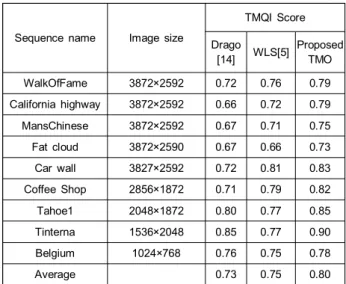
We used nine test sequences: Walk of fame, California highway, Mans Chinese, Fat cloud, Coffee shop, Tahoe1, Tinterna, and Belgium. These sequences are all in HDR format. For each test sequence, we compute TMQI score and compare results. Our proposed method shows good performance compared to the conventional methods [5, 14].
Table 1 shows TMQI Score comparison of the three tone mapping algorithms. The highest TMQI score in proposed algorithm is 0.90 on Tinterna. The average TMQI score in proposed algorithm is 0.80.
Sequence name Image size
TMQI Score Drago
[14] WLS[5] Proposed TMO
WalkOfFame 3872×2592 0.72 0.76 0.79
California highway 3872×2592 0.66 0.72 0.79
MansChinese 3872×2592 0.67 0.71 0.75
Fat cloud 3872×2590 0.67 0.66 0.73
Car wall 3827×2592 0.72 0.81 0.83
Coffee Shop 2856×1872 0.71 0.79 0.82
Tahoe1 2048×1872 0.80 0.77 0.85
Tinterna 1536×2048 0.85 0.77 0.90
Belgium 1024×768 0.76 0.75 0.78
Average 0.73 0.75 0.80
표1. 톤 매핑 이미지의TMQI 수치
Table 1. TMQI Score of the tone mapped images
Moreover, figure 2 (a) is the HDR image is shown in LDR monitor. Generally, LDR monitor displays HDR scene too dark and loses its detail. Thus, HDR image needs tone mapping operator. Figure 2 (b) shows tone mapped image which is based on WLS optimization framework [5].
(a)
(b)
(C) 그림2. 커피숍
Fig. 2. Coffee Shop
(a) HDR image shows in LDR monitor, (b) based on WLS optimization framework, (c) based on proposed algorithm.
(a)
(b)
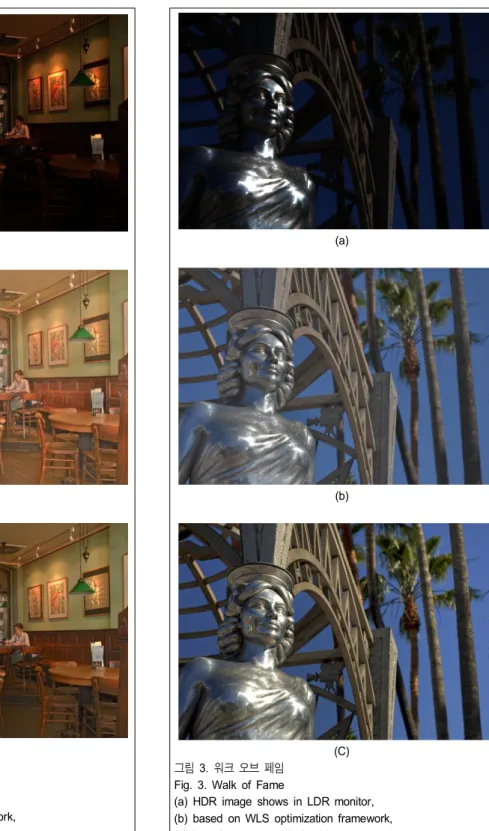
(C) 그림3. 워크 오브 페임
Fig. 3. Walk of Fame
(a) HDR image shows in LDR monitor, (b) based on WLS optimization framework, (c) based on proposed algorithm.
The tone mapped image shows more visible scene than non-processed image. However, our tone mapped image is much closer to real world than figure 2 (b). Especially, wooden furniture of figure 2 (c) is more realistic than (b).
The color appearance of telephone booth and ceiling lamp in the image is more vivid.
V. Conclusion
Generally, conventional tone mapping operators only process luminance scale and it causes color distortion. We have proposed a tone mapping algorithm which combines WLS filter and iCAM06 model. Our tone mapping operator inherits excellent edge-preserving ability of WLS filter.
Additionally, it applies chromatic adaption function and non-linear tone compression function to deal with color reproduction. The experiment shows that our approach is better than conventional tone mapping operators. However, we considered this kind of color enhancement has a limitation. The major problem is the accuracy of the white color estimation from the reference image. The selection of the white leads to different colors in tone mapped im- ages [15]. In another hand, computation is also a consid- erable issue.
In future work, we will focus on finding a progressive color enhancement strategy which can work on diverse HDR contents while avoiding the hue shifting problem.
참 고 문 헌 (References)
[1] D. Park, J. Kim, S. Lim, J. Kim, and H. Kim, "LCU-Level Rate Control for HEVC Considering Hierarchical Coding Structure," Journal of
Broadcast Engineering, vol. 16, no. 5, pp. 762-772, 2011.
[2] Y. Kim, J. Choi, and H. Choi, "Performance Analysis of Scalable HEVC Coding Tools," Journal of Broadcast Engineering, vol. 20, no.
4, pp. 497-508, 2015.
[3] J. Lim, Y. Ahn, W. Lim, S. Park, D. Sim, and J. Kang, "Layered Coding Method for Scalable Coding of HDR and SDR videos," Journal of Broadcast Engineering, vol. 20, no. 5, pp. 756-769, 2015.
[4] E. Francois, C. Fogg, Y. He, X. Li, A. Luthra, and A. Segall, "High Dynamic Range and Wide Color Gamut Video Coding in HEVC:
Status and Potential Future Enhancements," IEEE Trans. Circuits Syst.
Video Technol., vol. 26, no. 1, pp. 63-75, Jan. 2016.
[5] Z. Farbman, R. Fattal, D. Lischinski, and R. Szeliski, "Edge-preserving decompositions for multi-scale tone and detail manipulation," ACM Trans. Graph., vol. 27, Iss. 3, Aug. 2008.
[6] J. Kuang, G. Johnson, and M. Fairchild, "iCAM06: A refined image ap- pearance model for HDR image rendering," Journal of Visual Communication and Image Representation, vol. 18, Iss. 5, pp.
406-414, 2007.
[7] M. Fairchild, G. Johnson, "Meet iCAM: A next-generation color ap- pearance model," IS& T/SID 10th Color Imaging Conference, pp.
33-38, 2002.
[8] F. Durand, J. Dorsey, "Fast bilateral filtering for the display of high-dy- namic-range images," ACM Trans. Graph., vol. 21, no.3, pp. 257-266, 2002.
[9] P. Perona and J. Malik, "Scale-space and edge detection using aniso- tropic diffusion," IEEE Trans. Pattern Anal. Mach. Intell., vol. 12, no.
7, pp. 629-639, 1990.
[10] C. Tomasi and R. Manduchi, "Bilateral filtering for gray and color im- ages," In Proc. IEEE Int. Conf. on Computer Vision, pp. 836-846, 1998.
[11] D. Lischinski, Z. Farbman, M. Uyttendaele, and R. Szeliski,
"Interactive local adjustment of tonal values," ACM Trans. Graph., vol.
25, no. 3, pp. 646-653, 2006.
[12] H. Yeganeh and Z. Wang, "Objective Quality Assessment of Tone-Mapped Images," IEEE Trans. Image Process., vol. 22, no. 2, pp.
657-667, Feb. 2013.
[13] K. Ma, H. Yeganeh, K. Zeng, and Z. Wang, "High Dynamic Range Image Compression by Optimizing Tone Mapped Image Quality Index," IEEE Trans. Image Process., vol. 24, no. 10, pp. 3086-3097, Oct. 2015.
[14] F. Drago, K. Myszkowski, T. Annen, and N. Chiba, "Adaptive Logarithmic Mapping For Displaying High Contrast Scenes,"
Computer Graphics forum, vol. 22, Iss. 3, pp. 419-426, Sep. 2003.
[15] R. Mantiuk, A. Tomaszewska, and W. Heidrich, "Color correction for tone mapping," Computer Graphics forum, vol. 28, Iss. 2, pp. 193-202, April 2009.
저 자 소 개
박 미 선
- 2015년 6월 : YanBian University Department of Computer Science and Telecommunication (학사) - 현재 : 한양대학교 전자컴퓨터통신공학과 (석사과정)
- ORCID : http://orcid.org/0000-0001-9195-8051 - 주관심분야 : HDR, 영상압축, HEVC
이 경 준
- 2012년 2월 : 한양대학교 미디어통신공학전공 (학사) - 현재 : 한양대학교 전자컴퓨터통신공학과 (박사과정) - ORCID : http://orcid.org/0000-0001-5728-9368 - 주관심분야 : 영상압축, HEVC, FRUC, HDR
위 승 우
- 2015년 : 한양대학교 Erica 전자통신공학전공 (학사) - 현재 : 한양한양대학교 전자컴퓨터통신공학과 (석사과정) - ORCID: http://orcid.org/0000-0001-8704-0184 - 주관심분야: HDR, HEVC, 영상압축
정 제 창
- 1980년 2월 : 서울대학교 전자공학과 (학사) - 1982년 2월 : KAIST 전기전자공학과 (석사) - 1990년: 미국 미시간대학 전기공학과 (박사)
- 1980년 ~ 1986년 : KBS 기술연구소 연구원 (디지털 및 뉴미디어 연구) - 1990년 ~ 1991년 : 미국 미기간대학 전기공학과 연구교수 (영상 및 신호처리 연구) - 1991년 ~ 1995년 : 삼성전자 멀티미디어 연구소 (MPEG, HDTV, 멀티미디어 연구) - 1995년 ~ 현재 : 한양대학교 전자컴퓨터통식공학과 교수 (영상통신 및 신호처리 연구실) - ORCID : http://orcid.org/0000-0002-3759-3116
- 주관심분야: 영상처리, 영상압축, 3DTV
![Figure 1 is flowchart of our proposed algorithm. At first, we convert input HDR image RGB values to XYZ values by sRGB color space transform matrix [6]](https://thumb-ap.123doks.com/thumbv2/123dokinfo/4794042.520868/4.892.492.812.559.890/figure-flowchart-proposed-algorithm-convert-values-values-transform.webp)