39(9), 1366~1372(2010) DOI: 10.3746/jkfn.2010.39.9.1366
알코올 발효조건 및 효모를 달리한 현미식초의 품질 특성
이수원1․권중호1․윤성란1․우승미2․장세영2․여수환3․최지호3․정용진2†
1
경북대학교 식품공학과
2
계명대학교 식품가공학과 및 (주)계명푸덱스
3
농촌진흥청 국립농업과학원 농식품자원부 발효이용과
Quality Characteristics of Brown Rice Vinegar by Different Yeasts and Fermentation Condition
Su-Wone Lee1, Joong-Ho Kwon1, Sung-Ran Yoon1, Seung-Mi Woo2, Se-Young Jang2, Soo-Hwan Yeo3, Ji-Ho Choi3, and Yong-Jin Jeong2†
1Dept. of Food Science and Technology, Kyungpook National University, Daegu 702-701, Korea
2Dept. of Food Science and Technology, Keimyung University and Keimyung Foodex Co., Ltd, Daegu 704-701, Korea
3Fermentation & Food Processing Division, Department of Agrofood Resources, NAAS, RDA, Gyeonggi 411-853, Korea
Abstract
This study investigated the quality characteristics of brown rice vinegar (agitated culture and static culture) derived from brown rice Takju with different types of yeasts. The alcohol content by yeast was the highest in B (brown rice Takju produced by S. cerevisiae GRJ) at 14.3% and the titratable acidity was less than 0.6%
in all ranges. When quality characteristics of agitated and static culture brown rice vinegar using them were compared, acidity of agitated culture vinegar recorded the highest level or 6.05% at 7 day of fermentation DV (brown rice vinegar produced by S. kluyveri DJ97) with the initial acidity of 1.0% and the initial pH of 3.9~4.0, and AV (brown rice vinegar produced by S. cerevisiae JK99), CV (brown rice vinegar produced by S. cerevisiae H9) and BV (brown rice vinegar produced by S. cerevisiae GRJ) recorded as 5.64, 5.55 and 5.32%, respectively.
In addition, acidity of static culture vinegar increased continuously to 5.01~5.31% until the 14 day of fermenta- tion and then tended to decrease slightly from the 16 day of fermentation. Difference in acidity and pH of brown rice vinegar according to types of yeast was not significant. Comparison of free amino acid of brown rice vinegar showed that for agitated culture brown rice vinegar, the content of total free amino acid was higher in the order of BV, DV, AV and CV and the content of essential amino acid was the highest in BV by recording over 1,000 ppm. The content of total free amino acid of static culture brown rice vinegar was higher than that of agitated culture vinegar in all ranges and especially static culture brown rice vinegar contained more serine, alanine, valine, isoleucine, leucine and γ-aminobutyric acid than agitated culture vinegar. In particular, γ -aminobutyric acid recorded over ten times higher level or 456.91~522.66 ppm. From these results, quality characteristics of brown rice vinegar was affected by acetic acid fermentation methods rather than types of yeast. However, as future aging process is expected to change flavor components and sensory characteristics, studies on various quality factors of vinegar are needed.
Key words: brown rice, yeast, vinegar, agitated culture, static culture, acetic acid
†
Corresponding author. E-mail: [email protected]
†
Phone: 82-53-580-5557, Fax: 82-53-580-6477
서 론
식초는 오랜 역사를 지닌 전통발효식품으로 소량의 휘발 성 및 비휘발성 유기산, 당류, 아미노산, ester 등을 함유한 독특한 방향과 신맛을 가진다(1,2). 이러한 식초는 대표적인 알칼리성 식품으로 동맥경화증이나 혈전증을 일으키는 과 산화지질을 분해해 동맥경화 예방과 부신피질 호르몬의 분 비, 소화 및 식욕촉진, 항종양효과, 체지방 감소, 피로회복
효과 및 면역기능 향상 등의 다양한 생리활성이 보고되고
있다(3,4). 국내의 식초는 주정을 희석하여 무기염류를 첨가
한 발효식초, 과즙 30% 이상을 함유하는 과실식초, 곡물함량
4% 이상을 함유하는 곡물식초가 대부분이었으나 식초가 단
순 조미료 기능에서 건강용 식초로 소비 패턴이 변화되면서
100% 과즙 원료 식초 및 곡물함량이 높고 유기산뿐 아니라
아미노산이 풍부한 생쌀발효 흑초와 같은 고품질 발효식초
가 등장하고 있다(5). 또한 식초 제조방법에 있어 산업적 대
량생산방법 교반(속성)배양과 전통적 숙성방법 정치배양 식 초로 나뉘어 개발되고 있다. 현재까지 식초에 관한 연구는 주로 발효균주 및 속성제조 방법 등에 국한되어 있어 전통적 인 정치배양 식초의 품질 향상 및 기능성 강화방안은 미흡한 실정이다(6,7). 일본 가고시마현에서는 전통적인 정치배양 법으로 제조한 흑초가 산업화되어 2007년에 17억 7000만 엔 의 매출 규모로 신장하였다(5). 이러한 흑초에는 20종류 이 상의 천연 아미노산 및 다양한 기능성 성분들이 함유되어있 어 식초시장의 고급화 소재로 활용이 기대된다. 우리나라에 서는 고려시대부터 농가에서 탁주(막걸리)를 제조하여 전통 적인 정치배양법으로 식초를 제조하였으며 이러한 식초의 기질이 되는 술의 원료, 발효방법 특히 효모 등에 의한 식초 의 다양한 특성이 있을 것으로 생각된다(8).
탁주는 전분질 원료와 누룩을 발효제로 하여 발효시킨 술 덧을 혼탁하게 제성한 것을 말한다(8). 탁주는 일반 주류와 는 달리 생효모, 당질, 비타민 B군 및 단백질이 상당량 함유 되어있고, 누룩의 protease에 의한 분해산물인 valine, leu- cine, serine, proline 및 glycine 등의 아미노산이 풍부하여 영양학적으로 우수한 주류이다(9,10). 탁주 연구는 유리당, 아미노산, 유기산 등의 맛 성분에 관한 보고가 대부분이며 (11,12), 최근에는 휘발성 향기성분(13,14)에 관한 연구가 활 발히 이루어지고 있다. 효모 종류에 따른 탁주 술덧의 품질 특성(15)에 관한 연구가 일부 진행되고 있으나 향미성분들 의 종류도 다양할 것으로 추측되어 향후 연구 가능성이 기대 된다(16).
따라서 본 연구에서는 발효식초의 이화학적 품질특성을 고려한 품질지표 설정을 위해 알코올발효 조건 및 효모 종류 에 따른 현미 탁주의 품질특성을 조사하였으며, 이를 활용하 여 교반배양 및 전통적인 정치배양 방법에 따른 현미식초의 품질특성을 비교 조사하였다.
재료 및 방법
실험재료 및 사용균주
본 실험에 사용된 현미는 2009년 경북 상주지방에서 재배 한 일반계 현미를 구입하였으며, 누룩은 상주곡자(주)에서 구입하여 사용하였다. 현미 알코올발효에 사용된 효모는 계 명대학교 발효공학실에서 보관중인
Saccharomyces cer- evisiaeJK99(A),
Saccharomyces cerevisiaeGRJ(B),
Sac- charomyces cerevisiaeH9(C),
Saccharomyces kluyveriDJ97(D) 4종을 YPD 배지(yeast extract 1%, peptone 2%, glucose 2%, agar 2%, pH 6.0)에서 30
oC, 24시간 계대배양 하였으며, 초산균은
Acetobacter pomorumKJY 8(KCTC 10173BP)을 고체배지(glucose 3%, yeast extract 0.5%, CaCO
31%, ethanol 3%, agar 2%, pH 7.0)에서 30
oC, 48시간 계대배양 한 후 4
oC에서 냉장보관하면서 사용하였다.
주모 및 종초
코오지 500 g에 정제수 1,500 mL를 가수하여 55
oC에서 6시간 동안 당화시켜 부직포에 여과한 후 10
oBrix가 되도록 조절하였다. 그리고 121
oC에서 15분간 살균한 후 4종류의 효모(A, B, C 및 D)를 각각 접종하여 항온배양기(HB-103- 2H, Hanbaek Scientific Co., Bucheon, Korea)에서 30
oC, 24 시간 정치배양 시켜 주모로 사용하였다. 초산발효에 사용된 종초는 현미 알코올 발효액을 알코올 함량 6%로 희석한 후
Acetobacter pomorumKJY 8을 접종하여 30
oC에서 250 rpm으로 10일간 배양시켜 사용하였다.
효모 종류에 따른 현미 알코올발효
현미 1 kg을 5시간 동안 수침한 후, 물을 빼고 증미하였다.
증미한 현미에 누룩 300 g를 혼합하고 A, B, C 및 D 주모 50 mL과 정제수 1,600 mL를 각각 첨가한 후 골고루 저어 항온배양기(HB-103-2H, Hanbaek Scientific Co.)에서 30
oC, 3일간 정치배양 시켜 효모 종류에 따른 현미 알코올발효 특 성을 조사하였다.
정치 및 교반 배양에 따른 현미 초산발효
효모 종류별 현미 알코올발효 여과액을 알코올 함량 6%
(v/v)로 조절한 후, 종초 10%(v/v) 접종하여 교반 및 정치발 효를 실시하였다. 교반배양 구간은 진탕배양기(HB-201SL, Hanbaek Scientific Co.)에서 30
oC, 250 rpm으로 발효시켰으 며, 정치배양 구간은 항온배양기(HB-103-2H, Hanbaek Scientific Co.)에서 500 mL 삼각플라스크에 100 mL씩 담금 하여 30
oC로 정치발효 시켰으며, 원심분리 후 상징액을 시료 로 사용하였다.
알코올 함량 및 당도
알코올 함량은 시료 100 mL을 증류한 다음, 주정계를 이 용하여 측정한 값을 Gay Luccac Table로 환산하여 산출하 였으며(17), 당도는 digital refractometer(PR-101, Atago Co., Ltd., Tokyo, Japan)를 사용하여 측정하였다.
적정산도 및 pH
적정산도는 시료 l mL에 1% phenolphthalein 지시약을 2~3방울 떨어뜨린 다음 0.1 N NaOH로 중화 적정하여 acetic acid(%)로 환산하였으며, pH는 pH meter(Metrohm 691, Metrohm UK Ltd., Herisau, Switzerland)로 실온에서 측정하였다.
색도 및 탁도
색도 및 탁도는 UV-visible spectrophotometer(UV Spec-
trophotometer 1601, Shimadzu Co., Kyoto, Japan)를 이용하
여 측정하였다. 색도는 명도(L), 적색도(a), 황색도(b)값을
측정하여 Hunter’s color value로 나타내었다. 대조구는 증
류수(L=100.00, a=0.06, b=-0.16)를 사용하였고 탁도는 660
nm에서 흡광도로 측정하였다.
Table 1. Hunter's color value and turbidity of brown rice Takju with different yeasts
Samples
1)Hunter's color value
Turbidity
L a b
A B C D
83.7±0.0
2)73.9±0.0 84.3±0.0 85.8±0.0
-2.4±0.0 -1.6±0.0 -2.2±0.0 -2.5±0.0
20.8±0.0 18.1±0.0 19.5±0.0 20.1±0.0
0.08±0.0 0.19±0.0 0.08±0.0 0.07±0.0
1)
Refer to Fig. 1.
2)
Values are mean±SD (n=3).
Table 2. Free sugar content of brown rice Takju with differ- ent yeasts
Samples
1)Free sugar (mg%)
Fructose Glucose Sucrose Maltose A B
C D
50±3
2)64±4 61±2 55±1
160±7 342±10 406±6 205±5
ND
3)ND ND ND
135±6 148±5 75±6 151±3
1)
Refer to Fig. 1.
2)
Values are mean±SD (n=3).
3)
Not detected.
0 1 2 3 4 5
A B C D
Kind of yeast
T it ra ta b le a ci d it y ( % ) & p H .
Titratable acidity pH
Fig. 2. Titratable acidity and pH of brown rice Takju with different yeasts. A~D: Refer to Fig. 1.
0 2 4 6 8 10 12 14 16 18
A B C D
Kind of yeast A lc o h o l c o n te n t (% ) & s u g a r c o n te n t (
oB ri x ) .
Alcohol content Sugar content
Fig. 1. Alcohol and sugar content of brown rice Takju with different yeasts. A: brown rice Takju produced by S. cerevisiae JK99, B: brown rice Takju produced by S. cerevisiae GRJ, C:
brown rice Takju produced by S. cerevisiae H9, D: brown rice Takju produced by S. kluyveri DJ97.
유리당 함량
유리당은 알코올 발효액을 Sep-pak C
18cartridge에 통과 시킨 다음, 0.45 μm membrane filter로 여과하여 high per- formance liquid chromatography(HPLC, Waters 2487, Wa- ters Co., Milford, USA)로 분석하였다(18). 분석 column은 carbohydrate analysis column(3.9×300 mm, Waters Co.), mobile phase는 75% acetonitrile(J.T.baker Co., Phillipsburg, USA)을 사용하였고 flow rate는 1.0 mL/min, injection volume은 20 μL로 하여 RI detector(M410 RI, Waters Co.) 로 분석하였다.
유리아미노산 분석
초산 발효액의 유리아미노산 정량은 시료 10 mL에 ethanol 30 mL를 가한 다음 하룻밤 실온에 방치시켜 단백질 을 침전·제거하고 상징액을 8,000 rpm에서 15분간 원심분리 한 후, 위층을 취하여 중탕가열 건고시켰다. Citrate buffer (pH 2.2) 10 mL를 가하여 희석시킨 후 0.45 μm membrane filter로 여과한 여액을 amino acid autoanalyzer(L-8800, Hitachi Co., Tokyo, Japan)를 이용하여 분석하였다(19).
통계처리
알코올 및 초산 발효액의 성분분석은 3회 반복하여 측정 한 평균과 표준편차로 나타내었으며, 유리아미노산은 1회 분석값을 나타내었다.
결과 및 고찰
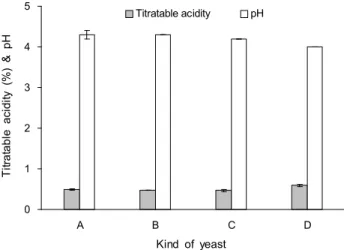
효모 종류에 따른 현미 알코올발효액의 품질특성 효모 종류에 따른 현미 알코올 발효액의 품질특성을 조사 한 결과, Fig. 1과 같이 알코올 함량은 B가 14.3%로 가장 높았고 A, C 및 D에서 각각 14.1, 13.0 및 12.4%로 나타났으 며, 당도는 알코올 함량과는 반대의 경향으로 나타났다. 이
는 Lee 등(20)이 생전분 분해효소를 이용한 현미 알코올발효 에서
S. cerevisiaeGRJ 주모를 접종하였을 때 알코올 함량 이 가장 높았다고 보고한 것과 유사한 경향이었다. 상기 조 건에서는 발효시간 및 온도를 동일하게 하여 시험한 결과로 서 일반적으로 탁주 발효 중 술덧의 당화 amylase, 발효 미 생물의 종류 및 활성도 등의 차이에 있으며(15), 상기 조건에 서도 발효기간 및 조건을 달리할 경우에는 알코올 함량은 더 증가할 것으로 생각된다. 적정산도는 모든 구간에서 0.6%
이하로 나타나 산패의 가능성은 없었으며, pH는 4.0~4.3 범 위로 나타나 효모 종류에 따른 차이는 크지 않았다(Fig. 2).
색도는 Table 1에서와 같이 L값은 B가 73.9로 가장 낮았고
나머지 시료들은 약 84~86의 수치를 나타내었다. a값은
-2.0, b값은 19 전후로 비슷한 수치를 나타내어 효모 종류에
따른 큰 차이는 없었다. 유리당 함량은 Table 2에서와 같이
0 1 2 3 4 5 6 7
0 1 2 3 4 5 6 7
Fermentation time (days)
T it ra ta b le a ci d it y ( % ) .
AV BV CV DV
3.0 3.5 4.0 4.5
0 1 2 3 4 5 6 7
Fermentation time (days)
p H .
AV BV CV DV
Fig. 3. Changes of titratable acidity and pH in brown rice vinegar by agitated fermentation with different yeasts. AV:
brown rice vinegar produced by S. cerevisiae JK99, BV: brown rice vinegar produced by S. cerevisiae GRJ, CV: brown rice vine- gar produced by S. cerevisiae H9, DV: brown rice vinegar pro- duced by S. kluyveri DJ97.
0 1 2 3 4 5 6
0 2 4 6 8 10 12 14 16
Fermentation time (days)
T it ra ta b le a ci d it y ( % ) .
AV BV CV DV
3 3.5 4 4.5
0 2 4 6 8 10 12 14 16
Fermentation time (days)
p H .
AV BV CV DV
Fig. 4. Changes of titratable acidity and pH in brown rice vinegar by static fermentation with different yeasts. AV~
DV: Refer to Fig. 3.
glucose가 160~406 mg%로 가장 많이 남았으며, maltose가 75~151 mg%, fructose가 50~64 mg%로 가장 낮게 나타났 으며 sucrose는 완전 발효되어 검출되지 않았다. 발효성 당 의 잔류 함량은 B에서 가장 높게 나타났으며 C, D 및 A 순으로 나타났다.
교반 및 정치배양에 따른 초산발효 특성
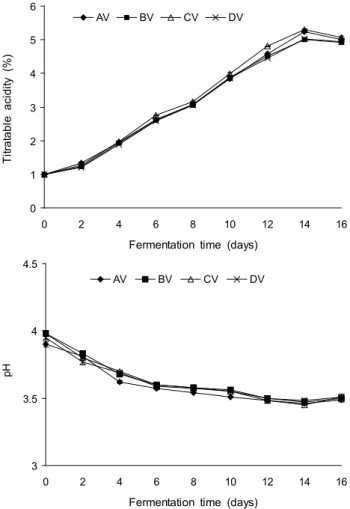
적정산도 및 pH: 효모 종류별 현미 알코올발효액의 알코 올 함량을 6%로 조절한 후, 종초 10%(v/v)를 접종하여 교반 및 정치배양 조건에 따른 초산발효 특성을 조사하였다. Fig.
3과 같이 교반배양의 초기산도는 1.0%, 초기 pH는 3.9~4.0 이었으며, 적정산도가 꾸준히 증가하는 경향으로 발효 7일 째 DV(brown rice vinegar produced by
S. kluyveriDJ97) 가 6.05%로 가장 높았고 AV(brown rice vinegar produced by
S. cerevisiaeJK99), CV(brown rice vinegar produced by
S. cerevisiaeH9) 및 BV(brown rice vinegar produced by
S. cerevisiaeGRJ)가 5.64, 5.55 및 5.32% 순으로 각각 나타났으나 효모 종류에 따른 큰 차이는 없었다. 그리고 일
반적인 속성배양의 경우 발효 용량, 방법 등에 따라 차이는 있으나 산도가 최고점에 도달한 후에는 감소함으로 본 실험 에서도 7일까지만 하였다. pH는 적정산도가 증가됨에 따라 점차 감소하여 발효 7일에 모든 구간에서 pH 3.3~3.4를 나 타내었다. 정치배양의 경우, Fig. 4와 같이 초기산도 및 초기 pH는 교반배양 시료와 동일하였으며, 적정산도는 발효 14일 째까지 꾸준히 증가하여 5.01~5.31%로, 교반배양에 비하여 적정산도는 최대 1% 정도 낮게 나타났으며, 효모 종류에 따른 큰 차이는 보이지 않았다. 발효 16일째부터 적정산도는 조금씩 감소하는 경향으로, 이는 정치배양과정 중 초산균이 발효 기질이 되는 알코올 성분을 모두 사용한 후, 생성된 초산을 분해하는 과산화가 발생한 것으로 생각된다(21). 정 치배양 용량이 커지면 발효기간이 더 길어질 것으로 예상되 며, 과산화가 일어나지 않도록 적절한 발효기간 설정이 필요 한 것으로 판단된다.
유리아미노산 함량
각각의 효모별 알코올발효액을 이용하여 교반 및 정치 초
산발효에 따른 현미식초의 유리아미노산 함량을 비교하였
다. Table 3과 같이 교반배양에서 총 유리아미노산 함량은
Table 3. Content of free amino acid in brown rice vinegar by agitated fermentation with different yeasts
Free amino acid content (mg%) AV
1)BV
2)CV
3)DV
4)Phosphoserine
Phosphoethanolamine Taurine
Aspartic acid Threonine Serine Glutamic acid α -Aminoadipic acid Glycine
Alanine
α -Aminobutyric acid Citrulline
Valine Cystine Methionine Cystachionine Isoleucine Leucine Tyrosine Phenylalanine β -Alanine
β -Aminoisobutyric acid γ -Aminobutyric acid Tryptophan
Ornithine Lysine Histidine
3-Methyl-histidine Arginine
Proline
1.29 ND
5)3.95 0.82 6.16 6.49 18.29 1.62 7.69 33.84 ND 2.25 13.08 0.22 6.40 0.35 7.79 21.19 12.26 14.74 ND 3.12 5.94 17.13 ND 17.59 7.18 0.32 9.69 21.43
1.34 4.65 ND 1.07 7.12 22.13 8.12 2.25 9.90 41.14 0.83 1.82 16.64 0.25 7.78 0.29 5.56 26.40 14.76 16.91 1.04 ND 5.00 21.76 ND 20.28 8.43 10.81 0.32 24.97
1.33 4.30 ND 0.95 6.58 18.10 6.87 4.65 7.78 35.87 2.67 ND 14.15 0.46 6.49 0.35 8.55 21.66 11.72 7.34 ND 8.91 5.44 20.08 3.87 13.13 3.75 0.13 0.75 22.07
1.73 4.03 ND 1.71 6.93 25.11 7.77 2.41 8.81 40.37 0.69 1.89 15.03 0.24 7.39 0.31 9.06 23.75 13.23 14.83 1.21 ND 4.56 20.68 ND 18.68 7.94 0.36 8.80 24.10 Total free amino acid 240.83 281.57 237.95 271.62 Essential amino acid 86.95 100.69 81.77 95.67
1)
AV: brown rice vinegar produced by S. cerevisiae JK99.
2)
BV: brown rice vinegar produced by S. cerevisiae GRJ.
3)
CV: brown rice vinegar produced by S. cerevisiae .
4)
DV: brown rice vinegar produced by S. kluyveri DJ97.
5)
ND: not detected.
Table 4. Content of free amino acid in brown rice vinegar by static fermentation with different yeasts
Free amino acid content (mg%) AV
1)BV
2)CV
3)DV
4)Phosphoserine
Phosphoethanolamine Taurine
Aspartic acid Threonine Serine Glutamic acid α -Aminoadipic acid Glycine
Alanine
α -Aminobutyric acid Citrulline
Cystine Valine Methionine Cystachionine Isoleucine Leucine Tyrosine Phenylalanine β -Alanine
β -Aminoisobutyric acid γ -Aminobutyric acid Tryptophan
Ornithine Lysine Histidine
3-Methyl-histidine Arginine
Proline
ND 2.03
5)5.98 0.63 17.40 16.61 10.20 18.51 1.99 74.02 ND 3.46 29.04 1.73 6.95 1.21 20.22 37.73 ND 7.60 0.98 0.61 51.89 ND 0.10 0.14 6.10 0.13 32.14 0.15
1.70 ND 4.88 0.63 14.04 14.64 10.52 18.03 2.46 66.88 0.95 2.33 27.01 1.77 7.24 1.20 28.39 36.00 9.21 ND 1.07 0.37 45.69 0.17 ND 0.10 1.17 0.09 37.40 0.12
1.88 ND 5.71 0.65 16.33 15.86 9.11 17.71 2.39 71.91 0.42 3.11 28.48 1.87 8.15 0.62 19.92 37.97 ND 9.49 0.85 1.39 46.76 ND 0.10 0.13 8.20 0.14 31.67 ND
2.03 ND 6.17 0.74 18.06 17.41 12.28 19.64 2.86 79.07 0.85 3.26 33.96 1.80 8.70 0.55 22.32 41.15 ND 9.38 1.14 0.32 52.27 ND 0.16 0.18 7.16 0.14 36.56 0.09
Total free amino acid 347.55 334.06 340.82 378.25 Essential amino acid 119.08 121.99 120.47 133.75
1-4)
Abbreviations are the same as in Table 3.
5)
ND: not detected.
BV, DV, AV 및 CV 순으로 나타났으며, 필수 유리아미노산 함량도 BV에서 100 mg% 이상으로 가장 높았다. 주요 아미 노산은 glutamic acid, alanine, valine, leucine, tyrosine penylalanin, ornithin, lysine, proline이었으며, 현미의 주요 한 기능성 강화물질로 알려진 γ-aminobutyric acid는 4.56
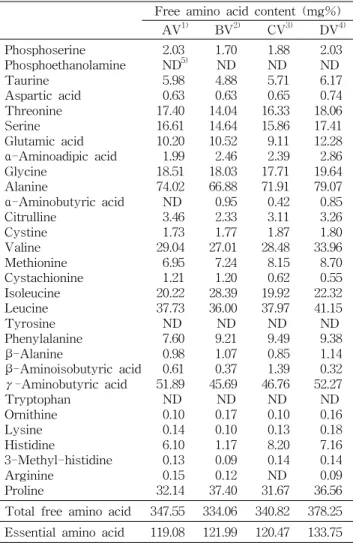
~5.94 mg%로 나타났다. 정치배양에서 총 유리아미노산 함 량은 DV, AV, CV 및 BV 순으로 나타났으며, 필수 유리아미 노산 함량은 DV가 133.75 mg%로 가장 높았으며 BV 121.99 mg%, CV 120.47 mg%, AV 119.08 mg%로 모든 구간에서 100 mg% 이상의 높은 함량을 나타내었다(Table 4). 주된 아 미노산은 threonine, serine, glutamic acid, glycine, alanine, valine, isoleucine, leucine, γ-aminobutyric acid, proline으 로 속성발효와 다르게 나타났다. 속성배양에서 다량 검출된 tyrosine 및 lysine 함량은 정치배양에 의해 크게 감소됨을 볼 수 있었고, 반면에 serine, glycine, alanine, valine, iso-
leucine, leucine, γ-aminobutyric acid 및 proline 등 대부분 의 유리아미노산 함량이 정치배양에서 크게 증가되었다. 특 히 γ-aminobutyric acid는 45.69~52.27 mg%로 교반배양 에 비하여 약 10배 정도 GABA 함량이 증가하는 것을 알 수 있었다. 따라서 효모 종류에 따른 영향보다 초산발효 배 양방법에 의해 유리아미노산 함량 차이가 더 큰 것으로 판단 된다.
색도
각각의 효모별 알코올발효액을 이용하여 교반 및 정치 초
산발효에 따른 현미식초의 색도 분석 결과는 Table 5, 6과
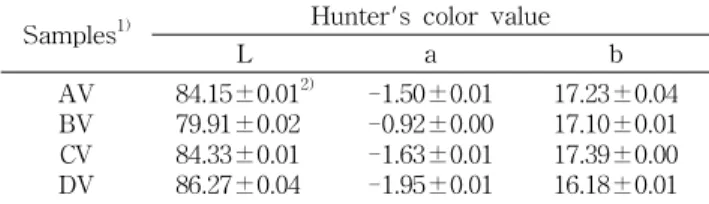
같다. L값은 교반배양에서는 BV가 79.91로 가장 낮았고 정
치배양에서도 BV가 79.68로 가장 낮게 나타났다. a 및 b값은
모든 시료에서 각각 -1.50 및 17.00 전후로 나타났으나 교반
배양에 비해 정치배양 시료들이 황색도가 조금 높았다. 이는
쌀 식초와 현미식초의 경우, 보존기간이 길어질수록 amino
carbonyl reaction에 의한 갈변현상으로 색이 짙어진다는 보
고(22)와 일치하였고, 대량발효에 의해 발효 및 숙성기간이
Table 6. Hunter's color value in brown rice vinegar by static fermentation with different yeasts
Samples
1)Hunter's color value
L a b
AV BV DV CV
83.50±0.10
2)79.68±0.04 84.92±0.04 80.82±0.05
-1.44±0.00 -1.08±0.01 -1.55±0.01 -1.21±0.01
17.57±0.01 17.75±0.00 17.68±0.00 18.78±0.03
1)
Refer to Fig. 3.
2)
Values are mean±SD (n=3).
Table 5. Hunter's color value in brown rice vinegar by agi- tated fermentation with different yeasts
Samples
1)Hunter's color value
L a b
AV BV DV CV
84.15±0.01
2)79.91±0.02 84.33±0.01 86.27±0.04
-1.50±0.01 -0.92±0.00 -1.63±0.01 -1.95±0.01
17.23±0.04 17.10±0.01 17.39±0.00 16.18±0.01
1)
Refer to Fig. 3.
2)
Values are mean±SD (n=3).
길어질수록 정치배양 시료들의 황색도가 더 높아질 것으로 생각된다. Jeong 등(23)의 2단계 발효에 의한 현미식초에서 색도는 L 70.31, a 2.75, b 36.45로 나타나 본 연구의 2단계 발효에 의한 현미식초의 b값과 비교하였을 때 매우 상이한 결과를 나타내었다. 이는 시료 전처리 및 가수량 등에 따른 차이인 것으로 생각된다.
요 약
알코올 발효 효모 종류를 달리하여 현미탁주를 제조하고 이를 이용한 현미식초(정치배양 및 교반배양)의 품질 특성 을 조사하였다. 효모 종류에 따른 알코올 함량은 B가 14.3%
로 가장 높았으며 적정산도는 모든 구간에서 0.6% 이하로 나타났다. 이를 이용한 교반 및 정치배양 현미식초의 품질특 성을 비교한 결과, 교반배양구간에서는 초기산도 1.0%, 초기 pH는 3.9~4.0에서 발효 7일째 DV구간에서 산도가 6.05%로 가장 높았고 AV, CV 및 BV가 5.64, 5.55 및 5.32% 순으로 나타났다. 또한 정치배양구간에서도 산도는 발효 14일째까 지 꾸준히 증가하여 5.01~5.31%로 나타났고 발효 16일째부 터 조금씩 감소하는 경향이었다. 효모 종류에 따른 현미식초 의 산도 및 pH 차이는 크게 나타나지 않았다. 현미식초의 유리아미노산 함량을 비교한 결과, 교반배양구간에서 총 유 리아미노산 함량은 BV, DV, AV 및 CV 순으로 높게 나타났 고 필수 유리아미노산 함량은 BV에서 100 mg% 이상으로 가장 높았다. 정치배양구간에서 유리아미노산 함량은 모든 구간에서 교반배양구간보다 높은 함량을 나타내었으며 serine, alanine, valine, isoleucine, leucine 및 γ-amino- butyric acid 등이 교반배양구간에 비하여 높았으며 특히 γ- aminobutyric acid는 45.69~52.27 mg%로 약 10배 이상 높
게 나타났다. 현재까지의 결과는 현미식초의 품질특성은 효 모 종류보다는 초산발효 방법에 따른 품질 차이가 더 큰 것 으로 나타났다. 그러나 향후 숙성과정에서 변화를 거치면서 향기성분, 관능적 특성에 차이가 있을 것으로 예상되어 다양 한 식초의 품질인자에 관한 연구가 요구된다.
감사의 글
본 연구는 농촌진흥청 공동연구사업(과제번호 : PJ0071- 732010)의 지원에 의해 이루어진 것임.
문 헌