발효조건을 달리하여 제조한 현미 막걸리의 품질특성
백창호1, 최지호1, 최한석1, 정석태1, 김재현1, 정용진2, 여수환1
*
1농촌진흥청국립농업과학원농식품자원부
2계명대학교식품가공학과
Received : October 15, 2012 / Revised : January 22, 2013 / Accepted : February 21, 2013
서 론
오래전부터농가에서는막걸리로식초를빚어음식에맛 을내는조미료로사용하였으며
,
최근에는쌀소비촉진과건강에대한관심증가로다양한식초가개발되고있다
[22].
우리나라술을대표하는막걸리는주로멥쌀을원료로누룩
을이용하여빚는발효곡주이다
[18].
이술은일반주류와는달리당질
,
비타민B
군및단백질등이풍부하고,
다양한 아미노산(valine, leucine, serine, proline, glycine)
들이 풍 부할뿐만아니라약주와과실주보다도영양가가우수한것으로알려져있다
[1].
생막걸리는효모와유산균이살아있어살균막걸리보다양조적성과소비자인지도가높은특성 을가지고있다
[4, 16].
막걸리의주원료는멥쌀
,
찹쌀,
소맥분등을사용하지만지 역에따라서는옥수수,
고구마,
보리,
좁쌀등다양한잡곡류로차별화된막걸리를제조하고있다
[19].
주원료인쌀은도정정도에따라현미와백미로구분되며
,
현미는백미에비 해영양성분(
식이섬유,
칼슘,
철분등의무기질및thiamine
과riboflavin
등의비타민)
이풍부하게함유되어있어심혈 관계질환,
당뇨병등성인병예방에효과가있는기능성식 품으로그활용성이크게대두되고있다[6, 9, 21].
현재
,
막걸리제조는누룩만을이용하는전통방식과개량누룩에효모를첨가하는방식으로술을빚고있다
[1].
최근에는주로무증자효소를이용하는당화법
[8, 11, 17],
첨가Quality Characteristics of Brown Rice Makgeolli Produced under Differing Conditions . Baek, Chang-Ho
1, Ji-Ho Choi
1, Han Seok Choi
1, Seok-Tae Jeong
1, Jae Hyun Kim
1, Yong-Jin Jeong
2, and Soo-Hwan Yeo
1*.
1Fermented Food Science Division, Department of Agro-food Resource, NAAS, RDA, Suwon 441-853, Korea,
2Department of Food Science and Tech- nology, Keimyung University, Daegu 704-701, Korea
In this study we investigated the possibility of preparing brewed brown rice makgeolli, a traditional Korean rice wine, under diverse conditions. For this purpose the physicochemical characteristics of makgeolli brewed at different temperatures, utilizing a variety of nuruks, the traditional Korean fermentation agent, were studied. The alcohol content was seen to be highest when brewing occurred at 30
oC, with the nuruk TN producing 16.2%. At 20
oCTN produced 14.1% alcohol content. The alcohol con- tent was therefore higher, by about 2%, for 30
oC fermentations than 20
oC fermentations. Similarly, saccharifying activity was influenced by temperature and sugar content, with a higher activity seen at 30
oC than at 20
oC. As the fermentations pro- gressed acidification petered out, with titratable acidity being 0.50-0.67% in all end samples. On the Hunter L, a, b scale; the a value decreased slightly, while the b value increased steadily during the fermentation process. Measurements of total organic acids were highest at 30
oC, with the nuruk AK, at about 550 mg%. The content of citric acid was the highest at 30
oC, being 230-310 mg% in all samples. However, more lactic acid was detected at 20
oC than at 30
oC. Total free amino acid was highest at 30
oC, with TN at 8,605 µg/ml, AK at 6,083 µg/ml, and RJ at 2,381 µg/ml. Total free amino acid and essential amino acid was shown to be higher at 30
oC than at 20
oC. The bioactive substance γ-aminobutyric acid was also higher at 30
oC, with TN at 223 µg/ml. From all of these results, we surmise that brown rice makgeolli manufacturing conditions are optimal at 30
oC fermenta- tion temperatures and using the nuruk TN for brewing vinegar. In addition, the nuruk used clearly affects the quality of brown rice makgeolli and an appropriate method to determine the best nuruk for various purposes should be pursued.
Keywords: Saccharifying activity, static fermentation, makgeolli, nuruk, organic acid
*Corresponding author
Tel: +82-31-299-0580, Fax: +82-31-299-0554 E-mail: [email protected]
© 2013, The Korean Society for Microbiology and Biotechnology
원료
[7, 19],
발효법[5],
발효미생물[10]
및사용발효제종류 별[12, 3]
로우리술연구를하고있다.
특히,
우리나라고유 의전통방식인농가형식초를빚기위한막걸리제조및이 들품질개선에대한연구는상당히미흡한실정이다.
따라서본연구에서는전통양조식초의발효법과이미·
이취등의문제점을해결하기위해
,
자체개발한밀누룩으로 현미막걸리를제조하여이들의품질특성을비교검토하였 으며,
향후,
이를활용한농가형양조식초제조의품질지표 기초자료로활용하고자한다.
재료 및 방법
사용원료 및 균주
본실험에사용한현미는경기도이천지역에서재배된일 반계현미
(2010 産)
를사용하였으며,
누룩제조에사용한밀과밀기울은전북익산지역에서생산
(2010 産)
된것을사용하였다
.
발효술덧의일반성분및유기산분석에사용한시 약은Sigma Co.(USA)
및시중에 시판되는Sigma-aldrich
특급품을사용하였다.
정치발효에사용한항아리는(
주)
갈산토기
(4 L)
로부터구입하였다.
알코올발효에사용한효모는농촌진흥청 발효식품과에서 보관중인
Saccharomyces cerevisiae GRJ
를YPD
배지(yeast extract 1%, peptone 2%, glucose 2%, agar 2%, pH 6.0)
에계대배양하여4
oC
에서냉 장보관하면서사용하였다.
주모 및 누룩제조
본연구에사용한주모는현미
(100 g)
에누룩(10%)
을첨 가하여55
oC
에서6
시간당화시킨후,
여과한여액을10
oBrix
로 보정한 다음, 121
oC
에서15
분간 고압살균하고Sac.
cerevisiae GRJ
접종하여 항온 배양기(EYELA SLI-700, Rikakikai Co., Ltd., Tokyo, Japan)
에서30
oC, 24
시간배양 한후,
사용하였다.
누룩제조는분쇄밀과밀기울을혼합하고,
각각의사상균[ Asp. kawachii (AK), Rhi. japonicus (RJ)]
을 밀기울액체배지에배양한후,
액체종국3%
을밀누룩에접 종하여제조하였으며,
대조구로사상균을접종하지않은것 을Control (TN)
로사용하였다.
누룩제조는30
oC
에서습도90%
조건으로30
일간발효시켜건조(50
oC, 24 h)
및법제된 것을사용하였다.
현미 막걸리 제조
현미막걸리제조는현미
1 kg
를세미및침미를하고증자 후,
냉각시켜각각의발효제인누룩(TN, AK, RJ)
을10% (w/w)
첨가하고, 160%(v/w)
로가수한다음,
주모를5% (v/w)
접종 하여발효온도별(20
oC, 30
oC)
로9
일간발효시켜막걸리를 빚었다.
알코올 함량 및 당도
발효술덧내의알코올함량분석은발효술덧을부직포
로조여과한여액을증류하여주정계로눈금을읽고
Gay-
Lussac table
로보정하여나타내었으며[14],
당도는술덧의 여액을디지털당도계(PR-32
α, ATAGO Co., Japan)
를이용 하여측정하였다.
적정산도 및 pH
적정산도는시료
1 ml
에1% phenolphthalein
지시약1-2
방울 떨어뜨린 다음
, 0.1 N NaOH
용액으로 적정한 후,
acetic acid (%)
로 환산하였으며, pH
는pH meter (Model 520A, Orion Co Ltd., USA)
를사용하여측정하였다.
색도색도는 색차계
(UltraScan
®Pro, Hunter Associates Laboratory, Inc., Reston, USA)
로측정하여명도(L),
적색도(a),
황색도(b)
값을측정하여Hunter's color value
로나타내 었다.
대조구는증류수(L = 96.31, a = 0.01, b =
−0.04)
를사 용하였다.
유기산 및 유리아미노산 분석
유기산은 발효 술덧을
HLB Sep-pak C
18cartridge (Waters Co., USA)
에 통과시켜HPLC (Sycam, S-series, Germany)
를이용하여분석하였다.
분석column
은Aminex HPX-87H (300 mm
×7.8 mm, Bio-rad Co., USA), mobile phase
는8 mM sulfuric acid
를 사용하였고, flow rate
는0.6 ml/min, injection volume
은20
µl
로하여UV detector (SPD-10A, 210 nm)
에서검출하였다[2].
초산발효액의유리 아미노산정량은시료1 ml
를0.02 N HCl
용액에20
배희 석하고0.2
µM membrane filter (Millipore Co. Ireland)
로 여과한 후, amino acid analysis system (Hitachi L-8900, Japan)
을이용하여분석하였다[15].
결과 및 고찰
현미 막걸리의 술덧성분 변화
현미
1 kg
에담금수160% (v/w)
로가수한다음,
각각의발 효제를10%
첨가하여온도(20
oC, 30
oC)
를달리하여알코올발효한결과를
Fig. 1
에나타내었다.
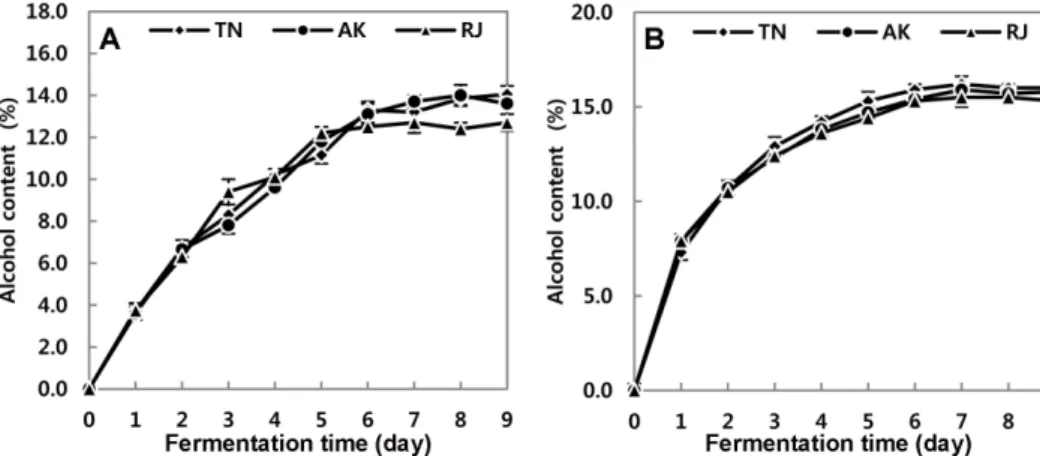
발효제에따른알코올생성능은
20
oC
의경우,
발효6
일째사상균을접종하지않은TN
의알코올생성능은13.2%, AK
는13.1%, RJ
는12.5%
로 완만히상승하였으며(Fig. 1A),
그이후에는큰변화가없었 다. 30
oC
의경우,
발효초기에알코올이급격히상승하다가4
일부터 완만히 상승하였으며,
발효7
일째TN (16.2%),
AK (15.9%), RJ (15.5%)
순으로높은알코올도수를나타낸이후
,
큰변화는없었다(Fig. 1B).
발효온도에따른알코올생성능은
20
oC
보다30
oC
에서평균
2%
정도높게나타났다.
당도는20
oC
에서발효2
일째가 장높았으며(8.3
oBrix),
그이후일정하게유지되었고(Fig.
Fig. 1. Changes in alcohol content by traditional static fermentation at different temperatures.
(A): 20
oC; (B): 30
oC; TN: control; AK: Asp. kawachii; RJ: Rhi. japonicus. Values are mean ± SD (n = 2)
Fig. 2. Changes in sugar content by traditional static fermentation at different temperatures.
(A)~(B): refer to Fig. 1, Values are mean ± SD (n = 2)
Fig. 3. Changes in pH by traditional static fermentation at different temperatures.
(A)~(B): refer to Fig. 1, Values are mean ± SD (n = 2)
2A), 30
oC
의경우,
발효1
일째14
oBrix
를나타낸후조금씩감소
(Fig. 2B)
하는것으로보아발효제에따른당화력은저온보다중온에서높은것으로보아
,
알코올함량에영향을 미치는것을알수있었다.
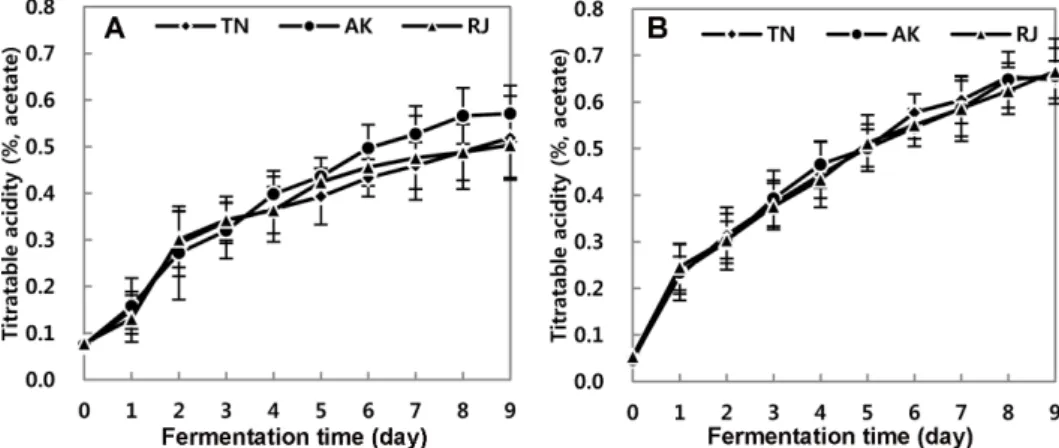
동일한발효온도에서발효제에Fig. 4. Changes in titratable acidity by traditional static fermentation at different temperatures.
(A)~(B): refer to Fig. 1, Values are mean ± SD (n = 2)
Table 1. Changes in hunter’s color values during alcohol fermentation by static fermentation at different temperature
Temp. Nuruka)Hunter'sColorb)
Fermentation times (day)
0 1 2 3 4 5 6 7 8 9
TN
L 92.76±0.03c) 92.06±0.02 92.21±0.00 92.17±0.02 91.26±0.03 91.32±0.04 91.42±0.04 91.62±0.05 91.41±0.02 91.67±0.02 a -0.90±0.01 -1.47±0.00 -1.39±0.01 -1.58±0.01 -1.56±0.01 -1.59±0.02 -1.57±0.01 -1.60±0.01 -1.90±0.01 -2.03±0.01 b 8.79±0.02 15.70±0.01 15.69±0.00 16.34±0.01 16.88±0.02 17.31±0.03 17.75±0.02 17.96±0.02 18.28±0.01 18.08±0.01
∆E 9.56±0.01 16.35±0.00 16.28±0.01 17.02±0.02 17.77±0.02 18.02±0.02 18.45±0.02 18.69±0.01 19.07±0.02 18.82±0.02 AK
L 93.29±0.03 92.22±0.02 92.47±0.00 92.66±0.01 91.96±0.02 91.95±0.03 91.91±0.03 91.97±0.03 91.57±0.02 91.80±0.01 30oC a -1.19±0.02 -1.23±0.01 -1.09±0.00 -1.31±0.01 -1.35±0.01 -1.34±0.01 -1.31±0.02 -1.29±0.02 -1.67±0.02 -1.73±0.00 b 11.52±0.03 15.54±0.01 13.84±0.01 14.04±0.00 14.47±0.01 14.88±0.02 15.26±0.01 15.64±0.02 16.40±0.01 16.00±0.00
∆E 11.98±0.03 15.17±0.00 14.42±0.01 14.65±0.01 15.25±0.01 15.36±0.03 15.82±0.02 16.35±0.02 17.21±0.01 16.77±0.01 RJ
L 91.76±0.03 91.76±0.00 92.65±0.023 92.35±0.03 92.00±0.02 91.95±0.04 91.89±0.03 91.80±0.04 91.55±0.03 91.78±0.02 a -1.07±0.01 -1.23±0.01 -1.14±0.01 -1.29±0.03 -1.39±0.02 -1.35±0.01 -1.38±0.02 -1.31±0.01 -1.75±0.01 -1.83±0.01 b 11.24±0.02 13.43±0.00 13.25±0.02 14.63±0.02 14.98±0.02 15.35±0.03 15.77±0.03 16.11±0.03 16.75±0.02 16.57±0.01
∆E 12.21±0.03 13.99±0.00 13.81±0.01 15.30±0.02 15.73±0.02 16.02±0.02 16.55±0.03 16.85±0.02 17.56±0.03 17.33±0.01 TN
L 92.65±0.03 92.08±0.02 92.26±0.03 92.21±0.01 91.88±0.02 91.68±0.00 91.65±0.04 91.23±0.00 91.54±0.01 91.35±0.04 a -0.91±0.02 -1.55±0.02 -1.47±0.01 -1.59±0.01 -1.60±0.00 -1.60±0.00 -1.62±0.01 -1.81±0.00 -1.88±0.00 -1.97±0.02 b 8.87±0.02 14.87±0.01 14.65±0.01 15.01±0.00 15.03±0.00 15.54±0.00 15.24±0.02 15.99±0.00 16.28±0.01 16.38±0.01
∆E 9.56±0.01 15.12±0.02 14.96±0.02 15.38±0.00 15.41±0.01 15.88±0.00 15.62±0.02 16.32±0.00 16.69±0.01 16.73±0.02 AK
L 93.20±0.01 93.18±0.03 92.88±0.02 92.56±0.02 92.66±0.03 92.32±0.04 91.78±0.03 92.02±0.05 91.85±0.03 91.46±0.03 20oC a -1.10±0.01 -1.10±0.02 -1.14±0.01 -1.20±0.02 -1.26±0.03 -1.32±0.02 -1.28±0.01 -1.31±0.01 -1.36±0.01 -1.39±0.01 b 9.38±0.02 12.68±0.02 13.02±0.01 13.00±0.01 13.47±0.03 13.66±0.03 13.83±0.02 14.21±0.03 14.63±0.01 14.49±0.02
∆E 9.56±0.01 12.88±0.02 13.27±0.01 13.18±0.01 14.00±0.03 14.66±0.02 14.83±0.02 15.21±0.02 15.63±0.01 15.49±0.03 RJ
L 92.66±0.01 92.51±0.03 92.73±0.00 92.41±0.02 92.22±0.02 92.05±0.05 91.46±0.04 91.58±0.04 91.32±0.03 91.22±0.03 a -1.07±0.00 -1.14±0.02 -1.16±0.00 -1.23±0.01 -1.40±0.01 -1.41±0.01 -1.45±0.01 -1.57±0.02 -1.63±0.01 -1.78±0.01 b 9.54±0.01 9.77±0.02 10.12±0.00 10.48±0.01 11.02±0.02 11.85±0.02 12.66±0.02 13.26±0.03 14.18±0.01 14.88±0.01
∆E 9.78± 0.00 9.89±0.02 10.54±0.00 10.77±0.01 11.26±0.01 12.54±0.03 12.87±0.02 13.44±0.03 14.67±0.02 15.08±0.01 a)
TN: Control; AK: Asp. kawachii; RJ: Rhi. japonicus.
b)
L: Lightness; a: Redness; b: Yellowness.
c)
Values are mean ± SD (n = 2).
따른당도차이는없는것으로나타났다
(Fig. 2). 30
oC
발효 에서당도변화는김등[7]
이보고한결과처럼담금1
일차에 급격히증가한이후,
서서히감소하는경향을나타내었다.
온도에따른pH
변화는20
oC
발효액이6.9
에서4.5
로발 효2
일 째 급격히 감소한 후,
일정하게 유지되었다(Fig.
3A). 30
oC
발효액의pH
는6.9
에서4.8
로크게감소한이후,
발효기간이늘어나도pH
변화는일정하게유지되었다(Fig.
3B).
알코올발효종료시각각의pH
는4.5
와4.4
로온도에 따른pH
변화는크게없었다.
보통막걸리발효pH
는4.0
에 서4.6
범위인데본연구에서현미막걸리의pH
도유사한범 위인것으로확인되었다[6].
발효액의적정산도는발효가끝 날때까지지속적으로증가하였는데(Fig. 4), 20
oC
에서AK
발효제로빚은발효술덧의적정산도는가장높았고(0.57%, Fig. 4A), 30
oC
발효액은0.65-0.66%
범위로나타나발효술 덧의산패가능성은없는것으로확인되었다(Fig. 4B).
김등[5]
의보고에따르면적정산도는온도가높을수록더많은 유기산을생성하고산의생성속도또한빠르다는결과와유 사하였다.
발효온도와발효제에따른현미막걸리의색차계 결과를Table 1
에나타내었다. 20
oC
에서빚은술덧의발효 초기L
값은각각TN 92.76, AK 93.29, RJ 91.76
이었으며,
발효종료후, RJ
를제외하고조금감소하였다. 30
oC
발효술 덧의발효초기L
값은TN 92.65, AK 93.20, 92.66
에서발 효종료후,
모두감소하였으며, 20
oC
발효술덧보다감소폭 이더큰것으로나타났다. a
값은모든발효술덧에서발효 초기에비해발효종료시에조금낮은경향이었으며, b
값은 발효가진행됨에따라꾸준히상승하는것으로나타났으나20
oC
발효술덧의상승폭이더크게나타났지만온도와누룩종류에따라서큰차이는없는것으로나타났다
.
우등[22]
은현미탁주의색도는주원료는동일하나부원료인누룩의 종류에따라알코올함량
,
색도,
갈색도등이차이가난다는 보고와는상이한결과를보였다.
이는본연구에서사용한 누룩이누룩제조시접종한사상균의종류가아니라사용된 원료에따라차이가발생한다고여겨진다.
현미 술덧의 유기산 함량
알코올발효
(9
일)
를종료한뒤,
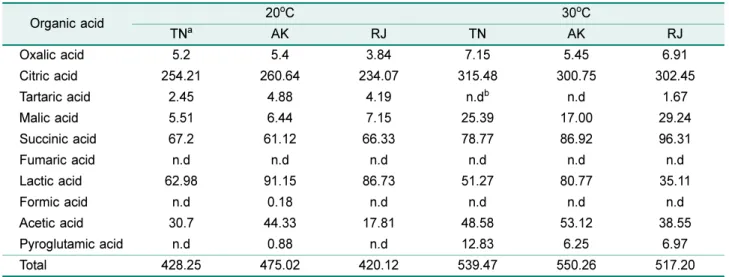
발효온도에따른술덧내 생성된유기산을분석하였다(Table 2). 20
oC
에서발효한현 미막걸리의유기산은9
종이검출되었으며,
그중citric acid
함량이200 mg%
이상으로가장많이검출되었다.
또한30
oC
에서발효한술덧도9
종의다양한유기산이검출되었으며,
그중citric acid
는300 mg%
이상으로20
oC
발효술덧보다1.5
배이상높게검출되었다. Citric, malic, succinic, acetic
및pyroglutamic acid
함량은20
oC
보다30
oC
발효술덧에서 더많이검출되었으며, lactic acid
는오히려20
oC
술덧에서 더많이검출된것으로보아온도에따라유기산함량의차 이가있는것으로나타났다.
김등[7]
은현미막걸리의주된 유기산은acetic, succinic, malic acid
순이라는보고와,
우 등[22]
은누룩의종류에따라현미막걸리의유기산중대부 분이lactic acid
라고보고한결과와는다르게나타났는데,
이 는사용한발효제종류,
발효조건등에따라유기산조성과 함량에차이가있는것으로여겨진다.
현미 술덧의 유리아미노산 변화
알코올발효
(9
일)
를종료한후,
발효온도에따라현미막Table 2. Organic acid composition of brown rice makgeolli after traditional static fermentation at different temperatures (mg%)
Organic acid 20
oC 30
oC
TN
aAK RJ TN AK RJ
Oxalic acid 5.2 5.4 3.84 7.15 5.45 6.91
Citric acid 254.21 260.64 234.07 315.48 300.75 302.45
Tartaric acid 2.45 4.88 4.19 n.d
bn.d 1.67
Malic acid 5.51 6.44 7.15 25.39 17.00 29.24
Succinic acid 67.2 61.12 66.33 78.77 86.92 96.31
Fumaric acid n.d n.d n.d n.d n.d n.d
Lactic acid 62.98 91.15 86.73 51.27 80.77 35.11
Formic acid n.d 0.18 n.d n.d n.d n.d
Acetic acid 30.7 44.33 17.81 48.58 53.12 38.55
Pyroglutamic acid n.d 0.88 n.d 12.83 6.25 6.97
Total 428.25 475.02 420.12 539.47 550.26 517.20
a
TN: Control; AK: Asp. kawachii; RJ: Rhi. japonicus.
b
Not detected.
걸리에생성된유리아미노산분석결과를
Table 3
에나타내 었다. 20
oC
발효술덧의경우, TN, AK, RJ
이각각24, 25, 22
종의유리아미노산이검출되었고그중에proline, arginine,
alanine
및glutamic acid
가주된아미노산으로100
µg/ml
이상 검출되었다.
발효제 별로 살펴보면, TN 1,136, AK 1,210, RJ 555
µg/ml
순으로, AK
발효제를사용한술덧의Table 3. Free amino acid composition of brown rice makgeolli after traditional static fermentation at different temperatures
(Units : µg/ml)
Free amino acid
Fermentation temperature
20
oC 30
oC
TN
aAK RJ TN AK RJ
Urea 0.00 3.79 0.00 34.31 38.33 9.40
Aspartic acid 29.60 31.56 11.98 400.17 243.34 105.83
Threonine
b15.13 17.08 5.92 267.93 162.56 78.05
Serine 29.40 32.06 10.64 432.85 285.43 132.85
Glutamic acid 106.88 111.26 44.94 767.43 585.04 266.66
α-Aminoadipic acid 0.00 0.00 0.00 42.11 31.60 7.98
Glycine 57.40 51.09 32.88 371.33 239.39 106.36
Alanine 109.32 103.97 63.47 821.03 537.74 229.12
Citrulline 0.00 0.00 0.00 12.34 6.22 0.00
α-Aminobutyric acid 0.00 0.00 0.00 31.18 6.34 0.00
Valine
b50.25 62.51 26.63 445.19 297.01 143.40
Cystine 0.00 0.00 0.00 176.42 108.12 29.33
Methionine
b18.14 31.64 6.56 204.11 144.12 51.52
Cystathionine 5.19 10.14 2.77 53.56 45.75 0.00
Isoleucine
b22.48 25.82 8.17 326.19 218.90 88.62
Leucine
b65.57 77.38 24.14 682.56 484.17 192.70
Tyrosine 58.72 67.59 25.63 465.37 361.95 137.63
Phenylalanine
b49.61 67.45 24.38 487.20 354.46 134.14
β-Alanine 0.96 5.76 0.00 24.38 29.29 0.65
β-Aminobutyric acid 1.17 4.26 0.89 80.20 81.24 7.78
γ- Aminobutyric acid 4.52 3.67 1.57 223.19 142.58 45.15
Ethanolamine 15.39 11.51 11.67 21.74 17.59 8.26
Ammonia 18.35 16.56 14.29 51.84 44.20 18.65
Hydroxylysine 0.00 0.00 0.00 0.00 0.00 0.00
Ornithine 4.68 4.01 3.11 155.08 129.98 31.56
Lysine
b48.63 62.42 11.42 459.36 325.71 130.23
Histidine
b7.59 11.10 0.00 124.84 85.43 33.61
Anserine 0.00 0.00 0.00 34.24 0.00 0.00
Carnosine 0.00 0.00 0.00 6.03 0.00 0.00
Arginine
b119.46 145.79 42.96 817.56 630.10 222.01
Hydroxyproline 7.03 5.74 8.96 8.44 8.78 0.00
Proline 291.41 246.39 172.25 577.43 438.62 169.60
Total amino acid 1136.85 1210.57 555.23 8605.60 6083.99 2381.08
Essential amino acid 396.86 568.78 150.18 3814.94 2702.46 1074.28
a
TN: Control; AK: Asp. kawachii; RJ: Rhi. japonicus.
b
Essential amino acids.
총유리아미노산이가장많이생성된것으로나타났다
.
또한 필수아미노산함량은각각TN 396, AK 501, RJ 150
µg/ml
으로나타나발효제종류에따라차이가큰것으로확인되 었다. 30
oC
발효술덧에서TN, AK, RJ
는각각31, 29, 25
종 의유리아미노산이검출되었으며,
주요아미노산(aspartic, serine, glutamic, alanine, valine, leucine, tyrosine, phenylalanine, lysine, arginine, proline) 11
종은400
에서800
µg/ml
이상검출되었다.
총아미노산함량은TN 8,605, AK 6,083, RJ 2,381
µg/ml
으로나타나20
oC
발효술덧보다 더많은유리아미노산이생성된것으로나타났다.
필수아미 노산함량은30
oC
발효술덧에서각각TN 3,814, AK 2,702, RJ 1,074
µg/ml
이검출된것으로보아동일한온도에서발 효를하더라도사용하는발효제에따라아미노산함량차이 가있었는데, 20
oC
발효술덧보다적게는5
배,
많게는10
배정도차이가 있는것으로 나타났다
.
신맛을내는aspartic
acid
는30
oC
의TN
에서400
µg/ml, 20
oC
에서는29
µg/ml
이 검출된것으로보아20
oC
보다30
oC
발효술덧에서약14
배 더많이 검출되었고,
감칠맛을내는glutamic acid
도30
oC TN
에서767
µg/ml, 20
oC AK
에서111
µg/ml
이검출되었다.
특히,
현미의주된생리활성물질인γ-aminobutryric acid
함 량역시30
oC TN
과AK
에서각각223
µg/ml, 142
µg/ml
이 검출되어다른실험구보다높게나타났다.
또한,
발효온도 에따라서가장많이검출된아미노산이다르게나타났는데20
oC
의 경우, TN, AK, RJ
모두proline
이각각291, 246, 172
µg/ml
검출되었으며, 30
oC
의경우TN
은alanine
이821
µg/ml, AK
는arginine
이630
µg/ml, RJ
는glutamic acid
가267
µg/ml
으로나타났다.
우등[22]
은발효제종류에따라유 리아미노산의조성이크게달라졌으며,
신맛,
감칠맛,
단맛 및쓴맛을나타내는유리아미노산이균형있게다량함유되 어있다는보고한결과와유사하게나타났으며,
발효온도가 높을수록유리아미노산이더욱풍부하게함유되어있는것 을알수있다.
이상의결과로보아
,
사용하는누룩종류와발효온도에따 라,
현미막걸리의품질이결정되는것으로보아기능성과 영양학적으로우수한발효제를선정하여막걸리를빚는것 이주질향상에도움이될것으로여겨진다.
요 약
본연구는발효조건을달리한현미막걸리의술덧성분변 화를조사하였다
.
서로다른발효제와발효온도에따른알코 올의차이는30
oC
발효가20
oC
보다알코올도수가평균2%
정도높은것으로나타났다
.
당화력차이는발효초기부터20
oC
보다30
oC
발효액의당도가높게나타난것으로보아 알코올도수에도영향을미치며, pH
는발효4
일까지는서서히감소하였고그이후
,
변화의폭은크지않았다.
적정산도 는발효가끝날때까지지속적으로증가하였으며, 20
oC AK
의적정산도가가장높게(0.57%)
나타났고, 30
oC
발효술덧 에서는0.66%
로산패가능성은없었다.
색도중L
값과a
값 은발효초기의모든술덧에비해발효종료시점에조금낮 아지며, b
값은발효가진행됨에따라꾸준히상승하였다.
발 효술덧의유기산은총9
종이검출되었으며,
그중citric acid
함량이가장높게나타났다. Lactic acid
는오히려20
oC
발 효술덧에서더많이검출된것으로보아발효온도에따라생 성된유기산이차이가있었다.
유리아미노산함량은발효제 종류및발효온도에따라크게차이가있었고,
유리아미노산 은20
oC
보다30
oC
발효술덧에많이있었다.
이상의결과를 살펴보면, 30
oC
에서제조한현미막걸리가더욱우수한품 질을가지며,
누룩종류및발효온도에따라서현미막걸리 의주질이결정된다.
향후,
농가형흑초제조에적합한현미 막걸리의술덧제조가가장중요하다고여겨진다.
Acknowledgements
This study was carried out with the support of Cooperative Research Program for Agricultural Science & Technology Develop- ment (PJ008488), Rural Development Adiministration, Republic of Korea and Research program for Agricultural Science & Technol- ogy Development (PJ006764), National Academy of Agricultural Science, Rural Development Adiministration, Republic of Korea.
References
1. Bae, S. M., Y. H. Lee, M. K. Lee, S. A. Kang, and C. Cheong.
2008. Effect of traditional nuruk ration and yeast on the fer- mentation and quality of yakju. J. East. Asian. Soc. Dietary Life. 18: 41-48.
2. Cho, K. S., E. Y. Jong, and M. K. Kim. 2012. Brewing and quality characteristics of SchisandrachinensisYakju. J. Appl.
Biol. Chem. 55: 163-167.
3. Han, E. H., T. S. Lee, B. S. Noh, and D. S. Lee. 1997. Quality characteristics in mash of makgeolli prepared by using differ- ent nuruk during fermentation. Korean J. Food Technol. 29:
555-562.
4. Han, E. H., T. S. Lee, B. S. Noh, and D. S. Lee. 1997. Volatile flavor components in mash of makgeolli prepared by using dif- ferent nuruks. Korean J. Food. Sci. Technol. 29: 563-570.
5. Jin, T. Y., H. J. Chung, and J. B. Eun. 2006. The effect of fer- mentation temperature on the quality of Jinyangju, a Korean traditional rice wine. Korean J. Food. Sci. Technol. 38: 414- 418.
6. Jo, D. H., H. J. Chung, H. Y. Cho, and S. T. Lim. 2011. Health function and utilization products of germinated brown rice.
Food. Sci. Ind. 44: 76-86.
7. Kim, H. R., S. J. Jo, S. J. Lee, and B. H. Ahn. 2008. Physico- chemical and sensory characterization of a Korean traditional rice wine prepared from different in ingredients. Korean J.
Food. Sci. Technol. 40: 551-557.
8. Kim, M. J., B. H. Kim, J. K. Han, S. Y. Lee, and K. S. Kim.
2011. Analysis of quality properties and fermentative microbial profiles of makgeolli and yakju brewed with or without steam- ing process. J. FdHyg. Safety 26: 64-69.
9. Ko, M. R., H. J. Choi, D. K. Han, S. S. Yoo, H. S. Kim, H. S.
Choi, S. W. Choi, N. Y. Hur, C. N. Kim, B. Y. Kim, and M. Y.
Baik. 2011. Antioxidative components and antioxidative capacity of brown and black rice. Food. Eng. Prog. 15: 195- 202.
10. Lee, H. S., C. S. Park, and J. Y. Choi. 2010. Quality character- istics of the mashes of makgeolli prepared using different yeasts. Korean J. Food. Sci. Technol. 42: 56-62.
11. Lee, O. S., Y. J. Jeong, Y. D. Ha, K. E. Kim, J. S. Shin, and H.
Kwon. 2001. Monitoring of alcohol fermentation condition with brown rice using raw starch-digesting enzyme. Korean J.
Post. Sci. Technol. 8: 412-418.
12. Lee, S. J. and B. H. Ahn. 2010. Sensory profiling of rice wines made with nuruks using different ingredients. Korean J. Food.
Sci. Technol. 42: 119-123.
13. Lee, S. W., J. H. Kwon, S. R. Yoon, S. M. Woo, S. Y. Jang, S.
H. Yeo, J. H. Choi, and Y. H. Jeong. 2010. Qualityh character- istics of brown rice vinegar by different yeasts and fermenta- tion condition. J. Korean Soc Food SciNutr. 39: 1366-1372.
14. Min, Y. K., M. K. Lee, and H. S. Jeong. 1997. Fermentation characteristics of jujube alcoholic beverage from different additional level of jujube fruit. J. Korean Agric. Chem. Soc. 40:
433-437.
15. Oh, Y. A., S. D. Kim, and K. H. Kim. 1997. Changers of sug- ars, organic acid and amino acids content during fermentation of pine needle added Kimchi. J. Food. Sci. Technol. Cuth. 9:
45-50.
16. Park, C. W., S. Y. Jang, E. J. Park, S. H. Yeo, O. M. Kim, and Y. J. Jeong. 2011. Comparison of the quality characteristics of commercial makgeolli type in South Korea. Korean J. Food.
Preserv. 18: 884-890.
17. Shin, J. S., O. S. Lee, K. E. Kim, and Y. J. Jeong. 2003. Moni- toring of alcohol fermentation condition of brown rice using raw starch digesting enzyme. J. Korean Soc. Food Sci. Nutr.
32: 375-380.
18. Son, H. S., B. D. Park, B. K. Ko, and C. H. Lee. 2011. Quality characteristics of makgeolliproduced by adding different amounts of water. Korean J. Food. Sci. Technol. 43: 453-457.
19. Song, J. C. and H. J. Park. 2003. Makgeolli brewing using the uncooked germed brown rice at second stage mash. J.
Korean Soc. Food Sci. Nutr. 32: 847-854.
20. Woo, K. S., J. S. Lee, J. Y. Ko, S. B. Song, B. G. Oh, J. R.
Kang, M. H. Nam, I. S. Ryu, and M. C. Seo. 2010. Physico- chemical characteristics of Korean traditional wine fermented from foxtail millet (Setaria italic Beauvios) and nuruk at differ- ent addition rates. Korean J. Food. Sci. Technol. 42: 298-303.
21. Woo, S. M., T. Y. Kim, S. H. Yeo, S. B. Kim, J. S. Kim, M. H.
Kim, and Y. J. Jeong. 2007. Quality characteristics of alcohol fermentation broth and by-product of brown rice varieties.
Korean J. Food. Preserv. 14: 557-563.
22. Woo, S. M., J .S. Shin, J. H. Seong, S. H. Yeo, J. H. Choi, T. Y.
Kim, and Y. J. Jeong. 2010. Quality characteristics of brown rice makgeolli by different nuruks. J. Korean Soc. Food Sci.
Nutr. 39: 301-307.