Reservation Conflict-Free MAC Design for Mobile Wireless USB Devices with Distributed MAC
Yang-Ick Joo
†, Moon Kyu Kwon
††ABSTRACT
In this paper, a collision-free resource reservation scheme for WUSB (Wireless Universal Serial Bus) networks with WiMedia D-MAC (Distributed Medium Access Control). Since distributed characteristic of the WiMedia D-MAC supporting DRP (Distributed Reservation Protocol) scheme may cause lots of conflicts, overall performances of the WUSB with WiMedia D-MAC can be deteriorated. In addition, when we consider multi-hop environment, "mobile" hidden node problem due to mobility of WUSB de- vices can be happened, and it is a critical problem to mobile WUSB devices transceiving real-time QoS (Quality of Service) traffic. To tackle the problem, we propose a new DRP reservation mechanism to prevent DRP conflicts for multi-hop mobility support in WUSB networks with WiMedia D-MAC and show its improved performance via simulation results.
Key words: Wireless USB (WUSB), WiMedia, Distributed MAC (D-MAC), Distributed Reservation Protocol (DRP), wireless resource reservation
※ Corresponding Author : Moon Kyu Kwon, Address : (606-791) Korea Maritime University, #727 Taejong-ro, Youngdo-gu, Busan, Korea, TEL : +82-51-410-4331, FAX : +82-51-405-8822, E-mail : [email protected] Receipt date : July 5, 2012, Revision date : July 30, 2012 Approval date : Aug. 10, 2012
††
Division of Electrical and Electronics Engineering, Korea Maritime Univ.
(E-mail: [email protected])
††
Department of Logistics System Engineering, Korea Maritime Univ.
1. INTRODUCTION
USB (Universal Serial Bus) technology has been used at an enormous number of USB devices as a universal interface. Technical advances in USB and wireless communication have introduced WUSB standard 1.0 that provides wireless tech- nology's convenience with wired USB's speed and compatibility.
In recent years, efficient and high quality multi- media communications in wireless home networks are increasingly required. Thus, UWB (Ultra Wide Band) of WiMedia Alliance is continuously gaining interest for ubiquitous connections in home enter-
tainment, security, and medical/military applica- tions due to its inexpensive cost, low power con- sumption, and small size. The salient features of UWB networks such as high-rate communica- tions, low interference with other radio systems, and low power consumption bring many benefits to users, thus enabling several new applications such as WUSB for connecting personal computers (PCs) to their peripherals and the consumer-elec- tronics (CEs) in people's living rooms [1,2].
A WUSB cluster consists of a WUSB host and several WUSB devices using a "hub and spoke"
model [3] as shown in Fig. 1. The WUSB host is the "hub" at the center, and each WUSB device sits at the end of a "spoke". Each spoke of the model represents a point-to-point connection between the host and a device. WUSB basically employs WUSB host driven scheduling scheme, that is, the WUSB host allocates time slots to WUSB devices in its own cluster.
Since WUSB host and devices with WiMedia D-
MAC have "distributed" and "wireless" character-
istics, we should consider resource reservation
Fig. 1. WUSB cluster.
Fig. 2. WUSB channel in WiMedia MAC superframe.
conflict due to such as hidden node problem and mobility of WUSB host and devices. However, the current WUSB standard has not considered the mobility of the WUSB host and devices [3].
Accordingly, in the WUSB home network environ- ment, the DRP (Distributed Reservation Protocol) reservation conflict can be occurred by the mobility of them. An avoidance method for the DRP reser- vation conflicts has been proposed in [4]. However, the method has false alarm probability since the proposed signaling message sequence of Get- Status(ExtendedMASAvailability) is made from GetStatus(MASAvailability) information from 1- hop neighbor devices including MAS (Medium Access Slot) availability information of itself as well. Because the false alarm makes both WUSB
hosts avoid using the possibly conflicted resources, the radio resources can be wasted. Therefore, in this paper, we propose a new mechanism to avoid WUSB data collision by providing actually over- lapped DRP reservation information only.
This paper is organized as follows: In Section 2, we describe the current method for resource res- ervation in WUSB. Our proposed DRP conflict avoidance algorithm among devices is explained in Section 3. In Section 4, a simulation model for the proposed scheme is presented and its performances are demonstrated. Finally, in Section 5, concluding remarks are presented.
2. Resource Reservation in WUSB
To utilize WiMedia PHY/MAC layer protocol, WUSB defines WUSB Channel which is encapsu- lated within a WiMedia MAC superframe via pri- vate DRP reservation blocks. The WUSB Channel is a continuous sequence of linked application-spe- cific control packets, called MMCs (Micro-sched- uled Management Commands), which are trans- mitted by WUSB host within the private DRP res- ervation blocks. The MMCs are used for WUSB devices to discover information about a WUSB cluster, to notify their intentions, to manage power, and to schedule data transmissions efficiently [3].
Fig. 2. shows the relationship between WiMedia
Fig. 3. The current DRP reservation in WUSB.
MAC and WUSB protocol. When a WUSB host becomes active, it reserves MASs where to operate WUSB Channel for WUSB data communications by sending DRP IE (Information Element). In this case, the WUSB host is the DRP reservation own- er, and WUSB devices are the DRP reservation targets.
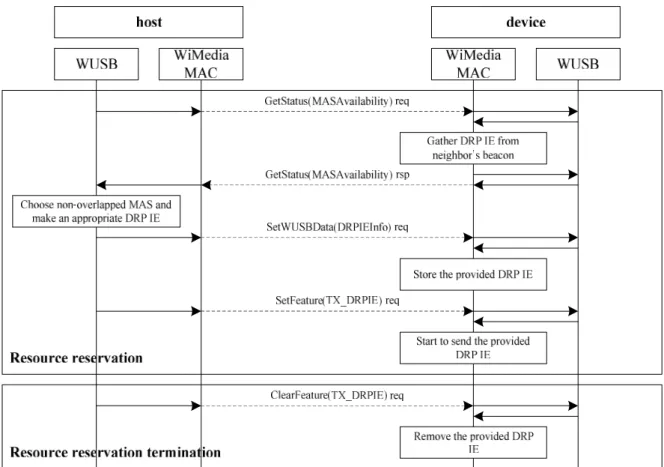
The current DRP reservation procedure in WUSB is depicted in Fig. 3. In order to retrieve a WUSB device's MAS availability information, a WUSB host uses a GetStatus(MASAvailability) request. A WUSB device that has received the GetStatus(MASAvailability) request from the WUSB host gathers the MAS availability in- formation from its neighbors' beacons and re- sponds to the GetStatus(MASAvailability) request using a GetStatus(MASAvailability) response message.
When the WUSB host receives the WUSB devi- ce's GetStatus(MASAvailability) response, it
chooses available MASs according to the response and provides the WUSB device with an appropriate DRP IE (Information Element) via SetWUSBData (DRPIEInfo) request.
When a WUSB device receives SetFeature (TX_DRPIE) request, it starts including the DRP IE provided by the SetWUSBData(DRPIEInfo) re- quest in its beacon. To terminate the DRP reser- vation, a WUSB host uses a ClearFeature(TX_
DRPIE) request to instruct a device to cease trans- mitting the DRP IE in its beacon.
Fig. 4 shows an example of DRP reservation conflict resolution operation between 2-hop range devices based on the current DRP protocol. In Fig.
4, a DRP reservation DRP
H1has been established between WUSB host H1 and WUSB device D1. H1 transmits data frames to D1 during the DRP
H1period. If some of the reserved MASs between
WUSB host H2 and WUSB device D2 are over-
lapped with DRP
H1, DRP conflicts happen between
Fig. 4. Example of DRP reservation conflict resolution operation between 2-hop range devices based on the current DRP protocol.
Fig. 5. The format of the GetStatus(MASAvailability).
DRP
H1and DRP
H2. In the WUSB standard [3], such a collision is prevented by using a bmMASAvail- ability field in GetStatus(MASAvailability) in Fig.
5. The bmMASAvailability field is used by a device to indicate its view of the current utilization of MASs by 1-hop neighbors in the current super- frame [4]. A device's bmMASAvailability field is made by receiving and combining the WiMedia DRP IEs from its 1-hop range neighbor devices.
From the MAS information of the received D1's WiMedia DRP IE, D2 marks DRP
H1period as un- available in its bmMASAvailability field. When H2 receives the GetStatus(MASAvailability) response from D2, H2 gets to know that the DRP
H1period is unavailable for D2. And in reserving DRP
H2peri- od, it excludes those MASs belonging to the DRP
H1period. Therefore, DRP reservation conflicts be- tween the 2-hop range hidden devices (i.e., D1 and H2 in Fig. 4) can be avoided by transmitting the
GetStatus(MASAvailability).
Now we consider another scenario taking
"mobile" hidden node into consideration. In Fig. 6, data can be exchanged without interference in each WUSB cluster when WUSB device D3 is at the initial location of D3. However, if WUSB device D3 moves to the new location of D3', i.e., within 1-hop range of D1, the reserved MASs of the D3 (DRP
H3) can be overlapped with the reserved ones of D1 (DRP
H1), and it will introduce interference between their reserved MAS resources.
To resolve DRP reservation conflict between
more than 2-hop range WUSB devices, a 3-hop
range DRP reservation conflict prevention method
using GetStatus(ExtendedMASAvailability) was
proposed in [4]. However, since the GetStatus
(ExtendedMASAvailability) responses received
from WUSB devices are made by simply accumu-
lating WiMedia MAC DRP Availability IEs which
Fig. 6. Example of DRP reservation conflict due to mobile hidden node.
Fig. 7. The format of the GetStatus(OverlappedMAS).
includes the WUSB host's own MAS reservation information as well, the method has false alarm problem on overlapped MAS. That is, the false alarm can be happened since D2 marks the corre- sponding resources as unavailable in its bmExtendedMASAvailability field of GetStatus (ExtendedMASAvailability) even when D2 only receives GetStatus(MASAvailability) of D1 with- out that of D3 or when D2 receives GetStatus (MASAvailability)s of both D1 and D3 without overlapped MASs between them.
Because the false alarm makes both WUSB hosts avoid using the possibly conflicted resources, the radio resources are wasted. Therefore, in this paper, we propose a new mechanism to avoid WUSB data collision by providing actually over- lapped DRP reservation information only.
3. Resource Reservation Conflict Avoi- dance Scheme for WUSB Devices
Once a DRP conflict occurs due to the mobile hidden node problem, only one of the DRP reser- vations involved in that DRP conflict maintains the reserved MASs, while the other DRP reservations must be terminated and DRP negotiations for them have to be re-started although only a few MASs are overlapped. Such DRP termination and re- negotiation time delays due to the DRP conflicts can be a critical problem to the mobile devices transceiving real-time QoS traffic streams. How- ever, if a WUSB host can know the information of multi-hop range hidden private DRP reservation status, it can avoid use of overlapped MASs.
Therefore, in this Section, we propose a conflict avoidance algorithm for WUSB resource reser- vation using a newly defined GetStatus(Over- lappedMAS). The GetStatus(OverlappedMAS) on- ly provides actually overlapped MAS reservation information which is made by combining the re- ceived WiMedia MAC DRP Availability IEs.
The format of the GetStatus(OverlappedMAS) is shown in Fig. 7. In Fig. 7, the bmOverlappedMAS bitmap field is up to 256-bit long, where each bit location corresponds to a MAS slot in the WiMedia D-MAC layer superframe. Using overlapped MAS detector, each bit is set to 'one' if the correspond- ing MAS is reserved by at least two devices in the same superframe, or each bit is set to 'zero' otherwise.
The proposed DRP reservation procedure in
WUSB is depicted in Fig. 8. To start a new private
DRP reservation process, a WUSB host uses the
GetStatus(MASAvailability) request to retrieve a
Fig. 8. The proposed DRP reservation in WUSB.
WUSB device's MAS availability information. A WUSB device that has received the GetStatus (MASAvailability) request from the WUSB host gathers the MAS availability information from its neighbors' beacons and responds to the GetStatus (MASAvailability) request using GetStatus (MASAvailability) response message.
A WUSB host that has received the GetStatus (MASAvailability) responses from WUSB devices transmits the GetStatus(OverlappedMAS) request to get the overlapped MAS reservation information within its multi-hop range private DRP reservation.
A WUSB device that has received the GetStatus (OverlappedMAS) request from the WUSB host listens the WiMedia MAC DRP Availability IEs of
neighbor devices and sends GetStatus(Overlapped- MAS) response. The WUSB host that has received the WUSB devices' responses for GetStatus (OverlappedMAS) chooses non-overlapped MASs based on the MAS reservation information pro- vided by GetStatus(MASAvailability) and GetStatus (OverlappedMAS) responses and provides the WUSB device with an appropriate DRP IE via SetWUSBData(DRPIEInfo) request.
When a WUSB device receives SetFeature (TX_DRPIE) request, it starts including the DRP IE provided by the SetWUSBData(DRPIEInfo) re- quest in its beacon. To terminate the DRP reser- vation, a WUSB host uses a ClearFeature(TX_
DRPIE) request to instruct a device to cease trans-
mitting the DRP IE in its beacon.
4. Performance Evaluation
Performance of the proposed scheme is eval- uated through NS-2 simulations. In the simulation, we assume that the network size is 10m*10m and the total 30 devices are randomly deployed into this area. The number of MASs in own DRP reser- vations of the reference WUSB device during 30 seconds denoted as DRP
ownis set to 20 MASs. And the number of MASs in private DRP periods re- served by 1-hop neighbor devices, 2-hop distance devices and 3-hop distance hidden devices of the reference device denoted as N
1-hop, N
2-hop, and N
3-hoprespectively are set to 30 MASs, 30 MASs, and 20 MASs. Each node has two kinds of mobility with corresponding probability of m
inand m
out. The m
inand m
outare a probability with which a device moves into a 1-hop closer range of the reference device (from (n+1)-hop to n-hop range) and a probability with which a device moves far a 1-hop range of the reference device (from n-hop to (n+1)-hop range) respectively. The m
outis set to 0.2 in the simulation. The size of a frame trans- mitted by devices in a beacon group is fixed to 4095 bytes.
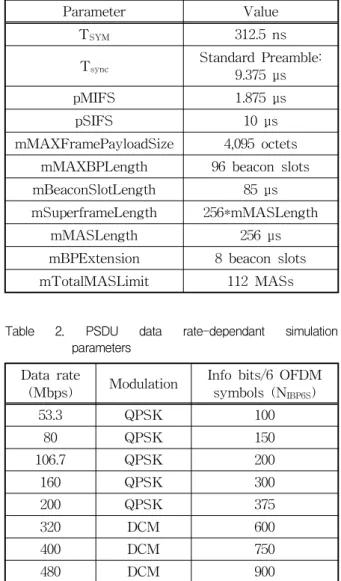
To analyze the designed MAC efficiency for WUSB device, we assume that (1) Bit error rate (BER) is zero (2) There are no losses due to colli- sions (3) No packet loss occurs due to buffer over- flow at the receiving node (4) Sending node always has sufficient packets to send (5) The MAC layer does not use fragmentation (6) Management frames such as beacon and association frames are not considered. The WiMedia PHY/MAC parame- ters and the PSDU data rate-dependant modulation parameters in the WiMedia standard [5] are found in Table 1 and Table 2, respectively.
Fig. 9 shows the probability of a 1-hop range private DRP conflict according to the L
1-hopvalue which is the number of MASs reserved by a 1-hop
Parameter Value
T
SYM312.5 ns
T
syncStandard Preamble:
9.375 μs
pMIFS 1.875 μs
pSIFS 10 μs
mMAXFramePayloadSize 4,095 octets mMAXBPLength 96 beacon slots
mBeaconSlotLength 85 μs
mSuperframeLength 256*mMASLength
mMASLength 256 μs
mBPExtension 8 beacon slots
mTotalMASLimit 112 MASs
Table 1. WiMedia PHY/MAC simulation parameters
Data rate
(Mbps) Modulation Info bits/6 OFDM symbols (N
IBP6S)
53.3 QPSK 100
80 QPSK 150
106.7 QPSK 200
160 QPSK 300
200 QPSK 375
320 DCM 600
400 DCM 750
480 DCM 900
Table 2. PSDU data rate-dependant simulation parameters
neighbor device. As shown in Fig. 9, the probability of a private DRP reservation conflict increases rapidly along with L
1-hopand m
invalues. This result may affect the QoS throughput performance and degrade the energy efficiency of the WiMedia D-MAC devices. Therefore, such DRP reservation conflicts should be considered seriously when de- signing the WiMedia D-MAC technology.
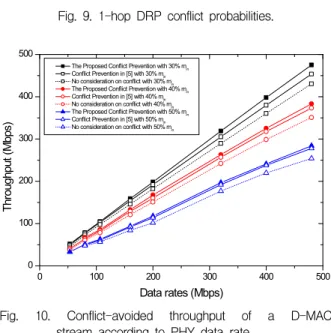
Fig. 10 shows conflict-avoided throughput QoS performance of a WiMedia D-MAC stream ac- cording to the PHY data rate of UWB for each m
inprobability. As shown in this simulation result, the
conflict-avoided throughput of a stream decreases
according to the probability of m
inof a 2-hop dis-
tant device. This is because the increment of the
0 5 10 15 20 25 30 35 40 45 50 0
10 20 30 40 50 60 70 80 90 100
1 -h o p D R P C o n fli ct P ro b a b ili ty ( % )
L
1-hop(MASs)
with 30 % m
inwith 40 % m
inwith 50 % m
inFig. 9. 1-hop DRP conflict probabilities.
0 100 200 300 400 500
0 100 200 300 400 500
T h ro u g h p u t (M b p s)
Data rates (Mbps)
The Proposed Conflict Prevention with 30% min Conflict Prevention in [5] with 30% min No consideration on conflict with 30% m The Proposed Conflict Prevention with 40% min in
Conflict Prevention in [5] with 40% min No consideration on conflict with 40% min The Proposed Conflict Prevention with 50% min Conflict Prevention in [5] with 50% m No consideration on conflict with 50% minin