온도와 차광이 참나물 발아 및 초기 생장 특성에 미치는 영향
전권석1·송기선1*·최규성2·김창환1·박용배1·김종진3
1국립산림과학원 남부산림자원연구소, 2국립수목원 유용식물증식센터, 3건국대학교 녹지환경계획학과
Effects of Temperature and Shading on Germination and Early Growth in Pimpinella brachycarpa
Kwon Seok Jeon1, Ki Seon Song1*, Kyu Seong Choi2, Chang Hwan Kim1, Yong Bae Park1, and Jong Jin Kim3
1Southern Forest Resources Research Center, Korea Forest Research Institute, 672 Jinju-dearo, Jinju-si, Gyungnam 660-300, Korea
2Useful Plants Resources Center, Korea National Arboretum, Gyeonggi 476-845, Korea
3Department of Environmental Design, Konkuk University, Seoul 143-701, Korea
Abstract. This study was carried out to determine the effects of temperature and shading on germination and early growth of Pimpinella brachycarpa. Experiment was performed by temperature controls (5oC, 10oC, 15oC, 20oC, 25oC, and 30oC) and shading treatments (control, 35% shading, 50% shading, and 75% shading). Seed pre-treatment before the germination experiment was carried out by temperature (with low temperature and wetting treatments for 0day, 20days, and 40days). Seeds of P. brachycarpa were, 20days of seed pre-treatment, germinated well at 5oC and the more temperature went up, the more germination rate went down. As a result of surveying shading treatments, the height, leaf area, leaf length, leaf width etc were the highest (7.3cm, 12.8cm2, 5.4cm, and 2.3cm, respectively) under 50% shading. Specially, the root was grown well under 35% and 50% shading. Fresh weight of shoot (leaves+stem) was the highest under 50% and 75% shading and dry weight of shoot (leaves+stem) was the highest under 35% and 50% shading. As a result of surveying the whole experiment, it is concluded that the production of P.
brachycarpa seedling is more effective under 50% shading.
Additional Key words : dry weight, fresh weight, germination rate, leaf growth, root growth
서 론
산채(山菜)류는 산이나 들에 자생하는 식물 중 식용이 가능한 식물을 뜻한다. 세계적으로 550,000여종의 식물 중에서 이용 가능한 종류는 약 3,000여종이며, 우리나라 에 자생하는 식물 3,200여종 중 약 480여종이 식용 가 능한 것으로 파악되었다(Hyun 등, 2010). 그 중 향과 맛 이 뛰어난 곰취와 참나물은 더덕이나 서덜취 등에 비해 토양수분 조건이 좋은 곳에서 제한적으로 분포하는 것으 로 알려져 있다(Kim과 Um, 1997).
참나물(Pimpinella brachycarpa)은 미나리과에 속하는 다년생 숙근초로서 ‘반디나물, 거린당이, 머내지’ 라는 별명을 갖고 있으며, 파드득나물, 반디나물, 삼엽채와 같 은 유사종이 있다. 키는 50~60cm정도이며, 잎은 서로
어긋나게 붙어있고 모양은 세 개로 갈라져 있다. 갈라진 잎조각의 생김새는 계란꼴 또는 넓은 타원형으로 끝이 뾰족하게 되어있다. 잎 가장자리에는 고르지 않게 생긴 날카로운 톱니가 있으며, 잎자루 아래 부분이 줄기를 감 싸고 있다. 어린 순을 채취하여 나물로 이용하는데 생체 를 고추장에 찍어 먹거나 무침, 튀김, 김치 등으로 조리 하기도 한다(Hong 등, 1999).
참나물의 무기성분 및 비타민 함량, 휘발성 향기성분 분석 등 물질 분석에 관한 연구는 다수 보고되었으나 (Chang 등, 2007; Choi와 Kim, 2002; Choi 등, 2001; Lee 등, 2007; Song 등, 1997), 재배와 생리에 관한 연구는 자 생지(Park과 Kim, 2011), 증식 및 재배기술 등(Kim, 2004; Na와 Chun, 2009; Suh, 1997) 많지 않다. 최근에는 참나물이 건강식으로 각광받는 고급 산채로 자리 매김을 하고 있으나 재배기술은 미흡한 실정이다(Choi 등, 2001).
따라서, 본 연구는 환경조절이 참나물의 종자발아와 유묘의 생장에 미치는 영향을 조사하고자 실시하였다.
*Corresponding author: [email protected]
*Received October 29, 2014; Revised November 24, 2014;
*Accepted November 27, 2014
재료 및 방법
1. 시험 재료
시험작물은 참나물(Pimpinella brachycarpa (Kom) Nakai)로 종자는 강원도 영월에서 2013년 10월에 구입 하였으며, 본 실험에 사용된 종자의 길이와 폭은 각각 4.4mm와 3.1mm이고, 품질은 Table 1과 같다.
재배용기는 육묘용 128구 tray (L27.5×W54.0×H5.0, cm)를 사용하였으며, 이 tray의 하나 cell 용량은 14mL이 었다. 상토는 시중에서 판매되고 있는 것으로 유기물질이 포함되지 않는 원예용 상토(부농, 한국)를 사용하였다.
2. 실험 방법
본 실험은 2개의 실험으로 구성되어 있다. 종자 발아 온 도 실험은 국립산림과학원 남부산림자원연구소에서 저온 습윤 처리기간(0일, 20일, 40일)과 온도(5oC, 10oC, 15oC, 20oC, 25oC, 30oC)를 각각 달리하여 실시하였다. 저온습윤 처리는 정선된 종자를 흡습지에 싸서 지퍼백에 넣은 후 증 류수로 지퍼백 내부를 습윤 처리하여 4oC의 저온저장고에 각각 저장하였다. 대조구(저온습윤 저장 0일) 종자는 2013 년 12월 16일에 상기 온도로 조절된 항온기에서 발아실험 을 하였다. 항온기 발아실험은 각 온도별로 filter paper를 2장씩 깐 petri dish (Ø90×H15, mm)에 증류수를 흐르지 않을 정도로 넣은 후 종자를 40립씩 3반복으로 실시하였 다. 항온기는 암조건이었으며, 종자를 배치한 petri dish를 넣은 후 습도를 유지하기 위하여 수시로 분무하였다.
생육실험은 남부산림자원연구소 플라스틱하우스에서 차광수준을 달리하여 무차광(대조구), 35% 차광, 50%
차광, 75% 차광 시험을 실시하였다. 종자를 상온에서 24시간동안 수침 처리 후 2014년 2월 19일에 128구 tray에 1셀당 1립씩 파종하여 3반복으로 시험하였다.
광도는 2014년 5월 2일 맑은 날에 측정하였으며, 차광 별 평균값은 Table 2와 같다.
3. 발아 및 생육 조사
저온습윤 처리기간별 및 온도별 발아실험을 실시한 후, 매일 발아 종자 개수를 조사하여 GR (germination rate), T50 (days to 50% of germination of final germination rates), MGT (mean germination time), GU (germination
uniformity)를 아래의 식을 이용하여 구하였다 (Coolbear 등, 1984; Gordon, 1971).
· GR = (N/S)× 100
· T50 = Ti + (Tj− Ti) × (N/2 − Ni) / (Nj − Ni)
· MGT =Σ (Tx·Nx) / Ν
· GU =Σ [(MGT − Tx)2·Nx] / N− 1
(N : 총 발아수, S : 총 시험 종자수, Ni : N에 대한 50% 발아 직전까지의 총 발아수, Nj : N에 대한 50%
발아 직후까지의 총 발아수, Ti : Ni 시점까지 소요된 발아기간, Tj : Nj 시점까지 소요된 발아기간, Nx : 조 사 당일의 발아수, Tx : 치상 후 조사일수)
차광수준별 파종 후 90일 뒤에 차광별 15개체를 대상 으로 초장과 줄기직경 생장을 조사하였다. 생체중은 지 상부(잎+줄기)와 지하부(뿌리)로 분리하여 각각 측정하였 다. 건물중은 생체중을 측정한 시료를 drying oven (DS- 80-5, 다솔과학(주), 한국)에서 105oC로 72시간 건조하여 구하였고, S/R율(leaf+stem/root ratio)을 산출하였다.
참나물의 엽면적은 휴대용엽면적 측정기(LI-3000C, Li-Cor Inc., USA)를 이용하여 측정하였으며, 엽두께는 Digimatic Caliper (Mitutoyo Co., Japan)로 세 지점을 측정하여 평균값을 산출하였다. 엽록소 함량은 chlorophyll meter (SPAD-502, Minolta Co. Ltd., Japan) 로 처리당 10개의 잎을 측정하여 평균 내었으며, 엽면적 비(leaf length/leaf width, leaf index)와 엽면적율(leaf area/total dry weight, leaf area ratio)을 각각 구하였다.
뿌리는 생장조사를 마친 취나물 유묘를 대상으로 전체 뿌리의 영상 분석(root image analysis), 전체뿌리길이
Table 1. Characteristics of seed length, width, weight of 1,000 seeds, seed weight per liter, and seed number per kg and per liter of P.
brachycarpa seed used in this experiment.
Seed length (mm)
Seed width (mm)
1,000 seeds weight (g)
Seed weight·L-1
(g) Seed number·kg-1 Seed number·L-1
4.4±0.5z 3.1±0.4 3.11 493.2 308,100 199,800
zMean±SD.
Table 2. Characteristics of light intensity at experimental site according to different shading treatments.
Shading (%)
Light intensity (µmol·m-2·s-1)
Relative light intensity (%)
0 690.0±147.6z 100
35 414.4± 43.6 60
50 272.0± 23.9 40
75 175.7± 9.8 25
zMean±SD(n=10).
(total root length), 뿌리투영단면적(total projected root area), 뿌리표면적(total root surface area), 뿌리부피(total root volume), 평균뿌리직경(average root diameter) 등을 조사하기 위해 WinRhizo 프로그램(2009 버전, Regent Instrument Inc., Canada)을 이용하여 차광별로 조사하였 으며(Arsenault 등, 1995; Bouma 등, 2000; Wang과 Zhang, 2009), 스캐너(Epson Expression 10000XL, Seiko Epson Corp., Japan)를 이용하여 스캔한 후 그 이미지를 WinRhizo 프로그램으로 분석하였다(Kim 등, 2010b).
4. 통계
통계 분석은 SPSS version 20을 이용하여 분산분석 (ANOVA)을 실시하였으며, 통계적으로 차이가 유의한 경우 Duncan’s multiple range test를 실시하였다.
결과 및 고찰
1. 발아 특성
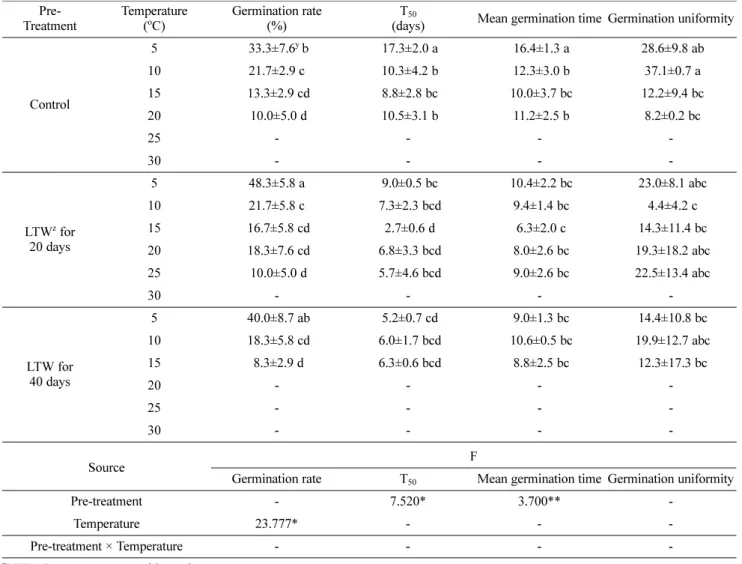
참나물의 발아율은 5oC에서 20일간 저온처리구에서 48.3%로 가장 높았으며(Table 3), 온도가 높아질수록 유 의적으로 낮아지는 경향을 보였다. 온도별로는 20일 저 온습윤 처리에서 가장 높은 발아율을 보였고 40일 저온 습윤 처리에서는 낮아지는 경향을 보였는데 이러한 결과 를 통해 참나물은 저온습윤 처리가 발아율과 직접적인 관련됨을 알 수 있었으며, Bonner (1988)는 온도가 발아 에 영향을 주는 중요한 환경요인이라고 보고하였다.
산채인 곰취, 참취, 어수리 등은 상대적으로 낮은 온도 에서 발아율이 높아(Kim 등, 2012a; Kwon 등, 1992, 1993) 본 실험과 유사한 결과를 나타냈는데, 이는 산림
Table 3. Effects of temperature on germination rate, T50, mean germination time, and germination uniformity of P. brachycarpa seeds pre- treated with low temperature and wetting.
Pre- Treatment
Temperature (oC)
Germination rate (%)
T50
(days) Mean germination time Germination uniformity
Control
5 33.3±7.6y b 17.3±2.0 a 16.4±1.3 a 28.6±9.8 ab
10 21.7±2.9 c 10.3±4.2 b 12.3±3.0 b 37.1±0.7 a
15 13.3±2.9 cd 8.8±2.8 bc 10.0±3.7 bc 12.2±9.4 bc
20 10.0±5.0 d 10.5±3.1 b 11.2±2.5 b 8.2±0.2 bc
25 - - - -
30 - - - -
LTWz for 20 days
5 48.3±5.8 a 9.0±0.5 bc 10.4±2.2 bc 23.0±8.1 abc
10 21.7±5.8 c 7.3±2.3 bcd 9.4±1.4 bc 4.4±4.2 c
15 16.7±5.8 cd 2.7±0.6 d 6.3±2.0 c 14.3±11.4 bc
20 18.3±7.6 cd 6.8±3.3 bcd 8.0±2.6 bc 19.3±18.2 abc
25 10.0±5.0 d 5.7±4.6 bcd 9.0±2.6 bc 22.5±13.4 abc
30 - - - -
LTW for 40 days
5 40.0±8.7 ab 5.2±0.7 cd 9.0±1.3 bc 14.4±10.8 bc
10 18.3±5.8 cd 6.0±1.7 bcd 10.6±0.5 bc 19.9±12.7 abc
15 8.3±2.9 d 6.3±0.6 bcd 8.8±2.5 bc 12.3±17.3 bc
20 - - - -
25 - - - -
30 - - - -
Source F
Germination rate T50 Mean germination time Germination uniformity
Pre-treatment - 7.520* 3.700** -
Temperature 23.777* - - -
Pre-treatment × Temperature - - - -
zLTW : Low temperature with wetting.
yDifferent letters in each column indicate significant differences according to Duncan's multiple range test (p=0.05).
*p<0.01. **p<0.05.
내 음지에서 잘 자라는 산채의 특성(Hong 등, 1999;
Lee 등, 2012) 때문인 것으로 판단된다.
참나물 종자가 5oC 저온습윤 처리구의 T50 (days to 50% of germination of final germination rates)과 평균 발아일수는 저온습윤 처리기간이 늘어날수록 짧아지는 경향을 보였고 발아균일도는 저온습윤 처리기간이 늘어 날수록 좋아지는 것으로 나타났다. 이러한 결과는 저온 습윤 처리를 통해 발아억제물질이 제거되었기 때문으로 판단된다(Schopmeyer, 1974).
2. 생장 특성 2.1 지상부
참나물의 초장은 50% 차광에서 7.3cm로 가장 컸으며, 그 다음은 75%, 35% 차광 순으로 크게 나타났다(Table 4). 줄기직경은 전체가 1.36~1.57mm로 처리구간에 유의 성을 나타내지 않았다. Suh (1997)는 1년생 참나물의 초 장이 50% 이상의 차광에서 큰 것으로 보고하였다. 산채 인 곤달비(Park 등, 2011)와 곰취(Park 등, 2012)는 50%
차광에서 생육이 가장 좋은 것으로 보고하였는데 이는 산채가 대부분 음지성 및 반음지성 식물이기 때문으로 생각된다.
엽면적, 엽장 및 엽폭은 대조구 보다 차광처리구에서 증가하였으나, 차광처리구간에는 유의성을 나타내지 않 았다. 차광처리구에서 유의적으로 높은 엽생장을 보인 것은 참나물에 유입되는 광량이 감소하여 잎의 생산에 상대적으로 동화산물을 더 사용하였기 때문으로 생각된 다(Kuroiwa 등, 1964). 참나물의 잎 생육은 차광처리구 에서 초장과 동일한 경향을 보였는데 이식 후에도 차광 을 통해 유입되는 광량을 조절한다면 생산량 증대에 효 과적일 것으로 생각된다. 엽면적 지수인 L/W율은 전체 가 2.3~3.2였으며, 차광율이 증가할수록 작아지는 경향을
보였다. 엽면적이 큰 50%와 75% 차광에서는 각각 2.3 과 2.4로 L/W율이 낮은 것으로 나타났다.
엽면적율 LAR (leaf area ratio)은 75% 차광에서 유의 적으로 가장 높게 조사되었다. 엽두께는 전체에서 0.09~0.15mm로 차광율에 따른 일정한 경향을 나타내지 않았으며, 엽수는 반음지성 식물인 참나물의 생육기간이 짧아 처리에 따라 2.8~3.3개로 처리간에 유의성을 나타 내지 않았다.
잎의 엽록소 함량은 처리에 따라 19.7~27.3으로 차광 처리구에서 증가하는 경향을 나타냈다. 곤달비(Park 등, 2011)는 50% 차광과 대조구에서 높고 30%와 80% 차광 에서 낮았으며, 산마늘(Park과 Bae, 2012)은 50% 차광 에서 가장 높고 80% 차광에서는 다시 감소하였다. 산채 류의 차광과 엽록소 함량은 작물적 특성에 따라 다른 양상을 나타내는 것으로 생각된다.
2.2 뿌리
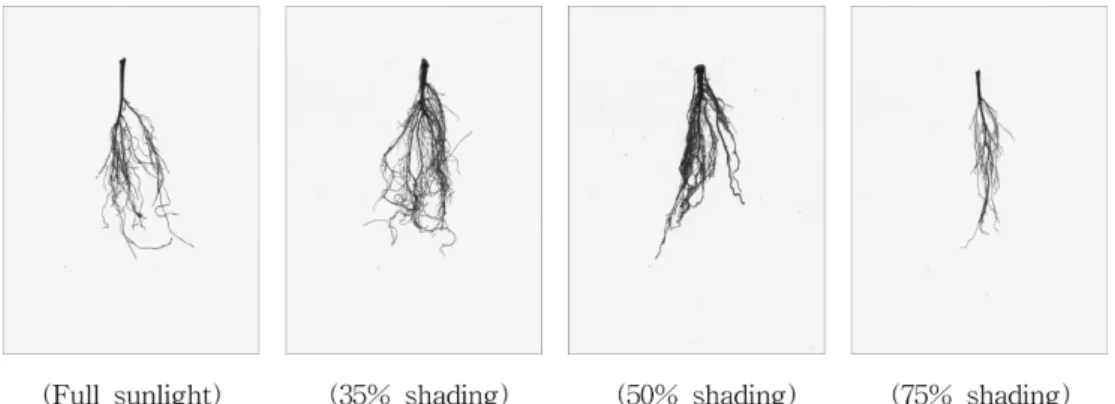
참나물 유묘의 뿌리는 35%와 50% 차광에서 상대적으 로 생육이 왕성하며, 75% 차광처리구에서 뿌리 생육이 현저히 감소하였다(Fig. 1).
참나물 유묘의 전체뿌리길이, 뿌리투영단면적, 뿌리표 면적, 뿌리부피는 35% 차광에서 각각 240.4cm, 9.5cm2, 29.7cm2, 0.29cm3로 가장 컸으며, 그 다음은 50% 차광 에서 각각 203.3cm, 8.3cm2, 26.2cm2, 0.27cm3로 커 대 조구 및 75% 차광처리구와는 통계적인 유의성을 나타냈 다. 이는 35%~50% 차광을 통해 유입되는 광량이 반음 지성 식물인 참나물의 생장환경에 적합하여 지상부의 생 장뿐만 아니라 뿌리 또한 좋은 생장을 한 것으로 생각 된다.
차광수준별 뿌리의 생육은 작물에 따라 다른데, 삽주 (Song 등, 2014b)와 잔대(Kim 등, 2012)는 25% 차광이, Table 4. Plant height, stem diameter, and leaf characteristics of P. brachycarpa seedlings by shading treatments.
Shading (%)
Plant height (cm)
Stem diameter (mm)
Leaf area (cm2)
Leaf length (A, cm)
Leaf width (B, cm)
Leaf index (A/B)
0 5.0±1.0z b 1.38±0.17 a 5.5±3.5 b 3.6±1.0 b 1.3±0.6 b 3.2±1.4 a
35 6.3±0.5 a 1.36±0.07 a 9.4±3.7 ab 5.0±0.9 a 1.8±0.5 ab 3.0±0.6 a
50 7.3±0.5 a 1.57±0.18 a 12.8±0.5 a 5.4±0.5 a 2.3±0.3 a 2.4±0.5 a
75 7.1±1.0 a 1.55±0.33 a 11.2±2.9 a 4.9±0.4 a 2.2±0.4 a 2.3±0.3 a
Shading (%)
LAR (cm2g-1)
Leaf thickness
(mm) No. of leaves SPAD value
0 68.7±25.1 b 0.09±0.04 b 2.8±0.5 a 19.7±6.8 b
35 73.9±23.8 b 0.15±0.02 a 2.8±1.0 a 22.0±5.8 ab
50 103.6±7.4 b 0.13±0.01 b 3.3±0.5 a 26.2±3.9 ab
75 153.1±28.8 a 0.11±0.01 b 3.3±0.8 a 27.3±2.8 a
ZMean±SD. Different letters in each column indicate significant differences according to Duncan's multiple range test (p=0.05).
곰취(Song 등, 2014a)는 52% 차광에서 왕성한 것으로 알려져 있다. 차광은 지상부 생육뿐만 아니라 지하부 생 육에도 관여되고 있음을 알 수 있었다.
3. 생장량
지상부의 경우에는 생체중이 50% 차광에서 0.660g으 로 가장 높았고 그 다음은 75%와 35% 차광에서 각각 0.513g과 0.473g으로 높았으며, 대조구에서 가장 낮았다 (Table 6). 이렇게 대조구에서 가장 낮은 생체중을 보인 것는 반음지식물인 참나물이 높은 광량의 유입으로 인해 생육활동이 저해되었기 때문으로 생각된다(Hiroki와 Ichino, 1998). 또한, 건물중은 35%와 50% 차광에서 각 각 76mg과 72mg 순으로 무거웠다.
뿌리의 경우에는 생체중 및 건물중이 모두 35%와 50% 차광에서 유의성을 보이며, 각각 0.394g, 48mg과 0.344g, 52mg으로 컸는데 이것은 뿌리가 35%와 50%
차광에서 상대적으로 좋은 생장을 보인 것에 기인한 결 과로 판단된다.
초장뿐만 아니라 엽생장, 뿌리생장, 생체중, 건물중이 종합적으로 유의성을 보이며 차광처리구에서 높았는데 참나물이 반음지 식물로서 차광이 생장에 도움 (Boardman, 1977)을 주어 좋은 생장을 하였기 때문으로 생각된다. 또한, 포트에서 생육된 곰취의 경우에도 상대 광도가 64~73%와 35%~42%인 처리구에서 건물중(잎, 뿌리, 전체)이 상대적으로 높게 나타나(Kim 등, 2010a),
반음지성 산채의 특성을 보인 것으로 생각된다.
S/R율은 전체적으로 1.5~3.8로 조사되었으며, 75% 차 광에서 가장 높게 나타났는데 부족한 광도를 극복하기 위해 지상부 보다 뿌리로 분배되는 광합성 산물이 감소 (Kim, 2000)되어 나타난 결과로 판단된다.
참나물 유묘의 생산은 저온습윤 처리하여 파종 후 Fig. 1. Root images of P. brachycarpa seedlings by shading treatments.
Table 5. Root morphological traits of P. brachycarpa seedlings by shading treatments.
Shading (%)
Total root length (cm)
Root project area (cm2)
Root surface area (cm2)
Root diameter (mm)
Root volume (cm3)
0 128.6±32.9z b 5.1±1.0 b 16.0±3.0 b 0.40±0.02 a 0.16±0.02 b
35 240.4±23.3 a 9.5±0.4 a 29.7±1.2 a 0.40±0.03 a 0.29±0.02 a
50 203.3±34.1 a 8.3±1.6 a 26.2±5.0 a 0.41±0.02 a 0.27±0.06 a
75 112.9±29.6 b 4.3±1.1 b 13.6±3.6 b 0.38±0.02 a 0.13±0.04 b
ZMean±SD(n=10). Different letters in each column indicate significant differences according to Duncan's multiple range test (p=0.05).
Table 6. Characteristics of fresh weight, dry weight, and S/R ratio of P. brachycarpa seedlings by shading treatments.
Shading (%)
Fresh weight (g) Shoot
(Leaves+Stem) Root Total
0 0.217±0.138z b 0.134±0.057 b 0.351±0.188 c 35 0.473±0.062 a 0.394±0.067 a 0.867±0.086 ab 50 0.660±0.091 a 0.344±0.025 a 1.004±0.109 a 75 0.513±0.163 a 0.132±0.057 b 0.644±0.213 b
Shading (%)
Dry weight (mg)
S(L+S)/R ratio Shoot
(Leaves+Stem) Root Total
0 51±18 a 23±13 b 74±25 b 2.6±1.4 ab 35 76±17 a 48± 9 a 124±20 a 1.6±0.4 b 50 72±15 a 52±12 a 124±13 a 1.5±0.5 b 75 58±18 a 18± 9 b 77±26 b 3.8±1.8 a
zMean±SD. Different letters in each column indicate significant differences according to Duncan's multiple range test (p=0.05).
50% 차광을 유지하는 것이 보다 좋은 유묘의 생산에 유 리할 것으로 생각되며, 유묘를 이식한다면 생산량 증대 에도 보다 효과적일 것으로 생각되며, 이식 후의 생장을 지속적으로 모니터링하는 것이 필요할 것으로 생각된다.
적 요
본 연구는 온도와 차광이 참나물 종자의 발아와 유묘 의 생장에 미치는 영향을 조사하고자 실시하였다. 실험 은 온도별(5oC, 10oC, 15oC, 20oC, 25oC, 30oC) 발아 시 험과 차광별(무차광, 35% 차광, 50% 차광, 75% 차광) 생육 시험의 두 종류로 실시되었으며, 발아실험 전 종자 는 0일, 20일, 40일로 각각 저온습윤 처리를 하였다. 발 아율은 20일 저온습윤 처리의 5oC에서 48.3%로 가장 높았으며, 온도가 높아질수록 낮아지는 경향을 보였다.
차광에 따른 초장, 엽면적, 엽장, 엽폭 등은 모두 50%
차광에서 각각 7.3cm, 12.8cm2, 5.4cm, 2.3cm로 가장 컸다. 특히, 뿌리는 35%와 50% 차광에서 생장이 좋았 다. 지상부의 생체중은 50% 차광과 75% 차광에서 가장 높았으며, 건물중은 35% 차광과 50% 차광에서 높았다.
본 실험결과를 종합적으로 살펴보면, 참나물 유묘는 50% 차광을 유지하여 생육하는 것이 이식용 유묘 생산 에 효과적일 것으로 판단된다.
추가주제어 : 건물중, 발아율, 뿌리생장, 생체중, 엽생장
Literature Cited
Arsenault, J.L., S. Poulcur, C. Messier, and R. Guay. 1995.
WinRHIZO, a root-measuring system with a unique over- lap correction method. HortScience. 30:906.
Boardman, N.K. 1977. Comparative photosynthesis of sun and shade plants. Annual Review of Plant Physiology. 28:355- 377.
Bonner, F.T. 1988. Seeds of woody plants. Advances in Research and Technology of Seeds. 11:81-112.
Bouma, T.J., K.L. Nielsen, and B. Koutstaal. 2000. Sample preparation and scanning protocol for computerised analy- sis of root length and diameter. Plant and Soil. 218:185-196.
Chang, K.M., M.S. Chung, M.K. Kim, and G.H. Kim. 2007.
Analysis of mineral and volatile flavor compounds in Pimp- inella brachycarpa N. by ICP-AES and SDE, HS-SPME- GC/MS. Journal of The Korean Society of Dietary Culture.
22:246-253 (in Korean).
Choi, M.H. and G.H. Kim. 2002. A study on quality character- istics of Pimpinella brachycarpa Kimchi during storage at different temperatures. Journal of the Korean Society of Food Science and Nutrition. 31:45-49 (in Korean).
Choi, N.S., S.S. Oh, and J.M. Lee. 2001. Change of Biologi- cally functional compounds of Pimpinella brachy- carpa(Chamnamul) by blanching conditions. Journal of The Korean Society of Dietary Culture. 16:388-397 (in Korean).
Choi, S.J., M.Y. Sim, J.W. Kim, M.H. An, B.K. Choi, and Y.M. Mo. 2001. Effects of air humidity control on the qual- ity and yield of Pimpinella brachycarpa Nakai. Korean Journal of Horticultural Science and Technology. 19:62-62 (in Korean).
Coolbear, P., A. Francis, and D. Grierson. 1984. The effect of low temperature pre-sowing treatment on the germination performance and membrane integrity of artificially aged tomato seeds. Journal of Experimental Botany. 35:1609- 1617.
Gordon, A.G. 1971. The germination resistance test-a new test for measuring germination quality of cereals. Canadian Journal of Plant Science. 51:181-183.
Hiroki, S. and K. Ichino. 1998. Comparison of growth habits under various light conditions between two climax species, Castanopsis sieboldii and Castanopsis cuspidata, with spe- cial reference to their shade tolerance. Ecological Research 13:65-72.
Hong, J.K., S.S. Ham, C.H. Park, K.J. Chang, and W.B. Kim.
1999. Wild edible greens production and using. JS Press. p.
176-184 (in Korean).
Hyun, B.K., S.J. Jung, Y.K. Son, C.W. Park, Y.S. Zhang, K.C.
Song, L.H. Kim, E.Y. Choi, S.Y. Hong, S.I. Kwon, and B.C.
Jang. 2010. Comparison between methods for suitability classification of wild edible greens. Korean Journal of Soil Science and Fertilizer. 43:696-704 (in Korean).
Kim, E.S., H.J. Kim, J.H. Ahn, D.G. Kim, K.C. Lee, and K.W.
Seo. 2012a. Effect of temperature on seed germination of Heracleum moellendorffii Hance. Conference of The Plant Resources Society of Korea. p. 131-131 (in Korean).
Kim, G.N., M.S. Cho, and K.W. Kwon. 2010a. Analysis growth performance and ascorbic acid contents of Allium victorialis var. platyphyllum, Ligularia fischeri, and L.
stenocephala under changing light intensity. Journal of Korean Forest Society. 99:68-74 (in Korean).
Kim, G.T. 2004. A study on the seed characteristics and germi- nation percent of several native herb species. Korean Jour- nal of Environment and Ecology. 18:1-6 (in Korean).
Kim, G.T. and T.W. Um. 1997. A study on the distribution of wild edible herb species in Mt. Kariwang. Journal of Korean Forest Society. 86:422-429 (in Korean).
Kim, J.J. 2000. Studies on optimum shading for seedling cul- tivation of Cornus controversa and C. walteri. Journal of Korean Forest Society. 89:591-597 (in Korean).
Kim, J.J., K.J. Lee, K.S. Song, Y.G. Cha, Y.S. Chung, J.H. Lee and T.S. Yoon. 2010b. Exploration of optimum container for production of Larix leptolepsis container seedlings. Journal of Korean Forest Society. 99:638-644 (in Korean).
Kim, J.W., J.H. Yoon, K.S. Jeon, J.M. Jung, H.R. Jung, M.G.
Cho, and H.S. Moon. 2012b. Growth characteristics of Ade- nophora triphylla var. japonicum by shading treatments.
Journal of Agriculture & Life Science. 46:19-25 (in Korean).
Kuroiwa, S., T. Horoi, K. Takada, and M. Monsi. 1964. Distri- bution ratio of net photosynthate to photosynthetic and non photosynthetic systems in shade plants. Botanical Magazine Tokyo 77:37-42.
Kwon, T.R., J.H. Jo, Y.S. Kwon, and S.P. Lee. 1992. A Study on using of native plants. Kyungpook RDA (Research Project). p. 459-471 (in Korean).
Kwon, T.R., J.H. Jo, Y.S. Kwon, S.P. Lee, and B.S. Choi.
1993. Study on seed treatments to facilitate germination of some wild edible greens. Korean Journal of Soil Science and Fertilizer. 35:416-421 (in Korean).
Lee, J.J., M.H. Choo, and M.Y. Lee. 2007. Physicochemical compositions of Pimpinella brachycarpa. Journal of the Korean Society of Food Science and Nutrition. 36:327-331 (in Korean).
Lee, K.C., H.B. Lee, W.G. Park, and S.S. Han. 2012. Research Articles : Physiological Response and Growth Performance of Parasenecio firmus under Different Shading Treatments.
Korean Journal of Agricultural and Forest Meteorology.
14:79-88 (in Korean).
Na, H.Y. and C.H. Chun. 2009. Nutritional, chemical and physical factors affecting somatic embryo formation and germination in Pimpinella brachycarpa. Korean Journal of Horticultural Science and Technology. 27:280-286.
Park, B.M. and J.H. Bae. 2012. Effect of shading levels on the growth and chlorophyll contents of Allium victorialis L. var.
platyphyllum Makino. Journal of Bio-Environment Control.
21:281-285 (in Korean).
Park, B.M., C.H. Kim, J.H. Bae, and J.R. Shin. 2011. Effect of
shading levels on the soil properties, growth characteristics, and chlorophyll contents of Ligularia stenocephala. Journal of Bio-Environment Control. 20:352-356 (in Korean).
Park, S.B., M.J. Kim, Y.M. Park, S.I. Hwang, and E.G. Kim.
2012. Profitability analysis for Ligularia fischeri forest farming. Journal of Korean Forest Society. 101:426-433 (in Korean).
Park, Y.M. and M.J. Kim. 2011. Environmental and growth characteristics of Pimpinella brachycarpa habitat in Mt.
Jeombong, Korea. Journal of Korean Forest Society.
100:687-692 (in Korean).
Schopmeyer, C.S. 1974. Seeds of Woody Plants in the United States. USDA Agric. Handb. No. 450. Forest Service USDA. Washington D.C. p. 883.
Song, H.S., H.S. Choi, and M.S. Lee. 1997. Analysis of vola- tile flavor components of Pimpinella brachycarpa. Korean Journal of Food and Cookery Science. 13:674-680 (in Korean).
Song, K.S., K.S. Jeon, C.H. Kim, J.H. Yoon, Y.B. Park, and J.J. Kim. 2014a. Effect of shading level on growth and mor- phological characteristics of Ligularia fischeri seedling. Pro- tected Horticulture and Plant Factory. 23:88-94 (in Korean).
Song, K.S., K.S. Jeon, J.H. Yoon, C.H. Kim, Y.B. Park, and J.J. Kim. 2014b. Growth and root development characteris- tics of Atractylodes japonica seedlings by different relative light intensity. Korean Journal of Medicinal Crop Science.
22:154-159 (in Korean).
Suh, J.T. 1997. Physioecological characteristics of wild Pimp- inella brachycarpa Nakai. Ph. D. Thesis. Kangwon Univer- sity. p. 1-89 (in Korean).
Wang, M.B. and Q. Zhang. 2009. Issues in using the Win- RHIZO system to determine physical characteristics of plant fine roots. Acta Ecologica Sinica. 29:136-138.