1. INTRODUCTION
In China, Korean language education as a second language began in Beijing University in 1946. An Binghao (2000) mentioned that Beijing University began to set up the subject of "Korean" in 1946 to cultivate Korean talents[1]. At that time, the textbook "South Korean language" was jointly compiled by university professors. After the estab- lishment of the People's Republic of China in 1949, the name of the "South Korean language" of Peking University was changed to the "North Korean lan- guage", which was recognized by the Ministry of Education of the people's Republic of China, which has been used up to now. From 1940 to 1980, there were only 5 universities in China setting up the
course including Peking University (1946), Univer- sity of International Trade and Economic Cooper- ation (1952), Luoyang Foreign Studies University (1956), Yanbian University(1972) and Beijing Se- cond Foreign Studies University (1972)[2] . At this time, the Korean language education at Chinese universities has a history of more than half a cen- tury, and economic exchanges between the two countries have deepened with the establishment of diplomatic relations between Korea and China. In the early days of diplomatic relations, the gap be- tween ideas and concepts in the two countries brought about by the long cold war has not been completely eliminated. Therefore, although there is a gap, economic exchanges and cooperation have
A Correlation Analysis of the Learning Status and Learning Medium of Korean Learners in Chinese Universities
Siyao Wang†, Yeon-Woo Lee††, Chee-Yong Kim†††
ABSTRACT
Korean education in China began at Peking University in the 1950s. At present, The Korean language education in China has made remarkable progress in many aspects such as scale, scope, level and achievement. In addition, with the increasingly frequent economic and cultural exchanges or cooperation between China and South Korea and the increasing trend of internationalization, the prosperity of Korean wave culture and the sound development of China-South Korea relations, the country's demand for Korean language talents is increasing day by day. However, with the rise of Korean education in China in recent years, some hidden problems also surfaced. In this paper, the Korean language proficiency test(TOPIK) is used to evaluate the Korean language proficiency of Korean learners, and Chinese juniors are used to evaluate the Korean language proficiency. In addition, a questionnaire survey was conducted to analyze the learning media of Chinese Korean learners at the present stage, and the relationship between learning media and learning outcomes was concluded. At the same time, deficiencies and problems existed in Korean education in colleges and universities were proposed and their own ideas were put forward.
Key words: Chinese Universities, Learning Medium, Korean Language Learners,Learning Status
※ Corresponding Author : Chee-Yong Kim, Address:
(47340) 176 Um Gwang-ro, Busanjin-gu, Busan City, Dong-Eui University, TEL : +82-10-4584-4036, FAX : +82-51-890-2265, E-mail : [email protected] Receipt date : Sep. 22, 2020, Revision date : Nov. 29, 2020 Approval date : Dec. 4, 2020
†††Dept. of Storytelling, Graduate School, Dong-Eui University (E-mail : [email protected])
†††Industry Professional Practice Center, Dong-Eui University (E-mail : [email protected])
†††Major of Game Animation Engineering, Dong-Eui University
crossed the barriers of ideas, and quickly spread to the fields of economy, technology, politics, aca- demia, tourism and other fields. In the process, the demand for Korean language talents has increased significantly, and Korean language departments have begun to flourish all over the country. At the same time, with the improvement of global eco- nomic strength and frequent cultural exchanges, the number of people interested in Korean culture has increased dramatically since the 1990s. In par- ticular, K-pop and Korean wave have become an opportunity for Korean education to spread around the world[3].
Korean Education in China can be divided into two types. One is Korean education aiming to Noth Korean ethnics, which is mainly concentrated in Yanbian area of China. The other is the foreign language education as a second language, which is a national education for non-Korean students.
The Korean language education mentioned in this paper is the second language learning for non- Korean students.
2. RESEARCH
2.1 Significance of research
With the frequent exchanges between China and South Korea, China's demand for Korean language talents is also increasing. Due to higher needs for proficient Korean language talents, there are more and more Chinese students learning Korean. South Korea's entertainment industry leads the trend in the world. Many people choose to learn Korean for their favorite stars or Korean culture. South Ko- rea’s tourism industry is also very mature and many people travel to South Korea. With the glob- alization of society and economy, the exchanges between China and South Korea are getting closer, and there are many in-depth cooperation in many fields, so professional Korean translation talents are favored by many multinational companies, who also play a very important role in the development
of the two countries, which shows that Korean teaching must be paid attention and be uplifted.
Language is a collection of conventions or rules formulated to express information. It is a means of voice, words, body movements, etc. or a social customary system used to express or convey ideas or feelings. (Fishman,j.a.1968)[4]. The importance of language as an essential communication tool in our daily lives is obvious. Now Korean major has become a popular major. Many college students have more choices for Korean learning. The proc- ess that learners gradually master the skills of how to use korean language is the language ac- quisition ability.
Media use is a description of the audience's use of mass media. The further analysis of me- dia usage is to understand the relationship be- tween media usage and demographic variables, lifestyle, time budget and other variables. From the audience’s frequency and satisfaction with the media, we can understand whether their needs for the media are met. The learning me- dium is also a very important part of influenc- ing students in the process of foreign language learning. In the process of second language ac- quisition, the learning medium will have a great impact on learners. Then the study of learning media will also help teachers discover many problems existing in Korean teaching in many universities at this stage.
Media use is a description of the audience's use of mass media. The further analysis of me- dia usage is to understand the relationship be- tween media usage and demographic variables, lifestyle, time budget and other variables. From the audience’s frequency and satisfaction with the media, we can understand whether their needs for the media are met. The learning me- dium is also a very important part of influenc- ing students in the process of language learning. In the process of second language ac- quisition, the learning medium will have a great
impact on learners. Learning media plays an intermediary role among all the elements of hu- man educational activities and is the material carrier of educational information. It can not only expand the space of imparting knowledge and skills, but also help improve the speed of imparting knowledge and skills and the quality of education[5]. Then the study of learning me- dia will also help teachers discover many prob- lems existing in Korean teaching in many uni- versities at this stage[6].
2.2 Research methods
This paper divides the learning content into four main elements: listening, speaking, reading and writing, and investigates and summarizes the learning situation of the four elements, and analyze the problems that need to be solved in the process of Korean learning in China. In this paper, the sur- vey object is mainly the third year students, which is based on the Chinese university courses. In the Korean professional education and training pro- gram, third year university students should master the intermediate Korean ability after completing the three-year university courses. Therefore, it is reasonable to take the third year students as the research object.
3. SURVEY ON KOREAN LANGUAGE LEARNING BY KOREAN LANGUAGE LEARNERS IN CHINESE UNIVERSITIES
In this paper, through a questionnaire survey of Korean learners in colleges and universities in China, the Korean learning of Korean learners in colleges and universities is investigated. This
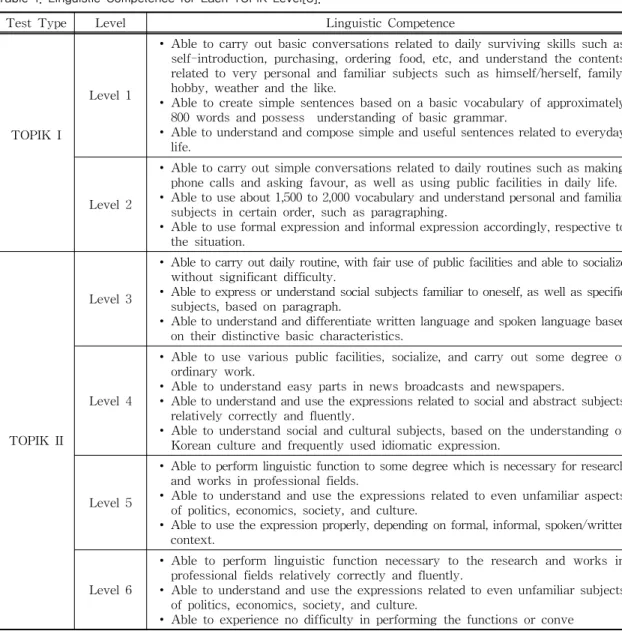
questionnaire combines the evaluation criteria of the Test of Proficiency in Korean(TOPIK) for non- native Korean learners[7]. It tests the four basic Korean elements of listening, speaking, reading and writing, and classifies Korean learners into six grades according to the TOPIK test. According to the test scores of learners, this paper also divides the four elements into six levels. In this paper, the original test questions in the Korean proficiency test are selected in the contents of listening, read- ing and writing. However, since there is no speak- ing test in the Korean language proficiency test, which is based on the evaluation principle of 6 lev- els, so each level of speaking should be masered by Korean learners.
Table 1 shows the equivalence evaluation cri- teria for the Topik test. However, the test was based on the six-level assessment of Korean profi- ciency, and the six-level tests were conducted on the basis of the Korean language proficiency test,
"Seoul National University Korean Language,"
which is used by most Korean language institutes.
In this survey, the author selected 124 students from the third year students from 5 Korean major universities in China as the survey objects. A total of 105 valid questionnaires were screened out by removing false or invalid questionnaires from 124 respondents. Next, I will make a specific analysis of the four elements of Korean language ability:
listening, speaking, reading and writing.
3.1 Listening
Fig. 1 Shows the performance of listening. In the test of listening ability, the number of people who meet the level 4 is the largest, accounting for 45%
of the total. Secondly, 31 people, accounting for
Distribution of Listening cores
Level Level 1 Level 2 Level 3 Level 4 Level 5 Level 6
People counting 2 4 31 47 16 5
Fig. 1. Schematic Diagram of Listening Score.
29% of the total, meet the level of level 3. The rest are 15% at level 5, 5% at level 6, 4% at level 2 and 2% at level 1. As shown in the figure, most of the respondents' Korean proficiency is con- centrated at level 3 or 4.
3.2 Speaking
Fig. 2 Shows the performance of speaking. In the test of speaking, the largest number of people are those who meet the level 3, accounting for 38%
of the total number of people, followed by the peo- ple of level 2, accounting for 29% of the total number. The proportion of the remaining four lev- els and above is 19%, 10% and 3%, respectively.
The number of people of level 1 is the least, only 1%.
3.3 Reading
Fig. 3 Shows the performance of reading. In the test of reading, people at level 4 accounted for Table 1. Linguistic Competence for Each TOPIK Level[8].
Test Type Level Linguistic Competence
TOPIK I
Level 1
∙ Able to carry out basic conversations related to daily surviving skills such as self-introduction, purchasing, ordering food, etc, and understand the contents related to very personal and familiar subjects such as himself/herself, family, hobby, weather and the like.
∙ Able to create simple sentences based on a basic vocabulary of approximately 800 words and possess understanding of basic grammar.
∙ Able to understand and compose simple and useful sentences related to everyday life.
Level 2
∙ Able to carry out simple conversations related to daily routines such as making phone calls and asking favour, as well as using public facilities in daily life.
∙ Able to use about 1,500 to 2,000 vocabulary and understand personal and familiar subjects in certain order, such as paragraphing.
∙ Able to use formal expression and informal expression accordingly, respective to the situation.
TOPIK II
Level 3
∙ Able to carry out daily routine, with fair use of public facilities and able to socialize without significant difficulty.
∙ Able to express or understand social subjects familiar to oneself, as well as specific subjects, based on paragraph.
∙ Able to understand and differentiate written language and spoken language based on their distinctive basic characteristics.
Level 4
∙ Able to use various public facilities, socialize, and carry out some degree of ordinary work.
∙ Able to understand easy parts in news broadcasts and newspapers.
∙ Able to understand and use the expressions related to social and abstract subjects relatively correctly and fluently.
∙ Able to understand social and cultural subjects, based on the understanding of Korean culture and frequently used idiomatic expression.
Level 5
∙ Able to perform linguistic function to some degree which is necessary for research and works in professional fields.
∙ Able to understand and use the expressions related to even unfamiliar aspects of politics, economics, society, and culture.
∙ Able to use the expression properly, depending on formal, informal, spoken/written context.
Level 6
∙ Able to perform linguistic function necessary to the research and works in professional fields relatively correctly and fluently.
∙ Able to understand and use the expressions related to even unfamiliar subjects of politics, economics, society, and culture.
∙ Able to experience no difficulty in performing the functions or conve
nearly half of the total population at 49%, followed by 24% at level 3, and 20% at level 5. The remaining 4% are all at level 6. There are non at level 1.
3.4 Writing
Fig. 4 Shows the performance of writing. In the test of writing, 43 people at level 4 accounted for 41% of the total number of people, but in contrast to the other three tests, the second largest number is at level 5, accounting for 29% of the total. The number of people at level 3 is 20%, and the number of people at level 2 and level 6 are similar, 5% and 4%, respectively. The number of people at the level 1 is the least, only 1%.
4. ANALYSIS OF INVESTIGATION RESULTS
4.1 Survey of Korean Language Learning The following is the specific content of the teaching and training program as a reference of the School of Foreign Languages, Nanjing University, China. Here is a list of the Korean abilities that ordinary college students should master in each grade[8].
Grade one is the basic stage. Arouse students' interest in learning Korean and guide them to lay
a good foundation. Cultivate students' sense of language in Korean, and strengthen practical teach- ing of pronunciation and listening. Teach Korean basic grammar knowledge, so that students can adapt to Korean language norms as soon as possible. The first grade students are required to master about 2000 words, and their Korean ability should reach TOPIK test level 1-2.
Grade two is the intermediate stage. Mainly tar- get at traditional basic language skills of listening, speaking, reading and writing, gradually increase the vocabulary and grammar sentence patterns to lay a solid language skills for students. In addition to the main professional courses, some cultural quality courses should be offered to broaden stu- dents' knowledge and improve their understanding of South Korea. The second year students are re- quired to masters about 2,500 vocabulary, and the Korean language ability should reach TOPIK level 2-3.
Grade three is the strengthening stage. Strengthen students' advanced reading and writing skills, so that students gradually develop their habits of thinking and presenting in Korean. At the same time, pay attention to improving Korean language application skills and communication skills, and Distribution of Speaking cores
Level Level 1 Level 2 Level 3 Level 4 Level 5 Level 6
People counting 1 30 40 20 11 3
Fig. 2. Schematic Diagram of Speaking Score.
Distribution of Reading cores
Level Level 1 Level 2 Level 3 Level 4 Level 5 Level 6
People counting 0 3 25 51 21 5
Fig. 3. Schematic Diagram of Reading Score.
Distribution of Writing cores
Level Level 1 Level 2 Level 3 Level 4 Level 5 Level 6
People counting 1 5 35 44 15 5
Fig. 4. Schematic Diagram of Writing Score.
send students to visit Korea through various channels. The third year students are required to master about 2500 words, and their Korean ability should reach TOPIK test level 4-5.
Grade 4 is the comprehensive stage. According to the needs of graduating students, the school of- fers practical courses such as translation and in- terpretation, encourages students to participate in various social practices, and strengthens students' comprehensive bilingual and coordination ability.
Through the guidance of writing graduation thesis, cultivate students' basic scientific research think- ing patterns. Fourth grade students are required to master about 3000 words, and their Korean ability should reach TOPIK test level 5-6.
According to the above survey results, most of the junior college students' Korean ability can reach the level of level 3 and level 4 in the Korean ability level test. In the listening, reading and writ- ing tests, the results show that the majority of peo- ple are concentrated in level 3 or 4, and the pro- portion of extremely high or extremely low levels very small. In the four ability tests, the average reading score is the highest, and there are no cases below the level 2. At this point, it is in line with the teaching objectives set in the syllabus of Korean majors in ordinary universities at this stage. Writing and listening results show that most of the students are able to reach the level 4. The Korean learners in the third grade of the university surveyed at this stage can basically meet the re-
quirements set by the college Korean teaching and training program in terms of listening, reading and writing. However, we need to be noted that stu- dents' performance in oral English is low. The ma- jority of people's oral English is concentrated at the level 2 or 3. In fact, such results actually fail to meet the requirements set in the Korean pro- fessional education and training program of ordi- nary colleges and universities.
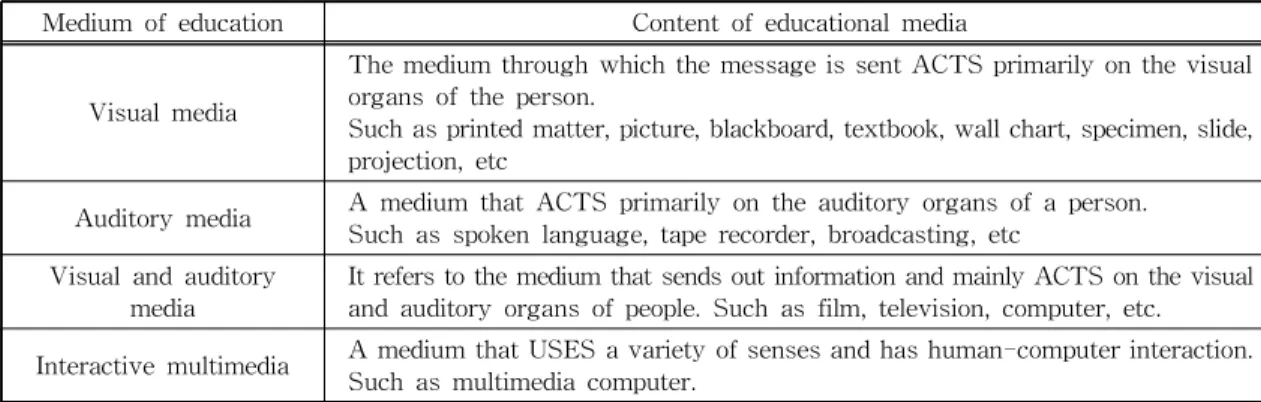
4.2 Korean Language Learning Media Survey A medium is a medium or tool that carries, proc- esses and transmits information. When a medium is used for teaching purposes, as a tool to carry educational information, it is called teaching medium. Teaching media is the carrier of teaching content, the expression form of teaching content, and the tool for transferring information between teachers and students[9]. Since there are many classification criteria for media, this paper chooses the method of using media to classify the percep- tive organs.
Table 2 shows the classification of learning me- dium and its contents. Table 3. shows the List of main learning media for Korean students studying Chinese. Through investigation, it can be found that Korean language learners in Chinese universities nowadays use various learning media in the proc- ess of Korean language learning. As shown in the figure, in the Korean proficiency test for Korean learners who passed 105, the average score in Table 2. List of Classification of educational media.
Medium of education Content of educational media
Visual media
The medium through which the message is sent ACTS primarily on the visual organs of the person.
Such as printed matter, picture, blackboard, textbook, wall chart, specimen, slide, projection, etc
Auditory media A medium that ACTS primarily on the auditory organs of a person.
Such as spoken language, tape recorder, broadcasting, etc Visual and auditory
media It refers to the medium that sends out information and mainly ACTS on the visual and auditory organs of people. Such as film, television, computer, etc.
Interactive multimedia A medium that USES a variety of senses and has human-computer interaction.
Such as multimedia computer.
reading was the highest, followed by listening and writing. But speaking, compared with other sub- jects, the average score is lower. Through the above table, we can find that the higher the score of the subject, the more learning media students use in the learning process. Conversely, the less learning media used in the learning process, the lower the average score. This shows that the learning medium plays a very important role in the process required for a second language. The most natural and efficient ordeal that humans use to ex- change opinions with each other is speech[10]. The medium is the means of information dissemination, and the learning medium is one of the essential means in the process of second language acquis- ition.
5. CONCLUSION
In conclusion, nowdays countries around the world develop closer relationship with each other.
Hence, education reform is essential, especially the reform of language as an irreplaceable means and tools of communication. The language education in Chinese universities should also keep up with the changing world and constantly update and develop in order to provide more and more talents for the motherland. In particular, various teaching strat- egies are needed to promote learners' interaction by inducing active participation, autonomous ex- ploration, discussion, and inquiry through various forms of learning activities, such as case studies, collective learning, and cooperative learning[11].
Through practical investigation and test, this paper finds that the basic elements of listening, speaking, reading and writing are not balanced de- veloped among students, especially speaking is far behind the other three abilities. Therefore, we should try our best to make up for the students' deficiencies in Korean speaking in the future, and strive to provide comprehensive Korean talents for the development of China in the future.
Acknowledgement
This work was supported by the Ministry of Education of the Republic of Korea and the National Research Foundation of Korea(NRF- 2019S1A5C2A04081101)
REFERENCEC
[ 1 ] B.H. An, “The Tense and Plan Development of Korean Textbooks in China,”Chinese Ko- rean Education, pp. 230-254, 2000.
[ 2 ] E.B. Chu,A Study on the Comprehensive Ko- rean Education Contents for Chinese Majors in Undergraduate Programs at Chinese Uni- versity, Doctor’s Thesis of Korea University of Technology, 2017.
[ 3 ] W.Y. Zhang, “On Korean Grammar Education for Chinese Students,” Curriculum educa- tion research, Vol. 6, pp. 24-33, 2016.
[ 4 ] J.A. Fishman, Readings in the Sociology of Language, De Gruyter Mouton, 1968.
[ 5 ] X.X. Xu, “New Trends in the Development of Educational Media,” New Media Research, Table 3. List of Classification of educational media.
Subject Content Average Score Main Medium
Listening 3.8 Auditory media, Visual and auditory media
Speaking 3.2 Auditory media
Reading 4.0 Auditory media
Visual media Visual and auditory media,
Writing 3.7 Visual media,
Visual and auditory media,
Vol. 005, pp.122-123, 2015.
[ 6 ] C.Q. Wen, “The Use of Chinese Media by Foreign Chinese Learners,” News Research, Vol. 4, pp. 95, 2011.
[ 7 ] Linguis Competence for Each TOPIK Level.
https://www.topik.go.kr/usr/cmm/inde- x.do (accessed January 7, 2014).
[ 8 ] Linguis Competence for Each TOPIK Level.
https://www.topik.go.kr/usr/cmm/inde- x.do (accessed January 7, 2014).
[ 9 ] Nanjing University College of Foreign Lan- guages Korean undergraduate teaching train- ing Program. https://wenku.baidu.com/view/
82e034b366ec102de2bd960590c69ec3d4bbdb13.
html (accessed 4 ,2019)
[10] M.Y. Gu, Educational Dictionary, Shanghai Educational Publishing House, 1986.
[11] G.Y.Lee and J.G. Lim “Establishment of the
‘Standard Hangul Phoneme into Character Conversion Rule’,” Proceedings of Korea Multimedia Society Conference, pp. 128- 132, 2002.
[12] K.M. Rhee, “The Study On Learning-Effect Improvement of Distance-Learning,” Proce- edings of the Korea Multimedia Society Con- ference, pp. 829-833, 2002.
Wang Siyao
she is currently studying in the Department of storytelling, Dong- Eui University, South Korea. In 2014, she graduated from the Teaching Chinese as Foreign Language Department of Anshan Normal University of China.
From 2014 to 2015, she worked as an international Chinese language teacher at the International Ex- change Center of Anshan Normal University. In 2015, she was admitted by thef Multicultural Education of the Korea Foreign Studies University and obtained a master's degree in 2018. She mainly studies Chinese International Education and Korean International Education cross-cultural communication, etc.
Yeon-Woo Lee
Received Ph.D. from the Dong- Eui University, Korea in 2018.
She worked as a producer at a broadcasting station from 2008 to 2019.
She was a time Lecturer, Dept.
of Design, Dong-Seo Universi- ty, Dept. of Digital Contents Engineering and Dept. of Storytelling Dong-Eui University. She was also Asso- ciate Professor, Dept. of Broadcasting Media and Media Studies, SuSung University. Now she is a pro- fessor at Dongeui University Industry Professional Practice Center.
Chee-Yong Kim
He received the B.S. degree, M.
S. degree and Ph.D. degree from Inje University, Republic of Ko- rea in 1991, 1994 and 2000 re- spectively . He is visiting pro- fessor at Oxford University in 2007, and visiting professor of the Digital Clothing Center at Seoul National Universi- ty in 2012.Currently, he is a professor of Major of Game Animation Engineering at Dong-Eui University.
Prof. Kim held private exhibitions four times both in Seoul and China and joined over 230 international group exhibitions. With his deep interest in 3D Ani- mation, Multimedia Design, Chaos & Fractal Design, VR/AR, Game Content Design, Virtual Fitting System and Transmedia Storytelling