J Korean Acad Community Health Nurs (지역사회간호학회지) http://dx.doi.org/10.12799/jkachn.2016.27.2.132
Effects of Sexual Abuse Prevention Education Program on Sexual
Knowledge and Attitude among Elementary School Students
Lee, Yun Hee
1․ Hwang, Won Ju
21Department of Health Education Graduate School of Education, Kyung Hee University, Seoul 2College of Nursing Science ․ East-West Nursing Research Institute, Kyung Hee University, Seoul, Korea
Purpose: The purpose of this study was to investigate the effects of sexual abuse prevention education program linked to elementary physical and psychological development on sexual knowledge and attitude. Methods: The par-ticipants were the elementary school students of fifth and sixth grades in S city, South Korea (experimental, compari-son, and control group=96, 96, and 74, respectively). The experimental group received sexual abuse prevention edu-cation linked physical and psychological development, 6 sessions (3 sessions are physical and psychological devel-opment educations and 3 other sessions are sexual abuse prevention educations). The comparison group received sexual abuse prevention educations, 3 sessions (the same curriculum of the experimental group). The control group didn't receive any sexual education. The data were analyzed by x2 test and t-test, and ANOVA using the SPSS program. Results: The experimental group showed significantly better sexual knowledge and attitude than the com-parison and control group. Conclusion: Sexual abuse prevention education program linked physical and psycho-logical development is required for elementary school students, to improve the sexual knowledge and attitude. Key Words: Sexual abuse, Education, School, Students, Development
Corresponding author: Hwang, WonJu
College of Nursing Science, Kyung Hee University 26 Kyunghee-daero, Dongdaemun-gu, Seoul 130-701, Korea. Tel: +82-2-961-0852, Fax: +82-2-961-9398, E-mail: [email protected]
- This manuscript is a revision of the first author's master's thesis from Kyung Hee University. Received: Oct 7, 2015 / Revised: May 5, 2016 / Accepted: May 19, 2016
This is an open access article distributed under the terms of the Creative Commons Attribution Non-Commercial License (http://creativecommons.org/licenses/ by-nc/3.0), which permits unrestricted non-commercial use, distribution, and reproduction in any medium, provided the original work is properly cited.
INTRODUCTION
1. Necessity of the Study
As children sexual abuse becomes a social issue, voices urging the prevention of sexual abuse are growing rapidly. According to Supreme Public Prosecutors' Office, children sexual abuse cases are constantly growing such as 735 in 2004, 844 in 2006, 971 in 2008 and 1,004 in 2010. As 958 chil-dren sexual abuse cases were reported in 2012 and 1,051 cases in 2013, approximately 1,000 children a year are ex-posed to sexual abuse crimes [1]. Sexual abuse is defined as doing a sexual act or asking someone to do a sexual act for the sexual satisfaction [2]. It causes fatal aftereffects on vic-tims. Especially, children victims may get fatal effects on their growth and development and may have intellectual, emotional, social and sexual developmental disorder [3]. Therefore, in sexual abuse primary preventive education
is very important as well as post countermeasures [2]. To prevent sexual abuse and improve sexual conscious-ness, sexual education is given in school. However, cur-rent sexual education in school is often a mere formality. According to the guidelines of Ministry of Education, Sci-ence and Technology [4] schools provide sex education 15 hours a year but it is not an independent curriculum but is given in related subject classes. Therefore it often becomes a formality and cannot contribute much to the composi-tion of the right sexual values. According to the investi-gation of sex education conditions by Planned Population Federation of Korea, out of 812 elementary school students who answer the survey 48.5% answered that they had sex education more than once a month. 21.6% answered that they had 2 to 3 times a semester, 17.0% more than once a semester, and 7.4% more than once a year and 5.5% an-swered that they did not have any sex education at all. It shows that there is difference between the actual hours of
sex education and the hours that students perceive. It im-plies that students do not perceive that those are sex edu-cation hours as sex eduedu-cation is performed in related sub-ject classes or sex education is not performed actually as planned [5].
As children sexual abuse incidents occur often and be-come social issues, the priority is placed on sexual abuse preventive education. According to the study on the per-ception and attitude on children sexual education on 812 elementary school students in Korea by Ministry of Health and Welfare and Planned Population Federation of Korea, the most frequently learned content in school sex educa-tion was sexual abuse preveneduca-tion (44.1%). The words ‘sex’ reminds were gender (male and female)(33.1%) and then sexual abuse (11.7%). It shows that school sex education is focused on sexual abuse preventive education [5]. As sys-tematic sex education is not performed as such, sexual pre-ventive education which is performed according to social necessity can make elementary school students have neg-ative attitudes on sex. Additionally, Zwi et al. [6] addressed that sexual abuse preventive education could make negative effects on children such as anger, fear, terror and nightmare.
Elementary school perioes is when they are easily af-fected by peers and environments as well as parents and siblings as their scope of movement is widened [7] and in-cludes adolescence when they experience physical and psy-chological changes. As changes as secondary sexual charac-ters emerging in this time are signals to prepare for another life, it is very important to love and value others as well as themselves by recognizing the reasons rather than perceiv-ing the changes in themselves as simple phenomena. There-fore systematic education should be performed so that they can accommodate individual difference in sexual maturity and difference between male and female and compose right sexual attitude, sexual consciousness and sense of value for other sex based on right knowledge on sex [8].
According to Planned Population Federation of Korea and Health Promotion Project, contents that they want to include in school sex education are in the order of sexual abuse pre-vention (86.1%), definition of sex (53.9%) and genital organ management (48.9%) among grade 1 to grade 4 students. Among grade 5 and grade 6 students, they are in the order of physical and psychological changes in adolescence (67.5%), sexual abuse prevention (57.5%) and damages by pornog-raphy and coping method (54.6%) [9]. In the study by Bae and others [10], grade 6 students wanted to have sexual edu-cation contents such as adolescence (43.3%), AIDS (17.5%) and sexual abuse (10.0%). As they want to include different contents in sex education according to their grade, we need to develop sex education considering physical and
psycho-logical development stage of the participants.
Sexual education emphasizing sexual abuse prevention and countermeasures without sex education considering physical and psychological development stage may reduce human relations, make them perceive current or future changes in them, and furthermore they may have negative sexual values [6]. Through sexual abuse prevention educa-tion considering physical and psychological development, they should understand birth and development, compose values to respect life, understand physical and psychologi-cal difference between men and women, understand changes in themselves, compose good values on sex by managing sex healthy and respect others, and make healthy behaviors related to sex.
Previous studies on sexual abuse prevention [2,11-16], they did not deal with effects of sexual abuse prevention education on general knowledge on sex although they verified effects of education focusing on sexual abuse prevention. There are no studies on the effects of sex-ual abuse prevention education considering physical and psychological development stages of the subjects. Ad-ditionally, studies reported different results regarding the effects of sexual abuse prevention education on sexual atti-tude. Therefore, this study tried to propose sexual abuse prevention education method to compose the right sex knowledge and sex attitudes in childhood by comparing the effects of sexual abuse prevention education connected with physical and psychological development education including physical and psychological development stages of the subjects and general sexual abuse prevention edu-cation.
2. Purpose of the Study
The purpose of this study is to provide basic sources for systematic sexual abuse prevention education to compose the right values of sex by executing sexual abuse preven-tion educapreven-tion connected with physical and psychological development education and general sexual abuse preven-tion educapreven-tion respectively, comparing sex knowledge and sex attitudes, verifying the effects of sexual abuse pre-vention education connection physical and psychological development.
3. Hypotheses of the Study
Hypothesis 1. There will be difference in sex knowledge between the experimental group who gets sexual abuse prevention education connection physical and psycho-logical development, the comparison group who gets
gen-eral sexual abuse prevention education without education on physical and psychological development, and the con-trol group who gets no sexual education.
Hypothesis 2. There will be difference in sex attitude be-tween the experimental group who gets sexual abuse pre-vention education connection physical and psychological development, the comparison group who gets general sex-ual abuse prevention education without education on physical and psychological development, and the control group who gets no sexual education.
METHODS
1. Research Design
This study was designed and performed as nonequiva-lent 3 group pre and post experiment design where sexual abuse prevention education connecting physical and psy-chological development is executed on Grade 5 and 6 ele-mentary students and effects of the education on sex know-ledge and sex attitude are identified. Previous studies [2, 11-16] compared and analyzed the experimental group who got general sexual abuse prevention education and the control group without sexual abuse prevention educa-tion. In this study, the group who got general sexual abuse prevention education became the comparison group and the group who got sexual abuse prevention education con-necting physical and psychological development became experimental group. It was tried to verify the effects of sex-ual abuse prevention education connecting physical and psychological development and general sexual abuse pre-vention education on sex knowledge and sex attitude. To prevent expansion and contamination of experiment han-dling the three groups received health education during the same period so that they could not know which group they were in. Additionally, those three groups were as-signed to different classes to prevent mutual interchanges.
2. Study Subjects
Convenience sampling was performed on all the Grade 5 and Grade 6 students in S elementary School located in Mapo-Gu in Seoul. Experiment group includes 2 Grade 5 classes and 2 Grade 6 classes (Male: 47, Female: 49), the comparison group includes 2 Grade 5 classes and 2 Grade 6 classes (Male: 46, Female: 50), and the control group in-cludes 1 Grade 5 classes and 2 Grade 6 classes (Male: 38, Female: 36). The size of sample was calculated using G* Power 3.1 program setting effect size (d) .20, test power (1-β) .80, significance level (⍺) .05 and number of groups 3
based on previous studies [17,18] and the sample size was calculated to be 244. As the subjects of this study were 266 so it satisfied the sample size requirement. During the study, there was no going-out of coming-in student. To re-duce wastage rate, researcher collected the survey materi-als in person and checked insincere answers. Thanks to ef-forts all the subjects' materials (n=266) could be used in the final analysis.
3. Research Tools
Sex consciousness is an opinion or values on sex and is composed of sex knowledge and sex attitude [19]. It was tried to identify the effects of sexual abuse prevention edu-cation connected with physical and psychological devel-opment education on changes in sex knowledge and sex attitude.
1) Measurement of sex knowledge
The survey questionnaire that Lee et al. [20] developed with the validity verification by 4 health care teachers and a majoring professor and Ryu et al. [21] modified and sup-plemented was used with the verbal authorization of the developers. The tool is composed of 20 questions such as 12 questions in physical and sex psychological develop-ment area, 5 questions in sex health area and 3 questions in sex culture and sex ethics area. They include physical changes, psychological changes, muscle development, sex hormone, menstruation, behaviors in menstruation, wet dream, ejaculation, circumcision and sexual abuse. In each question, subjects were asked to select from 'Yes,' 'No' and 'I Don't Know.' Total score was calculated as giving 2 to correct answers, 1 to incorrect answers and 0 when they answer that they don't know. The range of points is mini-mum 0 to maximini-mum 40. As the point gets higher, they have better sex knowledge[21]. Reliability of the tool at the time of development was Cronbach's ⍺=.88 and the reliability of the tool in this study was Cronbach's ⍺=.89.
2) Measurement of sex attitude
The survey questionnaire that Lee et al. [20] developed with the validity verification by 4 health care teachers and a majoring professor and Ryu et al. [21] modified and sup-plemented was used with the verbal authorization of the developers. The tool is composed of 20 questions such as 9 questions in physical and sex psychological development area, 3 questions in sex health area, 2 questions in human relationship area and 6 questions in sex culture and sex ethics area. They include sexual curiosity, adolescence, ex-pectation to physical changes, roles of males and females,
Table 1. Sexual Abuse Prevention Education Program linked Physical and Psychological Development
Sessions Topics Goals Contents Methods & materials
1 The importance of life I can explain the birth of life and managing the seeds of life
The birth of life
Managing the seeds of life
Power point templates, video, report, individual activity sheets
2 Physical and
psychological changes of puberty
I can understand physical and psychological changes of puberty
The meaning of puberty Changes of puberty
Coping with changes in puberty
Power point templates, doll of puberty, group activity sheets 3 Reproductive organ
development and physiology in puberty
I can explain physiology of man and woman
Physiology of man Physiology of woman
Power point templates, pictures of genital, group activity sheets
4 The meaning of sexual abuse and the damage
I can Know the meaning and damage of sexual abuse
The meaning of sexual abuse Damage of sexual abuse Creating sexual punishment
Power point templates, crying child pictures, post-it 5 Sexual abuse prevention and coping I can understand prevention of sexual abuse and treat the situation properly
The characteristics of sexual abuse
Prevention of sexual abuse Coping with sexual abuse
Power point template, individual activity sheets, group activity sheets
6 Prevention of sexual abuse among peers
I can explain the meaning and prevention of peer sexual abuse
Kind of peer sexual abuse Damage of peer sexual abuse Prevention of sexual abuse
among peers
Power point template, group activity sheets, post-it
importance of the role, sexual abuse and precious body. In each question, subjects were asked to answer the level of consistency according to their feelings or opinion as 5 steps such as from 'Yes, Very Much,' to 'No, Not At All.' The points of the answers were calculated by converting strong positive attitude as 5 and strong negative attitude as 1. The range of the points is from 20 to 100. As the point gets high-er, they have natural and positive attitude toward sex [21]. Reliability of the tool at the time of development was Cron-bach's ⍺=.85 and the reliability of the tool in this study was Cronbach's ⍺=.86.
4. Research Procedure
1) Sexual abuse Prevention Education connected with Phy-sical and Psychological Development Education Program Sexual abuse prevention education connected with phy-sical and psychological development education (6 units) was given to the experiment group, sexual abuse preven-tion educapreven-tion without physical and psychological devel-opment education (3 units) to the comparison group and no sex education including sexual abuse prevention edu-cation to the control group, referring to previous studies [10,11,19,21,22]. To exclude effects of number of education hours, the comparison group and the control group had 3
units and 6 units of health education which is not sex edu-cation respectively. Eduedu-cation contents were prepared by the researcher based on Sex and Health area in Grade 5 and 6 Health Subject textbooks (10 types) referring to the previous studies [12,13,19-21] and contents and methods of sexual abuse prevention education to experiment group and the comparison group were same.
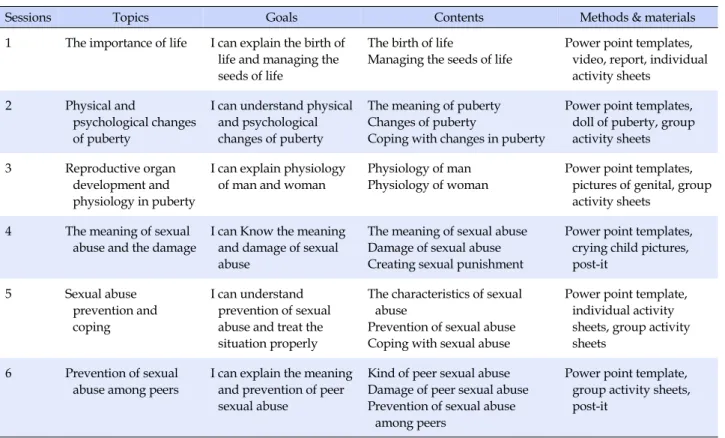
While the existing sexual abuse prevention education was emphasizing the negative aspects of sex as dealing with sexual abuse prevention [2,11-16], the sexual abuse prevention education program in this study proposed positive and negative sex in balance by connecting with physical and psychological development. Sexual abuse prevention education program is composed of 6 themes such as preciousness of life leaning about the meaning of the seeds of life and management methods, physical and psychological changes in adolescence learning meaning of adolescence changes in the adolescence and counter-measures, male and female sexual organ development in adolescence and how to manage them according to phys-iological phenomenon, meaning and damages of sexual abuse, prevention and countermeasures of sexual abuse prevention, and peer sexual abuse learning the meaning and prevention methods of peer sexual abuse (Table 1). To enhance the effects of the education, in every unit
in-dividual and group activity sheets were provided and vid-eo, sexual organ models, adolescence dolls and picture materials provided.
At Unit 1, seeds of life (sperm and egg) and growth of embryo are taught under theme of preciousness of life. While the previous studies [10,19,22] focused on thanking parents through activities knowing the growth process of embryo, writing thank you letter and simulating the preg-nancy experience, the education in this study focuses on letting them know the preciousness of life and perceive and practice how to manage their seeds of life.
They are asked to think reversely from the birth of baby and trace down to the seeds of life in males and females. They have time to think about the management of seeds of life and to make sure of the management. Through fertil-ization process of sperm and egg and growth of fetus in the womb, the preciousness of life was taught. It is also emphasized that life is also a part of sex. They are asked to respect others' life as their own lives and not to consider sex as shameful.
In the Unit 2 changes in the adolescence and how to re-spond to them are educated under theme of physical and psychological changes. In this unit, they learn to under-stand changes that they are experiencing and accept them as positive things as everyone experiences. They are asked to talk about the responses on the changes. They are also asked not to show negative responses to changes in their friends and not to be anxious by comparing them with their friends.
In the Unit 3, physiological phenomena that they expe-rience in adolescence are studied under theme of sexual organ development and physiological phenomena.
They come to thank and think positively on physio-logical phenomena by identifying the principle under it not perceiving the physiological phenomenon as a simple phenomenon, knowing the mystery of human body and preparing the life in the future. Additionally, they can ex-pand perception on sex as well as changes in adolescence to relationship with others by considering and under-standing friends who experience physiological phenom-ena in adolescence.
In the Unit 4, meaning and damages of sexual abuse are dealt with. The concept of sexual abuse is explained and it is emphasized that sexual violence is a crime by explain-ing it focusexplain-ing on 'abuse' not 'sex'. Through the group ac-tivities to understand the pains that the victim may feel and to console the victims, supports for the victims by peo-ple around them are emphasized. They are asked to identi-fy problems in the punishment for sexual abuse and to leg-islate and present the law to punish offenders.
In the Unit 5, sexual abuse prevention and coping me-thods according to various situations are taught. Sexual abuse situations that can happen frequently are presented and students are asked to think about the preventive and coping methods of sexual abuse incidents. They are asked to practice that they have learned in the class through in-direct experiences by sharing their opinions with their friends.
In the Unit 6, peer sexual abuse is studied. According to 2012 Seoul Sun Flower Child Center Report, cases that of-fenders and victims are in the same grade are around 22.7 % [23]. However, previous studies regarding sexual abuse prevention education [11,13,15] and regarding sex educa-tion including sexual abuse preveneduca-tion [10,19,21,22] have dealt with sexual abuse damage prevention only. There-fore, it is needed to expand the education to preventive methods not to inflict sexual abuse escaping from the da-mages inflicted on the victims. Accordingly, this study pro-vides peer sexual abuse cases to make them recognize the behaviors that they made for fun as sexual abuse beha-viors. It asks them not to make sexual abuse behaviors and if they made sexual abuse behaviors without intention it asks them to make apology actively.
2) Data Collection
Data collection was performed from May 6 toJune 23 in 2013 with the consent of the study participants and their parents. Pretest was done a week before the education. The researcher distributed sex knowledge and sex attitude questionnaires directly to the subjects, explained purpose of the survey and how to answer the survey, asked them to answer and collected the sheets at the place. For the ex-periment, the researcher gave education once a week to each class in health education room. It takes about 40 mi-nutes per unit. Posttest was performed on three groups such as experimental group, the comparison group, and the control group using the same measurement a week af-ter the sex education. Afaf-ter the posttest, sexual education was given to the control group and the comparison group using experiential class for the fairness of educational op-portunities.
3) Ethical Considerations
As subjects are elementary school student who are vul-nerable group and educational contents are related to sex, the study was approved by Kyung Hee University Ethics Committee (KHSIRB-13-010 (RA)) before execution for the ethical considerations. Before starting the study, the pur-pose of the study and confidentiality of survey answers were explained to students and parents through school
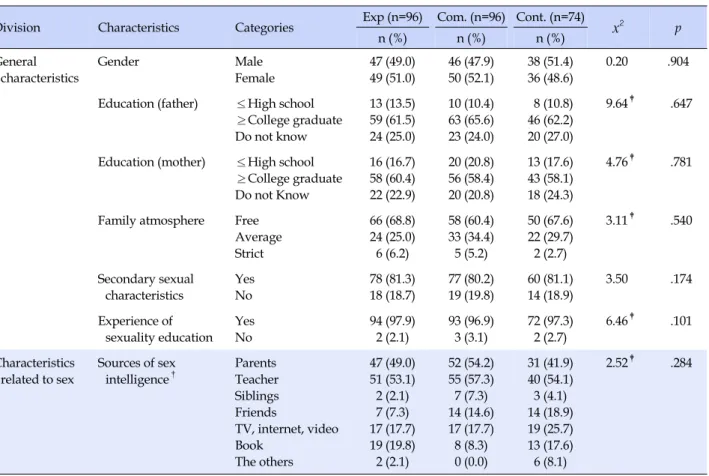
Table 2. Homogeneity Test of General Characteristics and Characteristics related to Sex (N=266) Division Characteristics Categories Exp (n=96) Com. (n=96) Cont. (n=74) x2 p
n (%) n (%) n (%) General characteristics Gender Male Female 47 (49.0) 49 (51.0) 46 (47.9) 50 (52.1) 38 (51.4) 36 (48.6) 0.20 .904 Education (father) ≤High school
≥College graduate Do not know 13 (13.5) 59 (61.5) 24 (25.0) 10 (10.4) 63 (65.6) 23 (24.0) 8 (10.8) 46 (62.2) 20 (27.0) 9.64‡ .647
Education (mother) ≤High school ≥College graduate Do not Know 16 (16.7) 58 (60.4) 22 (22.9) 20 (20.8) 56 (58.4) 20 (20.8) 13 (17.6) 43 (58.1) 18 (24.3) 4.76‡ .781
Family atmosphere Free Average Strict 66 (68.8) 24 (25.0) 6 (6.2) 58 (60.4) 33 (34.4) 5 (5.2) 50 (67.6) 22 (29.7) 2 (2.7) 3.11‡ .540 Secondary sexual characteristics Yes No 78 (81.3) 18 (18.7) 77 (80.2) 19 (19.8) 60 (81.1) 14 (18.9) 3.50 .174 Experience of sexuality education Yes No 94 (97.9) 2 (2.1) 93 (96.9) 3 (3.1) 72 (97.3) 2 (2.7) 6.46‡ .101 Characteristics related to sex Sources of sex intelligence† Parents Teacher Siblings Friends TV, internet, video Book The others 47 (49.0) 51 (53.1) 2 (2.1) 7 (7.3) 17 (17.7) 19 (19.8) 2 (2.1) 52 (54.2) 55 (57.3) 7 (7.3) 14 (14.6) 17 (17.7) 8 (8.3) 0 (0.0) 31 (41.9) 40 (54.1) 3 (4.1) 14 (18.9) 19 (25.7) 13 (17.6) 6 (8.1) 2.52‡ .284
Exp.=experimental group; Com.=comparison group; Cont.=control group; †
Multiple answer; ‡
Fisher's exact test. newsletters. The study was executed with informed
con-sents letting them know that they could discharge from the study at any time according to their will. Additionally, the comparison group received physical and psychologi-cal development education like the experimental group so that they could know positive and negative sex altogether [15].
5. Data Analysis
Collected materials were coded and analyzed using SPSS/WIN 21 program.
1) General characteristics and sex related characteristics of experimental group, the comparison group and the control group were analyzed with real number and percentages. For homogeneity test x2 test was used. For the homogeneity test of sex knowledge and sex at-titude of the three groups ANOVA was used. 2) To verify the effects of sexual abuse prevention
edu-cation connected with physical and psychological de-velopment education program on sex knowledge and sex attitude of the three groups, one-way analysis of variance and t-test were used.
RESULTS
1. Homogeneity Test of General Characteristics
and Sex-related Characteristics of the
Parti-cipatnts
Comparing general characteristics of the subjects such as sex, education of father and mother, conversation with parents and domestic atmosphere, there were no statisti-cally significant differences among three groups. Addi-tionally, comparing the sex-related characteristics such as secondary sex characteristics, experience in school sex ed-ucation and origin of sex knowledge, there were no stati-stically significant differences among three groups. There-fore, it was confirmed that the three groups are homoge-neous in general characteristics and sex-related character-istics (Table 2).
2. Homogeneity Test of the Dependent Variables
There was no statistically significant difference in sex knowledge among three groups such as 22.84 in experi-mental group, 21.46 in the comparison group and 19.81 inTable 3. Changes in Sexual Knowledge and Sexual Attitude Scores Pre-post Application of the Sexual Abuse Prevention
Education (N=266)
Variables Groups Exp. (n=96) Com. (n=96) Cont. (n=74) F p
M±SD M±SD M±SD
Sexual knowledge Pretest Posttest 22.84 (8.84) 23.32 (5.15) 21.46 (8.37) 19.08 (7.98) 19.81 (8.21) 19.93 (8.84) 2.66 8.74 .072 <.001 Sexual attitude Pretest
Posttest 45.48 (10.46) 61.73 (8.46) 45.48 (12.13) 43.45 (10.28) 44.11 (11.67) 46.04 (10.95) 0.39 94.03 .677 <.001
Exp.=experimental group; Com.=comparison group; Cont.=control group.
Table 4. Changes in Sexual Knowledge and Sexual Attitude Scores of the Experimental Group and Comparison Group (N=192)
Variables Groups Exp. (n=96) Com. (n=96) t p
M±SD M±SD
Sexual knowledge Pretest Posttest 22.84±8.84 23.32±5.15 21.46±8.37 19.08±7.98 1.11 4.37 .270 <.001 Sexual attitude Pretest
Posttest 45.48±10.46 61.73±8.46 45.48±12.13 43.45±10.28 0.00 9.25 1.000 <.001
Exp.=experimental group; Com.=comparison group.
Table 5. Changes in Sexual Knowledge and Sexual Attitude Scores between the Comparison and Control Group (N=170)
Variables Group Com. (n=96) Cont. (n=74) t p
M±SD M±SD
Sexual knowledge Pretest Posttest 21.46 (8.37) 19.08 (7.98) 19.81 (8.21) 19.93 (8.84) -1.29 1.44 .199 .152 Sexual attitude Pretest
Posttest 45.48 (12.13) 43.45 (10.28) 44.11 (11.67) 46.04 (10.95) -0.75 1.69 .456 .093
Com.=comparison group; Cont.=control group.
the control group. There was also no statistically signifi-cant difference in sex attitude among three groups such as 45.48 in experimental group, 45.48 in the comparison group and 44.11 in the control group. It shows that the three groups are homogeneous in sex knowledge and sex atti-tude (Table 3).
3. Hypothesis
The analysis results of the effects of sexual abuse pre-vention education connected with physical and psycho-logical development education on sex knowledge and sex attitude of elementary school students are found in Table 3.
When analyzing variances of pre- and post- sex knowl-edge of experimental group, the comparison group and the control group, it was found that sex knowledge of the ex-perimental group increased from 22.84 to 23.32, the com-parison group dropped from 21.46 to 19.08, and the con-trol group slightly increased from 19.81 to 19.93. There was statistically significant difference in sex knowledge of three groups.
Sex attitude of experimental group, the comparison group and the control group was changed after the experi-ment such as the experiexperi-mental group from 45.48 to 61.73, the comparison group from 45.48 to 43.45 and the control group from 44.11 to 46.04. There was statistically signifi-cant difference in sex attitude of three groups.
When compared sex knowledge and sex attitude be-tween the experimental group who had sexual abuse pre-vention education connected with physical and psycho-logical development education and the comparison group who had sexual abuse prevention education after the ex-periment, the experimental group showed significantly higher sex knowledge and sex attitude than the compar-ison group (Table 4). Additionally, when comparing sex knowledge and sex attitude of the comparison group who received sexual abuse prevention education and the con-trol group without any sex education including sexual abuse prevention education, it was found that there was no significant difference in sex knowledge and sex attitude of the comparison group and the control group (Table 5).
DISCUSSION
This study is to verify the effects of sexual abuse pre-vention education connected with physical and psycholo-gical development education on sexual knowledge and at-titude in elementary school students. While previous stu-dies compared and analyzed the experimental group with the sexual abuse prevention education and the control group without the sexual abuse prevention education. In this study the group with sexual abuse prevention educa-tion was set as the comparison group, the group with sex-ual abuse prevention education connecting physical and psychological development as the experimental group to verify the respective effects of sexual abuse prevention ed-ucation connecting physical and psychological develop-ment and the general sexual abuse prevention education on sex knowledge and sex attitude. Study results show that sexual abuse prevention education connected with physical and psychological development education was effective on enhancement of sex knowledge.
Sex knowledge of the experimental group with sexual abuse prevention education connected with physical and psychological development education was increased after experiment while sex knowledge of the comparison group with general sexual abuse prevention education decreased and that of the control group was not much different after the experiment. The reason why the experimental group showed higher sex knowledge than the comparison group is thought that the education could make the students per-ceive the preciousness of life through physical and psy-chological development education and provide informa-tion on the right responding method according to physical and psychological changes through physical and psycho-logical development education. It seems the method of ed-ucation such as providing sexual abuse prevention educa-tion after giving right informaeduca-tion on sex makes their con-centration on the education and eventually makes positive effects on the acquisition of knowledge on sexual abuse as well as general sex knowledge. The result of this study is consistent with previous studies [17,19,24] addressing that sex education including sexual abuse prevention educa-tion enhanced sex knowledge. It shows the sexual abuse prevention education connected with physical and psy-chological development education has effects on enhance-ment of sex knowledge.
However, sex knowledge of the experimental group with sexual abuse prevention education connected with physical and psychological development education was increased less than in previous study. When sex knowl-edge points are converted to total point 100, the point was
increased by 1.2. It is quite less than other studies such as Kim [12] and Kim [13] showing about 10 points increase, Lee and Lee [24] showing about 20 points, and Im and Park [17] and Lee et al. [19] showing about 30 points increase. The reason may be in the difference in sex knowledge mea-surement. Previous studies on the effects of sexual abuse prevention education [12,13] measured knowledge on sex-ual abuse and they used different tool to measure sex knowledge from this study which deal with physical and psychological changes in adolescence, how to deal with those changes, sexual physical management and sexual abuse prevention. Secondly, it may be because of the con-tents of sex education. When looking into the sex educa-tion contents of the previous studies, Im and Park [17] per-formed a unit of sexual abuse prevention education in to-tal 10 units' sexual education and Lee et al. [19] performed a unit of sexual violence prevention education in total 11 units' sex education. Lee & Lee [24] executed a unit of sex-ual violence prevention education in total 12 units' sex education. Most of previous studies executed more hours of sex education than this study (6 units) but less hour of sexual abuse education than this study (3 units). There-fore, sex education time should be expanded and contents from various areas should be included in sex education to greatly improve the points of sex knowledge. Based on the previous studies on sex education methods [10,17,21,22, 25,26], it is recommended to utilize Information & Com-munication Technology (ICT) rather than lecture type of education, to introduce various activity oriented educa-tion and cooperative educaeduca-tion in which students can par-ticipate, and to use various coaching methods in order to improve sex knowledge.
In addition, when comparing sex knowledge of the comparison group with physical and sexual abuse pre-vention education without physical and psychological de-velopment education and the control group without any sex education, no significant difference in changes in the points of sex knowledge was found in groups. It means general sexual abuse prevention education is not effective on the improvement of sex knowledge, which is incon-sistent with previous studies' results [2,11-14,16]. Son [2] reported that sexual vabuse prevention education was ef-fective on the improvement of knowledge in sexual abuse prevention and their responding capabilities when he studied on Grade 1 elementary school students. Bae [11] developed CD-ROM on 6 units regarding sex abuse and let Grade 1 to 3 elementary school students study with CD-ROM. He reported that knowledge on sexual abuse was significantly increased. Kim [12] reported that knowl-edge on sexual abuse prevention was not significantly
dif-ferent among Grade 4 elementary students but it signifi-cantly increased at Grade 5 and 6, Kim [13] reported that the experimental group showed significant increase in sexual abuse prevention knowledge although there was no significant difference in general sex knowledge of the control group with general sex education and the ex-perimental group who received sexual abuse prevention education with general sex education. Moon [14] who stu-died on Grade 6 elementary school students reported that points on the perception on sexual abuse prevention sig-nificantly increased in some items and Yook et al. [16] re-ported in their study on the perception on sexual abuse that there was significant difference in the knowledge on sexual violence according to whether they had sexual abuse prevention education or not. As such, most of pre-vious studies reported that sexual abuse prevention edu-cation was effective on the improvement of knowledge on sexual abuse prevention. However, in this study it did not show significant difference. It is because this study meas-ured sex knowledge in general areas including sexual abuse prevention knowledge so the sex knowledge measured in this study is different from the sex knowledge measured in the previous studies. Additionally, Kim [12] reported that the reason why there was no difference in sexual abuse prevention knowledge in Grade 4 students that they had low level of understanding on sex because of insufficient pre education. It shows young students cannot understand sex property only with sexual abuse prevention education. In this study, it is thought that sexual abuse prevention ed-ucation without physical and psychological development education will not help students to understand sex prop-erly as it deals with a part of 'sex' only and therefore it does not make effects on the improvement of sex knowledge. Effects of hours of education cannot be excluded. The parison group received less hours of sex education com-paring to the experimental group. Moon [14] addressed that the reason why there was no big difference in the per-ception on sexual abuse between the experimental group receiving sexual abuse prevention education and the con-trol group without the sexual abuse prevention education was the effects of education through mass media. The re-searcher also believes that there was no significant differ-ence in sex knowledge between the comparison group and the control group as education through parents and mass media affected sex knowledge of the control group.
Although there was no significant difference, the score of sex knowledge in the comparison group was dropped by 6 point from 53.7 to 47.7 when converting the points in-to 100 points as full score, while sex knowledge of the con-trol group did not change much as 49.5 and 49.8. It is
be-cause the education focusing on sexual abuse gave them negative perception on sex and affected negatively on the existing sex knowledge. Educating sex abuse can reduce sex knowledge because it may occur negative feelings such as fear, anger and anxiety and shrink though on sex, although it may be effective on preventive activities by alerting and promoting the awareness on sexual abuse [6]. Therefore, to improve sex knowledge sexual abuse pre-vention education connected with physical and psycho-logical development education rather than general sexual abuse prevention education should be introduced so that they can perceive sex appropriately.
Sexual abuse prevention education connected with phy-sical and psychological development education was effec-tive on the improvement of sex attitude. Sex attitude of the experimental group with sexual abuse prevention educa-tion connected with physical and psychological develop-ment education increased by 16.25 while that of the com-parison group with general sexual abuse prevention edu-cation dropped by 2.03. That of the control group increased 1.93. It is consistent with the result of the previous studies [10,27] showing that sex education including sexual abuse prevention education increased sex attitude. It shows that sexual abuse prevention education connected with physi-cal and psychologiphysi-cal development education made pos-itive effects on the composition of sex attitude. Bae et al. [10] thought that the provision sex knowledge utilizing picture materials from the perspectives of biology, behav-ioral science and moral contributed to positive sex attitude composition. The same can be applied to this study. In this study, multilateral sex education including preciousness of life and changes in adolescence make them acknowl-edge sex positive and consider others, which contributes to increase of sex attitude points of the experimental group. In this study, they were educated not to take sex lightly or shamefully and asked to think about the reason rather than focusing on changes in adolescence so that they could accept their changes positively. Furthermore, they were asked to expand the perception on sex to the relationship with others not limiting it to individual problems so that they could think about sexual abuse from various perspec-tives. Such changes in perspectives on sex may make pos-itive effects on sex attitude. To improve sex attitude, it is important to provide multilateral information on 'sex' and sex attitude can be improved more when students partic-ipate in the information provision based on the results of previous studies [10,21]. Lee et al. [19] reported that parents' attitude at home are closely related with sex attitude of children. Therefore, it is important for parents to have good sex attitude and systematic sex education for parents
is also important.
Next, there was no difference in sex attitude between the comparison group with sexual abuse prevention educa-tion without physical and psychological development ed-ucation and the control group without any sex eded-ucation. It implies that general sexual abuse prevention education did not make any effects on sex attitude. The result is not consistent with Kim's [13] result showing significant in-crease in sex attitude after education, while it is consistent with the results of previous studies by Bae [11] and Park and Kwon [15] showing there was no significant differ-ence in sex attitude after education. Bae [11] explained the reason why there was no significant difference in sex atti-tude was that the hours of education were not sufficient to change the attitude and attitude could be affected by vari-ous other factors as well besides education. Although in-significant, there was slight increase in the control group without any education by 1.93 but there was drop in the comparison group by 2.03 after the education. Based on the previous studies [28,29] addressing that there was pos-itive correlation between sex knowledge and sex attitude, it is thought that sex knowledge of the comparison group made effects on sex attitude in the same context that sex knowledge of the comparison group dropped after the education. Bae et al. [10] addressed that children's negative thought on sex education (80.0%) was because sex educa-tion was focused on sexual abuse preveneduca-tion educaeduca-tion. It explains that sex attitude point of the comparison group dropped after general sexual abuse prevention education. The researcher of this study also believes that the reason why sex attitude point of the comparison group dropped is that sexual abuse prevention education without giving positive information on sex is given to the students who do not understand sex very well and negative aspects of sex are emphasized. Sexual education focusing on sexual abuse prevention may compose anxiety and fear against sexual abuse and emphasize sexual abuse prevention be-haviors only. Therefore, it may limit the thoughts on sex, crook the concept of sex and result in negative sex attitude. To compose the right sex attitude of children, sexual edu-cation connected with physical and psychological devel-opment should be introduced to let them have correct and proper concept of sex.
This study can be applied in the school field directly as it provides direction of sexual abuse prevention educa-tion. It can be basic sources for a systematic sexual abuse prevention education program by studying the effects of sexual abuse prevention education connected with phys-ical and psychologphys-ical development education consider-ing the development stages of the subjects on the general
sex knowledge. However, this study has the limitations. First, as the participants of this study are limited to Grade 5 and 6 students in an elementary school in Seoul with convenience sampling. Therefore, there is limitation to ge-neralize the results to other regions or grade. To increase the external validity, it is recommenced to study on more students in various areas with random sampling. Second, there is difference in sex knowledge measurement tool. Previous studies used a sex knowledge measurement tool dealing with knowledge on sexual abuse as they studied effects of sexual abuse prevention education, while this study included more items such as physical and psycho-logical changes in adolescence, how to respond to those changes, how to manage sexual organs and how to pre-vent sexual abuse. It cannot be excluded this difference made effects on the program effect measurement. Third, further analysis is required in that sex knowledge of the experimental group did not increase and there was change in sex knowledge point of the comparison group, which implies that the effects may be significant. Additionally, this study executed the same sex education to Grade 5 and Grade 6 students without considering their development stage according to their Grade. To develop a systematic sexual abuse prevention program considering the devel-opment stage, effects by grade should be analyzed and a study on sexual abuse prevention education appropriate for the curriculum by grade should be performed.
CONCLUSION
This study is a qusi-experimental study with 3 group pre and post experiment design to find the effects of sexual abuse prevention education connected with physical and psychological development education on sex knowledge and sex attitude of Grade 5 and 6 elementary school stu-dents.
The results say that sex knowledge and sex attitude of the experimental group with sexual abuse prevention ed-ucation connected with physical and psychological devel-opment education are significantly higher than those of the comparison group with physical sexual abuse preven-tion educapreven-tion without physical and psychological devel-opment education and the control group without any sex education. Therefore, it is thought that sexual abuse pre-vention education connected with physical and psycho-logical development education considering the develop-ment stage of eledevelop-mentary school students who will experi-ence physical and psychological changes will improve sex knowledge and sex attitude of the subjects and contribute to composition of the right sexual values. It is also
ex-pected that students need to accept their changes positi-vely and respond to sexual abuse as sexual subjects.
The followings are proposed for further studies based on the results of this study.
First, the improvement of sex knowledge of the experi-mental group receiving education connected with phys-ical and psychologphys-ical development education was small-er than that in previous studies. It may be because of dif-ference in tools, education hours and educational contents. Therefore, studies on the effects of sexual abuse preven-tion educapreven-tion using general sex knowledge measurement tool and studies on program hours and contents should be followed. Second, this study analyzed the effects of sexual abuse prevention education connecting physical and psy-chological development areas considering development stages of the subjects who are Grade 5 and Grade 6 ele-mentary school students. A systematic sexual abuse pre-vention education program should be developed through studies comparing effects of sexual abuse prevention edu-cation connecting human relationship area, sexual culture and sexual ethics area as well as physical and psychologi-cal development area with effects of general sexual abuse prevention education.
REFERENCES
1. The Supreme Public Prosecutors Office of Korea. Statistic for child abuse [Internet]. Seoul: The Supreme Public Prosecutors Office of Korea. 2014 [cited 2014 September 1]. Available from: http://www.spo.go.kr/spo/info/stats/stats0211_2014.jsp 2. Son SA. The effectiveness of behavioral skill training for the
prevention of child sexual abuse. TheJournal of Korean Asso-ciation of Child Studies. 1992;13(2):189-201.
3. Lee SH, Park WJ. Development of standard education contents and methods for the prevention of sexual violence in late school- age children using delphi technique. KoreanJournal of Scien-tific Criminal Investigation. 2013;7(4):287-296.
4. Ministry of Education, Science and Technology. Guidelines for sexual education and sexual harassment. Evaluation Report. Sejong: Ministry of Education, Science and Technology; 2013. 5. Ministry of Health and Welfare, Planned Population Federa-tion of Korea. Sexual educaFedera-tion manual for elementary tea-chers. Seoul: Ministry of Health and Welfare; 2011. Report No. 11-1352000-000279-01.
6. Zwi KJ, Woolfenden SR, Wheeler DM, O'brien TA, Tait P, Wil-liams KW. School-based education programmes for the preven-tion of child sexual abuse. Cochrane Database of Systematic Reviews. 2007;(3):CD004380.
http://dx.doi.org/10.1002/14651858.CD004380.pub2 7. Jung OB. Child development. Seoul: Hakjisa; 2013. 668 p.
8. Cho YS, KimJH, Lee GS, WooJK. Development of elementary school sexuality education program: Focusing on the upper gra-des. TheJournal of Elementary Education. 2001;14(2):213-235. 9. Planned Population Federation of Korea, Management Center
for Health Promotion. General survey of school-based sexual-ity education at nurseries and elementary, middle and high school and developing sexuality education manuals for teach-ers and counselors. Health Promotion Study Project Report. Seoul: Planned Population Federation of Korea; 2010. 10. BaeJS, Kim YS, Kim HS. Effects of pictures on sexual education
among primary school children. TheJournal of the Korean So-ciety of School Health. 2010;23(2):217-227.
11. Bae JY. The effect of computer-assisted instruction (CAI) through the multimedia CD-ROM on the prevention of child sexual abuse. TheJournal of Korean Academic Society of Nurs-ing Education. 2004;10(2):239-251.
12. Kim HA. The effects of a child sexual abuse prevention pro-gram in rural elementary school children [master's thesis]. Seoul: Yonsei University; 2002. 64 p.
13. Kim MS. Effects on primary school children's sexual violence prevent knowledge and sexual attitude of preventative pro-gram about a sexual harrassment and a sexual violence [mas-ter's thesis]. Gongju: Gongju National University; 2004. 45 p. 14. Hebert M, Lavoie F, Piche C, Poitras M. Proximate effects of a
child sexual abuse prevention program in elementary school children. Child Abuse & Neglect. 2001;25(4):505-522.
15. Park KM, Kwon YS. A study on the effect of sex education pro-gram on sex attitude and prevention of sexual violence in ele-mentary students. TheJournal of Kemyung Nursing Science. 1998;2(1):1-13.
16. Yook JH, Park HK, ChaeJM. The evaluation of the primary school students' knowledge and recognition on the sexual as-sault.Journal of Forensic and Investigative Science. 2008;3(1): 25-42.
17. Im YI, Park KM. Effects of sexuality education coaching pro-gram on sex-related knowledge and attitude among elemen-tary school students.Journal of Korean Academy of Nursing. 2014;44(1):31-40.
18. Song ML, Park KM. Factors of depression in Korean-Chinese elders in the Yanbian Korean autonomous prefecture in China: With reference to Han-Chinese living in the Yanbian Korean autonomous prefecture. TheJournal of Korean Academy Com-munity Health Nursing. 2013;24(2);151-160.
19. LeeJH, Yu HK, Choi YS. The development of a parents-invol-ved group counseling program to improve sexual-conscious-ness of elementary school students in higher grade. The Korea Journal of Youth Counseling. 2011;19(2):47-64.
20. Lee SJ, LeeJS. The effect of sex education on sex knowledge and attitude of primary school students.Journal of Nursing Science. 2000;5(1):29-46.
21. RyuJE, Kim YS, Kim HS. Effects of cooperative learning meth-ods on sex education among primary school students. The Journal of the Korean Society of School Health. 2012;25(1): 122-132.
22. Kim YA, Yu HK, Choi YS. Development of a group counseling program to cultivate sexual perception of elementary school students in higher grade. The KoreanJournal of Educational Methodology Studier. 2010;22(4):67-90.
23. Seoul Habaragi Child Center. 2012 report for project [Internet]. Seoul: Seoul Habaragi Child Center. 2013 [cited 2013 Septem-ber 1]. Available from:
http://www.child1375.or.kr/data/newlaw/view.asp?idx=37 &page=1&board_num=37
24. Lee KS, LeeJS. The effect of a sex education program on sex-re-lated knowledge and attitude of 5th-grade elementary school students. TheJournal of the Korean Society of School Health. 2004;17(1):25-39.
25. Han SS, Gook MK. The effect of sex education based on ICT
(Information and Communication Technology) to sex know-ledge and attitude of 5th-year elementary students.Journal of Korean Society for Health Education and Promotion. 2004;21 (3):87-100.
26. Oh SM, Kim HL. Sex education, sex-related knowledge, sex-re-lated attitude of 6th-grade elementary school students. The Journal of Korean Society of School Health. 2010;23(2):228- 236.
27. Seo SH, Lee MS, Na BJ, Kang MY, HongJY. Effects of sexuality education in one elementary school students. TheJournal of Korean Society for School Health Education. 2012;13(3):73-86. 28. Kim SJ, LeeJE, Kim SH, Kang KA. The effect of sexual educa-tion on sex knowledge & attitude in elementary school stu-dents. TheJournal of Korean Public Health Nursing. 2012;26 (3):389-403.
29. OhJA. Sexual maturity, sexual knowledge, and sexual attitude in late elementary school children. The KoreanJournal of Child Health Nursing. 2008;14(3):305-314.