Insights into the ASME PRA Standard-based Quality Evaluation
on the Existing KSNP LERF Model
Kwang-Il Ahn,a Dae-Il Kang,a Joon-Eon Yang,a Soo-Yong Park,b See-Darl Kim,b a Integrated Safety Assessment Div., b T/H Safety Research Div., KAERI
Dukjindong, Yuseung-gu, Daejeon, 305-353, Korea, [email protected]
1. Introduction
The current Risk-informed Regulation (RIR) framework [1] employs both a Level 1 Core Damage Frequency (CDF) and a Level 2 Large Early Release Frequency (LERF) as two surrogate measures for the plant risk. For their use in making regulatory decisions for the plant risk, it has been required to maintain an appropriate level of quality for the plant risk models. The first step for this purpose is to evaluate the quality of the PSA model in a qualitative or quantitative manner. Recently, a similar type of quality evaluation has been made for the KSNP Level 1 PSA model [2] based on an ASME PRA Standard for the RIR application [3], but not for the corresponding LERF model. The main objective of this paper is to provide the ASME PRA Standard-based evaluation result for the existing KSNP Level 2 LERF model [4] and the insights obtained from the evaluation process.
2. Methods and Results
The “ASME PRA Standard [3]” provides a basis for the quality evaluation of the PSA Level 1 and Level 2 LERF model for the RIR application, which is the first substantial product in the world for this purpose. Regarding the LERF model, this standard provides 37 prescribed technical requirements and the subsequent peer review guidance for the quality evaluation. Three capability categories (i.e., I, II, and III) are assigned for each requirement, whose categorization is made according to the technical adequacy or quality of the corresponding LERF model.
2.1 Evaluation Approach
The ASME peer review guidance for the LERF model is classified into two closely related, but distinctive portions: one is the portion of the Level 1 and LERF interface process and the other is the portion of the LERF analysis. In turn, the latter typically includes (a) LERF definition and analysis method, (b) severe accident phenomena that impact on the radionuclide release portion of LERF, (c) human action and system success, (d) evaluation of a containment performance under severe
accident conditions, (e) functional events for a safe stable containment end state, (f) accident sequence mapping, and (g) sensitivity analysis.
For the existing KSNP LERF model, our main concern of the quality evaluation was to determine which requirement items belong to one of the three predefined capability categories first and what items and also what items need to be improved to upgrade the whole quality of the LERF model. For this purpose, the aforementioned LERF model review guidance has been summarized into the following 7 groups for review: (a) Level 1 and LERF interface (‘L1-2’), (b) Accident progression and containment response modeling & their quantification (‘APQ’), (c) Radionuclide release characterization for evaluating its risk contribution (‘RRC’), (d) Containment failure modes (‘CFM’), (e) Human action for accident mitigation (‘HAM’), (f) Uncertainty, sensitivity, and importance (‘USI’), and (g) Assumption & documentation (‘A&D’). For the existing KSNP LERF model, all the ASME LERF model requirements are allocated into one of the foregoing items for review.
2.2 Evaluation Results
As a result of the quality evaluation for the KSNP LERF model, Figures 1 and 2 show the grade-granted results for each of the present review items and the portion of all the ASME LERF requirements summarized to each category. According to Figure 2, it is noted that the overall quality of the KSNP LERF model is allocated between the ASME PRA Standard Capability Category I and II+. This trend seems to be very similar with the evaluation result on the Level PSA model [2].
The review result also shows that the low quality (i.e., corresponding to the category I or below) is more dominant for the ‘HAM’, ‘USI’, and ‘A&D’ items when compared with the other ones. This is mainly due to the fact that while the main role of the existing Level 2 PSA was limited to identifying the weak points of a new power plant design, and deriving the alternatives to eliminate such vulnerabilities, the LERF model requirements are more focused on assessing the plant risk in a more realistic manner as built and as operated. The low quality of the document-related items is mainly due to the lack of a qualified documentation procedure to manage the Transactions of the Korean Nuclear Society Autumn Meeting
documents and information regarding the LERF analysis. The low quality for the other technical requirements is due to the fact that a few portions of the existing KSNP Level 2 PSA report are out-of-date and any additional work for an improvement has not been made since its publication in 1996 though some changes have been for containment mitigation systems.
0% 10% 20% 30% 40% 50% 60% 70% 80% 90% 100%
L1-2 APQ RRC CFM HAM USI A&D
Category II+ Category II Category I Category
I-Fig.1 Category-granted result for each review items
Category I-8% Category I 19% Category II 59% Category II+ 14%
2.3 Items for Further Improvement
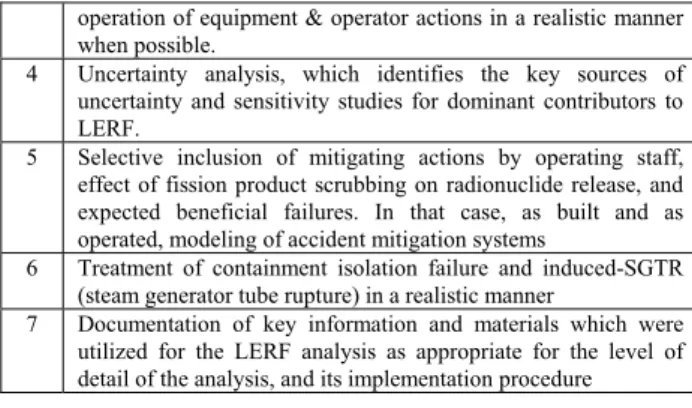
Through the present quality evaluation process, a few technical items have been evaluated as a low quality (e.g., category I or below) and most of those items are summarized in Table. Those items need to be improved to more to upgrade the overall quality of the KSNP LERF model (e.g., category II or above).
Table 1 Potential Items for the LERF model improvement
No Items for Improvements
1 Treatment of the potential LERF contributors such as dominant
accident phenomena (HPME (high pressure melt ejection), S/E (steam explosion), Hydrogen burn, etc.) and containment dynamic loads in a realistic manner
2 Treatment in a realistic manner of feasible operator actions
following the onset of core damage and use of HFEs (human failure errors) consistent with EOPs (emergency operating procedures) / SAMGs (severe accident management guidelines), proceduralized actions or TSC (technical support center) guidance.
3 Treatment of containment failure impacts on continued
operation of equipment & operator actions in a realistic manner when possible.
4 Uncertainty analysis, which identifies the key sources of uncertainty and sensitivity studies for dominant contributors to LERF.
5 Selective inclusion of mitigating actions by operating staff,
effect of fission product scrubbing on radionuclide release, and expected beneficial failures. In that case, as built and as operated, modeling of accident mitigation systems
6 Treatment of containment isolation failure and induced-SGTR
(steam generator tube rupture) in a realistic manner
7 Documentation of key information and materials which were
utilized for the LERF analysis as appropriate for the level of detail of the analysis, and its implementation procedure
Nevertheless, it should be noted that as mentioned in Reference 2, there is no formal and/or quantitative approach to determine the quality of the whole LERF model from the grade of each ASME requirement as yet.
3. Concluding Remarks
Through this paper, we have evaluated the ASME PRA Standard-based quality evaluation for the existing KSNP LERF model. As a result, we have identified which requirement items belong to one of the predefined capability categories (I, II, and II) and also derived what items should be improved more to upgrade the whole quality of the KSNP LERF model. According to the present evaluation, the overall quality of the existing KSNP PSA belongs to between the ASME PRA Standard Capability Categories I and II+. For a few items graded as a low quality (e.g., category I or below), a further improvement is required to upgrade more the overall quality of the KSNP LERF model.
ACKNOWLEDGEMENTS
This study was performed as a part of the ‘long term
research and development plan for the nuclear energy’
supported by the Ministry of Science and Technology.
REFERENCES
[1] USNRC Reg. Guide 1.174, “An Approach for Using Probabilistic Assessment in Risk-informed Decisions on Plant-specific Changes to the Licensing Basis,” U.S. Nuclear Regulatory Commission, July 1998.
[2] Yang, J.E. et al., "Review of UCN 3,4 PSA Model based on ASME PRA Standard, Rev.0," Korea Atomic Energy Research Institute, KAERI/TR-02509/2003. [3] ASME, "Standard for Probabilistic Risk Assessment for Nuclear Power Plant Applications," ASME RA-S-2002, 2002.
[4] KAERI, “Ulchin Units 3&4 Final Probabilistic Safety Assessment,” Prepared for KEPCO, 1996.