A Study of Hybrid System for Dissolved Oxygen Removal under the Various Conditions
Mun-Soo Kim, Duk-Won Kang, Min-Soo HanRadiation & Chemistry Group, Nuclear Power Lab, Korea Electric Power Research Institute, 103-16 Munji-dong Yuseong-gu Daejeon, 305-380, Korea, [email protected], [email protected], [email protected]
1. Introduction
The dissolved oxygen in the reactor coolant causes the corrosion of material and deterioration of the capacity of radiation shield. Recently, catalyst resin or degassing membrane[1] is used instead of chemical agents to remove the dissolved oxygen in the reactor water[2]. The Hybrid system intended to remove the dissolved oxygen creates an ideal combination between hollow fiber membrane module which is small but effective in removing dissolved oxygen and the module created by using Pt catalyst reaction of platinum on the surface of ACF(Activated Carbon Fiber)[3] which has fairly large surface area for its weight and easy to impregnate. This system maximizes efficiency and the treatment volumn.
This system is highly efficient degassing equipment that has more than 99.9% of DO removal efficiency in a once-through process.
2. Experimental
2.1 Results from the trial run in the lab-scale system
When more hydrogen is dissolved than the amount of oxygen in the water and water is put through catalyst layer, the dissolved oxygen concentration drops from 9.5 ppm to the low of 1 ppm.
From this experiment, it is proved that platinum catalyst has very good activity in the reaction of dissolved oxygen removal. When the concentration of dissolved oxygen in the water is 7.0 ppm, the removal rate of dissolved hydrogen according to its concentration level is stated in the table 1.
Table 1. Removal rate of DO by hybrid-type degassing equipment according to DH concentration
Concentration (ppm)
Inlet DO Inlet DHa) Outlet DO DO removal(%) pH
7.5 0.050 1.100 85.3 7.8 7.5 0.100 0.605 91.9 7.5 7.5 0.225 0.008 99.9 6.9
7.5 0.270 -b) 100.0 6.1
* Test condition: temperature 20 ℃, catalyst weight 37.6 g,
a) Dissolved hydrogen b) Non-detectable
When the hydrogen concentration is lower than the equivalent ratio DO removal efficiency is low but when the dissolved hydrogen concentration is adjusted to 1.0
ppm to make the equivalent ratio 114%, the DO removal efficiency increases up to 99.9%.
When the dissolved hydrogen concentration is 1.2 ppm which is 140% of the equivalent ratio, the DO is almost perfectly removed and didn't leave any trace at the Pt catalyst reactor vessel outlet.
2.2 Experiment on the removal of dissolved oxygen.
A 10 ton giant water tank is used to provide pure water as feed water. The operating condition of the dissolved oxygen removal system was 6 bar, 6 ton/hr water flux, 20℃ water temperature and once-through.
0 10 20 30 40 50 60 70 80 90 100 0 2 4 6 8 10 12 14 16 18 20 22 24 26 28 30 32 34 36 38 40 T im e ( m in ) R e m o v a l E ffic ie n c y ( % )
Figure 1. DO removal efficiency of Hybrid system (15 ton/hr)
The removal rate is more than 99.9% in average as stated in the Figure 1, the removal efficiency was stable enough to reach 99% in just 4 minutes.
The Figure number 2 indicates the results from the experiment of DO removal efficiency of under the various pressure conditions. Among of the 1, 3 and 6 bar in the system, the higher pressure shows the higher removal efficiency. This is deemed to be the result of the difference in the condition of H2 melting ratio.
Under the higher pressure, the H2 melting ratio in the
system becomes higher and this affects the DO removal efficiency by increasing the activity of H2 as a reducing
agent.
Transactions of the Korean Nuclear Society Autumn Meeting Busan, Korea, October 27-28, 2005
0 10 20 30 40 50 60 70 80 90 100 0 2 4 6 8 10 12 14 16 18 20 Time(min) Removal Efficiency (%) 6 bar 3 bar 1 bar
Figure 2. DO removal efficiency of Hybrid system (15 ton/hr) under various pressure
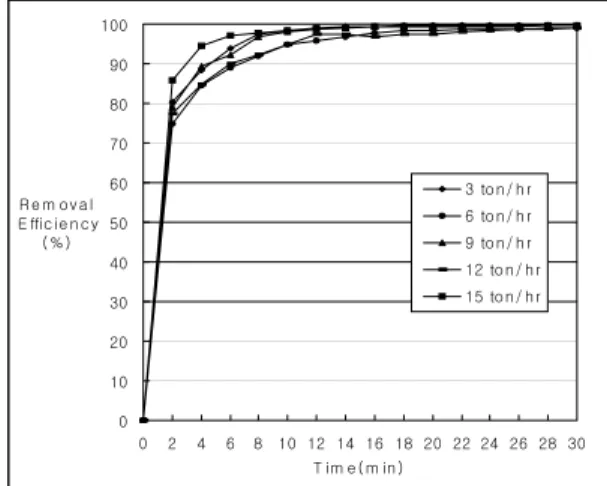
The Figure 3 indicates the DO removal efficiency’s under different water flux. The condition in the system is 6 bar, 20℃ water temperature and 3, 6, 9, 12, 15 ton/hr flow late.
As indicated in the result, quite a long time is needed for the system to became stable when is higher water flux and the removal efficiency stayed at higher than 99% in 30 minutes under any conditions.
0 10 20 30 40 50 60 70 80 90 100 0 2 4 6 8 10 12 14 16 18 20 22 24 26 28 30 T im e ( m in ) R e m ova l E ffic ie n c y ( % ) 3 ton / h r 6 ton / h r 9 ton / h r 12 ton / h r 15 ton / h r
Figure 3. DO removal efficiency of Hybrid system (15 ton/hr) under various flow rate
3. Conclusion
In the study of hybrid-type lab scale equipment, which uses ACF with impregnated catalyst for the DO removal technology and degassing membrane unit, the DO removal efficiency turned out to be higher than 99.8%. This efficiency shows the higher efficiency than expected. The hybrid-type equipment is expected to be very useful in continuous feed flow system because it allows ppb level water quality control possible at the outlet section. Moreover, the DO removal system that treats 15ton/hr , which is a scaled up system based in the lab scale equipment, has been the focus of experiment as it will be very efficient and useful. The
result shows that the system has more than 99.9% of DO removal efficiency. In the process, the amount of hydrogen supplied in the water that prevents metal catalyst from oxidation and keep them active is proved to be a critical factor.
REFERENCES
[1] Hoechst Celanese Corp., “membrane Contactor Technology for Gas Transfer of Ultrapure Water”, Private Communication (1998).
[2] S. G. Desilver, “Reduction of oxygen with hydrogen at ambient temperature using catalyst”, 45th International Water Conference (1984).
[3] Reduction reaction of dissolved oxygen in water by hydrazine over platinum supported activated carbon fiber catalyst A: General, 184 (1999) 41-48