© Korean Powder Metallurgy Institute 1193
1. Introduction
Ferrite magnetic nanoparticles (MNPs) with functional properties have been widely used in a wide range of biotechnology, such as drug and gene delivery, enzyme and protein immobilization, diagnostics, RNA and DNA purification.1-8 In this work we described preparation of sol-gel silica coated ferrite MNPs and their bioapplication to nucleic acid separation. Silica coated MNPs were prepared by changing the volume ratio of tetraehoxy orthosilicate(TEOS) for controlled coating thickness. The sol-gel process in silica coating on MNPs surface was adapted for relatively mild reaction condition, low-cost, and surfactant-free.9,10 After silica coating process, the amino-silanes monolayers were grafted on the silica coated MNPs to enforce the covalent bonding and to capture the λ-DNA as a anchored probes.11-13 DNA detection with amino functionalized Si-MNPs was demonstrated with electrophoresis methods, and the study on adsorption efficiency of λ-DNA with Si-MNPs was performed as a function of the number of amine groups. Moreover, the morphology, magnetic moment, electrostatic interaction and composition of the Si-MNPs were characterized by FT-IR, SEM, VSM, Zeta potential, BET and Electrophoresis.
2. Experimental and Results
All chemical used were of the highest purity grade. A Iron(II) Chloride, Iron(III) Chloride as a starting material, Tetraethyl orthosilicate(TEOS, 98%), 3-Aminopropyltri-ethoxysilane(APTES, 99%), N-[3-(Trimethoxysilyl)propyl] -ethylene diamine(97%) and N’-[3-(Trimethoxysilyl) propyl]-diethylene triamine(85%) as a silica compound, ammonia solution(NH4OH, 28~30%) as a catalyst were supplied by Sigma- Aldrich Chemical Company except for ammonia solution. Magnetite was made according to the
method of Sol-Gel. Typically, a fresh mixture of FeCl2•4H2O(2M) and FeCl3•6H2O(1M) was added to ammonia solution(0.7M) with vigorous stirring at room temperature.14,15 The obtained magnetic nanoparticles were fixed with a permanent magnet and the supernatant decanted, and then magnetite was promptly washed with di-water for 3~4 times and ethanol for 3 times by permanent magnet separation. Magnetite nanoparticles in suspension were added to a freshly prepared solution of tetraethyl orthosilicate(TEOS, 98%) in ethanol. The mole concen-tration of TEOS was varied in the range of 10mM~50mM and this suspension was allowed to react under mechanical stirring. The aqueous ammonia solution was dropped until the pH of the mixture raised to 12. Then, the mixture was reflexed at 100 for 24h and dense silica layer onto ℃ magnetite surfaces. Finally, the product was washed ethanol for 3 times and dried at 40 for 4h i℃ n vacuum oven. The silica coated magnetite as control was dispersed in toluene and then the solution was added to a APTES, N-[3- (Trimethoxysilyl)propyl]-ethylene diamine and N’-[3- (trimethoxysilyl) propyl]-diethylene triamine. These are added to the each different round bottom flask. The mixture was refluxed at 130 for 7h. Finally, the product was ℃ washed toluene for 3 times and dried at 40 for 4h in ℃ vacuum oven. Electrophoresis was demonstrated that a total of 10mg of functionalized silica-coated magnetite and 1mL of diionized water were mixed and voltexed at laboratory temperature. This mixture was uniformly prepared with a range from 1 to 20uL and then the human DNA was added(10uL). The human acid was separated using a 1% agarose gel electrophoresis in 0.5X TAE buffer. Finally, the DNA adsorption effect was obtained during 20min by electrophoresis.
The surface modification of ferrite nanoparticles with TEOS were characterised by FT-IR. The OH stretching vibrations of the Si-OH group absorbed at 830~1110cm-1.
Vibration for the Si-OH bond and Si-H bend(800~950 cm-1)
2006 POWDER METALLURGY World Congress
PC09-W-17
Polyamine Group Assembled Silica Coated Ferrite Nanoparticle
for Lambda DNA Detection
Moo Eon Park and Jeong Ho Chang
Korea Institute of Ceramic Engineering and Technology, Seoul 153-801, Korea [email protected]
Abstract
The magnetic ferrite nanoparticles were synthesized and coated by silica precursor in controlling the coating thicknesses and sizeses. The surface modification was performed with amino-functionalized organic silanes on silica coated magnetic nanoparticles. The use of functionalized self-assembled magnetic ferrite nanoparticles for nucleic acid separation process give a lot of advantages rather than the conventional silica based process.
© Korean Powder Metallurgy Institute 1194 -peaks in the FT-IR spectrum of the nanoparticles after TEOS modification that TEOS was chemically bonded to the ferrite nanoparticles. As a result, The FT-IR spectrum of silica-coated magnetite was indicated that silica layer was covered to the magnetite nanoparticles.
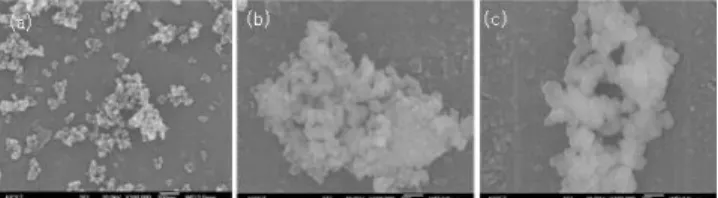
A particle size has been characterized by SEM images. Fig. 1 is SEM image of the synthesized ferrite nanoparticles, which show that the only difference in silica-coated magnetite obtained from each of the methods is the nanoparticle size distribution. A TEOS was increased silica wall by condensation and hydrolysis reaction. SEM image of silica-coated magnetite with controlled Si-shell thickness.
Fig. 1. SEM images of silica coating layers-controlled Si-MNPs as a function of TEOS molar ratios. Zeta potential analysis of amine modified MNPs was showed in Fig. 2(a) and the human DNA separation results of functionalized magnetite particles obtained by electro-phoresis image were also showed in which the bioactivity of silica coated magnetite and amino functionalized magnetite were measured from electrophoretic mobility measurements. Negative zeta potential was measured over the pH 7.5. Zeta potential profile exhibited the positive charge balances after synthesis of amino group. The adsorption of lambda DNA molecules on the amino functionalized Si-MNPs was affected by a number of the amine groups. The lambda DNA adsorption efficiency was preffered to the higher number of amine groups such as triamino functionalized silica coated MNPs. Therefore, the preliminary results could be widely used to recover lambda DNA with high troughput.
(a)
Functional Groups
(a) (b) (c) (d) (e) (f) (g) (h) (i) (j) (k)
mV -60 -40 -20 0 20 40 60 (a) (b) (a) Functional Groups
(a) (b) (c) (d) (e) (f) (g) (h) (i) (j) (k)
mV -60 -40 -20 0 20 40 60 (a) (b)
Fig. 2. (a) Zeta potential of the magnetite, Si-MNPs and amino functionalized Si-MNPs and (b) electro-phoresis image of the lambda DNA purification. (1) reference (2) monoamine/λ-DNA=10uL/10uL (3) diamine/λ-DNA= 10uL/10uL (4) triamine/ λ-DNA=10uL/10uL (5) monoamine/λ-DNA=30uL /10uL (6) diamine/λ-DNA=30uL/ 10uL (3) triamine/ λ-DNA=30uL/10uL.
3. Summary
In conclusion, a systematic study of the formation of silica-coated magnetic nanoparticles via sol-gel approach was prepared. The consequence is that the shell thickness was controlled by changing the concentration of the TEOS precursor on the magnetic nanoparticles. And then amino functionalized magnetic nanoparticles synthesized using amine groups as surface modification. It has been proved that the amino functionalized magnetic nanoparticles could significantly improve the lambda DNA detection..
4. References
1. J. J. Storhoff, R. Elghanian, R. C. Mucic, C. A. Mirkin, R. L. Letsinger, J. Am. Chem. Soc. Vol 120 (1998), p1959. 2. R. A. Reynolds, C. A. Mirkin, R. L. Letsinger, J. Am.
Chem. Soc. Vol 122(2000), p3795.
3. M. Han, X. Gao, J. Z. Su, S. Nie, Nat. Biotech. Vol 19(2001), p631.
4. L. Josephson, J. M. Perez, R. Weissleder, Angew. Chem., Int. Ed. Vol 40(2001), p3204.
5. J. M. Perez, T. Oloughin, F. J. Simeone, R. Weissleder, L. Josephson, J. Am. Chem. Soc. Vol 124(2002), p2856. 6. C. Xu, K. Su, H. Gu, X. Zhong, Z. Gao, R. Zheng, X.
Zhang, B. Xu, J. Am. Chem. Soc. Vol 126(2004), p3392. 7. L. Babes, B. Denizot, C. Tangguy, J. Jacques, L. Jeune, P.
Jallet, J. Colloid Interface Sci. Vol 212(1999), p474. 8. P. K. Gupta, C. T. Hung, Life Sci. Vol 44(1989), p175. 9. T. Fukushima, K. Sekizaqa, Y. Jin, M. Yamaya, H. Sasaki,
T. Takeshima, Am. J. Physiol. Vol 265(1993), pL67. 10. Y. Chemla, H. L. Crossman, Y. Poon, R. McDermott, R.
Stevens, M. D. Alper, J. Clarke, Proc. Natl. Acad. Sci. U.S.A. Vol 97(2000), p14268.
11. G. M. Whitesides, R. Kazlauskas, L. Josephson, TIBTECH Vol 114(1983)).
12. J. Ulstad, A. Berge, T. Ellingsen, R. Schmid, T. N. Nielsen, P. C. Mork, P. Stenstad, E. Hormes, O. Olsvik, Prog. Polym. Sci. Vol 17(1992), p87.
13. M. D. Cuyper, M. Hodenius, Z. G. M. Lacava, R. B. Azevedo, M. D. Silva, P. C. Morais, M. H. A. Santana, J. Colloid Interface Sci. Vol 245(2002), p274.
14. X. D. Tong, B. Xue, Y. Sun, Biotechnol. Progr. Vol 17(2001), p134.
15. R. Massart, V. Cabuil, J. Chem. Phys. Vol 84(1987), p967.