Seaweed Community Dynamics for First One Year after
Hebei Spirit Oil Spill in Taean, Korea
Seo Kyoung Park and Han Gil Choi*
Faculty of Biological Science and Research Institute for Basic Science, Wonkwang University, Iksan 54538, Korea Abstract : Macroalgal flora and community structures before and after the Hebei Spirit oil spill that occurred in December 2007 were examined from March 2007 to December 2008 at three study sites on the Taean Peninsula, Korea. Many seaweeds were damaged by oil spill and showed morphological changes. Species richness and biomass increased rapidly for one year after the spill due to ephemeral species such as filamentous and sheet-form algae becoming more abundant at oil polluted Hakampo. Specially, Ulva blooms were greater at the heavily oil polluted sites and in the low intertidal zone of Hakampo than at less oil impacted Bangpo site. These results indicate that increase of number of ephemeral species was a good biological indicator representing the impact of the oil spill on the seaweed community. Also, the results presented here suggest that oil pollution may shift macroalgal community structure away from perennial species to more ephemeral species resulting in increased biomass of ephemeral macroalgae such as Ulva spp. Key words : Biomass, oil spill, species richness, Ulva bloom
Introduction
Seaweeds growing on rocky shores are a fundamental component determining fisheries production and biodiversity of coastal ecosystems (Terawaki et al. 2001; Bernecker and Wehrtmann 2009), but they are vulnerable to anthropogenic impacts originating from land and sea (Thompson et al. 2002). Human induced environmental stressors (sedimentation, eutrophication, and oil spill) reduce seaweed biodiversity (Gorostiage and Díez 1996; Wells et al. 2007) and replace slow growing perennial species with fast growing ephemeral seaweeds (Díez et al. 1999; Orfanidis et al. 2003; Kim et al. 2010).
Sessile macroalgae are subject to oil pollution at the species and community levels (Southward and Southward 1978; Peterson 2001; Peterson et al. 2003; Kawai et al. 2007). Studies on the effects of oil pollution on intertidal seaweed communities were carried out after the oil spill disasters of the Torrey Canyon, Exxon Valdes, and Nakhodka (Southward and Southward 1978; Peterson 2001; Peterson et al. 2003; Kawai et al. 2007). After the Exxon Valdez oil spill and clean-up, Fucus gardneri was negatively affected and showed lower biomass, coverage, reduced reproduction, and an increase in epiphytism (Stekoll and Deysher 2000).
Ephemeral green algae initially colonized the bare rock areas that followed the toxic effects of the oil and dispersant after the Torrey Canyon spill (Southward and Southward 1978). A unique opportunity to understand the impacts of oil spills on macroalgal communities was provided by the Hebei Spirit oil spill. Data on macroalgal community structure at the two sites impacted by the spill around the Taean Peninsula was available prior to the spill occurring. Thus, the aim of this study was to examine the impact of the Hebei Spirit oil spill on seaweed community structure, species richness and biomass including Ulva species at heavily, moderately, and slightly oil polluted areas.
Materials and Methods
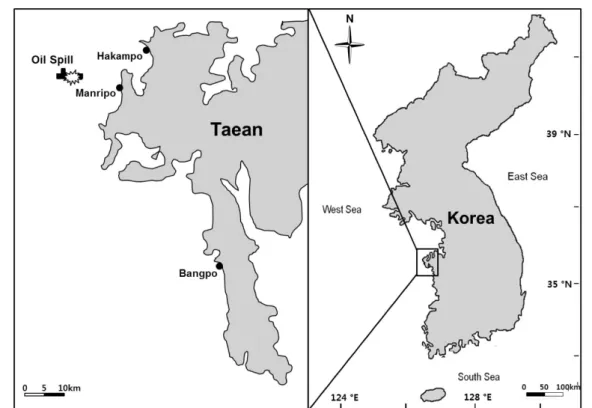
Seasonal sampling was carried out at three study sites (Manripo site was added after the oil spill, 2007) located along the coast of the Taean Peninsula, Korea (Figure 1) from March 2007 to December 2008. The oil spill occurred on 7 December 2007 about 10 km offshore from Manripo. Three study sites with different levels of oil pollution in polycyclic aromatic hydrocarbons (PAHs) were chosen (see Hong et al. 2014); heavy (Manripo site), moderated (Hakampo), slight (Bangpo) pollution. Three replicated quadrats (0.5 ×
*Corresponding author E-mail: [email protected]
0.5 m) were placed haphazardly at three shore heights (high, mid and low) in the intertidal zone, and all seaweeds within each quadrat were collected using a scraper. Tidal range of the study sites was about 6-7 m and it was divided into three zones; high (5-7 m), mid (2-5 m), low shore (1-2 m above Lowest Astronomical Tide). Seaweeds collected in each shore zone were placed in plastic bags, preserved in 5-10% formalin-seawater solution, and transported to the laboratory. Qualitative sampling was also conducted seasonally to examine the macroalgal flora at the three study sites. Morphological symptoms of many kinds of seaweeds were observed and photographed at Manripo, which is heavily oil polluted area. In addition, fifty fronds of Dumontia simplex, which had many different levels of damage, were sampled on the May 3 and June 6, 2008 after three and six months from oil spill accident at Manripo.
The seaweeds were rinsed with tap water in the laboratory, identified following the classification and nomenclature of Lee and Kang (2002), and divided into four functional form groups: ephemeral, perennial coarsely branched, perennial jointed calcareous, and perennial crustose forms following the recommendations of previous researches (Littler and Littler 1984; Steneck and Dethier 1994; Orfanidis et al. 2003). For each quadrat, macroalgal dry weight was measured and their biomass was calculated.
Statistical analyses were performed using STATISTICA ver. 5.0. For each study site, one-way ANOVAs were performed
to examine the effects of oil pollution on the macroalgal biomass between 2007 and 2008, and the collection dates of each year were used as replicates. Also, one-way ANOVAs were used to test the differences between the study years for the biomass of Ulva species growing in the low intertidal zone. Prior to analysis, the homogeneity in the variance was tested using Cochran’s test (Sokal and Rohlf 1995).
Results
1. Morphological symptoms of seaweeds within one year
Gloiopeltis spp. growing upper intertidal zone were oil coated as observed one week after Hebei Sprit oil spill (Figure 2A). After 20 days, mid- and lower intertidal species, Chondrus ocellatus and Gelidium sp. were discolored and necrotic (Figure 2B, C), but kelp species, Saccharina japonica inhabiting lower intertidal zone just covered by oily seawater (Figure 2D). On the 8th of March 2008, Sargassum thunbergii, which is dominant species at intertidal and tidal pools, were covered with white muscus materials and benthic diatoms (Figure 2E). Also, epiphytic algae such as Ectocarpus arctus and Sphacelaria rigidula were found on the fronds of Scytosiphon lomentaria and Sargassum thunbergii (Figure 2F, G). Some Grateloupia sp. discolored and had many epiphytic diatoms and bacteria on the fronds (Figure 2H). Dumontia fronds twisted and leaked pigments, and
Grateloupia species had rusty spots (Figure 2I, J).
A red alga, Dumontia simplex grows well in March and starts to discolor from July when seawater temperature is high. However, D. simplex fronds discolored from the apical to basal part in May and June, 2008 (Table 1). Normal fronds of D. simplex without discolor was just four plants in May, the active growing season. The percentage of Dumontia fronds discolored sharply increased from 40 in May to 82%
in June for the > 50% whitening fronds (Table 1).
2. Species richness and Biomass
The number of macroalgal species increased from 76 to 81 at Hakampo and from 84 to 95 species at Bangpo shore after one year from oil spill accident. At the rocky shore of Manripo, 91 species were recorded in 2008. The increase in species numbers was almost entirely due to annual ephemeral
Figure 2. Observations of seaweeds following the Hebei Spirit oil spill. Oil coated Gloiopeltis furcata (A), Discolored Chondrus ocellatus and Gelidium sp. (B and C), Saccharina japonica submersed in oily seawater (D), Sargassum thunbergii with microorganisms (E), Epiphytes on the fronds of Scytosiphon lomentaria and Sargassum thunbergii (F and G), discolored Grateloupia sp. with microorganisms (H), twisted and pigment leaked Dumontia simplex (I), Grateloupia sp. with rusty spots (J). Scale bars: A, B, C = 10 cm, D = 20 cm, E, F, G, H, I, J = 5 cm.
Table 1. The number fronds of a red alga Dumontia simplex with different degrees of discoloration after 6 and 7 months from Hebei Sprit oil spill of December 2007.
Sampling date Degree of discoloration Total
Normal < 25% 26-50% 51-75% 75% <
3, May, 2008 4 10 16 13 7 50
6, June, 2008 0 2 7 31 10 50
Table 2. Seasonal variations in biomass (g dry wt/m2, n = 3 replicates) of Ulva species growing in the low intertidal zones of more oil
impacted sites (Hakampo and Manripo) and of less impacted Bangpo site, Taean Peninsula, Korea from 2007 to 2008.
Year Study site
Hakampo Manripo Bangpo
Season Feb. May Aug. Oct. Feb. May Aug. Oct. Feb. May Aug. Oct.
2007* 1.60 2.79 5.66 3.04 - - - - 8.91 4.44 19.58 1.35
2008 8.56 19.87 31.27 27.74 8.60 12.30 37.48 31.39 5.62 18.55 21.21 6.54
filamentous and sheet type species.
Average seaweed biomass was significantly increased from 68.23±13.78 g dry wt./m2 to 101.23±18.07 g dry wt./m2 at Hakampo (p < 0.05) but no differences in biomass were detected at Bangpo site (from 122.99±9.46 g to 102.25±8.30 g dry wt./m2). Seaweed biomass increased about 1.5 times at the Hakampo site from 2007 to 2008 but it decreased at Bangpo shore as compared to before Hebei Sprit oil spill. At the Manripo site where heavy oil pollution occurred, seaweed biomass was 133.70±26.83 g dry wt./m2 in 2008. Unfortunately, no comparable seaweed biomass data are available before and after the oil spill at the Manripo site.
Ephemeral Ulva spp. biomass increased at low shore in May and August and decreased in October and February (Table 2). Clear seasonal patterns in Ulva biomass were observed at the three study sites (Hakampo, Manripo, and Bangpo). In particular, Ulva biomass increased about seven times, from 3.27 in 2007 to 21.86g dry wt./m2 in 2008 (one year after the oil spill) at the heavily polluted Hakampo. Ulva biomass was significantly different among the study year for Hakampo (p < 0.05). In contrast, Ulva biomass at the mode-rately oil polluted Bangpo site was not different before and after the oil accident (Table 2).
Discussion
Species richness increased within one year after the oil spill. In particular, the seaweed species that appeared were mainly ephemeral species, such as filamentous and sheet type seaweeds (i.e. Ulva spp. Cladophora spp. Ectocarpus spp., and Spacelaria spp.). Generally, perennial species requiring in unpolluted environments are replaced to opportunistic algae as pollutants are introduced (Díez et al. 2003; Orfanidis et al. 2003). Increases in ephemeral species were found in the more highly polluted sites in this study.
Seaweed biomass increased rapidly and significantly one year after the oil spill at the heavily oil polluted Hakampo shore, but no data were available prior to the spill at Manripo shore. After the Exxon Valdez oil spill, a perennial canopy alga, Fucus gardneri showed reduction in biomass, coverage and reproduction but an increase in epiphytism (Stekoll and Deysher 2000). On the coast of Taean, however, macroalgal biomass increased resulting from Ulva blooms for the first one year after Hebei Sprit oil spill. In the present study, biomass increase of Ulva species differed from the other blooms of Ulva species, which are usually associated with eutrophied marine environments (Fan et al. 2014). However, Stekoll and Deysher (2000) reported that maximal coverage of Ulva species occurred after 3-4 year from the Exxon
Valdez oil spill. Such a time difference in reaching maximal biomass (or coverage) resulted from the presence of Fucus gardneri canopy disappearing slowly and delaying Ulva bloom.
Ulva spp. blooms after the oil spill were recorded at low shore of the heavily oil polluted Hakampo and Manripo sites. Peterson et al. (2003) reported that ephemeral algae blooms, such as Ulva, Enteromorpha, and others, occurred 0.5-1.5 year after the Exxon Valdez oil spill. Ephemeral macroalgal blooms may be related to the tremendous reduction in herbivorous macrofauna, nutrients supported by dead benthic animals, and oil spill dispersants (Chassé 1978). Felder et al. (2014) reported that oil is composed of hydrocarbons and other organic compounds containing nitrogen, sulfur, and some metals (e.g., iron, nickel, and copper), and that these substances may stimulate some organisms. The massive blooms of opportunistic Ulva spp. related to anthropogenic disturbances are used as an indicator in many impact assessment studies of eutrophicated and disturbed coastal areas (Arévalo et al. 2007; Wells et al. 2007). Thus, ephemeral macroalgal blooms may be a general phenomenon following oil spills.
In conclusion, some seaweed fronds were discoloured and infected by epiphytic diatoms and filamentous algae (Ectocarpus arctus and Sphacelaria rigidula), as they were exposed to oil pollution. Ephemeral macroalgal blooms in species number and biomass occurred one year after the Hebei Spirit oil spill, which resulted in an increase in seaweed biomass. Such species richness and biomass increase were also found after the Exxon Valdez oil spill (Peterson et al. 2003). Biomass of Ulva spp. mainly increased in the low intertidal zone and particularly in the heavily oil polluted sites.
Acknowledgements
We would like to thank anonymous reviewers for their helpful comments that improved the manuscript. This paper was supported by Korea National Park Research Institute.
References
Arévalo R, S Pinedo, E Ballesteros. 2007. Changes in the composition and structure of Mediterranean rocky-shore communities following a gradient of nutrient enrichment: descriptive study and test of proposed methods to assess water quality regarding macroalgae. Marine Pollution Bulletin. 55: 104-113.
Bernecker A, IS Wehrtmann. 2009. New records of benthic marine algae and cyanobacteria for Costa Rica, and a
com-Amoco Cadiz oil spill. Marine Pollution Bulletin. 9: 298-301. Díez I, A Secilla, A Santolaria, JM Gorostiaga. 1999. Phytobenthic
intertidal community structure along an environmental pollution gradient. Marine Pollution Bulletin. 38: 463-472.
Díez I, A Santolaria, JM Gorostiaga. 2003. The relationship of environmental factors to the structure and distribution of subtidal seaweed vegetation of the western Basque coast (N Spain). Estuarine, Coastal and Shelf Science. 56: 1041-1054. Fan X, D Xu, Y Wang, X Zhang, S Cao, S Mou, N Ye. 2014. The
effect of nutrient concentrations, nutrient ratios and temperature on photosynthesis and nutrient uptake by Ulva prolifera: implications for the explosion in green tides. Journal of Applied Phycology. 26: 537-544.
Felder DL, BP Thoma, WE Schmidt, T Sauvage, SL Self-Krayesky, A Chistoserdov, HD Bracken-Grissom, S Fredericq. 2014. Seaweeds and decapod crustaceans on gulf deep banks after the Macondo oil spill. BioScience 64: 808-819.
Gorostiaga JM, I Díez. 1996. Changes in the sublittoral benthic marine marcroalgae in the polluted area of Abra de Bilbao and proximal coast (Northern Spain). Marine Ecology Progress Series. 130: 157-167.
Hong S, JS Kim, J Ryu, SG Kang, WJ Shim, UH Yim. 2014. Environmental and ecological effects and recoveries after five years of the Hebei Sprit oil spill, Taean, Korea. Ocean & Coastal Management. 102: 522-532.
Kawai H, M Kamiya, T Komatsu, M Nakaoka, T Yamamoto, Marine Life Research Group of Takeno. 2007. Ten years’ monitoring of intertidal macroalgal vegetation of Hyogo prefecture, Northwestern coast of Honshu, Japan to assess the impact of the Nakhodka oil spill. Algae. 22: 37-44.
Kim BY, WS Kim, HG Choi. 2010. Seasonal variability of seaweed biomass along the vertical shore gradients of Nachido and Odo islands, the Yellow Sea, Korean Fisheries Aquatic Science. 13: 324-331.
Lee YP, SY Kang. 2002. A Catalogue of the Seaweeds in Korea. Cheju National University Press, Jeju, 662 pp.
Littler MM, DS Littler. 1984. Relationships between macroalgal functional form groups and substrata stability in a subtropical
ecological evaluation index (EEI). Ecological Indicators. 3: 27-33.
Peterson CH. 2001. The Exxon Valdes oil spill in Alaska: Acute, indirect and chronic effects on the ecosystem. Advanced Marine Biology. 39: 1-103.
Peterson CH, SD Rice, JW Short, D Esler, JL Bodkin, BE Ballachey, DB Irons. 2003. Long-term ecosystem response to the Exxon Valdez oil spill. Science. 302: 2082-2086.
Sokal RR, FJ Rohlf. 1995. Biometry, 3rd edn. W. H Freeman, New York, 887 pp.
Southward AJ, EC Southward. 1978. Recolonization of rocky shores in Cornwall after use of toxic dispersants to clean up the Torrey Canyon spill. Canadian Journal Fisheries Aquatic Science. 35: 682-706.
Stekoll MS, L Deysher. 2000. Response of the dominant alga Fucus gardneri (Silva) (Phaeophyceae) to the Exxon Valdez oil spill and clean-up. Marine Pollution Bulletin. 40: 1028-1041.
Steneck RS, MN Dethier. 1994. A functional group approach to the structure of algal-dominated communities. Oikos. 69: 476-498.
Terawaki T, H Hasegawa, S Arai, M Ohno. 2001. Management-free techniques for restoration of Eisenia and Ecklonia beds along the central Pacific coast of Japan. Journal of Applied Phycology. 13: 13-17.
Thompson RC, TP Crowe, SJ Hawkins. 2002. Rocky intertidal communities: past environmental changes, present status and predictions for the next 25 years. Environmental Conservation. 29: 168-191.
Wells E, M Wilkinson, P Wood, C Scanlan. 2007. The use of macroalgal species richness and composition on intertidal rocky seashores in the assessment of ecological quality under the European water framework directive. Marine Pollution Bulletin. 55: 151-161.
(2019년 11월 11일 접수; 2019년 11월 24일 수정; 2019년 12월 14일 채택)