Development of the mailbox system for OLR
Jung-Soo Kim, Won Woo Na, Il-Jin Park, Gil Hoon Ahn, Gyung-Sik Min
National Nuclear Management and Control Agency - Korea Institute of Nuclear Safety P.O. Box 114, Yuseong Daejeon, 305-600 Korea
1. Introduction
A mailbox system under Integrated Safeguard (IS) is an important tool. Especially, at OLR, introducing the mailbox system was the reason that, on the spot, there would be not satisfied with the re-verification requirement for spent fuel being transferred to difficult-to-access conditions, where spent fuel has been previously verified and remained under successful C/S measure. Under IS, IAEA requires operators’ declarations with mailbox. In general, two mailbox concepts was considered; traditional mailbox concept and non-traditional mailbox concept. The former applied to verify flow of material into or out of the facility. And it used the idea of randomly sampling inspection times to verify a stratum of material. The latter used with containment/surveillance and improved the verification characteristics of a C/S system. Otherwise, in case of Japan, IAEA had decided to introduce SNRI(Short Notice Random Inspection) at LEU fuel fabrication plants. SNRI was a part of the strengthening measure of safeguards under the conventional safeguards agreement. The SNRI has introduced to one fuel fabrication plant(GNF-J) since 1998 as a trial mode. Since the SNRI was carried out without any significant problem, the IAEA requested to expand the SNRI regime to all other fuel fabrication facilities. The SNRI has been operating to all fabrication facilities since 2000. In practically, Mitsubishi Nuclear Fuel(MNF) has been operating the mailbox system since 2000. The mailbox system was an important tool to come up with SNRI. So, IAEA installed a mailbox system at fuel fabrication facilities during 1999. The facility operators have been required to input transaction data such as ”Birth”, “Death” and “Ship” for UF6, UO2 powder and fuel assembly, before a fixed time at each day. In the end of 2001, Japanese gov. had installed a new transmission system instead of IAEA’s system. The system is connected with IAEA and NMCC by telephone line. And then, inputted data has become to the IAEA office via NMCC since 2002[1]. According as Japanese case, the mailbox system was developed by NNCA for adapting for transfer campaign at OLR. Sec. 2 described the IAEA requirement for mailbox system. Sec. 3 represented the characteristics of the developing mailbox system and the developing system would coincidence with the requirement. Sec. 4 described the conclusion.
2. Requirement for Mailbox system
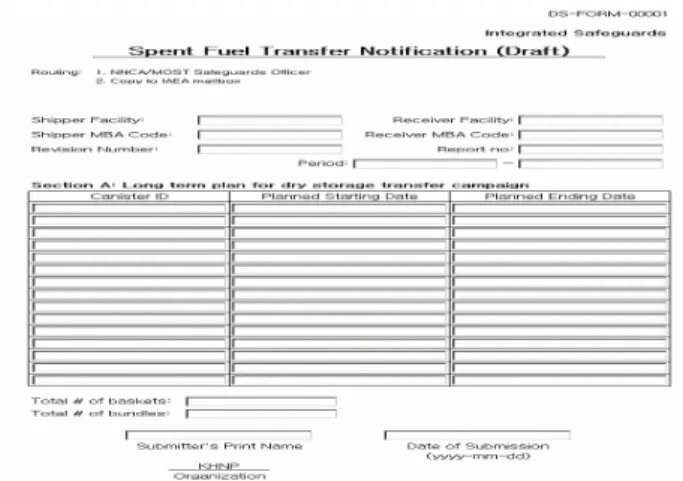
Under IS, IAEA requires Unannounced Inspections based on operators’ mailbox declaration. The Mailbox information will be included all activities of transfer campaign. These activities include the bundle verification within the Spent Fuel Storage Bay(SFSB); loading the basket with the verified bundle; transferring the basket from the Basket Loading Area to the Dry Storage Area; performing the Dry Storage Fingerprint and finally the completion of the transfer campaign processing at the site. For satisfying the requirement in the above mention, the mailbox information of operator’s declarations would be selected as following; Section A is “Long Term Plan for dry storage transfer campaign”. Section B is “7-day advance notice for dry canister loading”. Section C is “24-hour advance notice for canister loading”. Section D is “24-hour post-notice for basket transferring”. Section E is “After closing one canister”. Long term’s information described all information of campaign period, including all holiday in schedule. Fig. 1 shows the table of Sec. A. In Fig. 1, it described the draft schedule according to a batch like a canister and the amount of nuclear materials subject to transfer. Advance declaration’s information included the weekly and daily declaration of spent fuel transfer activities according to a batch like a basket. Post declaration’s information represented the daily declaration after working in order to check the daily activities. And IAEA compared the monthly ICR with post declaration information and checked whether diversion would be occurred or not. Also, the mailbox system should have an encrypted e-mail system. The mailbox system was developed by reflecting IAEA’s(server) and operator’s(client) requirement. In case of IAEA requirement, there were Non-repudiation, Trusted Time-Stamp, Uniqueness, Unalterable and Secure. Otherwise, in case of Operator requirement, there were Non-counterfeitable, Reviewable, Secure and Acknowledgement.
3. Development for Mailbox system
For satisfying the requirement in the above mention, the items within the table was selected. Shipper Facility, Shipper MBA code, Receiver Facility, Receiver MBA Code, Revision number and period were a common factor at five tables. Table 1 shows the contents of each type of the table.
Transactions of the Korean Nuclear Society Autumn Meeting Busan, Korea, October 27-28, 2005
Fig.1 the sample of the table Table 1. The contents of each type of table
Type of Table
Contents
Sec. A Canister ID, Planned Starting Date, Planned Ending Date, Total number of basket, Total number of bundles, Submitter’s Print Name, Date of Submission and Organization.
Sec. B Canister ID, Number of Basket, Planned Canister Loading Data and Time, Total number of baskets, Total number of bundles, Submitter’s Print Name, Date of Submission and Organizations.
Sec. C Canister ID, Number of Basket, Number of Bundle, Bundling Loading End, Basket Loading End, Submitter’s Print Name, Date of Submission and Organization.
Sec. D Canister ID, Basket ID, Nth of Bundles, Actual
Data(date, Departure, loading), Submitter’s Print Name, Date of Submission and Organization.
Sec. E Canister ID, Closing Date, Total U Mass(kg), Total Pu Mass(g), Submitter’s Print Name, Date of Submission and Organization.
And regarding as encrypted e-mail system, IAEA recommended the Sign and Forward method which described the electronics signature and enforced the security. The developed system at mailbox system took into consideration of the above requirement. Fig. 2 represented the configuration of the developed mailbox system.
(Facility) client
vpn 5xp
Netscreen 25XP (NNCA) server Fig.2 The configuration of the developed mailbox
system
Related with Non-reputation in NNCA, it was realized at Database. When operator opened to the new file or saved the file, the file included the user’s id and time to the file automatically. Therefore, Operator didn’t deny at the saving file. Regarding as Uniqueness, the MS-SQL was used to the mailbox system. MS-MS-SQL would be supported to the uniqueness of the data. With regard to Unalterable, MS-SQL would be of modified and
deleting function. But the mailbox system would be unusable to the modified and deleting function in order to meet the requirement of Unalterable. In case of secure, the mailbox system only used to the assigned port (virtual port) which is accessing to the database and the VPN component. The role of VPN would be protected from counterfeit and sniffing of data during communication. Regarding as Non-counterfeitable in facility, the mailbox system used to login function which limited to access permission of operator. That is, the NNCA server assigned the authority of operator. Only the assigned operator would be accessed to the database. Fig. 3 shows the example of login method at mailbox system.
Fig 3. The example of login function at mailbox system
Regarding as Reviewable, the mailbox system would be realized to preview function which was reviewed by operator before saving or sending at server. After writing the table by operator, operator would be reviewed to the making table. Fig. 4 represented the preview function. The acknowledgement would be realized to login function. Also, the secure requirement could be realized as same as the role of VPN at NNCA server.
Fig.4 the display of the preview function
4. Conclusion
The mailbox system was developed by NNCA for adapting for transfer campaign at OLR. In case of OLR plant, there would be not satisfied with the re-verification requirement for spent fuel being transferred to difficult-to-access conditions, where spent fuel has been previously verified and remained under successful C/S measure. Under IS, IAEA requires operators’ declarations with mailbox. Before IS, the developed system evaluated during transfer campaign at OLR plant. It was a fruitful result at evaluating period. And the system will be used at OLR plant under IS. Also, it is possible to apply the concept for fresh fuel fabrication plant under SNRI.
REFERENCES
[1] Won Woo Na,et.al, Short Notice Random Inspection workshop report, KINS/DR-1281, 2005, Jun.
approve connection
operator
NNCA require login information
send the login information
ADSL